According to Distrifood.nl (Dutch) the " man's cola" showed a nice profit this last year, making it the top new introduction to a brand in 2007.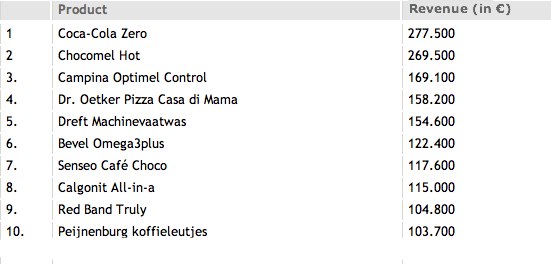
(Source picture: Elsevier.nl (Dutch))
I only point this out, since Coke Zero is one of the first food-related topics I wrote about on Tech IT Easy; a, fairly clear, signal that it was time to "spin-off" to this blog.
I took this title from a report on the future of Dutch supermarkets (English pdf). It identifies a number challenges to come, one of which is "stomach share," which is apparently a big deal because of the following three factors:
- Population decline: which translates into less consumers buying food
- Increased longevity: and older people have a lower caloric intake
- Increased awareness of health-issues: which also translates to a lower caloric intake.
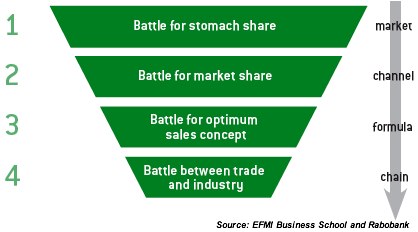
What the authors are seeing is that players from the bottom of the market (the discounters) are moving upwards, by broadening their assortment of goods, and players from the top of the market (luxury-stores) are moving downwards, by improving their prices. A number of underlying things are going on here: luxury-stores can become cheaper by improving the efficiency of their stores and sourcing cheaper brands. And discounters can increase their offering through their relationship with suppliers.
Following HBS-quote, from an article entitled "Finding success in the middle of the market", sheds some light how Tesco does it:
A company controls midfield by fielding a complete product line that includes backs and forwards. In its supermarkets, Tesco, the successful UK retailer, offers consumers three options—good, better and best—in most high turnover product categories. In addition, Tesco doesn't just sell groceries through one-size-fits-all supermarkets. Recognizing the need to shape as well as respond to an increasingly segmented market, Tesco reaches its consumers through at least seven different store formats, from convenient Tesco Express outlets at one end of the spectrum to full assortment hypermarkets at the other. But, within all its stores, Tesco implements the same merchandising principles: Better, Simpler, Cheaper.Can you guess who the loser is yet? Well, according to both the report and much data on the net, the losers are the new, innovative concepts, that may offer certain values to consumers on an ethical or health level, but are not able to reap the same advantages as more established players are.
That is also the answer why so many organic companies are being bought up by fmcg-companies. There's an interesting overview here; but if you want to follow one in real-time, check out this Inc. magazine blog run by Honest Tea, which has recently given away 40% of their company to Coca-Cola.
Of course that is only part of the answer. Consumers are not just focussed on price. And, while consumer-awareness of the global situation and their own health is clearly growing, that's not the whole answer either. People's lives are becoming ever more complex and convenience is a big selling point these days.
It's those companies that can combine a high level of consumer-responsiveness, together with assortment and price, that will capture the hearts of consumers. But I guess what is out, is the solo single-product-serving player in the market, purely focussed on softer advantages like "ethics," and forgetting that consumers still(!) have limited disposable income for their food-expenses, as well a limited time to engage in these activities.
 Not too long ago, asked the question about whether coffee is a bad business to be in, taking into account the exploding number of quick coffee-stops, as well as the fact that global players like Starbucks, and the soon-to-come McDonalds café, are saturating the market. There's another part to this, which I actually discussed before, but I didn't make the connection: coffee as a soft-drink.
In the Starbucks-book, "Pour your heart into it," Howard Schultz talks about how Starbucks got into the canned coffee business, with the help of a chemist and Pepsi. The chemist had come up with a method to captured the essence of coffee into an extract, which enabled Starbucks to add it to a number of new products, such as ice-cream and indeed "porta-coffee," also leading to more business-opportunities outside of Starbucks-outlets. Pepsico had the "porta" knowledge, as well as the distribution-channels, and from what I hear their partnership was a raging success.
About a month ago, I wrote that Coca-Cola had entered a partnership with Nestle, to develop similar products, and just read about a another partnership between Coke and illy, a premium brand of coffee and related products.
The rest of this post is speculation:
Now I'm sure that the coffee-makers will do their best to not have the can equal a taste of fresh coffee, though at the same time more competition in canned coffee will definitely drive the quality upwards. Perhaps up to a point where it will perhaps convince customers not to wait in the long queue associated with "good" coffee, and instead get a quickie at a supermarket or in a machine at work. Similarly, an increase in downstream-marketing by producers, may lead to an increased demand for these products up the chain, at cafés, giving Starbucks-, illy-, and Nestle-outlets an advantage over generic coffee-producers. Thinking defensively, all of this sounds pretty bad for existing cafés. I'm not a fan of thinking defensively however.
Offensively speaking, this is an opportunity. Comoditised coffee means that there is more space left for other activities which help increase the value of "third places." Comoditised coffee also means that the overall quality of coffee will go up, and that consumers will look for other selling-points. By taking a license on illy or Nestle coffee (I don't think/know if Starbucks licenses), cafés can profit from the downstream marketing that is already happening. Even cans of coffee can present an added value, for instance in large queue-situations (like the ones I discussed last time), which I perceive as an excellent opportunity for offering tasters.
And really, this may not change much for cafés. The manufacturers' downstream marketing towards consumers may cause an increased demand for illy or Nestle-coffee (or cans) in cafés, pressuring them to take it into their assortment. But the same has happened with drinks like soda and beer for decades, though I'm sure that there are some horror-stories to tell here too. And so far, canned coffee has definitely been lacking the taste department, so it may not all represent competition for existing drink-venues. I may be making an elephant out of a fly. In any case, interesting to think about and to see how this will play out.
Oh, and the picture is meant to represent a cup, spilling coffee. If it looks like crap (the coffee kinda does), my apologies.
In this regular segment I focus on news of note (to me at least), about brands that I'm familiar with. I may someday write about Nordstrom, Costco, and Walmart, whom I hear great things about in terms of service, supply-chain management, and frugality, but until I come in contact with what they sell, I'm not sure I can say much. That said, I'm aware that Walmart made moves into Germany (and failed, which intrigues me), and has taken over at least one chains (Asda) in the UK as well, which I have visited. So never say never.
Coca-Cola and Nestlé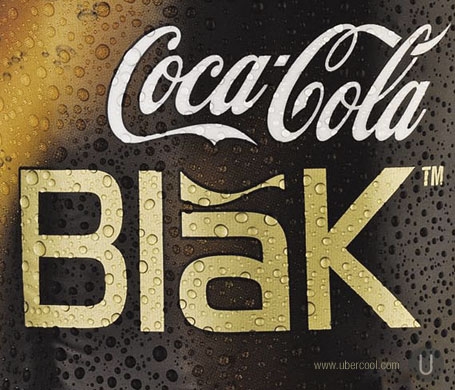 Coca-Cola has, for a third time, partnered up with Nestlé, this time to develop coffee and tea-products. The previous times, the company worked Nestlé to develop Enviga, a calory-burning drink; and with L'Oréal, a daughter-company of Nestlé, to develop the beauty-drink Lumae. So reports Dutch Marketing Tribune.
A few months ago on Tech IT Easy, I expressed my wonderment at the Coke Zero brand and what their aim was there, as well as held a rant on how un-innovative "junk"-drink (or -food) brands are in general. I think this is an interesting move. It won't make the world a better place, perhaps, but it'll be more colourful.
Similarly, I know that Starbucks formed a partnership with PepsiCo a few years back, to develop canned coffee-drinks, also to be sold in supermarkets. So this could very well be a competitive move, by either Nestlé and/or Coca-Cola to compete with a perceived threat of Pepsico's or Starbucks reach into customers' taste-buds. Update: Looks like MSNBC reported on a similar story last year.
Leonidas expands to the cafe-arena In other, coffee-related news, Belgian chocolate-manufacturer and retailer Leonidas is opening a coffee-outlet in the Netherlands, a first step of what it calls a worldwide expansion of its products and outlets. This according to Dutch publisher, Elsevier.
Again similarities can be drawn with Starbucks (sorry, SB-haters), which started as a producer and retailer of coffee-beans, before it expanded into the business of coffee-bars as well. I think what both Leonidas and Starbucks have in common is a reputation of offering fine products as well as offering a third place which customers feel comfortable in. It's a relatively easy step-up for Leonidas, if its experiment were to succeed, because it can simply adapt its existing retail-outlets.
Isn't the world of coffee exciting?

 The
The 


