 Disjointed, because I don't have the time or energy to write a beautiful essay about empowerment—I'm not even 100% certain what it means yet. And in a way, by writing about 'empowerment,' I'm breaking the first rule, which is "Don't speak about empowerment." Or at least it seems that way. Currently, there's around 505,000 articles online about the term, which qualifies it as a hype and as such something that has already been discussed too much. But also, empowerment is basically about trust, a behaviour, and how can you talk about a behaviour, you just behave.
I think I first came across the concept, without even using that term. A few years ago, I read a book on ants, called "Emergence." It was a great book, I thought, about how ants at every level exchange signals, in the shape of pheromones, to indicate what they were doing and whether they needed help. A completely decentralised organisation, and the only thing the queen needed to do was produce babies, which, equivalent in business-talk, is, I guess, take care of human resources. I was so excited about it, that it became a research proposal for my master-thesis in strategic management, and was very quickly rejected, as I guess I hadn't related it well to strategy.
I again came across the concept last week, after reading an interview with the then-CEO, Dennis Bakke, and the then-chairman, Roger Sant, of AES, a power-company, which was, at least at the time of the interview (1998), very big on empowerment. And it seemed to work pretty well for them, if you look at their share-price, it rose pretty steadily up to 1998, and even more up to ca. 2001. Though, it hasn't been doing quite as well these last few years.
Reading the interview, I got the impression that empowerment is a religion, which in itself is hard to quantify into a set of rules. Essentially, at AES, it was (or is, I don't know) a system of open exchange flows; people could evaluate each other's performance, investment-decisions were decentralised and crowd-sourced, job-rotation was common, and micro-teams of ca. 10 people, focussed on different projects and tasks, were spread all around the organisation. And that seemed to work pretty well.
But there were also some downsides, such as that the company didn't work well with other companies—rather, it preferred a contractual relationship—and there were constant pressure to revert back to the traditional top-down model, from the public, share-holders, even employees. Essentially, every employee at AES becomes a kind of mini-CEO, which is clearly not something everyone is conformable with.
And the question is, and I haven't figure that out 100% yet, is how you come from that top-down view of human "resources," to a decentralised ant-like model? The key-word, which is equally hyped but seems to apply, is "delegation"—i.e. shifting executive responsibilities out to a team.
I think the problem of this is quite well spelled out in a recent interview with Brad Bird from Pixar, who was at one point confronted with a team that was demoralised. The former director had taken their work and evaluated it in private, giving written comments to individuals, not giving them a chance to give any input. And in order to turn that team around, he had stand in front of them for two months, evaluating the work, in public, and encouraging to take part, through questions. Two months, it took to go from the traditional model to one of empowerment, and just for that team.
The good news is that for start-ups, this is pretty much the way it should be from day 1. The bad news is that for big companies, or as soon as a start-ups grows bigger, the dissonance between people becomes larger and larger. And you have to—if you want to, at least—find ways to decrease that gap, probably most easily achieved through team-building after team-building exercise.
Anyway, not much more to say about this for now, but empowerment is cool, let's leave it at that.
Ah yeah, I forgot! I liked these interview questions, which were typical of an AES job-interview at that time, and made me think about my own opinion on empowerment:
- Should everyone be treated equally? Explain.
- What do you do when something needs to be done and no procedure exists?
- What self-improvement-efforts are you making?
- Recall a time when people around you weren't being entirely honest. What did you do?
- What does "fair" mean to you? How important is fairness?
- For what have you been counselled about the most?
- What is the most difficult situation you have faced? What did you feel? How did you react?
- Describe two important achievements.
- Tell me about a time when a decision was needed and no supervisor was available.
- What kind of rewards are most satisfying to you?
- What does "fun on the job" mean to you?
The picture is of course of Che Guevara, who wasn't an entirely nice guy, but does stand for this whole "power to the people" movement.
 The world of business, I think, has a certain illogical—the "human element"—shell around it, but centres around the concept of supply and demand. How you create a business where demand is high, how to you make sure that you have sufficient supply and/or not too much supply. You can see this play out in a number of places, e.g. on the web you have scaling issues, when your service proves to popular (e.g. Twitter), or you have the case of the million+ blogs that are collecting dust, because no-one ever reads them, or because the blogger was unable to gather enough interesting supply.
In restaurants, or food-places, you also see this play out. A couple of months ago, I was going to write about take-out, how some businesses embrace and others avoid it, and why. I think the reason is, at least in part, to control supply. If you control supply, then you can focus on quality and charge a higher price. You also become an artist/creator, rather than a factory.
How do you limit supply? Two ways, I think. Mainly it's the physical space; by limiting the number of seats in your venue, you ensure that a certain quota is set (of course, the question is also whether that quota is met, which comes from quality inspiring demand). By investing in quality-ingredients, you not only limit your budget, but also your production-capacity, and it forces you to limit supply. That's a little vague, I know, I haven't worked it out 100%.
The other way, is to have an increased level of supply. How do take-out and fast-food places do it? By standardising as much as possible. Whether it's the ingredients, which are mainly starch-based (burgers, pizza, noodles, etc.) and cheap, the production-facility (often just an oven, a grill, or a big wok), or a standardised customer-space (from seats stapled to the floor, to waiting-lines, to a website/phone nr.). All of which enables you to deliver mass quickly.
I was thinking about this today after watching "Iron Man," which is one big Burger King (and US-army) commercial, and getting a cheese burger afterwards. Burger King was packed and, ironically, slow. The "waiting in line" method doesn't seem to work that well when you have 50+ people waiting, and a limited space behind the counter to deliver burgers and stuff. People on both sides were bumping into each other constantly, and I actually had to wait over 5 mins, even though I was second in line.
On some level, I like to think that technology can solve a little bit of this problem. If you look at Zara and H&M, which I wrote about last week, both are very advanced in this area, in order to optimise and speed up their production, logistics, and merchandising. Of course, that's on a back-office level, and that's not the same as the front-office, where customers interact with a business. No one wants to be confronted with a screen to do the ordering, but sometimes I wonder if people wouldn't be happier just pressing some buttons in a fast food joint, rather than waiting in line. Of course that would mean more seats, as more people would sit down, and more staff, as someone will have to bring that food to the table.
In the end, it probably comes down to experimentation and constant improvement. That said, apart from the computers that cashiers operate, and quicker food-preparation, not much has changed in the last 50 years for the people doing the actual eating.
The picture is courtesy of lightningspeed.net.
All right, in 10 mins or less…
I just started reading a series of essays, entitled "Wish I'd known: Insights and inspirations from the journeys of successful entrepreneurs." Do a search, and you'll find it for free online. One essay finishes with:
"I wish I'd started younger and wish I appreciated how much family and friends would support me beyond what was reasonable and fair. I wish I'd know it was OK to have fun and in so doing not taken myself so seriously—the journey is often superior to the destination."Words to live by!
Last weekend, I wrote the acknowledgements for my thesis. The cherry on top, which I'd left for one of the last things to finish. And it would've been impossible to write it before anyhow, as even in the last lap there were/are people driving me on.
During the writing, one person died, another got terminal cancer. Both much too young and undeserving of such a fate. And both of whom I consider good friends, whom I trusted and who trusted me. In part it was the thoughts about them that prevented me from giving up.
But, strangely perhaps, it was also my little brother, just 19 years of age, that was unrelenting in pushing me forward and not letting me quit. It was as silly as him telling me 6 months ago, "I want you to finish this in three weeks," which got me to get my act together, perhaps taking longer than three weeks, but not stopping until I was done.
And it was all the people I interviewed for this study—my subjects, and ultimately my customers—all of whom unquestionably agreed to share their wisdom and whom I ultimately do it for.
It's only about a page worth of acknowledgements, but it is for the people on that page that I spent countless months writing, that I ultimately produced a 120 page-document for, and without whom I wouldn't be anywhere close to where I am today.
That… is the value of support and why nothing is impossible!
(No picture, as I found nothing that could do them justice)
A VC: From Messes To Successes:
"The prescription for turning these messes into successes is really pretty straightforward. You need to build the team and bring in people who excel at the blocking and tackling and the PLANNING that most startups don't have the time or inclination to do. And you need to gradually change the culture of the business from one that is all about the product to one that is about the entire company. Sometimes, often times, that means changing the people around. And that's never easy. And it's even harder to change the people around when it was the initial team that made the product so popular in the first place. So you have to somehow find a way to add the 'operational' people without drowning out the 'product' people."
Eggbeater: Chef Owners Who Work The Line
I'm starting to think people should take a test before they open a restaurant. It will be like a triathlon: you must work the line, well, if not stellar. You must understand and be able to explain one P&L statement. You must understand why raw fish and cooked meat cannot share the same bin in the walk-in. You must understand how to make cookies, one dessert with chocolate that's not a molten chocolate cake and it would be great if you knew the difference between panna cotta and creme brulee. The test would list a series of questions and you would be graded on how much responsibility you took for your own actions or the actions of those you hired. For bonus points you might have to research why all the restaurants in your location before yours failed, or cooking in and creating a menu for a kitchen with no Latinos (or your State/ Country picks for easy-to-exploit-able peoples.)
Freakonomics: The Consequences of Being Green
There should be a rule: before helping the environment in one market, we should be required to think through the impacts on other markets.
 An interesting quote from the Economist this week. Particularly, because I personally suffer from it, and imagine a lot of other people & businesses do too.
Mr. Fellows [CEO of Callaway golfing equipment] believes that the "fundamental principles of running a company don't change just because the product category is different." In his view, Callaway's problems stemmed from the fact that it saw itself as a golf business, not as a consumer-goods company. He resolved to focus on "what the consumer wants, not our own feelings about what the game of golf should be."It doesn't matter if you're the CEO of a company, an investor, a sales-person, a blogger, etc., I think everyone has an idea of what they want and what customers should want. But what it really comes down to is the latter.
Face Value, my favourite section in the Economist, every week.
The picture is courtesy of digitalfreak.net
 Hey, a little busy at the moment, but here's some links, I've enjoyed recently.
- Jim Donald's, former Starbucks' CEO, month by Patricia Sellers (Fortune): After listening to an interview with Frank Addante on Venture Voice, where he said "Time is a finite asset!", I looked up "time-management CEO" on Google, and this is the first thing I found. Some good tips on meetings, getting up at 6, and generally managing your time.
- Monocle design-notes by Dan Hill: I printed this 32-page (!) document out this morning, and it will probably take me a few days to digest it, but I'm already enjoying the first few pages, where he writes about the vision behind Monocle as a mag. and as an internet-publication and how the multi-disciplinary team reflected this.
- 10 Ways to Improve Your Programming Productivity by Matt Moore: I love productivity-stuff, and think most of these tips apply to any activity really.
- The 7th Deadly Claim — “Best Value” by Jeff Sexton (Future Now): "The problem for most companies is that they don’t do BOTH well: Either they don’t do enough to persuade customers of the product’s value, or they price their high-quality item even higher than what they’ve been able to substantiate to the market."
- How Facebook Is Like Ikea by Tim Harford (Slate): Considering I wrote about something related a few months ago…
 When I started this blog, and my general thoughts about the area of food & retail, it was all about the people. A quality staff and happy customers, what more do you want? And I have to say, from past experiences, that I don't really like businesses that don't place people first.
For instance, one individual I worked with, suggested using handicapped people to put together a product manually. I instantly disliked him. Not that I don't want handicapped people to be productive, but it was the thought behind it; to find a "stupid" workforce, which you can save tons of money on. It was just distasteful.
Another company I worked for was very process-orientated.
There's nothing wrong with that of course, but it was a big company with a reputation for innovation and that is why I joined. And you expect such a company to at least push forward a solid project. Well, as it turned out, the organisation's core-strategy was to start a large number of risky projects and have them compete with each-other. Those that would fail would simply be abandoned, and their staff was expected to fall on their swords… metaphorically. The effect was an incredibly high turn-over of employees, all three projects I worked on no longer exist, and it deeply soured my feelings about this company.
Both these examples, to me, represent a lack of respect for the human element. I realise that business is a hard world, but if projects were designed to be solid in the first place, there would be less of a need for these kinds of practices. Just my 2 cents.
Part 2 - the challenges that people businesses face
HBR (Again! I'm sorry, but I read a lot of HBR-articles!) published an article about people businesses some time ago, which I enjoyed. Following are some notes + thoughts about it.
- People businesses are defined as: "operations which are characterised by 1. high overal employee costs, 2. a high ratio of employee costs to capital costs, and 3. limited spending on activities, such as R&D, aimed at generating future revenue."
- In a top-40 list of people-businesses, published in that same article, only a few qualify as food and/or retail related. These are the Hospital Corporation of America, Tenet Healthcare, Marriott hotels, and Accor hotels.
- For instance, a business like McDonalds does not classify as a people business; it has substantial assets in terms of brand & real-estate, and relatively low people-cost.
- People-businesses face a number of challenges, related to performance measurement, people-management, compensation, and business models.
- Measuring productivity is more important in these businesses, then other economic performance indicators, like return on assets or investment. The challenge is finding the right indicators (employee productivity & profitability), as well as benchmarking it against other companies (employee figures do not always need to be made public).
- To manage people, you need to align employees' interests with business objectives & execution. And you need to find ways to measure performance (see above) continuously and see where your weak spots are.
- Compensation is key, as productivity is very sensitive to it, and is a primary determinant of shareholder risks & returns. Other factors to consider are variability—productivity varies across the workforce and how do you get the most out of a diverse workforce—and reach—sometimes the lowest on the ladder are as, if not more important to a firm's performance, and how do you motivate these people to do their jobs as good as possible?
- There are a number of business models are used in these types of businesses: pricing per hour is a safe method, but does not account for extra performance; a fixed price per output allows companies to shave costs off the inputs and thus increase their profit-margins. It is very susceptible to a high-skilled workforce; a success-fee or commission offers the best returns, but also the greatest risks; some companies use a hybrid of these three.
- The strategic weakness with these types of businesses is that your assets are mobile and can walk out the door. By creating value above and beyond your employees, you can diversify some of that risk away. Of course, you could also try to keep your employees ;).
I guess it's up to individual businesses how they want to measure their firm's performance. The most straightforward is certainly return on assets or investment. But even that leads to some question-marks, particularly in today's highly software-based economy, where assets are no longer as necessary, or pricey, as they once were.
For my part, I still think that people are a key-asset to a business, and it's interesting to look at how exactly you motivate a workforce and get the most out of them, as well as how to overcome the challenges related to a people-based business.
Equally interesting is how to align the business-model to match the needs of your assets—the people. Since people are motivated by (financial & non-financial) compensation, do you keep the pay-rate aligned with time-spent; fixed; aligned with performance; or a hybrid of the three? I think the hybrid is always the best choice, but even then some combinations work better than others.
And retaining employees is also an interesting problem; though much less so in countries like France, where getting rid of them is a problem, and differently in places like Silicon Valley, where inter-firm mobility is a key-requirement for many employees. I think the solution is completely personal and cultural, and everybody's answer will be different on this.
The picture is courtesy of prairienet.org
 I am not a born bootstrapper, let me make that clear from the start. I just like titles that include words starting with the same letter (is there a term for that?).
Bootstrapping is, in my own definition, "the ability to generate growth on minimal financial resources." I was first going to call it "the ability to survive on minimal resources," however that would make most of the third world bootstrapping-geniuses.
No, it's when entrepreneurs have an idea that they want to grow into a commercial business, and since finding funding is difficult and less preferable for some, they do so with minimal financial means, perhaps while maintaining another source of income and by generating organic growth—revenues derived from within the company. In sociology, there is a concept called bricolage, which means more or less the same.
What makes a born bootstrapper, or rather a good one? I think it requires three qualities:
- The first is certainly the ability to live cheaply, and I'll refer you to one of Jeremy's post where he makes the point quite eloquently. The ability to live without luxury, eating at discounters, buying second-hand furniture (or dragging it off the street), living in cheaper areas, and, most importantly, to delay paying the bills, are certainly key-components here. As is, making resource-choices for your business. Easy to do when you work in software, less so in physical businesses, though inventory is fun to play around with.
- The second quality is time-management. You need to generate growth within your company and pay the rent, so you have to make choices. You have to find alternative revenue-streams, perhaps get another job, and work on your business during your free time. It requires you to set some clear priorities, skip the weekly cinema-visit or the time spent with your loved ones.
- The third and final quality, is to be goal-orientated. You could place that under time-management, perhaps, but where bootstrapping is most likely to fail is when motivation drops. You need to keep your eye on the ball at all times; the priority for a bootstrapper is to grow the business, not keep a stable job, and you need to see the light at the end of a tunnel and keep going until you reach it.
The picture is courtesy of rockies-ice.com
 Ten tips, taken from an essay written by Masterson, entitled "The Winner's Rule", from the book "Just One Thing
Advice is a funny thing. I don't think it's advice at all; rather it's a set of criteria or truths, and fairly shallow ones at that. They ignore the context a person, a reader, a student, a business goes through. And what if we all met these same criteria? Wouldn't the world be a much more boring place? As such, treat all "advice" with care.
I can classify Masterson's points into two categories: Business-related & person-related.
Business-related
1. It's not a business until you make the first sale.
2. The most effective way to enter a new market, is to offer a popular product at a drastically reduced price.
3. Sell, sell, sell: keep on increasing the perceived value, allowing you to ramp up the price, and increase profit margins.
All of these are sort of straight-forward, I think, though certain terms should be qualified. For instance, what does a 'sale' mean? It's easy to understand it within the context of a product going over the counter, but what about service-companies or the many web-businesses that fund themselves through advertising (if that)? I would nominate the first "rule" to be: It's not a business until you make money.
The second and third points, to me, seem like a typical VC-thing to say. Scale, scale, scale. Sell cheap and sell much. And worry about increasing the profit-margins later on. Again, it should be qualified, depending on the type of business. For instance, the internet is a market-place for countless cheap (or free) and mass-products; but as a result many products/services have become simple commodities, with no one willing to pay for them, and businesses having to look towards advertising as a funding-source (shudder).
Personality-related
4. When choosing a business, pick the one that can be grown without your personal involvement.
5. Before investing, know exactly how much you're willing to lose, and get out before you hit that point.
6. First, improve your strengths. Then, eliminate your weaknesses.
7. Focussing is more effective, than a diversified approach.
8. Let your winners run, and cut your losers off… quickly.
9. 80% of success comes from 20% of your resources.
10. Try to always focus on the good of the whole, vs. the good of the one (applies to any relationship).
Lot's more to say here.
Completely agreed with point four, as entrepreneurship should not be about enslaving yourself to another organisation, at least not for life. Many entrepreneurs seem to ignore that rule, however. Also, VCs often prefer to replace the founders with more qualified executives to "grow the pie."
Point five is spoken like an investor and is very much dependant on the perception of risk you have. Entrepreneurs are reputed to be risk-taking people, however the smart entrepreneur takes a calculated risk, and understanding how much you're willing to lose is part of that.
Point six and seven are a personal weakness of mine, I'm too damn curious for my own good sometimes, more interested in exploring areas (of myself or in life) that are unknown to me, rather than that which is known. That may change, but is certainly not a criteria that I personally meet. I wrote about focus before, btw. Differs from person to person.
Point eight comes with experience, I think. On the one hand, you need to have perseverance, even when things are hard or going badly, especially during the early stages of a start-up. On the other hand, a reality-check is price-less. I suggest bouncing your ideas off as many people as possible.
Point nine is true, nothing to add.
Point ten is about understanding the core-principles of business and, even as an employee, doing all you can to make that business (instead of yourself) profitable. Ram Charan is a good man to read on that.
Good essay, made me think about my place in the world.
Read more entrepreneurship articles here.
 Just a short tweet.
I'm currently reading a Dutch book on the 2003 crisis at Ahold, but which is actually a historical account of how the corporation came to be. A couple of things I found interesting:
- Ahold actually stands for AH (Albert Heijn) Holdings
- We all know that things are cyclical, but it was interesting to read how a recession and high oil prices were a challenge that Ahold had to face in the 60s-70s, and how they managed to survive.
- In order to inspire Dutch people to shop more, they introduced a financing scheme for fridges, which people couldn't afford at that time. General Motors did a similar thing to help people afford their cars; seems like an interesting way to "upgrade" an economy.
- The fear of a socialist government drove Albert Heijn to look outwards and form Ahold (similar to why IKEA decided to globalise also).
- One of the consequences of politics at that time was the board of directors, meant to provide impartial guidance and represent the workers.
- They made extensive use of consultancies (often McKinsey) whenever they decided on a strategic trajectory.
- One of the directors was a big fan of Harvard Business Review :)
- They use the US as a source of knowledge on how to design their supermarkets. Later on, moving to the US was also seen as a way to increase that learning, as well as a new revenue-source.
- When AH moved to the US, they also brought their own ideas, like, eh, advertising (a terrible, terrible idea).
 Just read an interview with Ford's ex-CEO Jacques Nasser on the training programs that were prevalent at that time (2000). He justified their need, by outlining the history of the car-industry between 1905 and now.
- 1905-1920s - colonisation of car-companies: smaller replicas of car-factories in the US were being built abroad. Hardly any competition.
- 1920s-1950s - nationalism: lots of countries were building their own national vehicles. Competition mostly on a regional level.
- 1960s-1980s - regionalism: the rise of trading-blocks (NAFTA, EU, etc.) and as a response the functional/regional division of companies.
- 1980+ - globalisation: global competitors, more markets, more divergence of consumers, more need for people/ideas/growth.
The situation at Ford
The result of the last period is that there are more Ford-people around the globe to manage, that more markets need to be served with different needs, and that the company that can generate economies of scale & scope, while being most consumer-orientated wins.
Two strategic priorities are at play here: consumers only see a part of the car, which means that the hidden qualities can be mass-produced; and consumers value those qualities most matched with their environment—e.g. in Brazil, so I read, roads are abysmal (if any Brazilian reads this, correct me), and good suspension is highly valued. In China, luxury models are mostly driven by chauffeurs, while the consumer sits in the back, hence he/she values luxury in that part of the car.
In this scenario, two types of qualities are valued with people: to understand the corporate qualities of Ford and make decisions that favour its mass-market strategies; and those that understand the local environment and can design car-offerings tailored to local needs.
Social operating mechanisms at Ford
Ford, at the time of the interview, had about 12 programs aimed at promoting these skills. The ones mentioned, included: Capstone, which is aimed at (24) executives; Executive partnering, aimed at (12) promising managers; Business leadership initiative, aimed at the whole organisation; and a weekly email-newsletter, called "Let's chat about business," also aimed at the whole organisation.
Methods + Aims were:
- Team-building - to get people to work more closely together / develop a corporate culture
- Teaching - to get people to understand the priorities at a corporate level, rather then just at a divisional/functional level
- Projects - to get people to come up with problems plaguing their organisations at that time and develop creative solutions to them.
- Shadowing - to develop leaders
Thoughts
Several thoughts going through my head at the moment. I am both uncertain how relevant this is to the SME-environment, and at the same time I do a lot of "social engineering" and can certainly think of a few cases in my past where a certain structure would have benefited the small teams I worked in. I'll probably write a third post about the SME-perspective at some point in the future.
My favourite way to picture "social engineering" however, is through designing processes that bring elements of the organisation together with customers and "raw-inputs" (new technologies, future employees, and partners, etc.). Maybe, I'll write about that at some point too.
Of course, I always appreciate the reader's perspective on this. Social programs at an SME-level, good for team-building or bad because it distracts from survival-priorities?
The picture is courtesy of articlescaravan.com
 Ran Charan, who I wrote about a few days ago, made another excellent contribution to my thinking (and hopefully yours), the concept of "social operating mechanisms." He defines them as mechanisms that synchronise individual contributors' efforts.
A step back
Individualism vs. collectivism represent two personality-types. There are the managers, who are integrators and bring both groups together and (are supposed to) identify with the greater purpose of the organisation: maximisation of profit, etc. And there are individual contributors, who through their own efforts bring forth new data and growth, etc. These types are not always suited for management, as they need that freedom to be creative.
Social operating mechanisms fit within the framework of execution, in the sense that that is one of the last stages in a multi-stage process. As the leader/problem-solver of an organisation, you start by identifying a problem; you come up with a set number of fundamental priorities to solve the problem; and you (design social operating mechanisms to) spread that solution throughout your organisation.
An example
Mr. Charan mentions a number of examples, but (for obvious reasons perhaps), I like the Wal-Mart one the best.
- In the early 90s, every Monday to Wednesday, ca. 30 regional managers visited 9 Wal-Mart stores and 6 competitor-ones, to check if Wal-Mart's strategy of offering lower prices than the competition was being implemented correctly.
- Every Thursday-morning, Sam Walton conducted a 4-hour session with a group of 50 people, including those regional managers, buyers, logistics- and advertising people to discuss the status quo, what was going right and wrong, and the future.
Making it relevant?
If this seems like a big-company problem, maybe so. But even on a smaller scale, you could see a similar process happening in the week of a franchise-owner, I discussed a few weeks ago.
As soon as an organisation grows beyond a few people, the barriers between your customers and the leadership of an organisation increase. The politics can be frustrating and are one of the main reasons why original founders leave. The Amazon-story, which I wrote about a while ago, and which also discusses of how Jeff Bezos, founder and CEO of Amazon tries to keep in touch with the core-principles of Amazon, is also an example of a social operating mechanism.
Naturally, today's reality is somewhat different from the time (2000) that the book was published. We have "the internet" now, which should make creating social mechanisms a much easier to solve. I say 'should' as opposed to 'will,' because it still requires the necessary cohesion, which many technological solutions (in my opinion) are still lacking.
It still comes down to designing people-processes which help you implement core-priorities, and having the tolerance for, let's call them, idiotic decisions that sometimes come from the type of group-think often prevalent in organisations.
The picture is courtesy of infed.org
 I'm currently reading "What the CEO wants you to know," by Ram Charan, and it's safe to say that it belongs in the top 10 business-books, I've ever read. It's only 140 pages short, but filled with advice that is extremely easy to digest, that I'll be sure to re-read it several times later on, and can warmly recommend to others too.
One chapter in the book struck me particularly, on coaching, as I consider it a vital skill in business-relationships. Although I think Mr. Charan paints a bit of a rosy picture, I consider it a good standard to aim for. Some quotes:
How would you feel if someone gave you positive feedback on the things you're doing well and specific suggestions for building your skills? Chances are you would feel that you had a personal coach, someone who wanted to hep you succeed. You would feel energized. I can tell you from experience that it works. You can do it for those who report to you, and in the process, you will expand your own capacity.The chapter also goes into a number of examples from real life.
…
Coaching is not a performance review. It's not about what someone did last year, and it's not about money. It's very personal. You're hitting the person between the eyes. You're helping him face his blind sides and learn to do things better. The feedback has to be honest and direct. No sugar coating.
…
Self-confident, secure leaders love to give true feedback because they know that growing people is their responsibility. By true feedback, I mean saying what they really think. Too often, people hesitate because they know they may be wrong, or that they feel reprisal. But chances are your instincts are correct, and they'll improve over time. I've seen numerous times that when you put experienced businesspeople around a table and they talk candidly about an individual, the judgements converge very quickly. It's not had to zero in on the most critical thing the person needs to improve.
Some people say this kind of coaching is a good idea, but their company doesn't have the ambiance for it. Still, you can start with three of four people who would be receptive for it.
Charan's book is all about understanding business principles and setting a limited number of fundamental priorities to improve a business. Coaching is a logical extension to that, as when you clearly communicate what the business priorities should be and how that individual can get there, that's essentially coaching (and makes your life considerably easier in the process).
The author also co-wrote a book called "Execution," which I haven't read, but based on this book, believe is a good choice if you need a more modern read. "What the CEO wants you to know," is from 2000, but I consider it timeless advice.
Cooking is ingredients!… it's timing!… it's cleanliness!… it's… … …restraint!
 These are just a few of the tips that Gareth Blackstock, chef at Le Chateaux Anglais, and lead character of the British comedy-series "Chef!," delivers to his staff in a kind and gentle manner… not. Even after re-watching this show 10+ years later, I'm still not sure whether Lenny Henry's portrayal of the angry chef is meant to be a realistic, or rather a satiric look at what goes on in these kitchens. The effect it's had on me, in any case, is one of silent terror when I think of kitchens in 2-star restaurants.
There's no denying that, generally, the world of HoReCa consists of flat hierarchies; there's the boss, either the head-manager and/or the head-chef, followed by some type of administrative class of underlings, and finally those that Gareth Blackstock likes to call
"There's the aristocracy, the upper class, the middle class, working class, dumb animals, waiters, creeping things, head lice, people who eat packet soup, then you.."
If you're thinking of high-tech start-ups in the IT-world, multi-star restaurants are their equivalent in the HoReCa-world. Competitive advantage in technology comes from both products that are differentiated enough from the competition and processes that enable a business to produce these products at a sufficiently low cost and high scale to reap a profit.
In restaurants, this is embodied by the chef, whose training, experience, personality, and, I guess, raw talent, inspire fear in all of those around him, especially the ones that feel his wrath. It is an innovation machine difficult to replicate, comes at a high price and is not for the faint of heart.
Everything else: coming up with a business-plan, talking to investors, setting up the site, buying the materials, hiring the people, getting customers to visit, etc.… seems easy, compared to finding, keeping, and managing a good chef. Because as soon as the chef finds out that he is the one that keeps the ball rolling, he is the vital cog in the machine, he will likely fire you as a boss and replace you with one of those people, generally found under head lice and packet soup.
So there you have it; I don't write about cuisine, same as people generally don't think about starting a business in space-flight. They are both sciences reserved for an elite pioneering-class, one that is fearless and willing to risk the laws of nature in order to succeed.
5 links: the obvious one, brand-logic, happy places, e-toys, neuroscience
0 comments Posted by Unknown at 11:02 AM It's Sunday again, and I have a nice big collection of links today: on running a cheap yet effective start-up; on why brands exist; on creating happy places for yourself and employees; on the business of children; and finally on a whole load of neuroscience. The aesthetically pleasing picture of Marilyn links to a particularly disgusting image of a "healthy" burger—my initial choice of illustration. You have been warned.
Previous link-discussions can be found here.
Link 1: the obvious one - Seriously, unless you actually used this weekend to, eh, have a life, you'll have noticed the firestorm started by Jason Calicanis, continued with Duncan Riley, tempered by Jason Fried, and the final words of wisdom by Micheal Arrington. Crazy, how opinionated these entrepreneurs/bloggers are, right? Yeah, right. A good read if you're (thinking about) running your own business, with like lazy employees and expensive tables.
Link 2: A brief history of brands - well actually a blurb about a book. I like:
"Branding became necessary when large-scale economies started mass-producing commodities such as alcoholic drinks, cosmetics and textiles. Ancient societies not only imposed strict forms of quality control over these commodities, but as today they needed to convey value to the consumer. Wengrow finds that commodities in any complex, large society needs to pass through a "nexus of authenticity.""
Link 3: the architecture of happiness -
"There are three concepts central to the “yoga of the home”…. The first rule is to align your schedule with universal schedules by getting up and going to bed with the sun. “We try to keep lightweight and low furnishings in the north and east — to create an openness — so that we can draw in the healthy early morning sun,” says Cox. Heavier, taller furniture goes in the south and west. Second is bringing nature indoors — plants, natural fibers, no synthetics. “Vastu is the first intentionally green science,” Cox says. And last, vastu asks us to “celebrate who we are and what we love” by surrounding ourselves with things that have meaning. “When someone enters our living room and we’re not in the room yet, we want this guest to get a sense of who we are,” she says. “The room speaks of us.”"I've been thinking about this topic and the general issue of creating happy places for a while. A worthwhile read is also Frank Addante, a serial entrepreneur, on choosing the office-space for his start-up: link 1 and 2.
Link 4: building a toy e-commerce store - since I linked to Lego last time this seemed appropriate. In all seriousness however, I think the subscription-model + children is a cash-cow; kids always want more stuff and have old stuff to get rid off. Applicable not just for toys, but clothing and furniture as well.
Link 5: Some neuroscientific stuff - ignorant shoppers are blissful, though information that stimulates the imagination still works (as do quality-labels as they allow you to charge a premium); body-language works for consumers, in other words an in-store-television-advert or one of those annoyingly friendly taster-people in supermarkets, should cause people to buy more food. A little bird tells me this applies more to the US than the French; 15% of women don't like perfume, which is interesting I think as I'm not a big fan either; and Art-adverts work, enough said. And yes, EurekAlert is my new favourite site.
Last weekend, the Dutch financial Times, FD.nl, had an interesting part-article / part-diary of Henk van der Doelen, owner of a chain of ca. 30 drugstores in the Netherlands. Originally part of a franchise called DA (2nd largest in the Netherlands, afaik), he and several people decided to split because of restrictive conditions. I've followed this story for a while because I'm interested in franchising, and because drugstores are big business in the Netherlands (market-size: ca. €3,5 billion), probably due to its trading history in spices and herbs.
His company, Drogisterij-parfumerie, was founded in 1970, has 270 employees, 29 branches, and an annual revenue of €23 million.
The business also employes a franchise-formula, called 'Pour Vous' (Dutch link), which has existed since 1975 as a soft franchise. It asks a monthly marketing-fee of €250 and / or (this part is unclear) €7000 per year for commercial and marketing-related activities. Total innital investment to join the formula is estimated at €300.000.
I created the colour-coded picture below out of curiosity. How exactly does a retail-chain owner divide his time? Naturally, one week's activity should not be generalised across greater periods or different businesses, and I probably mislabelled some activities. But you can let me know that in the comments. ;-)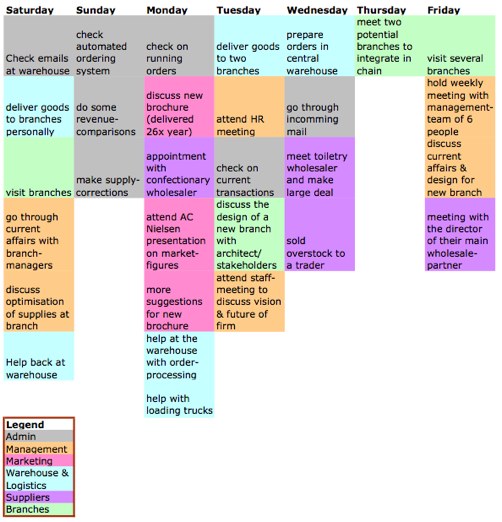
What is interesting is that there is a fairly even division of activities, apart from maybe marketing. From the article, I did get the sense that he was more focussed on warehouse-actitivities, also living close to the central warehouse, but he pretty much kept his finger in all the relevant pies for running a business of this sort.
What is also interesting is that he essentially plucked out a number of franchisee-branches out of DA's franchise-network and created his own. In the sense of whether franchising is entrepreneurship or not, I do think that this again confirms that the options remain wide open. This story also sheds a light on what can happen if a franchiser's policies are too restrictive for franchisees.
From my understanding, DA has been making moves towards a more integrated strategy, which did not sit well with many franchisees. Apart from the ca. 30 branches that Drogisterij-parfumerie took with it, another 40 left to join D.I.O. (4% market-share). This still leaves DA fairly strong, with 452 branches and 15% market-share, behind the number 1 in the Dutch market: A.S. Watson (Kruidvat, Trekpleister, and ICI Paris XL) with 877 branches and 40% market-share.
 If you follow my blogging-history, you may have noticed that I write about books… a lot! There are several reasons for this. One is certainly that I am a bookworm—I enjoy reading books, learning new things, and whenever I enter a bookstore, I go into a trance and start studying books to buy now or in the future. Case in point: I wasn't planning it, but I bought two more today! Talk about impulse-buy… More on those in a sec…
The other reason is more complicated. I actually think that books translate better to blogging than much of real life. This clearly differs from blogger to blogger. You won't find Robert Scoble blogging about books much, nor Fred Wilson, both of whom blog on more daily issues (Scoble is also a media-guy). Both John Gruber and Jason Kottke do cover books, but often base their writings on articles and other shorter readings.
For myself, it is different and I can give several examples of this. One, I was a pretty regular blogger until about a year and a half ago, when I started on a project of researching venture capital in the Netherlands. Not only was it a time-intensive process, but I was constantly questioning myself as to whether my blogging was ethical or not. There were certain topics reigning in my life, relating to that company, which i could just not disclose. A similar thing happened before that, when I worked at a high-tech start-up, and most recently, while completing my thesis.
There are several blogging friends I could mention (F., J., C., & M.), where you notice this same phenomenon.
Books instead, as well as articles, offer a foundation to build upon. One, they are public, which dismisses any confidentiality issues. Two, if they are well-written, they communicate core-ideas well, and you can add to that with your own knowledge. The complication with reading is of course, similar to writing, finding the time to do so. I think I found a doable system, by reading just before sleep, but I don't know how that will hold up in future projects.
The way I choose books (and articles)
As I look back at my short life, I find that I've evolved in the choices of books I made, and most recently after engaging on this trajectory—the food & retail blog and the underlying purpose that serves. While before, my choice of business-books was somewhat restrained to general management, strategy, and entrepreneurship books, I now choose books purposefully that fill a gap in my knowledge and focussed on business-issues in this industry.
Some examples
I choose the McDonalds (coverage here & here) and Starbucks books (here, here & here), because they seemed like a good venue-point from which to understand how food-businesses work. My interest has always been towards chains of businesses, not individual ones, so that was also a bonus. Similarly, the IKEA-book (here) offered insights into retail, and the eBay-book (here), while less relevant, into starting a business and running a community.
The Disney-book (here), which I'm currently reading, gives me insights into building a framework around the soft discipline of entertainment, story-telling, etc. It is very relevant to my earlier post today on cinemas, which is clearly a raw perspective, but one I hope I can refine, as entertainment is a core-value I have.
The two books, I've chosen today, are on two diverse, yet, to me, relevant subjects. "Managers as mentors" is about what the title suggests. The reason I chose it, is because I'm not a fan of the traditional perception of management. I find it a hard world. The way I relate to people is through learning and teaching. I've raised my brother since I was 11, as my parents were often away from home, and find it very rewarding to see him become an adult. I have a similar relationship towards people, where I like to turn them into more than they imagine themselves to be. So this book seemed right. That is not to say, that I have any problem with firing people that I don't feel have potential. ;-)
The second book is even more interesting to me, it's called "the growth strategies of hotel chains - best business practices by leading companies." It's very strategy-orientated, covering principles of diversification vs. specialisation, vertical/horizontal/diagonal integration, m&a's, franchising vs. ownership, branding & globalisation, and US vs. European differences, as well as examples of said leading chains at the end of each chapter. Exactly up my alley! Needless to say, I will read it after the Disney book!
So what about you?
Now, a discussion is only valuable if more people take part. So please, if you have an opinion on this, or on a better research-methodology for blogs, let me know in the comments!
The picture is courtesy of brandtarot.com
Just some finishing up on the IKEA-book. Following graph describes the structure of IKEA's business, as far as I understand it. 
1: Stores - The way the company expands horizontally, is through a tightly controlled franchising system. This both saves costs and minimises international risks.
2: Sales & service - the company is tightly integrates its sales- and service-operations with customers, the latter taking over 80% of the work (and loving it). Huge cost-savings, also benefiting customers.
3: Supply, manufacturing, design - The company is equally well-integrated back up the value chain, with suppliers, manufacturing, and design, and has—since the 90s—been expanding its operations in that direction. Some cost-savings by introducing savings up the logistics-chain, and more flexibility in manufacturing.
4: Management structure - non-public virtual entity that licenses the IKEA brand and is able to offset international tax-differences by being located in Belgium/the Netherlands and changing the terms of licensing-agreement as needed.
You can draw your own conclusions from that, together with what I've written before.
Things that stuck out from the book included:
- Ingvar Kamprad, the founder, who has both a trader's mentality and is at the same time a community-person;
- Sweden, IKEA's country of origin, whose restrictive tax policies actually resulted in pushing the business to become a global company;
- IKEA's cost-philosophy, which is very frugal and part of the company-culture, and also transmitted to the supply side and to customers. Some problems retaining top-employees as wages are not competitive;
- Its franchising-system, which somewhat surprised me, can be explained by the scientific way in which IKEA's operations has been built up. The more rational, the "easier" (a relative term) to replicate. It's also in line with the business's rapid global expansion and its drive to push down costs;
- It's a private company, which makes it less visible and (relatively) less accountable to the public.
- Its vertical integration with suppliers and customers, enabling it to quickly respond to new trends and problems, as well as introduce higher cost-savings than its competition.
P.S. I'll be taking a few days off, to recharge some creative energy.
 So, I finally finished the book on IKEA, which, sadly, is NOT yet available in English, though there are other choices + I seem to remember reading that it will be released soon.
In any case, a great book, which taught me a lot about the mentality that reigns inside IKEA, how logistics are organised, what determines design, what determines price, how people are managed, and… the most boring/interesting part: how IKEA evades taxes. That last one is really worth a read… they basically designed a complex financial structure, which enables them to offset tax-differences in various countries. As you may know the tax-levels in Sweden, its country of origin, are somewhat insane and have marked the company in a way that the Swedes probably didn't intend.
So what to do next. I'm a strong believer in making things actionable, vs. the passive digestion (& forgetting) of facts, and, in order to make this book useful, I need to do something about it. I previously thought about writing about the way that IKEA expanded internationally, as that sheds some insight into cultural differences of countries and the considerations a business has to make when launching there. It's also relevant IF you care about how the origins of a business determine where and how it will grow. I may still do that, but since it's a lot of work, I'll do it in note-form.
Something will probably come out of it. You can read about my previous coverage of IKEA here.
Next book: The Disney Way
While IKEA taught me about retail (and some extras), I'm hoping to learn more about how to organise entertainment. As I wrote a few days ago, a strong theme in my life is how to tell stories, in whatever form, but there is a whole process behind that and, while I have a rough view of what that is, I'm hoping that the Disney book has some practical tips.
I'll probably supplement this with The Toyota Way at some point, as I have a certain fascination for supply-chain management also.
Yes, yes, I read entirely too much…
FYI, previous book-reviews include:
- eBay's "The Perfect Store"
- McDonalds "Grinding It Out" here and here
- Starbucks' "Pour Your Heart Into It" here and here.
The picture is a mashup of this picture of a scary clown and this other lesser-known picture here.
 I've long been interested in the idea of franchising, though I'm somewhat conflicted about how to look at it. One the one side, it seems* like a relatively easy way to start a business, on the other side, it seems* a relatively cheap way to grow your business (*: within limits).
WSJ recently published an excellent study on high-performing franchises in the US. The choice of franchises is extensive, just like I concluded in my post on top-German franchises. At the same time, the most apparent choice, that of food, seems less and less attractive, and I quote from WSJ:
In particular, fast-food and casual-dining businesses, while still showing strength, with eight names on the list, also are facing pressure from wage and food cost increases. To lower operating costs, several food franchises already are shuttering some locations.Arguably, a business that is thinking about growing through franchising is faced with some restrictions. Writing a franchisees-manual is a scientific process, you'll probably have to restrict the complexity of operations so that they can be replicated, and there will still be some overhead related to managing the brand and some of the more problematic franchisees.
I think that it is that standardisation of operations, made big through the economies of scale so easily achievable in the US, that is bring competitive problems to chains, even to wholly owned ones like Starbucks. If your core-product is simple, and your business uses a simplified operation, then how hard is it for your competitors to replicate your whole business-model and -strategy in the long-term, really? It is only if your business strategy includes complex competitive advantages, such as extensive vertical and horizontal integration across the value chain, and/or if your business-model is based on "high-tech" components or processes, that you have a real chance of beating the clones. And to relate it to the rising operating costs, mentioned above, business with true competitive advantage can raise profit-margins or off-set the costs elsewhere, instead of having to close operations.
But ok, long-term strategic considerations aside, I see franchising is an attractive way to enter the business-world as an entrepreneur. The question of whether it's faux or real entrepreneurship, is not pertinent, I think. Considering that you have a wide range of choice of franchise-business opportunities, you'll still have to work hard to succeed, and the growth-opportunities can include starting multiple franchises also, it is not that different from starting any other kind of business. In my mind, I compare it to internet-entrepreneurship, which also relies on a large amount of free tools and distribution-mechanisms, but is still dependant on that special something for it to be successful.
What makes franchising particularly attractive, is the decreased amount of risk. According to a study in the Netherlands, 65% of franchises are still standing after 3 years. Compare that to independent start-ups, of which only 15% are alive at that time.
A large cause is, I'm sure, the level of support from the parent-company, which differ from business to business, and can include delivery of goods, marketing, administrative and IT services, made cheaper through centralisation. And they are frequently guided through the process of setting up and running the business, including legal advice. In exchange, they give away either a percentage of profits (ranging from 5 to 40%) or a set monthly sum to the franchiser.
The WSJ-article also lists the amount of investment typically needed to start a franchise. It ranges from ca. $5200 for an automotive company, to a staggering $1,3 million for a steakhouse. Of the 25 franchises recorded, only 5 received some kind of financial assistance (none of which in food). Another article at WSJ discusses some of the attitudes towards financing franchises, particularly during the current US-recession. Incidentally, another article in Dutch Elsevier magazine, sees franchising as an excellent way for businesses to grow during a recession, as it requires less human costs.
All in all, it is probably a safer way to start a business, though with all the points I made above, I don't think of it as 'light' entrepreneurship. There's clearly a lot of risk involved, beforehand, in terms of choosing the right franchise with growth-potential, financial risk to fund your business, market-risk, when you launch, and competitive risk, after your up and running.
I still want to discuss this topic further at a future date, particularly focussing on what its like to turn your own business into a franchise, and some other stuff related to buying into one.
The picture is courtesy of friendlyfranchising.com

 The
The