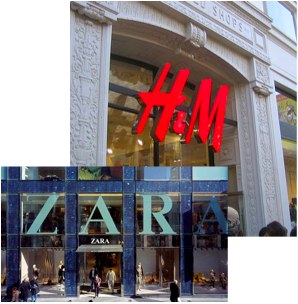
 Time for a wee break. In the last week, I've been researching Zara and H&M a little, to better understand the retail-sector and the fashion-segment. I'll probably have to do a follow-up to this post, as there is lots to say about both businesses, but here's some initial impressions, nevertheless.
First off, H&M appears a lot more clean in its approach. Judging by the annual reports alone, H&M not only has a 2007-edition (Zara is only up to 2006), but it is also only 85 pages long (presented in an eco-friendly 2-pages-per-side way), while for Zara, or actually Inditex, it's mother-company, the annual report is a stunning 450 page long!
Now, that's really not all that surprising, as Inditex is composed of a number of companies, and it is extremely vertically integrated, while H&M employs the Nike or Apple model—it designs and it retails, but it doesn't produce.
Why this is so, I can only guess, is due to their origins. Inditex comes from Spain, traditionally a low-waged country, while H&M is Swedish, not a low-waged country. Similar to IKEA, I imagine it was an economical decision to outsource most of its supplies.
It's very hard to separate Inditex from Zara, as both are founded and owned by the same person, Amancio Ortega Gaona, Spain's richest man. Zara has been in existence since 1975. H&M was founded by a Swede, Erling Person, in 1947, who ran the company to ca. the mid-90s, but which has continued to be a family firm.
Their business-philosophies are fairly similar, a low-cost, high-quality approach to fashion, as opposed to traditional brands, where quality most often equals price.
Zara made lots of headlines with its extremely high turnover of products—it produces around 11,000 items annually (as oppsed to 2,000-4,000 for other retailers); 15-20% produced before, 50-60% at the start of the season, and the rest during. If a product fails to do well, it is usually removed after a week in stores.
H&M made headlines with its celebrity-marketing, which is noteworthy, as Zara has virtually no marketing. Instead, because it has such a high turn-over of goods, customers tend to visit it more often, expecting new things—an average of 17 times per year vs. 3 times for other stores!
Both employ mostly a wholly-owned retail-strategy, except in countries where this is not possible. And both are very advanced in their use of IT to manage logistics and production, which is definitely seems to be a key-characteristic of delivering fashion quickly and find ways to decrease costs.
H&M's largest markets are Germany, Sweden, the USA, Spain, and the Netherlands (in terms of sales). For Zara it is Spain, France, Germany, and Mexico (in number of stores).
That's all I can think of in 30 mins or less…
I've included just the top-25 and annotated their focus. What's interesting, but not surprising, is that the majority of companies in that list are not independent horeca-orientated, apart from two: Hennie van der Most and Sjoerd Kooistra, both Dutch horeca-entrepreneurs.
The majority is hotel-chains, though the top-10 is quite diverse; a number of convenience-(fast)food places, resorts, as well as retailers. Interesting that both Ikea and Hema are on that list. Hema, as far as I know, has not been on the horeca-market for long (no revenue reported in 2006), but is already reaping significant successes. Probably my favourite retailer in the Netherlands, btw. Ikea, as I reported before, has been in the restaurant-business since 1971.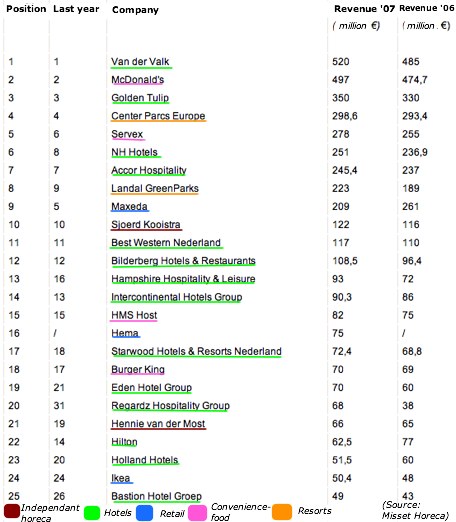
You can see the complete top-100 at Misset Horeca.
Interlude: From medical to space-tech - How technology affects incubation-strategies
0 comments Posted by Unknown at 8:48 AM High-tech… My never-ending hobby! Read about it on Tech IT Easy!
 Just a short tweet.
I'm currently reading a Dutch book on the 2003 crisis at Ahold, but which is actually a historical account of how the corporation came to be. A couple of things I found interesting:
- Ahold actually stands for AH (Albert Heijn) Holdings
- We all know that things are cyclical, but it was interesting to read how a recession and high oil prices were a challenge that Ahold had to face in the 60s-70s, and how they managed to survive.
- In order to inspire Dutch people to shop more, they introduced a financing scheme for fridges, which people couldn't afford at that time. General Motors did a similar thing to help people afford their cars; seems like an interesting way to "upgrade" an economy.
- The fear of a socialist government drove Albert Heijn to look outwards and form Ahold (similar to why IKEA decided to globalise also).
- One of the consequences of politics at that time was the board of directors, meant to provide impartial guidance and represent the workers.
- They made extensive use of consultancies (often McKinsey) whenever they decided on a strategic trajectory.
- One of the directors was a big fan of Harvard Business Review :)
- They use the US as a source of knowledge on how to design their supermarkets. Later on, moving to the US was also seen as a way to increase that learning, as well as a new revenue-source.
- When AH moved to the US, they also brought their own ideas, like, eh, advertising (a terrible, terrible idea).
 I'm still "on a break," but stumbled across this interesting titbit from a book on warehousing-practices. If you don't like reading lists, too bad because it's interesting, but I've also summarised the key-points in the end.
China
- Low labour and land-cost, but high equipment costs, translate into large (e.g. 250,000 square feet), low warehouses like in the US, but often lacking even a forklift.
- Certain goods like consumer electronics, are of such high value, have a short life-cycle, and thus a lower inventory-cost, that expenditure in state-of-the-art technology is justified.
- Certain cost-saving practices, like removing the pallets from shipments in order to ship more goods, cause some inefficiencies other countries, like, eh, re-adding pallets.
East Asia
- A traditional focus on personal relationships and less on computational models, means there's a lack of data and opportunities for improving performance are not well-developed.
- The most active economic areas are separated by lots of water, which means lots of product conveyed by air (for high-value or time-sensitive products) or ship (for bulky items or commodities). The high costs associated with this, are incentives to consolidate freight.
- Therefore, more strong regional hubs, like in Hong-Kong and Singapore, are expected to emerge.
Europe
- High labour-costs and an inflexibility of the work force have lead European warehouses to be more advanced in terms of automation.
- A growing common market will also lead to more economies of scale in the future, leading to larger, centralised warehouses.
India
- Characterised by cheap labour and land-cost, but relatively expensive capital costs (machinery and the like) and an underdeveloped infrastructure (both physical & administrative).
- The markets being supplied are generally local and not very wealthy, which leads to the SKUs not being high cost and there being little incentive to increase efficiency through capital expenditure (IT).
- Global demand means that larger distribution centres are being built around large ports like Mumbai (Bombay). The lack of land there is leading to high prices, comparable to Singapore/Hong-Kong.
North America
- Characterised by a culture of mass-consumption and a uniformity of the market and distribution infrastructure, which translates into large centralised warehouses and accelerating rates of product flow.
- Warehouses are often situated in the countryside surrounding metropolitan areas, which is cheaper, while being well-connected.
- A good telecommunications-infrastructure enables better supply-chain co-ordination; Warehouse management systems are generally advanced, and the rich data leads to better tracking and performance.
- High labour-cost are off-set by using cheaper migration-workers
Singapore, Hong Kong, Japan
- Due to a lack of land and high labour-cost, warehouses tend to be built high.
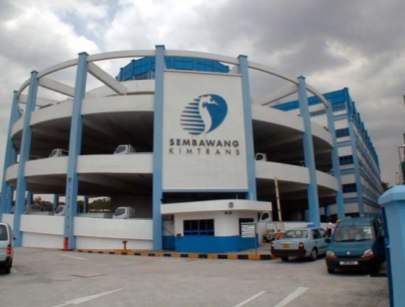
- Elevators are one bottleneck, caused by this style of building, however a Singapore warehouse has found a solution to this: A multi-floor facility with no automation or elevators, but, instead, a spiral truck ramp so that trailers may be docked at any floor (see pic). This does claim more land area, which must be recovered from above, and doesn't work well if trucks have to shuttle between multiple floors.
- While both Singapore and Hong-Kong act as hubs, Singapore is much more international, receiving goods from manufacturers all over Asia and shipping it to other countries; Hong-Kong receives mainly Chinese goods. Also, for the latter, many of the goods come in via trains and trucks, while leaving by ship or flight, while for Singapore it comes and leaves via sea and air.
South and Central America
- Labor costs are low, though not as low as in China, and the nature of its local economy and customers does not justify high equipment expenditure.
- The only exception is Mexico, which can quickly ship products to the US and keep its inventory low, thus justifying state-of-the-art technology.
Final thoughts
Some general conclusions can be drawn.
- Labour costs are a factor when considering automation; automation is a factor when considering optimisation; optimisation is a worthwhile expenditure when dealing with high value goods with a high velocity.
- Cheap land seems a fundamental advantage, looking at the logistical nightmares that Singapore and other high-rise builders must be experiencing.
- Access by land will significantly decrease the cost of transport. Generally, a well-developed infrastructure means more access to wealthy markets and enables warehouses to store high-value/high velocity goods, which is good for them.
The book 'WAREHOUSE & DISTRIBUTION SCIENCE,' which is available as a free download, provides some incredibly detailed info on how to effectively set up warehouses and distribution chains. Well worth a glimpse, if not more.
The role of the internet for the retail of *physical* goods.
0 comments Posted by Unknown at 9:01 PMOne of the stories, I covered last week in my links, uncovered an interesting statistic. Only about 3% of retail sales in the US happens online. I don't think these stats are at all coincidental. While I see a bright future ahead for the online retail of media-products, I find that what the internet cannot provide, is the "closeness," that is sometimes needed for evaluating certain types of goods, like food and clothing. I have commented on this before, implicitly, with a post on the web as a third place, and about the lack of cohesion that Facebook provides.
At the same time, as The New Yorker story reports, what the internet has changed is how we shop; it is much easier to research and comparison-shop than it was before the internet-days. A survey by Accenture found that ca. 66% of those surveyed compared products online, and another study showed that the internet played a significant role with ca. 75% of electronics purchases.
IInnovate has an interesting podcast interview with Scott Dunlap, CEO of NearbyNow, which has come up with an interesting way to exploit the informational advantages of the internet and mash that with the qualities of physical shopping. Following short video shows how their service works:
Clearly technology has evolved a lot in the last few years, making this possible. NearbyNow works via the web and via mobile. I'm not sure if they are using any location-tracking & matching services, but certainly they are heading in that direction. On the retailers' side, there is plenty of technology that makes this possible also. Electronic inventory and point of sale systems allow both for the checking of stock-levels and for consumers to reserve items to be picked up and tried on at a later date.
One issue that entered my mind, is that of efficiency. The way NearbyNow operates is through malls in the US, most of which are, as I found out, owned by 6 major companies across the nation. US's scale-economies win again! In Europe, the situation appears a little different. Culturally, linguistically, technologically, and legally, it is a much more fragmented market, with far fewer malls also, and that may make it difficult for a unified service like this to operate as efficiently as it would in the US.
There is also the issue of too much transparency, which is worrying to some retailers, and addressed in the podcast-interview. But what does seem certain is that this is exactly the type of service that consumers value, and as such one that any consumer-centric business should encourage.
Will a service like this ever replace shopping in its entirety? No, I'm essentially betting my future that there are plenty of qualities *real* environments will continue to offer over virtual ones. But there is no reason, none at all, to try to integrate the good qualities that the web does possess—information at your fingertips—as elegantly and effectively as possible into those experiences.
 I'm glad to get this out of my life. It is probably the last bit of procrastination left over from the period spent writing my thesis. Following is a continuation of my coverage of IKEA's growth as a business, which I began, in a wordy fashion, by looking at the Scandinavian years. I decided to shorten that somewhat, as really the book (if you can read it) already does a great job of describing IKEA, though my version is perhaps easier to digest.
1961 - Already when Ingvar Kamprad started trading, he had formed relationships with suppliers from abroad. He employed this strategy also when he launched IKEA, forming relationships with Polish and other Eastern European suppliers, which gave him a drastic price-advantage over his competitors.
1973 ca. - After the incubation-time in Scandinavia, Switzerland was the first country, that IKEA expanded too. Reasons included its neutrality, a healthy economy, low taxes, and a greater entrepreneurial spirit.
1973 ca. - When the Kamprad family left Sweden, they founded several foundations in the Netherlands, Switserland, Panama, and the Dutch Antilles.
1974 onwards - Expansion in Germany, Munich (one of the wealthiest cities in DE). The store was a great success, and Germany is still a pillar of profitability for IKEA today.
1975 - first stores opened in Australia, Honk-kong, and Canada, through franchising. In 1980, IKEA took over the Canada-chains, as those were not being run well.
1978 - First store in the Netherlands. It did not go well at all, due to a lagging marketing-campaign. Only in 1982 onwards did IKEA book successes with the Dutch. 1994 started a huge boom of expansions in the Netherlands (more detail was provided about Dutch branches, because the book was Dutch). Belgium also saw stores after 1978.
1982 - IKEA set up Stichting INGKA Foundation in the Netherlands, which was Kamprad's way of keeping IKEA for IKEA instead of having to give it away after he died. It was in charge of IKEA from then on.
1983-4 - stores in Gran Granaria, Tenerife, and Saudi-Arabia.
1984 - IKEA starts "IKEA Family" loyalty program for customers and also introduces its first luxury furniture product-lines.
1985 - first store in USA and kept expanding. Famously (I read at least 1 case-study about it) there was some teething-trouble at the beginning and it took a while for IKEA to find the correct formula for the US market.
1986 - 60-year old Kamprad steps back as CEO and gives reigns away to 35-year old Anders Moberg.
1989 - the fall of the Berlin wall. The roughly 500 suppliers that IKEA had been working with in the Eastern block, suddenly found their economic situation drastically change and prices started to go up. Out of loyalty, IKEA vowed to pay up to 40% of the price-increases for its Polish partners.
1991 - the Eastern European crisis lead to a strategy-change. IKEA became a producer of furniture. Due to its long-lasting relationship and involvement with suppliers, it possessed the necessary know-how, and becoming a producer would also have positive effects on its flexibility. IKEA could focus on Just-in-Time production to overcome the production-problems it had had in the past. In 1991, it took over a Swedish producer of wood-products, and after the privatisation of the Polish furniture-industry, IKEA took over three companies there in 1992 as well. This became part of a trend and every-time it had the chance, it would take over a supplier in Eastern Europe.
1991 onwards - also saw an IKEA expansion of stores in Eastern-Europe.
1992 - IKEA took over Habitat, a British retailer of furniture, that had previously caused a style-revolution in Britain. Until now, IKEA had not expanded to the UK, and it was assumed that it was Habitat's strength that was keeping it at bay. It was forced to sell, after expanding to France, Germany, and Spain, which had caused it to make huge losses. IKEA also used its presence in those countries as launch-pads, keeping Habitat as a separate brand.
1998 - China! Already having been a supplier of IKEA's since the 70s, and generally believed to be a huge opening market, IKEA opens its first store in Shanghai, through a joint venture with a Chinese firms. It was an exploratory step as the Chinese were not yet economically ready for the type of products the IKEA offered, though the assumption was that China's economy would grow 10% per year. IKEA wasn't competing on price either, basically being more expensive than any local competitor. Only after severe price-drops, did the business take off.
2000 - Russia. The company had already had talks in 1988 to open for business there, however the collapse of the Russian empire delayed that. Finally, based in part on Kamprad's gut-feeling, the decision was made. It was a good one. In year 2, the annual revenue was $260 million, making it one of the most successful expansions ever. 45,000 people applied to 600 vacancies in the first store. Due to high import-taxes of 28%, the decision was also made to start producing furniture locally also.
And everything else… is history.
Note that, as I used a single source for this time-line, a Dutch/German book on IKEA's 11 secrets, this blogpost cannot be taken as an ultimate authority on IKEA's growth-strategies. At the very least, I got some dates wrong.
Final thoughts
In my first post about IKEA's growth, I wanted to make clear that how a business expands is largely related to its origins. The relationship with Eastern-Europe is both due to a cultural proximity with that region, as well as Ingvar Kamprad's drive to lower costs. Germanic countries were also a logical step because of linguistic, and hence cultural similarities, as well as similar economic conditions.
Territories with which it was as yet unfamiliar, were being expanded into in a risk-reducing fashion, through franchising in Canada, China, and Australia, and later on in China, through joint ventures also. The acquisition of Habitat in the UK, could be perceived as a risk-reducing move also.
It is generally recognised that European firms are better at managing international expansion, simply because of the compressed experiences they get from growing in heterogeneous Europe, which makes them more flexible in other countries also. Still, you could see that certain culturally remote countries posed some difficulties, such as the US and China, and even the campaigns in Germany and the Netherlands did not proceed flawlessly.
All that aside, to me the most interesting part of all of this was IKEA's shift in strategy in the 90s, turning from being a retail-outlet to a producer-retailer hybrid. It is both a radical shift, but from what I understand, a very logical one.
That's it. Tomorrow, I'll publish some notes about the biggest pros and cons about IKEA's business.
The picture is a mash-up of the Evolution 101 podcast logo and IKEA's logo.
 I've long been interested in the idea of franchising, though I'm somewhat conflicted about how to look at it. One the one side, it seems* like a relatively easy way to start a business, on the other side, it seems* a relatively cheap way to grow your business (*: within limits).
WSJ recently published an excellent study on high-performing franchises in the US. The choice of franchises is extensive, just like I concluded in my post on top-German franchises. At the same time, the most apparent choice, that of food, seems less and less attractive, and I quote from WSJ:
In particular, fast-food and casual-dining businesses, while still showing strength, with eight names on the list, also are facing pressure from wage and food cost increases. To lower operating costs, several food franchises already are shuttering some locations.Arguably, a business that is thinking about growing through franchising is faced with some restrictions. Writing a franchisees-manual is a scientific process, you'll probably have to restrict the complexity of operations so that they can be replicated, and there will still be some overhead related to managing the brand and some of the more problematic franchisees.
I think that it is that standardisation of operations, made big through the economies of scale so easily achievable in the US, that is bring competitive problems to chains, even to wholly owned ones like Starbucks. If your core-product is simple, and your business uses a simplified operation, then how hard is it for your competitors to replicate your whole business-model and -strategy in the long-term, really? It is only if your business strategy includes complex competitive advantages, such as extensive vertical and horizontal integration across the value chain, and/or if your business-model is based on "high-tech" components or processes, that you have a real chance of beating the clones. And to relate it to the rising operating costs, mentioned above, business with true competitive advantage can raise profit-margins or off-set the costs elsewhere, instead of having to close operations.
But ok, long-term strategic considerations aside, I see franchising is an attractive way to enter the business-world as an entrepreneur. The question of whether it's faux or real entrepreneurship, is not pertinent, I think. Considering that you have a wide range of choice of franchise-business opportunities, you'll still have to work hard to succeed, and the growth-opportunities can include starting multiple franchises also, it is not that different from starting any other kind of business. In my mind, I compare it to internet-entrepreneurship, which also relies on a large amount of free tools and distribution-mechanisms, but is still dependant on that special something for it to be successful.
What makes franchising particularly attractive, is the decreased amount of risk. According to a study in the Netherlands, 65% of franchises are still standing after 3 years. Compare that to independent start-ups, of which only 15% are alive at that time.
A large cause is, I'm sure, the level of support from the parent-company, which differ from business to business, and can include delivery of goods, marketing, administrative and IT services, made cheaper through centralisation. And they are frequently guided through the process of setting up and running the business, including legal advice. In exchange, they give away either a percentage of profits (ranging from 5 to 40%) or a set monthly sum to the franchiser.
The WSJ-article also lists the amount of investment typically needed to start a franchise. It ranges from ca. $5200 for an automotive company, to a staggering $1,3 million for a steakhouse. Of the 25 franchises recorded, only 5 received some kind of financial assistance (none of which in food). Another article at WSJ discusses some of the attitudes towards financing franchises, particularly during the current US-recession. Incidentally, another article in Dutch Elsevier magazine, sees franchising as an excellent way for businesses to grow during a recession, as it requires less human costs.
All in all, it is probably a safer way to start a business, though with all the points I made above, I don't think of it as 'light' entrepreneurship. There's clearly a lot of risk involved, beforehand, in terms of choosing the right franchise with growth-potential, financial risk to fund your business, market-risk, when you launch, and competitive risk, after your up and running.
I still want to discuss this topic further at a future date, particularly focussing on what its like to turn your own business into a franchise, and some other stuff related to buying into one.
The picture is courtesy of friendlyfranchising.com
Building lifestyle-brands and the role that the internet can play
0 comments Posted by Unknown at 7:21 PM I'm a little distracted from blogging, I'm sorry. My current activities include a last-minute scrabble-play of my thesis, to make it a more logical read, and applying for jobs. And, not unsurprisingly, I'm having some writer's block as a result.
My post from a few weeks ago, about my anonymous friend, who's running a lifestyle-orientated business in a developing market, certainly opened my eyes to this area of the market.
Today, I'll talk about another company, Milner (cheese). There was an interesting article in Dutch marketing-magazine, Tijdschrift voor Marketing, on Milner's positioning-strategy from mass to lifestyle, which I'll discuss now, and which also lead to a post on Tech IT Easy about social networks as a strategic marketing-tool.
Milner = FMCG
Milner is considered a FMCG-company, that's fast-moving consumer goods, and falls into segment 2 on my food-industry map from last week. As I observed there also, this segment is usually the driver, if not always the conductor, of consumer-marketing.
The company is currently strongly present within the health-segment for cheese in the Netherlands, with over 50% market-share. This segment is also seeing between 60-70% growth from cheeses in general.
One thing that is clear for FMCGs is that margins are generally low (generally under 10%), competition is high, and as I made clear in my post on Tech IT Easy, features can easily be emulated by other companies.
Generating complex competitive advantages
The differentiating factor is the relationship the brand has with the consumer and vice versa. A brand that is designed for a lifestyle will generally have a much higher emotional value to consumers, than one based on features like cost or taste alone.
The logical conclusion is that those companies with deeper relationships to their customers will enjoy a higher competitive advantages over companies that do not focus on these relationships. And the complex nature of relationship is one that is difficult to emulate, hence giving companies a sustainable lead in the market.
But how to do that?
Paradigm-shift towards lifestyle
A lifestyle-product can be defined as a product that is built around the context of a certain group of consumers, resulting in an emotional value, as well as one based on features. This also has implications on the product-marketing strategies that a lifestyle-orientated company undertakes. As you may remember, the company my friend operates, still spends a considerable amount on marketing-activities after 2 years.
The theory that Milner cheese employs goes as follows. A great pain for food is health—which is really just an after-effect of the lifestyle people are leading. People are constantly looking for answers, so-called lifehacks, or more diet and exercise-related advice, all to regain power over their lives, minds, and bodies.
The key-issue is how to reach these customers. By addressing the pain that customers are feeling, by helping them live a healthier life, Milner is engaging in a relationship with its customers.
How does it do that?
How the internet fits into this
Traditionally, internet-marketing expenditure for FMCGs is quite low, around the 2% mark. Milner's budget currently assigns 10-15% to internet-marketing. It is able to do so, because it is already relatively well-positioned in terms of its brand and communication, so it feels more confident to experiment with new mediums.
As mentioned in my post on the food-industry-map, marketing to consumers is the responsibility of the consumer-goods-segment, however the degree that this activity is outsourced, depends on the amount of resources available to the company and the level of complexity of the activity. Arguably, both the novelty of internet-marketing to Milner, and particularly engaging into a relationship with consumers, make marketing fairly complex affair and the company did this via a third party, Advance, an interactive marking agency.
Advance set up a site called Je Beste Dag (translated: your best day), which advises visitors on how to have better days, based on a questionnaire they fill out. The first stage of the strategy is to build up a large mass of consumers that give out their email-adresses for further advice. Currently, there's 1 million people connected to the site. The second stage is to deepen that relationship, by encouraging return-visits and ultimately start a conversation.
It's both a time- and cost-consuming process for Milner. Essentially it is the sole sponsor of the campaign and has been running this campaign for nearly half a year no, without seeing any types of new product-developments yet. It is however working together with (other) marketing-agencies to develop its brands, which includes the design, positioning, quality, etc., as well as new product developments.
The interesting part of the whole process is that the majority of visitors already knows Milner, before even visiting the site. In other words, this clearly is an interactive marketing-campaign, which deepens the relationship between company and customer beyond the brand. Also, while the segment that Milner markets to via traditional channels, usually falls in the age-groups of 40-60, the age-group it is reaching now falls between 25-45, 60% of which don't yet have children.
Final thoughts
It is uncertain what exactly will come out of this. Milner is treating their internet-campaign as just another marketing-channel and holding Advance to targets it must meet. Which also allows them to measure its effectiveness. However, with a million young people connected to the site, and the communication-channels open, my gut tells me that they will be pretty happy.
The conversational aspects that the internet provides are certainly no surprise to the regular internet-user, however many web-companies are finding it difficult to generate sustainable business-models (e.g. Twitter / Facebook). As I made clear in my post on Tech IT Easy, I think these kinds of marketing-campaigns open up some possibilities there.
Premise of this post: I'm going to get my camera fixed, for the second time in 3 weeks, at a store called Saturn. It is, as far as I know, the only other German chain focussed on consumer-electronics in the Netherlands, next to Media Markt, which is clearly the no. 1 here and in Germany. Ironically, while they appear as competitors to the consumer, they are owned by the same concern, Metro Group.
Now, I don't know the exact reason behind internal store-competition. The only company I worked for, where something like this was the case, was Sony, who allocated annual budgets to individual departments based on their performance. Reminds me a lot of the way governments are run. Of course, bureaucrats have a job for life.
While I was at Sony, I've never seen so many departments closed and managers fired, and both physical locations where I worked in Germany & the Netherlands, are no longer in existence. To a large part, in my opinion, this explains the troubles that Sony is in today, many of which are a disconnect with its audience and, very likely, caused by disconnects within the gigantic company also. But… that's a story for another day.
The other area where I know about examples of internal competitions, are product-lines. Didn't Steve Jobs once say (paraphrased): "If anyone should take marketshare away from one of our products, it should be Apple." I think that this is a conscious decision of Apple and I briefly touched upon it at Tech IT Easy, in regards to form-factor of the Macbook Air (MBA)—the screen, hard-drive, and CPU, which very much overlap with (read: fit into) other products that Apple sells, and, to me, represent economies of scope and scale to the company. It doesn't matter if the MBA sells or doesn't, what matters is that component costs will go down and innovation will go up, which is good for Apple.
Now, none of this really answers the questions why Saturn and Media Markt occupy the same market-segment. And, I have to confess, I just opened my Retail Marketing book to find the answer, and couldn't find it (the book is apparently not focussed on business strategy much).
Both Media Mark & Saturn offer similar features to customers, which are mostly represented on the chart below: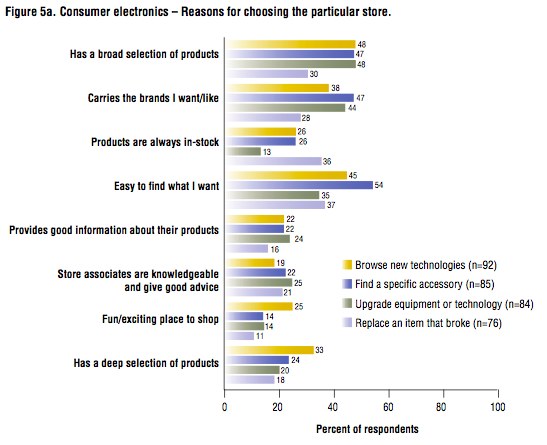
(Source: IBM white paper - "Deeper Customer Insight," which I wrote about several times before)
Some differences are perhaps that Saturn was most often located within another Metro Group-owned store, called Galeria Kaufhof, though I think they are changing that strategy in Germany, and certainly in the Netherlands, where they are stand-alone. Media Markt, as far as I know, has always been stand-alone. Both facilities are rather large, offer parking-facilities, and are usually located within the city (though in Rotterdam, Media Markt takes a more prominent place). And prices, promotions, and brands, while similar, differ in certain areas.
From this, I think it's safe to conclude that market-saturation is a clear goal of Metro-Group. By giving customers not one, but two large options, with separate deals to be had, at separate locations, etc., it appeals to an implicit customer-demand, that of choice, and takes attention away from other, "lesser," and certainly not Metro Group-owned choices.
Something else that is interesting, is mentioned on both companies' websites. Both chains are very decentralised in their management-structure. Every store acts as a self-sufficient enterprise, co-owned by each director, who, with his/her team, is responsible for how the store is run, and ultimately, how successful it is. Kind of sounds like a franchise.
So, I can only conclude that the internal competition paradigm is very much similar to that of Sony's, to force individual stores to perform better.
I think it's an interesting strategy and clearly Metro-Group is the winner here. How this plays out for individual stores and their share-holding directors is uncertain and clearly depends on the skill-level of store-management and the level of support given by their parent-company.
How being in the right place at the right time translates to entrepreneurship
0 comments Posted by Unknown at 12:53 PM If there's one I thing I learned from my thesis it's that everything is part of a system. Most often, this system's purpose is to shift resources from and to various interconnected, yet diverse and complementary parties.
In regards to entrepreneurship, and pretty much everything else, I have a philosophy: everything happens for a reason, usually related to how you respond to opportunities. And to bring it back to that interconnected system, being in the right spot, where you can intercept flows of ideas, people, and resources, tremendously increases the chances of you finding the right business to be in.
Two examples
Two people that are fairly close to me are perfect examples of that phenomenon. They shall remain nameless, for obvious reasons. They are both pretty bright, but what contributed to their lives most, is being where it mattered.
One of my friends did a very smart thing. We studied together and when he moved back to his Eastern-European country, he noticed that a lot of traffic was coming in from the European Union, in terms of regional funds aimed at bringing the country up to par for future integration.
So he started a consultancy with some friends, to advise companies on how to apply for those funds. Initially, he thought it might just be a hobby. But what actually happened was that a lot of traffic was coming in terms of companies—start-ups, looking for funding. And it allowed him to find a business to buy into, which was well-postioned to fill a current need, and had the capabilities, but not the business expertise to succeed.
A second friend of mine was also someone who I knew would always start his own business. But he did the smart thing when he graduated (actually he did several smart things before too). He got a job at a corporation counselling start-ups on how to deploy that corporation's technology. So, just like my other friend, he got a lot of traffic in terms of ideas and people, and all he had to wait for is the right idea that would fulfil a niche in the market. And bingo. I'm not sure if he planned it that way, but he's now the founder of a start-up, filling up a need.
Underlying principles
Right places matter, but so does mentality and a number of other factors. It's not enough to just be there. The reason you are there is because you are of value to whatever network you are part of. Following are I think some factors to consider:
- Be open to opportunities
- Make strategic choices about your initial placement
- Be of value to the network you are a part of - that means being an authority, which means you have to have some schooling
- Make strategic choices about the start-ups that you encounter - are they filling a gap in the market, can you fill a gap in their organisation?
- Go back to your initial network - analyse whether all the elements necessary for success are there—smart people, funding, exit-options, technology—and can be carried over.
- If yes: launch and succeed.
I always knew I wanted to start a business. Plenty of people at plenty of times, have counselled me to just jump in and do it. I didn't, because I felt the alignment wasn't there—between me, a business, and a need.
The way I'm visualising my path into this industry is among similar lines. Become a valuable resource myself. Find & build a network, where I can contribute value too. And then decide, based on timing, technology/idea, people, market-niche, and other elements needed for it to be a success.
Note to the reader: I'm still processing a lot of material I want to write about. Most of it is food and/or retail related, I promise. Expect at least two posts related to IKEA this week, on economics, design, branding, and customer-retention schemes.
 I have a general philosophy on restrictive business-model: that particular business (or industry) is in pain. Much like when you drive an animal into a corner, it will quickly start bearing its teeth and drawing the line.
I spent today searching for a gym close to me (healthy body = healthy mind), and most of what I met were restrictions and crazy prices, mostly summarised by:
limited opening times (don't people train on weekends?); a fat one-time-only entry-fee; multi-month/year lock-ins; and prices charged per 4 weeks instead of per month.So is the fitness-industry in trouble or is there another reason? I have some theories.
- Low price-elasticity due to the health-boom
- Too much competition - but it's not like barbers, which are on every corner, are trying to lock me into a 1-year contract.
- Too little competition - more likely (see point 4)
- Expensive cost-structure - likely, I imagine it's much higher than for other retail/entertainment-venues.
- Low education entry-barrier, translating into uncreative business models
- Extensive government-restrictions - seriously, what's with the stupid opening-times? High insurance-requirements also likely.
What I want, and sort of found, is the classic model: sweaty seats, instructors who growl at you when asked a stupid question, lots and lots of free weights, and if possible some over-muscular body-building chicks to compare muscle-size with. I'd also like the ability to pay per month, as well as a gym that opens before 8 a.m. (but that apparently is asking for too much).
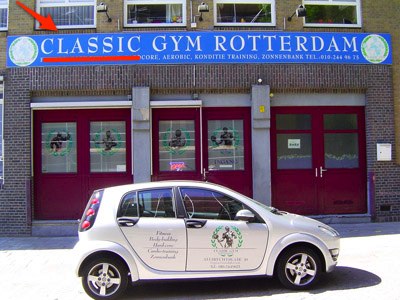
P.S. Finally found something in that sort of fits the bill (see pic). Classic Gym Rotterdam. I'll be joining tomorrow.
 It's perhaps a curious thing to say, but I think a lot of things in life depend on semantics—the meaning of words.
I should actually be calling my blog "Horeca & Retail" Blog, just because the word horeca describes what I want to do so much better. Horeca is an (Dutch afaik) umbrella-term, that describes the businesses mentioned in the title: hotels, restaurant, and cafes.
I picked "food" instead of horeca, because I couldn't find an English term that described what I wanted as well. There's restaurants, gastronomy, cooking, catering, cafes, etc. but all that is too specific. Incidentally, if a knowledgeable Brit, American, or international happens to know an anglo-term as suitable as Horeca, please let me know!
Whenever I discuss my business ideas with my dad (much more inspiring than any internet-based research), we don't talk about food or retail. I begin with that, because that's what I cover in my blog, but the conversation always evolves to how to run a café or some other kind of drink-related entertainment-venue. In other words, we talk "horeca."
Here's some stuff I learned from him (he used to own some bars and cafes):
- Try to imagine your place as a theatre - you're putting on a show every night.
- Personality of ownership is important - whenever he was active in this business, he tried to look for good partners: people who understood this world and had certain social qualities.
- When looking for investors, look for breweries - this is something I'll have to research.
- Location is not the top-priority for a horeca-venue - people will come if it's worth it.
- Horeca is a troublesome business - somewhat of a general statement, which I hear from a lot of people. Basically, it suffers from weird people-related issues—lot's of stress, lot's of alcohol, terrible working-conditions, funny contractual agreements, etc. And lot's of businesses go bankrupt (well, what else is new).
So, over the next few months, next to continuing to cover certain, universally applicable, retail-topics, I'll try to find out more about how to run entertainment-venues.
Essentially private labels, also sometimes called house brands, are products branded either with the name of the retailer, or, at times, sharing some kind of umbrella-name, decided by the distributor or otherwise. But what private labels really represent, to me, is the ultimate example of a power-struggle between a retailer and suppliers. Sometimes, but not always, it also means that some kind of vertical integration has been taking place between retailers and manufacturers, or, at the very least, packaging plants.
For now, I'll just be looking at some stats on private labels. At a later date, I'll take a look at more supplier-retailers dynamics, branding strategies, etc.
Geographic share
According to an ACNielsen report (pdf), the global* market-share for private brands was 17% in 2005 (* global meaning 38 countries and 80 categories), and had grown 6% that year.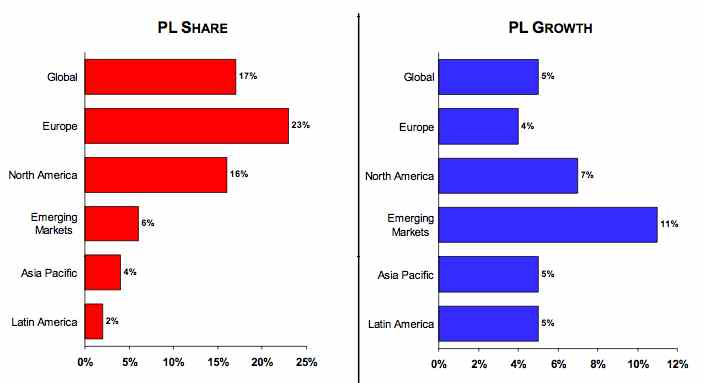
Figure 1: Share & growth rates of private label by region (based on value sales) (source: ACNielsen, 2005)
Europe has the largest market-share with 23%, and Latin America the smallest, with 2%. Top countries included Switzerland, with 45%, Germany, with 30%, and the UK, with 28%. The largest Private Label growth happened, unsurprisingly, in emerging markets (11%) like Croatia (77%), Greece (24%), and Thailand (18%).
One big growth-contributor in Europe is the strong growth of hard discounters, such as Aldi or Lidl (both German chains), who are present in every European country and expanding rapidly. With Aldi, for instance, private labels make up 95% of sales.
Private label foods
Category-wise, refrigerated foods have the largest overall share of private labels, namely 32%. Complete ready meals take the lead here, with an average of 47% private label-share. In the UK, 97% of ready-meal sales are in fact private label.
Another significant private label food, or rather drink, was milk, of which private labels make up 43% of sales.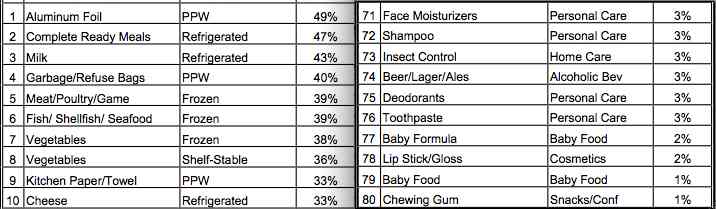
Figure 2: Value shares of private label by category (source: ACNielsen, 2005)
Other high private label food-products include frozen meat (39%), fish (39%), and vegetables (38%), and 37% for shelved vegetables. Frozen pizza is at number 27, with 17%, tea and coffee at numbers 37 and 38, with 14% and 13% respectively. Wine is at number 44, with 12%. And Beer is all the way at the bottom, at number 74 with 3% !
Among the fastest growing foods are drinking yoghurt (28% growth), baby food (20%), chocolate (13%), and water (13%).
Pricing trends
One of the strengths of private labels is of course that they are cheaper, on average 31% less than manufacturer brands. Emerging markets showed the biggest discount, with PL-goods costing 41% less on average. Europe wasn't lagging in this respect either, with an average price difference of -37%. On a country level, Greece, Australia, and Germany were taking the lead with, respectively, -48%, -47%, and -46% discounts (compared to manufacturer brands).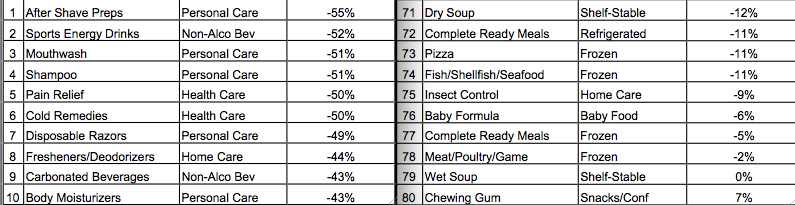
Figure 3: Price differential of private label by category (source: ACNielsen, 2005)
Again, concentrating on food-categories, the products that received the biggest discounts were Sports Energy Drinks (-55%), carbonated beverages (-43%), cereals (-40%), wine (-38%), and tea (-37%). Food-categories taking the least in discounts, included chewing gum (+7%), wet soup (no difference), meat (-2%), and ready meals (-5% <- I guess that explains their high market-share).
Final thoughts
That market share is increasing more quickly in emerging countries is not surprising. Retailers there will likely not be mature and/or consolidated enough to focus on such a strategy, but this is clearly changing.
Germany's dominance is also interesting, as both Aldi and Lidl originate from there. One of my next posts will be on Ikea's European growth and Germany's also very strong there, which suggests a certain preference for low prices with German customers.
Switzerland is still somewhat of an enigma, but I'll try to find out more about it.
In terms of products, both the dominance of private labels amongst ready-made meals, and that their prices are quite similar to regular brands, is very interesting. It could suggest that customers either don't care much for quality and brand-differentiation in that sector, or that private label brands are actually quite good. The price-level would suggest the latter conclusion.
Generally speaking, refrigerated goods are different in the eyes of consumers, I think, less scrutinised perhaps, and worthy of more investigation. Milk is of course similar to water, and hence not really a product where brand makes a huge difference.
What else? Certain beverages, like coffee, wine, and beer are quite interesting, as their private label share is quite low. This would suggest a high brand-sensitivity in these sectors. The low percentage for beer (3%) is certainly striking.
More on private labels as I come to it.
Let's start with a brief disclaimer: I am not a lawyer, fiscal expert, EU expert, or anything that can constitute an authority in matters of European legislation. I have linked to relevant data at the end of this article, which I strongly encourage interested readers to check out.
SEPA, meaning “Single Euro Payments Area,” is an initiative, due to be launched in 2008 and fully implemented by 2010, but has been in the planning ever since the EURO-currency was unleashed upon the member-countries in 2002.
Essentially, while the EURO brought some transparency to consumers, banks, and businesses on a cash-level, SEPA is meant to be the non-cash equivalent, introducing a common standard of non-cash transfers between banks, businesses, and consumers across the EU-region. This is facilitated by a standard referred to as "straight-through processing" (STP), which allows for an automated processing of payments between banks.
Technically speaking, this means that payment-messages between parties will contain certain data-elements that include information on the amount, bank account details and the names of the sender and receiver, and is exchanged between banks through a common ISO-standard, called: UNIFI (ISO 20022) XML.
All of this mumbo-jumbo is governed by the European Payments Council (EPC) (see pic below), which is the decision making and coordination body of the European banking industry in relation to payments, and consists of 67 members, including banks and banking associations.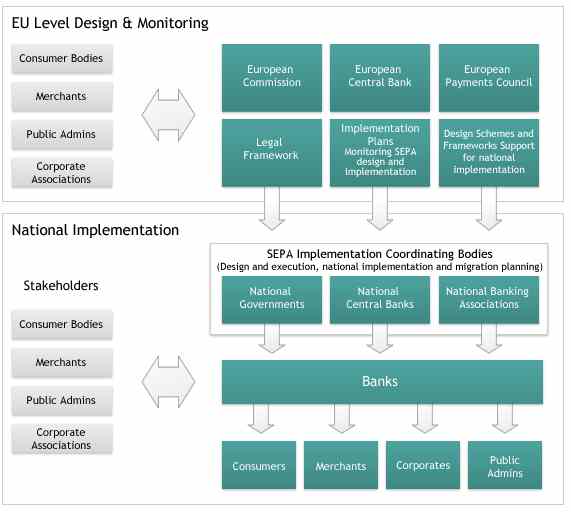
(click picture for more detail)
Benefits to consumers and businesses
These are manifold. Essentially, a harmonised standard allows consumers to easily, transparently, and securely make payments across borders, which also means that consumers don't need to open separate banks to handle their business in different European countries. In addition to this, it introduces a common standard for pension-transfers across banks (and I assume countries), and greatly increases the choice of financial service providers to consumers.
For businesses, the benefits are far more numerous. Essentially, having shared standards allows them to easily accept and process payments from any card from a SEPA-bank. National borders no longer need to be a barrier to growth and businesses can have a more direct financial relationship with consumers across the Euro-region. Similarly, B2B-transactions across borders enjoy similar "upgrades" and will require much less overhead, be more transparent, secure, and quicker than before.
For a more exhaustive list of changes, please check the EPC-report on Making SEPA a reality!
Final thoughts
While this all sounds very rosy-coloured, I expect that the key-factor will be marketing, i.e. communication about what SEPA is and how to use it. So far, there has been very little news on SEPA, even though it is due to be launched in less than 3 months from now. Similarly, a status-report by the EPC (pdf) points out that there has been very little communication from public authorities about their intention of using SEPA products, and another Dutch article, from a few days ago, reports that 92% of Dutch business-owners are not yet prepared for SEPA.
That said, if anything was needed after the EURO was introduced, it was increased transparency of financial services, and preferably on a pan-European level. Both the fact that businesses and consumers can run their financial affairs from a single bank in a single country, and that both also have more choice of service providers, is a huge improvement. For the latter, I hope the increased competition will lead to more efficient financial services. And for the first, I hope it will lead to more businesses expanding their operations across national borders, and more migration by European citizens across the continent.
Of course, much remains to be done before we can truly call Europe one "country," including a more harmonised patenting-standard, and of course overcoming many of the legal and cultural barriers which continue to exist. But the SEPA, if all goes according to plan, is a significant step ahead towards making this a reality.
Some helpful links
- The European Central Bank on SEPA
- The European Payments Council on SEPA
- EPC-report on Making SEPA a reality (very good to read!)
- Latest SEPA status-report
This is part I of my coverage on IKEA's growth, based on my reading of the book "The 11 secrets of IKEA" (more on this at the end of this article). You can read a previous blogpost on IKEA's "strange alien values" here. I'll continue this series as follows. Starting with Scandinavia, I'll go into how Ikea grew in this area. I'll then continue with Europe, and finally finish with the giants, the USA, China, and Russia.
 Some years ago, I worked on a project where we would try to find out how businesses expanded internationally. In this case, we looked at the tire-industry, and three companies, Bridgestone, Goodyear, and Michelin, and dug through tons of annual reports and news-releases to understand where, when, how, and why these companies expanded beyond their national borders.
The reasons these three companies make such an excellent case-study, is that they all originated from different continents and thus reflect different cultures. It is nearly an unwritten rule that US-companies perceive the world as a single market and make little effort to adapt to local conditions; that Japanese companies are very hierarchical in their structure; and that European companies, as a consequence of the cocktail that is Europe, internationalise quite quickly (or not at all). And for all international activities, it is another soft rule that they would expand to countries with some cultural, legal, and linguistic similarities first.
IKEA is of course a European firm, or rather, a Swedish one, and a preliminary conclusion would be that it would internationalise quite quickly also, yet starting in Scandinavia, then the rest of Europe, then the world. Another assumption would be that it would thread carefully (read: slowly or not at all) in areas which reflected alien values (to IKEA). As will be shown, this did indeed happen.
Ingvar Kamprad and Sweden
A business usually has different components, many of which reflect the values of the founder, and again the values of the society he or she grows up in. IKEA's founder, Ingvar Kamprad, was born in 1926, on a small farm in Sweden. He respected the feeling of community he experienced there. His grandmother, who had migrated from Germany at the end of the 19th century, taught him the value of hard work and encouraged his entrepreneurial spirit.
Ingvar Kamprad had started IKEA as an import-export business, and much of the way IKEA would be run would reflect that idea. When you're a trader, the idea is that the product doesn't matter and to be as efficient as possible (a modern-day example: eBay). In order to save costs, IKEA tried to get preferential treatment with its suppliers, started with selling products via mail-order, and ultimately set up a storefront, which was actually just a warehouse.
Of course, Sweden itself, with its strong socialist values, had a large degree of influence in the way IKEA took shape. Internally, the business was run quite informally, and in many ways reflected the communal environment where Ingvar Kamprad had grown up in. Similarly, the business of IKEA was not meant to be elitist, rather aimed at middle-class families, a large component of Swedish society. Sweden also had a long tradition in furniture and design and that was another influential factor.
IKEA
IKEA was set up in 1943, already a successful mail-order business, and soon after Kamprad would start a business-degree to learn the theory of distribution. After some years of studying, working for other businesses, and finally military service, IKEA's first employee was hired in 1948. This was also the year that Kamprad decided he wanted to make IKEA big and to that effect, started a folder-campaign via a regional newspaper.
The competition in this business was tough, however, plenty of mail-order-businesses in Sweden, and the competitive landscape orientated itself around lowering prices. A natural consequence was that the quality of products also went down. Because Kamprad was made aware of this through countless letters from customers, he came up with the idea of having customers check the products themselves, which is how IKEA, the store, was born.
Two features were important here, one was that the primary way to order was still the catalogue, and the store a complementary service. And two, the self-assembled furniture, which grew out of the need to ship products more safely. This also brought a new degree of involvement by IKEA with their suppliers, essentially bringing innovation upstream, which help suppliers to save costs, and downstream, as self-assembly became a large cost-saver for customers also.
At the same time, IKEA's new retail-focus brought in a new level of competition, that of other furniture-retailers. Afraid of the popular and far cheaper business-model of Kamprad's, and angry at the obvious copying of designs that IKEA was doing also, these retailers started pressuring local suppliers to no longer work with IKEA. This forced Kamprad to use some questionable business-practices, such as starting anonymous daughter-companies to deal with these suppliers, amongst others. In the end, it also lead to him to having to look abroad for new suppliers, which I will write more extensively about in following blogposts.
Noteworthy was that before expanding to the Swedish capital, Stockholm, IKEA had already opened an outlet in Oslo, Norway's capital, in 1963. Two years later, the first IKEA was opened in Stockholm, which turned out to be a massive success. IKEA was well-fitted for the times also. The Swedish socialist government had implemented an ambitious plan for urbanisation, which involved building a million houses between 1965 - 75. Since IKEA was well-able to meet the booming demand for cheap furniture, this was a match made in heaven.
In 1971, IKEA unleashed another innovation. A restaurant, which served food to the clientele at affordable prices. This was another way for IKEA to become a lifestyle-trendsetter, and also started the urban legend that meatballs were Swedish (IKEA's recipe was actually British).
Scandinavia
While IKEA was already established in Norway, and had suppliers in Denmark, it opened its first retail outlet there also, in 1969. Towards the end of the 70s, there were altogether 6 different IKEA-stores in the rest of Scandinavia. All of which were personally owned by Ingvar Kamprad.
It was not long after, 1973, that he and his family also moved to Denmark, to flee the insane taxation-system in Sweden, which I explained in my last post.
Final thoughts
Clearly, much of what made IKEA successful world-wide, started with innovations introduced in Sweden. IKEA's mail-order- and warehouse-model, its close integration with suppliers, its focus on providing cheap lifestyle products, and also its internal frugality—which I did not speak of, but IKEA-employees are traditionally paid below market-value. All of which fits with my philosophy of "where you are from and when you are from matters a great deal to where you are going."
IKEA's international expansion started with Scandinavia, which was a region with a lot of cultural similarities to Sweden. As I will explain later, this is a trend that would continue in Europe also. At the same time, the reason that IKEA expanded internationally, could also in large part be explained by the competitive pressures inland—IKEA's troublesome relationship with Swedish suppliers—and with the socialist regime, which was largely incompatible with running a profitable business, and forced Ingvar Kamprad to look elsewhere for a more business-friendly environment. This was also the philosophy, when expanding into Europe, which I describe in a future post.
All in all, IKEA makes an interesting case-study, because it is a European business, and it is interesting to see which of its values were compatible with other countries and which countries presented more difficulty and why. Much more on this in future posts.
The book "The 11 secrets of IKEA" is sadly not available in English. If you do read Dutch, I do recommend picking the book up here, and for German, check the German Amazon-store here. For other book-reviews, check out my look at eBay's "The Perfect Store" here, McDonalds "Grinding It Out" here and here, as well as at Starbucks' "Pour Your Heart Into It" here and here. The picture is courtesy of Culinaryartsblog.com
 I suck up data wherever I go (it's a curse, I know). Just last week, as I was waiting for my laptop-drive to be installed, I sat in a German bank and came across a magazine, called VR-future. Two articles caught my eye, one on the Bio*-boom in Germany, and another on Switzerland—a country that fascinates me, but that's a story for another day.
The bio-trend article consisted of an interview with Dr. Alexander Gerber, the Germany CEO of the BÖLW (the foundation for organic products in Germany) and revealed some interesting info on this segment. While it focussed entirely on Germany, I do think it brings some interesting insights on this topic in general. (*: "bio" being the German term for organic)
Now, I should say, that I'm generally weary of the word "Boom," as I inadvertedly associate it with the word "Bust." Any market is subject to the laws of supply and demand, and a boom usually suggest an explosion of one or both, eventually leading to some fall-off after a while. I have no doubt that the same will happen to the Bio-sphere as well. There are also particularities about the organic market which I do not like, and I will go into those in my final thoughts.
The rest of this post is structured as follows. I will begin with the definition of organic, then some stats on sales, after which I will look at employment-trends, and expected areas for growth. I'll conclude with some final thoughts, to answer why I am bearish on this whole organic trend.
So, what is "bio" or organic?
From Wikipedia:
For crops, it means they were grown without the use of conventional pesticides, artificial fertilizers, human waste, or sewage sludge, and that they were processed without ionizing radiation or food additives. For animals, it means they were reared without the routine use of antibiotics and without the use of growth hormones. In most countries, organic produce must not be genetically modified.
Bio-Sales
Worldwide, while the percentage is low (Wikipedia reports 1-2% of food), it is showing far quicker growth than conventional food. In the US, Wikipedia reports a 17-20% annual growth of organic food in the last few years before 2004(!), compared to 2-3% for regular food. 2.6% of food sold there is organic. In Europe, while I don't have the stats on exact growth-rates, the percentage of of agricultural land being used to grow organic produce, is on average 3.9%, with Austria (11%) and Italy (8.4%) leading the pack.
In Germany, the annual revenue from bio-products with discounters and supermarkets has more than doubled since 2000, up to € 4,6 billion in 2006. And, at the moment (2007), Bio-products have a 3% share of sales in small food-stores, which is expected to double by 2010. The level of food-prices, held low by government subsidies, is expected to rise in the future, which… will probably not mean much to the bottom-line of retailers and producers. And, apart from the ethical considerations, bio in Germany has very much become a lifestyle product, translating into lower price-sensitivity. According to Gerber also, a new bio-supermarket opens every week.
With all this positivity, there is the somewhat counter-intuitive trend that farmers in Germany are complaining about falling incomes, and annual growth in their area has slowed down from 20% in 2000 to 0,4% in 2006. I imagine that is so because the market is maturing and because large buyers are pushing the prices down. A similar trend is being reported in the documentary, The Future of Food. Gerber also mentioned that there is a lacklustre support from the German government and the European Union in terms of subsidies.
Employment-trends
In general, the organic sector is a pretty people-intensive industry. While I don't have global stats, in Germany, about 160.000 people are involved in creating, processing, and selling bio-wares. In the last 7 years, the employment in bio-related sectors has doubled, especially in processing and sales.
On the farming-side of things, a third more people are employed than in traditional farming. And there is a need for people in production, processing, and sales, especially in the last two areas. In addition to this, the bio-sphere is very consulting-intensive, meaning there's also a need for highly trained personnel.
With is all this need for people, the German education-system does not yet offer truly specialised courses in this area. There is a program, however, co-sponsored by the BÖLW, the government, and the companies involved, which offers training for practitioners interested in working in the organic industry. Generally however, "learning by doing" is encouraged in this field, which, incidentally, also explains the high number of consultants.
Growth-trends
Gerber sees three areas for growth: Small cities, food-venues, and apparel/cosmetics. Regarding the first, Bio-supermarkets and -shops are starting to be set up in German cities with less than 50.000 people. And there are many of those in Germany.
He also expects growth in food venues, both fast and traditional, who currently receive around 25% of food-related spending, in which bio is still only taking up a very small percentage. Finally, Gerber also expects a larger bio-component in textiles and cosmetics, though I have no stats on how important that industry is.
Some final thoughts
The organic value-chain seems to be organised in a fairly similar fashion to the traditional way of producing, processing, and selling farm-goods. Some points of note are the way that bio-products are produced, the accountability-aspects, and the educational ones.
For the first, the natural way of producing these products will require some serious adaptation by producers and distributors. And since information is such an important component to bio-products, and by now a legal requirement, it will also require producers, distributors, retailers, and marketeers to set up new procedures for extracting and exchanging information. Finally, the fact that this is a fairly new market and official training-courses seem as yet to be lacking, there is a need for educating both businesses and consumers.
All of this translates into higher costs of production, which is reflected in higher prices for consumers (Wikipedia reports this to be 10 - 40% more than with conventional products). It is only a good thing that the end-products have lifestyle and ethical value, meaning that customers will be less price-sensitive about them. But will this be enough in the long-term?
In general, farming is already highly dependant on government-subsidies, which is already a bad sign for bio-produce as that seems even less efficient. And the increased demand for goods like wheat and dairy-products, from countries like India and China, means that there is actually a need for more, rather than less efficiency in farming.
Also, the current boom in food-education seems one that is limited. Eventually, the market for information will mature, customers will know all they need to know, and will be looking at other differentiators, most likely price. Large retailers, who are able to keep prices down when needed, are better-positioned for this, versus the more specialised shops who seem to be purely focussed on lifestyle, and hence high prices. Eventually, as the market becomes mature, I expect there to be a fall-out for both smaller bio-shops and in the area of consultants and niche-marketeers.
All in all, while I'm no expert on organic produce, and while I am fairly optimistic about demand continuing to rise, I'm not sure if there are still big profits to be made on the supply-side, even though there seems to be explosive growth in that area.
That said, I'm not bearish on all things organic. Bio-food in food-venues like restaurants and similar is very intriguing and, I think, will fit very well into this environment, where fresh food and good food is a strong differentiator. I'll have to collect more data on this, but I'll definitely write something on business in this area in the future.
The picture is courtesy of Petdiscounters.com and was chosen purely for effect.
 As has become my custom, during my brief life as a blogger, I like to review books, while reading them, not necessarily after I'm finished. The book, I'm currently reading, is aptly titled "Ikea - The Secret of Its Success," a Dutch translation of a German biography of the business and its founder, Ingvar Kamprad. I've until now read very little in terms of European business, and looked forward to getting a grasp on the European mentality if there is such a thing. To be honest, there are vast cultural differences between countries in Europe, though Ikea's continental growth does serve as an interesting lens to understand some of the issues at play.
My initial thought when meeting people and businesses is that where you are from and when you are from matters a great deal to where you are going. There are a great number of social values that come from living in a given location, at a given time. Similarly, Ikea has had a particular past, which I think define the company and explain its goals.
Where Ikea's from, Sweden, is a strange, alien place to me, even more so, 80 odd years ago, when Ingvar Kamprad, Ikea's founder was born, and 60 years ago, when he founded the company. Painfully, I notice that my own business-education has been coloured by "Western" values, or rather Anglo-saxon capitalist ones, which give (the illusion that) individuals (have) pretty much free reign to reach their dreams, and Ingvar's story is very different from that (though he did achieve his dream, I think).
Briefly, before I describe Ikea's history, what is different about the company, as opposed to other multinationals?
- It is still a private company
- It thinks like a community, which has major consequences on work-relations and innovation
- Work-relations: historically, wages are kept low, workers are treated like family, there are no large power-differentials, and I don't think people get fired much.
- Innovation: the way the business develops often comes out of collaborative thinking—how can we make life easier for our workers, how can we make life easier for our customers? Very organic, pragmatic, and frugal!
Ingvar Kamprad, who had by that time already migrated to Denmark for related reasons, had himself had a particular past. He grew up on a farm in a small commune, where value was placed on hard work and family. Originally of Germany, emigrated to Sweden, his family felt some affinity with the Nazi-cause of freeing parts of Germany, separated after the first World War. Ingvar only abandoned these values in his late 20s, after having finished a business-degree and getting married.
By that time he already possessed a strong trader's spirit, importing small goods like pens at low cost, and selling them via mail to his customers at a small profit. He later expanded this to furniture, which organically evolved to what became Ikea. Much of his thinking was pragmatic and he wasn't afraid to listen to the advice of his co-workers, and ignore the advice of his competitors—the more established furniture-retailers. Business boomed, of course, and he soon built more warehouses (which acted as store-fronts) in other major cities in Sweden.
But the taxes were killing him. So much so, that he had to live in debt for several years, while being the owner of a very well-todo store. So, for this, and other reasons, he decided to migrate with his family to Denmark, while keeping Ikea in Sweden. Later he would move to Switserland and do something that probably goes against the grain of every capitalist out there. He gave the business away.
He did so for reasons of continuity. He did not want there to be confusion after he was gone, and he did not want his kids to feel pressured to take over the business. Instead he created a foundation (stichting), called INGKA, in the Netherlands, to make sure that Ikea belonged to Ikea, and not to the whimsical demands of its (future) leaders.
That's as far as I'll go today.
Every book has a different lesson in it. This one on Ikea is about its heritage, its values which are deeply ingrained into the Swedish perception of social community, and how these can be preserved as the business grows. I can't wait to learn more about Ikea and find out. I'm about 50% into the book, writing this, and I want to write about Ikea's expansion at a later date, as well as their internal workings. If you do read Dutch, I do recommend picking the book up here, and for German, check the German Amazon-store here.
For other book-reviews, check out my look at McDonalds "Grinding It Out" here and here, as well as at Starbucks' "Pour Your Heart Into It" here and here.
 I just picked up the German magazine "Starting UP" (initial impression, so-so), which featured a number of stories interesting to me. One was the 30 top-franchisers in Germany. I'm a little confused by how they rank these things (English translation: annual growth-rate of franchise and nominal growth-rate), which resulted in some kind of numbering system, where the number 1 got over 3000 points, and the number 2 939 points. Actually, I'm more than a little confused, but it's probably too early in the morning to me.
In any case, the number 1 was Subway, which grew from 190 German partners in 2004 to 600 in 2007 (and got 3113 points). And number 2 is DATAC, which provides accounting-support and proprietary software. It grew from 312 partners in 2004 to 522 in 2007 (and got 939 points.. ah I see, nominal = probably company growth rate). I'll list some more in a second.
Unfortunately the article was very sparing with its analysis regarding what makes a good franchise, which I would've found useful. The advantages listed for Subway are however:
- Low initial investment (ca. USD 10k entry-fee; charges around 8% of profit + 3.5% advertising fee)
- Strong international brand (28343 partners in 86 countries)
- flexible venue-size (doesn't take up much space / can be take-away or seated)
- simple operation (no frying, etc.)
- large health-factor / range of ingredients
- A 2 week training
- Help with site selection
- Help with restaurant design (though I think personal taste is very limited)
- Help with equipment ordering
Back to the list. I segmented the list of franchises into what I considered their primary focus to be.
- Consumer-services: 4 (PC-Feuerwehr; Schulerhilfe; Agentur Mary Poppins; Stage-coach)
- Logistics: 1 (Fastway Couriers)
- Business services: 4 (Datac; Mail Boxes etc.; Im-Press Promotions; Ultimo)
- Food: 4 (Subway; Joey's Pizza; Blizzeria; Haagen-Dazs)
- Health: 5 (CC Calorycoach; Bellissima; Ruck Zuck; Curves; Alkromat-Patrouille)
- Retail: 9 (Engel & Volkers; Videotaxi; Town & Country; Harper & Fields; Mobilcom; Re/Max; Das Futterhaus; Tiroler Bauernstandl; Babyone)
- Installation-services: 3 (Twintop; ; Isotec; Scheibenglass)
There are other underlying factors in running a good franchise, which I will write about at another point. Important to realise is that just because a company grows fast, doesn't mean that it's actually a good company. Many franchises, in my experience, suffer from a lack of shared standards of quality, which can be overcome through a number of methods, but often suffers because of the lack of a centralised control over who works for the company and how they interact with customers.
I still think my last post on how to shift tacit knowledge into the explicit kind is relevant here (also the one on the knowledge-spiral), as what we are speaking of here is really similar. A company is not just the product it sells, but the values of the people, and how to communicate that down the chain is a vital skill for successful companies and franchises alike.
The picture is, if you're wondering, meant to display a room in which you have a choice of (food-)products to sell. Eh, yeah… I'll improve someday, I promise! ;-)
I'm taking a little breather (what again?), to prepare some longer posts, a media-related one for Tech IT Easy, and some more tech- and logistic-related ones which I plan to mirror-post on both this blog and TIE. Hopefully, I'll be done with that soon.
In the mean time, I was thinking that there are actually quite a lot of songs inspired by and named after cities. The first one that comes to mind is Jacques Brel's "Le Port d'Amsterdam" (see video at the end of this post), also more commonly known as just "Amsterdam." I don't have the time to create a world-map of songs, though quite a few come to mind, which I may write about at a later date. And I'm also thinking about themes for food-venues, and where they come from.
There is a famous café in Brussels, called "A la Mort Subite," which Jacques Brel used to frequent and which has pictures of him hanging on the wall. I think it represents, for those that care, a great tourist-attraction and a piece of history. It's hard to control that, and I'm sure the café would have ended up differently, if it wasn't for Brel.
My dad told me a story about a café started in Bonn, Germany, which became a centre for political journalists in the 80s. As the interim capital of West-Germany, Bonn was important back then and it was only natural that such a place needed to exist. The café is dead now, of course, after the government moved to Berlin. Similarly, there is an artist-hangout in Dublin, one of the few authentic pubs left, and probably there since James Joyce, for all I know.
How this all happens, seems out of the control of the owners. Maybe just the right time/place, or the price being right for starving artists/journalists, who knows. Maybe there were other factors that can be "engineered." In any case, food for thought.
Enjoy the video. Le Port d'Amsterdam is incidentally also a Dutch pub in Paris.

 The


