 Still don't have too much time at the moment, but trying to produce content if possible, in a quick and (hopefully) digestible format. Some qualities of entrepreneurs that I'm thinking about:
- Perseverance: This is a tough, tough issue. I consider myself a person that bites into a project and doesn't let go; at the same time there are times when you have to or should abandon an idea. Even so, a start-up is an 80 hour a week job (let's say), it has stakeholders—investors, partners, employees—and it may take some time to go into the black. Perseverance is probably the most important quality to possess, but I'd love for it to be simpler to know when to persevere and when to abandon.
- Instinct: it's a funny thing, this one. There is of course good and bad instinct (e.g. bravery vs. fear), but sometimes a "bad" instinct is a good one too (fear > jump > evade car). And even if you try to follow your instinct, your rational self—your experiences, education, arrogance, other emotions—will want to interfere with it. The reason to follow instinct is because it's quicker and a more natural way to be (and my theory is that natural = confidence = charisma and all that good stuff). Still a tough one.
- Inside-knowledge: in an industry, sure saves you a lot of time finding contacts and focussing on the right stuff.
- The numbers: are important in a numbers-business. And every business is ultimately a numbers business, maybe not at the beginning when there's lots of growth, but certainly at that point when either your wallet begins to look empty or a competitor is moving in next door.
- Money: is kind of nice. The more you have, the less you need to give away in equity. Of course, rich parents help, but so does having an investment-portfolio. Investing in your industry means that you keep track of the latest trends, of your competition, and if you make money from that, that's a qualifier that your instincts are correct. And, ultimately, giving away equity to the right people, means having a smaller piece, perhaps, but of a bigger pie.
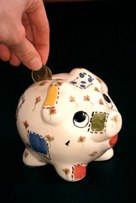
The picture is courtesy of fairinvestment.co.uk
 Take a look at this quote, which I posted a few days ago:
"There should be a rule: before helping the environment in one market, we should be required to think through the impacts on other markets." (source: Freakonomics blog).Or, to put it differently, every action has a (sometimes equal) reaction (I think the traditional phrasing ignores the human element). The idea that everything is interconnected is both fun to right-brained generalists like me (not a compliment), and scary at the same time. The global economy is very complex and, I would say, impossible to regulate.
There's a couple of things going on the world, which I'm sure everyone is aware of. There's a number of wars, there's the weakened dollar, there's some kind of housing-related recession going on, there's a shortage of oil, our planet is perceived as suffering and currently being saved (I hope), there's India and China, the rise of the Anglo-Saxon system, etc. etc.
And some of the biggest problems facing the food-industry (depending where you are in the chain), are rising food-prices, which relates to that oil-shortage (both in terms of pricing, but also because of alternative fuels using farm-products), the rise of India and China, and some other factors; and the costs of keeping green, which has largely been inspired by companies like Wal-Mart, but also by the (exaggerated) need for global diversity by customers (which the food-industry is also partially to blame for).
The solutions vary, and are, so far, very defensive in their nature. For the cost of going green, most pollution comes from transport and the solution is to either use the most eco-friendly way to go: on land, by train, across water, by ship; or to go local—which companies like Marqt seem to focus on, but which also comes with the pitfall of seasonal shortage.
For rising food-prices, again one solution is to go local, to save on transport and have some control over how farmers work, and be able to charge higher prices to the rising local-conscious consumer. But a bigger solution is for more food-production to happen (much of it currently goes to India & China, or to biofuels), and possibly from smaller farmers. The problem here is that it will take time (some estimate decades) for smaller farmers to get ready.
Both are definitely big picture-problems, and will take time to solve. One thing, I'm personally looking at, are micro-lending sites like Kiva.org, which put you into contact with local farmers, allowing you to help them out in your own way. From a Venture Voice interview with one of the founders, I understand that some of these investments happen within the context of a community, where each member keeps watch over the other's use and repayment of the funds, in order to ensure a good outcome, and so loans will continue to come in. But, while I think it's well worth the effort, this is still a small-picture solution to a much larger problem.
The way it looks right now, the solutions have to be planned in the long-term and on a large scale. There is definitely space in the farming-segment for more production to happen. In the mean time, food-prices will continue rise, as will the price of educating consumers to make more responsible choices. I like Tesco's approach in labelling the origins of their food and allowing people to make more carbon-friendly (locally focussed) decisions. But that doesn't solve the problem for farmers in remote areas of course.
Sigh, if you just got a headache, I sympathise, as I just got one too.
Further reading:
- NYTimes: Environmental Cost of Shipping Groceries Around the World
- Economist: The new face of hunger
- Buzzfeed: Food Hoarding
I've included just the top-25 and annotated their focus. What's interesting, but not surprising, is that the majority of companies in that list are not independent horeca-orientated, apart from two: Hennie van der Most and Sjoerd Kooistra, both Dutch horeca-entrepreneurs.
The majority is hotel-chains, though the top-10 is quite diverse; a number of convenience-(fast)food places, resorts, as well as retailers. Interesting that both Ikea and Hema are on that list. Hema, as far as I know, has not been on the horeca-market for long (no revenue reported in 2006), but is already reaping significant successes. Probably my favourite retailer in the Netherlands, btw. Ikea, as I reported before, has been in the restaurant-business since 1971.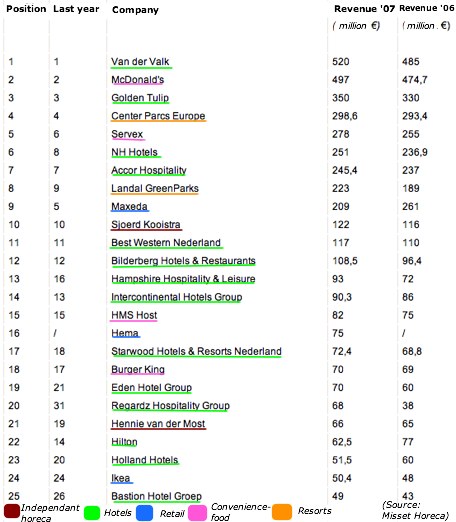
You can see the complete top-100 at Misset Horeca.
Interlude: From medical to space-tech - How technology affects incubation-strategies
0 comments Posted by Unknown at 8:48 AM High-tech… My never-ending hobby! Read about it on Tech IT Easy!
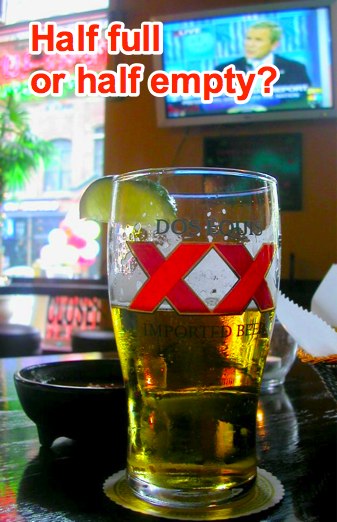 Normally, you would say that alcohol & money don't mix. But in the world of beer, at least in the Netherlands, there is tangled web that has been woven between financiers and the horeca-industry, which is difficult to unwind, and, some people argue, shouldn't be unwound.
First of all, what is investing all about?
It's all about profit, obviously, but it's also about minimising the risk for investors. Two big risks facing investors are informational.
One the one hand, there's moral hazard—the risk that entrepreneurs take their new assets (money) and misuse it in some way; On the other hand, there's adverse selection—the risk that entrepreneurs are not as capable as they claim to be.
Either of these situations requires a different response and a different type of investor. For moral hazard, the typical response is for investors to mingle in the affairs of their investee's operations and strategy and take equity; the so-called active investor, which includes business angels and venture capitalists.
For adverse selection, the typical response is to restrict the entrepreneurs movement through collateral, restrictive, covenants, and and short maturities, to minimise risk-engaging behaviour. This is the realm of the passive investor, which includes banks.
Financial beer-tactics
When looking at these two investors, you see some differences; Active investors take equity—become part owner of the firm—and they do this because they can't do much else to influence the use of their money. Passive investors prefer to use measures like lend against collateral, e.g. real estate or other tangible assets, which they can claim if the investment were to go wrong.
In the case of horeca-owners, you typically do have some kind of physical asset. You occupy a venue, you have machinery, and inventory. This is much more the realm for passive investors, who can relatively safely lend some money against the existing collateral.
There is one complication, however; Horeca is typically known for high failure-rates. I'm not sure why this is so. I guess that the leisure industry is largely sensitive to seasonal differences and economic downturns. And perhaps, the barriers to entry are low; there could be a lot of low-skilled entrepreneurs out there, who are not as capable of running & growing a business as they think. And finally, growth in itself could be a problem, if the capital requirements are significant.
The way investors get around it in the Netherlands is actually not to invest. Instead, they leave it up to breweries, who, against a right of exclusivity, lend a certain sum to the business, or give it a discount, and provided it with the necessary materials, branded of course.
What's the problem?
From my angle, there isn't one really. If horeca is such a risky business, and other investors are unwilling to invest, then I don't think an entrepreneur should complain about a simple exclusivity-contract. And particularly so, because of three factors.
For one, exclusivity is only valid if the brewery has less than 30% market-share. In the case of someone like Heineken, who also owns a number of other beer-brands, and has more than 30% market-share, you can quit such a contract after two months. Then again, Heineken does its best to provide other value-added services to make sure that this doesn't happen.
And second, there's a lot of consolidation in the alcohol-business. And just because a company has a certain exclusivity, it may have such a large portfolio of brands that there isn't any shortage of choice for customers; neither do I think these exclusivity-contracts are 100% bullet-proof.
The third factor seems to be a problem. By not giving customers a choice, they have learned not to care about brand so much when they enter a pub. They just ask for a beer. So for them, unless they're a beer-fanatic, it doesn't matter much. For producers, on the other hand, their brand has become a commodity, at least where nightlife is concerned.
Who cares, right?
Heineken seems to care, and is all for the liberalisation of Dutch pubs. Ignoring that a. this would disrupt a pretty good funding situation for Dutch pubs, and b. that Heineken owns more than 30% of the beer-market, making their exclusivity-deals vulnerable anyway, I do kind of see their point.
By turning a brand into a commodity, you take away marketing-potential. If you can position your beer-brand above that of regular beer, then you can reap higher profits. That makes 100% sense to me, from the brewery's perspective.
And, from what I understand, British pubs don't actually have such exclusive deals with breweries. The question is then, how they get funded, or whether the failure rate is perhaps lower in the UK? That, for now, is a question unanswered to me, but I'll do my best to find out.
(You can always give it to me in the comments.)
Part of this topic was inspired by a good article (unfortunately not online) in Dutch Marketing Tribune, still my favourite Dutch mag.
 When I started this blog, and my general thoughts about the area of food & retail, it was all about the people. A quality staff and happy customers, what more do you want? And I have to say, from past experiences, that I don't really like businesses that don't place people first.
For instance, one individual I worked with, suggested using handicapped people to put together a product manually. I instantly disliked him. Not that I don't want handicapped people to be productive, but it was the thought behind it; to find a "stupid" workforce, which you can save tons of money on. It was just distasteful.
Another company I worked for was very process-orientated.
There's nothing wrong with that of course, but it was a big company with a reputation for innovation and that is why I joined. And you expect such a company to at least push forward a solid project. Well, as it turned out, the organisation's core-strategy was to start a large number of risky projects and have them compete with each-other. Those that would fail would simply be abandoned, and their staff was expected to fall on their swords… metaphorically. The effect was an incredibly high turn-over of employees, all three projects I worked on no longer exist, and it deeply soured my feelings about this company.
Both these examples, to me, represent a lack of respect for the human element. I realise that business is a hard world, but if projects were designed to be solid in the first place, there would be less of a need for these kinds of practices. Just my 2 cents.
Part 2 - the challenges that people businesses face
HBR (Again! I'm sorry, but I read a lot of HBR-articles!) published an article about people businesses some time ago, which I enjoyed. Following are some notes + thoughts about it.
- People businesses are defined as: "operations which are characterised by 1. high overal employee costs, 2. a high ratio of employee costs to capital costs, and 3. limited spending on activities, such as R&D, aimed at generating future revenue."
- In a top-40 list of people-businesses, published in that same article, only a few qualify as food and/or retail related. These are the Hospital Corporation of America, Tenet Healthcare, Marriott hotels, and Accor hotels.
- For instance, a business like McDonalds does not classify as a people business; it has substantial assets in terms of brand & real-estate, and relatively low people-cost.
- People-businesses face a number of challenges, related to performance measurement, people-management, compensation, and business models.
- Measuring productivity is more important in these businesses, then other economic performance indicators, like return on assets or investment. The challenge is finding the right indicators (employee productivity & profitability), as well as benchmarking it against other companies (employee figures do not always need to be made public).
- To manage people, you need to align employees' interests with business objectives & execution. And you need to find ways to measure performance (see above) continuously and see where your weak spots are.
- Compensation is key, as productivity is very sensitive to it, and is a primary determinant of shareholder risks & returns. Other factors to consider are variability—productivity varies across the workforce and how do you get the most out of a diverse workforce—and reach—sometimes the lowest on the ladder are as, if not more important to a firm's performance, and how do you motivate these people to do their jobs as good as possible?
- There are a number of business models are used in these types of businesses: pricing per hour is a safe method, but does not account for extra performance; a fixed price per output allows companies to shave costs off the inputs and thus increase their profit-margins. It is very susceptible to a high-skilled workforce; a success-fee or commission offers the best returns, but also the greatest risks; some companies use a hybrid of these three.
- The strategic weakness with these types of businesses is that your assets are mobile and can walk out the door. By creating value above and beyond your employees, you can diversify some of that risk away. Of course, you could also try to keep your employees ;).
I guess it's up to individual businesses how they want to measure their firm's performance. The most straightforward is certainly return on assets or investment. But even that leads to some question-marks, particularly in today's highly software-based economy, where assets are no longer as necessary, or pricey, as they once were.
For my part, I still think that people are a key-asset to a business, and it's interesting to look at how exactly you motivate a workforce and get the most out of them, as well as how to overcome the challenges related to a people-based business.
Equally interesting is how to align the business-model to match the needs of your assets—the people. Since people are motivated by (financial & non-financial) compensation, do you keep the pay-rate aligned with time-spent; fixed; aligned with performance; or a hybrid of the three? I think the hybrid is always the best choice, but even then some combinations work better than others.
And retaining employees is also an interesting problem; though much less so in countries like France, where getting rid of them is a problem, and differently in places like Silicon Valley, where inter-firm mobility is a key-requirement for many employees. I think the solution is completely personal and cultural, and everybody's answer will be different on this.
The picture is courtesy of prairienet.org
 I am not a born bootstrapper, let me make that clear from the start. I just like titles that include words starting with the same letter (is there a term for that?).
Bootstrapping is, in my own definition, "the ability to generate growth on minimal financial resources." I was first going to call it "the ability to survive on minimal resources," however that would make most of the third world bootstrapping-geniuses.
No, it's when entrepreneurs have an idea that they want to grow into a commercial business, and since finding funding is difficult and less preferable for some, they do so with minimal financial means, perhaps while maintaining another source of income and by generating organic growth—revenues derived from within the company. In sociology, there is a concept called bricolage, which means more or less the same.
What makes a born bootstrapper, or rather a good one? I think it requires three qualities:
- The first is certainly the ability to live cheaply, and I'll refer you to one of Jeremy's post where he makes the point quite eloquently. The ability to live without luxury, eating at discounters, buying second-hand furniture (or dragging it off the street), living in cheaper areas, and, most importantly, to delay paying the bills, are certainly key-components here. As is, making resource-choices for your business. Easy to do when you work in software, less so in physical businesses, though inventory is fun to play around with.
- The second quality is time-management. You need to generate growth within your company and pay the rent, so you have to make choices. You have to find alternative revenue-streams, perhaps get another job, and work on your business during your free time. It requires you to set some clear priorities, skip the weekly cinema-visit or the time spent with your loved ones.
- The third and final quality, is to be goal-orientated. You could place that under time-management, perhaps, but where bootstrapping is most likely to fail is when motivation drops. You need to keep your eye on the ball at all times; the priority for a bootstrapper is to grow the business, not keep a stable job, and you need to see the light at the end of a tunnel and keep going until you reach it.
The picture is courtesy of rockies-ice.com
Premise of this post: Jeremy wrote a nice post today about the boons of starting young and I spent some time this morning advising my sister on writing a business-plan.
A picture says more than a 1000 words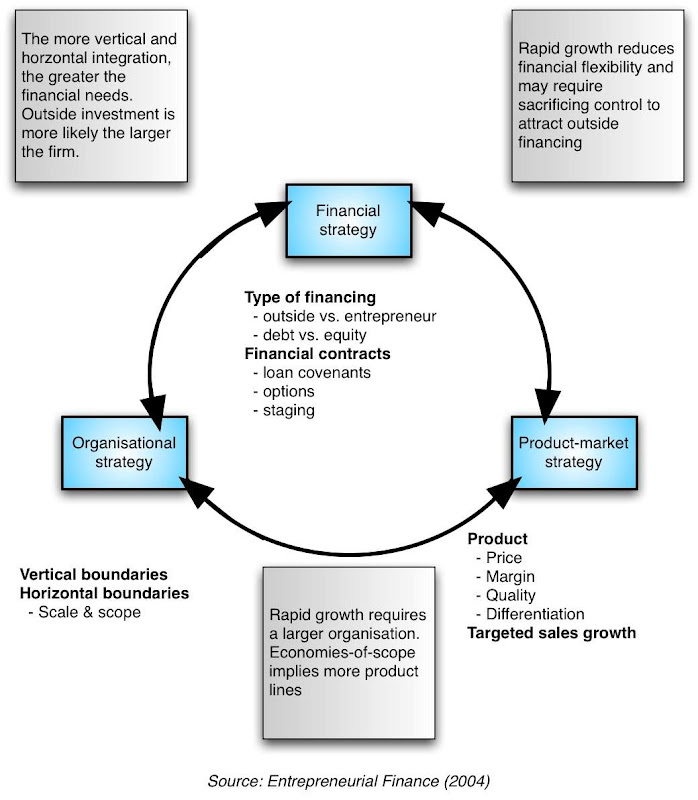
Strategy consists of three components, the financial, the product-market, and the organisational. All are interdependent and when they are in harmony, the chances of success are greatest.
For example, a larger organisation, which is a consequence of a more complicated product-market strategy, will also increase the need for financing, very likely the external kind.
Essentially you have to decide:
- What type of product(s) do you want to launch? What kind of market are you targeting?
- Do you want to be big (less control) or small (more control)?
- Do you feel comfortable with giving away shares of your business to investors?
I created the picture myself, but it was inspired by a graph in the book "Entrepreneurial Finance".
 I've long been interested in the idea of franchising, though I'm somewhat conflicted about how to look at it. One the one side, it seems* like a relatively easy way to start a business, on the other side, it seems* a relatively cheap way to grow your business (*: within limits).
WSJ recently published an excellent study on high-performing franchises in the US. The choice of franchises is extensive, just like I concluded in my post on top-German franchises. At the same time, the most apparent choice, that of food, seems less and less attractive, and I quote from WSJ:
In particular, fast-food and casual-dining businesses, while still showing strength, with eight names on the list, also are facing pressure from wage and food cost increases. To lower operating costs, several food franchises already are shuttering some locations.Arguably, a business that is thinking about growing through franchising is faced with some restrictions. Writing a franchisees-manual is a scientific process, you'll probably have to restrict the complexity of operations so that they can be replicated, and there will still be some overhead related to managing the brand and some of the more problematic franchisees.
I think that it is that standardisation of operations, made big through the economies of scale so easily achievable in the US, that is bring competitive problems to chains, even to wholly owned ones like Starbucks. If your core-product is simple, and your business uses a simplified operation, then how hard is it for your competitors to replicate your whole business-model and -strategy in the long-term, really? It is only if your business strategy includes complex competitive advantages, such as extensive vertical and horizontal integration across the value chain, and/or if your business-model is based on "high-tech" components or processes, that you have a real chance of beating the clones. And to relate it to the rising operating costs, mentioned above, business with true competitive advantage can raise profit-margins or off-set the costs elsewhere, instead of having to close operations.
But ok, long-term strategic considerations aside, I see franchising is an attractive way to enter the business-world as an entrepreneur. The question of whether it's faux or real entrepreneurship, is not pertinent, I think. Considering that you have a wide range of choice of franchise-business opportunities, you'll still have to work hard to succeed, and the growth-opportunities can include starting multiple franchises also, it is not that different from starting any other kind of business. In my mind, I compare it to internet-entrepreneurship, which also relies on a large amount of free tools and distribution-mechanisms, but is still dependant on that special something for it to be successful.
What makes franchising particularly attractive, is the decreased amount of risk. According to a study in the Netherlands, 65% of franchises are still standing after 3 years. Compare that to independent start-ups, of which only 15% are alive at that time.
A large cause is, I'm sure, the level of support from the parent-company, which differ from business to business, and can include delivery of goods, marketing, administrative and IT services, made cheaper through centralisation. And they are frequently guided through the process of setting up and running the business, including legal advice. In exchange, they give away either a percentage of profits (ranging from 5 to 40%) or a set monthly sum to the franchiser.
The WSJ-article also lists the amount of investment typically needed to start a franchise. It ranges from ca. $5200 for an automotive company, to a staggering $1,3 million for a steakhouse. Of the 25 franchises recorded, only 5 received some kind of financial assistance (none of which in food). Another article at WSJ discusses some of the attitudes towards financing franchises, particularly during the current US-recession. Incidentally, another article in Dutch Elsevier magazine, sees franchising as an excellent way for businesses to grow during a recession, as it requires less human costs.
All in all, it is probably a safer way to start a business, though with all the points I made above, I don't think of it as 'light' entrepreneurship. There's clearly a lot of risk involved, beforehand, in terms of choosing the right franchise with growth-potential, financial risk to fund your business, market-risk, when you launch, and competitive risk, after your up and running.
I still want to discuss this topic further at a future date, particularly focussing on what its like to turn your own business into a franchise, and some other stuff related to buying into one.
The picture is courtesy of friendlyfranchising.com
Lowest common denominators - the key to simple business strategies?
0 comments Posted by Unknown at 12:02 PM Arguably, I managed to write some strange posts while I was writing my thesis… some of which seem completely unrelated to this blog, and which I may shift to another blog, my first blog, which I'm resurrecting just for these types of "philosophical" topics.
Still, I liked my post on the lowest common denominator (LCD) from a few months ago, simply because I can still apply that thinking to other disciplines also. To remind you, the LCD is defined as the "lowest"—least useful, least advanced, or similar—member of a class.
The LCD of business-components
It came back to me last night, when thinking about what I wrote in my last post, on how it was difficult to sell a lifestyle product, if conditions for that lifestyle are not yet present. So you find other unique selling points (USPs), and in this case it was health as that was a key driver. To me that is finding the LCD in marketing—you find the "keyword(s)" that connects your product's message with the context of the customer.
Another example. I was thinking about writing about IKEA this week again, but it was such a simple point that a paragraph will do. IKEA is well-known for its design, yet also for its low prices. Actually design was never core-objective, it was finding the cheapest way to produce and to distribute. Design came afterwards, and was even then a matter of working with what you have: whether it's a certain kind of wood from Poland, or the hollowing of walls to make them lighter, or removing the legs from a table for packaging. It's all a matter of lowering the costs, and only afterwards about making it look nice. The LCD of production is finding that sweet spot between a cost that works for a business and a design + price that works for the customer.
Business-planning = the reduction of assumptions
One of the first things we learned in our entrepreneurship-masters, is that business-planning is a fantasy-story—we make up stuff that we hope is believable. If we can reduce the assumptions in the document, however, to the level that an outside party (and inside parties) start finding it believable, that is the key to the mission-statement, the operational plan, and to finding funding.
Bringing things down to the LCD is a way of reducing assumptions and convincing others of my idea. Explaining that production is subject to costs and design comes later is logical; or that reaching customers is a matter of finding the simplest things that connect us.
Essentially, a business-plan is a simplification of reality. Your financial predictions will likely be off by a lot or (hopefully) a little. Your marketing-plan will make certain simplified assumptions about your customers. Your production-plan will assume that all goes well. Keeping it essential, however, does have a better chance of convincing investors, etc. that you can see through the mist and identify the key-drivers for success.
Simplicity, yes, but not of skills
As I wrote last time, it's good to know the LCD of whatever you're doing for yourself. It's not good to shout it out to the world (oh, the irony!), as that really decreases your competitive advantage.
Still, while focussing on LCDs arguable simplifies the strategy, finding those LCDs and profiting from them is a matter of skill and study, of knowing your processes, your industry, your customers, etc.
Abstraction…
Now if all of this seems pretty abstract to you, you're not alone. I'm still trying to figure stuff out for myself. One reason is certainly the fact that you need to have the skills, the know-how to accurately identify key-aspects of a business-strategy, which differs from business to business. Another possible reason is that I'm completely wrong about this (let's hope not).
A final reason is that I still need to write a recap of months 3-6, which I'll try to do this weekend, before going on to other topics.
Anyway, agree or disagree? Let me know in the comments.
 I'm spending a lot of time with a friend this week, who runs a start-up in a developing (2nd world) country in the lifestyle-food sector. I won't mention his name, his company or focus, or his country, nor anything confidential, because I don't want the information to be used against him. Instead, I'll talk about some general principles, that I've identified.
The irrelevance of business-literature
We both studied at Rotterdam school of management (sometimes known as Erasmus), and spent some time there last night. Funnily, I came across an article in a university-published journal identifying 6 traits of leadership to ask for in the "new" workforce. Keywords included: ethics, diversity, global outlook, tech savvy, adaptive capacity, and the X-factor (charisma?). I asked him, as a joke, which he thought applied to him. Global and adaptive, he responded. The rest meant virtually nothing to him. As a start-up, I guess, you have to do what you have to do, to stay alive.
The advantages of 2nd world start-ups
I distinguish between 1st world (e.g. the Netherlands), 2nd world (e.g. Brazil), and 3rd world (e.g. a large part of Africa), when I look at countries. 1st world countries are mature in their development, 2n world countries are not yet mature, but their economies are growing pretty fast, and 3rd world… well, I'm pretty depressed about that, though sometimes there's surprising pockets of entrepreneurship and innovation.
The advantage of a fast growing economy is that people are still figuring stuff out, meaning there are a lot of inefficiencies and gaps in the market. Another advantage, in his country's case, is the interests of governments in boosting those economies. If your innovative, the grants you receive may be both easier to get and larger in size than anything available in 1st world countries.
For start-ups, another advantage is that you can look at what works in a 1st world country and use that for your own business. This principle is not exclusive to start-ups, it's also relevant to the innovation race between Europe and the US, for instance.
The costs of educating a market
My friend operates a lifestyle-food start-up, as I said. One gap in 2nd world markets is usually that that segment is underdeveloped. But, if the economy is booming, wealth is increasing, and that certainly has a positive effect on the luxury-market.
However, when you introduce a new product to a market, you'll have to build the market up first. There are various approaches to marketing, I'll just go into the one that my friend used.
Essentially, you want to get your products into a supermarket, and you want people to buy the food. Sometimes one, sometimes both will take some convincing. In the beginning. he spent a lot of time in supermarkets, getting people to taste his food. After that went well, he could use that success to convince other supermarkets to become customers also.
Two advantages of supermarkets: they usually have pre-written contracts for suppliers so you don't have to draft them yourself. And they sometimes operate in chains, which makes it easier to get larger customers.
There's two further things to do with food, to make customer-adoption a little easier. One is to sell it in an easily digestible fashion, e.g. a snack. Two is to not do so, and instead provide customers with instructions to prepare the food. You could do this on the packaging, a website, and even more drastically (can't mention what). My friend is pretty active in this area.
Another problem with 2nd world countries is that, while your food may be part of a lifestyle in the 1st world, it's close to impossible to lead that lifestyle over there, because all the components are not there yet. So, in fact, you don't use that lifestyle as a marketing-term. Instead, focus on health-advantages, as that is often the underlying driver for such demand.
Still, even after more than a year, my friend spends about half of his monthly expenditure on marketing—which goes through a marketing-agency that designs the brand, the colours, etc.
Global outlook?
As a start-up, you have to work within certain boundaries: limited money, staff, production-facilities, time, etc.
The clients for a food-company may very well be supermarkets, which, as I mentioned, have the ability to buy a lot. My friend is expanding into other countries, but he's carefully picking the ones that don't exceed his capabilities.
He prefers a fragmented market, where he can concentrate on a one or two chains at a time, not a market where there's national chains that could bleed him dry.
Related to this, fragmented markets are usually underdeveloped also, so in fact he is exporting to countries similar to his own. That, at least, is as theoretically expected.
Theory, schmeory.
While there are certainly concepts that can be found in a number of different fields, ranging from entrepreneurship & strategy, innovation, supply-chain management, and marketing, it remains a matter of being practical, and specific to the business.
Entrepreneurship is a 60-80 hour / week job, usually. You don't have time to check out business-journals, etc. to do your job.
P.S. his business-plan was 2 pages long.
And those… are the facts of life. More, if I can think of it. The picture is completely unrelated to his product.
How being in the right place at the right time translates to entrepreneurship
0 comments Posted by Unknown at 12:53 PM If there's one I thing I learned from my thesis it's that everything is part of a system. Most often, this system's purpose is to shift resources from and to various interconnected, yet diverse and complementary parties.
In regards to entrepreneurship, and pretty much everything else, I have a philosophy: everything happens for a reason, usually related to how you respond to opportunities. And to bring it back to that interconnected system, being in the right spot, where you can intercept flows of ideas, people, and resources, tremendously increases the chances of you finding the right business to be in.
Two examples
Two people that are fairly close to me are perfect examples of that phenomenon. They shall remain nameless, for obvious reasons. They are both pretty bright, but what contributed to their lives most, is being where it mattered.
One of my friends did a very smart thing. We studied together and when he moved back to his Eastern-European country, he noticed that a lot of traffic was coming in from the European Union, in terms of regional funds aimed at bringing the country up to par for future integration.
So he started a consultancy with some friends, to advise companies on how to apply for those funds. Initially, he thought it might just be a hobby. But what actually happened was that a lot of traffic was coming in terms of companies—start-ups, looking for funding. And it allowed him to find a business to buy into, which was well-postioned to fill a current need, and had the capabilities, but not the business expertise to succeed.
A second friend of mine was also someone who I knew would always start his own business. But he did the smart thing when he graduated (actually he did several smart things before too). He got a job at a corporation counselling start-ups on how to deploy that corporation's technology. So, just like my other friend, he got a lot of traffic in terms of ideas and people, and all he had to wait for is the right idea that would fulfil a niche in the market. And bingo. I'm not sure if he planned it that way, but he's now the founder of a start-up, filling up a need.
Underlying principles
Right places matter, but so does mentality and a number of other factors. It's not enough to just be there. The reason you are there is because you are of value to whatever network you are part of. Following are I think some factors to consider:
- Be open to opportunities
- Make strategic choices about your initial placement
- Be of value to the network you are a part of - that means being an authority, which means you have to have some schooling
- Make strategic choices about the start-ups that you encounter - are they filling a gap in the market, can you fill a gap in their organisation?
- Go back to your initial network - analyse whether all the elements necessary for success are there—smart people, funding, exit-options, technology—and can be carried over.
- If yes: launch and succeed.
I always knew I wanted to start a business. Plenty of people at plenty of times, have counselled me to just jump in and do it. I didn't, because I felt the alignment wasn't there—between me, a business, and a need.
The way I'm visualising my path into this industry is among similar lines. Become a valuable resource myself. Find & build a network, where I can contribute value too. And then decide, based on timing, technology/idea, people, market-niche, and other elements needed for it to be a success.
Note to the reader: I'm still processing a lot of material I want to write about. Most of it is food and/or retail related, I promise. Expect at least two posts related to IKEA this week, on economics, design, branding, and customer-retention schemes.
 I have a general philosophy on restrictive business-model: that particular business (or industry) is in pain. Much like when you drive an animal into a corner, it will quickly start bearing its teeth and drawing the line.
I spent today searching for a gym close to me (healthy body = healthy mind), and most of what I met were restrictions and crazy prices, mostly summarised by:
limited opening times (don't people train on weekends?); a fat one-time-only entry-fee; multi-month/year lock-ins; and prices charged per 4 weeks instead of per month.So is the fitness-industry in trouble or is there another reason? I have some theories.
- Low price-elasticity due to the health-boom
- Too much competition - but it's not like barbers, which are on every corner, are trying to lock me into a 1-year contract.
- Too little competition - more likely (see point 4)
- Expensive cost-structure - likely, I imagine it's much higher than for other retail/entertainment-venues.
- Low education entry-barrier, translating into uncreative business models
- Extensive government-restrictions - seriously, what's with the stupid opening-times? High insurance-requirements also likely.
What I want, and sort of found, is the classic model: sweaty seats, instructors who growl at you when asked a stupid question, lots and lots of free weights, and if possible some over-muscular body-building chicks to compare muscle-size with. I'd also like the ability to pay per month, as well as a gym that opens before 8 a.m. (but that apparently is asking for too much).
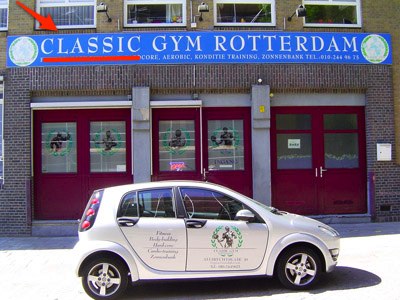
P.S. Finally found something in that sort of fits the bill (see pic). Classic Gym Rotterdam. I'll be joining tomorrow.
Hi all, let's face it. This blog is on hiatus until beginning of 2008 and as such I can only post the occasional link.
Exhibit 1: 11 Myths of the Small Business Entrepreneur, by Susan Dunn, describes 11 misnomers about entrepreneurship, such as being the boss, being free, independence, etc. All of which are all somewhat incorrect. I already knew most of them, but a good reality-check, nevertheless.Why am I thinking about a framework? With blogging there is a constant trade-off between providing content and linking to content. Well, trade-off is a big word, it would suggest that there is an opportunity cost. Since the only cost of blogging is time, there really is no trade-off in my mind—if someone can phrase words better than you (which comes from having done more research, usually), than you're better off linking to them.
Exhibit 2: Why early stage venture investments fail, by Fred Wilson, outlines two primary reasons why an investment may fail—a dumb and/or misdirected idea—and gave me a cool quote, which made the whole bookmark worthwhile: "the art of a successful deal is figuring out dead ends quickly and trying another and another until you find the one paved with gold (source: Dick Costello)"I am also thinking about the nature of links because it's the 10-year anniversary of blogging, and I read a guide to blogs by one of the first bloggers on the net.
Exhibit 3: Top 10 Tips for New Bloggers From Original Blogger Jorn Barger, by Jorn Blogger, is a list of tips that really made me think. For instance: "if you have more original posts than links, you probably need to learn some humility." Or: "Being truly yourself is always hipper than suppressing a link just because it's not trendy enough." Or: "Always include some adjective describing your own reaction to the linked page (great, useful, imaginative, clever, etc.)." Yes, really an, ahum, insightful guide to being a link-blogger.I don't consider myself a linkblogger, not like Jason Kottke or Robert Scoble at least, both whom I think excel in their craft. And, of course, if everyone were to become a linkblogger—and the rise of link-blogging platforms like Tumblr and del.icio.us would certainly suggest it—then it would lead to a fall in content.
But I feel that I need a framework for what links I post and what links I don't, as the latter are links that I plan to incorporate in my own "original" content (sorry for the lack of humility, Jorn).
I think it's as follows. When I read a cool story, which I think is well-researched and adds some general value to coming up with new ideas, or which falls out of my core-competencies, then I'll link it.
Exhibit 4: The Advertising Slogan Hall of Fame lists some noteworthy slogans between the years 2000-2003, such as: "All the news that's fit to print (NY Times)," or "Let your fingers do the walking (Yellow Pages)," as well as offers a—somewhat spammy—guide to developing your own slogan.Any original content, which I plan to start producing again beginning of 2008, will be in the form of a brainstorm, where I write about what matters to doing business in the food & retail-space. Sometimes these will be somewhat long posts, at other times, they will be short bursts. But whatever happens, I hope it adds just as much value to your life as it does mine, and that it does the legacy of blogs proud.
Another thing I'm thinking about is whether I should be more or less specific about my links. For instance, I link a lot more to stuff about entrepreneurship, innovation, and design, than I do about e.g. food.
Exhibit 5: A bookreview of "Starbucked", by P. J. O’Rourke, NY Times, discusses what the rise of Starbucks may have had on the general coffee-culture in the US, competition, and the fair-use of coffee. I find it pretty balanced, and interesting that between 1989-2007, the number of coffeeshops in the US has grown from 585 to 24,000—57% of which are "mom & pop". And that Starbucks only sources 2% of the global coffee-supply and does not have as much an effect on "fair conditions in coffee" as people may think.It's links like these that a reader of a food & retail blog will perhaps prefer to read.
But the framework should be, I think, one that is based on balance. Content, which i think is already well-produced, and for which the only value I can add, is a link with a well-phrased description, should just be just that: a link. Content, where I think I need to do more research for my own self-development, and where it helps that I write a good piece of text about it, should be written by myself.
Stuff on this blog, for the rest of 2007, will be limited. I plan to produce a list of perhaps my favourite albums of 2007, as music, I think, has a great influence on how people feel in environments that I want to create. After Xmas, I think. And next year, I'll start with an overview of what I've written so far, to continue with a clean slate.
Heh, a good way to present 5 links, I think. For more like these, check out my bookmarks or the Link-tag on this blog.
The picture is part of the Reuters pictures of the year 2007 collection (hope they don't sue me).
 Hello,
In this piece, I am planning to discuss my current thoughts about my thesis, this blog, and my plans for the future.
I suppose, to a great degree I like to be a focussed person. I like to have goals, pursue them, and not get too distracted by things. It's kind of a silly attitude, because life is an exercise in overcoming distractions. As Fred Wilson wrote recently about something that Dick Costolo, co-founder of FeedBurner, said:
"A startup is the process of going down lots of dark alleys only to find that they are dead ends. The art of a successful deal is figuring out that they are dead ends quickly and trying another and another until you find the one paved with gold."I love that quote and I think it's a great attitude in life as well.
But, as I said, I love planting myself behind a project and shutting the door to everything else. I tried doing this here, 8 days ago, and, as a result, underwent a pretty amazing productive period since then. So what are my plans for my thesis?
My thesis on funding high-tech start-ups
As I said, 12 days break, which would give me another 4 days. Truth be told, I have to add writing a conclusion, writing mini-summaries per chapter, an executive summary, and editing the whole thing into the mix, so I will like likely be busy for another 10 days after that. The nice thing about conclusions is that they are already in your head, summaries happen automatically as you edit a piece, and editing is a perfect all-nighter activity.
The not-so-nice part is that we are currently at 150 pages of material, which would more or less make my thesis a book about innovation, entrepreneurship, venture capital, and incubators.
2 thoughts:
- One of my thoughts is to edit it down to a reasonable size and publish the whole thing as a pdf.
- A second thought is that as I write summaries per chapter, I might as well turn them into blogposts about innovation, entrepreneurship, finance, and incubators, and publish them in the form of regular blogposts on Tech IT Easy.
Which brings me to this blog…
The status of (my blog on) sounds + food and retail
The funny thing about this blog is that it is interconnected with my life. Random readers may think this is a nice (or not so nice) blog about subjects concerning music, food, and retail, but it is in fact, what I see as, one of several stages towards forming a career and a business (or series of) in this industry.
So my head has not stopped thinking about this subject, and I've actually been making summaries about interesting topics, and thinking about the shape of things to come. I cannot interrupt this blog too long, at the same time it is reassuring (to me), that even though my publishing took a break, my mind did not.
Concerning this blog then, I will be back and I already have a huge backlog of material to publish here… looking forward to that!
The status of "real life"
As I speak with friends and strangers about my ideas I also realise that there is much that remains to be done in "real life" also. I believe everything starts with a good business-plan with realistic assumptions about what you want to set up. It is the ultimate "social object" towards getting my plans in motion, convincing partners, investors, employees to work with me.
Questions I have received so far include:
- What type of place do you want to set up? My answer has so far been: probably a night-venue, a restaurant or night-club, or something in between (this may come as a surprise to some of my readers, as I write a lot about retail). Ultimately though, I want to set up a successful venue and am flexible on the format.
- Where do you want to set it up? My answer: I'm flexible, but it depends on where I feel most comfortable to set it up.
- How are you going to fund it? My answer: I'll need to save a bit, but I expect my first business to be sponsored, probably over 50%, and will look for suitable working partners also.
- When do you want to set it up? My answer: 3-5 years from now would a realistic number in my mind.
- When do you want to exit? My answer: Depends on how much fun I am having, as well as other factors. I see myself as both a serial entrepreneur and someone who wants to create great things, and I'll have to find the middle-path between both.
Final thoughts
First thing first. Finish my current project, get a degree, close this chapter of my life.
Intermediary thing, publish blog-posts when I can and want to, in between.
Afterwards, blog more, look for a cool job to gain experience, contacts, and cash. I also want to travel for a bit through Europe to decide on a suitable location, check out different formats, and brainstorm with friends.
And then, take the plunge.
So, à bientôt, I hope!
Vincent
Metaphor: I am the bunny or rather my thesis is. Everything is progressing well, but of course it's a lot of work. More when I'm done.
(via Kottke)
5 links to let people know I'm not dead:
- How to choose a name for your product / service / business by Scott Trimble - not much to say about it, except it rocks.
- The 8 challenges innovations face by Scott Berkun - there's so much talk about how cool innovation is (flying cars, anyone?), and very little about how hard it is to actually bring it to the market. Exactly the topic of my thesis, btw., mostly focussed on Scott's point 3: "Find a sponsor and funding".
- The 2007 Esquire 100 has some awesome food-related stuff. Namely on Luxardo, Sechuan buttons, New Texas Cuisine, Rum, shrinking cocktails, The Best Breakfast in America (mmmh looks good!), Washington Wine, and other cool stuff.
- Understanding Web Design by Jeffrey Zeldman - "Web design is the creation of digital environments that facilitate and encourage human activity; reflect or adapt to individual voices and content; and change gracefully over time while always retaining their identity." Kind of applies to designing other kinds of interactive environments as well (don't shoot me Jeff).
- Wal-Mart’s Environmental Report Card (NYTimes) - the point is that Walmart is continuously increasing its competitive advantage in the area of green tech, which is sure to affect businesses bottom-line in the future. So get busy!
 Still following the great book on Retail Marketing, by Dr. P. McGoldrick, this time I'll cover the different types of cost that are included in buying, developing, and running retail locations. For previous coverage, check out post I and II
Before buying property, considerable data analysis must happen in regards into estimating turnover, which comes from data on competition, accessibility, and population. And a calculation of costs must happen, least of which is the purchase price, and more complex will be three types of cost: development costs; running costs; and contextual* costs (*: for lack of a better word).
Much of this cost data will likely come from negotiations with site developers, lease owners, and an estimation of the costs involved in the development of the location.
Naturally, with the proliferation of the internet, there are plenty of databases that offer interested parties an overview of typical sums per region or type of location. Though the following are mostly aimed at private individuals, both My-Currency and Zillow offer these types of services, and Jeremy Fain wrote about a French service, called BMyKey.com on Tech IT Easy.
Purchase price
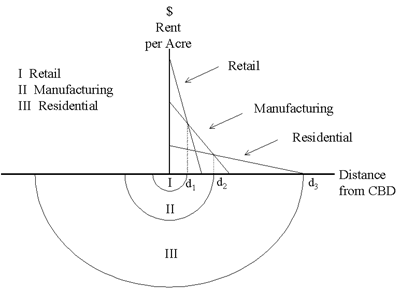
Traditionally, rent bid theory explains a lot of price-differencials within an inner-city environment. Variety and women's clothing stores would typically pay the highest rents and grocery stores the lowest. With the emergence of superstores and their focus on out-of-town locations, this formula can not be applied so generously anymore, though, as mentioned, I think that it should logically still apply to inner-city environments, and probably to inner-malls ones also.
And while buying the property may cost a certain sum, it is not atypical that the three of the following types of cost will far outweigh the initial purchase price.
Development costs
Three types of estimates need to be made here: design estimates, which include the costs of the architectural work; bid estimates, which involves negotiating the costs of labor, material and equipment; and control estimates, which are the costs of monitoring the project-development. For more info on these, check out this document.
In addition to this there are a number of costs that can be substantial, but are sometimes not taken into account. One is site preparation, which be steep, especially if the land needs to be converted or extensive demolishing needs to take place.
In addition to this local authorities can impose a number of restrictions on the height of the building, other architectural and landscaping aspects, and demand significant concessions from retailers to build there. All of which can at the very least slow down development considerably.
Running costs
The choice of location, site, and design can greatly affect the cost of running the operation once it's constructed. For instance, multiple floors and parking will mean that lifts will need to be maintained regularly. A location with a high crime-rate will require higher security-costs and lead to more theft. And high employment and income areas will also lead to issues regarding staff recruitment and retention.
Contextual costs
I made up this term, but it actually includes costs like delivery, promotion, and the impact on other branches of the business. Delivery costs are affected by the location choice of the outlet—how accessible it is via road or otherwise; how remote it is from the main distribution network. Promotion costs are also a factor (but a topic for another day). And the impact on other branches are a very important factor to consider. The higher the existing market-share in an area, the greater the potential loss, though, according to the book, this is often accepted as a necessary trade-off to a high growth strategy.
Final thoughts
Clearly real estate is something that needs to be thought about as part of a long-term strategy and with the help of professionals. And some of this is probably not applicable to start-ups in the retail-space. That said, choosing a location by itself is already a science—whether you rent, lease, buy, or build it. And both the direct costs—purchase or rent—and indirect costs—development, running, and contextual—will play an important part in the decision-making and business-planning.
Until now, I have mainly covered the issue of competition and cost in relation to a real-estate strategy. I'll probably not go into population and accessibility just yet, and will instead focus more on more complicated tools used in real estate strategy, beyond the simple checklist, which I covered in my first post on this. These include mathematical, mapping, and some other models, as well as, hopefully, some more data on the role of IT in this process.
For a more in-depth reading, I of course recommend buying the book on Retail Marketing, which largely inspired this article.
Let's start with a brief disclaimer: I am not a lawyer, fiscal expert, EU expert, or anything that can constitute an authority in matters of European legislation. I have linked to relevant data at the end of this article, which I strongly encourage interested readers to check out.
SEPA, meaning “Single Euro Payments Area,” is an initiative, due to be launched in 2008 and fully implemented by 2010, but has been in the planning ever since the EURO-currency was unleashed upon the member-countries in 2002.
Essentially, while the EURO brought some transparency to consumers, banks, and businesses on a cash-level, SEPA is meant to be the non-cash equivalent, introducing a common standard of non-cash transfers between banks, businesses, and consumers across the EU-region. This is facilitated by a standard referred to as "straight-through processing" (STP), which allows for an automated processing of payments between banks.
Technically speaking, this means that payment-messages between parties will contain certain data-elements that include information on the amount, bank account details and the names of the sender and receiver, and is exchanged between banks through a common ISO-standard, called: UNIFI (ISO 20022) XML.
All of this mumbo-jumbo is governed by the European Payments Council (EPC) (see pic below), which is the decision making and coordination body of the European banking industry in relation to payments, and consists of 67 members, including banks and banking associations.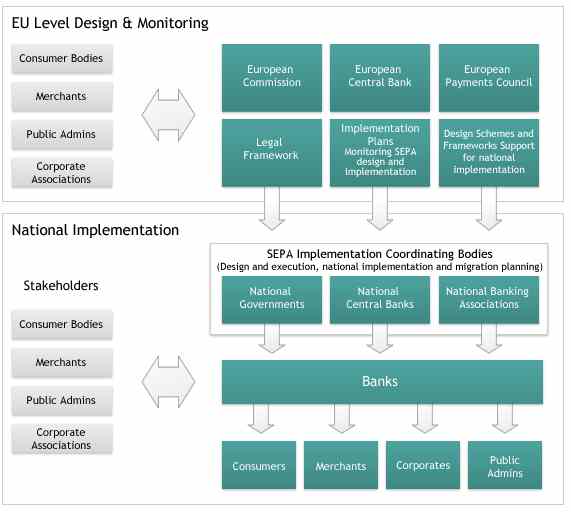
(click picture for more detail)
Benefits to consumers and businesses
These are manifold. Essentially, a harmonised standard allows consumers to easily, transparently, and securely make payments across borders, which also means that consumers don't need to open separate banks to handle their business in different European countries. In addition to this, it introduces a common standard for pension-transfers across banks (and I assume countries), and greatly increases the choice of financial service providers to consumers.
For businesses, the benefits are far more numerous. Essentially, having shared standards allows them to easily accept and process payments from any card from a SEPA-bank. National borders no longer need to be a barrier to growth and businesses can have a more direct financial relationship with consumers across the Euro-region. Similarly, B2B-transactions across borders enjoy similar "upgrades" and will require much less overhead, be more transparent, secure, and quicker than before.
For a more exhaustive list of changes, please check the EPC-report on Making SEPA a reality!
Final thoughts
While this all sounds very rosy-coloured, I expect that the key-factor will be marketing, i.e. communication about what SEPA is and how to use it. So far, there has been very little news on SEPA, even though it is due to be launched in less than 3 months from now. Similarly, a status-report by the EPC (pdf) points out that there has been very little communication from public authorities about their intention of using SEPA products, and another Dutch article, from a few days ago, reports that 92% of Dutch business-owners are not yet prepared for SEPA.
That said, if anything was needed after the EURO was introduced, it was increased transparency of financial services, and preferably on a pan-European level. Both the fact that businesses and consumers can run their financial affairs from a single bank in a single country, and that both also have more choice of service providers, is a huge improvement. For the latter, I hope the increased competition will lead to more efficient financial services. And for the first, I hope it will lead to more businesses expanding their operations across national borders, and more migration by European citizens across the continent.
Of course, much remains to be done before we can truly call Europe one "country," including a more harmonised patenting-standard, and of course overcoming many of the legal and cultural barriers which continue to exist. But the SEPA, if all goes according to plan, is a significant step ahead towards making this a reality.
Some helpful links
- The European Central Bank on SEPA
- The European Payments Council on SEPA
- EPC-report on Making SEPA a reality (very good to read!)
- Latest SEPA status-report
 It's time for another monthly summary (a few days late). This time, rather than the rather unattractive list-view which I used for my month 1-summary, I'm going to try turning the past month's posts into a little story. As I wrote, this blog is my way of learning about this industry, so let's take a look at what I've covered so far.
The Human element
I started the first post of month 2 with one related to self-development, and I kept that thread going for a while. This post was on the the way that leadership has evolved throughout society, from an individualistic to a social kind of leading. A lot of developments today, in business, politics, or other arenas, are so complex, that a form of collaboration is more constructive than tyrannical leadership. This is perhaps made clearest in in the example of Ikea and eBay, who—often by necessity—used collaborative methods to develop and introduce new features and innovations.
Again related to self-development, I also looked at particular careers in retail (with a nice chart) and in knowledge-based firms. Apart from simply researching the functions out there, my conclusions were that different roles require different talents, and that a manager/founder/entrepreneur should take care to surround himself with a diverse kinds of people. A similar point was made in a post on doing what you do best. Again, in the eBay-post, I discussed professionalising your firm quickly, by bringing in talent that can help in growing the business.
The strategic lens
A second big thread last month was business strategy. I started with the coffee-business, mentioning some examples like Coca-Cola, who is expanding into canned coffee, and Leonidas, a chocolatier, who is starting coffee-shops. Later, in two follow-up posts (1 and 2), I drew the conclusion that the coffee-arena is pretty crowded and that I wasn't sure if that was the best area to start a business in.
I also looked at the area of value chains and Porter's five forces, using examples like Ikea, Apple, and Amazon, and before that China and the issue of meeting it's exploding beef-demand. Generally, and the same applies to coffee, I think it's useful to take a horizontal and vertical view at how the industry is organised and find opportunities that way. In the case of China, which imposes some barriers to beef-imports, the answer was to import methodologies and grow beef on Chinese land. Other examples are mentioned in my five-forces post.
Another big topic is climate-change and it again helps to analyse this in terms of the value-chain, i.e. looking at all the internal and external activities related to your company and related to bringing value towards customers. And optimising those to take the cost of climate-change into account, which can later be turned into a significant competitive advantage over your competitors.
And I looked at some examples of Franchising in Germany, noting that retail is clearly leading in that field, and that a big challenge is to transmit tacit knowledge down your (largely decentralised) organisation.
Branding & marketing
Another large topic this month was the issue of customers, and how you market to them. IBM presented a nice white paper, of which I discussed the Well Curve as a possible methodology to understand the customer decision process, which was a second post on this topic.
I also looked at the way some business interact with customers, including T-Mobile and Harvard Business Review, and observed that conversational marketing is definitely a way to increase price-elasticity.
I have not looked much at food-business so far, but I did manage to discuss two restaurants: a pancake-place, where I discussed methods on how to make me remember its damn name, and a restaurant in Germany, which I thought received excellent advice in a show called "Rach - the restaurant tester," in regards to geographic marketing and building a brand.
Finally, even though my forte is not advertising, I came up with a—possibly stupid, but fun—idea on how to advertise a new concept coming to a town near you.
Innovation
Somewhat of a micro-topic, I looked at the way that music-media and money evolved and how that illustrated that customers love convenience, as well as how the Ford SYN-US was developed from start to finish. The latter is very interesting for thinking about what it takes to come up with new innovations.
Finance
Another micro-topic, which I will have to spend more time on in the future. I approached this in two posts. In the first, "other people's money," I reflected on some of the different types of investors there are and how some can add considerable value to growing your business. Also, in the eBay post, I looked at why it was so important for eBay to involve venture capitalists, even though it didn't need the money. The right kind of investor for your business will help you professionalise your business, by helping you find more talent, setting targets to meet, pressuring you to grow, and (hopefully) much more, all besides investing in your business, and taking shares.
Final thoughts
So, pretty diverse stuff I think, and while I could be writing more about food and retail—which will happen—I'm happy to have written and learned about all of these interesting topics.
For the future, I hope to look more at franchising, in-store activities, and particularly at supply chain topics, such as lean manufacturing, logistics, and anything dealing with the supplier-perspective. My future reading-list includes: The Disney Way, The Great Good Place, and The Toyota Way, as well as countless articles, pdf's, blogs, HBR-magazines, and so much more.
Well, here we are. Another month flew by! I enjoyed writing this post, and hope you enjoyed reading it too! For past coverage, you can check my slightly less aesthetically-presented month 1 summary. For more in the area of food and retail, I do encourage people to check my blog-roll on the right, and my bookmarks, updated 24/7.
The picture is an exercise of drawing a (my) hand in 5 min. or less.

Normally, I would review a book in pieces, but since I read the book some 4-5 months ago, I'll instead try to summarise the key points I got from the book.
Where you are from matters to where you are going: I notice this over and over again. Pierre Omidyar, eBay's founder, is a Libertarian, which rougly translates to letting people solve their own problems, with as little interference as possible. You can see this play out in eBay's largely decentralised shopping-model. The lesson here is not, I think, that everyone should be like eBay, but that whatever you do, should in some way reflect what you believe in.
Be professional quickly: I don't think eBay would be where it was today, if Pierre hadn't immediately tried to attract talent, starting with Jeff Skoll, an acquaintance and Stanford MBA, all the way up to Meg Whitman, who was instrumental in handling the IPO and is still eBay's CEO today. Many entrepreneurs are in the game because they want to be independent. Opinions may vary, but a smaller piece of a bigger pie is usually better than a small pie all to yourself.
Venture capital is not just money: eBay was consistently profitable from day one, so they actually didn't need financing. But there was one important reason for going to a venture capitalist: professionalisation. eBay needed to send a signal to the world, that it was an important player on the market. It needed to attract talent, and form a growth strategy. All of which happened after it took on venture capital.
Community matters: eBay's key to success was not only her low capital costs (no stock, little overhead), but also her close ties with the users of the site. At the beginning, little in features was introduced on the site without consulting the users first. Because of this and ultimately the high switching costs, eBay benefited from what is known as the Network Effect. That said, as a company grows, community-involvement cannot be as strong, and new mechanisms must be put in place to place to stay in touch with your core-users. eBay had a lot of problems in this area.
IPO's can be traumatic: Somewhat related to the point about communities and change, when Ebay went public, it created a rift between the core-values of her original workforce and users, and the values of the financial community and the media. There's not much to say about this, except that just as it takes a particular type of people to start a company, the same applies for people taking a company public, and as a founder (and start-up-employee), you must learn to let go.
Make your IT-infrastructure scaleable: this is the only tech-advice in this post, but Pierre had no idea how quickly eBay would take off, and the company was plagued by technical issues from the start. Only some years later, when Meg Whitman became the new CEO, did proper staff get hired and was the infrastructure upgraded for scale.
That's about it. I'm sure, I forgot some key-points, and would appreciate comments on this, if you have read the book. I do remember thinking that "The Perfect Store" was the absolute best book I ever read on starting a company, interacting with community and stakeholders, and the effects of an IPO. So, highly recommended for this reason alone, and also to gain a good insight into eBay as a business until 2001-2.
(This review is mirror-posted on Tech IT Easy.)

 The


