 The world of business, I think, has a certain illogical—the "human element"—shell around it, but centres around the concept of supply and demand. How you create a business where demand is high, how to you make sure that you have sufficient supply and/or not too much supply. You can see this play out in a number of places, e.g. on the web you have scaling issues, when your service proves to popular (e.g. Twitter), or you have the case of the million+ blogs that are collecting dust, because no-one ever reads them, or because the blogger was unable to gather enough interesting supply.
In restaurants, or food-places, you also see this play out. A couple of months ago, I was going to write about take-out, how some businesses embrace and others avoid it, and why. I think the reason is, at least in part, to control supply. If you control supply, then you can focus on quality and charge a higher price. You also become an artist/creator, rather than a factory.
How do you limit supply? Two ways, I think. Mainly it's the physical space; by limiting the number of seats in your venue, you ensure that a certain quota is set (of course, the question is also whether that quota is met, which comes from quality inspiring demand). By investing in quality-ingredients, you not only limit your budget, but also your production-capacity, and it forces you to limit supply. That's a little vague, I know, I haven't worked it out 100%.
The other way, is to have an increased level of supply. How do take-out and fast-food places do it? By standardising as much as possible. Whether it's the ingredients, which are mainly starch-based (burgers, pizza, noodles, etc.) and cheap, the production-facility (often just an oven, a grill, or a big wok), or a standardised customer-space (from seats stapled to the floor, to waiting-lines, to a website/phone nr.). All of which enables you to deliver mass quickly.
I was thinking about this today after watching "Iron Man," which is one big Burger King (and US-army) commercial, and getting a cheese burger afterwards. Burger King was packed and, ironically, slow. The "waiting in line" method doesn't seem to work that well when you have 50+ people waiting, and a limited space behind the counter to deliver burgers and stuff. People on both sides were bumping into each other constantly, and I actually had to wait over 5 mins, even though I was second in line.
On some level, I like to think that technology can solve a little bit of this problem. If you look at Zara and H&M, which I wrote about last week, both are very advanced in this area, in order to optimise and speed up their production, logistics, and merchandising. Of course, that's on a back-office level, and that's not the same as the front-office, where customers interact with a business. No one wants to be confronted with a screen to do the ordering, but sometimes I wonder if people wouldn't be happier just pressing some buttons in a fast food joint, rather than waiting in line. Of course that would mean more seats, as more people would sit down, and more staff, as someone will have to bring that food to the table.
In the end, it probably comes down to experimentation and constant improvement. That said, apart from the computers that cashiers operate, and quicker food-preparation, not much has changed in the last 50 years for the people doing the actual eating.
The picture is courtesy of lightningspeed.net.
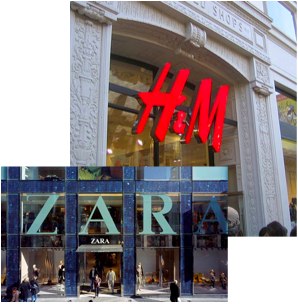 Time for a wee break. In the last week, I've been researching Zara and H&M a little, to better understand the retail-sector and the fashion-segment. I'll probably have to do a follow-up to this post, as there is lots to say about both businesses, but here's some initial impressions, nevertheless.
First off, H&M appears a lot more clean in its approach. Judging by the annual reports alone, H&M not only has a 2007-edition (Zara is only up to 2006), but it is also only 85 pages long (presented in an eco-friendly 2-pages-per-side way), while for Zara, or actually Inditex, it's mother-company, the annual report is a stunning 450 page long!
Now, that's really not all that surprising, as Inditex is composed of a number of companies, and it is extremely vertically integrated, while H&M employs the Nike or Apple model—it designs and it retails, but it doesn't produce.
Why this is so, I can only guess, is due to their origins. Inditex comes from Spain, traditionally a low-waged country, while H&M is Swedish, not a low-waged country. Similar to IKEA, I imagine it was an economical decision to outsource most of its supplies.
It's very hard to separate Inditex from Zara, as both are founded and owned by the same person, Amancio Ortega Gaona, Spain's richest man. Zara has been in existence since 1975. H&M was founded by a Swede, Erling Person, in 1947, who ran the company to ca. the mid-90s, but which has continued to be a family firm.
Their business-philosophies are fairly similar, a low-cost, high-quality approach to fashion, as opposed to traditional brands, where quality most often equals price.
Zara made lots of headlines with its extremely high turnover of products—it produces around 11,000 items annually (as oppsed to 2,000-4,000 for other retailers); 15-20% produced before, 50-60% at the start of the season, and the rest during. If a product fails to do well, it is usually removed after a week in stores.
H&M made headlines with its celebrity-marketing, which is noteworthy, as Zara has virtually no marketing. Instead, because it has such a high turn-over of goods, customers tend to visit it more often, expecting new things—an average of 17 times per year vs. 3 times for other stores!
Both employ mostly a wholly-owned retail-strategy, except in countries where this is not possible. And both are very advanced in their use of IT to manage logistics and production, which is definitely seems to be a key-characteristic of delivering fashion quickly and find ways to decrease costs.
H&M's largest markets are Germany, Sweden, the USA, Spain, and the Netherlands (in terms of sales). For Zara it is Spain, France, Germany, and Mexico (in number of stores).
That's all I can think of in 30 mins or less…
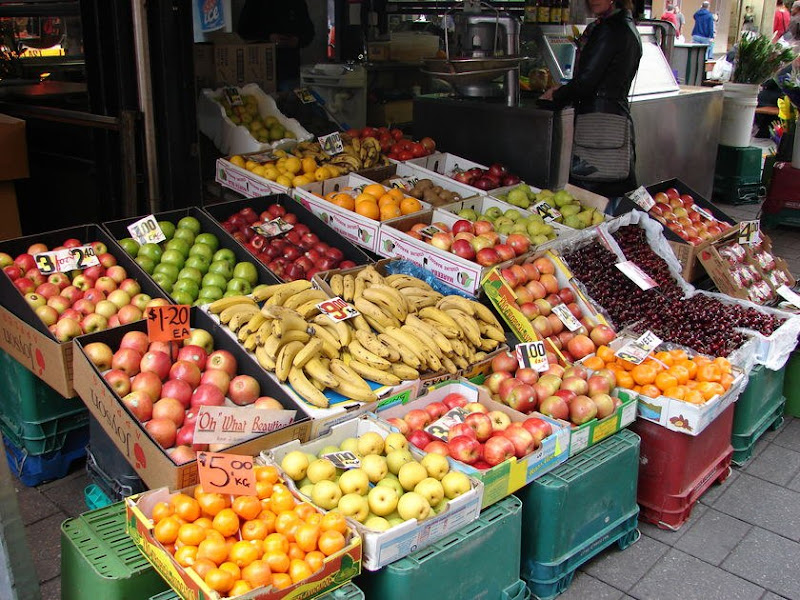 Take a look at this quote, which I posted a few days ago:
"There should be a rule: before helping the environment in one market, we should be required to think through the impacts on other markets." (source: Freakonomics blog).Or, to put it differently, every action has a (sometimes equal) reaction (I think the traditional phrasing ignores the human element). The idea that everything is interconnected is both fun to right-brained generalists like me (not a compliment), and scary at the same time. The global economy is very complex and, I would say, impossible to regulate.
There's a couple of things going on the world, which I'm sure everyone is aware of. There's a number of wars, there's the weakened dollar, there's some kind of housing-related recession going on, there's a shortage of oil, our planet is perceived as suffering and currently being saved (I hope), there's India and China, the rise of the Anglo-Saxon system, etc. etc.
And some of the biggest problems facing the food-industry (depending where you are in the chain), are rising food-prices, which relates to that oil-shortage (both in terms of pricing, but also because of alternative fuels using farm-products), the rise of India and China, and some other factors; and the costs of keeping green, which has largely been inspired by companies like Wal-Mart, but also by the (exaggerated) need for global diversity by customers (which the food-industry is also partially to blame for).
The solutions vary, and are, so far, very defensive in their nature. For the cost of going green, most pollution comes from transport and the solution is to either use the most eco-friendly way to go: on land, by train, across water, by ship; or to go local—which companies like Marqt seem to focus on, but which also comes with the pitfall of seasonal shortage.
For rising food-prices, again one solution is to go local, to save on transport and have some control over how farmers work, and be able to charge higher prices to the rising local-conscious consumer. But a bigger solution is for more food-production to happen (much of it currently goes to India & China, or to biofuels), and possibly from smaller farmers. The problem here is that it will take time (some estimate decades) for smaller farmers to get ready.
Both are definitely big picture-problems, and will take time to solve. One thing, I'm personally looking at, are micro-lending sites like Kiva.org, which put you into contact with local farmers, allowing you to help them out in your own way. From a Venture Voice interview with one of the founders, I understand that some of these investments happen within the context of a community, where each member keeps watch over the other's use and repayment of the funds, in order to ensure a good outcome, and so loans will continue to come in. But, while I think it's well worth the effort, this is still a small-picture solution to a much larger problem.
The way it looks right now, the solutions have to be planned in the long-term and on a large scale. There is definitely space in the farming-segment for more production to happen. In the mean time, food-prices will continue rise, as will the price of educating consumers to make more responsible choices. I like Tesco's approach in labelling the origins of their food and allowing people to make more carbon-friendly (locally focussed) decisions. But that doesn't solve the problem for farmers in remote areas of course.
Sigh, if you just got a headache, I sympathise, as I just got one too.
Further reading:
- NYTimes: Environmental Cost of Shipping Groceries Around the World
- Economist: The new face of hunger
- Buzzfeed: Food Hoarding
I took this title from a report on the future of Dutch supermarkets (English pdf). It identifies a number challenges to come, one of which is "stomach share," which is apparently a big deal because of the following three factors:
- Population decline: which translates into less consumers buying food
- Increased longevity: and older people have a lower caloric intake
- Increased awareness of health-issues: which also translates to a lower caloric intake.
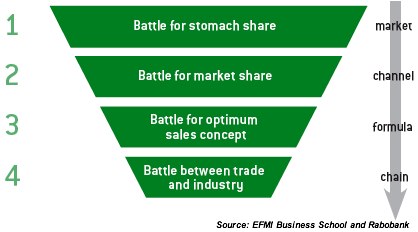
What the authors are seeing is that players from the bottom of the market (the discounters) are moving upwards, by broadening their assortment of goods, and players from the top of the market (luxury-stores) are moving downwards, by improving their prices. A number of underlying things are going on here: luxury-stores can become cheaper by improving the efficiency of their stores and sourcing cheaper brands. And discounters can increase their offering through their relationship with suppliers.
Following HBS-quote, from an article entitled "Finding success in the middle of the market", sheds some light how Tesco does it:
A company controls midfield by fielding a complete product line that includes backs and forwards. In its supermarkets, Tesco, the successful UK retailer, offers consumers three options—good, better and best—in most high turnover product categories. In addition, Tesco doesn't just sell groceries through one-size-fits-all supermarkets. Recognizing the need to shape as well as respond to an increasingly segmented market, Tesco reaches its consumers through at least seven different store formats, from convenient Tesco Express outlets at one end of the spectrum to full assortment hypermarkets at the other. But, within all its stores, Tesco implements the same merchandising principles: Better, Simpler, Cheaper.Can you guess who the loser is yet? Well, according to both the report and much data on the net, the losers are the new, innovative concepts, that may offer certain values to consumers on an ethical or health level, but are not able to reap the same advantages as more established players are.
That is also the answer why so many organic companies are being bought up by fmcg-companies. There's an interesting overview here; but if you want to follow one in real-time, check out this Inc. magazine blog run by Honest Tea, which has recently given away 40% of their company to Coca-Cola.
Of course that is only part of the answer. Consumers are not just focussed on price. And, while consumer-awareness of the global situation and their own health is clearly growing, that's not the whole answer either. People's lives are becoming ever more complex and convenience is a big selling point these days.
It's those companies that can combine a high level of consumer-responsiveness, together with assortment and price, that will capture the hearts of consumers. But I guess what is out, is the solo single-product-serving player in the market, purely focussed on softer advantages like "ethics," and forgetting that consumers still(!) have limited disposable income for their food-expenses, as well a limited time to engage in these activities.
 Just read an interview with Ford's ex-CEO Jacques Nasser on the training programs that were prevalent at that time (2000). He justified their need, by outlining the history of the car-industry between 1905 and now.
- 1905-1920s - colonisation of car-companies: smaller replicas of car-factories in the US were being built abroad. Hardly any competition.
- 1920s-1950s - nationalism: lots of countries were building their own national vehicles. Competition mostly on a regional level.
- 1960s-1980s - regionalism: the rise of trading-blocks (NAFTA, EU, etc.) and as a response the functional/regional division of companies.
- 1980+ - globalisation: global competitors, more markets, more divergence of consumers, more need for people/ideas/growth.
The situation at Ford
The result of the last period is that there are more Ford-people around the globe to manage, that more markets need to be served with different needs, and that the company that can generate economies of scale & scope, while being most consumer-orientated wins.
Two strategic priorities are at play here: consumers only see a part of the car, which means that the hidden qualities can be mass-produced; and consumers value those qualities most matched with their environment—e.g. in Brazil, so I read, roads are abysmal (if any Brazilian reads this, correct me), and good suspension is highly valued. In China, luxury models are mostly driven by chauffeurs, while the consumer sits in the back, hence he/she values luxury in that part of the car.
In this scenario, two types of qualities are valued with people: to understand the corporate qualities of Ford and make decisions that favour its mass-market strategies; and those that understand the local environment and can design car-offerings tailored to local needs.
Social operating mechanisms at Ford
Ford, at the time of the interview, had about 12 programs aimed at promoting these skills. The ones mentioned, included: Capstone, which is aimed at (24) executives; Executive partnering, aimed at (12) promising managers; Business leadership initiative, aimed at the whole organisation; and a weekly email-newsletter, called "Let's chat about business," also aimed at the whole organisation.
Methods + Aims were:
- Team-building - to get people to work more closely together / develop a corporate culture
- Teaching - to get people to understand the priorities at a corporate level, rather then just at a divisional/functional level
- Projects - to get people to come up with problems plaguing their organisations at that time and develop creative solutions to them.
- Shadowing - to develop leaders
Thoughts
Several thoughts going through my head at the moment. I am both uncertain how relevant this is to the SME-environment, and at the same time I do a lot of "social engineering" and can certainly think of a few cases in my past where a certain structure would have benefited the small teams I worked in. I'll probably write a third post about the SME-perspective at some point in the future.
My favourite way to picture "social engineering" however, is through designing processes that bring elements of the organisation together with customers and "raw-inputs" (new technologies, future employees, and partners, etc.). Maybe, I'll write about that at some point too.
Of course, I always appreciate the reader's perspective on this. Social programs at an SME-level, good for team-building or bad because it distracts from survival-priorities?
The picture is courtesy of articlescaravan.com
 I'm still "on a break," but stumbled across this interesting titbit from a book on warehousing-practices. If you don't like reading lists, too bad because it's interesting, but I've also summarised the key-points in the end.
China
- Low labour and land-cost, but high equipment costs, translate into large (e.g. 250,000 square feet), low warehouses like in the US, but often lacking even a forklift.
- Certain goods like consumer electronics, are of such high value, have a short life-cycle, and thus a lower inventory-cost, that expenditure in state-of-the-art technology is justified.
- Certain cost-saving practices, like removing the pallets from shipments in order to ship more goods, cause some inefficiencies other countries, like, eh, re-adding pallets.
East Asia
- A traditional focus on personal relationships and less on computational models, means there's a lack of data and opportunities for improving performance are not well-developed.
- The most active economic areas are separated by lots of water, which means lots of product conveyed by air (for high-value or time-sensitive products) or ship (for bulky items or commodities). The high costs associated with this, are incentives to consolidate freight.
- Therefore, more strong regional hubs, like in Hong-Kong and Singapore, are expected to emerge.
Europe
- High labour-costs and an inflexibility of the work force have lead European warehouses to be more advanced in terms of automation.
- A growing common market will also lead to more economies of scale in the future, leading to larger, centralised warehouses.
India
- Characterised by cheap labour and land-cost, but relatively expensive capital costs (machinery and the like) and an underdeveloped infrastructure (both physical & administrative).
- The markets being supplied are generally local and not very wealthy, which leads to the SKUs not being high cost and there being little incentive to increase efficiency through capital expenditure (IT).
- Global demand means that larger distribution centres are being built around large ports like Mumbai (Bombay). The lack of land there is leading to high prices, comparable to Singapore/Hong-Kong.
North America
- Characterised by a culture of mass-consumption and a uniformity of the market and distribution infrastructure, which translates into large centralised warehouses and accelerating rates of product flow.
- Warehouses are often situated in the countryside surrounding metropolitan areas, which is cheaper, while being well-connected.
- A good telecommunications-infrastructure enables better supply-chain co-ordination; Warehouse management systems are generally advanced, and the rich data leads to better tracking and performance.
- High labour-cost are off-set by using cheaper migration-workers
Singapore, Hong Kong, Japan
- Due to a lack of land and high labour-cost, warehouses tend to be built high.
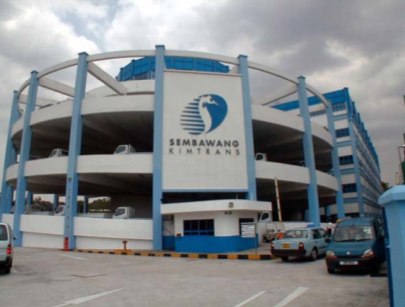
- Elevators are one bottleneck, caused by this style of building, however a Singapore warehouse has found a solution to this: A multi-floor facility with no automation or elevators, but, instead, a spiral truck ramp so that trailers may be docked at any floor (see pic). This does claim more land area, which must be recovered from above, and doesn't work well if trucks have to shuttle between multiple floors.
- While both Singapore and Hong-Kong act as hubs, Singapore is much more international, receiving goods from manufacturers all over Asia and shipping it to other countries; Hong-Kong receives mainly Chinese goods. Also, for the latter, many of the goods come in via trains and trucks, while leaving by ship or flight, while for Singapore it comes and leaves via sea and air.
South and Central America
- Labor costs are low, though not as low as in China, and the nature of its local economy and customers does not justify high equipment expenditure.
- The only exception is Mexico, which can quickly ship products to the US and keep its inventory low, thus justifying state-of-the-art technology.
Final thoughts
Some general conclusions can be drawn.
- Labour costs are a factor when considering automation; automation is a factor when considering optimisation; optimisation is a worthwhile expenditure when dealing with high value goods with a high velocity.
- Cheap land seems a fundamental advantage, looking at the logistical nightmares that Singapore and other high-rise builders must be experiencing.
- Access by land will significantly decrease the cost of transport. Generally, a well-developed infrastructure means more access to wealthy markets and enables warehouses to store high-value/high velocity goods, which is good for them.
The book 'WAREHOUSE & DISTRIBUTION SCIENCE,' which is available as a free download, provides some incredibly detailed info on how to effectively set up warehouses and distribution chains. Well worth a glimpse, if not more.
Last weekend, the Dutch financial Times, FD.nl, had an interesting part-article / part-diary of Henk van der Doelen, owner of a chain of ca. 30 drugstores in the Netherlands. Originally part of a franchise called DA (2nd largest in the Netherlands, afaik), he and several people decided to split because of restrictive conditions. I've followed this story for a while because I'm interested in franchising, and because drugstores are big business in the Netherlands (market-size: ca. €3,5 billion), probably due to its trading history in spices and herbs.
His company, Drogisterij-parfumerie, was founded in 1970, has 270 employees, 29 branches, and an annual revenue of €23 million.
The business also employes a franchise-formula, called 'Pour Vous' (Dutch link), which has existed since 1975 as a soft franchise. It asks a monthly marketing-fee of €250 and / or (this part is unclear) €7000 per year for commercial and marketing-related activities. Total innital investment to join the formula is estimated at €300.000.
I created the colour-coded picture below out of curiosity. How exactly does a retail-chain owner divide his time? Naturally, one week's activity should not be generalised across greater periods or different businesses, and I probably mislabelled some activities. But you can let me know that in the comments. ;-)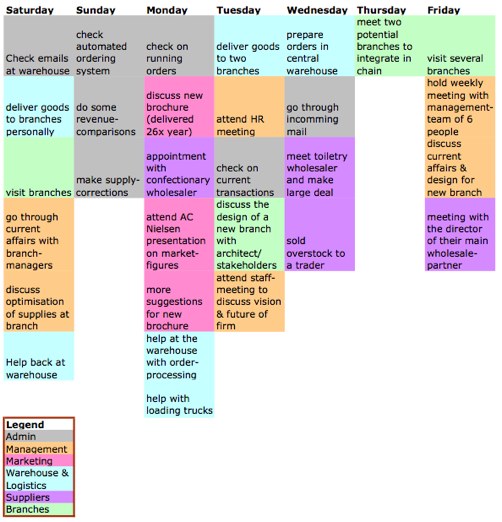
What is interesting is that there is a fairly even division of activities, apart from maybe marketing. From the article, I did get the sense that he was more focussed on warehouse-actitivities, also living close to the central warehouse, but he pretty much kept his finger in all the relevant pies for running a business of this sort.
What is also interesting is that he essentially plucked out a number of franchisee-branches out of DA's franchise-network and created his own. In the sense of whether franchising is entrepreneurship or not, I do think that this again confirms that the options remain wide open. This story also sheds a light on what can happen if a franchiser's policies are too restrictive for franchisees.
From my understanding, DA has been making moves towards a more integrated strategy, which did not sit well with many franchisees. Apart from the ca. 30 branches that Drogisterij-parfumerie took with it, another 40 left to join D.I.O. (4% market-share). This still leaves DA fairly strong, with 452 branches and 15% market-share, behind the number 1 in the Dutch market: A.S. Watson (Kruidvat, Trekpleister, and ICI Paris XL) with 877 branches and 40% market-share.
The role of the internet for the retail of *physical* goods.
0 comments Posted by Unknown at 9:01 PMOne of the stories, I covered last week in my links, uncovered an interesting statistic. Only about 3% of retail sales in the US happens online. I don't think these stats are at all coincidental. While I see a bright future ahead for the online retail of media-products, I find that what the internet cannot provide, is the "closeness," that is sometimes needed for evaluating certain types of goods, like food and clothing. I have commented on this before, implicitly, with a post on the web as a third place, and about the lack of cohesion that Facebook provides.
At the same time, as The New Yorker story reports, what the internet has changed is how we shop; it is much easier to research and comparison-shop than it was before the internet-days. A survey by Accenture found that ca. 66% of those surveyed compared products online, and another study showed that the internet played a significant role with ca. 75% of electronics purchases.
IInnovate has an interesting podcast interview with Scott Dunlap, CEO of NearbyNow, which has come up with an interesting way to exploit the informational advantages of the internet and mash that with the qualities of physical shopping. Following short video shows how their service works:
Clearly technology has evolved a lot in the last few years, making this possible. NearbyNow works via the web and via mobile. I'm not sure if they are using any location-tracking & matching services, but certainly they are heading in that direction. On the retailers' side, there is plenty of technology that makes this possible also. Electronic inventory and point of sale systems allow both for the checking of stock-levels and for consumers to reserve items to be picked up and tried on at a later date.
One issue that entered my mind, is that of efficiency. The way NearbyNow operates is through malls in the US, most of which are, as I found out, owned by 6 major companies across the nation. US's scale-economies win again! In Europe, the situation appears a little different. Culturally, linguistically, technologically, and legally, it is a much more fragmented market, with far fewer malls also, and that may make it difficult for a unified service like this to operate as efficiently as it would in the US.
There is also the issue of too much transparency, which is worrying to some retailers, and addressed in the podcast-interview. But what does seem certain is that this is exactly the type of service that consumers value, and as such one that any consumer-centric business should encourage.
Will a service like this ever replace shopping in its entirety? No, I'm essentially betting my future that there are plenty of qualities *real* environments will continue to offer over virtual ones. But there is no reason, none at all, to try to integrate the good qualities that the web does possess—information at your fingertips—as elegantly and effectively as possible into those experiences.
5 links—retail-saturation, RFID's costs, elements of fun, tricking shoppers, & home-cinemas
0 comments Posted by Unknown at 10:41 AMIt is time for those links again! This time, we'll be discussing the economics of Apple's physical stores, how Walmart is enforcing RFID, how retailers are trying to trick people to buy more expensive things, how people perceive fun in games, and 10 ultra-geeky home-cinemas.
As usual, my bookmarks can be found here, and the previously covered links, here. Enjoy!
Link 1: Why is Apple saturating (US) cities with retail stores? is a question that Choire Sicha asks on Kottke.org, and lead me to this profit & cost breakdown of Apple's retail stores at Seeking Alpha (see pic below). It does appear it's all about the money, though hard it remains to read Apple's mind 100%. In related news, OObject lists all the items needed to build an Apple store.
Link 2: Is RFID economically feasible? I'm planning to dedicate at least 1-2 posts on RFID on this blog in the future, as I've essentially been following its development since the early coverage on Slashdot. This story on InformationWeek discusses the pressure that Walmart, certainly the biggest champion for RFID in the retail-arena, is putting on its suppliers to finally add RFID into their logistics-chain. As far as I remember, the latter have been complaining about the unfair balance of cost that RFID causes, shifting most of them onto suppliers. I assume, however, that these chips and pallets are reusable.
Link 3: What makes games fun? Lightspeed Venture Partners has an interesting blog, which mostly discusses the business and principles behind digital games. I follow it because games are fun, and if you can understand the source-code of fun, you can replicate it elsewhere. In that spirit, then, it links to an interesting white paper trying to map out what exactly goes on in gamers' heads while playing games. Part 1 is also very much worth a read.
Link 4: A buyer's christmas? The New Yorker digs into consumers' buying behaviour. Interesting is, that people use the net most often to find info, not to buy, but can use that info inside stores (we'll still need ubiquitous internet for it to be shoppers' utopia, however). Equally interesting is, that if a store has two microwaves, consumers will usually buy the cheaper one. With three products, however, they will usually by the mid-priced one. There's still room for trickery, I guess…
Link 5: 10 stunning ultra-geeky home cinemas. In the spirit of my previous post on cinemas & luxury, I thought that this link would be fitting. The Star Trek-themed one is a little too geeky for me, but the Titanic one (no. 6) looks awesome. I'm still doubtful about whether it's about the design or about the movie, but I can't deny that people put a lot of work into designing these.
Just some finishing up on the IKEA-book. Following graph describes the structure of IKEA's business, as far as I understand it. 
1: Stores - The way the company expands horizontally, is through a tightly controlled franchising system. This both saves costs and minimises international risks.
2: Sales & service - the company is tightly integrates its sales- and service-operations with customers, the latter taking over 80% of the work (and loving it). Huge cost-savings, also benefiting customers.
3: Supply, manufacturing, design - The company is equally well-integrated back up the value chain, with suppliers, manufacturing, and design, and has—since the 90s—been expanding its operations in that direction. Some cost-savings by introducing savings up the logistics-chain, and more flexibility in manufacturing.
4: Management structure - non-public virtual entity that licenses the IKEA brand and is able to offset international tax-differences by being located in Belgium/the Netherlands and changing the terms of licensing-agreement as needed.
You can draw your own conclusions from that, together with what I've written before.
Things that stuck out from the book included:
- Ingvar Kamprad, the founder, who has both a trader's mentality and is at the same time a community-person;
- Sweden, IKEA's country of origin, whose restrictive tax policies actually resulted in pushing the business to become a global company;
- IKEA's cost-philosophy, which is very frugal and part of the company-culture, and also transmitted to the supply side and to customers. Some problems retaining top-employees as wages are not competitive;
- Its franchising-system, which somewhat surprised me, can be explained by the scientific way in which IKEA's operations has been built up. The more rational, the "easier" (a relative term) to replicate. It's also in line with the business's rapid global expansion and its drive to push down costs;
- It's a private company, which makes it less visible and (relatively) less accountable to the public.
- Its vertical integration with suppliers and customers, enabling it to quickly respond to new trends and problems, as well as introduce higher cost-savings than its competition.
P.S. I'll be taking a few days off, to recharge some creative energy.
 I'm glad to get this out of my life. It is probably the last bit of procrastination left over from the period spent writing my thesis. Following is a continuation of my coverage of IKEA's growth as a business, which I began, in a wordy fashion, by looking at the Scandinavian years. I decided to shorten that somewhat, as really the book (if you can read it) already does a great job of describing IKEA, though my version is perhaps easier to digest.
1961 - Already when Ingvar Kamprad started trading, he had formed relationships with suppliers from abroad. He employed this strategy also when he launched IKEA, forming relationships with Polish and other Eastern European suppliers, which gave him a drastic price-advantage over his competitors.
1973 ca. - After the incubation-time in Scandinavia, Switzerland was the first country, that IKEA expanded too. Reasons included its neutrality, a healthy economy, low taxes, and a greater entrepreneurial spirit.
1973 ca. - When the Kamprad family left Sweden, they founded several foundations in the Netherlands, Switserland, Panama, and the Dutch Antilles.
1974 onwards - Expansion in Germany, Munich (one of the wealthiest cities in DE). The store was a great success, and Germany is still a pillar of profitability for IKEA today.
1975 - first stores opened in Australia, Honk-kong, and Canada, through franchising. In 1980, IKEA took over the Canada-chains, as those were not being run well.
1978 - First store in the Netherlands. It did not go well at all, due to a lagging marketing-campaign. Only in 1982 onwards did IKEA book successes with the Dutch. 1994 started a huge boom of expansions in the Netherlands (more detail was provided about Dutch branches, because the book was Dutch). Belgium also saw stores after 1978.
1982 - IKEA set up Stichting INGKA Foundation in the Netherlands, which was Kamprad's way of keeping IKEA for IKEA instead of having to give it away after he died. It was in charge of IKEA from then on.
1983-4 - stores in Gran Granaria, Tenerife, and Saudi-Arabia.
1984 - IKEA starts "IKEA Family" loyalty program for customers and also introduces its first luxury furniture product-lines.
1985 - first store in USA and kept expanding. Famously (I read at least 1 case-study about it) there was some teething-trouble at the beginning and it took a while for IKEA to find the correct formula for the US market.
1986 - 60-year old Kamprad steps back as CEO and gives reigns away to 35-year old Anders Moberg.
1989 - the fall of the Berlin wall. The roughly 500 suppliers that IKEA had been working with in the Eastern block, suddenly found their economic situation drastically change and prices started to go up. Out of loyalty, IKEA vowed to pay up to 40% of the price-increases for its Polish partners.
1991 - the Eastern European crisis lead to a strategy-change. IKEA became a producer of furniture. Due to its long-lasting relationship and involvement with suppliers, it possessed the necessary know-how, and becoming a producer would also have positive effects on its flexibility. IKEA could focus on Just-in-Time production to overcome the production-problems it had had in the past. In 1991, it took over a Swedish producer of wood-products, and after the privatisation of the Polish furniture-industry, IKEA took over three companies there in 1992 as well. This became part of a trend and every-time it had the chance, it would take over a supplier in Eastern Europe.
1991 onwards - also saw an IKEA expansion of stores in Eastern-Europe.
1992 - IKEA took over Habitat, a British retailer of furniture, that had previously caused a style-revolution in Britain. Until now, IKEA had not expanded to the UK, and it was assumed that it was Habitat's strength that was keeping it at bay. It was forced to sell, after expanding to France, Germany, and Spain, which had caused it to make huge losses. IKEA also used its presence in those countries as launch-pads, keeping Habitat as a separate brand.
1998 - China! Already having been a supplier of IKEA's since the 70s, and generally believed to be a huge opening market, IKEA opens its first store in Shanghai, through a joint venture with a Chinese firms. It was an exploratory step as the Chinese were not yet economically ready for the type of products the IKEA offered, though the assumption was that China's economy would grow 10% per year. IKEA wasn't competing on price either, basically being more expensive than any local competitor. Only after severe price-drops, did the business take off.
2000 - Russia. The company had already had talks in 1988 to open for business there, however the collapse of the Russian empire delayed that. Finally, based in part on Kamprad's gut-feeling, the decision was made. It was a good one. In year 2, the annual revenue was $260 million, making it one of the most successful expansions ever. 45,000 people applied to 600 vacancies in the first store. Due to high import-taxes of 28%, the decision was also made to start producing furniture locally also.
And everything else… is history.
Note that, as I used a single source for this time-line, a Dutch/German book on IKEA's 11 secrets, this blogpost cannot be taken as an ultimate authority on IKEA's growth-strategies. At the very least, I got some dates wrong.
Final thoughts
In my first post about IKEA's growth, I wanted to make clear that how a business expands is largely related to its origins. The relationship with Eastern-Europe is both due to a cultural proximity with that region, as well as Ingvar Kamprad's drive to lower costs. Germanic countries were also a logical step because of linguistic, and hence cultural similarities, as well as similar economic conditions.
Territories with which it was as yet unfamiliar, were being expanded into in a risk-reducing fashion, through franchising in Canada, China, and Australia, and later on in China, through joint ventures also. The acquisition of Habitat in the UK, could be perceived as a risk-reducing move also.
It is generally recognised that European firms are better at managing international expansion, simply because of the compressed experiences they get from growing in heterogeneous Europe, which makes them more flexible in other countries also. Still, you could see that certain culturally remote countries posed some difficulties, such as the US and China, and even the campaigns in Germany and the Netherlands did not proceed flawlessly.
All that aside, to me the most interesting part of all of this was IKEA's shift in strategy in the 90s, turning from being a retail-outlet to a producer-retailer hybrid. It is both a radical shift, but from what I understand, a very logical one.
That's it. Tomorrow, I'll publish some notes about the biggest pros and cons about IKEA's business.
The picture is a mash-up of the Evolution 101 podcast logo and IKEA's logo.
Cracking impregnable fortresses - on the art of war and blue oceans
0 comments Posted by Unknown at 9:14 AM Every industry has a number of pains. Arguably, a problem in the FMCG (fast-moving consumer goods) sector is that the market is saturated and that margins are fairly low. Over the next few weeks, I plan to take a deeper look at companies within the FMCG-segment for food, in order to understand the structure of the industry better, and the challenges faced by companies—new and existing.
Somewhat related to this, I came across an interesting article at HBR, on "strategies to crack well-guarded markets," which I'll go into now.
I'm a great fan of the book "The Art of War" (not to be confused with "The War of Art," that I reviewed a few months ago…). Sun Tsu offers some timeless and broadly applicable tips on how to fight battles that cannot be won by force alone. The quote I remember best goes something like this (paraphrased):
"A big army is like water; it is fluid, it can envelop you, but it is also hard to control. Fight a big army like you would water, in places where it finds it difficult to move."HBR makes a similar point in their article (abstractly paraphrased to stay in character):
- Thread lightly - using a minimum of resources to enter these new markets also minimises the risk associated with these experiments.
- Be unpredicatable - when doing things fundamentally different from your enemy, you end up catching him off-guard and slow to respond.
- Use a dagger, not a sword - just like Sun Tsu's point about water, it perhaps makes little sense to use a bucket at the beginning. Instead attack there where it least expects it—via a market-niche—and start building towers.
- As well as a combination of any of the above
It reminded me to pick up the book, "Blue Ocean Strategy" again, which describes methods on how to find uncontested market-space, based on an analysis of existing products and companies and their shortcomings.
A pretty obvious example of this is the Nintendo Wii, which Jeremy discussed on Tech IT Easy some time ago, and which is reaching out to a whole new group of consumers, who traditionally not play console-/computer-games. Interestingly, the HBR-article looks at a related company, Jakks Pacific, which has also entered the console-market to compete with the big three, and has done so successfully by competing on price ($20 consoles) and marketing (working with big partners like Disney).
Other examples of Blue Ocean Strategies include Cirque Du Soleil v.s traditional circuses, which is a big inspiration to me personally, and Starbucks in the 80s-90s and on US-soil (!).
In the case of Starbucks, you certainly couldn't argue that their strategy is "blue ocean" in Europe or even globally today. However in the US, when they started, they targeted a niche demand for quality coffee, reshaped the value chain of a coffee-retailer, and initially grew through the acquisition of the Starbucks-brand and coffee-plant. Today the situation is somewhat different, Starbucks is the incumbent and its competitive advantage relies on finding new business opportunities. Whether they succeed, the future will show.
Any successful Blue Ocean Strategy depends, I feel, on the inability of incumbents to react—i.e. focussing on areas which incumbents are either neglecting or are finding it difficult to manoeuvre in. Starbucks is in a different business-cycle now, its novelty has worn off, and other companies can benefit from similar advantages in the value chain, such as sourcing quality raw materials and a huge demand in the market. I guess, to a degree, Starbucks' educational focus has created that market and given competitors a success-formula to emulate.
As mentioned, during the next few weeks, I'll be looking at other food-companies, particularly FMCG-ones, to get a better understanding of the industry and the challenges facing these firms. Who knows, maybe I'll discover some blue oceans…
The picture is courtesy of valuebasedmanagement.net.
 I'm still following my tradition of looking back at what I covered and processing it into a blogpost. The general aim is for me to process the stuff I wrote about before, and give a reader some compressed value of an otherwise unforgiving linear medium. Time waits for no-one.
Why did it take so friggin' long?
For Months 1 & 2, I did so on a monthly basis. Later on, I was interrupted for study-related reasons, so hereby a 3 month summary (though only about 6 weeks of real activity).
Now, if month 1 can be categorised as a focus on market research, design, core-values, the value chain, and trends in FnR, and month 2 on human resources, business strategy, branding & marketing, innovation, and finance, months 3-6 aimed at news & trends, operational issues, marketing & branding, entrepreneurship, and strategy. Phew, what a mouthful… this is going to be a long post, so let's get started.
Micro-topics
Following three headings cover, what I call, micro-topics. They delve into specific situations (news & trends) or issues in running a business (operational, branding & marketing).
News & Trends
I noticed a decreased focus on news these months, simply because I didn't want to re-blog other people's stuff, and found conceptual lenses, and micro-topics more interesting. Also, my links often covered some news, as do my continuously updated bookmarks.
Nevertheless, I tried to identified some trends, namely private labels, organics, and SEPA, which I discussed at some greater depth. For Private labels, I looked at what regions and product lines were doing best, and came to the conclusion that there's huge potential in terms of lifestyle-products and offering higher quality goods than manufacturers can, simply because of the savings in marketing. I discussed lifestyle in a number of other posts, but I will go into those later on.
For organics, which has seen a huge upsurge in the last 5 years, I remain bearish, simply because I see it as a very inefficient, resource, and human-intensive process, that, in combination with the high energy-costs and rising food-prices, may not appeal to consumers increasingly shrinking wallets. That said, innovations are usually inefficient at the start, organics fill a certain need, and more automisation in such production-methods may dissolve many of my arguments.
I also looked at SEPA—the single European payment area—which was just launched (and you should be seeing an option to pay via SEPA in your internet-banking site now). Arguably the most boring post, I've ever, ever written (well, there are some contenders), but since I want Europe to be a single market so that businesses can finally benefit from the same economies of scale as the US, China, India, and Brazil, I thought it be important to discuss it.
Microscopically, and just for fun, I also identified some trends in terms of cinematics, beers, and pie, as well as a changing perception of expertise (more on this when I discuss entrepreneurship later on).
Operational
A second focal point was on operations of food & retail-outlets. I'm fascinated by optimising internal processes of businesses, so one of the topics I focussed on was whether it would be possible to use lean Toyota principles in a Food / Retail environment. I think it is, but at the same time, should not act as a replacement for customer-service. Granted, competition is fierce and any cost-savings should be welcomed, but the differentiating factor should be the amount of cherries on top: service-quality, product-quality, etc. I still need to read the book, though, and I definitely have more to learn/write about this subject.
I also looked at real-estate, fairly extensively, though some topics for future exploration remain. Clearly one of the biggest pains for FnR-venues is location, location, location… (it is also an inherent strategic component to large franchises like McDonalds) and I started with looking at structuring search and using checklists. In a second post I looked at the competitive/cooperative context of choosing a location, and in the third post, I looked at a number of costs that are part of the location choice.
Marketing & Branding
M & B is a continuous micro-topic of mine, even though I don't consider myself a marketeer. Two of my favourite topics include "the service paradox - on self-service and customer-rentention," which discusses the strangely liberating effect that no service has on today's individualised customers and positively affects their loyalty in return… talk about an eye-opener, for me at least… and "Lifestyle products - the costs of educating a market," which looks at the significant marketing-costs associated with starting a company in an unmapped market. As for the latter, I'll definitely be writing more about the particularities of lifestyle-products pretty soon.
The other three topics were interludes—hence the reason why I don't consider myself an expert. I wrote about how much of marketing is based on arguments, how arguments are often designed to distract or confuse an audience, how the consumer is overwhelmed with them, and how their value is ultimately decreased drastically. Very abstract… I also proposed that this is exactly why simple products work exactly so well: kill the argument.
Two more interludes include a review of Malcolm Gladwell's books, which both offer great insight into how people think (and how to market products), and I re-blogged "a marketing plan in a nutshell," kindly provided by an MBA-student at MeFi, which should be useful as a general reference.
Macro-topics
Following are topics that are core to what I write about: entrepreneurship and strategy. The first aiming at starting, running, and growing FnR-related companies, and the second at the bigger picture: taking an industry-perspective, how to interact within the context of a value-chain, core-pains, etc. There is also considerable overlap between the links I discuss now and those that came before.
Entrepreneurship
Looking at my eship-posts, I found that I often take a more personal stance at issues, compared to other disciplines. I think that's related to that the human element is stronger in these businesses, something I found out from speaking to many start-ups, incl. ca. 300 start-ups for my thesis.
In "The business of HoReCa - Hotels, Restaurants, Cafes," I discuss the issue of semantics in regards to choosing a vocation, and the perspective of my father, who helps me think about this area a lot. This is somewhat contrasted by my post on my own generalised (vs. specialised) look at the food & retail-industry, in the sense that I care more about the big picture (for now at least). I'll come back to this in the future, I'm sure.
In my post on "lifestyle-products," which I mentioned before, I also try to approach the topic of starting such a business in a second-world country, through a friend's eyes. Similarly, my post on "How being in the right place at the right time translates to starting a business," takes a very personal, and perhaps subjective approach to the issue.
Some micro- and just-for-fun topics include the "10,000-hours-to-be-an-expert rule," in which I identify a trend that's pretty similar to crowdsourcing expertise. On Tech IT Easy, Georgia Psyllidou discusses a similar phenomenon about how people can find work nowadays, and I think I will approach this topic again in the future. Call it semantic, crowdsourcing, open innovation, etc., but the world is changing, it is getting flatter, which has both implications to finding human resources, as well as distributing knowledge. For instance, in a recent article on HBR, the topic of authentic leadership is discussed entirely from the perspective of 1000s of examples. Worth a read and thought-inspiring!
Another fun topic was the Lowest Common Denominator (LCD). I first approached this abstractly, while under thesis-stress, but I find it a useful way of thinking about simplicity of action. What is the simplest, most basic feature that your product needs, that your strategy needs, that your company needs to work? Later on, I explored this again concerning my friend's lifestyle-business.
The strategic lense
Strategy has always been difficult to conceptualise, I felt, because there's strategy to everything—war, running a business, running your life, getting the girl, etc. That's perhaps the reason why I never got around to writing a thesis for it, and chose entrepreneurship instead.
I discussed IKEA a number of times in my blog, and one strategic issue I approached, were the early years of growth for the company. My philosophy concerning business is that, generally, "where you are from and when you are from matters a great deal to where you are going," and the same applies to IKEA. Of course, IKEA went far beyond Scandinavia, and I hope to get around to discussing the later expansions the company went through.
Amazon & Jeff Bezos was another topic, in which I wrote about Amazon's approach to innovation (very customer-focussed) and Bezos' transformation from entrepreneur to CEO (from micro to macro, challenging for many).
Another topic was the growth strategy of Starbucks (wholly-owned), vs. that of Subway's (franchise), which is clearly receiving a lot of flack these last months. In the article, I commented on some of the reasons given by other smart people, about why these strategies differ. Some good economical reasons were given, however, none, I felt, went into the roots of the issue. Two factors affected Starbucks' strategy: the roots of the business and the roots of the founders.
Somewhat related, a few weeks ago, i discussed the intriguing strategy of Metro-Group, which has placed two electronics-chains into the European market, Media Markt vs. Saturn, seeming to everyone as competitors. Turns out they are the equivalent to a franchise-system (though certainly a more complex one than Subway), which I think are meant to saturate the market.
Some just-for-fun topics included another post on the lowest common denominator, which I felt was a good lens through which simple strategies can be designed; two posts (1 & 2) about big pains the food-industry is feeling (and which ties into my post from yesterday; and why fitness studios are employing such restrictive contracts, which I felt was caused by either an inelasticity of demand or because they were in trouble.
Clearly a number of other topics fit within the strategic paradigm, but I'm not going to discuss them here.
Wrapping up
What about those Sounds?
I'm considering dropping the "Sounds" from S+FnR, however, it is still a very strong topic in the back of my mind as I'd like to work in venues where people dance… No, seriously. The way I'm looking at it is that I have to focus on certain basics first, and music & media will eventually pop up. So the title stays as it is.
Final thoughts
The nice thing about blogging is that you can measure your progress. I measure them both by readers, by feedback, and by my own perception. During the first months, I was very much in the dark about this industry, and to a degree, I still am. But I notice that things start making more sense, there is a certain logic to how processes work, why certain business models are chosen, etc. So, mentally, for me, there is a certain growth and I hope I can continue at that rate in the future.
I'm still on a certain trajectory in my mind, regarding the amount of secondary and primary activities I have to do to reach new levels. On the latter front, I definitely have a much better idea of where I want to go, after having blogged/thought/discussed about these topics for so many months.
That is all! I can enjoy my weekend, enjoy yours, and until next week.
I'm currently working on a wrap-up of what I wrote about in months 3-6. It's usually a monthly tradition (see months 1 & 2), but this one is extra long and taking me some time. Apologies for the silence this has been causing this week.
One of the things, I'm working on is a work in progress, a map of the food-industry. Step 1 is to identify the individual segments, which, I should note, are probably transferable to a great number of industries. Future iterations will include identifying specific companies in each segment, as well as sub-segments, and specific segment-pains also. 
- Segment 1 - the production of raw materials: This can involve anything from growing coffee-beans, to potatoes, to rubber and trees (later used for packaging). Some vertical integration with segment 2 and perhaps 3.
- Segment 2 - the production of consumer-goods: The activities here involve sourcing raw materials and producing them into goods, ready for retail. From my understanding, there are a number of super-producers (Unilever, P&G, etc.) and more specialised ones. Some vertical integration with other segments, plenty of horizontal integration also.
- Segment 3 - retail: A diversified segment, consisting of super-markets, specialised stores, and hybrids (which combine retail with other services like music, etc.). Some vertical integration occurring, with e.g. private labels, and large franchises like McDonalds & Starbucks that communicate directly with segment 1.
- Segment 4 - consumers: too diversified for me to summarise at this stage. What I do note is that the reach of customers is increasing up the value chain: organics, enviromentalism, etc. are all signs of this.
- Sub-segments - marketing & logistics: It has been my observation that the degree that these are externalised depends on the resources available within and the complexities of the tasks. What I also noticed is that it's the supplier, not the buyer, that takes care of these things. And finally, that it's segment 2 that is usually responsible for marketing their products to segment 4, the consumers. I expect that something similar is or will be occurring from segment 1 to segment 4, to address concerns consumers may be having about production-methods.
- Meta-segment A - regulation: It has been my observation from my thesis that the government is a factor at pretty much every stage of the process of bringing a product to the market. It is a tool both for consumers, for larger interest-groups, and for businesses to stimulate change within industries, with all the consequences that has. Again, regulations pertaining to organic & green production-methods, as well as human rights and memberships of trade-unions are just a few of many factors to consider here.
- Meta-segment B - optimisation: This is where I would place consultancies, which are super-specialists aimed at improving processes in and between organisations, but also aiming at customers who are having more and more information at their disposal, more cash, and more complex needs.
I'm hoping to finish up my wrap-up by this weekend and that it will be business as usual next week.
What's the biggest pain in your industry II - Carbon emissions
0 comments Posted by Unknown at 11:17 AMContinuing from part I - obesity, this post will be equally light as I have "♫ my mind on my money and my money on my mind… ♫" Or something to that effect.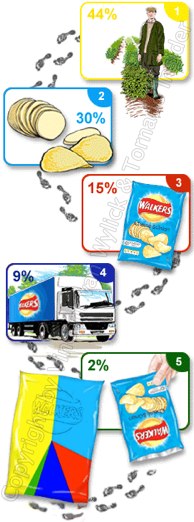 According to a carbon-emission calculation of PepsiCo's Walkers crisps, the majority of carbon emissions come from the production of raw materials (44%) and processing thereof (30%). A Dutch magazine, Tijdschrift voor Marketing, attributes the majority of the carbon footprint to transportation of said materials, and forms the conclusion that more and more production and consumption has to happen on a localised scale.
Even though the makeup of those figures may be open to interpretation—there is no breakdown about what in the first 44% is due to actual farming and what to transportation—perhaps, Mr. Kuiper, the author of that piece, has a point.
In a TED-lecture, James Howard Kunstler argues that the 'hydrogen-economy' is a pipe-dream and we must start thinking about creating urban environments fully equipped with the means of production, transportation, living, and waste-disposal, all in one. Very inspiring, though clearly requiring significant paradigm- and resource-shifts from today's globalised economy.
Clearly transportation comes at a cost, the question is how much the alternative would cost. Building super-farms, creating artificial climates to grow exotic food, waste-disposal, dealing with virus-outbreaks—regarding the latter, farmers already have problems dealing with chickens, sheep, and cows now, let alone having to deal with something like Kunstler's utopian vision—all of which represent costs that have to be accounted for.
But, I don't want to sound like a pessimist. I actually love the idea of a super-farm and a super-urban environment, regardless of the monetary cost. I'm sure plenty a sci-fi artist has tried to draw such a very thing (as have I). It's complicated, expensive, but exciting at the same time.
Asking you a tough question: How would you do it? What would a Kunstler-inspired localised economy look like to you? Is it even possible? … well, something to think about anyway…
Premise of this post: I'm going to get my camera fixed, for the second time in 3 weeks, at a store called Saturn. It is, as far as I know, the only other German chain focussed on consumer-electronics in the Netherlands, next to Media Markt, which is clearly the no. 1 here and in Germany. Ironically, while they appear as competitors to the consumer, they are owned by the same concern, Metro Group.
Now, I don't know the exact reason behind internal store-competition. The only company I worked for, where something like this was the case, was Sony, who allocated annual budgets to individual departments based on their performance. Reminds me a lot of the way governments are run. Of course, bureaucrats have a job for life.
While I was at Sony, I've never seen so many departments closed and managers fired, and both physical locations where I worked in Germany & the Netherlands, are no longer in existence. To a large part, in my opinion, this explains the troubles that Sony is in today, many of which are a disconnect with its audience and, very likely, caused by disconnects within the gigantic company also. But… that's a story for another day.
The other area where I know about examples of internal competitions, are product-lines. Didn't Steve Jobs once say (paraphrased): "If anyone should take marketshare away from one of our products, it should be Apple." I think that this is a conscious decision of Apple and I briefly touched upon it at Tech IT Easy, in regards to form-factor of the Macbook Air (MBA)—the screen, hard-drive, and CPU, which very much overlap with (read: fit into) other products that Apple sells, and, to me, represent economies of scope and scale to the company. It doesn't matter if the MBA sells or doesn't, what matters is that component costs will go down and innovation will go up, which is good for Apple.
Now, none of this really answers the questions why Saturn and Media Markt occupy the same market-segment. And, I have to confess, I just opened my Retail Marketing book to find the answer, and couldn't find it (the book is apparently not focussed on business strategy much).
Both Media Mark & Saturn offer similar features to customers, which are mostly represented on the chart below: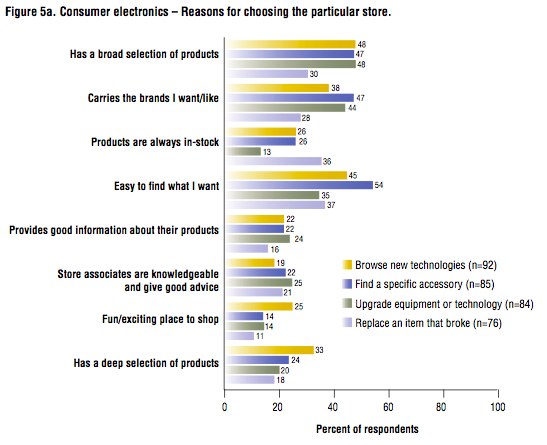
(Source: IBM white paper - "Deeper Customer Insight," which I wrote about several times before)
Some differences are perhaps that Saturn was most often located within another Metro Group-owned store, called Galeria Kaufhof, though I think they are changing that strategy in Germany, and certainly in the Netherlands, where they are stand-alone. Media Markt, as far as I know, has always been stand-alone. Both facilities are rather large, offer parking-facilities, and are usually located within the city (though in Rotterdam, Media Markt takes a more prominent place). And prices, promotions, and brands, while similar, differ in certain areas.
From this, I think it's safe to conclude that market-saturation is a clear goal of Metro-Group. By giving customers not one, but two large options, with separate deals to be had, at separate locations, etc., it appeals to an implicit customer-demand, that of choice, and takes attention away from other, "lesser," and certainly not Metro Group-owned choices.
Something else that is interesting, is mentioned on both companies' websites. Both chains are very decentralised in their management-structure. Every store acts as a self-sufficient enterprise, co-owned by each director, who, with his/her team, is responsible for how the store is run, and ultimately, how successful it is. Kind of sounds like a franchise.
So, I can only conclude that the internal competition paradigm is very much similar to that of Sony's, to force individual stores to perform better.
I think it's an interesting strategy and clearly Metro-Group is the winner here. How this plays out for individual stores and their share-holding directors is uncertain and clearly depends on the skill-level of store-management and the level of support given by their parent-company.
 I'm spending a lot of time with a friend this week, who runs a start-up in a developing (2nd world) country in the lifestyle-food sector. I won't mention his name, his company or focus, or his country, nor anything confidential, because I don't want the information to be used against him. Instead, I'll talk about some general principles, that I've identified.
The irrelevance of business-literature
We both studied at Rotterdam school of management (sometimes known as Erasmus), and spent some time there last night. Funnily, I came across an article in a university-published journal identifying 6 traits of leadership to ask for in the "new" workforce. Keywords included: ethics, diversity, global outlook, tech savvy, adaptive capacity, and the X-factor (charisma?). I asked him, as a joke, which he thought applied to him. Global and adaptive, he responded. The rest meant virtually nothing to him. As a start-up, I guess, you have to do what you have to do, to stay alive.
The advantages of 2nd world start-ups
I distinguish between 1st world (e.g. the Netherlands), 2nd world (e.g. Brazil), and 3rd world (e.g. a large part of Africa), when I look at countries. 1st world countries are mature in their development, 2n world countries are not yet mature, but their economies are growing pretty fast, and 3rd world… well, I'm pretty depressed about that, though sometimes there's surprising pockets of entrepreneurship and innovation.
The advantage of a fast growing economy is that people are still figuring stuff out, meaning there are a lot of inefficiencies and gaps in the market. Another advantage, in his country's case, is the interests of governments in boosting those economies. If your innovative, the grants you receive may be both easier to get and larger in size than anything available in 1st world countries.
For start-ups, another advantage is that you can look at what works in a 1st world country and use that for your own business. This principle is not exclusive to start-ups, it's also relevant to the innovation race between Europe and the US, for instance.
The costs of educating a market
My friend operates a lifestyle-food start-up, as I said. One gap in 2nd world markets is usually that that segment is underdeveloped. But, if the economy is booming, wealth is increasing, and that certainly has a positive effect on the luxury-market.
However, when you introduce a new product to a market, you'll have to build the market up first. There are various approaches to marketing, I'll just go into the one that my friend used.
Essentially, you want to get your products into a supermarket, and you want people to buy the food. Sometimes one, sometimes both will take some convincing. In the beginning. he spent a lot of time in supermarkets, getting people to taste his food. After that went well, he could use that success to convince other supermarkets to become customers also.
Two advantages of supermarkets: they usually have pre-written contracts for suppliers so you don't have to draft them yourself. And they sometimes operate in chains, which makes it easier to get larger customers.
There's two further things to do with food, to make customer-adoption a little easier. One is to sell it in an easily digestible fashion, e.g. a snack. Two is to not do so, and instead provide customers with instructions to prepare the food. You could do this on the packaging, a website, and even more drastically (can't mention what). My friend is pretty active in this area.
Another problem with 2nd world countries is that, while your food may be part of a lifestyle in the 1st world, it's close to impossible to lead that lifestyle over there, because all the components are not there yet. So, in fact, you don't use that lifestyle as a marketing-term. Instead, focus on health-advantages, as that is often the underlying driver for such demand.
Still, even after more than a year, my friend spends about half of his monthly expenditure on marketing—which goes through a marketing-agency that designs the brand, the colours, etc.
Global outlook?
As a start-up, you have to work within certain boundaries: limited money, staff, production-facilities, time, etc.
The clients for a food-company may very well be supermarkets, which, as I mentioned, have the ability to buy a lot. My friend is expanding into other countries, but he's carefully picking the ones that don't exceed his capabilities.
He prefers a fragmented market, where he can concentrate on a one or two chains at a time, not a market where there's national chains that could bleed him dry.
Related to this, fragmented markets are usually underdeveloped also, so in fact he is exporting to countries similar to his own. That, at least, is as theoretically expected.
Theory, schmeory.
While there are certainly concepts that can be found in a number of different fields, ranging from entrepreneurship & strategy, innovation, supply-chain management, and marketing, it remains a matter of being practical, and specific to the business.
Entrepreneurship is a 60-80 hour / week job, usually. You don't have time to check out business-journals, etc. to do your job.
P.S. his business-plan was 2 pages long.
And those… are the facts of life. More, if I can think of it. The picture is completely unrelated to his product.
How being in the right place at the right time translates to entrepreneurship
0 comments Posted by Unknown at 12:53 PM If there's one I thing I learned from my thesis it's that everything is part of a system. Most often, this system's purpose is to shift resources from and to various interconnected, yet diverse and complementary parties.
In regards to entrepreneurship, and pretty much everything else, I have a philosophy: everything happens for a reason, usually related to how you respond to opportunities. And to bring it back to that interconnected system, being in the right spot, where you can intercept flows of ideas, people, and resources, tremendously increases the chances of you finding the right business to be in.
Two examples
Two people that are fairly close to me are perfect examples of that phenomenon. They shall remain nameless, for obvious reasons. They are both pretty bright, but what contributed to their lives most, is being where it mattered.
One of my friends did a very smart thing. We studied together and when he moved back to his Eastern-European country, he noticed that a lot of traffic was coming in from the European Union, in terms of regional funds aimed at bringing the country up to par for future integration.
So he started a consultancy with some friends, to advise companies on how to apply for those funds. Initially, he thought it might just be a hobby. But what actually happened was that a lot of traffic was coming in terms of companies—start-ups, looking for funding. And it allowed him to find a business to buy into, which was well-postioned to fill a current need, and had the capabilities, but not the business expertise to succeed.
A second friend of mine was also someone who I knew would always start his own business. But he did the smart thing when he graduated (actually he did several smart things before too). He got a job at a corporation counselling start-ups on how to deploy that corporation's technology. So, just like my other friend, he got a lot of traffic in terms of ideas and people, and all he had to wait for is the right idea that would fulfil a niche in the market. And bingo. I'm not sure if he planned it that way, but he's now the founder of a start-up, filling up a need.
Underlying principles
Right places matter, but so does mentality and a number of other factors. It's not enough to just be there. The reason you are there is because you are of value to whatever network you are part of. Following are I think some factors to consider:
- Be open to opportunities
- Make strategic choices about your initial placement
- Be of value to the network you are a part of - that means being an authority, which means you have to have some schooling
- Make strategic choices about the start-ups that you encounter - are they filling a gap in the market, can you fill a gap in their organisation?
- Go back to your initial network - analyse whether all the elements necessary for success are there—smart people, funding, exit-options, technology—and can be carried over.
- If yes: launch and succeed.
I always knew I wanted to start a business. Plenty of people at plenty of times, have counselled me to just jump in and do it. I didn't, because I felt the alignment wasn't there—between me, a business, and a need.
The way I'm visualising my path into this industry is among similar lines. Become a valuable resource myself. Find & build a network, where I can contribute value too. And then decide, based on timing, technology/idea, people, market-niche, and other elements needed for it to be a success.
Note to the reader: I'm still processing a lot of material I want to write about. Most of it is food and/or retail related, I promise. Expect at least two posts related to IKEA this week, on economics, design, branding, and customer-retention schemes.
 A few months ago, I wrote about Starbucks' vertically integrated strategy. This morning, i wanted to link to it, so I did a Google Blog-search. Usually a search for Starbucks and "vertical integration" would yield my blogpost first, but now it's the no. 2 result.
Somehow, the net has started discussing why Starbucks had a corporate strategy that involved owning all of its subsidiaries and Subway's strategy went a different way.
There seem to be a number of theories on the market. Namely that Starbucks
- … cares less about cross-store cannibalization
- … has a higher need for monitoring
- … relies more on “impulse sales”
- … has higher profit-margins
Some good posts about this are written here and here (both by Josh Wright), here (Stephen Bainbridge), here (Keith Sharfman), and here (Paul Jaminet)
All excellent theories in their own right, and all very rational. However, in my experience, people, and we are talking about people here, often don't behave rationally (at least not as rationally as economic theory dictates). Instead they behave in ways that they are able—either through innate capability or through their environment.
Starbucks did not start as retailer, it did not even start as a store owned by Howard Schultz. It was a coffee-bean roaster and vendor. Its aim was to educate the US-population, which was—according to Schultz—a wide open market in terms of high-quality coffee. Schultz, who first worked there as an employee, started an independant coffee-chain, and only a few years later took over the Starbucks-business (incl. the roasting factory) and the brand-name. But the core-idea remained that it had to deliver quality-products and quality-education to its customers. Along with this, Schultz was highly educated, had plenty of work-experience, and venture capital behind him.
Subway started as a retailer. According to the history, published on their site, Fred DeLuca started Subway's as a 17 year-old and $1,000 starting-capital. Subway had, as far as I know, no world-changing mission. It was a sandwich-store, one of many, and one of it's key assets was to be more efficient and qualitatively better than its competition.
I still think that the stories of these two men, their business-idea, and the environment they started it in, is the key-deciding factor of why one decided to expand wholly-owned and the other through franchising. I haven't studied Subway, but I have McDonald's, and the same dynamic can be witnessed there.
Now, you can go all "economic theory" on this, and focus on points like that coffee is a product that requires much more monitoring than sandwich-ingredients. And I think that's completely correct. Not to mention that Starbucks has a very different employee-based strategy than Subway—they like theirs to be smart and pay them well. And I also think that due to Starbucks's high real-estate presence, franchising for them has become an unfeasible solution. But I think the first two factors are the cause and the latter is the consequence of Starbucks's wholly-owned strategy.
When you start out, whether to franchise or not is a completely personal decision. It comes down to how comfortable you feel about whether you can offer your customers the highest quality possible, while maintaining healthy economic growth.
And your initial decisions will clearly have some kind of lock-in effect later on, which is something I only realised after reading the linked-to blogposts and writing my own.

 The
The 


