Last weekend, the Dutch financial Times, FD.nl, had an interesting part-article / part-diary of Henk van der Doelen, owner of a chain of ca. 30 drugstores in the Netherlands. Originally part of a franchise called DA (2nd largest in the Netherlands, afaik), he and several people decided to split because of restrictive conditions. I've followed this story for a while because I'm interested in franchising, and because drugstores are big business in the Netherlands (market-size: ca. €3,5 billion), probably due to its trading history in spices and herbs.
His company, Drogisterij-parfumerie, was founded in 1970, has 270 employees, 29 branches, and an annual revenue of €23 million.
The business also employes a franchise-formula, called 'Pour Vous' (Dutch link), which has existed since 1975 as a soft franchise. It asks a monthly marketing-fee of €250 and / or (this part is unclear) €7000 per year for commercial and marketing-related activities. Total innital investment to join the formula is estimated at €300.000.
I created the colour-coded picture below out of curiosity. How exactly does a retail-chain owner divide his time? Naturally, one week's activity should not be generalised across greater periods or different businesses, and I probably mislabelled some activities. But you can let me know that in the comments. ;-)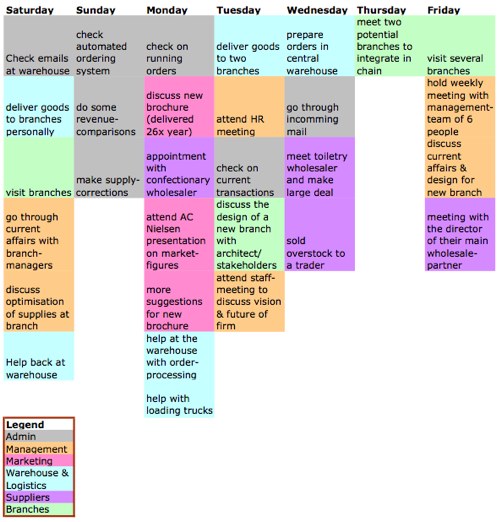
What is interesting is that there is a fairly even division of activities, apart from maybe marketing. From the article, I did get the sense that he was more focussed on warehouse-actitivities, also living close to the central warehouse, but he pretty much kept his finger in all the relevant pies for running a business of this sort.
What is also interesting is that he essentially plucked out a number of franchisee-branches out of DA's franchise-network and created his own. In the sense of whether franchising is entrepreneurship or not, I do think that this again confirms that the options remain wide open. This story also sheds a light on what can happen if a franchiser's policies are too restrictive for franchisees.
From my understanding, DA has been making moves towards a more integrated strategy, which did not sit well with many franchisees. Apart from the ca. 30 branches that Drogisterij-parfumerie took with it, another 40 left to join D.I.O. (4% market-share). This still leaves DA fairly strong, with 452 branches and 15% market-share, behind the number 1 in the Dutch market: A.S. Watson (Kruidvat, Trekpleister, and ICI Paris XL) with 877 branches and 40% market-share.
Just some finishing up on the IKEA-book. Following graph describes the structure of IKEA's business, as far as I understand it. 
1: Stores - The way the company expands horizontally, is through a tightly controlled franchising system. This both saves costs and minimises international risks.
2: Sales & service - the company is tightly integrates its sales- and service-operations with customers, the latter taking over 80% of the work (and loving it). Huge cost-savings, also benefiting customers.
3: Supply, manufacturing, design - The company is equally well-integrated back up the value chain, with suppliers, manufacturing, and design, and has—since the 90s—been expanding its operations in that direction. Some cost-savings by introducing savings up the logistics-chain, and more flexibility in manufacturing.
4: Management structure - non-public virtual entity that licenses the IKEA brand and is able to offset international tax-differences by being located in Belgium/the Netherlands and changing the terms of licensing-agreement as needed.
You can draw your own conclusions from that, together with what I've written before.
Things that stuck out from the book included:
- Ingvar Kamprad, the founder, who has both a trader's mentality and is at the same time a community-person;
- Sweden, IKEA's country of origin, whose restrictive tax policies actually resulted in pushing the business to become a global company;
- IKEA's cost-philosophy, which is very frugal and part of the company-culture, and also transmitted to the supply side and to customers. Some problems retaining top-employees as wages are not competitive;
- Its franchising-system, which somewhat surprised me, can be explained by the scientific way in which IKEA's operations has been built up. The more rational, the "easier" (a relative term) to replicate. It's also in line with the business's rapid global expansion and its drive to push down costs;
- It's a private company, which makes it less visible and (relatively) less accountable to the public.
- Its vertical integration with suppliers and customers, enabling it to quickly respond to new trends and problems, as well as introduce higher cost-savings than its competition.
P.S. I'll be taking a few days off, to recharge some creative energy.
 I've long been interested in the idea of franchising, though I'm somewhat conflicted about how to look at it. One the one side, it seems* like a relatively easy way to start a business, on the other side, it seems* a relatively cheap way to grow your business (*: within limits).
WSJ recently published an excellent study on high-performing franchises in the US. The choice of franchises is extensive, just like I concluded in my post on top-German franchises. At the same time, the most apparent choice, that of food, seems less and less attractive, and I quote from WSJ:
In particular, fast-food and casual-dining businesses, while still showing strength, with eight names on the list, also are facing pressure from wage and food cost increases. To lower operating costs, several food franchises already are shuttering some locations.Arguably, a business that is thinking about growing through franchising is faced with some restrictions. Writing a franchisees-manual is a scientific process, you'll probably have to restrict the complexity of operations so that they can be replicated, and there will still be some overhead related to managing the brand and some of the more problematic franchisees.
I think that it is that standardisation of operations, made big through the economies of scale so easily achievable in the US, that is bring competitive problems to chains, even to wholly owned ones like Starbucks. If your core-product is simple, and your business uses a simplified operation, then how hard is it for your competitors to replicate your whole business-model and -strategy in the long-term, really? It is only if your business strategy includes complex competitive advantages, such as extensive vertical and horizontal integration across the value chain, and/or if your business-model is based on "high-tech" components or processes, that you have a real chance of beating the clones. And to relate it to the rising operating costs, mentioned above, business with true competitive advantage can raise profit-margins or off-set the costs elsewhere, instead of having to close operations.
But ok, long-term strategic considerations aside, I see franchising is an attractive way to enter the business-world as an entrepreneur. The question of whether it's faux or real entrepreneurship, is not pertinent, I think. Considering that you have a wide range of choice of franchise-business opportunities, you'll still have to work hard to succeed, and the growth-opportunities can include starting multiple franchises also, it is not that different from starting any other kind of business. In my mind, I compare it to internet-entrepreneurship, which also relies on a large amount of free tools and distribution-mechanisms, but is still dependant on that special something for it to be successful.
What makes franchising particularly attractive, is the decreased amount of risk. According to a study in the Netherlands, 65% of franchises are still standing after 3 years. Compare that to independent start-ups, of which only 15% are alive at that time.
A large cause is, I'm sure, the level of support from the parent-company, which differ from business to business, and can include delivery of goods, marketing, administrative and IT services, made cheaper through centralisation. And they are frequently guided through the process of setting up and running the business, including legal advice. In exchange, they give away either a percentage of profits (ranging from 5 to 40%) or a set monthly sum to the franchiser.
The WSJ-article also lists the amount of investment typically needed to start a franchise. It ranges from ca. $5200 for an automotive company, to a staggering $1,3 million for a steakhouse. Of the 25 franchises recorded, only 5 received some kind of financial assistance (none of which in food). Another article at WSJ discusses some of the attitudes towards financing franchises, particularly during the current US-recession. Incidentally, another article in Dutch Elsevier magazine, sees franchising as an excellent way for businesses to grow during a recession, as it requires less human costs.
All in all, it is probably a safer way to start a business, though with all the points I made above, I don't think of it as 'light' entrepreneurship. There's clearly a lot of risk involved, beforehand, in terms of choosing the right franchise with growth-potential, financial risk to fund your business, market-risk, when you launch, and competitive risk, after your up and running.
I still want to discuss this topic further at a future date, particularly focussing on what its like to turn your own business into a franchise, and some other stuff related to buying into one.
The picture is courtesy of friendlyfranchising.com
 I'm still following my tradition of looking back at what I covered and processing it into a blogpost. The general aim is for me to process the stuff I wrote about before, and give a reader some compressed value of an otherwise unforgiving linear medium. Time waits for no-one.
Why did it take so friggin' long?
For Months 1 & 2, I did so on a monthly basis. Later on, I was interrupted for study-related reasons, so hereby a 3 month summary (though only about 6 weeks of real activity).
Now, if month 1 can be categorised as a focus on market research, design, core-values, the value chain, and trends in FnR, and month 2 on human resources, business strategy, branding & marketing, innovation, and finance, months 3-6 aimed at news & trends, operational issues, marketing & branding, entrepreneurship, and strategy. Phew, what a mouthful… this is going to be a long post, so let's get started.
Micro-topics
Following three headings cover, what I call, micro-topics. They delve into specific situations (news & trends) or issues in running a business (operational, branding & marketing).
News & Trends
I noticed a decreased focus on news these months, simply because I didn't want to re-blog other people's stuff, and found conceptual lenses, and micro-topics more interesting. Also, my links often covered some news, as do my continuously updated bookmarks.
Nevertheless, I tried to identified some trends, namely private labels, organics, and SEPA, which I discussed at some greater depth. For Private labels, I looked at what regions and product lines were doing best, and came to the conclusion that there's huge potential in terms of lifestyle-products and offering higher quality goods than manufacturers can, simply because of the savings in marketing. I discussed lifestyle in a number of other posts, but I will go into those later on.
For organics, which has seen a huge upsurge in the last 5 years, I remain bearish, simply because I see it as a very inefficient, resource, and human-intensive process, that, in combination with the high energy-costs and rising food-prices, may not appeal to consumers increasingly shrinking wallets. That said, innovations are usually inefficient at the start, organics fill a certain need, and more automisation in such production-methods may dissolve many of my arguments.
I also looked at SEPA—the single European payment area—which was just launched (and you should be seeing an option to pay via SEPA in your internet-banking site now). Arguably the most boring post, I've ever, ever written (well, there are some contenders), but since I want Europe to be a single market so that businesses can finally benefit from the same economies of scale as the US, China, India, and Brazil, I thought it be important to discuss it.
Microscopically, and just for fun, I also identified some trends in terms of cinematics, beers, and pie, as well as a changing perception of expertise (more on this when I discuss entrepreneurship later on).
Operational
A second focal point was on operations of food & retail-outlets. I'm fascinated by optimising internal processes of businesses, so one of the topics I focussed on was whether it would be possible to use lean Toyota principles in a Food / Retail environment. I think it is, but at the same time, should not act as a replacement for customer-service. Granted, competition is fierce and any cost-savings should be welcomed, but the differentiating factor should be the amount of cherries on top: service-quality, product-quality, etc. I still need to read the book, though, and I definitely have more to learn/write about this subject.
I also looked at real-estate, fairly extensively, though some topics for future exploration remain. Clearly one of the biggest pains for FnR-venues is location, location, location… (it is also an inherent strategic component to large franchises like McDonalds) and I started with looking at structuring search and using checklists. In a second post I looked at the competitive/cooperative context of choosing a location, and in the third post, I looked at a number of costs that are part of the location choice.
Marketing & Branding
M & B is a continuous micro-topic of mine, even though I don't consider myself a marketeer. Two of my favourite topics include "the service paradox - on self-service and customer-rentention," which discusses the strangely liberating effect that no service has on today's individualised customers and positively affects their loyalty in return… talk about an eye-opener, for me at least… and "Lifestyle products - the costs of educating a market," which looks at the significant marketing-costs associated with starting a company in an unmapped market. As for the latter, I'll definitely be writing more about the particularities of lifestyle-products pretty soon.
The other three topics were interludes—hence the reason why I don't consider myself an expert. I wrote about how much of marketing is based on arguments, how arguments are often designed to distract or confuse an audience, how the consumer is overwhelmed with them, and how their value is ultimately decreased drastically. Very abstract… I also proposed that this is exactly why simple products work exactly so well: kill the argument.
Two more interludes include a review of Malcolm Gladwell's books, which both offer great insight into how people think (and how to market products), and I re-blogged "a marketing plan in a nutshell," kindly provided by an MBA-student at MeFi, which should be useful as a general reference.
Macro-topics
Following are topics that are core to what I write about: entrepreneurship and strategy. The first aiming at starting, running, and growing FnR-related companies, and the second at the bigger picture: taking an industry-perspective, how to interact within the context of a value-chain, core-pains, etc. There is also considerable overlap between the links I discuss now and those that came before.
Entrepreneurship
Looking at my eship-posts, I found that I often take a more personal stance at issues, compared to other disciplines. I think that's related to that the human element is stronger in these businesses, something I found out from speaking to many start-ups, incl. ca. 300 start-ups for my thesis.
In "The business of HoReCa - Hotels, Restaurants, Cafes," I discuss the issue of semantics in regards to choosing a vocation, and the perspective of my father, who helps me think about this area a lot. This is somewhat contrasted by my post on my own generalised (vs. specialised) look at the food & retail-industry, in the sense that I care more about the big picture (for now at least). I'll come back to this in the future, I'm sure.
In my post on "lifestyle-products," which I mentioned before, I also try to approach the topic of starting such a business in a second-world country, through a friend's eyes. Similarly, my post on "How being in the right place at the right time translates to starting a business," takes a very personal, and perhaps subjective approach to the issue.
Some micro- and just-for-fun topics include the "10,000-hours-to-be-an-expert rule," in which I identify a trend that's pretty similar to crowdsourcing expertise. On Tech IT Easy, Georgia Psyllidou discusses a similar phenomenon about how people can find work nowadays, and I think I will approach this topic again in the future. Call it semantic, crowdsourcing, open innovation, etc., but the world is changing, it is getting flatter, which has both implications to finding human resources, as well as distributing knowledge. For instance, in a recent article on HBR, the topic of authentic leadership is discussed entirely from the perspective of 1000s of examples. Worth a read and thought-inspiring!
Another fun topic was the Lowest Common Denominator (LCD). I first approached this abstractly, while under thesis-stress, but I find it a useful way of thinking about simplicity of action. What is the simplest, most basic feature that your product needs, that your strategy needs, that your company needs to work? Later on, I explored this again concerning my friend's lifestyle-business.
The strategic lense
Strategy has always been difficult to conceptualise, I felt, because there's strategy to everything—war, running a business, running your life, getting the girl, etc. That's perhaps the reason why I never got around to writing a thesis for it, and chose entrepreneurship instead.
I discussed IKEA a number of times in my blog, and one strategic issue I approached, were the early years of growth for the company. My philosophy concerning business is that, generally, "where you are from and when you are from matters a great deal to where you are going," and the same applies to IKEA. Of course, IKEA went far beyond Scandinavia, and I hope to get around to discussing the later expansions the company went through.
Amazon & Jeff Bezos was another topic, in which I wrote about Amazon's approach to innovation (very customer-focussed) and Bezos' transformation from entrepreneur to CEO (from micro to macro, challenging for many).
Another topic was the growth strategy of Starbucks (wholly-owned), vs. that of Subway's (franchise), which is clearly receiving a lot of flack these last months. In the article, I commented on some of the reasons given by other smart people, about why these strategies differ. Some good economical reasons were given, however, none, I felt, went into the roots of the issue. Two factors affected Starbucks' strategy: the roots of the business and the roots of the founders.
Somewhat related, a few weeks ago, i discussed the intriguing strategy of Metro-Group, which has placed two electronics-chains into the European market, Media Markt vs. Saturn, seeming to everyone as competitors. Turns out they are the equivalent to a franchise-system (though certainly a more complex one than Subway), which I think are meant to saturate the market.
Some just-for-fun topics included another post on the lowest common denominator, which I felt was a good lens through which simple strategies can be designed; two posts (1 & 2) about big pains the food-industry is feeling (and which ties into my post from yesterday; and why fitness studios are employing such restrictive contracts, which I felt was caused by either an inelasticity of demand or because they were in trouble.
Clearly a number of other topics fit within the strategic paradigm, but I'm not going to discuss them here.
Wrapping up
What about those Sounds?
I'm considering dropping the "Sounds" from S+FnR, however, it is still a very strong topic in the back of my mind as I'd like to work in venues where people dance… No, seriously. The way I'm looking at it is that I have to focus on certain basics first, and music & media will eventually pop up. So the title stays as it is.
Final thoughts
The nice thing about blogging is that you can measure your progress. I measure them both by readers, by feedback, and by my own perception. During the first months, I was very much in the dark about this industry, and to a degree, I still am. But I notice that things start making more sense, there is a certain logic to how processes work, why certain business models are chosen, etc. So, mentally, for me, there is a certain growth and I hope I can continue at that rate in the future.
I'm still on a certain trajectory in my mind, regarding the amount of secondary and primary activities I have to do to reach new levels. On the latter front, I definitely have a much better idea of where I want to go, after having blogged/thought/discussed about these topics for so many months.
That is all! I can enjoy my weekend, enjoy yours, and until next week.
Premise of this post: I'm going to get my camera fixed, for the second time in 3 weeks, at a store called Saturn. It is, as far as I know, the only other German chain focussed on consumer-electronics in the Netherlands, next to Media Markt, which is clearly the no. 1 here and in Germany. Ironically, while they appear as competitors to the consumer, they are owned by the same concern, Metro Group.
Now, I don't know the exact reason behind internal store-competition. The only company I worked for, where something like this was the case, was Sony, who allocated annual budgets to individual departments based on their performance. Reminds me a lot of the way governments are run. Of course, bureaucrats have a job for life.
While I was at Sony, I've never seen so many departments closed and managers fired, and both physical locations where I worked in Germany & the Netherlands, are no longer in existence. To a large part, in my opinion, this explains the troubles that Sony is in today, many of which are a disconnect with its audience and, very likely, caused by disconnects within the gigantic company also. But… that's a story for another day.
The other area where I know about examples of internal competitions, are product-lines. Didn't Steve Jobs once say (paraphrased): "If anyone should take marketshare away from one of our products, it should be Apple." I think that this is a conscious decision of Apple and I briefly touched upon it at Tech IT Easy, in regards to form-factor of the Macbook Air (MBA)—the screen, hard-drive, and CPU, which very much overlap with (read: fit into) other products that Apple sells, and, to me, represent economies of scope and scale to the company. It doesn't matter if the MBA sells or doesn't, what matters is that component costs will go down and innovation will go up, which is good for Apple.
Now, none of this really answers the questions why Saturn and Media Markt occupy the same market-segment. And, I have to confess, I just opened my Retail Marketing book to find the answer, and couldn't find it (the book is apparently not focussed on business strategy much).
Both Media Mark & Saturn offer similar features to customers, which are mostly represented on the chart below: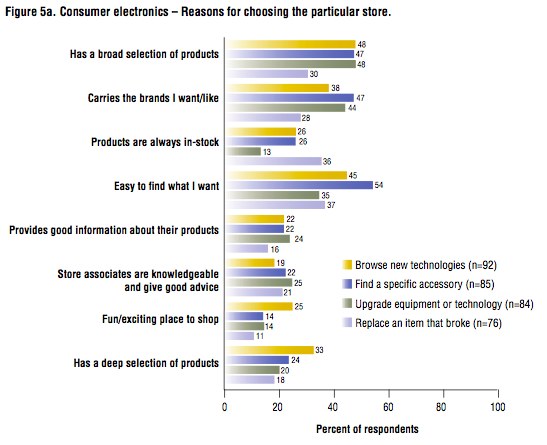
(Source: IBM white paper - "Deeper Customer Insight," which I wrote about several times before)
Some differences are perhaps that Saturn was most often located within another Metro Group-owned store, called Galeria Kaufhof, though I think they are changing that strategy in Germany, and certainly in the Netherlands, where they are stand-alone. Media Markt, as far as I know, has always been stand-alone. Both facilities are rather large, offer parking-facilities, and are usually located within the city (though in Rotterdam, Media Markt takes a more prominent place). And prices, promotions, and brands, while similar, differ in certain areas.
From this, I think it's safe to conclude that market-saturation is a clear goal of Metro-Group. By giving customers not one, but two large options, with separate deals to be had, at separate locations, etc., it appeals to an implicit customer-demand, that of choice, and takes attention away from other, "lesser," and certainly not Metro Group-owned choices.
Something else that is interesting, is mentioned on both companies' websites. Both chains are very decentralised in their management-structure. Every store acts as a self-sufficient enterprise, co-owned by each director, who, with his/her team, is responsible for how the store is run, and ultimately, how successful it is. Kind of sounds like a franchise.
So, I can only conclude that the internal competition paradigm is very much similar to that of Sony's, to force individual stores to perform better.
I think it's an interesting strategy and clearly Metro-Group is the winner here. How this plays out for individual stores and their share-holding directors is uncertain and clearly depends on the skill-level of store-management and the level of support given by their parent-company.
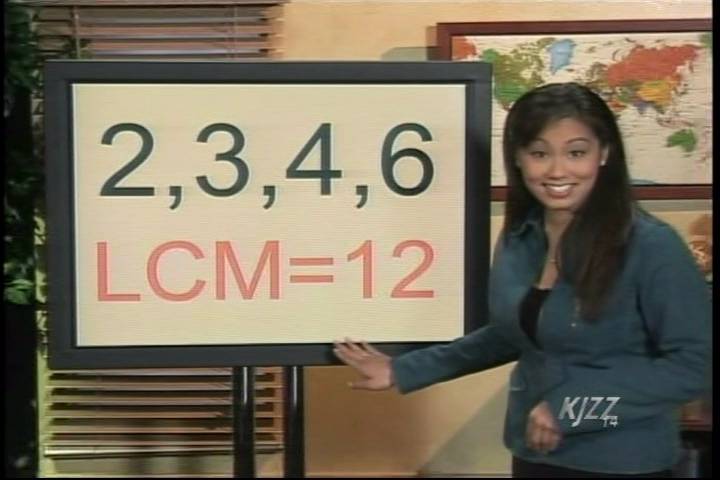 I like maths. I wasn't always good at it, but I've always tried to push forward in it, because I consider it a language, just like any other one. The reason I like maths is because it allows you to communicate in simple terms.
One of my favourite concepts in maths is the lowest common denominator (LCD). It brings complicated things down to a communicatable level.
I think that in life common denominators are very important. When growing, what is the simplest thing you need to do to achieve that? What qualifies success? What does your brand constitute of? What is culture? Etc.
Now in many cases the LCD can be something like people, money, quality, but the question again becomes what the LCD of e.g. people is. Is it effort? Is it education? Is it a skill-set? Is it training? You can always bring it down a level until you reach the point where you can in all essence write a manual for it.
And at times there are things that you don't want to bring down to the LCD. Love for instance, success, beauty, etc.
If you brought them down to the point that everyone could replicate the LCDs, then they would be nothing special. Still it helps to know for yourself what the LCD of love is. What makes you love a person, what makes that person love you? That's a tremendous knowledge to have. Similar to what makes you successful and what doesn't.
Food for thought…
The picture is courtesy of j-archive.com.
 A few months ago, I wrote about Starbucks' vertically integrated strategy. This morning, i wanted to link to it, so I did a Google Blog-search. Usually a search for Starbucks and "vertical integration" would yield my blogpost first, but now it's the no. 2 result.
Somehow, the net has started discussing why Starbucks had a corporate strategy that involved owning all of its subsidiaries and Subway's strategy went a different way.
There seem to be a number of theories on the market. Namely that Starbucks
- … cares less about cross-store cannibalization
- … has a higher need for monitoring
- … relies more on “impulse sales”
- … has higher profit-margins
Some good posts about this are written here and here (both by Josh Wright), here (Stephen Bainbridge), here (Keith Sharfman), and here (Paul Jaminet)
All excellent theories in their own right, and all very rational. However, in my experience, people, and we are talking about people here, often don't behave rationally (at least not as rationally as economic theory dictates). Instead they behave in ways that they are able—either through innate capability or through their environment.
Starbucks did not start as retailer, it did not even start as a store owned by Howard Schultz. It was a coffee-bean roaster and vendor. Its aim was to educate the US-population, which was—according to Schultz—a wide open market in terms of high-quality coffee. Schultz, who first worked there as an employee, started an independant coffee-chain, and only a few years later took over the Starbucks-business (incl. the roasting factory) and the brand-name. But the core-idea remained that it had to deliver quality-products and quality-education to its customers. Along with this, Schultz was highly educated, had plenty of work-experience, and venture capital behind him.
Subway started as a retailer. According to the history, published on their site, Fred DeLuca started Subway's as a 17 year-old and $1,000 starting-capital. Subway had, as far as I know, no world-changing mission. It was a sandwich-store, one of many, and one of it's key assets was to be more efficient and qualitatively better than its competition.
I still think that the stories of these two men, their business-idea, and the environment they started it in, is the key-deciding factor of why one decided to expand wholly-owned and the other through franchising. I haven't studied Subway, but I have McDonald's, and the same dynamic can be witnessed there.
Now, you can go all "economic theory" on this, and focus on points like that coffee is a product that requires much more monitoring than sandwich-ingredients. And I think that's completely correct. Not to mention that Starbucks has a very different employee-based strategy than Subway—they like theirs to be smart and pay them well. And I also think that due to Starbucks's high real-estate presence, franchising for them has become an unfeasible solution. But I think the first two factors are the cause and the latter is the consequence of Starbucks's wholly-owned strategy.
When you start out, whether to franchise or not is a completely personal decision. It comes down to how comfortable you feel about whether you can offer your customers the highest quality possible, while maintaining healthy economic growth.
And your initial decisions will clearly have some kind of lock-in effect later on, which is something I only realised after reading the linked-to blogposts and writing my own.
5 links to think - on Japan, designing experiences, globalisation, and endorsements
0 comments Posted by Unknown at 3:12 PM Really no shortage of interesting links this week, which is always nice. At the same time, it makes choosing 5 that much harder, but here goes.
- An Alien in Japan: Charlie Stross describes his trip to Japan last summer. …From Yokohama to Tokyo to Kyoto; …about shaved cats, getting lost in shopping malls, to Hello Kitty, and extreme bathing, to monorails and re-building history. A very interesting read, which presents some insights into that alien world, Japan.
- Blasting scents into coffee-consumers' brains: Roger Dooley explains the importance of environment to sensory experience, and describes how Nestle's Nespresso found their way into people's noses, brains, and hearts. In coffee, just as with good food and wine, scent is everything! Food for thought.
- Can experience be designed? After reading Bob Jacobson's essay, I'm not so sure. He writes about placing human experience into the centre of the design process, about systemic relationship between information and the environments (see above link as an example), about the difference between user- and human experience design, and how you can probably never design an experience to completely meet a person's expectations. At least, I think that's what he writes. So much of this text is far above my head, but worth reading to guide your mind into new directions, and a must-read for anyone interested in creating experiences. It's all a pre-cursor to a book, which, judging by the range of material, I expect to be published in 2 to 5 years, but which will be well-worth the wait. In the meantime, check out Bob's great blog.
- The downside of franchising: Richard Layman, in his artsy urban blog, writes about how franchises have transformed L.A.… into a clone of just about any other city. A little anecdote: I observed a similar trend when I was last in Belgrade, Serbia, which I hadn't visited since the war. It looks just the same as any other city, and that's sad because I remember there being a lot more authentic clothing- and food-venues. When I see this, I'm not sure I'm a fan of globalisation, or franchising for that matter.
- A twosie on Human brand-carriers (Sounds like a disease, doesn't it?): Two articles discuss this, one, by the NY-Times, on rock-stars and their interaction with brands. As one artist put it: "The barriers are changing and we as artists are making less and less money, and we have to get creative." At the same time, I have great sympathy for artists like Springsteen, Tool, and N.I.N., who refuse to corrupt their art. And another article, by HBR, on endorsements in sports, which is, at last count, a 100 billion dollar industry. I'm fascinated by this phenomenon, so maybe I'll write something about it in the future.
HBS Working Knowledge, in an article on lean principles in services industries, lists the four principles that the Toyota Production System is based on:
Rule 1: All work shall be highly specified as to content, sequence, timing, and outcome.
Rule 2: Every customer-supplier connection must be direct, and there must be an unambiguous yes or no way to send requests and receive responses.
Rule 3: The pathway for every product and service must be simple and direct.
Rule 4: Any improvement must be made in accordance with the scientific method, under the guidance of a teacher, at the lowest possible level in the organization.
I love stuff that saves me reading a whole book, but would this work in a food / retail environment? I can't say 100%, but I can hypothesise.
Let's take a restaurant or coffee-shop. The way I see the information-flow is in the shape of a funnel, which is wide on both ends and quite narrow in the middle.
(If the words are unclear, it's, from left to right, a. customers, b. information, d. goods, and b. production (though the last should be c.))
Essentially:
- customers have a ton of choice when they order
- they narrow down this choice to their selected items
- pass it onto the waiter
- who passes it onto a kitchen
- where another wide selection of ingredients is narrowed down
- and the end-product is produced
- which is again delivered to the customer.
Rule 1 - Specification of content, sequence, timing, and outcome?
Content is the stuff on the menu, which can be set to a limited number of choices, matching the availability of ingredients in the kitchen. Sequence are points a to d on the picture. Timing is an unwritten agreement between the customers and the food-place that their order will be delivered as quickly as possible. Outcome will be the satisfied customer (who will pay for his order).
Rule 2 - A direct customer-supplier connection / yes or no communication?
Again, this should be possible, by making the menu as transparent as possible and the kitchen organised to produce pre-specified combinations quickly. As for the direct connection, there are several ways this could be happening. A low-tech way would be a number associated with an item on the menu. Little miscommunication can happen on the way to the kitchen. One high-tech way being used right now is electronic notepads, which communicate with the kitchen or bar. I'm not a fan of it, because I think it erects a barrier (of slowness) between the customer and the waiter, but ok, it's a somewhat direct link. Another way could be to simply give the customer an electronic menu. It works online, why couldn't it work on a food-venue environment? The customer presses some buttons, the kitchen gets the order, the waiter delivers or the customer picks it up. Simple (but probably expensive).
Rule 3 - Simple / direct pathway for every product or service?
I'm a little confused by how this differs from rule 2, so I'll probably have to pick up the book after all… damn.
Rule 4 - Bottom-up scientifically co-ordinated improvements?
The key to successful growth is writing a manual / formula that can be reproduced over and over. If you can capture the components of quality that distinguish your venues from competitors, you can take over the world. What this rule means to me is that with a manual should come expertise, and this expertise should be used to train people from the lowest level upwards. The lowest level in the restaurant-scenario is the customer or the customer-interface. Placing experts in that vicinity, ensures a good bottom-up approach and improvements that are targeted at improving the customer-experience. This will also provide quick feedback about what could be wrong in other parts of the supply-chain, e.g. the communication, the timing, the quality of the food/drinks, etc.
Final thoughts
Now, of course, I won't pretend that these four rules are a replacement for me learning more about lean operations. I'll definitely be picking up The Toyota Way, to grasp the more subtle nuances. This was simply an exercise to see if lean principles can be applied to other—non-car—areas. I think they can. At the same time I don't think that leanness is necessarily an excuse for frugality either. It simplifies operations to focus on other areas instead, like e.g. improve the end-product quality for customers.
 It's time for another monthly summary (a few days late). This time, rather than the rather unattractive list-view which I used for my month 1-summary, I'm going to try turning the past month's posts into a little story. As I wrote, this blog is my way of learning about this industry, so let's take a look at what I've covered so far.
The Human element
I started the first post of month 2 with one related to self-development, and I kept that thread going for a while. This post was on the the way that leadership has evolved throughout society, from an individualistic to a social kind of leading. A lot of developments today, in business, politics, or other arenas, are so complex, that a form of collaboration is more constructive than tyrannical leadership. This is perhaps made clearest in in the example of Ikea and eBay, who—often by necessity—used collaborative methods to develop and introduce new features and innovations.
Again related to self-development, I also looked at particular careers in retail (with a nice chart) and in knowledge-based firms. Apart from simply researching the functions out there, my conclusions were that different roles require different talents, and that a manager/founder/entrepreneur should take care to surround himself with a diverse kinds of people. A similar point was made in a post on doing what you do best. Again, in the eBay-post, I discussed professionalising your firm quickly, by bringing in talent that can help in growing the business.
The strategic lens
A second big thread last month was business strategy. I started with the coffee-business, mentioning some examples like Coca-Cola, who is expanding into canned coffee, and Leonidas, a chocolatier, who is starting coffee-shops. Later, in two follow-up posts (1 and 2), I drew the conclusion that the coffee-arena is pretty crowded and that I wasn't sure if that was the best area to start a business in.
I also looked at the area of value chains and Porter's five forces, using examples like Ikea, Apple, and Amazon, and before that China and the issue of meeting it's exploding beef-demand. Generally, and the same applies to coffee, I think it's useful to take a horizontal and vertical view at how the industry is organised and find opportunities that way. In the case of China, which imposes some barriers to beef-imports, the answer was to import methodologies and grow beef on Chinese land. Other examples are mentioned in my five-forces post.
Another big topic is climate-change and it again helps to analyse this in terms of the value-chain, i.e. looking at all the internal and external activities related to your company and related to bringing value towards customers. And optimising those to take the cost of climate-change into account, which can later be turned into a significant competitive advantage over your competitors.
And I looked at some examples of Franchising in Germany, noting that retail is clearly leading in that field, and that a big challenge is to transmit tacit knowledge down your (largely decentralised) organisation.
Branding & marketing
Another large topic this month was the issue of customers, and how you market to them. IBM presented a nice white paper, of which I discussed the Well Curve as a possible methodology to understand the customer decision process, which was a second post on this topic.
I also looked at the way some business interact with customers, including T-Mobile and Harvard Business Review, and observed that conversational marketing is definitely a way to increase price-elasticity.
I have not looked much at food-business so far, but I did manage to discuss two restaurants: a pancake-place, where I discussed methods on how to make me remember its damn name, and a restaurant in Germany, which I thought received excellent advice in a show called "Rach - the restaurant tester," in regards to geographic marketing and building a brand.
Finally, even though my forte is not advertising, I came up with a—possibly stupid, but fun—idea on how to advertise a new concept coming to a town near you.
Innovation
Somewhat of a micro-topic, I looked at the way that music-media and money evolved and how that illustrated that customers love convenience, as well as how the Ford SYN-US was developed from start to finish. The latter is very interesting for thinking about what it takes to come up with new innovations.
Finance
Another micro-topic, which I will have to spend more time on in the future. I approached this in two posts. In the first, "other people's money," I reflected on some of the different types of investors there are and how some can add considerable value to growing your business. Also, in the eBay post, I looked at why it was so important for eBay to involve venture capitalists, even though it didn't need the money. The right kind of investor for your business will help you professionalise your business, by helping you find more talent, setting targets to meet, pressuring you to grow, and (hopefully) much more, all besides investing in your business, and taking shares.
Final thoughts
So, pretty diverse stuff I think, and while I could be writing more about food and retail—which will happen—I'm happy to have written and learned about all of these interesting topics.
For the future, I hope to look more at franchising, in-store activities, and particularly at supply chain topics, such as lean manufacturing, logistics, and anything dealing with the supplier-perspective. My future reading-list includes: The Disney Way, The Great Good Place, and The Toyota Way, as well as countless articles, pdf's, blogs, HBR-magazines, and so much more.
Well, here we are. Another month flew by! I enjoyed writing this post, and hope you enjoyed reading it too! For past coverage, you can check my slightly less aesthetically-presented month 1 summary. For more in the area of food and retail, I do encourage people to check my blog-roll on the right, and my bookmarks, updated 24/7.
The picture is an exercise of drawing a (my) hand in 5 min. or less.
 I just picked up the German magazine "Starting UP" (initial impression, so-so), which featured a number of stories interesting to me. One was the 30 top-franchisers in Germany. I'm a little confused by how they rank these things (English translation: annual growth-rate of franchise and nominal growth-rate), which resulted in some kind of numbering system, where the number 1 got over 3000 points, and the number 2 939 points. Actually, I'm more than a little confused, but it's probably too early in the morning to me.
In any case, the number 1 was Subway, which grew from 190 German partners in 2004 to 600 in 2007 (and got 3113 points). And number 2 is DATAC, which provides accounting-support and proprietary software. It grew from 312 partners in 2004 to 522 in 2007 (and got 939 points.. ah I see, nominal = probably company growth rate). I'll list some more in a second.
Unfortunately the article was very sparing with its analysis regarding what makes a good franchise, which I would've found useful. The advantages listed for Subway are however:
- Low initial investment (ca. USD 10k entry-fee; charges around 8% of profit + 3.5% advertising fee)
- Strong international brand (28343 partners in 86 countries)
- flexible venue-size (doesn't take up much space / can be take-away or seated)
- simple operation (no frying, etc.)
- large health-factor / range of ingredients
- A 2 week training
- Help with site selection
- Help with restaurant design (though I think personal taste is very limited)
- Help with equipment ordering
Back to the list. I segmented the list of franchises into what I considered their primary focus to be.
- Consumer-services: 4 (PC-Feuerwehr; Schulerhilfe; Agentur Mary Poppins; Stage-coach)
- Logistics: 1 (Fastway Couriers)
- Business services: 4 (Datac; Mail Boxes etc.; Im-Press Promotions; Ultimo)
- Food: 4 (Subway; Joey's Pizza; Blizzeria; Haagen-Dazs)
- Health: 5 (CC Calorycoach; Bellissima; Ruck Zuck; Curves; Alkromat-Patrouille)
- Retail: 9 (Engel & Volkers; Videotaxi; Town & Country; Harper & Fields; Mobilcom; Re/Max; Das Futterhaus; Tiroler Bauernstandl; Babyone)
- Installation-services: 3 (Twintop; ; Isotec; Scheibenglass)
There are other underlying factors in running a good franchise, which I will write about at another point. Important to realise is that just because a company grows fast, doesn't mean that it's actually a good company. Many franchises, in my experience, suffer from a lack of shared standards of quality, which can be overcome through a number of methods, but often suffers because of the lack of a centralised control over who works for the company and how they interact with customers.
I still think my last post on how to shift tacit knowledge into the explicit kind is relevant here (also the one on the knowledge-spiral), as what we are speaking of here is really similar. A company is not just the product it sells, but the values of the people, and how to communicate that down the chain is a vital skill for successful companies and franchises alike.
The picture is, if you're wondering, meant to display a room in which you have a choice of (food-)products to sell. Eh, yeah… I'll improve someday, I promise! ;-)

 The


