 Disjointed, because I don't have the time or energy to write a beautiful essay about empowerment—I'm not even 100% certain what it means yet. And in a way, by writing about 'empowerment,' I'm breaking the first rule, which is "Don't speak about empowerment." Or at least it seems that way. Currently, there's around 505,000 articles online about the term, which qualifies it as a hype and as such something that has already been discussed too much. But also, empowerment is basically about trust, a behaviour, and how can you talk about a behaviour, you just behave.
I think I first came across the concept, without even using that term. A few years ago, I read a book on ants, called "Emergence." It was a great book, I thought, about how ants at every level exchange signals, in the shape of pheromones, to indicate what they were doing and whether they needed help. A completely decentralised organisation, and the only thing the queen needed to do was produce babies, which, equivalent in business-talk, is, I guess, take care of human resources. I was so excited about it, that it became a research proposal for my master-thesis in strategic management, and was very quickly rejected, as I guess I hadn't related it well to strategy.
I again came across the concept last week, after reading an interview with the then-CEO, Dennis Bakke, and the then-chairman, Roger Sant, of AES, a power-company, which was, at least at the time of the interview (1998), very big on empowerment. And it seemed to work pretty well for them, if you look at their share-price, it rose pretty steadily up to 1998, and even more up to ca. 2001. Though, it hasn't been doing quite as well these last few years.
Reading the interview, I got the impression that empowerment is a religion, which in itself is hard to quantify into a set of rules. Essentially, at AES, it was (or is, I don't know) a system of open exchange flows; people could evaluate each other's performance, investment-decisions were decentralised and crowd-sourced, job-rotation was common, and micro-teams of ca. 10 people, focussed on different projects and tasks, were spread all around the organisation. And that seemed to work pretty well.
But there were also some downsides, such as that the company didn't work well with other companies—rather, it preferred a contractual relationship—and there were constant pressure to revert back to the traditional top-down model, from the public, share-holders, even employees. Essentially, every employee at AES becomes a kind of mini-CEO, which is clearly not something everyone is conformable with.
And the question is, and I haven't figure that out 100% yet, is how you come from that top-down view of human "resources," to a decentralised ant-like model? The key-word, which is equally hyped but seems to apply, is "delegation"—i.e. shifting executive responsibilities out to a team.
I think the problem of this is quite well spelled out in a recent interview with Brad Bird from Pixar, who was at one point confronted with a team that was demoralised. The former director had taken their work and evaluated it in private, giving written comments to individuals, not giving them a chance to give any input. And in order to turn that team around, he had stand in front of them for two months, evaluating the work, in public, and encouraging to take part, through questions. Two months, it took to go from the traditional model to one of empowerment, and just for that team.
The good news is that for start-ups, this is pretty much the way it should be from day 1. The bad news is that for big companies, or as soon as a start-ups grows bigger, the dissonance between people becomes larger and larger. And you have to—if you want to, at least—find ways to decrease that gap, probably most easily achieved through team-building after team-building exercise.
Anyway, not much more to say about this for now, but empowerment is cool, let's leave it at that.
Ah yeah, I forgot! I liked these interview questions, which were typical of an AES job-interview at that time, and made me think about my own opinion on empowerment:
- Should everyone be treated equally? Explain.
- What do you do when something needs to be done and no procedure exists?
- What self-improvement-efforts are you making?
- Recall a time when people around you weren't being entirely honest. What did you do?
- What does "fair" mean to you? How important is fairness?
- For what have you been counselled about the most?
- What is the most difficult situation you have faced? What did you feel? How did you react?
- Describe two important achievements.
- Tell me about a time when a decision was needed and no supervisor was available.
- What kind of rewards are most satisfying to you?
- What does "fun on the job" mean to you?
The picture is of course of Che Guevara, who wasn't an entirely nice guy, but does stand for this whole "power to the people" movement.
 I took part in a "flirting in business" workshop last night, pretty fun and insightful. It tried to explain the fundamentals of communications to us—around 50 professionals, students, work-seeking-people, etc., both shy and outgoing, all with their own qualities and questions—and I took a lot home from it, including a book by the presenter.
So, apparently a "flirty" conversation has three main components:
- giving attention;
- showing curiosity;
- showing trust.
Several things, like conditioning, fear, and ego stand in the way of change, and the only way to get around it, is to acknowledge the feeling as it happens and know that you have a choice. Good to know! Apparently, a conditioned change—one that lasts—can happen quite quickly, you have to practice it around 15 separate times for it to become internalised.
A round of answers were given concerning what people pay attention to during a first meet, the infamous first impression: it ranged from dry hands (which you can't do anything about), tone of voice, general looks, and, most importantly, the smile, as that overcomes a lot.
It was also interesting to hear that only 7% of the message that we get from people is verbal, and the rest is sensory. That explains why I often don't listen and go on instinct, I guess… :)
Did I take anything big back from that meeting? Not really, except that it's really not that hard to sell yourself, as long as you have a certain awareness of what's going on in your head and what matters to other people.
 Ten tips, taken from an essay written by Masterson, entitled "The Winner's Rule", from the book "Just One Thing
Advice is a funny thing. I don't think it's advice at all; rather it's a set of criteria or truths, and fairly shallow ones at that. They ignore the context a person, a reader, a student, a business goes through. And what if we all met these same criteria? Wouldn't the world be a much more boring place? As such, treat all "advice" with care.
I can classify Masterson's points into two categories: Business-related & person-related.
Business-related
1. It's not a business until you make the first sale.
2. The most effective way to enter a new market, is to offer a popular product at a drastically reduced price.
3. Sell, sell, sell: keep on increasing the perceived value, allowing you to ramp up the price, and increase profit margins.
All of these are sort of straight-forward, I think, though certain terms should be qualified. For instance, what does a 'sale' mean? It's easy to understand it within the context of a product going over the counter, but what about service-companies or the many web-businesses that fund themselves through advertising (if that)? I would nominate the first "rule" to be: It's not a business until you make money.
The second and third points, to me, seem like a typical VC-thing to say. Scale, scale, scale. Sell cheap and sell much. And worry about increasing the profit-margins later on. Again, it should be qualified, depending on the type of business. For instance, the internet is a market-place for countless cheap (or free) and mass-products; but as a result many products/services have become simple commodities, with no one willing to pay for them, and businesses having to look towards advertising as a funding-source (shudder).
Personality-related
4. When choosing a business, pick the one that can be grown without your personal involvement.
5. Before investing, know exactly how much you're willing to lose, and get out before you hit that point.
6. First, improve your strengths. Then, eliminate your weaknesses.
7. Focussing is more effective, than a diversified approach.
8. Let your winners run, and cut your losers off… quickly.
9. 80% of success comes from 20% of your resources.
10. Try to always focus on the good of the whole, vs. the good of the one (applies to any relationship).
Lot's more to say here.
Completely agreed with point four, as entrepreneurship should not be about enslaving yourself to another organisation, at least not for life. Many entrepreneurs seem to ignore that rule, however. Also, VCs often prefer to replace the founders with more qualified executives to "grow the pie."
Point five is spoken like an investor and is very much dependant on the perception of risk you have. Entrepreneurs are reputed to be risk-taking people, however the smart entrepreneur takes a calculated risk, and understanding how much you're willing to lose is part of that.
Point six and seven are a personal weakness of mine, I'm too damn curious for my own good sometimes, more interested in exploring areas (of myself or in life) that are unknown to me, rather than that which is known. That may change, but is certainly not a criteria that I personally meet. I wrote about focus before, btw. Differs from person to person.
Point eight comes with experience, I think. On the one hand, you need to have perseverance, even when things are hard or going badly, especially during the early stages of a start-up. On the other hand, a reality-check is price-less. I suggest bouncing your ideas off as many people as possible.
Point nine is true, nothing to add.
Point ten is about understanding the core-principles of business and, even as an employee, doing all you can to make that business (instead of yourself) profitable. Ram Charan is a good man to read on that.
Good essay, made me think about my place in the world.
Read more entrepreneurship articles here.
 Just read an interview with Ford's ex-CEO Jacques Nasser on the training programs that were prevalent at that time (2000). He justified their need, by outlining the history of the car-industry between 1905 and now.
- 1905-1920s - colonisation of car-companies: smaller replicas of car-factories in the US were being built abroad. Hardly any competition.
- 1920s-1950s - nationalism: lots of countries were building their own national vehicles. Competition mostly on a regional level.
- 1960s-1980s - regionalism: the rise of trading-blocks (NAFTA, EU, etc.) and as a response the functional/regional division of companies.
- 1980+ - globalisation: global competitors, more markets, more divergence of consumers, more need for people/ideas/growth.
The situation at Ford
The result of the last period is that there are more Ford-people around the globe to manage, that more markets need to be served with different needs, and that the company that can generate economies of scale & scope, while being most consumer-orientated wins.
Two strategic priorities are at play here: consumers only see a part of the car, which means that the hidden qualities can be mass-produced; and consumers value those qualities most matched with their environment—e.g. in Brazil, so I read, roads are abysmal (if any Brazilian reads this, correct me), and good suspension is highly valued. In China, luxury models are mostly driven by chauffeurs, while the consumer sits in the back, hence he/she values luxury in that part of the car.
In this scenario, two types of qualities are valued with people: to understand the corporate qualities of Ford and make decisions that favour its mass-market strategies; and those that understand the local environment and can design car-offerings tailored to local needs.
Social operating mechanisms at Ford
Ford, at the time of the interview, had about 12 programs aimed at promoting these skills. The ones mentioned, included: Capstone, which is aimed at (24) executives; Executive partnering, aimed at (12) promising managers; Business leadership initiative, aimed at the whole organisation; and a weekly email-newsletter, called "Let's chat about business," also aimed at the whole organisation.
Methods + Aims were:
- Team-building - to get people to work more closely together / develop a corporate culture
- Teaching - to get people to understand the priorities at a corporate level, rather then just at a divisional/functional level
- Projects - to get people to come up with problems plaguing their organisations at that time and develop creative solutions to them.
- Shadowing - to develop leaders
Thoughts
Several thoughts going through my head at the moment. I am both uncertain how relevant this is to the SME-environment, and at the same time I do a lot of "social engineering" and can certainly think of a few cases in my past where a certain structure would have benefited the small teams I worked in. I'll probably write a third post about the SME-perspective at some point in the future.
My favourite way to picture "social engineering" however, is through designing processes that bring elements of the organisation together with customers and "raw-inputs" (new technologies, future employees, and partners, etc.). Maybe, I'll write about that at some point too.
Of course, I always appreciate the reader's perspective on this. Social programs at an SME-level, good for team-building or bad because it distracts from survival-priorities?
The picture is courtesy of articlescaravan.com
I decided that the one thing that was missing, for myself, on this blog, was the "fun" post, where I could write about the softer side of sounds + food & retail. The other two sides, facts & opinion, are also areas I plan to develop on, but without fun, there's no balance. Therefore, I am re-instating the interlude, but trying to not exaggerate, like I did during my thesis-break.
The reason to like fiction, I guess, is because, unlike the mechanics of business, its dreamlike qualities encourage the viewer to think abstractly. And abstract thoughts, to bring it back to business, lead to creative ideas that no-one had before, and have the potential to create market-spaces, no one imagine before that. At least that is my theory.
Two of the following movies are quite surreal: one is about adulthood and the other about childhood. They are both about creativity, about dealing with the demands of real life, and about embracing your passions.  "Where the heart is"
A typical 80s flick, where the characters are misaligned with the hard-cruel "real" world. In this case, the two beautiful daughters (Uma Thurman and Suzy Amis) and one son (the guy who plays McKay in Stargate Atlantis, if that means anything to you) are disowned by their wealthy father and placed in a broken down house in the middle of the business-district. What I liked about the film is that the house becomes a place of self-expression, and each individual that inhabits it is an artist of some kind. The father eventually loses all his money also and ends up living in this house, and he comes to accept that the world doesn't revolve around money, but around believing in what you do. A light comedy with some deeper principles. 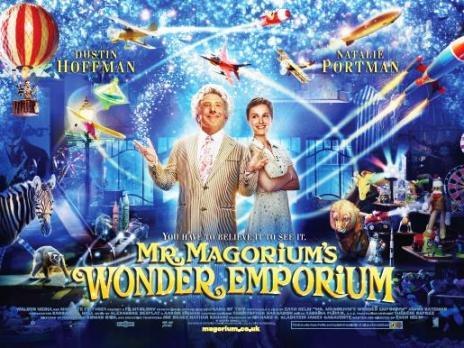 "Mr. Magorium's Wonder Emporium"
Here's an interesting exercise: Get a block of wood, as bland as possible. And believe in it.
The weird thing about it is that the block of wood is you. Anything can happen to it, as long as you believe in it. The block may initially appear lifeless, but it is your faith and work that makes it more than its parts, so to say. And that block can be anything. A piece of clay that you turn into a sculpture, a room that you turn into a living thing, an idea that you turn into a business. All it takes is a little faith.
Well, that is the extent of my learning from this film, which was really about a toy-shop that is alive and a girl, Natalie Portman, who refused to accept it was her destiny to run it. It's entirely not meant for my age but I enjoyed it nevertheless.
That's it from me this week, I'll be spending this Easter with my family. Have a good one and until the next time!
 Ran Charan, who I wrote about a few days ago, made another excellent contribution to my thinking (and hopefully yours), the concept of "social operating mechanisms." He defines them as mechanisms that synchronise individual contributors' efforts.
A step back
Individualism vs. collectivism represent two personality-types. There are the managers, who are integrators and bring both groups together and (are supposed to) identify with the greater purpose of the organisation: maximisation of profit, etc. And there are individual contributors, who through their own efforts bring forth new data and growth, etc. These types are not always suited for management, as they need that freedom to be creative.
Social operating mechanisms fit within the framework of execution, in the sense that that is one of the last stages in a multi-stage process. As the leader/problem-solver of an organisation, you start by identifying a problem; you come up with a set number of fundamental priorities to solve the problem; and you (design social operating mechanisms to) spread that solution throughout your organisation.
An example
Mr. Charan mentions a number of examples, but (for obvious reasons perhaps), I like the Wal-Mart one the best.
- In the early 90s, every Monday to Wednesday, ca. 30 regional managers visited 9 Wal-Mart stores and 6 competitor-ones, to check if Wal-Mart's strategy of offering lower prices than the competition was being implemented correctly.
- Every Thursday-morning, Sam Walton conducted a 4-hour session with a group of 50 people, including those regional managers, buyers, logistics- and advertising people to discuss the status quo, what was going right and wrong, and the future.
Making it relevant?
If this seems like a big-company problem, maybe so. But even on a smaller scale, you could see a similar process happening in the week of a franchise-owner, I discussed a few weeks ago.
As soon as an organisation grows beyond a few people, the barriers between your customers and the leadership of an organisation increase. The politics can be frustrating and are one of the main reasons why original founders leave. The Amazon-story, which I wrote about a while ago, and which also discusses of how Jeff Bezos, founder and CEO of Amazon tries to keep in touch with the core-principles of Amazon, is also an example of a social operating mechanism.
Naturally, today's reality is somewhat different from the time (2000) that the book was published. We have "the internet" now, which should make creating social mechanisms a much easier to solve. I say 'should' as opposed to 'will,' because it still requires the necessary cohesion, which many technological solutions (in my opinion) are still lacking.
It still comes down to designing people-processes which help you implement core-priorities, and having the tolerance for, let's call them, idiotic decisions that sometimes come from the type of group-think often prevalent in organisations.
The picture is courtesy of infed.org
 I'm currently reading "What the CEO wants you to know," by Ram Charan, and it's safe to say that it belongs in the top 10 business-books, I've ever read. It's only 140 pages short, but filled with advice that is extremely easy to digest, that I'll be sure to re-read it several times later on, and can warmly recommend to others too.
One chapter in the book struck me particularly, on coaching, as I consider it a vital skill in business-relationships. Although I think Mr. Charan paints a bit of a rosy picture, I consider it a good standard to aim for. Some quotes:
How would you feel if someone gave you positive feedback on the things you're doing well and specific suggestions for building your skills? Chances are you would feel that you had a personal coach, someone who wanted to hep you succeed. You would feel energized. I can tell you from experience that it works. You can do it for those who report to you, and in the process, you will expand your own capacity.The chapter also goes into a number of examples from real life.
…
Coaching is not a performance review. It's not about what someone did last year, and it's not about money. It's very personal. You're hitting the person between the eyes. You're helping him face his blind sides and learn to do things better. The feedback has to be honest and direct. No sugar coating.
…
Self-confident, secure leaders love to give true feedback because they know that growing people is their responsibility. By true feedback, I mean saying what they really think. Too often, people hesitate because they know they may be wrong, or that they feel reprisal. But chances are your instincts are correct, and they'll improve over time. I've seen numerous times that when you put experienced businesspeople around a table and they talk candidly about an individual, the judgements converge very quickly. It's not had to zero in on the most critical thing the person needs to improve.
Some people say this kind of coaching is a good idea, but their company doesn't have the ambiance for it. Still, you can start with three of four people who would be receptive for it.
Charan's book is all about understanding business principles and setting a limited number of fundamental priorities to improve a business. Coaching is a logical extension to that, as when you clearly communicate what the business priorities should be and how that individual can get there, that's essentially coaching (and makes your life considerably easier in the process).
The author also co-wrote a book called "Execution," which I haven't read, but based on this book, believe is a good choice if you need a more modern read. "What the CEO wants you to know," is from 2000, but I consider it timeless advice.
Dear readers,
I'll be taking a few days to a few weeks off to reflect on my current state and activities, my goals and the steps needed to reach them. I'll likely post a few thoughts about this on Tech IT Easy in the near future, as that seems more suited for that somehow.
Until then, my links are being still updated and I'll discuss some of them this weekend again. At the end of this month, I'll also wrap-up what I've covered in February 2008.
Until then, take care,
Vincent
 If you follow my blogging-history, you may have noticed that I write about books… a lot! There are several reasons for this. One is certainly that I am a bookworm—I enjoy reading books, learning new things, and whenever I enter a bookstore, I go into a trance and start studying books to buy now or in the future. Case in point: I wasn't planning it, but I bought two more today! Talk about impulse-buy… More on those in a sec…
The other reason is more complicated. I actually think that books translate better to blogging than much of real life. This clearly differs from blogger to blogger. You won't find Robert Scoble blogging about books much, nor Fred Wilson, both of whom blog on more daily issues (Scoble is also a media-guy). Both John Gruber and Jason Kottke do cover books, but often base their writings on articles and other shorter readings.
For myself, it is different and I can give several examples of this. One, I was a pretty regular blogger until about a year and a half ago, when I started on a project of researching venture capital in the Netherlands. Not only was it a time-intensive process, but I was constantly questioning myself as to whether my blogging was ethical or not. There were certain topics reigning in my life, relating to that company, which i could just not disclose. A similar thing happened before that, when I worked at a high-tech start-up, and most recently, while completing my thesis.
There are several blogging friends I could mention (F., J., C., & M.), where you notice this same phenomenon.
Books instead, as well as articles, offer a foundation to build upon. One, they are public, which dismisses any confidentiality issues. Two, if they are well-written, they communicate core-ideas well, and you can add to that with your own knowledge. The complication with reading is of course, similar to writing, finding the time to do so. I think I found a doable system, by reading just before sleep, but I don't know how that will hold up in future projects.
The way I choose books (and articles)
As I look back at my short life, I find that I've evolved in the choices of books I made, and most recently after engaging on this trajectory—the food & retail blog and the underlying purpose that serves. While before, my choice of business-books was somewhat restrained to general management, strategy, and entrepreneurship books, I now choose books purposefully that fill a gap in my knowledge and focussed on business-issues in this industry.
Some examples
I choose the McDonalds (coverage here & here) and Starbucks books (here, here & here), because they seemed like a good venue-point from which to understand how food-businesses work. My interest has always been towards chains of businesses, not individual ones, so that was also a bonus. Similarly, the IKEA-book (here) offered insights into retail, and the eBay-book (here), while less relevant, into starting a business and running a community.
The Disney-book (here), which I'm currently reading, gives me insights into building a framework around the soft discipline of entertainment, story-telling, etc. It is very relevant to my earlier post today on cinemas, which is clearly a raw perspective, but one I hope I can refine, as entertainment is a core-value I have.
The two books, I've chosen today, are on two diverse, yet, to me, relevant subjects. "Managers as mentors" is about what the title suggests. The reason I chose it, is because I'm not a fan of the traditional perception of management. I find it a hard world. The way I relate to people is through learning and teaching. I've raised my brother since I was 11, as my parents were often away from home, and find it very rewarding to see him become an adult. I have a similar relationship towards people, where I like to turn them into more than they imagine themselves to be. So this book seemed right. That is not to say, that I have any problem with firing people that I don't feel have potential. ;-)
The second book is even more interesting to me, it's called "the growth strategies of hotel chains - best business practices by leading companies." It's very strategy-orientated, covering principles of diversification vs. specialisation, vertical/horizontal/diagonal integration, m&a's, franchising vs. ownership, branding & globalisation, and US vs. European differences, as well as examples of said leading chains at the end of each chapter. Exactly up my alley! Needless to say, I will read it after the Disney book!
So what about you?
Now, a discussion is only valuable if more people take part. So please, if you have an opinion on this, or on a better research-methodology for blogs, let me know in the comments!
The picture is courtesy of brandtarot.com
 I'm spending a lot of time with a friend this week, who runs a start-up in a developing (2nd world) country in the lifestyle-food sector. I won't mention his name, his company or focus, or his country, nor anything confidential, because I don't want the information to be used against him. Instead, I'll talk about some general principles, that I've identified.
The irrelevance of business-literature
We both studied at Rotterdam school of management (sometimes known as Erasmus), and spent some time there last night. Funnily, I came across an article in a university-published journal identifying 6 traits of leadership to ask for in the "new" workforce. Keywords included: ethics, diversity, global outlook, tech savvy, adaptive capacity, and the X-factor (charisma?). I asked him, as a joke, which he thought applied to him. Global and adaptive, he responded. The rest meant virtually nothing to him. As a start-up, I guess, you have to do what you have to do, to stay alive.
The advantages of 2nd world start-ups
I distinguish between 1st world (e.g. the Netherlands), 2nd world (e.g. Brazil), and 3rd world (e.g. a large part of Africa), when I look at countries. 1st world countries are mature in their development, 2n world countries are not yet mature, but their economies are growing pretty fast, and 3rd world… well, I'm pretty depressed about that, though sometimes there's surprising pockets of entrepreneurship and innovation.
The advantage of a fast growing economy is that people are still figuring stuff out, meaning there are a lot of inefficiencies and gaps in the market. Another advantage, in his country's case, is the interests of governments in boosting those economies. If your innovative, the grants you receive may be both easier to get and larger in size than anything available in 1st world countries.
For start-ups, another advantage is that you can look at what works in a 1st world country and use that for your own business. This principle is not exclusive to start-ups, it's also relevant to the innovation race between Europe and the US, for instance.
The costs of educating a market
My friend operates a lifestyle-food start-up, as I said. One gap in 2nd world markets is usually that that segment is underdeveloped. But, if the economy is booming, wealth is increasing, and that certainly has a positive effect on the luxury-market.
However, when you introduce a new product to a market, you'll have to build the market up first. There are various approaches to marketing, I'll just go into the one that my friend used.
Essentially, you want to get your products into a supermarket, and you want people to buy the food. Sometimes one, sometimes both will take some convincing. In the beginning. he spent a lot of time in supermarkets, getting people to taste his food. After that went well, he could use that success to convince other supermarkets to become customers also.
Two advantages of supermarkets: they usually have pre-written contracts for suppliers so you don't have to draft them yourself. And they sometimes operate in chains, which makes it easier to get larger customers.
There's two further things to do with food, to make customer-adoption a little easier. One is to sell it in an easily digestible fashion, e.g. a snack. Two is to not do so, and instead provide customers with instructions to prepare the food. You could do this on the packaging, a website, and even more drastically (can't mention what). My friend is pretty active in this area.
Another problem with 2nd world countries is that, while your food may be part of a lifestyle in the 1st world, it's close to impossible to lead that lifestyle over there, because all the components are not there yet. So, in fact, you don't use that lifestyle as a marketing-term. Instead, focus on health-advantages, as that is often the underlying driver for such demand.
Still, even after more than a year, my friend spends about half of his monthly expenditure on marketing—which goes through a marketing-agency that designs the brand, the colours, etc.
Global outlook?
As a start-up, you have to work within certain boundaries: limited money, staff, production-facilities, time, etc.
The clients for a food-company may very well be supermarkets, which, as I mentioned, have the ability to buy a lot. My friend is expanding into other countries, but he's carefully picking the ones that don't exceed his capabilities.
He prefers a fragmented market, where he can concentrate on a one or two chains at a time, not a market where there's national chains that could bleed him dry.
Related to this, fragmented markets are usually underdeveloped also, so in fact he is exporting to countries similar to his own. That, at least, is as theoretically expected.
Theory, schmeory.
While there are certainly concepts that can be found in a number of different fields, ranging from entrepreneurship & strategy, innovation, supply-chain management, and marketing, it remains a matter of being practical, and specific to the business.
Entrepreneurship is a 60-80 hour / week job, usually. You don't have time to check out business-journals, etc. to do your job.
P.S. his business-plan was 2 pages long.
And those… are the facts of life. More, if I can think of it. The picture is completely unrelated to his product.
 One of the downsides of not being at home for three months is that the mail tends to pile up. The culprit is The (weekly) Economist, which forced my landlord to dedicate a special cabinet just to accommodate them all. He was happy to see me.
My thesis is handed in, and while I'm anxiously waiting for the feedback / grade, I'm doing a variety of stuff to diffuse the thesis-haze that was in my head these last months. One of these is thinking about how I will organise the research that I collect for my work / blog. This is part of a dual trajectory I'm pursuing—one side is research, which I use to build up my knowledge about the field of food & retail, the other side the practical path, which I can now finally pursue freely.
The pile of 15 or so Economists is actually a good exercise to think about what really matters, and I'm going through them quickly, marking the articles that are interesting to read, and later cutting them out and adding them to special folder, after which I may categorise them by country and subject perhaps.
It's easy with The Economist, but there other publications that I'm much less eager to chop into pieces. My books are filled with pencil-marks, as are my Harvard Business Reviews, but there's no way that they'll ever feel the cold blade of my scissors. With those publications, I'm forced to keep all that extra paper and try to get my thoughts to paper as quickly as possible.
The other, sort of, complication are web-articles. I've been printing stuff to pdf and have a special S+FNR folder, reserved for anything from fashion-trends to human-resource management. I'm also going to print them out and add them to my folder for future analysis.
As you can see, I take my research seriously. A probable after-effect of writing a 180-page thesis, studying three academic fields—innovation, entrepreneurship, and finance—and interviewing roughly 300 businesses.
But I wonder how the real bloggers do it. If you're someone who takes blogging seriously, how do you organise your material, or do you organise it? If you do so on paper, I'm curious as to what kind of folders you use (incl. a link to a photo if possible).
Note: If you use a computer to store stuff digitally, I assume you use a personal database, like Devonthink or Jojimbo for the Mac. I'll tell you right now, I've used them all (to organise my thesis) and found it frustrating that they wouldn't do everything I wanted and tried to lock me in in the process (I've spent many hours migrating everything from app to app—it sucks!). They also don't help you much with paper-based materials, like mags, journals, and books. No, on the computer, I prefer a regular folder and to add text & pdf to it. Simple, portable, and cross-platform.
 Dear all,
My fingers are really itching to get back into blogging and pursuing my passions. I've also lately been thinking that my interest in the communicative arts is perhaps a sign to go into marketing. I wonder how "blogger for 2+ years" looks on a resumé?
Today, I started with writing my conclusions for my thesis, which involves me going through it, and picking up the pieces that I like. That should also lead to a better introduction and executive summary. My next deadline is for this Sunday (or before), after which some more detail-work will need to happen (cutting/editing, checking/formatting references, prettying up some graphics etc.).
Btw. now that I'm actually reading what I wrote, I'm liking what I'm seeing. It'll be hard to cut much.
5 Links
I need to take a break for 30 min., so I'll take a look at if I bookmarked something interesting for y'all. I wish I could write something more in-depth, but it would just be too distracting at the moment.
- St. Petersburg Times (US) has a very interesting write-up about a new "health food restaurant and Hip-Hop-themed video-gaming business," called HipHopSodaShop, that is opening in their 'hood. This would normally be nothing special, except I'm pretty interested in symbiotic businesses, and particularly anything reflecting popular culture. The article includes a number of details related to the legal aspects, the financing, etc. Worth a read. More details can also be found via BuzzFeed.
- Ha! MetaFilter does a write-up about a new bookstore opening in one of my hometowns, Maastricht, where my parents live and where I attended school for 5 years. The bookstore, Selexyz, is actually located in a Dominican church and makes for some interesting pictures. I was hoping to visit it last weekend, but I only got to see some of Maastricht's other architectural gems (the city is booming with development) and two of its museums.
- Yahoo-news publishes a list of 80 things to watch out for in 2008, from a marketeer's perspective. Big things include the Beijing Olympics and the US-elections of course. I also like "De-teching," "Eco-fatigue," "Green weddings," "Hip-hop's Retro Kids," "Intellectual luxury," … and actually 30 more I think.
- PSFK points us to an Economist article about the decline of the shopping mall in the US. Honestly, if I had a choice, I would prefer for my shop to be located in one of the new open city projects in Maastricht or elsewhere, than in a dusty high-riser with artificial light and air. PSFK also writes that "consumerism is thriving in downtown shopping districts and outdoor shopping meccas," rather than in the infamous mall.
- 2 for 1: Starbucks is in trouble. The Starbucks Gossip Blog points us to two stories. One on McDonalds converting its venues to Starbucks-clones (surprise, surprise), another on Howard Schultz taking back the reigns (a Dell manoeuvre?).
Happy reading!
The picture is of course my own… jumping into 2008!
Idealistic interlude - what I wish people (& myself) for 2OO8 and beyond
0 comments Posted by Unknown at 11:46 PM I'm in a philosophical mood. Got the flu, lack of sleep, an excess of stress, and the general feeling that I need to "get things done" before I have earned the right to enjoy life (though I will try to enjoy seeing old friends on the 31st).
Yesterday, or this morning, I published a list of materialistic wishes for 2OO8… now it is time for the a-materilistic, or rather the idealistic wishes I have for my family, friends and myself in the near and more distant future.
Surprises - After composing a list of idealistic "to-do's," I felt that no matter what you plan it's important to experience and be open to surprises. What life is worth living without them?
Financial success for my family & friends - as materialistic as it may seem, there is a clear correlation between success and happiness, and I wish this very much to the people I know, those that I don't know, and myself of course. Money not only makes the world go round, it makes for a better world.
Beware of the accelerator - I can't speak for other people, but I've noticed a clear trend with myself. I'm like a ball, when I start rolling, I go faster and faster, until it becomes hard to stop. This is true for my work, for my more artistic projects, even for depressive days. It's important to keep the balance, as theoretical as that may sound. Even if it feels "wrong" to stop sometimes, stop, and even if it feels wrong to work sometimes, work. It's a little connected to 'surprises' also.
No assassinations during the holidays - a minor point perhaps (is it?), but have you noticed that last year on this day, Saddam Hussein was executed, as was Benazir Bhutto a few days ago? A serious bummer, dude.
A better US president… perhaps - I think there is a complex interplay between what I would call macro-leadership and micro-management. Both are important, and one cannot exist without the other. The US makes a good case-study for observing the interplay between federal and state-politics. When Bush goes against the climate, you see plenty of bottom-up activity for improving the climate on a city or state-level. I would love a US president that is more moderate and appreciative of the complexities of international politics, terrorism, climate-change, world-hunger, world-disease, emerging economies, etc. But really, I just want people to fight for what they believe in, whether it be top-down, or bottom-up.
For myself:
A good job in 2OO8 - one that I enjoy doing and that teaches me skills that help me be a better project-manager.
My own company for 2OO9 onwards - not sure when and how this will manifest itself, but that is what I'm working towards.
 Hello,
In this piece, I am planning to discuss my current thoughts about my thesis, this blog, and my plans for the future.
I suppose, to a great degree I like to be a focussed person. I like to have goals, pursue them, and not get too distracted by things. It's kind of a silly attitude, because life is an exercise in overcoming distractions. As Fred Wilson wrote recently about something that Dick Costolo, co-founder of FeedBurner, said:
"A startup is the process of going down lots of dark alleys only to find that they are dead ends. The art of a successful deal is figuring out that they are dead ends quickly and trying another and another until you find the one paved with gold."I love that quote and I think it's a great attitude in life as well.
But, as I said, I love planting myself behind a project and shutting the door to everything else. I tried doing this here, 8 days ago, and, as a result, underwent a pretty amazing productive period since then. So what are my plans for my thesis?
My thesis on funding high-tech start-ups
As I said, 12 days break, which would give me another 4 days. Truth be told, I have to add writing a conclusion, writing mini-summaries per chapter, an executive summary, and editing the whole thing into the mix, so I will like likely be busy for another 10 days after that. The nice thing about conclusions is that they are already in your head, summaries happen automatically as you edit a piece, and editing is a perfect all-nighter activity.
The not-so-nice part is that we are currently at 150 pages of material, which would more or less make my thesis a book about innovation, entrepreneurship, venture capital, and incubators.
2 thoughts:
- One of my thoughts is to edit it down to a reasonable size and publish the whole thing as a pdf.
- A second thought is that as I write summaries per chapter, I might as well turn them into blogposts about innovation, entrepreneurship, finance, and incubators, and publish them in the form of regular blogposts on Tech IT Easy.
Which brings me to this blog…
The status of (my blog on) sounds + food and retail
The funny thing about this blog is that it is interconnected with my life. Random readers may think this is a nice (or not so nice) blog about subjects concerning music, food, and retail, but it is in fact, what I see as, one of several stages towards forming a career and a business (or series of) in this industry.
So my head has not stopped thinking about this subject, and I've actually been making summaries about interesting topics, and thinking about the shape of things to come. I cannot interrupt this blog too long, at the same time it is reassuring (to me), that even though my publishing took a break, my mind did not.
Concerning this blog then, I will be back and I already have a huge backlog of material to publish here… looking forward to that!
The status of "real life"
As I speak with friends and strangers about my ideas I also realise that there is much that remains to be done in "real life" also. I believe everything starts with a good business-plan with realistic assumptions about what you want to set up. It is the ultimate "social object" towards getting my plans in motion, convincing partners, investors, employees to work with me.
Questions I have received so far include:
- What type of place do you want to set up? My answer has so far been: probably a night-venue, a restaurant or night-club, or something in between (this may come as a surprise to some of my readers, as I write a lot about retail). Ultimately though, I want to set up a successful venue and am flexible on the format.
- Where do you want to set it up? My answer: I'm flexible, but it depends on where I feel most comfortable to set it up.
- How are you going to fund it? My answer: I'll need to save a bit, but I expect my first business to be sponsored, probably over 50%, and will look for suitable working partners also.
- When do you want to set it up? My answer: 3-5 years from now would a realistic number in my mind.
- When do you want to exit? My answer: Depends on how much fun I am having, as well as other factors. I see myself as both a serial entrepreneur and someone who wants to create great things, and I'll have to find the middle-path between both.
Final thoughts
First thing first. Finish my current project, get a degree, close this chapter of my life.
Intermediary thing, publish blog-posts when I can and want to, in between.
Afterwards, blog more, look for a cool job to gain experience, contacts, and cash. I also want to travel for a bit through Europe to decide on a suitable location, check out different formats, and brainstorm with friends.
And then, take the plunge.
So, à bientôt, I hope!
Vincent
 Today should be called Meta-Monday… I seem to be in some kind of reflective or introverted mood. And as any blogger probably knows, moods and blogging, that's like a burger and fries—they go hand-in-hand. But no worries, tomorrow it's business as usual.
One thing I discussed in my last post was finding a job. Yesterday, during a jog, I thought it would be a good idea to crowdsource my application-letter when the time comes. I'm not sure if it's the best idea—no one I know does it, and probably for a good reason—but I'll consider it.
Another thought I had yesterday, was on the type of job I would be looking for. I already wrote about "one with broad development-opportunities," but that doesn't say anything about where to start. Yesterday, I actually argued with my father about this, as his vision of my vision is somewhat different of my vision of my vision—if that makes sense. Essentially the conversation went somewhat like this:
Me: "So, what would you guys think about me getting a job at a place like Ikea (just an example, don't get any ideas!)?"
Dad: "That's idiotic. If you want to start a restaurant, you should just start one. No detours. What does Ikea have to do with a restaurant anyway?"
What does Ikea have to do with a restaurant anyway?
That's a good question. First of all, I'm pretty sure I don't want to start a restaurant. Everything I've seen so far leads me to believe that it is a terrible environment: People are stressed and unfriendly, chefs are arrogant, long hours even after a start-up is no longer a start-up, etc. I might change my mind, but that just doesn't fit my vision.
Second, my attitude on business is that the product doesn't matter. But that said, I am more passionate about some products than others, namely food, media-related stuff, technology, etc. and I care a great deal about the atmosphere of the place.
So what does Ikea have to do with a restaurant? It sells goods to customers, which it sources from suppliers. It thinks about the customers, it competes with other businesses, it expands nationally and internationally, it works with suppliers, etc. Not to mention that it also has a restaurant. It's a business and its principles are just as applicable to a restaurant or any comparable business. The product doesn't necessarily matter.
That doesn't mean I want to work at IKEA per se, I'm making a different point.
Meet Mr. Generalist
The stereotype of a generalist is probably that he or she cares about everything and anything. I, being a generalist myself, don't agree with that. Instead a generalist, to me, means:
"To care about nothing specifically, instead to care about everything that produces an outcome. In business this means to care about the four dimensions that I mentioned in my last post: the components of the business; the value chain; the past, present, and future of the industry; and how people fit into the picture."That said, nobody cares about nothing and the more experience you get, the more you will care about certain areas more than others.
In terms of people, I am constantly on the look-out for specialists—people with in-depth knowledge about a certain field—and to some extent generalists—people who also have a broad view about what makes a business function. The phase and size of a business certainly affects the need for either type of person. I can't say much more about this, except that just to find the best (wo)man for the job, is always the right attitude.
In regards to finding a job, being a generalist (probably) puts me in a similar conundrum to when I studied strategic management. There are no starting jobs as strategists, and I'm not sure that—at least in large firms—there are starting jobs for generalists either.
I think that I will have to decide in what function I want to start in and see what happens from there on in. I'm thinking logistics, but I will keep an open mind.
The image is courtesy of acponline.org
 A blog is a service—both to me, and to you, the reader. To me, it serves as a way to collect a large amount of information, and, more importantly, process it so that it stays in my brain. The better, and more focussed the information is, the more it helps me, and the more it becomes useful as a general information-source for you too. There are a couple of specific goals I have, which will certainly affect the status and value of this blog. These are, as follows:
1. Develop a framework of how everything in a food- and retail-business fits together
The reason why I write about a large number of topics is because I see any business as system or a machine made up of a number of components. I need to think on four dimensions: the business-components; the value chain; the past, present, and future of this industry; and how people (incl. me) fit into the picture.
Implication: This simply means that my broad coverage of topics will continue, but that the implicit understanding is that it all needs to fit into one of these four dimensions. It also means that, in addition to researching these topics, I need to start converting the broad framework I have in my mind, to paper.
2. Gain practical experience
I see this on two levels. One, I need to seriously understand the process of retail or food business from start to finish. The best way to accomplish this is to learn by doing. This can be achieved in two ways: the more logical one would be to work at a business that offers a good amount development opportunities—allowing me to see many aspects of that business; and eventually I see myself starting my own business also. The second reason why practical experience is important is reputation. This business in particular is pretty resource-intensive. To start a business you need to have access to a good network of people, and investors. Both trust you more, the more practical experience you have. Put your money where your mouth is.
Implication: This is still some months off, because I still need to finish some business before that. When it does happen, I think it will affect the blog in two ways: one, I will have less time to blog. And two, I will have more practical data that I can share (within reason).
There is a third point—starting my business and everything that involves, but that's a topic for another day. For now, if you have questions or comments about the above, feel free to share.
This blog will continue as usual for now. Expect a new post tomorrow!
The non-sensical picture is a few months old… until I get my camera back from the store (any week now), my ability to draw and and scan into the PC is somewhat constrained.
5 Links: human sigma, link-baiting, neuroscience, brand experience, wine
0 comments Posted by Unknown at 11:47 AM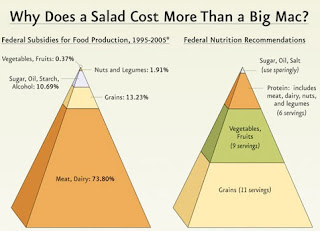 While I'm stuck on writing some other posts—the idea is there, the execution some way off—it is time for another collection of links.
- Using Human Sigma for measuring customer engagement - Mitch Owen reviews a new book on the market, that suggests that evaluating our efforts at customer satisfaction happen on four levels: Confidence, Integrity, Pride, Passion.
- How to coast to a writing career - Valleywag writes an insightful post (for once) about what matters when blogging. I like "AVOID: Blogger ego. If you do blog, just write and forget about it. Don't reply to your comments with more than "Good point, h8rboi, thanks. Don't troll other bloggers for links, or try to get onto Techmeme by posting about whatever's already there. ... People in the real media don't care what your Technorati rank is, they'll just Google you to see what you write." That said, I have no intent to engage on a writing career.
- Mind hacks: an interview with Jonah Lehrer on neuroscience - What I like: "Artists are constantly being forced to reverse-engineer the brain. By reverse-engineering the art - by trying to understand why, exactly, it resonates with us - we can learn about the mind."
- Thirteen examples of successful brand experiences - could be filed under architecture. The British design council points us to 13 different "experience-castles" (my own term), where customers can be enchanted.
- Calculating the carbon footprint of wine - What can I say? It's the new world! Some key-points: organic is not as efficient as we think; distance matters; packaging matters.
- Bonus Link: Why does a salad cost more than a big mac. - A picture says more than a 1000 words. This is just as applicable to Europe btw. Thank Wolsey for inventing the subsidy!
Enjoy! More of this: check out the S+FnR bookmarks—updated 24/7 !
I've written two posts in the past, reviewing Gladwell's books, Blink and The Tipping Point. Both posts are no longer online and thus game for reproduction. Following will be these two reviews (lightly edited), which were already rather short, and would make for a good marketing-related interlude.
"The Tipping Point - How Little Things Can Make a Big Difference" (reviewed October 2006)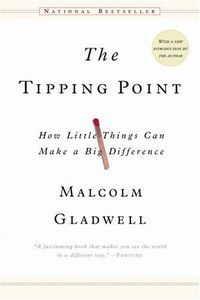 I read The Tipping Point by Malcolm Gladwell, about a year ago, a slightly older book from 2000, but with some timeless insights on viral marketing and tipping the user-adoption scale.
Essentially, the author takes takes cues from biology and epidemiology to explain how ideas can spread like virusses, facilitated by three key-players: Connectors, Mavens, and Salesmen. Each of these play a role at different stages of the adoption process, with Mavens acting as the knowledgeable early adopter, the Connectors acting as hubs between groups of user, and Salesman taking care of the last mile, the mainstream-market.
The book explains how people take in information, using a variety of examples from TV-shows to Sneakers, as well as how companies can shape their marketing-efforts to gain access to those three key-figures. Only in the afterword, does Gladwell cover issues like email and the rule of 150 - the latter refers to “Dunbar's Number,” which proposes there are limits to our cognitive social functions and that it's only possible to actively maintain a certain sized (150 people) social circle (Whether this still applies today can perhaps be disputed).
The Tipping Point does a fairly good job in translating social theories to practice, better so than recent attempts like Freakonomics (which, in my opinion, was too abstract), and the insights will continue to be relevant. That said, I expect that some trendspotting-practices of companies will change, or have changed drastically since the time of writing, in the sense that consumer-driven products seem to be taking off, as well as “long-tail” business (which may or may not be the same thing) . Perhaps his newest book, Blink, corrects this.
"Blink - The Power of Thinking Without Thinking" (reviewed December 2006) “If you Blink, you're dead!” This must be a phrase you hear in movies often, mostly when one character has a gun pointed at another (editor: seriously, this must be the corniest start of a post ever). Gladwell has definitely taken this phrase to an extreme, attempting to research everything about it.
My first reaction when hearing this book was “Malcolm, what were you thinking when wrote this book?” The space of two seconds—the time it takes to blink—turns out to be gigantic and many people wouldn't even know where to begin exploring what happens there. But mr. Gladwell does his best, looking through the lenses of experts from various disciplines and giving a broad range of examples.
The book starts with describing the purchase of a statue by a museum. After consulting many experts they decide the statue is authentic and pay a huge sum for it. Then, however, another expert, one from the field this time, takes a quick look and feels something is wrong with it. And he's right, the statue is in fact a fake. Malcolm Gladwell asks the question as to why some people have an instinct that can judge things, people, and situations more quicly, than studied experts can over the space of weeks, months, or years. The answer is perhaps obvious: practice.
Following this example, Gladwell proceeds to describe the fields of rleationship-therapy, facial recognition science, security, sociology, and some others, where the practice of instinct, or rather the rapid understanding of situations, is very important, so much so that there are therapists that can predict whether a relationship will end quickly or last forever, are able to tell if you're lying, can teach policemen to judge whether a person is drawing a gun or a mobile phone. But where the book really shines is in understanding where racism and discrimination comes from, which, Gladwell shows, can have deadly consequences in fields like police-work, and which continues to be relevant in today's polarised society.
I see Blink as a book aimed at experts, but sold in a mainstream-market. There are principles in the book which are clearly valuable to everyone, yet to get there it takes hard work and practice. But, having read and reviewed his previous book, The Tipping Point, I believe the point is not for the reader to become a genius. Rather, it's to surround yourself with the right people that have access to this knowledge. The example of the museum clearly shows the usefulness of this.
For further reading you may want to check out this Scientific American Mind article, on the science behind facial recognition (and exposing lies).
Final thoughts
Blink and the Tipping Point are at different points in Gladwell's evolutionary scale, and I think, judging by his latest speech and his soon-to-be-released book on "the workplace of the future," he's more and more moving towards understanding the upper regions of the brain. At the same time, an inherent risk in this approach is usually that you forget that there are real people involved, and I don't get a sense that this is happening.
Rather, when you listen to his speech on the nature of intelligence, and read his books, you see that he is very careful to understand the context of why something happens, not just the occurrence itself. And that context alone makes for some excellent reading, because I suspect that that is one of of the secret ingredients to becoming one of the geniuses that Gladwell describes.
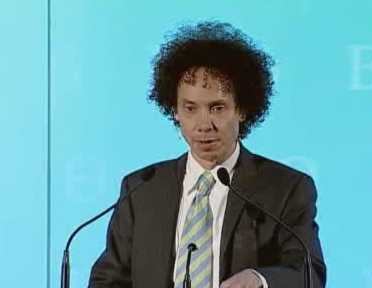 HBR writes about this rule, and Malcolm Gladwell (picture) speaks about it. Essentially, it means that being an expert at anything does not require any special talent (though liking what you do, helps), but instead it requires 10,000 hours of dedicated practice. This applies just as much to musicians, as to technologists, as to retail-entrepreneurs.
Take Candy Dufler, whom I wrote about the other day. She's been playing saxophone since I don't know when, but the hit "Lily was here" is approximately 20 years old. And if you calculate that 10 hours per week of practice, multiplied by 20 years, equals 10,000 hours, and combine that with Dave Stewart's compliment on her "encyclopaedic knowledge of riffs," you understand that she's an expert in her craft.
The point about all this is that anything can be mastered with sufficient practice. Malcolm Gladwell adds to this that this practice is not a solitary activity either, nor is it a matter of simple repetition. Rather it is imperative that it is guided by other experts and mentors, much like Dave Stewart is to Candy Dufler. And it has to push the boundaries, entering areas where the comfort-zone is low.
I think about this 10,000 hour principle a lot. It is very relevant to blogging, for instance. We, the people, are surrounded by experts, be it writers for the Financial Times or Harvard Business Review, or bloggers like Nick Carr, Seth Godin, and countless others. And we reproduce their writing to form a synthesis of it, eventually building a collaborate bucket of knowledge. This is why blogging is great, because it is open, it is curious, and, on the aggregate, self-correcting. But to individuals, it is only beneficial if part of a long-term strategy of dedicated learning and application.
The "Rule" also offers insights into hiring people and finding jobs. If your future employee is not happy (or able) to share his or her know-how, then how can your other employees (or yourself) increase their expertise? And if your job consists of spending countless hours behind an excel-sheet, locked away in a room, then may I suggest that that is what they call dead-end? Alternatively, if you can find someone who can actually present proof that they have 10,000 hours of applied practice behind them (or even half that!), you can feel pretty good about hiring them, and vice versa, they can feel pretty confident that they can add value to the area which they have practised for.
Ultimately, this kind of thinking suggests that we can only improve, and indeed innovate, as people, businesses, or products, by opening up to a ton of information, for a long-long-long time, perhaps forever. In other words, long live the open economy, the tools that connect us, and the computer that is our brain.
"What do you want to do?" is a terrible question. Not because I don't have the answer, but because it's always followed by "How are you going to do it?" It forces you to be honest and practical. Does "winging it" count?
No, probably not…
Knowing what you want to do is the greatest career-and life-related joy that can exist. It gives you a sense of purpose, and sometimes, not always, it gives you the answer to the question of how.
Luckily, the American National Retail Federation provides part of the answer, at least if you want to work in retail. I have decide to phrase it in a "Do you care about.." format, because that makes more sense to me than anything else, followed by the appropriate area in retail, and some sample job-descriptions. If anything, it should be of great help when answering human-resource questions.
Please note: If the picture is not legible, please click to see it full-size.
For further information about each field, go to the NRF-page and click on the "learn more" link below the texts. The site also kindly provides a nice chart to see where you stand as opposed to other functions and co-workers.

 The
The 


