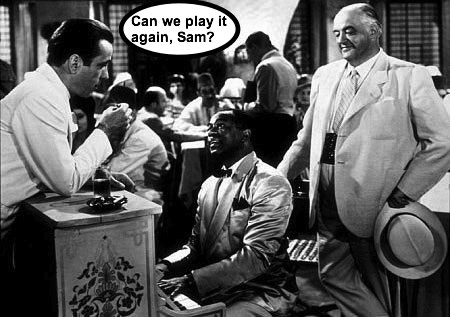
 The argument for mass-production is that it enables innovations to become cheaper and hence raises the general quality of life of consumers. The argument against mass-production is a more controversial one: that it destroys the unique quality of, let's call it, art.
Starbucks is a very good example of those principles. It brought a higher standard of coffee to the American masses, who, according to Howard Schultz's Starbucks biography, had long been oppressed by low-quality coffee from retailers and coffeeshops alike. At the same time, as the recent crisis at Starbucks illustrates, it has reached a saturation-point: it has brought Starbucks-outlets to every corner in the US, as well as spawned a whole army of competitors, and its brand has become diluted. It has become a commodity.
Back to their roots?
The re-enstatement of Howard Schultz as CEO is a signal, that the business has lost some of its original spirit and is in need of a guiding light. A letter that is rumoured (!) to be written by Schultz confirms that Starbucks will be focussing on re-introducing that original spirit, as hard as that will prove to be. There's only so much that you can change, after your company has reached a certain size. It would, at this point, be like saying that McDonalds is planning to become your corner-restaurant where everybody knows your name and favourite food.
The innovative angle
A friend of mine made me aware of a new coffee-brewing machine on the market, called Clover, which promises to deliver a higher quality coffee to consumers, though also at a higher price. According to Bruce Milletto, a retail consultant to the coffee industry, "a typical American café spends around $50,000 on equipment, about one-quarter of which goes on an espresso machine. At $11,000, a Clover costs the same again." Thus the investment-proposition is not an attractive one to the average cash-strapped café, who would have to spend that kind of money and charge an expected $6 per cup to recuperate that cost.
Following the rules of mass-production, Starbucks + Clover makes for a match made in heaven, and so it is: Starbucks has in fact acquired Coffee Equipment Company, the four-year-old Seattle-based maker of the Clover coffee brewing machine, for an undisclosed sum.
Considering that Starbucks has long been threatened by the commoditisation of coffee in the US, through the birth of literarily 1000s of new franchisers who, on the surface, provide the same value-proposal, though perhaps at a lower quality and price, it makes sense to acquire one piece of machinery that makes a bit of difference in the eyes of certain consumers. Considering the recent partnership with Apple, I believe that these consumers share a similar taste and price-insensitivity, and since that segment appears to be growing, I believe that Starbucks made the right call. They appeal to the type of customer that will pay $6 for a cup, and with their economies of scale, that price is sure to drop to a slightly more acceptable level of (I guess) ca. $5.
The cultural angle
There is another side to this. The USA is not the world, and while Starbucks has been thriving over there, the Europeans (I can't speak for other continents) have enjoyed a coffee-culture for quite some time. For people like my parents, who are respectively citizens from Southern- and Western-Europe, and avid café-visitors, they would not even consider going to the Starbucks in the centre of their German hometown, because there are plenty of alternatives with more atmosphere, more identity. To them, Starbucks is like a McDonalds, a franchise that in fact shares many cultural values—bringing a good to the masses—and does so by building ecosystems of services—from music-retail to the happy-meal—to deepen the (commercial) relationships with its customers.
Consciously and subconsciously, I'm a sympathiser of "unique" café-outlets. I like spending time in them, sometimes hours at a time, read my newspaper in peace, and enjoy a reasonably good coffee at slightly less than $2 a cup. I don't actually care about spending twice that for a coffee, but all the Starbucks's I've been too (exclusively in Germany and the UK, I must admit), have been so devoid of atmosphere that I don't really spend more than a few minutes there, 30 max. The only thing that does attract me about them and similar stores, is that I can grab a cup-to-go, mostly in the summer, and enjoy it out in the sun.
As a citizen of Europe, I think I am a fan of the heritage of the traditional café and don't really want it to go. If that makes me "backwards" or conservative, I am sorry. I want the chance to enjoy a Turkish coffee in Brussels, an Italian coffee in Cologne, or simply a Dutch one here in Rotterdam. I enjoy knowing the history of a pub that has existed for over a 100 years in Antwerp, and the same in Maastricht, or Amsterdam. I want there to be a diversity, and most important, I want that choice to be mine. I don't want there to be a cloned coffeeshop on every corner.
One of the saddest things I heard, while I was in Belgrade last year, was the exactly such a historical café was replaced by a chain (and the coffee stunk too); and I was equally sad to see that nearly all of the traditional retailers I remember from before the war had been replaced by a cloned shopping-centre that would've made any Western city proud: from H&M to Footlocker.
Opponent: Starbucks?
Globalisation is a situation we must all deal with. Its oldest proponents are the FMCG-companies, who are focussed on producing the same good for millions of people. The question is whether coffeeshops should embrace the FMCG-principles like McDonalds and Starbucks clearly have.
Starbucks is a formidable opponent: it is both a roaster, a retailer, and an FMCG-producer. It is strong in the US, and has a significant presence in the rest of the world. It will not go away, And not all believe that their presence is all that disruptive. I don't either, as long as Starbucks knows its limits. There are parts of the world that do not share the same qualities as US-towns. Some cities have long histories and places of heritage that should perhaps not be housing a McDonalds or Starbucks.
In a way cafés are stuck. They need the kind of innovation that Clover brings, but they are not in a position to buy their way in. If they did, they too would have to become mass-marketeers, in order to recuperate that cost. Instead they need to focus on what they do best, and coffee-machine makers to do the same and just license their technology. And whether the latter is able or willing to do that is the question.
I'm not sure how much Clover was acquired for, no one is. And I'm not sure how far Starbucks is willing to go to ensure their qualitative and quantitative dominance of the market. Will they grab every new piece of technology that promises to introduce a higher quality of coffee to consumers, keep it for themselves, and leave the traditional cafés to differentiate themselves simply by their "culture"? Sheer business-principles dictate that they will.
Howard Schultz made me believe, in his book, that it was Starbucks' mission to bring better coffee to the world. Let's hope that a richer coffee does not come at the price of a blander world.
This piece is in fact incomplete. Optimally I should write up a list of actions for coffeeshops to take. However, I am not yet that familiar with all the business-issues facing these organisations and all of my suggestions would be targeted at growing in size and battling on similar terms as a national or global player. And I'm pretty sure that many would not be willing to do that. So I think I'll wait until I have a more objective grasp—from all angles—on the situation, before giving practical advice. Feel free to provide me with that objectivity through your comments.
 When I first wrote this post this afternoon, it was really long. After cutting it a little it's still really long. Sorry about that.
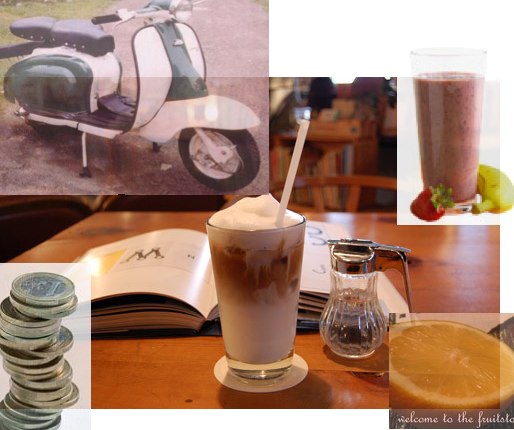
A lot of people I know from uni are into this thing called New Business Development (NBD). It makes sense, since it's the title of a course we studied together and it was absolutely the best course I've had in my life. Around 60 hours of hell per week for 2-3 months, but one hell of a ride too.
NBD is a necessary mechanism for when your core-business is stagnating. Let's say you have a good high-volume business, but competition is hammering you with low prices. If you can find a new business opportunity that allows you to make money differently, preferably at high margins, it's a good business opportunity. If it's synergetic with your core-focus, then it's an excellent business opportunity. Three small examples I stumbled across these last few days come to mind.
1. Bookstore + café. Verdict: logical
Buying books is a luxury. They serve no real purpose (unless you want them to) and are generally aimed at price-insensitive people. It is also a fairly slow sale. You are selling information, people are swamped with information, and it takes them time to make a decision. Sometimes… not always. I think time + the amount spent on an item also correlates positively, up to a limit.
That combines well with a café. The luxury-aspect allows you to charge more in cafés as well, meaning higher profit margins. Cafés lead people to relax and spend more time in bookstores, meaning they will likely purchase more books too. Combining the high traffic of price-insensitive consumers together with high profit margins and you have a good business. Also, it's a great way to compete against online-retailers, who are not able to add the atmospheric value.
2. Fruit-vendor + fruit-shake stand. Verdict: logical
Fruit is generally a low-margin product. The fruit-vendor in question sells 5 KG of Spanish oranges for €2. You can charge more for fruit-shakes; To the consumer, they taste good, represent health, and require very little in work (all emotional values = higher price-insensitivity). The fruit-retailer sells an orange fruit-shake of 0.5 litres for €2.50. Assuming that's about 1 KG of Spanish oranges, that's quite a lot more profit than €0.40 would give you. But of course there are other considerations.
The fruit-vendor is located right in the centre of Rotterdam on the busiest street. Likely the cost of renting a place is expensive, so is the added cost of producing the shake. The fruit-vendor also competes with a fruit and vegetable market, located a few hundred metres away, and a supermarket, 50 metres away. And his new business competes with other fruit-shake stands. What makes this combination work?
The higher profit margins for convenience-fruit-products, combined with high volume of people passing by is good. It also persuades investors to loan the money for the fruit-shake machinery, which they would probably not do for a low-margin business in a less favourable location. There's a lot of efficiency also; fruit is sourced from the same suppliers, so are packaging-materials, and the retail-space acts as a warehouse. Because fruit is cheap and the retailer has a large selection, he can charge lower prices than the competition and offer more variety. And he enjoys high profit margins even if the volume of fruit-purchases is lower because of the price-competition from the (super-)markets.
3. A eurostore + scooters. Verdict: illogical
This case is a little more complex and contextual. A year ago a eurostore, which is like a dollarstore—a shop offering a great variety of goods at low prices—started offering scooters alongside their regular products. They quickly abandoned the experiment and I have a theory why.
Likely this deal came out of partnership with scooter-retailer/-importer. The eurostore was in a good location with lots of traffic (good for the scooters) and the scooters would give it much higher margins than their regular products. Seems like a win-win.
Consumption of "euro-"goods is different from that of scooters, however. With the first, people expect stuff to break and don't come asking for a warranty. They just buy another. Buying a scooter or anything over a certain amount is very different. People expect extensive information, they may want a test-drive, they certainly want a warranty, and after-sale support.
Since the eurostore is what it is, a store with low margins, this kind of service is out of its realm. It ends up referring customers to the actual scooter-retailer, and very likely the purchase happens there also. Unless you have a contract that specifies this eventuality, gone is the alluring profit-margin. And that, as they say, is that.
Final thoughts
High traffic of goods is a good basis for new business development. It means you have a customer-base to which you can try and sell other products and services, hopefully at a good margin. Location and demographics are important also. Both the book- and the fruit-retailer were well-located and had access to a good demographic, allowing them to sell at high margins and high volume. The eurostore was only well-located. Synergies are vital. For the bookstore it was consumption-pattern and price-insensitivity; for the fruit-vendor it was offering essentially the same product in different packaging; for the eurostore there was little, or rather, none.
Isn't new business development fun? And was my analysis correct?
5 links - sense of smell, false green ads, farming boom, Lego, fun e-shopping
0 comments Posted by Unknown at 10:49 AM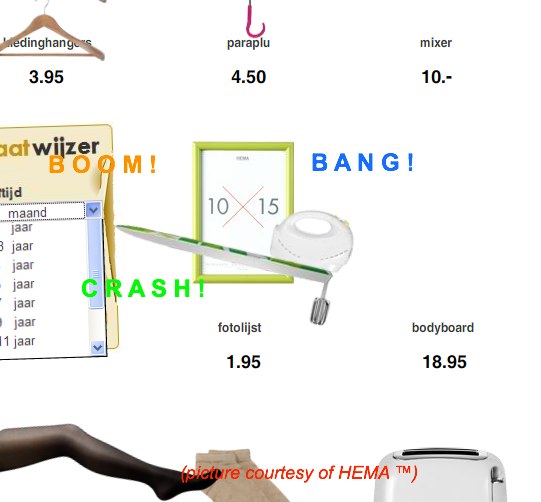 Time for those Sunday-links again. Today, I'll discuss the cocktail that is smell and how some things just don't mix; how green is not all it's cut out to be; a possible shift of power from retail to farming (or not); how lego came to be and where it is going; and how to sell me online shopping.
Previous link-discussions can be found here and my bookmarks here.
Link 1: Starbucks Admits Sensory Mistake - These are the kinds of stories that make me I like the NeuroscienceMarketing-blog. If you follow the science-section of the Economist, you'll know that neuroscience is a big deal anyway. In any case, this story is about how Starbucks designs atmosphere, largely influenced by smells. Apparently, smell of heating egg and cheese sandwiches doesn't mix well with the coffee aroma.
Link 2: False 'Green' Ads Draw Global Scrutiny - Two problems linked to green adverts these days, I think. One is that consumers are growing tired of it. And two is that, as this story shows, just because companies say they are, doesn't mean they are. I like the Norwegian approach to this. They ban green adverts by products that cause more problems, no matter how innovative they are (about hiding it).
Link 3: Farmers Wonder if Boom In Grain Prices Is a Bubble That food-prices are rising is an inescapable fact. But it also presents an interesting shift in the status quo. In the food-chain of the grocery-business, farmers are pretty much at the bottom. Now, even though their own costs are increasing also, they can charge more on top of it and decrease retailers' margins. Time will tell if this is something that will be acceptable for a long time. Certain signals very much suggest to me that farmers may be in the right position to cut out the middle-man and become retailers themselves.
Link 4: The Making of…a LEGO - I'm still a kid at heart, so I love anything to do with games and toys. My parents never bought me much lego as a child, which I regret as I hear it breeds geniuses. In essentially two pages, the article describes how lego came to be, what makes it so perfect, and what the company's strategy is. I was always impressed with the brand-extensions they did with the games, the robots, and the theme-park. A company to follow.
Link 5: Online shopping at Hema.nl - I've linked to this on twitter before, but it brought another smile to my face watching it again. Just when I think that online-shopping has no future, innovative uses of technology surprise me again.
Cracking impregnable fortresses - on the art of war and blue oceans
0 comments Posted by Unknown at 9:14 AM Every industry has a number of pains. Arguably, a problem in the FMCG (fast-moving consumer goods) sector is that the market is saturated and that margins are fairly low. Over the next few weeks, I plan to take a deeper look at companies within the FMCG-segment for food, in order to understand the structure of the industry better, and the challenges faced by companies—new and existing.
Somewhat related to this, I came across an interesting article at HBR, on "strategies to crack well-guarded markets," which I'll go into now.
I'm a great fan of the book "The Art of War" (not to be confused with "The War of Art," that I reviewed a few months ago…). Sun Tsu offers some timeless and broadly applicable tips on how to fight battles that cannot be won by force alone. The quote I remember best goes something like this (paraphrased):
"A big army is like water; it is fluid, it can envelop you, but it is also hard to control. Fight a big army like you would water, in places where it finds it difficult to move."HBR makes a similar point in their article (abstractly paraphrased to stay in character):
- Thread lightly - using a minimum of resources to enter these new markets also minimises the risk associated with these experiments.
- Be unpredicatable - when doing things fundamentally different from your enemy, you end up catching him off-guard and slow to respond.
- Use a dagger, not a sword - just like Sun Tsu's point about water, it perhaps makes little sense to use a bucket at the beginning. Instead attack there where it least expects it—via a market-niche—and start building towers.
- As well as a combination of any of the above
It reminded me to pick up the book, "Blue Ocean Strategy" again, which describes methods on how to find uncontested market-space, based on an analysis of existing products and companies and their shortcomings.
A pretty obvious example of this is the Nintendo Wii, which Jeremy discussed on Tech IT Easy some time ago, and which is reaching out to a whole new group of consumers, who traditionally not play console-/computer-games. Interestingly, the HBR-article looks at a related company, Jakks Pacific, which has also entered the console-market to compete with the big three, and has done so successfully by competing on price ($20 consoles) and marketing (working with big partners like Disney).
Other examples of Blue Ocean Strategies include Cirque Du Soleil v.s traditional circuses, which is a big inspiration to me personally, and Starbucks in the 80s-90s and on US-soil (!).
In the case of Starbucks, you certainly couldn't argue that their strategy is "blue ocean" in Europe or even globally today. However in the US, when they started, they targeted a niche demand for quality coffee, reshaped the value chain of a coffee-retailer, and initially grew through the acquisition of the Starbucks-brand and coffee-plant. Today the situation is somewhat different, Starbucks is the incumbent and its competitive advantage relies on finding new business opportunities. Whether they succeed, the future will show.
Any successful Blue Ocean Strategy depends, I feel, on the inability of incumbents to react—i.e. focussing on areas which incumbents are either neglecting or are finding it difficult to manoeuvre in. Starbucks is in a different business-cycle now, its novelty has worn off, and other companies can benefit from similar advantages in the value chain, such as sourcing quality raw materials and a huge demand in the market. I guess, to a degree, Starbucks' educational focus has created that market and given competitors a success-formula to emulate.
As mentioned, during the next few weeks, I'll be looking at other food-companies, particularly FMCG-ones, to get a better understanding of the industry and the challenges facing these firms. Who knows, maybe I'll discover some blue oceans…
The picture is courtesy of valuebasedmanagement.net.
 Dear all,
My fingers are really itching to get back into blogging and pursuing my passions. I've also lately been thinking that my interest in the communicative arts is perhaps a sign to go into marketing. I wonder how "blogger for 2+ years" looks on a resumé?
Today, I started with writing my conclusions for my thesis, which involves me going through it, and picking up the pieces that I like. That should also lead to a better introduction and executive summary. My next deadline is for this Sunday (or before), after which some more detail-work will need to happen (cutting/editing, checking/formatting references, prettying up some graphics etc.).
Btw. now that I'm actually reading what I wrote, I'm liking what I'm seeing. It'll be hard to cut much.
5 Links
I need to take a break for 30 min., so I'll take a look at if I bookmarked something interesting for y'all. I wish I could write something more in-depth, but it would just be too distracting at the moment.
- St. Petersburg Times (US) has a very interesting write-up about a new "health food restaurant and Hip-Hop-themed video-gaming business," called HipHopSodaShop, that is opening in their 'hood. This would normally be nothing special, except I'm pretty interested in symbiotic businesses, and particularly anything reflecting popular culture. The article includes a number of details related to the legal aspects, the financing, etc. Worth a read. More details can also be found via BuzzFeed.
- Ha! MetaFilter does a write-up about a new bookstore opening in one of my hometowns, Maastricht, where my parents live and where I attended school for 5 years. The bookstore, Selexyz, is actually located in a Dominican church and makes for some interesting pictures. I was hoping to visit it last weekend, but I only got to see some of Maastricht's other architectural gems (the city is booming with development) and two of its museums.
- Yahoo-news publishes a list of 80 things to watch out for in 2008, from a marketeer's perspective. Big things include the Beijing Olympics and the US-elections of course. I also like "De-teching," "Eco-fatigue," "Green weddings," "Hip-hop's Retro Kids," "Intellectual luxury," … and actually 30 more I think.
- PSFK points us to an Economist article about the decline of the shopping mall in the US. Honestly, if I had a choice, I would prefer for my shop to be located in one of the new open city projects in Maastricht or elsewhere, than in a dusty high-riser with artificial light and air. PSFK also writes that "consumerism is thriving in downtown shopping districts and outdoor shopping meccas," rather than in the infamous mall.
- 2 for 1: Starbucks is in trouble. The Starbucks Gossip Blog points us to two stories. One on McDonalds converting its venues to Starbucks-clones (surprise, surprise), another on Howard Schultz taking back the reigns (a Dell manoeuvre?).
Happy reading!
The picture is of course my own… jumping into 2008!
Hi all, let's face it. This blog is on hiatus until beginning of 2008 and as such I can only post the occasional link.
Exhibit 1: 11 Myths of the Small Business Entrepreneur, by Susan Dunn, describes 11 misnomers about entrepreneurship, such as being the boss, being free, independence, etc. All of which are all somewhat incorrect. I already knew most of them, but a good reality-check, nevertheless.Why am I thinking about a framework? With blogging there is a constant trade-off between providing content and linking to content. Well, trade-off is a big word, it would suggest that there is an opportunity cost. Since the only cost of blogging is time, there really is no trade-off in my mind—if someone can phrase words better than you (which comes from having done more research, usually), than you're better off linking to them.
Exhibit 2: Why early stage venture investments fail, by Fred Wilson, outlines two primary reasons why an investment may fail—a dumb and/or misdirected idea—and gave me a cool quote, which made the whole bookmark worthwhile: "the art of a successful deal is figuring out dead ends quickly and trying another and another until you find the one paved with gold (source: Dick Costello)"I am also thinking about the nature of links because it's the 10-year anniversary of blogging, and I read a guide to blogs by one of the first bloggers on the net.
Exhibit 3: Top 10 Tips for New Bloggers From Original Blogger Jorn Barger, by Jorn Blogger, is a list of tips that really made me think. For instance: "if you have more original posts than links, you probably need to learn some humility." Or: "Being truly yourself is always hipper than suppressing a link just because it's not trendy enough." Or: "Always include some adjective describing your own reaction to the linked page (great, useful, imaginative, clever, etc.)." Yes, really an, ahum, insightful guide to being a link-blogger.I don't consider myself a linkblogger, not like Jason Kottke or Robert Scoble at least, both whom I think excel in their craft. And, of course, if everyone were to become a linkblogger—and the rise of link-blogging platforms like Tumblr and del.icio.us would certainly suggest it—then it would lead to a fall in content.
But I feel that I need a framework for what links I post and what links I don't, as the latter are links that I plan to incorporate in my own "original" content (sorry for the lack of humility, Jorn).
I think it's as follows. When I read a cool story, which I think is well-researched and adds some general value to coming up with new ideas, or which falls out of my core-competencies, then I'll link it.
Exhibit 4: The Advertising Slogan Hall of Fame lists some noteworthy slogans between the years 2000-2003, such as: "All the news that's fit to print (NY Times)," or "Let your fingers do the walking (Yellow Pages)," as well as offers a—somewhat spammy—guide to developing your own slogan.Any original content, which I plan to start producing again beginning of 2008, will be in the form of a brainstorm, where I write about what matters to doing business in the food & retail-space. Sometimes these will be somewhat long posts, at other times, they will be short bursts. But whatever happens, I hope it adds just as much value to your life as it does mine, and that it does the legacy of blogs proud.
Another thing I'm thinking about is whether I should be more or less specific about my links. For instance, I link a lot more to stuff about entrepreneurship, innovation, and design, than I do about e.g. food.
Exhibit 5: A bookreview of "Starbucked", by P. J. O’Rourke, NY Times, discusses what the rise of Starbucks may have had on the general coffee-culture in the US, competition, and the fair-use of coffee. I find it pretty balanced, and interesting that between 1989-2007, the number of coffeeshops in the US has grown from 585 to 24,000—57% of which are "mom & pop". And that Starbucks only sources 2% of the global coffee-supply and does not have as much an effect on "fair conditions in coffee" as people may think.It's links like these that a reader of a food & retail blog will perhaps prefer to read.
But the framework should be, I think, one that is based on balance. Content, which i think is already well-produced, and for which the only value I can add, is a link with a well-phrased description, should just be just that: a link. Content, where I think I need to do more research for my own self-development, and where it helps that I write a good piece of text about it, should be written by myself.
Stuff on this blog, for the rest of 2007, will be limited. I plan to produce a list of perhaps my favourite albums of 2007, as music, I think, has a great influence on how people feel in environments that I want to create. After Xmas, I think. And next year, I'll start with an overview of what I've written so far, to continue with a clean slate.
Heh, a good way to present 5 links, I think. For more like these, check out my bookmarks or the Link-tag on this blog.
The picture is part of the Reuters pictures of the year 2007 collection (hope they don't sue me).
 A few months ago, I wrote about Starbucks' vertically integrated strategy. This morning, i wanted to link to it, so I did a Google Blog-search. Usually a search for Starbucks and "vertical integration" would yield my blogpost first, but now it's the no. 2 result.
Somehow, the net has started discussing why Starbucks had a corporate strategy that involved owning all of its subsidiaries and Subway's strategy went a different way.
There seem to be a number of theories on the market. Namely that Starbucks
- … cares less about cross-store cannibalization
- … has a higher need for monitoring
- … relies more on “impulse sales”
- … has higher profit-margins
Some good posts about this are written here and here (both by Josh Wright), here (Stephen Bainbridge), here (Keith Sharfman), and here (Paul Jaminet)
All excellent theories in their own right, and all very rational. However, in my experience, people, and we are talking about people here, often don't behave rationally (at least not as rationally as economic theory dictates). Instead they behave in ways that they are able—either through innate capability or through their environment.
Starbucks did not start as retailer, it did not even start as a store owned by Howard Schultz. It was a coffee-bean roaster and vendor. Its aim was to educate the US-population, which was—according to Schultz—a wide open market in terms of high-quality coffee. Schultz, who first worked there as an employee, started an independant coffee-chain, and only a few years later took over the Starbucks-business (incl. the roasting factory) and the brand-name. But the core-idea remained that it had to deliver quality-products and quality-education to its customers. Along with this, Schultz was highly educated, had plenty of work-experience, and venture capital behind him.
Subway started as a retailer. According to the history, published on their site, Fred DeLuca started Subway's as a 17 year-old and $1,000 starting-capital. Subway had, as far as I know, no world-changing mission. It was a sandwich-store, one of many, and one of it's key assets was to be more efficient and qualitatively better than its competition.
I still think that the stories of these two men, their business-idea, and the environment they started it in, is the key-deciding factor of why one decided to expand wholly-owned and the other through franchising. I haven't studied Subway, but I have McDonald's, and the same dynamic can be witnessed there.
Now, you can go all "economic theory" on this, and focus on points like that coffee is a product that requires much more monitoring than sandwich-ingredients. And I think that's completely correct. Not to mention that Starbucks has a very different employee-based strategy than Subway—they like theirs to be smart and pay them well. And I also think that due to Starbucks's high real-estate presence, franchising for them has become an unfeasible solution. But I think the first two factors are the cause and the latter is the consequence of Starbucks's wholly-owned strategy.
When you start out, whether to franchise or not is a completely personal decision. It comes down to how comfortable you feel about whether you can offer your customers the highest quality possible, while maintaining healthy economic growth.
And your initial decisions will clearly have some kind of lock-in effect later on, which is something I only realised after reading the linked-to blogposts and writing my own.
5 links to think - on Japan, designing experiences, globalisation, and endorsements
0 comments Posted by Unknown at 3:12 PM Really no shortage of interesting links this week, which is always nice. At the same time, it makes choosing 5 that much harder, but here goes.
- An Alien in Japan: Charlie Stross describes his trip to Japan last summer. …From Yokohama to Tokyo to Kyoto; …about shaved cats, getting lost in shopping malls, to Hello Kitty, and extreme bathing, to monorails and re-building history. A very interesting read, which presents some insights into that alien world, Japan.
- Blasting scents into coffee-consumers' brains: Roger Dooley explains the importance of environment to sensory experience, and describes how Nestle's Nespresso found their way into people's noses, brains, and hearts. In coffee, just as with good food and wine, scent is everything! Food for thought.
- Can experience be designed? After reading Bob Jacobson's essay, I'm not so sure. He writes about placing human experience into the centre of the design process, about systemic relationship between information and the environments (see above link as an example), about the difference between user- and human experience design, and how you can probably never design an experience to completely meet a person's expectations. At least, I think that's what he writes. So much of this text is far above my head, but worth reading to guide your mind into new directions, and a must-read for anyone interested in creating experiences. It's all a pre-cursor to a book, which, judging by the range of material, I expect to be published in 2 to 5 years, but which will be well-worth the wait. In the meantime, check out Bob's great blog.
- The downside of franchising: Richard Layman, in his artsy urban blog, writes about how franchises have transformed L.A.… into a clone of just about any other city. A little anecdote: I observed a similar trend when I was last in Belgrade, Serbia, which I hadn't visited since the war. It looks just the same as any other city, and that's sad because I remember there being a lot more authentic clothing- and food-venues. When I see this, I'm not sure I'm a fan of globalisation, or franchising for that matter.
- A twosie on Human brand-carriers (Sounds like a disease, doesn't it?): Two articles discuss this, one, by the NY-Times, on rock-stars and their interaction with brands. As one artist put it: "The barriers are changing and we as artists are making less and less money, and we have to get creative." At the same time, I have great sympathy for artists like Springsteen, Tool, and N.I.N., who refuse to corrupt their art. And another article, by HBR, on endorsements in sports, which is, at last count, a 100 billion dollar industry. I'm fascinated by this phenomenon, so maybe I'll write something about it in the future.
Watching this as I drink my Pepsi Max. Thanks Fred Brunel!
 Not too long ago, asked the question about whether coffee is a bad business to be in, taking into account the exploding number of quick coffee-stops, as well as the fact that global players like Starbucks, and the soon-to-come McDonalds café, are saturating the market. There's another part to this, which I actually discussed before, but I didn't make the connection: coffee as a soft-drink.
In the Starbucks-book, "Pour your heart into it," Howard Schultz talks about how Starbucks got into the canned coffee business, with the help of a chemist and Pepsi. The chemist had come up with a method to captured the essence of coffee into an extract, which enabled Starbucks to add it to a number of new products, such as ice-cream and indeed "porta-coffee," also leading to more business-opportunities outside of Starbucks-outlets. Pepsico had the "porta" knowledge, as well as the distribution-channels, and from what I hear their partnership was a raging success.
About a month ago, I wrote that Coca-Cola had entered a partnership with Nestle, to develop similar products, and just read about a another partnership between Coke and illy, a premium brand of coffee and related products.
The rest of this post is speculation:
Now I'm sure that the coffee-makers will do their best to not have the can equal a taste of fresh coffee, though at the same time more competition in canned coffee will definitely drive the quality upwards. Perhaps up to a point where it will perhaps convince customers not to wait in the long queue associated with "good" coffee, and instead get a quickie at a supermarket or in a machine at work. Similarly, an increase in downstream-marketing by producers, may lead to an increased demand for these products up the chain, at cafés, giving Starbucks-, illy-, and Nestle-outlets an advantage over generic coffee-producers. Thinking defensively, all of this sounds pretty bad for existing cafés. I'm not a fan of thinking defensively however.
Offensively speaking, this is an opportunity. Comoditised coffee means that there is more space left for other activities which help increase the value of "third places." Comoditised coffee also means that the overall quality of coffee will go up, and that consumers will look for other selling-points. By taking a license on illy or Nestle coffee (I don't think/know if Starbucks licenses), cafés can profit from the downstream marketing that is already happening. Even cans of coffee can present an added value, for instance in large queue-situations (like the ones I discussed last time), which I perceive as an excellent opportunity for offering tasters.
And really, this may not change much for cafés. The manufacturers' downstream marketing towards consumers may cause an increased demand for illy or Nestle-coffee (or cans) in cafés, pressuring them to take it into their assortment. But the same has happened with drinks like soda and beer for decades, though I'm sure that there are some horror-stories to tell here too. And so far, canned coffee has definitely been lacking the taste department, so it may not all represent competition for existing drink-venues. I may be making an elephant out of a fly. In any case, interesting to think about and to see how this will play out.
Oh, and the picture is meant to represent a cup, spilling coffee. If it looks like crap (the coffee kinda does), my apologies.
I'm taking a little breather (what again?), to prepare some longer posts, a media-related one for Tech IT Easy, and some more tech- and logistic-related ones which I plan to mirror-post on both this blog and TIE. Hopefully, I'll be done with that soon.
In the mean time, I was thinking that there are actually quite a lot of songs inspired by and named after cities. The first one that comes to mind is Jacques Brel's "Le Port d'Amsterdam" (see video at the end of this post), also more commonly known as just "Amsterdam." I don't have the time to create a world-map of songs, though quite a few come to mind, which I may write about at a later date. And I'm also thinking about themes for food-venues, and where they come from.
There is a famous café in Brussels, called "A la Mort Subite," which Jacques Brel used to frequent and which has pictures of him hanging on the wall. I think it represents, for those that care, a great tourist-attraction and a piece of history. It's hard to control that, and I'm sure the café would have ended up differently, if it wasn't for Brel.
My dad told me a story about a café started in Bonn, Germany, which became a centre for political journalists in the 80s. As the interim capital of West-Germany, Bonn was important back then and it was only natural that such a place needed to exist. The café is dead now, of course, after the government moved to Berlin. Similarly, there is an artist-hangout in Dublin, one of the few authentic pubs left, and probably there since James Joyce, for all I know.
How this all happens, seems out of the control of the owners. Maybe just the right time/place, or the price being right for starving artists/journalists, who knows. Maybe there were other factors that can be "engineered." In any case, food for thought.
Enjoy the video. Le Port d'Amsterdam is incidentally also a Dutch pub in Paris.
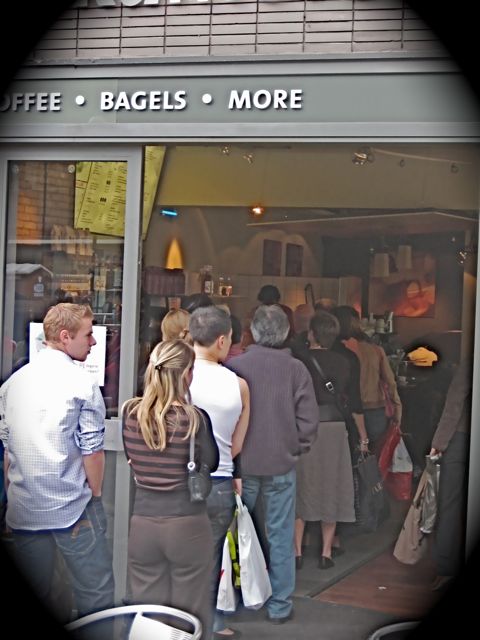 It's a fair question. Look at the picture on the right. This should be a familiar view in just about any city: a long queue for a tall latte. The picture suggests several things. One, that coffee seems to be a popular product; two, that there is space for more coffee-shops; or three, that this particular coffee-shop should perhaps improve its service.
The truth is that this trend is scary for many an existing coffee-shop owner. Because the café, in Europe, has been around for quite some time, centuries for all I know. Yet if you walk just down the street from where I took that picture at a Rotterdam coffee-shop, you'll see a line of traditional cafes, spacious and atmospheric, yet entirely empty. The fact that people would line up at this particular coffee-shop—the only Starbucks-like venue in Rotterdam—suggests that they don't care about space, about atmosphere. All they are about is convenience (if you call waiting for 5 mins. a convenience); coffee-to-go; and exotically-named and expensive coffee. What is happening here is not so much the comoditisation of coffee itself, rather the comoditisation (read: non-importance) of the coffee-selling venue.
I'm not sure if people would care whether they bought a coffee at McDonalds or the Metropole-cafe in Brussels anymore, to be honest. If the selling point is how quickly you can get the coffee and get out, what does it matter if the venue is a palace, ready to serve its customers on its hands and knees?
There are plenty of stories about "how Starbucks drove me out of business" (here's a borderline case), strangely outweighed by stories about "how Starbucks saved my life" (here's one). And with McDonalds increasingly getting ready to become a competitor to Starbucks, and other venues, like Leonidas, a Belgian chocolatier, transforming their previous chocolate-laced focus into a coffee-one, I don't think it's unnatural to be afraid. If a coffee-venue is a commodity, then how hard is it to change your existing venue? Insert some coffee-pumping machines, put a to-go sign on your door, and you're set.
So what should an entrepreneur do? Leave or fight? Yesterday's odd post about Beef, of all things, did suggest another way of looking at business: on a system-level. What was essential to the Chinese beef industry, to meet demand? Proximity to the market, amongst other factors. And what is essential to the coffee-industry? Probably not more coffee-venues, but maybe something else.
When you look at the way the coffee-industry is structured, and probably most industries, it's like a funnel: there are a number of coffee-producers (not sure how many), and a definitely greater number of coffee-venues. The latter is battling for the attention of customers. They do so by engaging in new business development opportunities, both internally (e.g. music), and externally (e.g. coffee in cans). They need to open more and more locations to maintain their air of convenience, just look at the picture above. They need to brand themselves as the number one place to go, versus all the 100s of other new and traditional venues. They need properly trained staff. They need good coffee, and other quick food-products, etc.
This would suggest following openings*:
- marketing consultants
- new business developers
- new business providers
- real-estate agents
- customer service consultants
- coffee-buyers
- temp-agencies
- quick food producers, e.g. a bakers
- and I don't know what else.
The point is that, while a certain, most obvious, business opportunity is shrinking, doesn't mean that there isn't a need for more business. As a (creative) entrepreneur, you just have to look outside the coffee-cup (read: box) and see if customers and coffee-venues would not be in need of other services. And perhaps I am wrong, and because it is so easy to implement a "to-go" formula, it is actually easy to start some kind of food-related venue and add the coffee on top.
Anyway, all this coffee-talk is making me thirsty for one myself.

 The
The 


