 Read it on Tech IT Easy!
This is as much a celebration of technologies like MixWit, which make publishing playlists (legally) possible, as it is a spotlight on one of my favourite musical discoveries last year.
Róisín (Pronounced "Roshiin") Murphy, former lead-singer in the British band Moloko, with a voice that reminds me a lot of Annie Lennox. I have to confess that, except for some remixes, I wasn't a big fan of either of these artists back in the day.
Still, Ms. Murphy is a breath of fresh air in what often seems like a stale and regurgitated pop-scene (I exaggerate). And… I simply can't get the first song on this playlist, "Dear Miami", out of my head!
Not for you, if you don't like electronica or pop.
Enjoy!

Funny how moods influence musical preference. Last week on my run, I would've told you that Junior Jack is the sh*t; a few weeks ago, on a lonely walk through a misty and deserted street, it would've have been Lisa Gerard's haunting voice. But last night, as my eyes were feeling heavy with sleep, it was Grant Green that touched me most.
I first stumbled on Mr. Green's music after trying to prove to my brother that many rap-songs are sampled from other (better) songs. Turns out Grant Green performed a song, named "Better Tomorrow," that was later sampled in Dr. Dre's hit-song "Still DRE." Even though it's not my favourite track of Green's, it's one of the few I could find on YouTube. So here you go, a very recognisable melody after 1:20 mins.
P.S. The Grant Green album I like the most, is called "Ballads."
Addendum
Thanks to the power of Mixwit, you can listen to a whole playlist of Grant Green songs, sourced from all over the web. Enjoy!

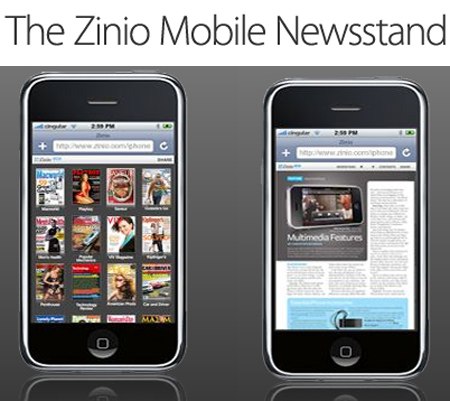 One of the things I do on this blog is deciding on the potential of industry-segments, ranging from farming to coffee-shops, and from grocery to other types of retail. On Tech IT Easy I've previously expressed my scepticism at media (in which I include text, art, audio, video, and gaming), especially in terms of business-models, which I think that segment lacks.
Equally so, I see fairly little space for it in the physical retail segment, simply because it is so much more convenient to purchase and consume it via digital means. The PC (and other tech-gadgets) have essentially become the hub for all things media, and creating barriers to that experience just leads consumers to pursue more convenient ways of experiencing that media. That search for convenience is something that I've also approached in a previous post on this blog.
Let's look at some media-types and how they are being sold online.
For Video - there's iTunes, consoles, and set-top boxes that are controlled by media-producers. In any case, the power-differentials between producers and intermediaries is very unbalanced and it isn't a nice segment to enter as a retailer. Also, let's not forget the free alternatives: YouTube et. al and piracy.
For Audio - again iTunes, Rhapsody, and Amazon MP3 Store, but also smaller digital store for independent artists, like CD-Baby (which operates through iTunes also). Let us again not forget piracy and the fact that much of music is being produced through digital means and it makes sense to organise distribution that way also.
For text - there's again online outlets like Amazon for eBooks (Kindle) and Zinio for magazines. And let's not forget that 99% of text-based media is viewable for free online. Still, admittedly, electronic devices for consumption are not yet able to compete with paper-based methods, at least where price is concerned. Also Audible should not be forgotten as a source for audio-books, recently bought up by Amazon and partially distributed through iTunes again.
For Gaming - I'm not too familiar with the online market for this one. Even so, there's Steam, a digital distribution system by Valve, a platform which they recently opened up for use by other game-publishers. There's also plenty of smaller games being distributed through Xbox-live, the future Playstation Home, and of course the internet.
Finally, Art - here the situation is more complex, while on the other hand being relatively simple. It is complex for artists like my mother, who paints, and conducts business on a personal level by interacting with her customers. On the other hand, there's photography and digital art, arguably the evolution of traditional art, which is easy (for some) to produce digitally and distribute online. I suppose every industry has that friction between the traditional way of doing things and "the new way."
All in all, I don't see media as a big cash-cow for physical retail. I like to think that, because production and distribution becomes cheaper, that its cost will eventually fall to a very low price, allowing for it to be included as an added-value component in the service-proposition of physical retail-outlets (to which I also include restaurants, etc.). I also like to think that creating environments that make the consumption of media a comfortable process (e.g. cinemas) also has some potential.
But my outlook for selling media as a product, something that could easily be sold digitally, remains bleak. Please let me know if there are arguments against my point of view, as I'm here to learn.
My relationship with story-telling - a short autobiography part I
0 comments Posted by Unknown at 1:45 PMI'm in a philosophical mood today, after having spend an hour this morning sorting through the rough drafts for this blog (estimated at around 150), which I categorised as "idea," "rough notes," "feature complete," and "send it already." There were so many of them that I found myself a little overwhelmed to address a single one, a little afraid to miss seeing the forest through the trees, and instead decided to write about a core-principle in my life: story-telling.
I'm very attracted to the concept of telling stories. It's perhaps a little difficult to explain, but certainly related to the reason why I write so much, and also integral to what I want to do with my life.
When I grew up, I was reading all the time. From the back of cereal boxes, to encyclopaedias, to even the bible (which I thought was a great fantasy book). As a kid, I also remember building up cities in my room and garden, made out of toy-parts and characters, and constructing visual stories around what was happening.
I did not watch TV until I was 10, but, around that time, I fell in love with fantasy and sci-fi stories, both in book-form and on TV. I liked the way the story was constructed, and loved to imagine myself being there. I remember having magnificent visions of what I imagined the future of society, cities, and the home to look like.
Around 17, I decided to hold my first teen-party (the last one before that was probably around the ages 8-9). At that time, I was playing around in a band and very much into music-culture. I remember coming up with the party idea, which was essentially a visualisation of a club. It was lucky timing. We were just about to move and I had a huge house to my disposal.
The way I visualised it was to have rock-bands playing live in the living-room, a techno-room with a (borrowed, I think) strobe-light in the basement, and some other theme-related room elsewhere. Important were of course drinks and drugs, as, hey, I was 17. And equally important was the concept of complete freedom, which I think was communicated quite clearly.
A large inspiration was this video by the Prodigy - No Good (start the dance):
The end-result was great: around 50 people showed up, 2-3 bands were playing, and people did some crazy stuff, without getting me in trouble. In the end, I was still the one responsible, and took that seriously, but essentially everyone could do what they wanted. I repeated a similar party a few months later, which revolved around the same principles, with some restrictions, though around twice the amount of people.
That's where I'll end this. Lot's of stuff happened since then and will continue to happen, and I hope to write a second part in maybe 5-10 years from now (maybe sooner) about all the adventures I'll hopefully have, and evolutionary leaps I'll hopefully make.
Core to everything, I think, is vision and freedom. When you create a story, you have a vision of the components and the way they fit together into a dynamic process. At the same time, a story-teller must realise that his/her story is just the start for the listener/viewer/experiencer. It's a synergetic interaction between creator and beholder and the end-result can be both unpredictable and quite beautiful sometimes, a risk that, to me, is entirely worth it.
P.S. Happy Valentines day!
- Cordless earplugs that are also headphones - imagine going to bed and blocking out your partner's snoring, and waking up to the sweet sounds of […insert your sweet sound here…].
- Fluorescent permanent marker - to convert my non-pro Apple laptop-keyboard, into one that lights up in the dark.
- A binder/folder that allows me to bind printed web-articles into an easy to read non-webzine.
- A mobile (!) pad that allows me to draw on paper, which stores these drawings electronically, and allows me to later transfer them to my computer - saw this somewhere for €80, always regret not buying it.
- Some kickin' clothes.
- For my Laptop and iPod to last me through their 3rd year.
- Anything on my wish-list.
For 2OO9
- An Apple laptop that is as light and as thin as possible - So no disk-drive as that can be external. 3-4 USB-ports to compensate would be nice.
- The next OS (10.6 or 11.0) from Apple.
- An iPod with a nice screen and no phone - for music, video, books on the road.
- A small car (unless I live in a big city, then a good rent-a-car service).
- Orexin A.
- More public wifi / or a pan-European service.
- A Wii / DS and time to play it.
- Some kickin' clothes.
5 Links: human sigma, link-baiting, neuroscience, brand experience, wine
0 comments Posted by Unknown at 11:47 AM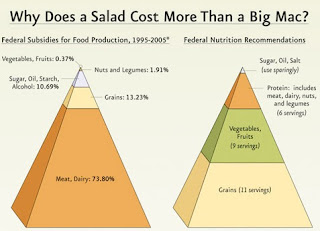 While I'm stuck on writing some other posts—the idea is there, the execution some way off—it is time for another collection of links.
- Using Human Sigma for measuring customer engagement - Mitch Owen reviews a new book on the market, that suggests that evaluating our efforts at customer satisfaction happen on four levels: Confidence, Integrity, Pride, Passion.
- How to coast to a writing career - Valleywag writes an insightful post (for once) about what matters when blogging. I like "AVOID: Blogger ego. If you do blog, just write and forget about it. Don't reply to your comments with more than "Good point, h8rboi, thanks. Don't troll other bloggers for links, or try to get onto Techmeme by posting about whatever's already there. ... People in the real media don't care what your Technorati rank is, they'll just Google you to see what you write." That said, I have no intent to engage on a writing career.
- Mind hacks: an interview with Jonah Lehrer on neuroscience - What I like: "Artists are constantly being forced to reverse-engineer the brain. By reverse-engineering the art - by trying to understand why, exactly, it resonates with us - we can learn about the mind."
- Thirteen examples of successful brand experiences - could be filed under architecture. The British design council points us to 13 different "experience-castles" (my own term), where customers can be enchanted.
- Calculating the carbon footprint of wine - What can I say? It's the new world! Some key-points: organic is not as efficient as we think; distance matters; packaging matters.
- Bonus Link: Why does a salad cost more than a big mac. - A picture says more than a 1000 words. This is just as applicable to Europe btw. Thank Wolsey for inventing the subsidy!
Enjoy! More of this: check out the S+FnR bookmarks—updated 24/7 !
5 links to think - on Japan, designing experiences, globalisation, and endorsements
0 comments Posted by Unknown at 3:12 PM Really no shortage of interesting links this week, which is always nice. At the same time, it makes choosing 5 that much harder, but here goes.
- An Alien in Japan: Charlie Stross describes his trip to Japan last summer. …From Yokohama to Tokyo to Kyoto; …about shaved cats, getting lost in shopping malls, to Hello Kitty, and extreme bathing, to monorails and re-building history. A very interesting read, which presents some insights into that alien world, Japan.
- Blasting scents into coffee-consumers' brains: Roger Dooley explains the importance of environment to sensory experience, and describes how Nestle's Nespresso found their way into people's noses, brains, and hearts. In coffee, just as with good food and wine, scent is everything! Food for thought.
- Can experience be designed? After reading Bob Jacobson's essay, I'm not so sure. He writes about placing human experience into the centre of the design process, about systemic relationship between information and the environments (see above link as an example), about the difference between user- and human experience design, and how you can probably never design an experience to completely meet a person's expectations. At least, I think that's what he writes. So much of this text is far above my head, but worth reading to guide your mind into new directions, and a must-read for anyone interested in creating experiences. It's all a pre-cursor to a book, which, judging by the range of material, I expect to be published in 2 to 5 years, but which will be well-worth the wait. In the meantime, check out Bob's great blog.
- The downside of franchising: Richard Layman, in his artsy urban blog, writes about how franchises have transformed L.A.… into a clone of just about any other city. A little anecdote: I observed a similar trend when I was last in Belgrade, Serbia, which I hadn't visited since the war. It looks just the same as any other city, and that's sad because I remember there being a lot more authentic clothing- and food-venues. When I see this, I'm not sure I'm a fan of globalisation, or franchising for that matter.
- A twosie on Human brand-carriers (Sounds like a disease, doesn't it?): Two articles discuss this, one, by the NY-Times, on rock-stars and their interaction with brands. As one artist put it: "The barriers are changing and we as artists are making less and less money, and we have to get creative." At the same time, I have great sympathy for artists like Springsteen, Tool, and N.I.N., who refuse to corrupt their art. And another article, by HBR, on endorsements in sports, which is, at last count, a 100 billion dollar industry. I'm fascinated by this phenomenon, so maybe I'll write something about it in the future.
I'm preparing a few posts for this week, but had the chance to watch a documentary about Dutch artist, Candy Dulfer this evening. She made a very favourable impression on me. Her most famous song, "Lily was here," was a spontaneous collaboration with Dave Stewart, recorded some 18 years ago. Stewart, whom she describes as her mentor, in turn describes her style as "very fluid," and her knowledge of riffs "encyclopaedic," which makes her an excellent collaborator with other artists.
Love the song, love the person. Enjoy!
Watching this as I drink my Pepsi Max. Thanks Fred Brunel!
I'm taking a little breather (what again?), to prepare some longer posts, a media-related one for Tech IT Easy, and some more tech- and logistic-related ones which I plan to mirror-post on both this blog and TIE. Hopefully, I'll be done with that soon.
In the mean time, I was thinking that there are actually quite a lot of songs inspired by and named after cities. The first one that comes to mind is Jacques Brel's "Le Port d'Amsterdam" (see video at the end of this post), also more commonly known as just "Amsterdam." I don't have the time to create a world-map of songs, though quite a few come to mind, which I may write about at a later date. And I'm also thinking about themes for food-venues, and where they come from.
There is a famous café in Brussels, called "A la Mort Subite," which Jacques Brel used to frequent and which has pictures of him hanging on the wall. I think it represents, for those that care, a great tourist-attraction and a piece of history. It's hard to control that, and I'm sure the café would have ended up differently, if it wasn't for Brel.
My dad told me a story about a café started in Bonn, Germany, which became a centre for political journalists in the 80s. As the interim capital of West-Germany, Bonn was important back then and it was only natural that such a place needed to exist. The café is dead now, of course, after the government moved to Berlin. Similarly, there is an artist-hangout in Dublin, one of the few authentic pubs left, and probably there since James Joyce, for all I know.
How this all happens, seems out of the control of the owners. Maybe just the right time/place, or the price being right for starving artists/journalists, who knows. Maybe there were other factors that can be "engineered." In any case, food for thought.
Enjoy the video. Le Port d'Amsterdam is incidentally also a Dutch pub in Paris.
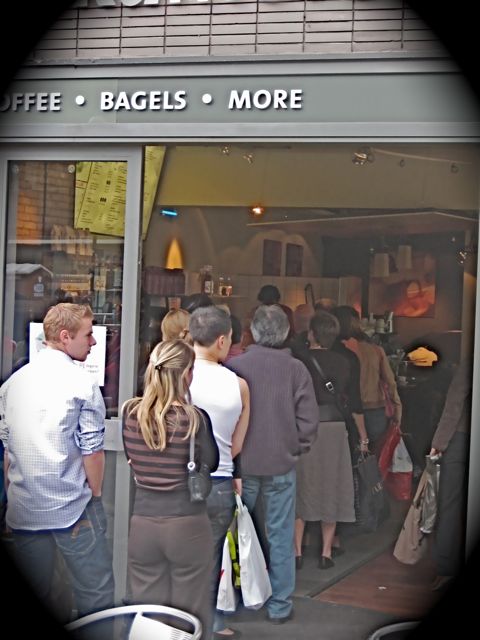 It's a fair question. Look at the picture on the right. This should be a familiar view in just about any city: a long queue for a tall latte. The picture suggests several things. One, that coffee seems to be a popular product; two, that there is space for more coffee-shops; or three, that this particular coffee-shop should perhaps improve its service.
The truth is that this trend is scary for many an existing coffee-shop owner. Because the café, in Europe, has been around for quite some time, centuries for all I know. Yet if you walk just down the street from where I took that picture at a Rotterdam coffee-shop, you'll see a line of traditional cafes, spacious and atmospheric, yet entirely empty. The fact that people would line up at this particular coffee-shop—the only Starbucks-like venue in Rotterdam—suggests that they don't care about space, about atmosphere. All they are about is convenience (if you call waiting for 5 mins. a convenience); coffee-to-go; and exotically-named and expensive coffee. What is happening here is not so much the comoditisation of coffee itself, rather the comoditisation (read: non-importance) of the coffee-selling venue.
I'm not sure if people would care whether they bought a coffee at McDonalds or the Metropole-cafe in Brussels anymore, to be honest. If the selling point is how quickly you can get the coffee and get out, what does it matter if the venue is a palace, ready to serve its customers on its hands and knees?
There are plenty of stories about "how Starbucks drove me out of business" (here's a borderline case), strangely outweighed by stories about "how Starbucks saved my life" (here's one). And with McDonalds increasingly getting ready to become a competitor to Starbucks, and other venues, like Leonidas, a Belgian chocolatier, transforming their previous chocolate-laced focus into a coffee-one, I don't think it's unnatural to be afraid. If a coffee-venue is a commodity, then how hard is it to change your existing venue? Insert some coffee-pumping machines, put a to-go sign on your door, and you're set.
So what should an entrepreneur do? Leave or fight? Yesterday's odd post about Beef, of all things, did suggest another way of looking at business: on a system-level. What was essential to the Chinese beef industry, to meet demand? Proximity to the market, amongst other factors. And what is essential to the coffee-industry? Probably not more coffee-venues, but maybe something else.
When you look at the way the coffee-industry is structured, and probably most industries, it's like a funnel: there are a number of coffee-producers (not sure how many), and a definitely greater number of coffee-venues. The latter is battling for the attention of customers. They do so by engaging in new business development opportunities, both internally (e.g. music), and externally (e.g. coffee in cans). They need to open more and more locations to maintain their air of convenience, just look at the picture above. They need to brand themselves as the number one place to go, versus all the 100s of other new and traditional venues. They need properly trained staff. They need good coffee, and other quick food-products, etc.
This would suggest following openings*:
- marketing consultants
- new business developers
- new business providers
- real-estate agents
- customer service consultants
- coffee-buyers
- temp-agencies
- quick food producers, e.g. a bakers
- and I don't know what else.
The point is that, while a certain, most obvious, business opportunity is shrinking, doesn't mean that there isn't a need for more business. As a (creative) entrepreneur, you just have to look outside the coffee-cup (read: box) and see if customers and coffee-venues would not be in need of other services. And perhaps I am wrong, and because it is so easy to implement a "to-go" formula, it is actually easy to start some kind of food-related venue and add the coffee on top.
Anyway, all this coffee-talk is making me thirsty for one myself.
Taking a few days off blogging. For some, easily explained reason, I'm completely burned out and unable to phrase intelligent arguments about why food and/or retail is great... or anything else for that matter.
I leave you with this video from "Lost in Translation," because that's how I feel. But don't worry, I'll be back and on fire before you know it.
The song is "Moby - Porcelain."
Nothing illustrates people's preference for convenience more than the evolution of money. Go from bartering goods (think rotting tomatoes), to (heavy) gold, to (less heavy) gold-pieces, to certificates of value, to paper-money, to credit-cards, to ... mobile phones(?) and I hope the point is clear. When it comes to money, people would rather not deal with it at all; they just want to be able to buy stuff.
The same applies to music-media and the need for quality vs. convenience. Take a live concert: the best possible quality of music, not only can you hear it in the best surround-sound possible, you can also see the band, and feel the emotions going through the crowd. It's exhilarating, at least I think so. Anything reproduced really only gives you half the quality.
The tape became a success, even though they were accompanied by a lot of hissing, because it was so easy to integrate it into social life, like music should be. You could exchange it with friends, carry them in your pocket, even listen to it in your car. The CD really had the same qualities, with the added benefit of no hiss. And along came MP3s, worse quality than CDs again, with their compression and small sizes. Yet it became an instant success because we could exchange it globally, and it had no DRM for liberal home-use. You could burn it on cheap cds and play in your car.. yay!
iPods are infinitely more expensive, and even though I got my 20 gigs worth for only €50 (student-deal), I don't think I would hesitate to buy a €300 model when mine breaks. The simple answer is convenience again. It is expensive, yes, but it's so nice to carry a device around that allows you to play songs in any order, create flexible playlists, as well as play podcasts and, for some (not me), play video and browse websites, even call / photograph people. How cool / convenient is that?
John Gruber wrote another good post about Amazon's new MP3 store and the fact that it works so well with iTunes and hence iPods:
People buy iPods because they love them. If your music doesn’t play on iPods, it isn’t going to sell. And so if (a) you refuse to sell music downloads without DRM; and (b) no other DRM system other than Apple’s is compatible with iPods; then we’re left with a situation where the only successful store is going to be iTunes. What Universal and EMI now seem to have learned, at long last, is that (b) is completely under Apple’s control; only (a) — the labels’ own willingness to allow their music to be sold without DRM — is under their control.
The point being is that people don't care about DRM, it will not affect the way they decide things. They did not buy at the iTunes store because they were locked into the iPod. They bought at the iTunes store because it worked so well with the iPod.
That said, the way Apple treats the rest of the world is disgraceful and I have yet to buy more than 1 song in iTunes. It pissed me of because I couldn't use it anywhere else, because US-customers get a more complete offering, including video, because I already feel like a criminal before I even stole anything... But hey, I agree with the core-idea of iTunes, not necessarily the legalese surrounding international business.
Allow me to digress for the rest of the post.
 Recently, I bought my brother a Sony Ericsson W580i phone. It has a lot of media-capabilities and is actually kind of cool. I like the way that Sony is trying to turn this little device into the new walkman. But there's two things I hate about it. One is that I need to use a special plug* with any headphones I want to use (they don't show you that in the picture). OK, it sucks, but I can deal with it. And two, the software that comes with the phone stinks!
It might be the computer (note that iTunes works well on that one), but as soon as the software started I was both confused and frustrated. Moving music is a three-step process; I had to dig to understand how to import my music; and the whole process is kind of slow... even lags down my brother's PC (might be his crappy PC :). But you could summarise the whole thing down to being pretty unsatisfactory. Alternatively you can use the phone as a hard drive and drag files to it using explorer, but it then doesn't import metadata, like eh what the artist is called and the album.
In both cases, Apple and Sony, you are restricted to using the software. But the iTunes experience is actually kind of nice (except if you want to export things — if it wants to become DRM-free it should also allow me to move music out of my iPod). You can create brilliant playlists, etc. iTunes is in fact the interface that no media-player manufacturer has as yet managed to create, both on the player or on the computer. And what you see with Creative, Sony, etc. is that they are clearly not software-companies, focussing all their energy on the player instead of the software on the computer. But I digress.
The point is that, even though the W580i is infinitely cheaper, it is not Walkman 2 or 3, because there is actually no improvement in the experience. In the technology, yes, in the experience it's a couple of steps backwards. The reason is very much Sony-specific; it has the weirdest business-structure where it splits all its divisions into a competitive matrix, where each has to fight for its yearly budget (if that sounds familiar, it's because public institutions like schools operate in the same idiotic way.) And because of this divided structure, there is no co-operation, no synergy. The hardware-people create brilliant hardware, like they've always done. The software-people, because they suck, create inferior software, and continue to under-perform under Sony's "interesting" mechanism of only rewarding the strong.
Businesses who want to compete for the next medium in music need to understand that customers make decisions based on a very simple principle: "How is my life better because of using your product?" You need to look beyond the lab, into people's homes to see if your hardware-solution might benefit from better software, or vice versa. Or else, you can't even hope to succeed against Apple.
The good thing about the rise of online media-stores, is that if you can create software that works well with them (e.g. Amazon imports music in to iTunes), as well as well with your player, you are already half way there.
 I feel like I've written enough about Apple over the last months on Tech IT Easy, and similarly the blog-space is a-buzz with the news of iPods, new colours, new ways to get media, blablabla, how boring huh?
Well, while I still want an iPhone, especially now that it's dropped to a price where the synergy between media-player, mobile PC, and phone is actually quite compelling, I was much more interested to hear the news about yet another partnership, this time with Starbucks. If you aren't a faithful reader of Tech IT Easy, you may not have noticed that lately I spent a lot of time discussing food-related things (completely unrelated to tech of course) and in particular, several posts about Starbucks. The first was on how Starbucks uses vertical integration to maintain a high level of quality throughout their value chain (it is not a franchise!), and the second, more tech after-all, on the concept of a third place and how the web fit into this.
The third place
I hopefully do not need to go into this again too much, as much of the definition can be found on my post and on Wikipedia. But essentially a third place is the space between home-life and work-life, where we try to find some time for ourselves.
Starbucks has really been pushing this concept, both in their amazing book, and of course in their stores. I should mention that, as a European, I'm quite spoiled as far as third places / food-related leisure venues go, and Starbucks, in my opinion, could use some... personality, for lack of a better word. But that is mainly the legacy of scale economies, which is king in the US, and lead to the global and uniform-looking chains, like McDonalds (see my other post on that here), that we are used to seeing, of which Europe, in turn, has very little to offer.
How has Starbucks tried to make their venues third-place worthy? Well it starts with creating a place where people like to be. Initially, Starbucks was a coffee-bean retailer, not selling coffee-drinks, and a big credo at that time, and ever since then, was to educate people about coffee. This is based on two vital ingredients: excellent coffee and a staff both qualified and approachable. And education and customer-service are pretty much the core of Starbucks, as I see it.
Second is creating an atmosphere that makes people feel at home. Here, music plays an important part as well as providing places where people can work and browse the internet. This has manifested itself in several partnership, with music-producers and artists, incl. Apple, as well as T-mobile to provide fairly global internet-coverage in their chains.
The latest is of course Apple's announcement that people will be able to buy songs currently playing in a Starbucks at a finger-click through itunes, and at no internet-charge.
Starbucks the retailer
After reading the book "Pour your heart into it," I've always seen Starbucks as much more than a simple coffee-chain. The company is aggressively forming partnerships to offer customers a richer experience in their stores, and expanding their reach into supermarkets as well, in order to gain mind-share. And, as Schultz announced in the Apple Keynote, the company is still in its embryonic stages, which I can easily believe.
Focussing purely on their retail-outlets for now (and not their innovative shifts into people's homes), that is what their coffee-houses are in fact becoming. Building on the reputation of their coffee, Starbucks has been extending that to other products in their stores as well, always using the credo of "quality first." While, similar to Apple, this quality comes at a premium, Starbucks is playing into current market -trends that quality leads to less price-sensitive customers, and as long as the company keeps doing well, it can keep charging these prices.
What I see is a shift from the supermarket, book- or music-stores, to places where people come first of all to relax and second to surround themselves in a type of glamour, listen to good music and buy it, read a good book and buy it, have a great coffee and buy some beans to take home.
This is only made possible because Starbucks has a strong control over their value chain and a lot of marketing power at its disposal. A regular coffee-chain, which does not own its own coffee-factories, nor have the financial capacity to own multiple stores, instead franchising them, does not have the same negotiating strength with partners to guarantee this level of quality.
While Starbucks did not entirely start from the ground up—Howard Schultz actually acquired the bean-maker after a while and took their name, it clearly pays off to start as high as possible on the value-chain, as a manufacturer, while having a keen eye for what customers want.
You can't always be informative, you got to have fun too. That, and I need to take time for Tech IT Easy too, for which I have written a post on innovation management and hope to publish it tomorrow. So, as I expect this to happen more often, I have decided to have regular music and media-interludes to bring a little "colour" to this weblog.
"Bagdad Café," aka "Out of Rosenheim" (imdb / wikipedia) is one of my favourite movies. It's very different from what you'd expect. The story plays in the desert, somewhere in the US. A German woman gets stranded there and starts renting a room at the Bagdad Café, which is a little hotel-bar-restaurant in the middle of nowhere. The female owner of the place, in the mean time, is very stressed and unhappy with her current situation. But as soon as her German visitor arrives, weird stuff starts happening. The place mysteriously gets cleaned up and people start having fun. The cafe really transforms from a dusty emptiness, to a vibrant hangout where people want to be. I really like that.
So without further ado, the video below shows some pictures from the film, and is accompanied by the theme-song "Calling You," by Jevetta Steele, which is on the soundtrack. I had no idea it had been covered about a million times since then, for other renditions by people like Elton John to a house-version, do a Google-video-search. I like the Dominique-one also.
Enjoy! And check out the movie if you get a chance!
This is an area, I'm probably most comfortable with, and thus like to talk / write about. I suppose there is different formats to go with here, of which there are four categorisations:
- Pop-music
- Niche-music
- Loud-music
- Background-music
 That brings forth some design-considerations. Let's propose scenario 1:
3 floors, guests enter on the level floor, which is the bar, they descend to the basement, which is the dance-floor, or they ascend to the top-floor, which is the restaurant.
 There's also scenario 2:
A flat building, with 3 rooms. Guests enter through the bar, from there they can go through a soundproof tunnel to the dance-area, or through a second doorway, to the restaurant.
It is one large room. There is a dance-floor in the middle, and bars surrounding it, as well as one being in the middle. On the edges of the room, there are arrangements for people to eat. And this is the gist for it all to integrate! The room has a relaxing music playing, and the dancers, they get headphones to dance with.
 Why I like scenario 3, is because I'd like to find a solution where people can easily dance and lose themselves in music. But I'd like for people to easily be able to switch to chat-mode. Why I don't like it is because of the technological barriers: is it comfortable to dance with headphones? How would you organise the logistics? And would people feel comfortable in such a setting? Still, I like this scenario the most somehow, it's different.
 This blog and myself are still in the gestation-phase, which means I'm still forming my thoughts about my future business and finding my voice here. That said, all my past thoughts about opening a venue in this area involved creating great experiences, yes, offering food 'n' drink, yes, but also making music an important ingredient. Much of this should've already been clear to me from my post on inspirations, but hey, I'm not that smart.

 The


