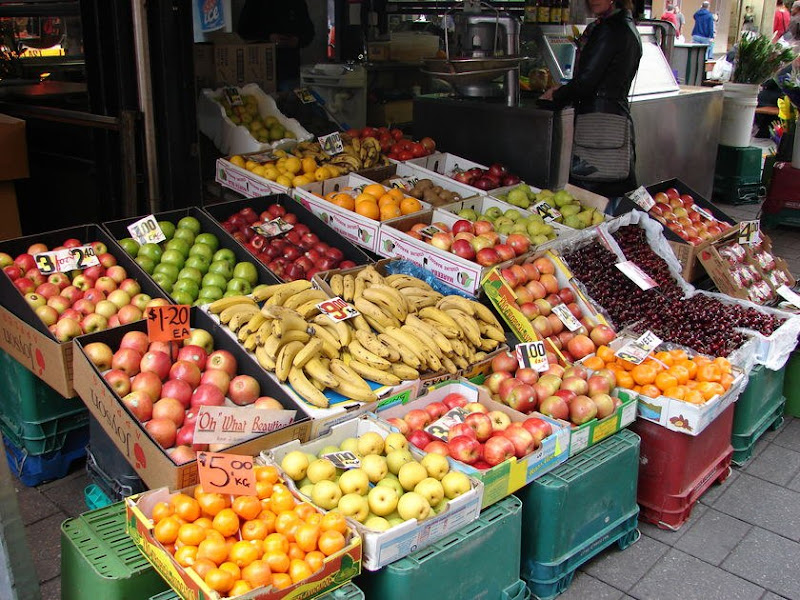
 Take a look at this quote, which I posted a few days ago:
"There should be a rule: before helping the environment in one market, we should be required to think through the impacts on other markets." (source: Freakonomics blog).Or, to put it differently, every action has a (sometimes equal) reaction (I think the traditional phrasing ignores the human element). The idea that everything is interconnected is both fun to right-brained generalists like me (not a compliment), and scary at the same time. The global economy is very complex and, I would say, impossible to regulate.
There's a couple of things going on the world, which I'm sure everyone is aware of. There's a number of wars, there's the weakened dollar, there's some kind of housing-related recession going on, there's a shortage of oil, our planet is perceived as suffering and currently being saved (I hope), there's India and China, the rise of the Anglo-Saxon system, etc. etc.
And some of the biggest problems facing the food-industry (depending where you are in the chain), are rising food-prices, which relates to that oil-shortage (both in terms of pricing, but also because of alternative fuels using farm-products), the rise of India and China, and some other factors; and the costs of keeping green, which has largely been inspired by companies like Wal-Mart, but also by the (exaggerated) need for global diversity by customers (which the food-industry is also partially to blame for).
The solutions vary, and are, so far, very defensive in their nature. For the cost of going green, most pollution comes from transport and the solution is to either use the most eco-friendly way to go: on land, by train, across water, by ship; or to go local—which companies like Marqt seem to focus on, but which also comes with the pitfall of seasonal shortage.
For rising food-prices, again one solution is to go local, to save on transport and have some control over how farmers work, and be able to charge higher prices to the rising local-conscious consumer. But a bigger solution is for more food-production to happen (much of it currently goes to India & China, or to biofuels), and possibly from smaller farmers. The problem here is that it will take time (some estimate decades) for smaller farmers to get ready.
Both are definitely big picture-problems, and will take time to solve. One thing, I'm personally looking at, are micro-lending sites like Kiva.org, which put you into contact with local farmers, allowing you to help them out in your own way. From a Venture Voice interview with one of the founders, I understand that some of these investments happen within the context of a community, where each member keeps watch over the other's use and repayment of the funds, in order to ensure a good outcome, and so loans will continue to come in. But, while I think it's well worth the effort, this is still a small-picture solution to a much larger problem.
The way it looks right now, the solutions have to be planned in the long-term and on a large scale. There is definitely space in the farming-segment for more production to happen. In the mean time, food-prices will continue rise, as will the price of educating consumers to make more responsible choices. I like Tesco's approach in labelling the origins of their food and allowing people to make more carbon-friendly (locally focussed) decisions. But that doesn't solve the problem for farmers in remote areas of course.
Sigh, if you just got a headache, I sympathise, as I just got one too.
Further reading:
- NYTimes: Environmental Cost of Shipping Groceries Around the World
- Economist: The new face of hunger
- Buzzfeed: Food Hoarding
I just discovered a new podcast called "Big Ideas" (iTunes-link), a series of lectures on anything from the impact of urbanisation on musical tastes, to designing menus for restaurants. Oh, and it's Canadian. Not that that's bad, but some parts of the lecture covered local conditions.
John Schneeberger starts his lecture (dated March 1, 2008) off with the basics of menu-design, namely that they should reflect three things:
- What you stand for? Aka. what kind of food do you like to work with?
- What demographics are you targeting? Income, religious issues, etc.
- What are the current trends? And are they for real or just a fad?
- Customer-decisions are always a trade-off between price and quality
- Traditionally, dishes consist of three components: protein, starch, and vegetables.
- What we understand as taste, actually comes from three sources: fat, salt, and sugar.
Schneeberger discussed three booming trends, vegetarianism, organic food, and local produce, and mentioned a number of challenges related to these.
 Vegetarian cooking
The thing to understand about this, is that it's generally cheaper. Schneeberger mentioned a 1:10 ratio when you compare the cost of producing vegetables to the cost of growing a cow. And while it's a booming trend, the industry, somewhat mis-guidedly, still often focusses on trying to replicate the taste of meat, which is impossible (think veggie-burgers, etc.).
Instead, they should be thinking about nutritional value— vegetarian food has been correlated with lower health-problems and is for that reason often recommended by doctors. The problem with these types of diets is of course that they are low in those qualities we would traditionally associate with taste: fat, salt, and sugar.
To create dishes that people actually enjoy, restaurants have to look globally, e.g. Asia, where more exotic vegetable components can bring some needed flavour to these dishes. I think he mentioned seaweed, but also stinky tofu (see pic), which is a type of fermented tofu and one of the few ways to naturally bring flavour to that type of protein.
The implication is that vegetarian food requires a significant amount of specialisation and is often hard to combine with meat-cooking.
Another complication arises from vegan (no dairy, honey, animal-derived products) versus lacto-ovo (incl. dairy, honey, animal-derived) cooking. The first makes it very hard to create a (traditionally) tasty dish. The second, lacto-ovo, allows for more flexibility, through the use of ingredients like eggs, which not only provide extra protein, but also bring a lot of flexibility to the kitchen. You can, for instance, make foam out if it, which would enable the creation of deserts & soups, etc.
Organic cooking
First of all (and I'm not sure if this is just restricted to Canada), an organic food label refers to the production method, not necessarily the quality and taste. Since organic food is more expensive, and taste is not guaranteed, you have to wonder if your clientele is willing to pay extra for that service (remember the trade-off between price & quality!).
The big selling-point here is the information about the product. People like to know how their food was produced; it has a certain value to know that there are no chemicals or genetically modified components in what you are eating. But again, that must be a value that is clearly advertised and which may not be important to every type of demographic.
Local produce
The advantage for the restaurant is that they can form better relationships with their suppliers, it's also cleaner in terms of carbon footprint (less transport), and it also has some marketing value to a certain demographic.
The disadvantage is that supply cannot be guaranteed during all seasons. Schneeberger mentioned something called a "100 mile diet" for instance, but restaurants catering to that need will probably have problems in the winter.
Thoughts
Overall, a pretty insightful lecture of the more exotic (and trendy) type of cooking and its trade-offs.
These types of specialisation are still pretty niche, require significant resources in terms of tools, know-how, and supplier-relations. But, if executed well, a niche can be extremely profitable.
I thought that it was interesting that all the traditional means of cooking, the ingredients and the taste-makers, were pretty incompatible with these newer trends. As such, you are essentially climbing up a hill, trying to educate the mass-market. At the same time, good execution, together with differentiation from the norm, seems like a formula for success.
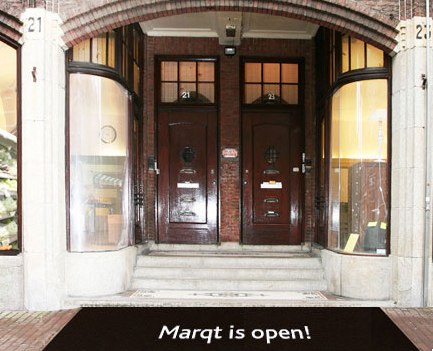 Marqt is a market for farmers, recently launched in Amsterdam by Quirijn Bolle en Meike Beeren (both ex-Ahold). Can't really sum it up much more than that.
It focusses on two opportunities: from the supply-side, many farmers want to sell their products, but are unable to because of the power-play from regular retailers and/or at relatively low profit-margins. Last year, when I briefly looked at the organic boom, I already thought that there is an opportunity here, for farmers to become retailers themselves.
This is made possible by the other part of this equation, an elevated demand by customers for natural and ethical produce, and, to a lesser degree, local produce.
Bolle and Beeren rightly identified an absence of identity in food-retailers, an absence of accountability for the product-decisions they make. But they also identified a need by consumers for quality-guarantees.
Because you have to wonder, how is Marqt different from the regular outdoor-market that exists in every city? Well, here's one difference, and I'll try to give an example. 'Tis the season of mangoes, and I'm hooked. I've been buying these babies at €1 a piece at my supermarket, but stumbled across some great deals at the local market: €2.50 for a box of 8! The only problem: about 6 of these were either unripe or overripe. And who do I complain to? One of the 100s of vendors on the market, whose name or brand I don't even remember?
From my understanding (I don't live in Amsterdam), Marqt-products are more expensive than those of local markets, about on par with regular supermarket-foods. They work with partners that are able to supply in greater numbers, offer a quality-guarantee, and, very interesting, train Marqt's staff to understand and explain how products work.
Their added value is that they can offer suppliers higher margins, and consumers a richer shopping-experience. And from what I hear, though I have no numbers, the store is doing reasonably well.
Two other interesting facets: Marqt houses individual suppliers' stores. So you have Store X for dairy, store Y for meat, and store Z for bread. Marqt provides the space, the staff, the marketing, and collects a percentage of the profits.
Also interesting: the store doesn't accept cash. It's progressive, I agree, but also great marketing-value, sure to raise an eyebrow or 1000. And it saves money on the back-end, though I hope they get rid of the €0.50 transaction-fee.
I think it's a great idea, and hope the store continues to do well. Gives me hope, both in terms of opportunities for retail-entrepreneurship, and entrepreneurship in the Netherlands in general, which (in my opinion) could use a boost.
5 links - sense of smell, false green ads, farming boom, Lego, fun e-shopping
0 comments Posted by Unknown at 10:49 AM Time for those Sunday-links again. Today, I'll discuss the cocktail that is smell and how some things just don't mix; how green is not all it's cut out to be; a possible shift of power from retail to farming (or not); how lego came to be and where it is going; and how to sell me online shopping.
Previous link-discussions can be found here and my bookmarks here.
Link 1: Starbucks Admits Sensory Mistake - These are the kinds of stories that make me I like the NeuroscienceMarketing-blog. If you follow the science-section of the Economist, you'll know that neuroscience is a big deal anyway. In any case, this story is about how Starbucks designs atmosphere, largely influenced by smells. Apparently, smell of heating egg and cheese sandwiches doesn't mix well with the coffee aroma.
Link 2: False 'Green' Ads Draw Global Scrutiny - Two problems linked to green adverts these days, I think. One is that consumers are growing tired of it. And two is that, as this story shows, just because companies say they are, doesn't mean they are. I like the Norwegian approach to this. They ban green adverts by products that cause more problems, no matter how innovative they are (about hiding it).
Link 3: Farmers Wonder if Boom In Grain Prices Is a Bubble That food-prices are rising is an inescapable fact. But it also presents an interesting shift in the status quo. In the food-chain of the grocery-business, farmers are pretty much at the bottom. Now, even though their own costs are increasing also, they can charge more on top of it and decrease retailers' margins. Time will tell if this is something that will be acceptable for a long time. Certain signals very much suggest to me that farmers may be in the right position to cut out the middle-man and become retailers themselves.
Link 4: The Making of…a LEGO - I'm still a kid at heart, so I love anything to do with games and toys. My parents never bought me much lego as a child, which I regret as I hear it breeds geniuses. In essentially two pages, the article describes how lego came to be, what makes it so perfect, and what the company's strategy is. I was always impressed with the brand-extensions they did with the games, the robots, and the theme-park. A company to follow.
Link 5: Online shopping at Hema.nl - I've linked to this on twitter before, but it brought another smile to my face watching it again. Just when I think that online-shopping has no future, innovative uses of technology surprise me again.
 I suck up data wherever I go (it's a curse, I know). Just last week, as I was waiting for my laptop-drive to be installed, I sat in a German bank and came across a magazine, called VR-future. Two articles caught my eye, one on the Bio*-boom in Germany, and another on Switzerland—a country that fascinates me, but that's a story for another day.
The bio-trend article consisted of an interview with Dr. Alexander Gerber, the Germany CEO of the BÖLW (the foundation for organic products in Germany) and revealed some interesting info on this segment. While it focussed entirely on Germany, I do think it brings some interesting insights on this topic in general. (*: "bio" being the German term for organic)
Now, I should say, that I'm generally weary of the word "Boom," as I inadvertedly associate it with the word "Bust." Any market is subject to the laws of supply and demand, and a boom usually suggest an explosion of one or both, eventually leading to some fall-off after a while. I have no doubt that the same will happen to the Bio-sphere as well. There are also particularities about the organic market which I do not like, and I will go into those in my final thoughts.
The rest of this post is structured as follows. I will begin with the definition of organic, then some stats on sales, after which I will look at employment-trends, and expected areas for growth. I'll conclude with some final thoughts, to answer why I am bearish on this whole organic trend.
So, what is "bio" or organic?
From Wikipedia:
For crops, it means they were grown without the use of conventional pesticides, artificial fertilizers, human waste, or sewage sludge, and that they were processed without ionizing radiation or food additives. For animals, it means they were reared without the routine use of antibiotics and without the use of growth hormones. In most countries, organic produce must not be genetically modified.
Bio-Sales
Worldwide, while the percentage is low (Wikipedia reports 1-2% of food), it is showing far quicker growth than conventional food. In the US, Wikipedia reports a 17-20% annual growth of organic food in the last few years before 2004(!), compared to 2-3% for regular food. 2.6% of food sold there is organic. In Europe, while I don't have the stats on exact growth-rates, the percentage of of agricultural land being used to grow organic produce, is on average 3.9%, with Austria (11%) and Italy (8.4%) leading the pack.
In Germany, the annual revenue from bio-products with discounters and supermarkets has more than doubled since 2000, up to € 4,6 billion in 2006. And, at the moment (2007), Bio-products have a 3% share of sales in small food-stores, which is expected to double by 2010. The level of food-prices, held low by government subsidies, is expected to rise in the future, which… will probably not mean much to the bottom-line of retailers and producers. And, apart from the ethical considerations, bio in Germany has very much become a lifestyle product, translating into lower price-sensitivity. According to Gerber also, a new bio-supermarket opens every week.
With all this positivity, there is the somewhat counter-intuitive trend that farmers in Germany are complaining about falling incomes, and annual growth in their area has slowed down from 20% in 2000 to 0,4% in 2006. I imagine that is so because the market is maturing and because large buyers are pushing the prices down. A similar trend is being reported in the documentary, The Future of Food. Gerber also mentioned that there is a lacklustre support from the German government and the European Union in terms of subsidies.
Employment-trends
In general, the organic sector is a pretty people-intensive industry. While I don't have global stats, in Germany, about 160.000 people are involved in creating, processing, and selling bio-wares. In the last 7 years, the employment in bio-related sectors has doubled, especially in processing and sales.
On the farming-side of things, a third more people are employed than in traditional farming. And there is a need for people in production, processing, and sales, especially in the last two areas. In addition to this, the bio-sphere is very consulting-intensive, meaning there's also a need for highly trained personnel.
With is all this need for people, the German education-system does not yet offer truly specialised courses in this area. There is a program, however, co-sponsored by the BÖLW, the government, and the companies involved, which offers training for practitioners interested in working in the organic industry. Generally however, "learning by doing" is encouraged in this field, which, incidentally, also explains the high number of consultants.
Growth-trends
Gerber sees three areas for growth: Small cities, food-venues, and apparel/cosmetics. Regarding the first, Bio-supermarkets and -shops are starting to be set up in German cities with less than 50.000 people. And there are many of those in Germany.
He also expects growth in food venues, both fast and traditional, who currently receive around 25% of food-related spending, in which bio is still only taking up a very small percentage. Finally, Gerber also expects a larger bio-component in textiles and cosmetics, though I have no stats on how important that industry is.
Some final thoughts
The organic value-chain seems to be organised in a fairly similar fashion to the traditional way of producing, processing, and selling farm-goods. Some points of note are the way that bio-products are produced, the accountability-aspects, and the educational ones.
For the first, the natural way of producing these products will require some serious adaptation by producers and distributors. And since information is such an important component to bio-products, and by now a legal requirement, it will also require producers, distributors, retailers, and marketeers to set up new procedures for extracting and exchanging information. Finally, the fact that this is a fairly new market and official training-courses seem as yet to be lacking, there is a need for educating both businesses and consumers.
All of this translates into higher costs of production, which is reflected in higher prices for consumers (Wikipedia reports this to be 10 - 40% more than with conventional products). It is only a good thing that the end-products have lifestyle and ethical value, meaning that customers will be less price-sensitive about them. But will this be enough in the long-term?
In general, farming is already highly dependant on government-subsidies, which is already a bad sign for bio-produce as that seems even less efficient. And the increased demand for goods like wheat and dairy-products, from countries like India and China, means that there is actually a need for more, rather than less efficiency in farming.
Also, the current boom in food-education seems one that is limited. Eventually, the market for information will mature, customers will know all they need to know, and will be looking at other differentiators, most likely price. Large retailers, who are able to keep prices down when needed, are better-positioned for this, versus the more specialised shops who seem to be purely focussed on lifestyle, and hence high prices. Eventually, as the market becomes mature, I expect there to be a fall-out for both smaller bio-shops and in the area of consultants and niche-marketeers.
All in all, while I'm no expert on organic produce, and while I am fairly optimistic about demand continuing to rise, I'm not sure if there are still big profits to be made on the supply-side, even though there seems to be explosive growth in that area.
That said, I'm not bearish on all things organic. Bio-food in food-venues like restaurants and similar is very intriguing and, I think, will fit very well into this environment, where fresh food and good food is a strong differentiator. I'll have to collect more data on this, but I'll definitely write something on business in this area in the future.
The picture is courtesy of Petdiscounters.com and was chosen purely for effect.

 The
The 


