 Just a short tweet.
I'm currently reading a Dutch book on the 2003 crisis at Ahold, but which is actually a historical account of how the corporation came to be. A couple of things I found interesting:
- Ahold actually stands for AH (Albert Heijn) Holdings
- We all know that things are cyclical, but it was interesting to read how a recession and high oil prices were a challenge that Ahold had to face in the 60s-70s, and how they managed to survive.
- In order to inspire Dutch people to shop more, they introduced a financing scheme for fridges, which people couldn't afford at that time. General Motors did a similar thing to help people afford their cars; seems like an interesting way to "upgrade" an economy.
- The fear of a socialist government drove Albert Heijn to look outwards and form Ahold (similar to why IKEA decided to globalise also).
- One of the consequences of politics at that time was the board of directors, meant to provide impartial guidance and represent the workers.
- They made extensive use of consultancies (often McKinsey) whenever they decided on a strategic trajectory.
- One of the directors was a big fan of Harvard Business Review :)
- They use the US as a source of knowledge on how to design their supermarkets. Later on, moving to the US was also seen as a way to increase that learning, as well as a new revenue-source.
- When AH moved to the US, they also brought their own ideas, like, eh, advertising (a terrible, terrible idea).
 I'm still "on a break," but stumbled across this interesting titbit from a book on warehousing-practices. If you don't like reading lists, too bad because it's interesting, but I've also summarised the key-points in the end.
China
- Low labour and land-cost, but high equipment costs, translate into large (e.g. 250,000 square feet), low warehouses like in the US, but often lacking even a forklift.
- Certain goods like consumer electronics, are of such high value, have a short life-cycle, and thus a lower inventory-cost, that expenditure in state-of-the-art technology is justified.
- Certain cost-saving practices, like removing the pallets from shipments in order to ship more goods, cause some inefficiencies other countries, like, eh, re-adding pallets.
East Asia
- A traditional focus on personal relationships and less on computational models, means there's a lack of data and opportunities for improving performance are not well-developed.
- The most active economic areas are separated by lots of water, which means lots of product conveyed by air (for high-value or time-sensitive products) or ship (for bulky items or commodities). The high costs associated with this, are incentives to consolidate freight.
- Therefore, more strong regional hubs, like in Hong-Kong and Singapore, are expected to emerge.
Europe
- High labour-costs and an inflexibility of the work force have lead European warehouses to be more advanced in terms of automation.
- A growing common market will also lead to more economies of scale in the future, leading to larger, centralised warehouses.
India
- Characterised by cheap labour and land-cost, but relatively expensive capital costs (machinery and the like) and an underdeveloped infrastructure (both physical & administrative).
- The markets being supplied are generally local and not very wealthy, which leads to the SKUs not being high cost and there being little incentive to increase efficiency through capital expenditure (IT).
- Global demand means that larger distribution centres are being built around large ports like Mumbai (Bombay). The lack of land there is leading to high prices, comparable to Singapore/Hong-Kong.
North America
- Characterised by a culture of mass-consumption and a uniformity of the market and distribution infrastructure, which translates into large centralised warehouses and accelerating rates of product flow.
- Warehouses are often situated in the countryside surrounding metropolitan areas, which is cheaper, while being well-connected.
- A good telecommunications-infrastructure enables better supply-chain co-ordination; Warehouse management systems are generally advanced, and the rich data leads to better tracking and performance.
- High labour-cost are off-set by using cheaper migration-workers
Singapore, Hong Kong, Japan
- Due to a lack of land and high labour-cost, warehouses tend to be built high.
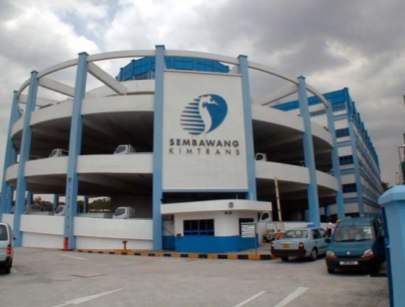
- Elevators are one bottleneck, caused by this style of building, however a Singapore warehouse has found a solution to this: A multi-floor facility with no automation or elevators, but, instead, a spiral truck ramp so that trailers may be docked at any floor (see pic). This does claim more land area, which must be recovered from above, and doesn't work well if trucks have to shuttle between multiple floors.
- While both Singapore and Hong-Kong act as hubs, Singapore is much more international, receiving goods from manufacturers all over Asia and shipping it to other countries; Hong-Kong receives mainly Chinese goods. Also, for the latter, many of the goods come in via trains and trucks, while leaving by ship or flight, while for Singapore it comes and leaves via sea and air.
South and Central America
- Labor costs are low, though not as low as in China, and the nature of its local economy and customers does not justify high equipment expenditure.
- The only exception is Mexico, which can quickly ship products to the US and keep its inventory low, thus justifying state-of-the-art technology.
Final thoughts
Some general conclusions can be drawn.
- Labour costs are a factor when considering automation; automation is a factor when considering optimisation; optimisation is a worthwhile expenditure when dealing with high value goods with a high velocity.
- Cheap land seems a fundamental advantage, looking at the logistical nightmares that Singapore and other high-rise builders must be experiencing.
- Access by land will significantly decrease the cost of transport. Generally, a well-developed infrastructure means more access to wealthy markets and enables warehouses to store high-value/high velocity goods, which is good for them.
The book 'WAREHOUSE & DISTRIBUTION SCIENCE,' which is available as a free download, provides some incredibly detailed info on how to effectively set up warehouses and distribution chains. Well worth a glimpse, if not more.
The role of the internet for the retail of *physical* goods.
0 comments Posted by Unknown at 9:01 PMOne of the stories, I covered last week in my links, uncovered an interesting statistic. Only about 3% of retail sales in the US happens online. I don't think these stats are at all coincidental. While I see a bright future ahead for the online retail of media-products, I find that what the internet cannot provide, is the "closeness," that is sometimes needed for evaluating certain types of goods, like food and clothing. I have commented on this before, implicitly, with a post on the web as a third place, and about the lack of cohesion that Facebook provides.
At the same time, as The New Yorker story reports, what the internet has changed is how we shop; it is much easier to research and comparison-shop than it was before the internet-days. A survey by Accenture found that ca. 66% of those surveyed compared products online, and another study showed that the internet played a significant role with ca. 75% of electronics purchases.
IInnovate has an interesting podcast interview with Scott Dunlap, CEO of NearbyNow, which has come up with an interesting way to exploit the informational advantages of the internet and mash that with the qualities of physical shopping. Following short video shows how their service works:
Clearly technology has evolved a lot in the last few years, making this possible. NearbyNow works via the web and via mobile. I'm not sure if they are using any location-tracking & matching services, but certainly they are heading in that direction. On the retailers' side, there is plenty of technology that makes this possible also. Electronic inventory and point of sale systems allow both for the checking of stock-levels and for consumers to reserve items to be picked up and tried on at a later date.
One issue that entered my mind, is that of efficiency. The way NearbyNow operates is through malls in the US, most of which are, as I found out, owned by 6 major companies across the nation. US's scale-economies win again! In Europe, the situation appears a little different. Culturally, linguistically, technologically, and legally, it is a much more fragmented market, with far fewer malls also, and that may make it difficult for a unified service like this to operate as efficiently as it would in the US.
There is also the issue of too much transparency, which is worrying to some retailers, and addressed in the podcast-interview. But what does seem certain is that this is exactly the type of service that consumers value, and as such one that any consumer-centric business should encourage.
Will a service like this ever replace shopping in its entirety? No, I'm essentially betting my future that there are plenty of qualities *real* environments will continue to offer over virtual ones. But there is no reason, none at all, to try to integrate the good qualities that the web does possess—information at your fingertips—as elegantly and effectively as possible into those experiences.
 I'm glad to get this out of my life. It is probably the last bit of procrastination left over from the period spent writing my thesis. Following is a continuation of my coverage of IKEA's growth as a business, which I began, in a wordy fashion, by looking at the Scandinavian years. I decided to shorten that somewhat, as really the book (if you can read it) already does a great job of describing IKEA, though my version is perhaps easier to digest.
1961 - Already when Ingvar Kamprad started trading, he had formed relationships with suppliers from abroad. He employed this strategy also when he launched IKEA, forming relationships with Polish and other Eastern European suppliers, which gave him a drastic price-advantage over his competitors.
1973 ca. - After the incubation-time in Scandinavia, Switzerland was the first country, that IKEA expanded too. Reasons included its neutrality, a healthy economy, low taxes, and a greater entrepreneurial spirit.
1973 ca. - When the Kamprad family left Sweden, they founded several foundations in the Netherlands, Switserland, Panama, and the Dutch Antilles.
1974 onwards - Expansion in Germany, Munich (one of the wealthiest cities in DE). The store was a great success, and Germany is still a pillar of profitability for IKEA today.
1975 - first stores opened in Australia, Honk-kong, and Canada, through franchising. In 1980, IKEA took over the Canada-chains, as those were not being run well.
1978 - First store in the Netherlands. It did not go well at all, due to a lagging marketing-campaign. Only in 1982 onwards did IKEA book successes with the Dutch. 1994 started a huge boom of expansions in the Netherlands (more detail was provided about Dutch branches, because the book was Dutch). Belgium also saw stores after 1978.
1982 - IKEA set up Stichting INGKA Foundation in the Netherlands, which was Kamprad's way of keeping IKEA for IKEA instead of having to give it away after he died. It was in charge of IKEA from then on.
1983-4 - stores in Gran Granaria, Tenerife, and Saudi-Arabia.
1984 - IKEA starts "IKEA Family" loyalty program for customers and also introduces its first luxury furniture product-lines.
1985 - first store in USA and kept expanding. Famously (I read at least 1 case-study about it) there was some teething-trouble at the beginning and it took a while for IKEA to find the correct formula for the US market.
1986 - 60-year old Kamprad steps back as CEO and gives reigns away to 35-year old Anders Moberg.
1989 - the fall of the Berlin wall. The roughly 500 suppliers that IKEA had been working with in the Eastern block, suddenly found their economic situation drastically change and prices started to go up. Out of loyalty, IKEA vowed to pay up to 40% of the price-increases for its Polish partners.
1991 - the Eastern European crisis lead to a strategy-change. IKEA became a producer of furniture. Due to its long-lasting relationship and involvement with suppliers, it possessed the necessary know-how, and becoming a producer would also have positive effects on its flexibility. IKEA could focus on Just-in-Time production to overcome the production-problems it had had in the past. In 1991, it took over a Swedish producer of wood-products, and after the privatisation of the Polish furniture-industry, IKEA took over three companies there in 1992 as well. This became part of a trend and every-time it had the chance, it would take over a supplier in Eastern Europe.
1991 onwards - also saw an IKEA expansion of stores in Eastern-Europe.
1992 - IKEA took over Habitat, a British retailer of furniture, that had previously caused a style-revolution in Britain. Until now, IKEA had not expanded to the UK, and it was assumed that it was Habitat's strength that was keeping it at bay. It was forced to sell, after expanding to France, Germany, and Spain, which had caused it to make huge losses. IKEA also used its presence in those countries as launch-pads, keeping Habitat as a separate brand.
1998 - China! Already having been a supplier of IKEA's since the 70s, and generally believed to be a huge opening market, IKEA opens its first store in Shanghai, through a joint venture with a Chinese firms. It was an exploratory step as the Chinese were not yet economically ready for the type of products the IKEA offered, though the assumption was that China's economy would grow 10% per year. IKEA wasn't competing on price either, basically being more expensive than any local competitor. Only after severe price-drops, did the business take off.
2000 - Russia. The company had already had talks in 1988 to open for business there, however the collapse of the Russian empire delayed that. Finally, based in part on Kamprad's gut-feeling, the decision was made. It was a good one. In year 2, the annual revenue was $260 million, making it one of the most successful expansions ever. 45,000 people applied to 600 vacancies in the first store. Due to high import-taxes of 28%, the decision was also made to start producing furniture locally also.
And everything else… is history.
Note that, as I used a single source for this time-line, a Dutch/German book on IKEA's 11 secrets, this blogpost cannot be taken as an ultimate authority on IKEA's growth-strategies. At the very least, I got some dates wrong.
Final thoughts
In my first post about IKEA's growth, I wanted to make clear that how a business expands is largely related to its origins. The relationship with Eastern-Europe is both due to a cultural proximity with that region, as well as Ingvar Kamprad's drive to lower costs. Germanic countries were also a logical step because of linguistic, and hence cultural similarities, as well as similar economic conditions.
Territories with which it was as yet unfamiliar, were being expanded into in a risk-reducing fashion, through franchising in Canada, China, and Australia, and later on in China, through joint ventures also. The acquisition of Habitat in the UK, could be perceived as a risk-reducing move also.
It is generally recognised that European firms are better at managing international expansion, simply because of the compressed experiences they get from growing in heterogeneous Europe, which makes them more flexible in other countries also. Still, you could see that certain culturally remote countries posed some difficulties, such as the US and China, and even the campaigns in Germany and the Netherlands did not proceed flawlessly.
All that aside, to me the most interesting part of all of this was IKEA's shift in strategy in the 90s, turning from being a retail-outlet to a producer-retailer hybrid. It is both a radical shift, but from what I understand, a very logical one.
That's it. Tomorrow, I'll publish some notes about the biggest pros and cons about IKEA's business.
The picture is a mash-up of the Evolution 101 podcast logo and IKEA's logo.
 I've long been interested in the idea of franchising, though I'm somewhat conflicted about how to look at it. One the one side, it seems* like a relatively easy way to start a business, on the other side, it seems* a relatively cheap way to grow your business (*: within limits).
WSJ recently published an excellent study on high-performing franchises in the US. The choice of franchises is extensive, just like I concluded in my post on top-German franchises. At the same time, the most apparent choice, that of food, seems less and less attractive, and I quote from WSJ:
In particular, fast-food and casual-dining businesses, while still showing strength, with eight names on the list, also are facing pressure from wage and food cost increases. To lower operating costs, several food franchises already are shuttering some locations.Arguably, a business that is thinking about growing through franchising is faced with some restrictions. Writing a franchisees-manual is a scientific process, you'll probably have to restrict the complexity of operations so that they can be replicated, and there will still be some overhead related to managing the brand and some of the more problematic franchisees.
I think that it is that standardisation of operations, made big through the economies of scale so easily achievable in the US, that is bring competitive problems to chains, even to wholly owned ones like Starbucks. If your core-product is simple, and your business uses a simplified operation, then how hard is it for your competitors to replicate your whole business-model and -strategy in the long-term, really? It is only if your business strategy includes complex competitive advantages, such as extensive vertical and horizontal integration across the value chain, and/or if your business-model is based on "high-tech" components or processes, that you have a real chance of beating the clones. And to relate it to the rising operating costs, mentioned above, business with true competitive advantage can raise profit-margins or off-set the costs elsewhere, instead of having to close operations.
But ok, long-term strategic considerations aside, I see franchising is an attractive way to enter the business-world as an entrepreneur. The question of whether it's faux or real entrepreneurship, is not pertinent, I think. Considering that you have a wide range of choice of franchise-business opportunities, you'll still have to work hard to succeed, and the growth-opportunities can include starting multiple franchises also, it is not that different from starting any other kind of business. In my mind, I compare it to internet-entrepreneurship, which also relies on a large amount of free tools and distribution-mechanisms, but is still dependant on that special something for it to be successful.
What makes franchising particularly attractive, is the decreased amount of risk. According to a study in the Netherlands, 65% of franchises are still standing after 3 years. Compare that to independent start-ups, of which only 15% are alive at that time.
A large cause is, I'm sure, the level of support from the parent-company, which differ from business to business, and can include delivery of goods, marketing, administrative and IT services, made cheaper through centralisation. And they are frequently guided through the process of setting up and running the business, including legal advice. In exchange, they give away either a percentage of profits (ranging from 5 to 40%) or a set monthly sum to the franchiser.
The WSJ-article also lists the amount of investment typically needed to start a franchise. It ranges from ca. $5200 for an automotive company, to a staggering $1,3 million for a steakhouse. Of the 25 franchises recorded, only 5 received some kind of financial assistance (none of which in food). Another article at WSJ discusses some of the attitudes towards financing franchises, particularly during the current US-recession. Incidentally, another article in Dutch Elsevier magazine, sees franchising as an excellent way for businesses to grow during a recession, as it requires less human costs.
All in all, it is probably a safer way to start a business, though with all the points I made above, I don't think of it as 'light' entrepreneurship. There's clearly a lot of risk involved, beforehand, in terms of choosing the right franchise with growth-potential, financial risk to fund your business, market-risk, when you launch, and competitive risk, after your up and running.
I still want to discuss this topic further at a future date, particularly focussing on what its like to turn your own business into a franchise, and some other stuff related to buying into one.
The picture is courtesy of friendlyfranchising.com
 A few months ago, I wrote about Starbucks' vertically integrated strategy. This morning, i wanted to link to it, so I did a Google Blog-search. Usually a search for Starbucks and "vertical integration" would yield my blogpost first, but now it's the no. 2 result.
Somehow, the net has started discussing why Starbucks had a corporate strategy that involved owning all of its subsidiaries and Subway's strategy went a different way.
There seem to be a number of theories on the market. Namely that Starbucks
- … cares less about cross-store cannibalization
- … has a higher need for monitoring
- … relies more on “impulse sales”
- … has higher profit-margins
Some good posts about this are written here and here (both by Josh Wright), here (Stephen Bainbridge), here (Keith Sharfman), and here (Paul Jaminet)
All excellent theories in their own right, and all very rational. However, in my experience, people, and we are talking about people here, often don't behave rationally (at least not as rationally as economic theory dictates). Instead they behave in ways that they are able—either through innate capability or through their environment.
Starbucks did not start as retailer, it did not even start as a store owned by Howard Schultz. It was a coffee-bean roaster and vendor. Its aim was to educate the US-population, which was—according to Schultz—a wide open market in terms of high-quality coffee. Schultz, who first worked there as an employee, started an independant coffee-chain, and only a few years later took over the Starbucks-business (incl. the roasting factory) and the brand-name. But the core-idea remained that it had to deliver quality-products and quality-education to its customers. Along with this, Schultz was highly educated, had plenty of work-experience, and venture capital behind him.
Subway started as a retailer. According to the history, published on their site, Fred DeLuca started Subway's as a 17 year-old and $1,000 starting-capital. Subway had, as far as I know, no world-changing mission. It was a sandwich-store, one of many, and one of it's key assets was to be more efficient and qualitatively better than its competition.
I still think that the stories of these two men, their business-idea, and the environment they started it in, is the key-deciding factor of why one decided to expand wholly-owned and the other through franchising. I haven't studied Subway, but I have McDonald's, and the same dynamic can be witnessed there.
Now, you can go all "economic theory" on this, and focus on points like that coffee is a product that requires much more monitoring than sandwich-ingredients. And I think that's completely correct. Not to mention that Starbucks has a very different employee-based strategy than Subway—they like theirs to be smart and pay them well. And I also think that due to Starbucks's high real-estate presence, franchising for them has become an unfeasible solution. But I think the first two factors are the cause and the latter is the consequence of Starbucks's wholly-owned strategy.
When you start out, whether to franchise or not is a completely personal decision. It comes down to how comfortable you feel about whether you can offer your customers the highest quality possible, while maintaining healthy economic growth.
And your initial decisions will clearly have some kind of lock-in effect later on, which is something I only realised after reading the linked-to blogposts and writing my own.
Essentially private labels, also sometimes called house brands, are products branded either with the name of the retailer, or, at times, sharing some kind of umbrella-name, decided by the distributor or otherwise. But what private labels really represent, to me, is the ultimate example of a power-struggle between a retailer and suppliers. Sometimes, but not always, it also means that some kind of vertical integration has been taking place between retailers and manufacturers, or, at the very least, packaging plants.
For now, I'll just be looking at some stats on private labels. At a later date, I'll take a look at more supplier-retailers dynamics, branding strategies, etc.
Geographic share
According to an ACNielsen report (pdf), the global* market-share for private brands was 17% in 2005 (* global meaning 38 countries and 80 categories), and had grown 6% that year.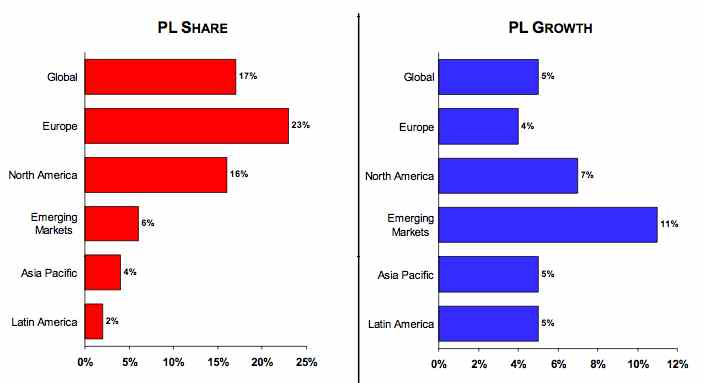
Figure 1: Share & growth rates of private label by region (based on value sales) (source: ACNielsen, 2005)
Europe has the largest market-share with 23%, and Latin America the smallest, with 2%. Top countries included Switzerland, with 45%, Germany, with 30%, and the UK, with 28%. The largest Private Label growth happened, unsurprisingly, in emerging markets (11%) like Croatia (77%), Greece (24%), and Thailand (18%).
One big growth-contributor in Europe is the strong growth of hard discounters, such as Aldi or Lidl (both German chains), who are present in every European country and expanding rapidly. With Aldi, for instance, private labels make up 95% of sales.
Private label foods
Category-wise, refrigerated foods have the largest overall share of private labels, namely 32%. Complete ready meals take the lead here, with an average of 47% private label-share. In the UK, 97% of ready-meal sales are in fact private label.
Another significant private label food, or rather drink, was milk, of which private labels make up 43% of sales.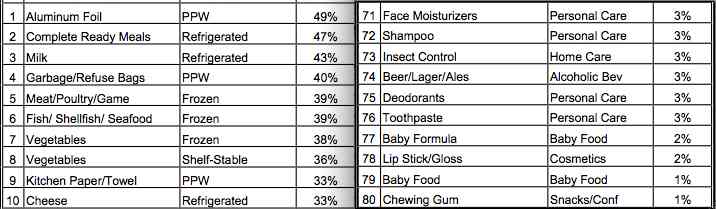
Figure 2: Value shares of private label by category (source: ACNielsen, 2005)
Other high private label food-products include frozen meat (39%), fish (39%), and vegetables (38%), and 37% for shelved vegetables. Frozen pizza is at number 27, with 17%, tea and coffee at numbers 37 and 38, with 14% and 13% respectively. Wine is at number 44, with 12%. And Beer is all the way at the bottom, at number 74 with 3% !
Among the fastest growing foods are drinking yoghurt (28% growth), baby food (20%), chocolate (13%), and water (13%).
Pricing trends
One of the strengths of private labels is of course that they are cheaper, on average 31% less than manufacturer brands. Emerging markets showed the biggest discount, with PL-goods costing 41% less on average. Europe wasn't lagging in this respect either, with an average price difference of -37%. On a country level, Greece, Australia, and Germany were taking the lead with, respectively, -48%, -47%, and -46% discounts (compared to manufacturer brands).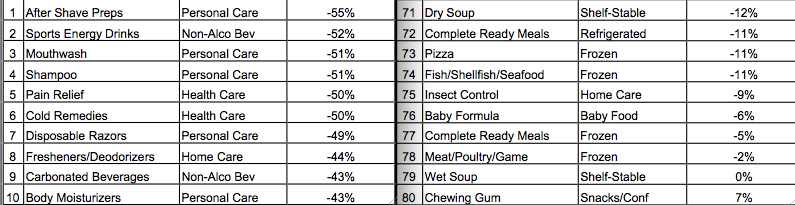
Figure 3: Price differential of private label by category (source: ACNielsen, 2005)
Again, concentrating on food-categories, the products that received the biggest discounts were Sports Energy Drinks (-55%), carbonated beverages (-43%), cereals (-40%), wine (-38%), and tea (-37%). Food-categories taking the least in discounts, included chewing gum (+7%), wet soup (no difference), meat (-2%), and ready meals (-5% <- I guess that explains their high market-share).
Final thoughts
That market share is increasing more quickly in emerging countries is not surprising. Retailers there will likely not be mature and/or consolidated enough to focus on such a strategy, but this is clearly changing.
Germany's dominance is also interesting, as both Aldi and Lidl originate from there. One of my next posts will be on Ikea's European growth and Germany's also very strong there, which suggests a certain preference for low prices with German customers.
Switzerland is still somewhat of an enigma, but I'll try to find out more about it.
In terms of products, both the dominance of private labels amongst ready-made meals, and that their prices are quite similar to regular brands, is very interesting. It could suggest that customers either don't care much for quality and brand-differentiation in that sector, or that private label brands are actually quite good. The price-level would suggest the latter conclusion.
Generally speaking, refrigerated goods are different in the eyes of consumers, I think, less scrutinised perhaps, and worthy of more investigation. Milk is of course similar to water, and hence not really a product where brand makes a huge difference.
What else? Certain beverages, like coffee, wine, and beer are quite interesting, as their private label share is quite low. This would suggest a high brand-sensitivity in these sectors. The low percentage for beer (3%) is certainly striking.
More on private labels as I come to it.
Christine Huang, at the "Trends & Innovation agency", PSFK, points us to a commercial film, shot by Unilever's Axe and featuring David Spade. The subject is… I would guess, food presented in a dirty and sexy package.
Just like Christine, I'm not sure I get it. I don't think it's aimed at European audiences either. But, all in all, definitely an interesting 5 minutes of your life.
The only question I have: So are you guys gonna take a shower now or what?
Incidentally, if this is the first post of mine you're seeing today, also check out my post on Amazon's Jeff Bezos just below.
5 Links: human sigma, link-baiting, neuroscience, brand experience, wine
0 comments Posted by Unknown at 11:47 AM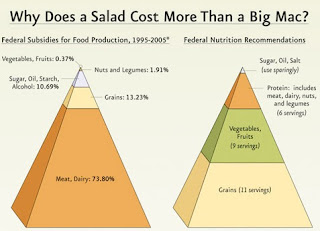 While I'm stuck on writing some other posts—the idea is there, the execution some way off—it is time for another collection of links.
- Using Human Sigma for measuring customer engagement - Mitch Owen reviews a new book on the market, that suggests that evaluating our efforts at customer satisfaction happen on four levels: Confidence, Integrity, Pride, Passion.
- How to coast to a writing career - Valleywag writes an insightful post (for once) about what matters when blogging. I like "AVOID: Blogger ego. If you do blog, just write and forget about it. Don't reply to your comments with more than "Good point, h8rboi, thanks. Don't troll other bloggers for links, or try to get onto Techmeme by posting about whatever's already there. ... People in the real media don't care what your Technorati rank is, they'll just Google you to see what you write." That said, I have no intent to engage on a writing career.
- Mind hacks: an interview with Jonah Lehrer on neuroscience - What I like: "Artists are constantly being forced to reverse-engineer the brain. By reverse-engineering the art - by trying to understand why, exactly, it resonates with us - we can learn about the mind."
- Thirteen examples of successful brand experiences - could be filed under architecture. The British design council points us to 13 different "experience-castles" (my own term), where customers can be enchanted.
- Calculating the carbon footprint of wine - What can I say? It's the new world! Some key-points: organic is not as efficient as we think; distance matters; packaging matters.
- Bonus Link: Why does a salad cost more than a big mac. - A picture says more than a 1000 words. This is just as applicable to Europe btw. Thank Wolsey for inventing the subsidy!
Enjoy! More of this: check out the S+FnR bookmarks—updated 24/7 !
After my little over-academic look at the cost of real-estate this morning, I thought it would be nice to lighten the mood a little. Check out the video where:
"The New Frontier casino-hotel was imploded early Tuesday, giving a violent end to the second property to open on the Las Vegas Strip. This, to make way for a multibillion-dollar resort bearing The Plaza brand, set to open in 2011."(via Missethoreca.nl)
On a related, but perhaps more aesthetic, note, you might want to check out New York Magazine collection of vintage videos on architecture, ranging from the Brooklyn Bridge in 1899 to the construction of the World Trade Center in 1966-73 (via Kottke).
 For those that don't know, "The Perfect Store" tells the story of eBay, how it was started, who was involved, its community, its growth, and the IPO, basically everything up to around 2001. The book was very well-written, I thought. So much so, that I felt more affinity with the company before it went public than afterwards. For the entrepreneurial section of the book, I was eating the pages up, breathlessly soaking in the stories of many of the people involved—these large number of perspectives included in the book, are one of its strengths. Then, after d-day, the IPO, my sentiments sank. I felt the floor opening up beneath me, all my pioneering instincts gone, given away to the "suits." But I imagine some people will see it from a different perspective, and that is how well-written "The Perfect Store" is.
Normally, I would review a book in pieces, but since I read the book some 4-5 months ago, I'll instead try to summarise the key points I got from the book.
Where you are from matters to where you are going: I notice this over and over again. Pierre Omidyar, eBay's founder, is a Libertarian, which rougly translates to letting people solve their own problems, with as little interference as possible. You can see this play out in eBay's largely decentralised shopping-model. The lesson here is not, I think, that everyone should be like eBay, but that whatever you do, should in some way reflect what you believe in.
Be professional quickly: I don't think eBay would be where it was today, if Pierre hadn't immediately tried to attract talent, starting with Jeff Skoll, an acquaintance and Stanford MBA, all the way up to Meg Whitman, who was instrumental in handling the IPO and is still eBay's CEO today. Many entrepreneurs are in the game because they want to be independent. Opinions may vary, but a smaller piece of a bigger pie is usually better than a small pie all to yourself.
Venture capital is not just money: eBay was consistently profitable from day one, so they actually didn't need financing. But there was one important reason for going to a venture capitalist: professionalisation. eBay needed to send a signal to the world, that it was an important player on the market. It needed to attract talent, and form a growth strategy. All of which happened after it took on venture capital.
Community matters: eBay's key to success was not only her low capital costs (no stock, little overhead), but also her close ties with the users of the site. At the beginning, little in features was introduced on the site without consulting the users first. Because of this and ultimately the high switching costs, eBay benefited from what is known as the Network Effect. That said, as a company grows, community-involvement cannot be as strong, and new mechanisms must be put in place to place to stay in touch with your core-users. eBay had a lot of problems in this area.
IPO's can be traumatic: Somewhat related to the point about communities and change, when Ebay went public, it created a rift between the core-values of her original workforce and users, and the values of the financial community and the media. There's not much to say about this, except that just as it takes a particular type of people to start a company, the same applies for people taking a company public, and as a founder (and start-up-employee), you must learn to let go.
Make your IT-infrastructure scaleable: this is the only tech-advice in this post, but Pierre had no idea how quickly eBay would take off, and the company was plagued by technical issues from the start. Only some years later, when Meg Whitman became the new CEO, did proper staff get hired and was the infrastructure upgraded for scale.
That's about it. I'm sure, I forgot some key-points, and would appreciate comments on this, if you have read the book. I do remember thinking that "The Perfect Store" was the absolute best book I ever read on starting a company, interacting with community and stakeholders, and the effects of an IPO. So, highly recommended for this reason alone, and also to gain a good insight into eBay as a business until 2001-2.
(This review is mirror-posted on Tech IT Easy.)
 A few weeks ago, it was announced that the world's dairy prices (and anything related to that) will rise by a few percentage points. The reason being that the demand for dairy-products, most often in the form of milk-powder goods, is soaring in China.
But it's not only milk that's hot in demand, another cow-related trend is making the rounds. Surprisingly (or perhaps not), this trend was started by McDonalds-restaurants, who have been in China since 1990. And while traditionally, the use of beef was sparingly reserved for stir-fry dishes, the Mac in McDonalds has caused a drastic taste-change towards more beef-orientated dishes.
Beef-importers would be all excited, if it wasn't for one little snag: the mad cow disease, which lead to at least a few countries being banned as beef-importers to China, including the US. This certainly can't have been comfortable for them, considering they exported around $3.19 billion worth of beef in 2003, which fell to $605 million in 2004 (after the ban), and, only in 2006, did it pass the $1 billion mark to $1.63 billion.
Time Magazine writes about how Western Cattle Company found an interesting method to get around the ban, by breeding the cows in China itself. In other words, they are exporting their know-how to Chinese farmgrounds, in the city of Hohhot, China's dairy capital, which houses two of China's biggest dairy companies, Mengniu and Yili, as well as around a million cows. The Western Cattle Company is not importing cows, it buys them, fattens them up, and its off to the slaughterhouse.
The company plays both a smart and risky game. With China's beef-consumption up 31% since 2006 alone (source: USDA), and US-imports being banned, it firmly implants itself as the leading US beef-producer in China. At the same time, several similarly-aimed joint ventures have failed in the past and a large reason is both the risk of competitors and the lack of a good supporting infrastructure. As for the first, China, as with most of Asia, clearly has a reputation for being quick on the uptake and even quicker to copy. And with a lacking standard-setting authority in China, consumers will find it hard to judge whether beef comes from an authentic source or a local competitor.
Still, beef-businesses are hopeful, that as demand soars, so must complex and hard to replicate mass-production-methods. With large quantities of beef being produced comes a new problem however, that of guaranteeing the safety of the environment. Even if the cows are kept safe, there is no guarantee that the water or air is pollution-free, and that the corn being fed to cows is clear of pesticides.
Clearly, setting up shop in China does not only depend on being there quickly, but also on being able to produce mass-quanities of goods to meet the staggering demand, doing so in a fashion which makes it hard to replicate by the locals, and implementing a lobbying campaign focussed on improving the infrastructure around your production-facility. The last of which will be a nightmare for many, I'm sure.
"What do you want to do?" is a terrible question. Not because I don't have the answer, but because it's always followed by "How are you going to do it?" It forces you to be honest and practical. Does "winging it" count?
No, probably not…
Knowing what you want to do is the greatest career-and life-related joy that can exist. It gives you a sense of purpose, and sometimes, not always, it gives you the answer to the question of how.
Luckily, the American National Retail Federation provides part of the answer, at least if you want to work in retail. I have decide to phrase it in a "Do you care about.." format, because that makes more sense to me than anything else, followed by the appropriate area in retail, and some sample job-descriptions. If anything, it should be of great help when answering human-resource questions.
Please note: If the picture is not legible, please click to see it full-size.
For further information about each field, go to the NRF-page and click on the "learn more" link below the texts. The site also kindly provides a nice chart to see where you stand as opposed to other functions and co-workers.
 So I watched this movie yesterday, I think it illustrates the concept of shareholders and investors, and what businesses really stand for, quite well. In part, you have a responsibility towards your employees today. In part, and that's where investors come in, you have a responsibility towards the future. In a sense, if both stakeholders were to communicate, the world would be a better world…
For me, it's a pretty safe bet that if I want to start a business, I'll need investors. And people starting a business in the world of food/retail venues, will definitely need a team also. Both will be depending on getting paid; the employees depending on today's cash flow, and the investors betting on a future value. That is life and the way this resource-intensive industry works.
The fact is that venture-backed firms—firms that have external and usually active investors, which hold a share in the business—are usually more successful that firms that are not. The reason for this is that active investors, while sometimes appearing cruel, actually make a business more efficient through various mechanisms such "fat-"trimming and performance-based investing, and also through their know-how and contacts in the industry.
This of course depends on the type of investors you have. On Tech IT Easy, I wrote about the four types of business angels, namely:
- Operational Expertise Business Angels: These have been or are major executives in the industry they are again investing in and are instrumental in growing the company through providing both financing, expertise, and contacts to suppliers, partners, and customers. Venture capitalists highly value these types of early-stage investors.
- Financial Returns Business Angels: These are high-worth individuals, but characterised by a passive involvement in the companies they invest in, except for maybe some business-advice. Too many of these types has a negative effect on attracting venture capitalists, as it does not grow the financial pie.
- Guardian Business Angels: These are probably the most active types, provide a lot of support, take seats on the board of directors, help find venture capitalists, and are highly valued by them. Since entrepreneurship is a highly people-chemical business, this makes sense.
- Professional Entrepreneur Business Angels: These are investors with the personal experience of having set up their own firms. Also the most well-know type, I think. They may sometimes invest outside of their expertise, which can be a problem, but have a lot of experience in and provide support with market-research, building up the company, meeting milestones, and other business-building activities. They are also highly valued by venture capitalists.
Garbage-in-garbage-out
When dealing with investors, it's important to find out what their expectations are. On what basis are they valuing your business. If it's garbage, there is no point in continuing with an investor. I'm not going to define garbage extensively, but if an investor is only after personal profit, then that's a sign of garbage. If he or she is after maximising profit for the business, that is better.. to the degree that the core-values of the business don't get minimised.
That's why it's better to deal with investors that have at least two qualities*, preferably three. One: he or she has to know the industry, or else how can they accurately calculate the value—taking into account stuff that can't be entered in formulas; Two: depending on the stage of the business, he or she will have to be in it for several years, at least 7 when it concerns a start-ups, I would think. And three, he or she has to be what is called a Mensch.
(*: feel free to correct me on any of those).
In terms of employees, you also need a certain profile of people. They need to be dedicated to the business, not necessarily their pay-check; They need to understand business-concerns, and for that to happen, be involved with the business beyond their job-function. They need to understand and share similar values, which again requires two-way communication.
The implication for management is fairly clear, I think. When trying to reconcile both parties, you need to understand you're dealing with someone beyond their job-description. Employees, active investors, shareholders, customers, all have something in common. They are human, they can have vision, they can learn, grow, adapt, change, do. This is important during the selection stage—which employees will I hire, who will I ask to invest in me?—and the co-operative stage—how will I find the middle-ground between these people's concerns?
Other people's money? Get rid of the "other," get rid of the dissonance, and you're on the right track.
I'm intrigued with finding out more about the creative process of creating real-life things, as it will be helpful in designing venues that work. Last night, I caught an interesting documentary on Discovery, on the creation of the SYN-US, a Ford concept car for the Detroit Auto Show in 2005.
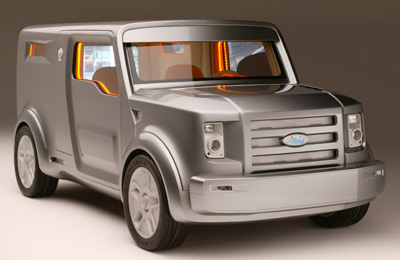 What is the SYN-US?
Well, as you can see from the picture, it's a tough-looking car. Part of its name comes from the word Synthesis, meaning a mix of the hard, edgy exterior, and the soft, flowing interior.
Some of the influences were, as far as I can tell:
- the hard landscape of the US (mainly L.A.)
- possibly post-911 sentiments (speculation)
- the "Pimp my ride" madness, which affected interior design (speculation)
- the pressure of concept-car competition - trying to be different
- the particular profile of cars showcased at the Detroit show - typically manly
- the SUV (exterior) versus the metro-sexual trend (interior) (speculation)
- the engineering platform used (more on this later)
The evolution of the car-image
During the documentary, the Ford's brand-image person, responsible for this project, gave a nice overview of the way the car has been perceived and designed over time.
60s - rebellion = tough cars
70s - confusion = she didn't know if there was a clear trend
80s - status = luxury cars
90s - lifestyle = differentiated cars
00s - choice = more and more fragmentation in design
Project SYN-US
For some reason, Ford decided on a B-model car, meaning a smaller model, even though those traditionally didn't do well in the US. From what I could see, the process was done in several stages: research; design; building phase; and interior design. All of which had different considerations, and was, of course, supervised by Ford's management (e.g. the brand-image person). And then of course, the presentation phase.
Research-phase
Essentially, the team needed to form an image of the current situation in the US, as well as how it would develop, to design a product that would fit in, or possibly lead the way. A couple of (cocky) trend-researchers were hired, who tried to look at all things currently playing on the market (I speculate: post-911, pimp-my-ride, beginning of the green trend, metro-sexuality), from the internet and other media, as well as just driving around. The project was code-named "Gorilla" of that gives you a clue. They came up with a film, which was supposed to inspire the designers while creating the concept.
Design-phase
This was conducted by two main designers, one British and one Italian, I think, who came up with a tank-like model with a soft interior. This model was moulded in clay by an advanced machine, and little tweaks were made on the outside. One of these was to create door-handles which appeared like those used on a safe.
Important is to realise that there was a big constraint to the project: the engineering platform. For economic reasons, it can be useful to use existing technology, because that would make the whole product-process much cheaper (factories don't have to be adapted, etc.). In this case, they choose the existing B-model, the Ford Sierra, which had consequences on the dimensions of the SYN-US and type of engine used. Usually, I think this is done when a previous model in the same category is doing very well, and it would not be sensible to create a whole new parallel production process.
The building-process
I can't say much about that. Much machine work and quite integrated with the previous phase. I can say that the design was exaggerated for effect—auto-shows can be very competitive.
Interior-design
Again, quite integrated with the previous phase. Essentially, a trendy-looking interior designer (female, Swedish-looking) was brought to the project to bring this soft, flowing vision of the interior to reality. She decided on soft, skin-like materials in an equally skin-like colour theme. Noteworthy was that she had the words "do not touch" painted on the door-handle, expecting people to want to touch it anyway. Those quirky designers...
The presentation phase
Not much to say here either. A movie was shown, an executive gave a speech, and people could touch it. Typical auto-show stuff. Apparently feedback was not too negative.
 Final toughts: The knowledge spiral
All of this reminds me of the knowledge spiral, a concept known in innovation. Basically it's the movement from tacit knowledge—highly personal, hard to formalise and communicate—to explicit knowledge—formal and systematic, easily communicated and shared—back to tacit knowledge, and again explicit knowledge, moving in a continuous spiral. Essentially this works in a fairly rhythmic pattern, staring with an individual that comes up with an idea.
This idea comes from some kind of tacit place—a feeling, experience, know-how. In the case of the SYN-US, it was the trend-research being done. This can be communicated to others, but slowly, maybe in a participative style (the documentary-film that they produced). This must then be made explicit for the organisation (Ford) to use this knowledge. A design is made as well as a model—explicit knowledge is shared among the project people. If this model is successful, it can be shared throughout the model-B division (like happened between the Ford Sierra and this project) and the explicit knowledge spreads. After a while, it can become internalised in the principles and values of the firm, in which case it again becomes tacit. The company can then use this tacit know-how to develop further innovations, ingraining some of what they know already into future designs.
So essentially the movement, like on the picture is:
tacit - tacit
tacit - explicit
explicit - explicit
explicit - tacit
etc.
More on the knowledge spiral can be found here.
Final thoughts 2: relating this to Food and Retail
In the sense of architecture, you have two types of design. The original, where you construct a building, which can develop in a similar process as above, and in the sense of an engineering platform—you end up working with the constraints imposed by the internal space, as well as the environment you are working in. In both cases, some interesting lessons come forth from the way the SYN-US was developed.
FnR-businesses are also people-businesses, which can benefit from understanding the way the knowledge-spiral works. Essentially someone (the founder) can have an idea, it is still tacit at this stage. His or her initial partners will also likely share the same values or be able to understand them quickly. But the bigger the organisation becomes, the more important it is to work on the explicit. Developing operational manuals, films, processes, etc. all of which can be shared through training and other communication, are essential to growing large and well-working organisations. Again, the way the the SYN-US was developed—by people and through processes—sheds some light on that issue.
Nothing illustrates people's preference for convenience more than the evolution of money. Go from bartering goods (think rotting tomatoes), to (heavy) gold, to (less heavy) gold-pieces, to certificates of value, to paper-money, to credit-cards, to ... mobile phones(?) and I hope the point is clear. When it comes to money, people would rather not deal with it at all; they just want to be able to buy stuff.
The same applies to music-media and the need for quality vs. convenience. Take a live concert: the best possible quality of music, not only can you hear it in the best surround-sound possible, you can also see the band, and feel the emotions going through the crowd. It's exhilarating, at least I think so. Anything reproduced really only gives you half the quality.
The tape became a success, even though they were accompanied by a lot of hissing, because it was so easy to integrate it into social life, like music should be. You could exchange it with friends, carry them in your pocket, even listen to it in your car. The CD really had the same qualities, with the added benefit of no hiss. And along came MP3s, worse quality than CDs again, with their compression and small sizes. Yet it became an instant success because we could exchange it globally, and it had no DRM for liberal home-use. You could burn it on cheap cds and play in your car.. yay!
iPods are infinitely more expensive, and even though I got my 20 gigs worth for only €50 (student-deal), I don't think I would hesitate to buy a €300 model when mine breaks. The simple answer is convenience again. It is expensive, yes, but it's so nice to carry a device around that allows you to play songs in any order, create flexible playlists, as well as play podcasts and, for some (not me), play video and browse websites, even call / photograph people. How cool / convenient is that?
John Gruber wrote another good post about Amazon's new MP3 store and the fact that it works so well with iTunes and hence iPods:
People buy iPods because they love them. If your music doesn’t play on iPods, it isn’t going to sell. And so if (a) you refuse to sell music downloads without DRM; and (b) no other DRM system other than Apple’s is compatible with iPods; then we’re left with a situation where the only successful store is going to be iTunes. What Universal and EMI now seem to have learned, at long last, is that (b) is completely under Apple’s control; only (a) — the labels’ own willingness to allow their music to be sold without DRM — is under their control.
The point being is that people don't care about DRM, it will not affect the way they decide things. They did not buy at the iTunes store because they were locked into the iPod. They bought at the iTunes store because it worked so well with the iPod.
That said, the way Apple treats the rest of the world is disgraceful and I have yet to buy more than 1 song in iTunes. It pissed me of because I couldn't use it anywhere else, because US-customers get a more complete offering, including video, because I already feel like a criminal before I even stole anything... But hey, I agree with the core-idea of iTunes, not necessarily the legalese surrounding international business.
Allow me to digress for the rest of the post.
 Recently, I bought my brother a Sony Ericsson W580i phone. It has a lot of media-capabilities and is actually kind of cool. I like the way that Sony is trying to turn this little device into the new walkman. But there's two things I hate about it. One is that I need to use a special plug* with any headphones I want to use (they don't show you that in the picture). OK, it sucks, but I can deal with it. And two, the software that comes with the phone stinks!
It might be the computer (note that iTunes works well on that one), but as soon as the software started I was both confused and frustrated. Moving music is a three-step process; I had to dig to understand how to import my music; and the whole process is kind of slow... even lags down my brother's PC (might be his crappy PC :). But you could summarise the whole thing down to being pretty unsatisfactory. Alternatively you can use the phone as a hard drive and drag files to it using explorer, but it then doesn't import metadata, like eh what the artist is called and the album.
In both cases, Apple and Sony, you are restricted to using the software. But the iTunes experience is actually kind of nice (except if you want to export things — if it wants to become DRM-free it should also allow me to move music out of my iPod). You can create brilliant playlists, etc. iTunes is in fact the interface that no media-player manufacturer has as yet managed to create, both on the player or on the computer. And what you see with Creative, Sony, etc. is that they are clearly not software-companies, focussing all their energy on the player instead of the software on the computer. But I digress.
The point is that, even though the W580i is infinitely cheaper, it is not Walkman 2 or 3, because there is actually no improvement in the experience. In the technology, yes, in the experience it's a couple of steps backwards. The reason is very much Sony-specific; it has the weirdest business-structure where it splits all its divisions into a competitive matrix, where each has to fight for its yearly budget (if that sounds familiar, it's because public institutions like schools operate in the same idiotic way.) And because of this divided structure, there is no co-operation, no synergy. The hardware-people create brilliant hardware, like they've always done. The software-people, because they suck, create inferior software, and continue to under-perform under Sony's "interesting" mechanism of only rewarding the strong.
Businesses who want to compete for the next medium in music need to understand that customers make decisions based on a very simple principle: "How is my life better because of using your product?" You need to look beyond the lab, into people's homes to see if your hardware-solution might benefit from better software, or vice versa. Or else, you can't even hope to succeed against Apple.
The good thing about the rise of online media-stores, is that if you can create software that works well with them (e.g. Amazon imports music in to iTunes), as well as well with your player, you are already half way there.
In this regular segment I focus on news of note (to me at least), about brands that I'm familiar with. I may someday write about Nordstrom, Costco, and Walmart, whom I hear great things about in terms of service, supply-chain management, and frugality, but until I come in contact with what they sell, I'm not sure I can say much. That said, I'm aware that Walmart made moves into Germany (and failed, which intrigues me), and has taken over at least one chains (Asda) in the UK as well, which I have visited. So never say never.
Coca-Cola and Nestlé Coca-Cola has, for a third time, partnered up with Nestlé, this time to develop coffee and tea-products. The previous times, the company worked Nestlé to develop Enviga, a calory-burning drink; and with L'Oréal, a daughter-company of Nestlé, to develop the beauty-drink Lumae. So reports Dutch Marketing Tribune.
A few months ago on Tech IT Easy, I expressed my wonderment at the Coke Zero brand and what their aim was there, as well as held a rant on how un-innovative "junk"-drink (or -food) brands are in general. I think this is an interesting move. It won't make the world a better place, perhaps, but it'll be more colourful.
Similarly, I know that Starbucks formed a partnership with PepsiCo a few years back, to develop canned coffee-drinks, also to be sold in supermarkets. So this could very well be a competitive move, by either Nestlé and/or Coca-Cola to compete with a perceived threat of Pepsico's or Starbucks reach into customers' taste-buds. Update: Looks like MSNBC reported on a similar story last year.
Leonidas expands to the cafe-arena In other, coffee-related news, Belgian chocolate-manufacturer and retailer Leonidas is opening a coffee-outlet in the Netherlands, a first step of what it calls a worldwide expansion of its products and outlets. This according to Dutch publisher, Elsevier.
Again similarities can be drawn with Starbucks (sorry, SB-haters), which started as a producer and retailer of coffee-beans, before it expanded into the business of coffee-bars as well. I think what both Leonidas and Starbucks have in common is a reputation of offering fine products as well as offering a third place which customers feel comfortable in. It's a relatively easy step-up for Leonidas, if its experiment were to succeed, because it can simply adapt its existing retail-outlets.
Isn't the world of coffee exciting?
Last Sunday, I finally got around to watching the F8 Facebook developers-keynote, which was released in May this year (Thanks Jeremy). Similarly, this morning I got to read the transcript of Mark Zuckerberg's, the CEO of Facebook, keynote and Q&A on the Techcrunch40 event. Both made quite an impression to me, enough, I'm sure, to warrant a discussion (not started by me) on Tech IT Easy, I hope.
During F8, Mark presented Facebook as combination of three consideration for developers: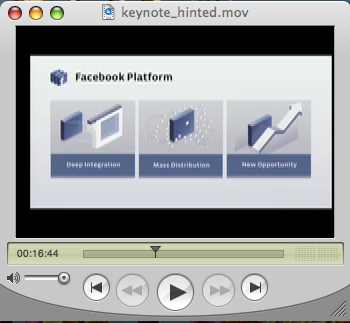
- Deep Integration
- Mass Distribution
- New Opportunity
Ignoring the marketing-speak and the fact that Facebook is a software, there are many parallels to be found in successful retailing.
Deep Integration: Mark speaks of code, I speak of the source-code that a retail-outlet is made of, it's internal design, stock, packaging, marketing, etc. If you want to optimise the situation for both you and non-store brands, you should find a way to deeply integrate their products into your assortment, and adapt your marketing and design accordingly. There are subtle strategic considerations why this may not always be happening, mainly related to maintaining a power-balance between retailers and suppliers, but that is a conversation for another day.
Mass Distribution: This is based on both the number of visitors your store has and the number of outlets spread regionally, nationally, or worldwide. The more eyeballs you can offer third parties, the more attractive your store becomes to their presence.
New Opportunity: Mark speaks about revenue, offering application-developers the ability to integrate their own advertising and transaction-possibilities and to collect 100% of those returns. This would be very un-characteristic for "real-world" retailers, I would imagine. For one, their cost-structure is very different from Facebook. Renting out space to applications on Facebook is fairly cost-free, ignoring bandwidth, and would cost some real dollars in the real world.
In the software-world, there is the interesting concept of an API, an application programming interface. Facebook released one for its developers, and while they have the full freedom (within norms) to develop applications, there is still an underlying framework of how to build it and in what fashion to present it to users.
I'm just hypothesising, but this would be one way of integrating similar philosophies into food and retail places. Think about the way values are passed down to subsidiaries or franchises. By bringing a business to a level that much can be rationalised into training- and franchisee-manuals, you can apply similar thinking to 3rd-party's in-store activities.
One such example, at least it seemed that way, is a Naked Chef stand, which I came across in a Dutch department-store the other day.

As you can see on the picture above (I hope), the stand is located in the middle of the kitchen-section of the store. It features a combination of books by the naked chef, wines and other ingredients, and on the back, high quality cooking-utensils.
This is the kind of partnership that does well, I think, selling products from both parties in a symbiotic fashion.
The other big online retail-platform is of course eBay, and since I read The Perfect Store, perhaps I'll write more on that in the future.
 I feel like I've written enough about Apple over the last months on Tech IT Easy, and similarly the blog-space is a-buzz with the news of iPods, new colours, new ways to get media, blablabla, how boring huh?
Well, while I still want an iPhone, especially now that it's dropped to a price where the synergy between media-player, mobile PC, and phone is actually quite compelling, I was much more interested to hear the news about yet another partnership, this time with Starbucks. If you aren't a faithful reader of Tech IT Easy, you may not have noticed that lately I spent a lot of time discussing food-related things (completely unrelated to tech of course) and in particular, several posts about Starbucks. The first was on how Starbucks uses vertical integration to maintain a high level of quality throughout their value chain (it is not a franchise!), and the second, more tech after-all, on the concept of a third place and how the web fit into this.
The third place
I hopefully do not need to go into this again too much, as much of the definition can be found on my post and on Wikipedia. But essentially a third place is the space between home-life and work-life, where we try to find some time for ourselves.
Starbucks has really been pushing this concept, both in their amazing book, and of course in their stores. I should mention that, as a European, I'm quite spoiled as far as third places / food-related leisure venues go, and Starbucks, in my opinion, could use some... personality, for lack of a better word. But that is mainly the legacy of scale economies, which is king in the US, and lead to the global and uniform-looking chains, like McDonalds (see my other post on that here), that we are used to seeing, of which Europe, in turn, has very little to offer.
How has Starbucks tried to make their venues third-place worthy? Well it starts with creating a place where people like to be. Initially, Starbucks was a coffee-bean retailer, not selling coffee-drinks, and a big credo at that time, and ever since then, was to educate people about coffee. This is based on two vital ingredients: excellent coffee and a staff both qualified and approachable. And education and customer-service are pretty much the core of Starbucks, as I see it.
Second is creating an atmosphere that makes people feel at home. Here, music plays an important part as well as providing places where people can work and browse the internet. This has manifested itself in several partnership, with music-producers and artists, incl. Apple, as well as T-mobile to provide fairly global internet-coverage in their chains.
The latest is of course Apple's announcement that people will be able to buy songs currently playing in a Starbucks at a finger-click through itunes, and at no internet-charge.
Starbucks the retailer
After reading the book "Pour your heart into it," I've always seen Starbucks as much more than a simple coffee-chain. The company is aggressively forming partnerships to offer customers a richer experience in their stores, and expanding their reach into supermarkets as well, in order to gain mind-share. And, as Schultz announced in the Apple Keynote, the company is still in its embryonic stages, which I can easily believe.
Focussing purely on their retail-outlets for now (and not their innovative shifts into people's homes), that is what their coffee-houses are in fact becoming. Building on the reputation of their coffee, Starbucks has been extending that to other products in their stores as well, always using the credo of "quality first." While, similar to Apple, this quality comes at a premium, Starbucks is playing into current market -trends that quality leads to less price-sensitive customers, and as long as the company keeps doing well, it can keep charging these prices.
What I see is a shift from the supermarket, book- or music-stores, to places where people come first of all to relax and second to surround themselves in a type of glamour, listen to good music and buy it, read a good book and buy it, have a great coffee and buy some beans to take home.
This is only made possible because Starbucks has a strong control over their value chain and a lot of marketing power at its disposal. A regular coffee-chain, which does not own its own coffee-factories, nor have the financial capacity to own multiple stores, instead franchising them, does not have the same negotiating strength with partners to guarantee this level of quality.
While Starbucks did not entirely start from the ground up—Howard Schultz actually acquired the bean-maker after a while and took their name, it clearly pays off to start as high as possible on the value-chain, as a manufacturer, while having a keen eye for what customers want.
The case of NBC vs. Apple - a problem of customer-disassociation?
3 comments Posted by Unknown at 9:47 PM I don't like the principle of re-blogs, but sometimes, no many times, people say smarter stuff than I do (in this case, John Gruber), so here goes.
NBC, in a public statement, said following noteworthy things:
In addition, we asked Apple to take concrete steps to protect content from piracy, since it is estimated that the typical iPod contains a significant amount of illegally downloaded material.and
NBC Universal also wants iTunes to stiffen anti-piracy provisions so computer users would not have easy access to illegal downloads.Gruber's response:
This is straight out of the music industry’s playbook: assume your customers are criminals and treat them with contempt.and
It Is Estimated That NBC Could Not Have Screwed This iTunes Thing Up Any Worse.No, I don't highlight this because I hang on everyone of Gruber's words, far from it, but this does point out a core-problem in the supplier-retail relationship, in my opinion. That of disassociation.
Yes, their estimation of pirated content on the iPod is probably an accurate one, but what business is it of theirs? It would be similar to me entering a record-store and having to submit to a strip-search for "estimated" pirated content. It is disrespectful and any customer-focussed company would know that.
However, NBC is not a customer-focussed company. It is a supplier of content, which means it is a business-2-business company. It acts merely as a legal entity connecting the creators, e.g. the lovely Tina Fey from 30 Rock (who is clearly a human-being), to the owners of iTunes, Apple. They, in turn, sell their products to people, which makes them more customer-focussed (though online selling isn't exactly the same as being in the same room with your customers).
It is my personal opinion that people, and businesses, are the way they are, because of experience... at least as far as people-interaction is concerned (case in point: "the rise of tech is killing the art of chat?"). The more a business interacts with its customers, the human kind, the more it will start to see their point of view. Right now, NBC only understands contracts, and perhaps the creators point of view. But it does not seem to understand that people would be perfectly happy to buy their products, as long as the relationship is based on good value for them, which includes both respect and a fair price.
The way to get around this is not simple market-research. It requires a constant stream of information back to NBC, a barometer of moods, trends, and plain-and-simple information, which gives NBC an idea of where it stands. And of course that won't prevent mistakes. But it will lead to more mistake-fixing instead of making public statements where they call all of us iPod-owners pirates. For one method on how to accomplish this, read my blogpost about Proctor & Gamble's take on shopper marketing.
To a degree, it is understandable why this does not happen. It is not efficient, unless NBC has control over the sales-channel. And it is not efficient for NBC to enter sales, from their perspective, I think. But that is no excuse! If they don't understand a business, they must either gain the necessary knowledge to operate well in it, or stay out of the kitchen! [/end rant]
Btw, how does not having their content in a legal outlet, lessen the risk of piracy? Wouldn't that result in more piracy?

 The


