 The world of business, I think, has a certain illogical—the "human element"—shell around it, but centres around the concept of supply and demand. How you create a business where demand is high, how to you make sure that you have sufficient supply and/or not too much supply. You can see this play out in a number of places, e.g. on the web you have scaling issues, when your service proves to popular (e.g. Twitter), or you have the case of the million+ blogs that are collecting dust, because no-one ever reads them, or because the blogger was unable to gather enough interesting supply.
In restaurants, or food-places, you also see this play out. A couple of months ago, I was going to write about take-out, how some businesses embrace and others avoid it, and why. I think the reason is, at least in part, to control supply. If you control supply, then you can focus on quality and charge a higher price. You also become an artist/creator, rather than a factory.
How do you limit supply? Two ways, I think. Mainly it's the physical space; by limiting the number of seats in your venue, you ensure that a certain quota is set (of course, the question is also whether that quota is met, which comes from quality inspiring demand). By investing in quality-ingredients, you not only limit your budget, but also your production-capacity, and it forces you to limit supply. That's a little vague, I know, I haven't worked it out 100%.
The other way, is to have an increased level of supply. How do take-out and fast-food places do it? By standardising as much as possible. Whether it's the ingredients, which are mainly starch-based (burgers, pizza, noodles, etc.) and cheap, the production-facility (often just an oven, a grill, or a big wok), or a standardised customer-space (from seats stapled to the floor, to waiting-lines, to a website/phone nr.). All of which enables you to deliver mass quickly.
I was thinking about this today after watching "Iron Man," which is one big Burger King (and US-army) commercial, and getting a cheese burger afterwards. Burger King was packed and, ironically, slow. The "waiting in line" method doesn't seem to work that well when you have 50+ people waiting, and a limited space behind the counter to deliver burgers and stuff. People on both sides were bumping into each other constantly, and I actually had to wait over 5 mins, even though I was second in line.
On some level, I like to think that technology can solve a little bit of this problem. If you look at Zara and H&M, which I wrote about last week, both are very advanced in this area, in order to optimise and speed up their production, logistics, and merchandising. Of course, that's on a back-office level, and that's not the same as the front-office, where customers interact with a business. No one wants to be confronted with a screen to do the ordering, but sometimes I wonder if people wouldn't be happier just pressing some buttons in a fast food joint, rather than waiting in line. Of course that would mean more seats, as more people would sit down, and more staff, as someone will have to bring that food to the table.
In the end, it probably comes down to experimentation and constant improvement. That said, apart from the computers that cashiers operate, and quicker food-preparation, not much has changed in the last 50 years for the people doing the actual eating.
The picture is courtesy of lightningspeed.net.
I've included just the top-25 and annotated their focus. What's interesting, but not surprising, is that the majority of companies in that list are not independent horeca-orientated, apart from two: Hennie van der Most and Sjoerd Kooistra, both Dutch horeca-entrepreneurs.
The majority is hotel-chains, though the top-10 is quite diverse; a number of convenience-(fast)food places, resorts, as well as retailers. Interesting that both Ikea and Hema are on that list. Hema, as far as I know, has not been on the horeca-market for long (no revenue reported in 2006), but is already reaping significant successes. Probably my favourite retailer in the Netherlands, btw. Ikea, as I reported before, has been in the restaurant-business since 1971.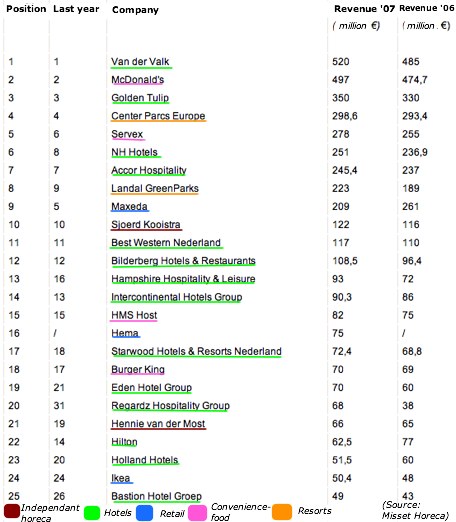
You can see the complete top-100 at Misset Horeca.
I just discovered a new podcast called "Big Ideas" (iTunes-link), a series of lectures on anything from the impact of urbanisation on musical tastes, to designing menus for restaurants. Oh, and it's Canadian. Not that that's bad, but some parts of the lecture covered local conditions.
John Schneeberger starts his lecture (dated March 1, 2008) off with the basics of menu-design, namely that they should reflect three things:
- What you stand for? Aka. what kind of food do you like to work with?
- What demographics are you targeting? Income, religious issues, etc.
- What are the current trends? And are they for real or just a fad?
- Customer-decisions are always a trade-off between price and quality
- Traditionally, dishes consist of three components: protein, starch, and vegetables.
- What we understand as taste, actually comes from three sources: fat, salt, and sugar.
Schneeberger discussed three booming trends, vegetarianism, organic food, and local produce, and mentioned a number of challenges related to these.
 Vegetarian cooking
The thing to understand about this, is that it's generally cheaper. Schneeberger mentioned a 1:10 ratio when you compare the cost of producing vegetables to the cost of growing a cow. And while it's a booming trend, the industry, somewhat mis-guidedly, still often focusses on trying to replicate the taste of meat, which is impossible (think veggie-burgers, etc.).
Instead, they should be thinking about nutritional value— vegetarian food has been correlated with lower health-problems and is for that reason often recommended by doctors. The problem with these types of diets is of course that they are low in those qualities we would traditionally associate with taste: fat, salt, and sugar.
To create dishes that people actually enjoy, restaurants have to look globally, e.g. Asia, where more exotic vegetable components can bring some needed flavour to these dishes. I think he mentioned seaweed, but also stinky tofu (see pic), which is a type of fermented tofu and one of the few ways to naturally bring flavour to that type of protein.
The implication is that vegetarian food requires a significant amount of specialisation and is often hard to combine with meat-cooking.
Another complication arises from vegan (no dairy, honey, animal-derived products) versus lacto-ovo (incl. dairy, honey, animal-derived) cooking. The first makes it very hard to create a (traditionally) tasty dish. The second, lacto-ovo, allows for more flexibility, through the use of ingredients like eggs, which not only provide extra protein, but also bring a lot of flexibility to the kitchen. You can, for instance, make foam out if it, which would enable the creation of deserts & soups, etc.
Organic cooking
First of all (and I'm not sure if this is just restricted to Canada), an organic food label refers to the production method, not necessarily the quality and taste. Since organic food is more expensive, and taste is not guaranteed, you have to wonder if your clientele is willing to pay extra for that service (remember the trade-off between price & quality!).
The big selling-point here is the information about the product. People like to know how their food was produced; it has a certain value to know that there are no chemicals or genetically modified components in what you are eating. But again, that must be a value that is clearly advertised and which may not be important to every type of demographic.
Local produce
The advantage for the restaurant is that they can form better relationships with their suppliers, it's also cleaner in terms of carbon footprint (less transport), and it also has some marketing value to a certain demographic.
The disadvantage is that supply cannot be guaranteed during all seasons. Schneeberger mentioned something called a "100 mile diet" for instance, but restaurants catering to that need will probably have problems in the winter.
Thoughts
Overall, a pretty insightful lecture of the more exotic (and trendy) type of cooking and its trade-offs.
These types of specialisation are still pretty niche, require significant resources in terms of tools, know-how, and supplier-relations. But, if executed well, a niche can be extremely profitable.
I thought that it was interesting that all the traditional means of cooking, the ingredients and the taste-makers, were pretty incompatible with these newer trends. As such, you are essentially climbing up a hill, trying to educate the mass-market. At the same time, good execution, together with differentiation from the norm, seems like a formula for success.
 The argument for mass-production is that it enables innovations to become cheaper and hence raises the general quality of life of consumers. The argument against mass-production is a more controversial one: that it destroys the unique quality of, let's call it, art.
Starbucks is a very good example of those principles. It brought a higher standard of coffee to the American masses, who, according to Howard Schultz's Starbucks biography, had long been oppressed by low-quality coffee from retailers and coffeeshops alike. At the same time, as the recent crisis at Starbucks illustrates, it has reached a saturation-point: it has brought Starbucks-outlets to every corner in the US, as well as spawned a whole army of competitors, and its brand has become diluted. It has become a commodity.
Back to their roots?
The re-enstatement of Howard Schultz as CEO is a signal, that the business has lost some of its original spirit and is in need of a guiding light. A letter that is rumoured (!) to be written by Schultz confirms that Starbucks will be focussing on re-introducing that original spirit, as hard as that will prove to be. There's only so much that you can change, after your company has reached a certain size. It would, at this point, be like saying that McDonalds is planning to become your corner-restaurant where everybody knows your name and favourite food.
The innovative angle
A friend of mine made me aware of a new coffee-brewing machine on the market, called Clover, which promises to deliver a higher quality coffee to consumers, though also at a higher price. According to Bruce Milletto, a retail consultant to the coffee industry, "a typical American café spends around $50,000 on equipment, about one-quarter of which goes on an espresso machine. At $11,000, a Clover costs the same again." Thus the investment-proposition is not an attractive one to the average cash-strapped café, who would have to spend that kind of money and charge an expected $6 per cup to recuperate that cost.
Following the rules of mass-production, Starbucks + Clover makes for a match made in heaven, and so it is: Starbucks has in fact acquired Coffee Equipment Company, the four-year-old Seattle-based maker of the Clover coffee brewing machine, for an undisclosed sum.
Considering that Starbucks has long been threatened by the commoditisation of coffee in the US, through the birth of literarily 1000s of new franchisers who, on the surface, provide the same value-proposal, though perhaps at a lower quality and price, it makes sense to acquire one piece of machinery that makes a bit of difference in the eyes of certain consumers. Considering the recent partnership with Apple, I believe that these consumers share a similar taste and price-insensitivity, and since that segment appears to be growing, I believe that Starbucks made the right call. They appeal to the type of customer that will pay $6 for a cup, and with their economies of scale, that price is sure to drop to a slightly more acceptable level of (I guess) ca. $5.
The cultural angle
There is another side to this. The USA is not the world, and while Starbucks has been thriving over there, the Europeans (I can't speak for other continents) have enjoyed a coffee-culture for quite some time. For people like my parents, who are respectively citizens from Southern- and Western-Europe, and avid café-visitors, they would not even consider going to the Starbucks in the centre of their German hometown, because there are plenty of alternatives with more atmosphere, more identity. To them, Starbucks is like a McDonalds, a franchise that in fact shares many cultural values—bringing a good to the masses—and does so by building ecosystems of services—from music-retail to the happy-meal—to deepen the (commercial) relationships with its customers.
Consciously and subconsciously, I'm a sympathiser of "unique" café-outlets. I like spending time in them, sometimes hours at a time, read my newspaper in peace, and enjoy a reasonably good coffee at slightly less than $2 a cup. I don't actually care about spending twice that for a coffee, but all the Starbucks's I've been too (exclusively in Germany and the UK, I must admit), have been so devoid of atmosphere that I don't really spend more than a few minutes there, 30 max. The only thing that does attract me about them and similar stores, is that I can grab a cup-to-go, mostly in the summer, and enjoy it out in the sun.
As a citizen of Europe, I think I am a fan of the heritage of the traditional café and don't really want it to go. If that makes me "backwards" or conservative, I am sorry. I want the chance to enjoy a Turkish coffee in Brussels, an Italian coffee in Cologne, or simply a Dutch one here in Rotterdam. I enjoy knowing the history of a pub that has existed for over a 100 years in Antwerp, and the same in Maastricht, or Amsterdam. I want there to be a diversity, and most important, I want that choice to be mine. I don't want there to be a cloned coffeeshop on every corner.
One of the saddest things I heard, while I was in Belgrade last year, was the exactly such a historical café was replaced by a chain (and the coffee stunk too); and I was equally sad to see that nearly all of the traditional retailers I remember from before the war had been replaced by a cloned shopping-centre that would've made any Western city proud: from H&M to Footlocker.
Opponent: Starbucks?
Globalisation is a situation we must all deal with. Its oldest proponents are the FMCG-companies, who are focussed on producing the same good for millions of people. The question is whether coffeeshops should embrace the FMCG-principles like McDonalds and Starbucks clearly have.
Starbucks is a formidable opponent: it is both a roaster, a retailer, and an FMCG-producer. It is strong in the US, and has a significant presence in the rest of the world. It will not go away, And not all believe that their presence is all that disruptive. I don't either, as long as Starbucks knows its limits. There are parts of the world that do not share the same qualities as US-towns. Some cities have long histories and places of heritage that should perhaps not be housing a McDonalds or Starbucks.
In a way cafés are stuck. They need the kind of innovation that Clover brings, but they are not in a position to buy their way in. If they did, they too would have to become mass-marketeers, in order to recuperate that cost. Instead they need to focus on what they do best, and coffee-machine makers to do the same and just license their technology. And whether the latter is able or willing to do that is the question.
I'm not sure how much Clover was acquired for, no one is. And I'm not sure how far Starbucks is willing to go to ensure their qualitative and quantitative dominance of the market. Will they grab every new piece of technology that promises to introduce a higher quality of coffee to consumers, keep it for themselves, and leave the traditional cafés to differentiate themselves simply by their "culture"? Sheer business-principles dictate that they will.
Howard Schultz made me believe, in his book, that it was Starbucks' mission to bring better coffee to the world. Let's hope that a richer coffee does not come at the price of a blander world.
This piece is in fact incomplete. Optimally I should write up a list of actions for coffeeshops to take. However, I am not yet that familiar with all the business-issues facing these organisations and all of my suggestions would be targeted at growing in size and battling on similar terms as a national or global player. And I'm pretty sure that many would not be willing to do that. So I think I'll wait until I have a more objective grasp—from all angles—on the situation, before giving practical advice. Feel free to provide me with that objectivity through your comments.
I'm writing today's post mostly as a way to relax me. I've been in a bit of a panic these last few days because my main machine, my trustworthy mac, is giving me kernel panics and I'm in the middle of a project. It's not a nice feeling, and any repairs, I've been informed, are bound to take 10 days. So, blogging to relax, yes, but don't expect regular ones, especially considering this machine can "explode" at any time.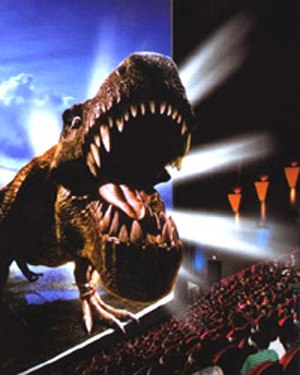 NYTimes recently wrote about a strategy employed by US cinemas to draw in more people. I quote:
"Reserved seating, plush rocking chairs and made-to-order food make Mr. Redford’s Sundance Kabuki theater feel more like a restaurant than a traditional cinema. It also has a 50-foot-high lobby with live bamboo, a glass atrium and reclaimed wood walls. Here, a night at the movies is less about enduring the hordes at the mall and more about feeling pampered."According to the article, big US-chains are building such upscale cinemas to draw people back into the experience.
While I am a big fan of the cinema-experience and actually worked at exactly such a venue, years ago, as a cocktail-mixing barkeeper, I think there are several reasons why such a strategy won't work.
The nature of movie-viewing (1): regardless of how luxurious a place like that is, you'll still have to sit in a dark room and won't actively notice the luxury or people around you, except for before and after the movie. The reason why people like dining in luxury-restaurants is because of the luxury, yes, but also because you share it with a group of people. In cinemas, luxury is not an emotional draw.
The nature of cinemas: cinemas are still very much in a mind-frame of providing experience of the masses. That manifests itself in a McDonalds' mentality of serving guests standardised services, having a lot of seat-rotation, cleaning big rooms (badly) in less than 10 mins, etc. It's a lot of little things, but they add up to a reputation for mediocrity, and people really just come to view the movie and be with their friends.
The nature of movie-viewing (2): YouTube, the internet, modern lifestyles, etc. have created different viewing-patterns, and there is a much greater focus towards viewing media in bursts. I think that the cinema-industry thinks that it is competing with some kind of emulated experience at home, but I don't think that's generally the case. So what are cinemas competing with and should they compete with it?
Luxury is not mass: Cinemas need masses of people coming in, and luxury cinemas actually only aim to address the (imagined!) needs of a few. In my opinion, it is not a customer-focussed strategy, and is for that reason alone bound to fail.
What should cinemas do?
Now, I'm not all against a certain level of luxury. I like comfortable seats as much as the next guy and I'd love a good cocktail every once in a while. But I think standards should be upgraded throughout the cinema, all the way down to the lowest seats, and that everyone should have the option to get a cocktail (if they have the budget).
There's two main selling-points for cinemas, I think, and those are timing and technology. They are still the first to air a film (ignoring piracy), which will hopefully not change. So, for blockbusters, cinemas reign is pretty much guaranteed.
Apart from blockbusters, there's something special about seeing indie movies in cinemas, which I include into timing. I'll never forget watching "Howl's moving castle" in the cinema, it was a magical experience, one that I could never have at home.
As far as technology is concerned, admittedly we are in an age where big screens and high-def visuals and sounds are becoming commoditised, though no one is as yet planning to install a 50 ft. screen in their house, afaik. I do think that cinema-technolgy should be upgraded, all the way to the point of the IMAX-experience.
Admittedly, there are some problems with 3D-tech. It increases the cost of producing a film and won't translate well to home-viewing (I think). But my point is that cinemas should keep differentiating themselves technologically.
People is a third selling-point, though I think that unless you like going with 8+ people to the cinema, you will be able to emulate that at home.
As far as luxury is concerned, again the basics should be present, and cinemas have to make money, but cinemas would become a lot more popular if they kept the price of seats down, increased the quality of service, and charged what they charged for luxuries. The one thing that I can't stress enough is staying a leader in technology (video & audio) as that is truly where the emotional draw for cinemas comes from.
But maybe I'm wrong!? Feel free to let me know in the comments.
5 links - cool vs. tech, touch-screens, women, pizza, & bookstores
0 comments Posted by Unknown at 12:09 PMMan, I collected so many links, that I'll probably have to write three updates to cover the most important ones. We've got a lot of ground to cover, so let's get started. You can find my previous coverage on interesting links from the web, here, and my continuous stream of bookmarks, here.
Link 1: On Magnetbox - Correlating cool with tech - With pictures like the one below, my work on this blog is really done. Interesting is the rise of computers vs. dance & hip-hop music (both of which are hugely benefiting from the cost-savings made possible by PC-based studios. (A note: low industry-barriers = high chance of suckage!). Also note the fall of art, after the colour TV was introduced. Kottke also made some comments about it.
Link 2: On BuzzFeed - Touch-Screen Ordering - BuzzFeed presents us with some stories about automatised ordering. There are both advantages and disadvantages, I think. Good is that it minimises errors in ordering and can interface well with back-office operations, such as ordering new supplies. It might also fit with the individualistic preference for self-service, I wrote about before. The disadvantage is the cost and the margins of error that information systems bring (I still shudder at the thought of the LAS disaster (pdf)) + the lack of the human factor. Martin Kunzelnick (German) links to some videos of Microsoft's Surface in a restaurant-environment.
Link 3: On Lightspeed Venture Partners - It is no accident that Typhoid Mary was a woman - Although it's a horrible-horrible title, and perhaps an obvious point, I've been coming across many stories about the social qualities that women possess, making them better at PR, marketing, sales, relationship-building. Something to keep in mind for any people-based business.
Link 4: On Reuters - Pizza Hut rolls out nationwide mobile ordering - A news-item (finally), and I'll probably delve into this topic sometime in the future. Arguably, Pizza Hut has been pursuing a different strategy from pretty much 98% of the pizza-restaurants out there. I'm sure that there is considerably brand-loyalty towards Pizza Hut, which will give it an advantage over delivering pizza-franchises, HOWEVER, it will probably be competing on price, which the franchise has not done so far. I'm not sure how that will affect their brand at all, but it's something to keep an eye on.
Link 5: On WSJ - Who's Buying the Bookstore? - arguably, there are few retail-outlets that evoke such an emotional response as bookstores. I find them comforting, and very similar to churches, in the way that it really is expected of you to be silent while browsing (on a side-note, I discussed a link of Dutch bookstore being opened in a church before). It's also a symbol of a community, as WSJ points out. Well, with competitive pressures from Amazon et al., these types of stores are clearly disappearing, or changing into hybrid monsters, which smaller stores can no longer compete with. WSJ points out a phenomenon related to that community-spirit, which is very touching. Capitalism isn't everything, particularly in places that target the softer pleasures in life. I'll have to reflect more on this, as I'm very attracted to these types of stores, and would love to set one up myself.
That's it, for this week. I'll see how I'll catch up on the rest of my links, but this went great (took 20 mins), and I always enjoy re-reading my bookmarks. I hope you do too.
The service-paradox - on self-service and customer-retention
0 comments Posted by Unknown at 11:31 AM Every now and again, you come across something that changes the colour of your perception, that allows you to see the world in different ways. One such moment happened after reading a chapter in the IKEA-book, I wrote about before (1 & 2), on how the customer is deeply involved in the logistical process and the effects and cause of it.
As you may, or may not know, when you shop at IKEA, you generally go into the store, choose the furniture you want, pick up the already-boxed version of that item, put it in a cart, pay, drive home, and assemble it with some tools that are in the box. All-together, the customer at IKEA does 80% of the work related to sales.
I had read, in my bachelor, I think, that the reason that IKEA introduced this system was because of when it first opened its store, there was such a mass of people that their staff couldn't handle it, and that they then just decided to let the mob do all that stuff. I thought that the reason that system remained was cost-saving; I mean, how cheap is that to let customers do all that work for themselves, right? Well, that's definitely a reason, but only part of the story.
The other part is the effect it had on customers. Because you always ask yourself, why would someone go through that, when they can just pay the store a little extra for the transport and the assembly? And that's where it gets interesting.
To start, IKEA, even though it offers low-cost goods, is well-positioned for the middle-class market. The stores are outside the city, and pretty much all their customers have cars, which they can use to transport the furniture back home. I'm not 100% sure if this was by design or a consequence of other factors. But at the very least, the conditions for making the customer part of the logistics process are in place. Still, you kind of wonder. Aren't these exactly the people that could afford a little extra service?
The explanation is culture. Western culture, you could argue, has seen a shift towards individualism. People are over-informed, over-serviced, over-indulged. Sales-clerks and waiters can't wait to throw themselves at you and ask you if you're happy, if you want another…, and another, and another. It's exhausting, both for the store and for the clients.
In comes this place, which tells you, very Scandinavian, here… go do it yourself. Like a party, where you can mix your own cocktails. Where you control what goes in and what comes out. And most of all, where you get the feeling that you are part of a productive ecosystem. It's the good kind of stress.
The book quotes some sociologists, Robert Jungk and Ivan Illich, according to whom, a society which receives too many services, where every screw has a handyman, is a broken society. Services, they say, destroy activities. For every small chore, you can call an expert and let them do work that you actually do yourself. On a larger scale, services destroy the entrepreneurial drive. Also Thomas Düllo, according to whom, we live in a world of indirectness, and because of this, it's very exciting to be asked to do something. A French student was also quoted, calling IKEA: "Lego for Adults."
And there are definitely signs that suggest that society wants to move into another direction: open source, Wikipedia, Make-magazine, do-it-yourself, self-help, etc. Probably even blogging. A collection of niches to be sure, but growing ones.
Ever since reading that chapter, I sit in restaurants, stores, etc. and wonder how this principle can be worked into their or other businesses. For instance, is the take-away coffee part of it, or McDonalds' policy of throw-it-away-yourself, or Amazon. All of these "features" cause both a downward-shift in the bottom-line of "service" businesses, but they also remove the "service." And these businesses are unarguably booming too.
But I also wonder which services can be removed, and which shouldn't. More on that when I have the answer. Or perhaps you have it yourself? Let me know in the comments.
The picture is courtesy of Marco.org
- For Technology, it's arguably Waste-disposal (I'll be writing about this soon on TechITEasy)
- For Media, it's finding a Business-model to compete with free.
- For Food, I would say it's O B E S I T Y.
And yes, I'm back! My 180-page thesis (or 135 at font-size 9) is being checked, and I'm in Rotterdam picking up the pieces of my life and making a delicious milkshake… whoops, I meant a yoghurt-smoothy… gotta watch that diet !!!
 It's perhaps a curious thing to say, but I think a lot of things in life depend on semantics—the meaning of words.
I should actually be calling my blog "Horeca & Retail" Blog, just because the word horeca describes what I want to do so much better. Horeca is an (Dutch afaik) umbrella-term, that describes the businesses mentioned in the title: hotels, restaurant, and cafes.
I picked "food" instead of horeca, because I couldn't find an English term that described what I wanted as well. There's restaurants, gastronomy, cooking, catering, cafes, etc. but all that is too specific. Incidentally, if a knowledgeable Brit, American, or international happens to know an anglo-term as suitable as Horeca, please let me know!
Whenever I discuss my business ideas with my dad (much more inspiring than any internet-based research), we don't talk about food or retail. I begin with that, because that's what I cover in my blog, but the conversation always evolves to how to run a café or some other kind of drink-related entertainment-venue. In other words, we talk "horeca."
Here's some stuff I learned from him (he used to own some bars and cafes):
- Try to imagine your place as a theatre - you're putting on a show every night.
- Personality of ownership is important - whenever he was active in this business, he tried to look for good partners: people who understood this world and had certain social qualities.
- When looking for investors, look for breweries - this is something I'll have to research.
- Location is not the top-priority for a horeca-venue - people will come if it's worth it.
- Horeca is a troublesome business - somewhat of a general statement, which I hear from a lot of people. Basically, it suffers from weird people-related issues—lot's of stress, lot's of alcohol, terrible working-conditions, funny contractual agreements, etc. And lot's of businesses go bankrupt (well, what else is new).
So, over the next few months, next to continuing to cover certain, universally applicable, retail-topics, I'll try to find out more about how to run entertainment-venues.
5 links to think - on Japan, designing experiences, globalisation, and endorsements
0 comments Posted by Unknown at 3:12 PM Really no shortage of interesting links this week, which is always nice. At the same time, it makes choosing 5 that much harder, but here goes.
- An Alien in Japan: Charlie Stross describes his trip to Japan last summer. …From Yokohama to Tokyo to Kyoto; …about shaved cats, getting lost in shopping malls, to Hello Kitty, and extreme bathing, to monorails and re-building history. A very interesting read, which presents some insights into that alien world, Japan.
- Blasting scents into coffee-consumers' brains: Roger Dooley explains the importance of environment to sensory experience, and describes how Nestle's Nespresso found their way into people's noses, brains, and hearts. In coffee, just as with good food and wine, scent is everything! Food for thought.
- Can experience be designed? After reading Bob Jacobson's essay, I'm not so sure. He writes about placing human experience into the centre of the design process, about systemic relationship between information and the environments (see above link as an example), about the difference between user- and human experience design, and how you can probably never design an experience to completely meet a person's expectations. At least, I think that's what he writes. So much of this text is far above my head, but worth reading to guide your mind into new directions, and a must-read for anyone interested in creating experiences. It's all a pre-cursor to a book, which, judging by the range of material, I expect to be published in 2 to 5 years, but which will be well-worth the wait. In the meantime, check out Bob's great blog.
- The downside of franchising: Richard Layman, in his artsy urban blog, writes about how franchises have transformed L.A.… into a clone of just about any other city. A little anecdote: I observed a similar trend when I was last in Belgrade, Serbia, which I hadn't visited since the war. It looks just the same as any other city, and that's sad because I remember there being a lot more authentic clothing- and food-venues. When I see this, I'm not sure I'm a fan of globalisation, or franchising for that matter.
- A twosie on Human brand-carriers (Sounds like a disease, doesn't it?): Two articles discuss this, one, by the NY-Times, on rock-stars and their interaction with brands. As one artist put it: "The barriers are changing and we as artists are making less and less money, and we have to get creative." At the same time, I have great sympathy for artists like Springsteen, Tool, and N.I.N., who refuse to corrupt their art. And another article, by HBR, on endorsements in sports, which is, at last count, a 100 billion dollar industry. I'm fascinated by this phenomenon, so maybe I'll write something about it in the future.
 It's time for another monthly summary (a few days late). This time, rather than the rather unattractive list-view which I used for my month 1-summary, I'm going to try turning the past month's posts into a little story. As I wrote, this blog is my way of learning about this industry, so let's take a look at what I've covered so far.
The Human element
I started the first post of month 2 with one related to self-development, and I kept that thread going for a while. This post was on the the way that leadership has evolved throughout society, from an individualistic to a social kind of leading. A lot of developments today, in business, politics, or other arenas, are so complex, that a form of collaboration is more constructive than tyrannical leadership. This is perhaps made clearest in in the example of Ikea and eBay, who—often by necessity—used collaborative methods to develop and introduce new features and innovations.
Again related to self-development, I also looked at particular careers in retail (with a nice chart) and in knowledge-based firms. Apart from simply researching the functions out there, my conclusions were that different roles require different talents, and that a manager/founder/entrepreneur should take care to surround himself with a diverse kinds of people. A similar point was made in a post on doing what you do best. Again, in the eBay-post, I discussed professionalising your firm quickly, by bringing in talent that can help in growing the business.
The strategic lens
A second big thread last month was business strategy. I started with the coffee-business, mentioning some examples like Coca-Cola, who is expanding into canned coffee, and Leonidas, a chocolatier, who is starting coffee-shops. Later, in two follow-up posts (1 and 2), I drew the conclusion that the coffee-arena is pretty crowded and that I wasn't sure if that was the best area to start a business in.
I also looked at the area of value chains and Porter's five forces, using examples like Ikea, Apple, and Amazon, and before that China and the issue of meeting it's exploding beef-demand. Generally, and the same applies to coffee, I think it's useful to take a horizontal and vertical view at how the industry is organised and find opportunities that way. In the case of China, which imposes some barriers to beef-imports, the answer was to import methodologies and grow beef on Chinese land. Other examples are mentioned in my five-forces post.
Another big topic is climate-change and it again helps to analyse this in terms of the value-chain, i.e. looking at all the internal and external activities related to your company and related to bringing value towards customers. And optimising those to take the cost of climate-change into account, which can later be turned into a significant competitive advantage over your competitors.
And I looked at some examples of Franchising in Germany, noting that retail is clearly leading in that field, and that a big challenge is to transmit tacit knowledge down your (largely decentralised) organisation.
Branding & marketing
Another large topic this month was the issue of customers, and how you market to them. IBM presented a nice white paper, of which I discussed the Well Curve as a possible methodology to understand the customer decision process, which was a second post on this topic.
I also looked at the way some business interact with customers, including T-Mobile and Harvard Business Review, and observed that conversational marketing is definitely a way to increase price-elasticity.
I have not looked much at food-business so far, but I did manage to discuss two restaurants: a pancake-place, where I discussed methods on how to make me remember its damn name, and a restaurant in Germany, which I thought received excellent advice in a show called "Rach - the restaurant tester," in regards to geographic marketing and building a brand.
Finally, even though my forte is not advertising, I came up with a—possibly stupid, but fun—idea on how to advertise a new concept coming to a town near you.
Innovation
Somewhat of a micro-topic, I looked at the way that music-media and money evolved and how that illustrated that customers love convenience, as well as how the Ford SYN-US was developed from start to finish. The latter is very interesting for thinking about what it takes to come up with new innovations.
Finance
Another micro-topic, which I will have to spend more time on in the future. I approached this in two posts. In the first, "other people's money," I reflected on some of the different types of investors there are and how some can add considerable value to growing your business. Also, in the eBay post, I looked at why it was so important for eBay to involve venture capitalists, even though it didn't need the money. The right kind of investor for your business will help you professionalise your business, by helping you find more talent, setting targets to meet, pressuring you to grow, and (hopefully) much more, all besides investing in your business, and taking shares.
Final thoughts
So, pretty diverse stuff I think, and while I could be writing more about food and retail—which will happen—I'm happy to have written and learned about all of these interesting topics.
For the future, I hope to look more at franchising, in-store activities, and particularly at supply chain topics, such as lean manufacturing, logistics, and anything dealing with the supplier-perspective. My future reading-list includes: The Disney Way, The Great Good Place, and The Toyota Way, as well as countless articles, pdf's, blogs, HBR-magazines, and so much more.
Well, here we are. Another month flew by! I enjoyed writing this post, and hope you enjoyed reading it too! For past coverage, you can check my slightly less aesthetically-presented month 1 summary. For more in the area of food and retail, I do encourage people to check my blog-roll on the right, and my bookmarks, updated 24/7.
The picture is an exercise of drawing a (my) hand in 5 min. or less.
 Not too long ago, asked the question about whether coffee is a bad business to be in, taking into account the exploding number of quick coffee-stops, as well as the fact that global players like Starbucks, and the soon-to-come McDonalds café, are saturating the market. There's another part to this, which I actually discussed before, but I didn't make the connection: coffee as a soft-drink.
In the Starbucks-book, "Pour your heart into it," Howard Schultz talks about how Starbucks got into the canned coffee business, with the help of a chemist and Pepsi. The chemist had come up with a method to captured the essence of coffee into an extract, which enabled Starbucks to add it to a number of new products, such as ice-cream and indeed "porta-coffee," also leading to more business-opportunities outside of Starbucks-outlets. Pepsico had the "porta" knowledge, as well as the distribution-channels, and from what I hear their partnership was a raging success.
About a month ago, I wrote that Coca-Cola had entered a partnership with Nestle, to develop similar products, and just read about a another partnership between Coke and illy, a premium brand of coffee and related products.
The rest of this post is speculation:
Now I'm sure that the coffee-makers will do their best to not have the can equal a taste of fresh coffee, though at the same time more competition in canned coffee will definitely drive the quality upwards. Perhaps up to a point where it will perhaps convince customers not to wait in the long queue associated with "good" coffee, and instead get a quickie at a supermarket or in a machine at work. Similarly, an increase in downstream-marketing by producers, may lead to an increased demand for these products up the chain, at cafés, giving Starbucks-, illy-, and Nestle-outlets an advantage over generic coffee-producers. Thinking defensively, all of this sounds pretty bad for existing cafés. I'm not a fan of thinking defensively however.
Offensively speaking, this is an opportunity. Comoditised coffee means that there is more space left for other activities which help increase the value of "third places." Comoditised coffee also means that the overall quality of coffee will go up, and that consumers will look for other selling-points. By taking a license on illy or Nestle coffee (I don't think/know if Starbucks licenses), cafés can profit from the downstream marketing that is already happening. Even cans of coffee can present an added value, for instance in large queue-situations (like the ones I discussed last time), which I perceive as an excellent opportunity for offering tasters.
And really, this may not change much for cafés. The manufacturers' downstream marketing towards consumers may cause an increased demand for illy or Nestle-coffee (or cans) in cafés, pressuring them to take it into their assortment. But the same has happened with drinks like soda and beer for decades, though I'm sure that there are some horror-stories to tell here too. And so far, canned coffee has definitely been lacking the taste department, so it may not all represent competition for existing drink-venues. I may be making an elephant out of a fly. In any case, interesting to think about and to see how this will play out.
Oh, and the picture is meant to represent a cup, spilling coffee. If it looks like crap (the coffee kinda does), my apologies.
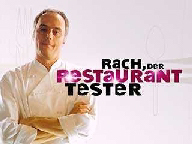 Finally, something more food-related! On television, there seem to be two types of shows related to the business of food: apprentice-type shows like "The Restaurant," which present a new challenge every episode and where one team/person loses and gets kicked out; and then there's another type of show, not quite as successful commercially, in which an expert is brought in to help a business in need. Last night, in a bout of insomnia, I got a chance to watch an episode of the latter category, a German show called Rach the restaurant-tester, where Christian Rach, an experienced cook and food-entrepreneur helps restaurants get back on their feet.
This one dealt with a restaurant in Berlin, called "Die Blaue Ente" (translated: "The Blue Duck"), which had some interesting ideas surrounding it, but many were unfinished, and was located in the middle of nowhere, in the outskirts of Berlin.
The restaurant had several things going for it. The cook (59), was energetic and outgoing, had lots of ideas, loved animals and even had a little zoo going with ducks and other farm-animals. The food was adequate and the atmosphere inside was friendly. His wife took care of the welcoming and did so authentically.
But the restaurant had been running badly for some time. The founder had many ideas, but many were unfinished. The restaurant served all kinds of diverse dishes, but there was no clear menu-identity. And the cooking, while good, was disorganised and slow. The business was in trouble.
The challenge was two-fold. Establish a clear identity for The Blue Duck and make people in Berlin aware of the restaurant.
Brand-idenity
The cooking was already good, but it needed to shine. People needed to come to the restaurant for a reason and leave with good memories. The straightforward answer was to make the food and the name one and the same. Bring more duck-like dishes on the menu, but with a twist. So gone were the diverse dishes that had previously been served. Rach gave them a couple of easy ways to create a broad offering of "winged" dishes, which were not only easy to prepare but also allowed for synergies in cooking (you can make a lot of different dishes from one chicken). But the challenge was to bring the food to the people, and that is exactly what they did.
Creating awareness
The founder had previously been toying with an idea to serve food on the road, with the help of one of those catering-trucks. He bought a second-hand one, but had abandoned the idea and left it rusting in the garden. This gave Rach an idea though. If the people weren't coming to the food, why not bring the food to the people? So he bought the restaurant another small catering-truck, one with which they could use to serve Blue Duck-snacks at a market in Berlin. And he got them a transportable oven, which they could use to keep the food warm, and attract visitors with sweet scents. Bingo! Not only was the cart a raging success, but it lead to exactly the desired result. People started coming to the Blue Duck.
Final thoughts
I wanted to write about geographic marketing for a while, because I consider it a vital ingredient to the leisure business. As a restaurant or other leisure-venue, you don't have much flexibility to move, and I think that the thinking goes that you must be located in a premium location in order to be successful. That's true, but it also reminds me of the gold-rush during "cowboy" times, where everyone would move to the same place to mine their gold and when the gold was gone, the town would be dead. Premium locations are like goldmines, and there's a great first-mover advantage. Instead, an interesting concept is to choose any location (within reason) and try to bring customers to you based on the quality you bring.
An entrepreneur in the tourism-industry, who taught at my school, told us about a similar thing he did. He asked: "as a local tourist-attraction, how important is international business?" As it turns out, it was very important. To him, international activities involved advertising in travel-agencies all around the world, as that is where he would get the majority of his clientele.
Frequently, when I see restaurants/cafés where the staff seems depressed and business is bad, that's the first thing that comes to mind. Have you done geographic marketing?
As for the brand, not much to say there. Clearly no marketing can make a bad product good, and establishing a clear identity is key in differentiating yourself from competitors, and more importantly, gain loyal customers.
It was a really nice show, I thought, more constructive than the typical apprentice-styled alternative. Competition is perhaps part of life, but there are a lot of smart people out there who can help you just as well. All it takes is a little altruism…
 I just picked up the German magazine "Starting UP" (initial impression, so-so), which featured a number of stories interesting to me. One was the 30 top-franchisers in Germany. I'm a little confused by how they rank these things (English translation: annual growth-rate of franchise and nominal growth-rate), which resulted in some kind of numbering system, where the number 1 got over 3000 points, and the number 2 939 points. Actually, I'm more than a little confused, but it's probably too early in the morning to me.
In any case, the number 1 was Subway, which grew from 190 German partners in 2004 to 600 in 2007 (and got 3113 points). And number 2 is DATAC, which provides accounting-support and proprietary software. It grew from 312 partners in 2004 to 522 in 2007 (and got 939 points.. ah I see, nominal = probably company growth rate). I'll list some more in a second.
Unfortunately the article was very sparing with its analysis regarding what makes a good franchise, which I would've found useful. The advantages listed for Subway are however:
- Low initial investment (ca. USD 10k entry-fee; charges around 8% of profit + 3.5% advertising fee)
- Strong international brand (28343 partners in 86 countries)
- flexible venue-size (doesn't take up much space / can be take-away or seated)
- simple operation (no frying, etc.)
- large health-factor / range of ingredients
- A 2 week training
- Help with site selection
- Help with restaurant design (though I think personal taste is very limited)
- Help with equipment ordering
Back to the list. I segmented the list of franchises into what I considered their primary focus to be.
- Consumer-services: 4 (PC-Feuerwehr; Schulerhilfe; Agentur Mary Poppins; Stage-coach)
- Logistics: 1 (Fastway Couriers)
- Business services: 4 (Datac; Mail Boxes etc.; Im-Press Promotions; Ultimo)
- Food: 4 (Subway; Joey's Pizza; Blizzeria; Haagen-Dazs)
- Health: 5 (CC Calorycoach; Bellissima; Ruck Zuck; Curves; Alkromat-Patrouille)
- Retail: 9 (Engel & Volkers; Videotaxi; Town & Country; Harper & Fields; Mobilcom; Re/Max; Das Futterhaus; Tiroler Bauernstandl; Babyone)
- Installation-services: 3 (Twintop; ; Isotec; Scheibenglass)
There are other underlying factors in running a good franchise, which I will write about at another point. Important to realise is that just because a company grows fast, doesn't mean that it's actually a good company. Many franchises, in my experience, suffer from a lack of shared standards of quality, which can be overcome through a number of methods, but often suffers because of the lack of a centralised control over who works for the company and how they interact with customers.
I still think my last post on how to shift tacit knowledge into the explicit kind is relevant here (also the one on the knowledge-spiral), as what we are speaking of here is really similar. A company is not just the product it sells, but the values of the people, and how to communicate that down the chain is a vital skill for successful companies and franchises alike.
The picture is, if you're wondering, meant to display a room in which you have a choice of (food-)products to sell. Eh, yeah… I'll improve someday, I promise! ;-)
I'm taking a little breather (what again?), to prepare some longer posts, a media-related one for Tech IT Easy, and some more tech- and logistic-related ones which I plan to mirror-post on both this blog and TIE. Hopefully, I'll be done with that soon.
In the mean time, I was thinking that there are actually quite a lot of songs inspired by and named after cities. The first one that comes to mind is Jacques Brel's "Le Port d'Amsterdam" (see video at the end of this post), also more commonly known as just "Amsterdam." I don't have the time to create a world-map of songs, though quite a few come to mind, which I may write about at a later date. And I'm also thinking about themes for food-venues, and where they come from.
There is a famous café in Brussels, called "A la Mort Subite," which Jacques Brel used to frequent and which has pictures of him hanging on the wall. I think it represents, for those that care, a great tourist-attraction and a piece of history. It's hard to control that, and I'm sure the café would have ended up differently, if it wasn't for Brel.
My dad told me a story about a café started in Bonn, Germany, which became a centre for political journalists in the 80s. As the interim capital of West-Germany, Bonn was important back then and it was only natural that such a place needed to exist. The café is dead now, of course, after the government moved to Berlin. Similarly, there is an artist-hangout in Dublin, one of the few authentic pubs left, and probably there since James Joyce, for all I know.
How this all happens, seems out of the control of the owners. Maybe just the right time/place, or the price being right for starving artists/journalists, who knows. Maybe there were other factors that can be "engineered." In any case, food for thought.
Enjoy the video. Le Port d'Amsterdam is incidentally also a Dutch pub in Paris.
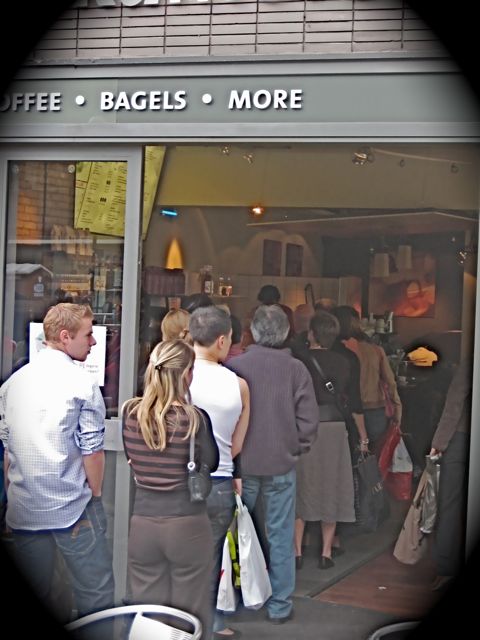 It's a fair question. Look at the picture on the right. This should be a familiar view in just about any city: a long queue for a tall latte. The picture suggests several things. One, that coffee seems to be a popular product; two, that there is space for more coffee-shops; or three, that this particular coffee-shop should perhaps improve its service.
The truth is that this trend is scary for many an existing coffee-shop owner. Because the café, in Europe, has been around for quite some time, centuries for all I know. Yet if you walk just down the street from where I took that picture at a Rotterdam coffee-shop, you'll see a line of traditional cafes, spacious and atmospheric, yet entirely empty. The fact that people would line up at this particular coffee-shop—the only Starbucks-like venue in Rotterdam—suggests that they don't care about space, about atmosphere. All they are about is convenience (if you call waiting for 5 mins. a convenience); coffee-to-go; and exotically-named and expensive coffee. What is happening here is not so much the comoditisation of coffee itself, rather the comoditisation (read: non-importance) of the coffee-selling venue.
I'm not sure if people would care whether they bought a coffee at McDonalds or the Metropole-cafe in Brussels anymore, to be honest. If the selling point is how quickly you can get the coffee and get out, what does it matter if the venue is a palace, ready to serve its customers on its hands and knees?
There are plenty of stories about "how Starbucks drove me out of business" (here's a borderline case), strangely outweighed by stories about "how Starbucks saved my life" (here's one). And with McDonalds increasingly getting ready to become a competitor to Starbucks, and other venues, like Leonidas, a Belgian chocolatier, transforming their previous chocolate-laced focus into a coffee-one, I don't think it's unnatural to be afraid. If a coffee-venue is a commodity, then how hard is it to change your existing venue? Insert some coffee-pumping machines, put a to-go sign on your door, and you're set.
So what should an entrepreneur do? Leave or fight? Yesterday's odd post about Beef, of all things, did suggest another way of looking at business: on a system-level. What was essential to the Chinese beef industry, to meet demand? Proximity to the market, amongst other factors. And what is essential to the coffee-industry? Probably not more coffee-venues, but maybe something else.
When you look at the way the coffee-industry is structured, and probably most industries, it's like a funnel: there are a number of coffee-producers (not sure how many), and a definitely greater number of coffee-venues. The latter is battling for the attention of customers. They do so by engaging in new business development opportunities, both internally (e.g. music), and externally (e.g. coffee in cans). They need to open more and more locations to maintain their air of convenience, just look at the picture above. They need to brand themselves as the number one place to go, versus all the 100s of other new and traditional venues. They need properly trained staff. They need good coffee, and other quick food-products, etc.
This would suggest following openings*:
- marketing consultants
- new business developers
- new business providers
- real-estate agents
- customer service consultants
- coffee-buyers
- temp-agencies
- quick food producers, e.g. a bakers
- and I don't know what else.
The point is that, while a certain, most obvious, business opportunity is shrinking, doesn't mean that there isn't a need for more business. As a (creative) entrepreneur, you just have to look outside the coffee-cup (read: box) and see if customers and coffee-venues would not be in need of other services. And perhaps I am wrong, and because it is so easy to implement a "to-go" formula, it is actually easy to start some kind of food-related venue and add the coffee on top.
Anyway, all this coffee-talk is making me thirsty for one myself.
Interlude: a brief review of pancake-place "forgot the name"
0 comments Posted by Unknown at 2:01 PM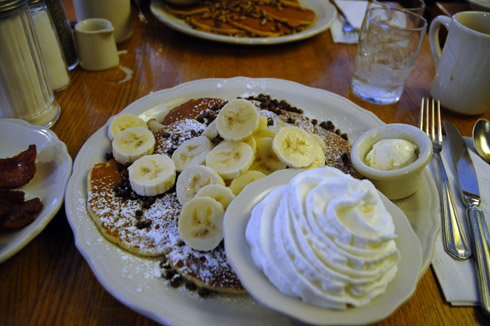 First of all, "forgot the name?" Indeed I did and that's already a bad sign for any place. I was brainstorming with my dad on business-ideas in a pancake-shop that had just opened. It still smelled of paint and the coffee stunk as well. The owners were stuck at the back, busy with making pancakes. But ok, I can blame plenty of this on lack of experience, growing pains, whatever you want to call it.
But here's a list of some good things, I think a pancake-place should possess.
Pictures of pancakes: these are wonderful creations, can be filled with sweet and savoury things. Why not advertise that. Instead they had this:
Pancakes (list of ingredients).............Small.....Large
1 ingredient.................................price X...price Y
2 ingredients................................price X...price Y
3 ingredients................................price X...price Y
Very organised, but so lifeless. How does this make me want to try one of their oh-so-delicious pancakes. It doesn't.
A take-out menu: I was a vegetarian for two years. One of the things I missed was that there are very few places catering to non-meat eaters. A savoury pancake can not only offer a great alternative to meat-dishes, it's also a great alternative to pizza. Why not grow your business a little?
Feedback-cards: as a new food-venue, i would consider this vital. How do you know that your formula works? Customers (e.g. me) can sometimes be much more creative than you can imagine.
Free internet and plugs: I already made this point before, and I know pigs will fly before it happens, but free internet = viral marketing!
Something to make me remember the name: a take-out menu, feedback-card, business-card, anything; don't be a commodity!
Finally, a better coffee would be nice. I understand that it's a pancake-place but they don't expect everyone to eat pancakes, do they?
And something I was brainstorming about with my dad: the importance and fallacy of personality in running a food-related venue. I'm sure I'll go into that another time.
The picture is courtesy of thisnylife.com
 So it's been nearly 30 days since I started this weblog, and not much longer since I decided to endeavour on the journey of learning about the world of sound + food and retail, and eventually opening a business there. The posting-rhythm on this blog has been going relatively well, I pretty much always have ideas on what to write about and, right now, already have material for the next 20 days (1 month of blogging), which is crazy!
I want to make it a monthly tradition to recap, both for my own benefit, because my topics tend to be very diverse; and for the benefit of the few readers that are passing by, because I think that blogs navigate terribly.
I will start with a recap of this blog, and then go through what I'm currently thinking about, and what the future will bring, both on- and off-line.
Previously, on Sounds + Food 'N' Retail...
So far, I've tried to approach the fields from different angles and relating pretty much any material I could find to it. User-response has not been great and the cause is probably that I need more focus, but let me attempt to bring together what I've thought about so far.
There are several issues, I felt I needed to focus on. One were my own vision and ideas about the business I would like to start, and initial thoughts were phrased in my posts on:
- My vision and inspirations part 1 and 2;
- Music venue scenarios.
- P&G's approach to shopper-marketing;
- NBC's disassociated relationship with Apple's iTunes and customers in general;
- Starbucks and how it works with 3rd parties to create a better space;
- Platforms - how Facebook does it.
Tschibo and LaPlace; NBC; McDonalds; Starbucks, as well as the country of China and its explosive growth.
Coming up, in Sound + Food 'N' Retail...
 So, so, so much! If this enterprise were climbing Mount Everest, I would say that I'm still planting my tent. So far, I have looked at a number of topics and formed some understanding of the principles of people-organisations, as well as some understanding of my own values towards running a business. That will continue for some time.
Generally, for this blog, I've decided on some regular features that I want to hold in the future, including:
- News from the hive - where I discuss stories of note about retail and/or food;
- Media-interludes - which really is just an excercise in taste;
- Strategic discussions - like the HBR-discussions, where I discuss issues of how to structure business-activities;
- Personal development - where I discuss methods of improving both yourself and your staff;
- Personal vision - where I discuss my own plans in the industry (much of this is also engrained in the material that I write about);
- Inspirations - where I highlight people and businesses that I admire and discuss their sites / books / work etc.
I have to admit that, at this stage, anything can change. I am looking for a relevant job, and have a number of considerations regarding this, which I will write about in the near future. I think that being in the right place at the right time can accelerate a lot of things, alternatively, I may love my job so much that I could decide to stay for a while longer. I'm also composing a list about what people I want to talk to and what places I need to visit. One event is still on my agenda, visiting a workshop for entrepreneurs in this field, next month in Amsterdam. I hope to meet a lot of interesting people there.
My passion for this field has been with me since I shopped for food with my parents as a teenager; or went on holiday, or ate at restaurants and danced at clubs. It is part of me, so this blog, in whatever shape it may develop, will continue for a long time to come.
 Corporate strategy fascinates me, as do the twists and turns a brand can make. Michelin is known for at least two very different, yet strangely related things: it is a manufacturer of tires and it publishes the Michelin Guide, the latter of which is very relevant to the industry of my choosing and what I briefly want to write about.
Travel at its heart
From the company's history, you can see a clear passion for exploring new places, greatly facilitated by the most-used vehicle for exploration in the world: the automobile. As innovation lead to more and more cars, busses, and trucks being used worldwide, and thus more tired being sold, it was only a logical step to enrich people's lives with guides and maps, to share the quality places that were out there. The company could have chosen to remain a simple commodity, a manufacturer of the seemingly simple tire. Instead, it chose to glorify it, and I think many people's lives are better for it.
The Michelin star
This rating, given to restaurants, is probably the most well-known worldwide. Having or losing a star can make or break a restaurant, sometimes leading to 100,000s to millions of Euros more in a restaurant's annual revenue, or vice versa. Michelin, which publishes these ratings in their Michelin Guide, classifies restaurants as follows:
- Bib gourmand: This is not a star, but an award for "serving a good meal at an affordable price."
- Espoir: This is a new rating (since 2006), and indicates promising restaurants, which might be awarded a first or second star next year.
- Restaurant *: One star means that it's a very good restaurant in its category.
- Restaurant **: Two stars mean that it's a refined cuisine, worth a detour.
- Restaurant ***: Three stars mean that it's an exemplary cuisine, worth a special journey.
In 2005, France had the most restaurants that were awarded stars (620); followed by the UK (230); and Italy (255). And, while I'm not sure it's very significant, Luxembourg has the most stars per million people (32.6); followed by Switzerland (15.7), Belgium (11.0), and France (10.5).
From Michelin's FAQ, I found out that their guide is based on the same principles as when it was founded in 1900, "because they are approved and supported by readers and travellers and are considered a benchmark of quality within the profession." These include:
- Visits by anonymous inspectors, who are professionals with a background in the industry and are on the full-time Michelin payroll.
- Offering a selection of the best hotels and restaurants in all categories of price and comfort, with no preconception or agenda other than to meet the expectations of readers.
- Independence, meaning that inspectors always pay their own bills and the MICHELIN Guide is entirely independent of the hotel and restaurant industry.
- And, that the guide is updated every year to guarantee the accuracy of the information in it.
For further reading, check:
The restaurant-business clearly is very different from regular retail-businesses. More competitive perhaps, and certainly perfectionistic. But also very secretive, in the sense of a closed kitchen and sometimes the attitude that some of these restaurants portray.
The Michelin star completely falls within the vision of transparency that I have of a good business. While not perfect, it provides a service to both customers, by showing them where quality is, and to restaurant-owners, by forcing them to improve. In other words, I am a fan of such awards and competitions, as it ultimately brings an industry forward.
 My apologies for the break of several days, I'm a little under the weather from a flue of some sort. Nevertheless, I can't help looking at things and coming up with a ton of ideas, which must simply be written down, for your and my pleasure.
This time, I'm thinking about eco-issues, which is clearly a rising trend. I surely don't need to remind people of the effect that the disasters over the last years have had on the media (think: Al Gore's "An Inconvenient Truth"), and the effect it has had on blue- and white-collar enterprises all over the world. But you (or at least I) don't really hear that much from the Food & Retail sector in this regard.
Nevertheless, yesterday I read a good article (in Dutch) on a night-club in Rotterdam, MyTown, which is rebuilding itself in an eco-style way, and another blurb on Marks & Spencer, which is opening their first Eco-store in Scotland. I'm sure there are plenty of other examples, only a Google-search away, but I want to keep it light for today.
For both venues, the eco-part comes from architectural design, making it harder for existing stores to do the same, without incurring cash-flow problems. I'm fairly impressed with some of the innovative measures that MyTown is taking, including building a dance-floor that creates energy through movement (kinetic), and a "relax roof," with solar panels and (how typically Dutch) windmills. Retail Analysis, as usual, is sparse with its details on what Marks & Spencer is doing, except implement energy-efficient measures on its electrical components (lighting, refrigeration, etc.) and using renewable wood-materials.
The business of Eco
This is a world, I've only superficially studied, so excuse mistakes in legislation. From my understanding, ever since the Kyoto agreement, the carbon-emissions per country and per company have become big business, even being traded globally. This manifests itself in such a way that even companies that pollute can acquire carbon-points from companies that are far in the clear in that regard.
In the Netherlands, and I can't speak for other countries, except perhaps the European Union, subsidies centred around this issue are big business too. MyTown received up to €300,000 for it's reconstruction, and many architects will purposefully choose certain materials because of their eco-quality and the savings in costs it brings through subsidies. From my understanding, the same is happening across the EU, though I cannot confirm this.
As mentioned, this is the first time, I've delved into the FnR-aspect of eco-business, so I'm not sure how prevalent it is. Perhaps, with enough savings, a similar carbon-trading situation can or is occuring, certainly amongst larger chains like M&S.
Is Eco good marketing?
This is an issue I still have to study and perhaps write a future post about. Certainly eco-awareness amongst the public is at an all-time high and business "doing the right thing" can only appear more positive in their eyes. Whether it makes a difference per location or only on a Goodwill-level remains to be seen. For Clubs like MyTown, the entertainment-aspects will of course outweigh what kind of electricity they use for their fridges, however if they can package their eco-friendliness in an entertaining way, I can only see positive things coming out of that.
Oh, and in case you're wondering about the "Dolphin" picture. I was in an abstract kind of mode.

 The


