 Disjointed, because I don't have the time or energy to write a beautiful essay about empowerment—I'm not even 100% certain what it means yet. And in a way, by writing about 'empowerment,' I'm breaking the first rule, which is "Don't speak about empowerment." Or at least it seems that way. Currently, there's around 505,000 articles online about the term, which qualifies it as a hype and as such something that has already been discussed too much. But also, empowerment is basically about trust, a behaviour, and how can you talk about a behaviour, you just behave.
I think I first came across the concept, without even using that term. A few years ago, I read a book on ants, called "Emergence." It was a great book, I thought, about how ants at every level exchange signals, in the shape of pheromones, to indicate what they were doing and whether they needed help. A completely decentralised organisation, and the only thing the queen needed to do was produce babies, which, equivalent in business-talk, is, I guess, take care of human resources. I was so excited about it, that it became a research proposal for my master-thesis in strategic management, and was very quickly rejected, as I guess I hadn't related it well to strategy.
I again came across the concept last week, after reading an interview with the then-CEO, Dennis Bakke, and the then-chairman, Roger Sant, of AES, a power-company, which was, at least at the time of the interview (1998), very big on empowerment. And it seemed to work pretty well for them, if you look at their share-price, it rose pretty steadily up to 1998, and even more up to ca. 2001. Though, it hasn't been doing quite as well these last few years.
Reading the interview, I got the impression that empowerment is a religion, which in itself is hard to quantify into a set of rules. Essentially, at AES, it was (or is, I don't know) a system of open exchange flows; people could evaluate each other's performance, investment-decisions were decentralised and crowd-sourced, job-rotation was common, and micro-teams of ca. 10 people, focussed on different projects and tasks, were spread all around the organisation. And that seemed to work pretty well.
But there were also some downsides, such as that the company didn't work well with other companies—rather, it preferred a contractual relationship—and there were constant pressure to revert back to the traditional top-down model, from the public, share-holders, even employees. Essentially, every employee at AES becomes a kind of mini-CEO, which is clearly not something everyone is conformable with.
And the question is, and I haven't figure that out 100% yet, is how you come from that top-down view of human "resources," to a decentralised ant-like model? The key-word, which is equally hyped but seems to apply, is "delegation"—i.e. shifting executive responsibilities out to a team.
I think the problem of this is quite well spelled out in a recent interview with Brad Bird from Pixar, who was at one point confronted with a team that was demoralised. The former director had taken their work and evaluated it in private, giving written comments to individuals, not giving them a chance to give any input. And in order to turn that team around, he had stand in front of them for two months, evaluating the work, in public, and encouraging to take part, through questions. Two months, it took to go from the traditional model to one of empowerment, and just for that team.
The good news is that for start-ups, this is pretty much the way it should be from day 1. The bad news is that for big companies, or as soon as a start-ups grows bigger, the dissonance between people becomes larger and larger. And you have to—if you want to, at least—find ways to decrease that gap, probably most easily achieved through team-building after team-building exercise.
Anyway, not much more to say about this for now, but empowerment is cool, let's leave it at that.
Ah yeah, I forgot! I liked these interview questions, which were typical of an AES job-interview at that time, and made me think about my own opinion on empowerment:
- Should everyone be treated equally? Explain.
- What do you do when something needs to be done and no procedure exists?
- What self-improvement-efforts are you making?
- Recall a time when people around you weren't being entirely honest. What did you do?
- What does "fair" mean to you? How important is fairness?
- For what have you been counselled about the most?
- What is the most difficult situation you have faced? What did you feel? How did you react?
- Describe two important achievements.
- Tell me about a time when a decision was needed and no supervisor was available.
- What kind of rewards are most satisfying to you?
- What does "fun on the job" mean to you?
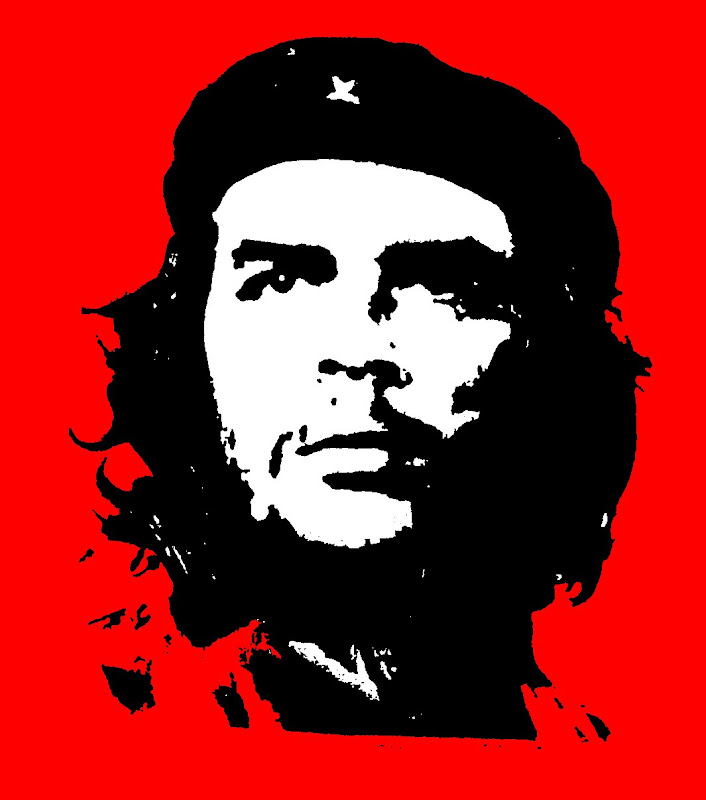
The picture is of course of Che Guevara, who wasn't an entirely nice guy, but does stand for this whole "power to the people" movement.
 The world of business, I think, has a certain illogical—the "human element"—shell around it, but centres around the concept of supply and demand. How you create a business where demand is high, how to you make sure that you have sufficient supply and/or not too much supply. You can see this play out in a number of places, e.g. on the web you have scaling issues, when your service proves to popular (e.g. Twitter), or you have the case of the million+ blogs that are collecting dust, because no-one ever reads them, or because the blogger was unable to gather enough interesting supply.
In restaurants, or food-places, you also see this play out. A couple of months ago, I was going to write about take-out, how some businesses embrace and others avoid it, and why. I think the reason is, at least in part, to control supply. If you control supply, then you can focus on quality and charge a higher price. You also become an artist/creator, rather than a factory.
How do you limit supply? Two ways, I think. Mainly it's the physical space; by limiting the number of seats in your venue, you ensure that a certain quota is set (of course, the question is also whether that quota is met, which comes from quality inspiring demand). By investing in quality-ingredients, you not only limit your budget, but also your production-capacity, and it forces you to limit supply. That's a little vague, I know, I haven't worked it out 100%.
The other way, is to have an increased level of supply. How do take-out and fast-food places do it? By standardising as much as possible. Whether it's the ingredients, which are mainly starch-based (burgers, pizza, noodles, etc.) and cheap, the production-facility (often just an oven, a grill, or a big wok), or a standardised customer-space (from seats stapled to the floor, to waiting-lines, to a website/phone nr.). All of which enables you to deliver mass quickly.
I was thinking about this today after watching "Iron Man," which is one big Burger King (and US-army) commercial, and getting a cheese burger afterwards. Burger King was packed and, ironically, slow. The "waiting in line" method doesn't seem to work that well when you have 50+ people waiting, and a limited space behind the counter to deliver burgers and stuff. People on both sides were bumping into each other constantly, and I actually had to wait over 5 mins, even though I was second in line.
On some level, I like to think that technology can solve a little bit of this problem. If you look at Zara and H&M, which I wrote about last week, both are very advanced in this area, in order to optimise and speed up their production, logistics, and merchandising. Of course, that's on a back-office level, and that's not the same as the front-office, where customers interact with a business. No one wants to be confronted with a screen to do the ordering, but sometimes I wonder if people wouldn't be happier just pressing some buttons in a fast food joint, rather than waiting in line. Of course that would mean more seats, as more people would sit down, and more staff, as someone will have to bring that food to the table.
In the end, it probably comes down to experimentation and constant improvement. That said, apart from the computers that cashiers operate, and quicker food-preparation, not much has changed in the last 50 years for the people doing the actual eating.
The picture is courtesy of lightningspeed.net.
All right, in 10 mins or less…
I just started reading a series of essays, entitled "Wish I'd known: Insights and inspirations from the journeys of successful entrepreneurs." Do a search, and you'll find it for free online. One essay finishes with:
"I wish I'd started younger and wish I appreciated how much family and friends would support me beyond what was reasonable and fair. I wish I'd know it was OK to have fun and in so doing not taken myself so seriously—the journey is often superior to the destination."Words to live by!
Last weekend, I wrote the acknowledgements for my thesis. The cherry on top, which I'd left for one of the last things to finish. And it would've been impossible to write it before anyhow, as even in the last lap there were/are people driving me on.
During the writing, one person died, another got terminal cancer. Both much too young and undeserving of such a fate. And both of whom I consider good friends, whom I trusted and who trusted me. In part it was the thoughts about them that prevented me from giving up.
But, strangely perhaps, it was also my little brother, just 19 years of age, that was unrelenting in pushing me forward and not letting me quit. It was as silly as him telling me 6 months ago, "I want you to finish this in three weeks," which got me to get my act together, perhaps taking longer than three weeks, but not stopping until I was done.
And it was all the people I interviewed for this study—my subjects, and ultimately my customers—all of whom unquestionably agreed to share their wisdom and whom I ultimately do it for.
It's only about a page worth of acknowledgements, but it is for the people on that page that I spent countless months writing, that I ultimately produced a 120 page-document for, and without whom I wouldn't be anywhere close to where I am today.
That… is the value of support and why nothing is impossible!
(No picture, as I found nothing that could do them justice)
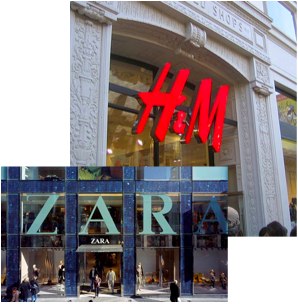 Time for a wee break. In the last week, I've been researching Zara and H&M a little, to better understand the retail-sector and the fashion-segment. I'll probably have to do a follow-up to this post, as there is lots to say about both businesses, but here's some initial impressions, nevertheless.
First off, H&M appears a lot more clean in its approach. Judging by the annual reports alone, H&M not only has a 2007-edition (Zara is only up to 2006), but it is also only 85 pages long (presented in an eco-friendly 2-pages-per-side way), while for Zara, or actually Inditex, it's mother-company, the annual report is a stunning 450 page long!
Now, that's really not all that surprising, as Inditex is composed of a number of companies, and it is extremely vertically integrated, while H&M employs the Nike or Apple model—it designs and it retails, but it doesn't produce.
Why this is so, I can only guess, is due to their origins. Inditex comes from Spain, traditionally a low-waged country, while H&M is Swedish, not a low-waged country. Similar to IKEA, I imagine it was an economical decision to outsource most of its supplies.
It's very hard to separate Inditex from Zara, as both are founded and owned by the same person, Amancio Ortega Gaona, Spain's richest man. Zara has been in existence since 1975. H&M was founded by a Swede, Erling Person, in 1947, who ran the company to ca. the mid-90s, but which has continued to be a family firm.
Their business-philosophies are fairly similar, a low-cost, high-quality approach to fashion, as opposed to traditional brands, where quality most often equals price.
Zara made lots of headlines with its extremely high turnover of products—it produces around 11,000 items annually (as oppsed to 2,000-4,000 for other retailers); 15-20% produced before, 50-60% at the start of the season, and the rest during. If a product fails to do well, it is usually removed after a week in stores.
H&M made headlines with its celebrity-marketing, which is noteworthy, as Zara has virtually no marketing. Instead, because it has such a high turn-over of goods, customers tend to visit it more often, expecting new things—an average of 17 times per year vs. 3 times for other stores!
Both employ mostly a wholly-owned retail-strategy, except in countries where this is not possible. And both are very advanced in their use of IT to manage logistics and production, which is definitely seems to be a key-characteristic of delivering fashion quickly and find ways to decrease costs.
H&M's largest markets are Germany, Sweden, the USA, Spain, and the Netherlands (in terms of sales). For Zara it is Spain, France, Germany, and Mexico (in number of stores).
That's all I can think of in 30 mins or less…
A VC: From Messes To Successes:
"The prescription for turning these messes into successes is really pretty straightforward. You need to build the team and bring in people who excel at the blocking and tackling and the PLANNING that most startups don't have the time or inclination to do. And you need to gradually change the culture of the business from one that is all about the product to one that is about the entire company. Sometimes, often times, that means changing the people around. And that's never easy. And it's even harder to change the people around when it was the initial team that made the product so popular in the first place. So you have to somehow find a way to add the 'operational' people without drowning out the 'product' people."
Eggbeater: Chef Owners Who Work The Line
I'm starting to think people should take a test before they open a restaurant. It will be like a triathlon: you must work the line, well, if not stellar. You must understand and be able to explain one P&L statement. You must understand why raw fish and cooked meat cannot share the same bin in the walk-in. You must understand how to make cookies, one dessert with chocolate that's not a molten chocolate cake and it would be great if you knew the difference between panna cotta and creme brulee. The test would list a series of questions and you would be graded on how much responsibility you took for your own actions or the actions of those you hired. For bonus points you might have to research why all the restaurants in your location before yours failed, or cooking in and creating a menu for a kitchen with no Latinos (or your State/ Country picks for easy-to-exploit-able peoples.)
Freakonomics: The Consequences of Being Green
There should be a rule: before helping the environment in one market, we should be required to think through the impacts on other markets.
 I'm thinking about adding another "interlude" to my collection, inspired by ADD without a doubt. It's the cookerlude, baby, aimed at collecting thoughts and notes on cooking in order not to forget and to better understand the world that a cook goes through. While I cook nearly every day, I don't consider myself a good cook. I simply don't have the taste-buds for it; but I do love the good food, which, luckily, my gut no longer shows!
I recently discovered a podcast, called/by The Restaurant Guys, which, apart from the insanely long commercials, actually seems quite interesting and is funny enough to keep my attention. Some notes.
Salt: So, we seem to have this internal taste-meter for the stuff, which in some ways is tied to the percentage of salt in salt-water. At the same time, our saliva actually dilutes salt in food, reducing it, meaning there should be a higher percentage in food than salt-water, for us to enjoy it.
Sugar: apparently there's no set limit for that, people love sugar (I must be the exception).
Salt + Sugar: whenever you make a sugary desert, adding a little(!) salt helps the taste; apparently they do funny stuff to each-other in your mouth, a party in your mouth, so to speak.
Taste-enhancers: apart from the above, olive oil, mushrooms, garlic, tomato-paste, alcohol (and much more) enhances the taste in your mouth.
Pretty basic, no? You can listen to the whole episode on what (American) people like in their food, here.
My own world
(This is where I talk a little about what I discovered myself in regard to cooking. Pretty basic too, so I'll try not to embarrass myself.)
I'm a big fan of salads, I make and eat one nearly every day as a meal. I often use canned tuna, but I recently discovered salmon in a can, which tastes better, is less salty, healthier, and costs about the same here in the Netherlands.
But steamed salmon is the best. You can get an expensive steamer, but a cheap solution is a microwave-steamer. I found one in a Chinese store for about €10, you can steam whatever you want in 5-10 mins and it magnifies the taste. Add some green beans and carrots, and you got a great salad for a meal! Add some potatoes or rice, and you won't need the salad.
Last, but not least, sometimes, not always,Ketchup actually makes for an interesting dressing (together with some oil and spices). It often contains vinegar, which salads like, and the tomato mixes well with the salmon-taste.
That's about it for today, I'm not sure how often I'll repeat these cookerludes, but I hope you enjoyed it! The picture is of course of Chef!, the show.
 An interesting quote from the Economist this week. Particularly, because I personally suffer from it, and imagine a lot of other people & businesses do too.
Mr. Fellows [CEO of Callaway golfing equipment] believes that the "fundamental principles of running a company don't change just because the product category is different." In his view, Callaway's problems stemmed from the fact that it saw itself as a golf business, not as a consumer-goods company. He resolved to focus on "what the consumer wants, not our own feelings about what the game of golf should be."It doesn't matter if you're the CEO of a company, an investor, a sales-person, a blogger, etc., I think everyone has an idea of what they want and what customers should want. But what it really comes down to is the latter.
Face Value, my favourite section in the Economist, every week.
The picture is courtesy of digitalfreak.net
 When I started this blog, and my general thoughts about the area of food & retail, it was all about the people. A quality staff and happy customers, what more do you want? And I have to say, from past experiences, that I don't really like businesses that don't place people first.
For instance, one individual I worked with, suggested using handicapped people to put together a product manually. I instantly disliked him. Not that I don't want handicapped people to be productive, but it was the thought behind it; to find a "stupid" workforce, which you can save tons of money on. It was just distasteful.
Another company I worked for was very process-orientated.
There's nothing wrong with that of course, but it was a big company with a reputation for innovation and that is why I joined. And you expect such a company to at least push forward a solid project. Well, as it turned out, the organisation's core-strategy was to start a large number of risky projects and have them compete with each-other. Those that would fail would simply be abandoned, and their staff was expected to fall on their swords… metaphorically. The effect was an incredibly high turn-over of employees, all three projects I worked on no longer exist, and it deeply soured my feelings about this company.
Both these examples, to me, represent a lack of respect for the human element. I realise that business is a hard world, but if projects were designed to be solid in the first place, there would be less of a need for these kinds of practices. Just my 2 cents.
Part 2 - the challenges that people businesses face
HBR (Again! I'm sorry, but I read a lot of HBR-articles!) published an article about people businesses some time ago, which I enjoyed. Following are some notes + thoughts about it.
- People businesses are defined as: "operations which are characterised by 1. high overal employee costs, 2. a high ratio of employee costs to capital costs, and 3. limited spending on activities, such as R&D, aimed at generating future revenue."
- In a top-40 list of people-businesses, published in that same article, only a few qualify as food and/or retail related. These are the Hospital Corporation of America, Tenet Healthcare, Marriott hotels, and Accor hotels.
- For instance, a business like McDonalds does not classify as a people business; it has substantial assets in terms of brand & real-estate, and relatively low people-cost.
- People-businesses face a number of challenges, related to performance measurement, people-management, compensation, and business models.
- Measuring productivity is more important in these businesses, then other economic performance indicators, like return on assets or investment. The challenge is finding the right indicators (employee productivity & profitability), as well as benchmarking it against other companies (employee figures do not always need to be made public).
- To manage people, you need to align employees' interests with business objectives & execution. And you need to find ways to measure performance (see above) continuously and see where your weak spots are.
- Compensation is key, as productivity is very sensitive to it, and is a primary determinant of shareholder risks & returns. Other factors to consider are variability—productivity varies across the workforce and how do you get the most out of a diverse workforce—and reach—sometimes the lowest on the ladder are as, if not more important to a firm's performance, and how do you motivate these people to do their jobs as good as possible?
- There are a number of business models are used in these types of businesses: pricing per hour is a safe method, but does not account for extra performance; a fixed price per output allows companies to shave costs off the inputs and thus increase their profit-margins. It is very susceptible to a high-skilled workforce; a success-fee or commission offers the best returns, but also the greatest risks; some companies use a hybrid of these three.
- The strategic weakness with these types of businesses is that your assets are mobile and can walk out the door. By creating value above and beyond your employees, you can diversify some of that risk away. Of course, you could also try to keep your employees ;).
I guess it's up to individual businesses how they want to measure their firm's performance. The most straightforward is certainly return on assets or investment. But even that leads to some question-marks, particularly in today's highly software-based economy, where assets are no longer as necessary, or pricey, as they once were.
For my part, I still think that people are a key-asset to a business, and it's interesting to look at how exactly you motivate a workforce and get the most out of them, as well as how to overcome the challenges related to a people-based business.
Equally interesting is how to align the business-model to match the needs of your assets—the people. Since people are motivated by (financial & non-financial) compensation, do you keep the pay-rate aligned with time-spent; fixed; aligned with performance; or a hybrid of the three? I think the hybrid is always the best choice, but even then some combinations work better than others.
And retaining employees is also an interesting problem; though much less so in countries like France, where getting rid of them is a problem, and differently in places like Silicon Valley, where inter-firm mobility is a key-requirement for many employees. I think the solution is completely personal and cultural, and everybody's answer will be different on this.
The picture is courtesy of prairienet.org
 I am not a born bootstrapper, let me make that clear from the start. I just like titles that include words starting with the same letter (is there a term for that?).
Bootstrapping is, in my own definition, "the ability to generate growth on minimal financial resources." I was first going to call it "the ability to survive on minimal resources," however that would make most of the third world bootstrapping-geniuses.
No, it's when entrepreneurs have an idea that they want to grow into a commercial business, and since finding funding is difficult and less preferable for some, they do so with minimal financial means, perhaps while maintaining another source of income and by generating organic growth—revenues derived from within the company. In sociology, there is a concept called bricolage, which means more or less the same.
What makes a born bootstrapper, or rather a good one? I think it requires three qualities:
- The first is certainly the ability to live cheaply, and I'll refer you to one of Jeremy's post where he makes the point quite eloquently. The ability to live without luxury, eating at discounters, buying second-hand furniture (or dragging it off the street), living in cheaper areas, and, most importantly, to delay paying the bills, are certainly key-components here. As is, making resource-choices for your business. Easy to do when you work in software, less so in physical businesses, though inventory is fun to play around with.
- The second quality is time-management. You need to generate growth within your company and pay the rent, so you have to make choices. You have to find alternative revenue-streams, perhaps get another job, and work on your business during your free time. It requires you to set some clear priorities, skip the weekly cinema-visit or the time spent with your loved ones.
- The third and final quality, is to be goal-orientated. You could place that under time-management, perhaps, but where bootstrapping is most likely to fail is when motivation drops. You need to keep your eye on the ball at all times; the priority for a bootstrapper is to grow the business, not keep a stable job, and you need to see the light at the end of a tunnel and keep going until you reach it.
The picture is courtesy of rockies-ice.com
 Ten tips, taken from an essay written by Masterson, entitled "The Winner's Rule", from the book "Just One Thing
Advice is a funny thing. I don't think it's advice at all; rather it's a set of criteria or truths, and fairly shallow ones at that. They ignore the context a person, a reader, a student, a business goes through. And what if we all met these same criteria? Wouldn't the world be a much more boring place? As such, treat all "advice" with care.
I can classify Masterson's points into two categories: Business-related & person-related.
Business-related
1. It's not a business until you make the first sale.
2. The most effective way to enter a new market, is to offer a popular product at a drastically reduced price.
3. Sell, sell, sell: keep on increasing the perceived value, allowing you to ramp up the price, and increase profit margins.
All of these are sort of straight-forward, I think, though certain terms should be qualified. For instance, what does a 'sale' mean? It's easy to understand it within the context of a product going over the counter, but what about service-companies or the many web-businesses that fund themselves through advertising (if that)? I would nominate the first "rule" to be: It's not a business until you make money.
The second and third points, to me, seem like a typical VC-thing to say. Scale, scale, scale. Sell cheap and sell much. And worry about increasing the profit-margins later on. Again, it should be qualified, depending on the type of business. For instance, the internet is a market-place for countless cheap (or free) and mass-products; but as a result many products/services have become simple commodities, with no one willing to pay for them, and businesses having to look towards advertising as a funding-source (shudder).
Personality-related
4. When choosing a business, pick the one that can be grown without your personal involvement.
5. Before investing, know exactly how much you're willing to lose, and get out before you hit that point.
6. First, improve your strengths. Then, eliminate your weaknesses.
7. Focussing is more effective, than a diversified approach.
8. Let your winners run, and cut your losers off… quickly.
9. 80% of success comes from 20% of your resources.
10. Try to always focus on the good of the whole, vs. the good of the one (applies to any relationship).
Lot's more to say here.
Completely agreed with point four, as entrepreneurship should not be about enslaving yourself to another organisation, at least not for life. Many entrepreneurs seem to ignore that rule, however. Also, VCs often prefer to replace the founders with more qualified executives to "grow the pie."
Point five is spoken like an investor and is very much dependant on the perception of risk you have. Entrepreneurs are reputed to be risk-taking people, however the smart entrepreneur takes a calculated risk, and understanding how much you're willing to lose is part of that.
Point six and seven are a personal weakness of mine, I'm too damn curious for my own good sometimes, more interested in exploring areas (of myself or in life) that are unknown to me, rather than that which is known. That may change, but is certainly not a criteria that I personally meet. I wrote about focus before, btw. Differs from person to person.
Point eight comes with experience, I think. On the one hand, you need to have perseverance, even when things are hard or going badly, especially during the early stages of a start-up. On the other hand, a reality-check is price-less. I suggest bouncing your ideas off as many people as possible.
Point nine is true, nothing to add.
Point ten is about understanding the core-principles of business and, even as an employee, doing all you can to make that business (instead of yourself) profitable. Ram Charan is a good man to read on that.
Good essay, made me think about my place in the world.
Read more entrepreneurship articles here.
I just discovered a new podcast called "Big Ideas" (iTunes-link), a series of lectures on anything from the impact of urbanisation on musical tastes, to designing menus for restaurants. Oh, and it's Canadian. Not that that's bad, but some parts of the lecture covered local conditions.
John Schneeberger starts his lecture (dated March 1, 2008) off with the basics of menu-design, namely that they should reflect three things:
- What you stand for? Aka. what kind of food do you like to work with?
- What demographics are you targeting? Income, religious issues, etc.
- What are the current trends? And are they for real or just a fad?
- Customer-decisions are always a trade-off between price and quality
- Traditionally, dishes consist of three components: protein, starch, and vegetables.
- What we understand as taste, actually comes from three sources: fat, salt, and sugar.
Schneeberger discussed three booming trends, vegetarianism, organic food, and local produce, and mentioned a number of challenges related to these.
 Vegetarian cooking
The thing to understand about this, is that it's generally cheaper. Schneeberger mentioned a 1:10 ratio when you compare the cost of producing vegetables to the cost of growing a cow. And while it's a booming trend, the industry, somewhat mis-guidedly, still often focusses on trying to replicate the taste of meat, which is impossible (think veggie-burgers, etc.).
Instead, they should be thinking about nutritional value— vegetarian food has been correlated with lower health-problems and is for that reason often recommended by doctors. The problem with these types of diets is of course that they are low in those qualities we would traditionally associate with taste: fat, salt, and sugar.
To create dishes that people actually enjoy, restaurants have to look globally, e.g. Asia, where more exotic vegetable components can bring some needed flavour to these dishes. I think he mentioned seaweed, but also stinky tofu (see pic), which is a type of fermented tofu and one of the few ways to naturally bring flavour to that type of protein.
The implication is that vegetarian food requires a significant amount of specialisation and is often hard to combine with meat-cooking.
Another complication arises from vegan (no dairy, honey, animal-derived products) versus lacto-ovo (incl. dairy, honey, animal-derived) cooking. The first makes it very hard to create a (traditionally) tasty dish. The second, lacto-ovo, allows for more flexibility, through the use of ingredients like eggs, which not only provide extra protein, but also bring a lot of flexibility to the kitchen. You can, for instance, make foam out if it, which would enable the creation of deserts & soups, etc.
Organic cooking
First of all (and I'm not sure if this is just restricted to Canada), an organic food label refers to the production method, not necessarily the quality and taste. Since organic food is more expensive, and taste is not guaranteed, you have to wonder if your clientele is willing to pay extra for that service (remember the trade-off between price & quality!).
The big selling-point here is the information about the product. People like to know how their food was produced; it has a certain value to know that there are no chemicals or genetically modified components in what you are eating. But again, that must be a value that is clearly advertised and which may not be important to every type of demographic.
Local produce
The advantage for the restaurant is that they can form better relationships with their suppliers, it's also cleaner in terms of carbon footprint (less transport), and it also has some marketing value to a certain demographic.
The disadvantage is that supply cannot be guaranteed during all seasons. Schneeberger mentioned something called a "100 mile diet" for instance, but restaurants catering to that need will probably have problems in the winter.
Thoughts
Overall, a pretty insightful lecture of the more exotic (and trendy) type of cooking and its trade-offs.
These types of specialisation are still pretty niche, require significant resources in terms of tools, know-how, and supplier-relations. But, if executed well, a niche can be extremely profitable.
I thought that it was interesting that all the traditional means of cooking, the ingredients and the taste-makers, were pretty incompatible with these newer trends. As such, you are essentially climbing up a hill, trying to educate the mass-market. At the same time, good execution, together with differentiation from the norm, seems like a formula for success.
 Just a short tweet.
I'm currently reading a Dutch book on the 2003 crisis at Ahold, but which is actually a historical account of how the corporation came to be. A couple of things I found interesting:
- Ahold actually stands for AH (Albert Heijn) Holdings
- We all know that things are cyclical, but it was interesting to read how a recession and high oil prices were a challenge that Ahold had to face in the 60s-70s, and how they managed to survive.
- In order to inspire Dutch people to shop more, they introduced a financing scheme for fridges, which people couldn't afford at that time. General Motors did a similar thing to help people afford their cars; seems like an interesting way to "upgrade" an economy.
- The fear of a socialist government drove Albert Heijn to look outwards and form Ahold (similar to why IKEA decided to globalise also).
- One of the consequences of politics at that time was the board of directors, meant to provide impartial guidance and represent the workers.
- They made extensive use of consultancies (often McKinsey) whenever they decided on a strategic trajectory.
- One of the directors was a big fan of Harvard Business Review :)
- They use the US as a source of knowledge on how to design their supermarkets. Later on, moving to the US was also seen as a way to increase that learning, as well as a new revenue-source.
- When AH moved to the US, they also brought their own ideas, like, eh, advertising (a terrible, terrible idea).
I took this title from a report on the future of Dutch supermarkets (English pdf). It identifies a number challenges to come, one of which is "stomach share," which is apparently a big deal because of the following three factors:
- Population decline: which translates into less consumers buying food
- Increased longevity: and older people have a lower caloric intake
- Increased awareness of health-issues: which also translates to a lower caloric intake.
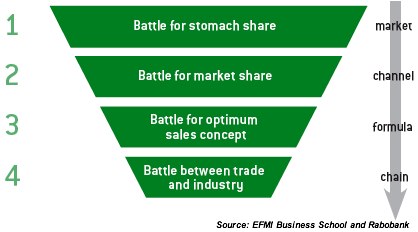
What the authors are seeing is that players from the bottom of the market (the discounters) are moving upwards, by broadening their assortment of goods, and players from the top of the market (luxury-stores) are moving downwards, by improving their prices. A number of underlying things are going on here: luxury-stores can become cheaper by improving the efficiency of their stores and sourcing cheaper brands. And discounters can increase their offering through their relationship with suppliers.
Following HBS-quote, from an article entitled "Finding success in the middle of the market", sheds some light how Tesco does it:
A company controls midfield by fielding a complete product line that includes backs and forwards. In its supermarkets, Tesco, the successful UK retailer, offers consumers three options—good, better and best—in most high turnover product categories. In addition, Tesco doesn't just sell groceries through one-size-fits-all supermarkets. Recognizing the need to shape as well as respond to an increasingly segmented market, Tesco reaches its consumers through at least seven different store formats, from convenient Tesco Express outlets at one end of the spectrum to full assortment hypermarkets at the other. But, within all its stores, Tesco implements the same merchandising principles: Better, Simpler, Cheaper.Can you guess who the loser is yet? Well, according to both the report and much data on the net, the losers are the new, innovative concepts, that may offer certain values to consumers on an ethical or health level, but are not able to reap the same advantages as more established players are.
That is also the answer why so many organic companies are being bought up by fmcg-companies. There's an interesting overview here; but if you want to follow one in real-time, check out this Inc. magazine blog run by Honest Tea, which has recently given away 40% of their company to Coca-Cola.
Of course that is only part of the answer. Consumers are not just focussed on price. And, while consumer-awareness of the global situation and their own health is clearly growing, that's not the whole answer either. People's lives are becoming ever more complex and convenience is a big selling point these days.
It's those companies that can combine a high level of consumer-responsiveness, together with assortment and price, that will capture the hearts of consumers. But I guess what is out, is the solo single-product-serving player in the market, purely focussed on softer advantages like "ethics," and forgetting that consumers still(!) have limited disposable income for their food-expenses, as well a limited time to engage in these activities.
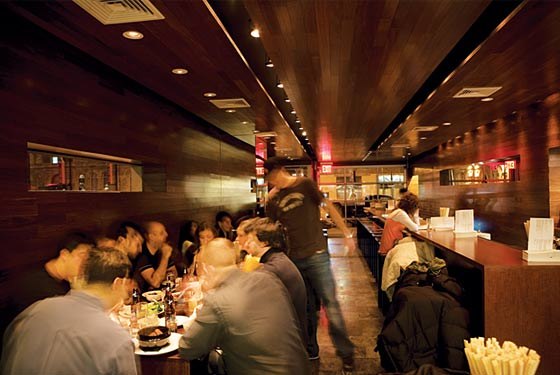 The reasons to love bookstore-cafés is that you get a chance to discover new stuff to read. The reason to hate my particular café is that, every week, even when I ask for a *normal* coffee, the waitress continues to regurgitate the same phrase: "will that be a large of a small?" Anyway…
I read a nice article in the New Yorker today, about a stressed out restaurant-entrepreneur called David Chang, who runs several noodle-bar-styled restaurants in New York City. The Yorker's articles are always so long, but it was a captivating article. I took some notes, which I'll share with you now.
- Waiters make way more money than chefs, simply because of the tips; the figure mentioned was $1700 per 32 hours vs. $350 that chefs make. Turning chefs into waiters, which seems like a logical decision in a noodle-bar, comes with the challenge that these types are not always that domesticated (can't help thinking about Chef! here).
- The front-end of a restaurant—servers(?), the set-up, beverages—is relatively simple (compared to the work that goes into cooking) and can be consolidated across multiple restaurants.
- Personal integrity in cooking—e.g. cutting fish-cakes properly, even though the customer won't notice them in a bowl of ramen—is the difference between a quality-restaurant and a McDonalds or Uno.
- Standards: A piece of chicken can taste wonderful to a customer, he won't know why, but it's actually because it's been prepared (marinated, dried, etc.) for more than 24 hours.
- Quote: "The great thing about fast-food is that you could sell out without worrying about it, because fast-food isn't pretentious and selling out is in the nature of the business."
- Quote: "Cooking is honest work; gives you a way to measure yourself."
The thing about restaurants is that I'm painfully ignorant about so many things going on in that world. Cuisine is like art—it's dynamic and filled with critics. For instance, there's the "foam" trend, mentioned in the article, hot in the 90s, but which I never heard off.
For me, I'm always interested to find out more about this industry, because I want to be part of something that produces culture. But I'm constantly thinking about whether it's wise to enter such an industry without a basic familiarity. It would be like me entering the tech-industry, without being aware of open-source, how to write code, or do project-management; it's just not done.
Food for (mostly, my own) thoughts.
 Just read an interview with Ford's ex-CEO Jacques Nasser on the training programs that were prevalent at that time (2000). He justified their need, by outlining the history of the car-industry between 1905 and now.
- 1905-1920s - colonisation of car-companies: smaller replicas of car-factories in the US were being built abroad. Hardly any competition.
- 1920s-1950s - nationalism: lots of countries were building their own national vehicles. Competition mostly on a regional level.
- 1960s-1980s - regionalism: the rise of trading-blocks (NAFTA, EU, etc.) and as a response the functional/regional division of companies.
- 1980+ - globalisation: global competitors, more markets, more divergence of consumers, more need for people/ideas/growth.
The situation at Ford
The result of the last period is that there are more Ford-people around the globe to manage, that more markets need to be served with different needs, and that the company that can generate economies of scale & scope, while being most consumer-orientated wins.
Two strategic priorities are at play here: consumers only see a part of the car, which means that the hidden qualities can be mass-produced; and consumers value those qualities most matched with their environment—e.g. in Brazil, so I read, roads are abysmal (if any Brazilian reads this, correct me), and good suspension is highly valued. In China, luxury models are mostly driven by chauffeurs, while the consumer sits in the back, hence he/she values luxury in that part of the car.
In this scenario, two types of qualities are valued with people: to understand the corporate qualities of Ford and make decisions that favour its mass-market strategies; and those that understand the local environment and can design car-offerings tailored to local needs.
Social operating mechanisms at Ford
Ford, at the time of the interview, had about 12 programs aimed at promoting these skills. The ones mentioned, included: Capstone, which is aimed at (24) executives; Executive partnering, aimed at (12) promising managers; Business leadership initiative, aimed at the whole organisation; and a weekly email-newsletter, called "Let's chat about business," also aimed at the whole organisation.
Methods + Aims were:
- Team-building - to get people to work more closely together / develop a corporate culture
- Teaching - to get people to understand the priorities at a corporate level, rather then just at a divisional/functional level
- Projects - to get people to come up with problems plaguing their organisations at that time and develop creative solutions to them.
- Shadowing - to develop leaders
Thoughts
Several thoughts going through my head at the moment. I am both uncertain how relevant this is to the SME-environment, and at the same time I do a lot of "social engineering" and can certainly think of a few cases in my past where a certain structure would have benefited the small teams I worked in. I'll probably write a third post about the SME-perspective at some point in the future.
My favourite way to picture "social engineering" however, is through designing processes that bring elements of the organisation together with customers and "raw-inputs" (new technologies, future employees, and partners, etc.). Maybe, I'll write about that at some point too.
Of course, I always appreciate the reader's perspective on this. Social programs at an SME-level, good for team-building or bad because it distracts from survival-priorities?
The picture is courtesy of articlescaravan.com
 Ran Charan, who I wrote about a few days ago, made another excellent contribution to my thinking (and hopefully yours), the concept of "social operating mechanisms." He defines them as mechanisms that synchronise individual contributors' efforts.
A step back
Individualism vs. collectivism represent two personality-types. There are the managers, who are integrators and bring both groups together and (are supposed to) identify with the greater purpose of the organisation: maximisation of profit, etc. And there are individual contributors, who through their own efforts bring forth new data and growth, etc. These types are not always suited for management, as they need that freedom to be creative.
Social operating mechanisms fit within the framework of execution, in the sense that that is one of the last stages in a multi-stage process. As the leader/problem-solver of an organisation, you start by identifying a problem; you come up with a set number of fundamental priorities to solve the problem; and you (design social operating mechanisms to) spread that solution throughout your organisation.
An example
Mr. Charan mentions a number of examples, but (for obvious reasons perhaps), I like the Wal-Mart one the best.
- In the early 90s, every Monday to Wednesday, ca. 30 regional managers visited 9 Wal-Mart stores and 6 competitor-ones, to check if Wal-Mart's strategy of offering lower prices than the competition was being implemented correctly.
- Every Thursday-morning, Sam Walton conducted a 4-hour session with a group of 50 people, including those regional managers, buyers, logistics- and advertising people to discuss the status quo, what was going right and wrong, and the future.
Making it relevant?
If this seems like a big-company problem, maybe so. But even on a smaller scale, you could see a similar process happening in the week of a franchise-owner, I discussed a few weeks ago.
As soon as an organisation grows beyond a few people, the barriers between your customers and the leadership of an organisation increase. The politics can be frustrating and are one of the main reasons why original founders leave. The Amazon-story, which I wrote about a while ago, and which also discusses of how Jeff Bezos, founder and CEO of Amazon tries to keep in touch with the core-principles of Amazon, is also an example of a social operating mechanism.
Naturally, today's reality is somewhat different from the time (2000) that the book was published. We have "the internet" now, which should make creating social mechanisms a much easier to solve. I say 'should' as opposed to 'will,' because it still requires the necessary cohesion, which many technological solutions (in my opinion) are still lacking.
It still comes down to designing people-processes which help you implement core-priorities, and having the tolerance for, let's call them, idiotic decisions that sometimes come from the type of group-think often prevalent in organisations.
The picture is courtesy of infed.org
 I'm currently reading "What the CEO wants you to know," by Ram Charan, and it's safe to say that it belongs in the top 10 business-books, I've ever read. It's only 140 pages short, but filled with advice that is extremely easy to digest, that I'll be sure to re-read it several times later on, and can warmly recommend to others too.
One chapter in the book struck me particularly, on coaching, as I consider it a vital skill in business-relationships. Although I think Mr. Charan paints a bit of a rosy picture, I consider it a good standard to aim for. Some quotes:
How would you feel if someone gave you positive feedback on the things you're doing well and specific suggestions for building your skills? Chances are you would feel that you had a personal coach, someone who wanted to hep you succeed. You would feel energized. I can tell you from experience that it works. You can do it for those who report to you, and in the process, you will expand your own capacity.The chapter also goes into a number of examples from real life.
…
Coaching is not a performance review. It's not about what someone did last year, and it's not about money. It's very personal. You're hitting the person between the eyes. You're helping him face his blind sides and learn to do things better. The feedback has to be honest and direct. No sugar coating.
…
Self-confident, secure leaders love to give true feedback because they know that growing people is their responsibility. By true feedback, I mean saying what they really think. Too often, people hesitate because they know they may be wrong, or that they feel reprisal. But chances are your instincts are correct, and they'll improve over time. I've seen numerous times that when you put experienced businesspeople around a table and they talk candidly about an individual, the judgements converge very quickly. It's not had to zero in on the most critical thing the person needs to improve.
Some people say this kind of coaching is a good idea, but their company doesn't have the ambiance for it. Still, you can start with three of four people who would be receptive for it.
Charan's book is all about understanding business principles and setting a limited number of fundamental priorities to improve a business. Coaching is a logical extension to that, as when you clearly communicate what the business priorities should be and how that individual can get there, that's essentially coaching (and makes your life considerably easier in the process).
The author also co-wrote a book called "Execution," which I haven't read, but based on this book, believe is a good choice if you need a more modern read. "What the CEO wants you to know," is from 2000, but I consider it timeless advice.
 I'm still "on a break," but stumbled across this interesting titbit from a book on warehousing-practices. If you don't like reading lists, too bad because it's interesting, but I've also summarised the key-points in the end.
China
- Low labour and land-cost, but high equipment costs, translate into large (e.g. 250,000 square feet), low warehouses like in the US, but often lacking even a forklift.
- Certain goods like consumer electronics, are of such high value, have a short life-cycle, and thus a lower inventory-cost, that expenditure in state-of-the-art technology is justified.
- Certain cost-saving practices, like removing the pallets from shipments in order to ship more goods, cause some inefficiencies other countries, like, eh, re-adding pallets.
East Asia
- A traditional focus on personal relationships and less on computational models, means there's a lack of data and opportunities for improving performance are not well-developed.
- The most active economic areas are separated by lots of water, which means lots of product conveyed by air (for high-value or time-sensitive products) or ship (for bulky items or commodities). The high costs associated with this, are incentives to consolidate freight.
- Therefore, more strong regional hubs, like in Hong-Kong and Singapore, are expected to emerge.
Europe
- High labour-costs and an inflexibility of the work force have lead European warehouses to be more advanced in terms of automation.
- A growing common market will also lead to more economies of scale in the future, leading to larger, centralised warehouses.
India
- Characterised by cheap labour and land-cost, but relatively expensive capital costs (machinery and the like) and an underdeveloped infrastructure (both physical & administrative).
- The markets being supplied are generally local and not very wealthy, which leads to the SKUs not being high cost and there being little incentive to increase efficiency through capital expenditure (IT).
- Global demand means that larger distribution centres are being built around large ports like Mumbai (Bombay). The lack of land there is leading to high prices, comparable to Singapore/Hong-Kong.
North America
- Characterised by a culture of mass-consumption and a uniformity of the market and distribution infrastructure, which translates into large centralised warehouses and accelerating rates of product flow.
- Warehouses are often situated in the countryside surrounding metropolitan areas, which is cheaper, while being well-connected.
- A good telecommunications-infrastructure enables better supply-chain co-ordination; Warehouse management systems are generally advanced, and the rich data leads to better tracking and performance.
- High labour-cost are off-set by using cheaper migration-workers
Singapore, Hong Kong, Japan
- Due to a lack of land and high labour-cost, warehouses tend to be built high.
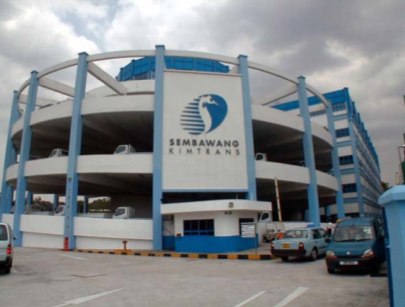
- Elevators are one bottleneck, caused by this style of building, however a Singapore warehouse has found a solution to this: A multi-floor facility with no automation or elevators, but, instead, a spiral truck ramp so that trailers may be docked at any floor (see pic). This does claim more land area, which must be recovered from above, and doesn't work well if trucks have to shuttle between multiple floors.
- While both Singapore and Hong-Kong act as hubs, Singapore is much more international, receiving goods from manufacturers all over Asia and shipping it to other countries; Hong-Kong receives mainly Chinese goods. Also, for the latter, many of the goods come in via trains and trucks, while leaving by ship or flight, while for Singapore it comes and leaves via sea and air.
South and Central America
- Labor costs are low, though not as low as in China, and the nature of its local economy and customers does not justify high equipment expenditure.
- The only exception is Mexico, which can quickly ship products to the US and keep its inventory low, thus justifying state-of-the-art technology.
Final thoughts
Some general conclusions can be drawn.
- Labour costs are a factor when considering automation; automation is a factor when considering optimisation; optimisation is a worthwhile expenditure when dealing with high value goods with a high velocity.
- Cheap land seems a fundamental advantage, looking at the logistical nightmares that Singapore and other high-rise builders must be experiencing.
- Access by land will significantly decrease the cost of transport. Generally, a well-developed infrastructure means more access to wealthy markets and enables warehouses to store high-value/high velocity goods, which is good for them.
The book 'WAREHOUSE & DISTRIBUTION SCIENCE,' which is available as a free download, provides some incredibly detailed info on how to effectively set up warehouses and distribution chains. Well worth a glimpse, if not more.
Should the platform for interacting with your customers be "open" both ways?
0 comments Posted by Unknown at 12:00 PMThese next few weeks, my posting-rhythm will slow down due to personal issues, sorry about that. It does however feed into this topic here.
Premise: A couple of things happened these last few days, which I think are noteworthy. The Zuckerberg-interview on SXSW got slaughtered by the twitter-crowd (though there's a human behind every trigger), and which is an example of a BAD interview. There's Steve Balmer, who came across as both human (sympathetic) and capable, an example of a GOOD interview. And there's John Battelle, who wrote two good posts on that every business is a media-business and every business should find a way to engage with its customers.
It's all about PR of course, and somehow some people got it into their head that social media—blogs, social networks, web-sms (my term for Twitter, Pounce, Jaiku,etc.)—is a good way to relate to the public. The problem, if I may call it that, is that these are two-way conversations between people that are essentially observers: users + media. And that, as the Zuckerberg-interview shows, when users + media get angry, they get ANGRY. Now, you could argue, bad publicity is still publicity, I just consider it disruptive.  Business, in my opinion, is two things: a machine that produces output, and engineers that seek to optimise the machine and increase its output. Arguably, user-feedback is useful for tweaking the machine to perform better, and optimally get more users to purchase its output. And outward PR (marketing) also means that more people are aware of your great machine and want the output. Ah, machine-analogies, gotta love them.
Just like the life-cycle-model of a product, which evolves from slow to strong growth, to maturity, and ultimately decline, our machine is very susceptible to tweaking at the early stages, can produce extra output, etc., but ultimately reaches a saturation-point. The same, I believe applies to user-feedback and marketing. The return on investment levels off after a while.
You have the PR, which is the interviews and other kinds of marketing, and there's the user-feedback, which should be restricted to the product-level. And, aside from the life-cycle-model, there is general a limit to the value of both. You don't want a mob disrupting your interviews, no matter how bad they go. You don't want a mob disrupting your business, period, unless you're developing something like a nuclear weapon.
What I'm essentially arguing against is that companies should be 100% social. They should be social enough in order to improve their products and let the people know about them. Should they engage in a two-way conversation? Only if it's directly product-related or your business is bad for the environment (arguably a government-issue), should you engage and customers should vote with their wallets. Note that I'm referring to business-PR here; individuals can blog about whatever they want, if you ask me.
There will always be the "backroom-talk," the social-media people who have opinions on anything, from using Plaxo-scripts to milk Facebook-data, to 17+ ways on how you should (not) run your start-up. And there will always be "Skynet"—the realm of the machines—which have to keep running because social media will not put that food on your table, the farmer will.
This somewhat-cynical article will NOT be mirror-posted on Tech IT Easy tomorrow
Cooking is ingredients!… it's timing!… it's cleanliness!… it's… … …restraint!
 These are just a few of the tips that Gareth Blackstock, chef at Le Chateaux Anglais, and lead character of the British comedy-series "Chef!," delivers to his staff in a kind and gentle manner… not. Even after re-watching this show 10+ years later, I'm still not sure whether Lenny Henry's portrayal of the angry chef is meant to be a realistic, or rather a satiric look at what goes on in these kitchens. The effect it's had on me, in any case, is one of silent terror when I think of kitchens in 2-star restaurants.
There's no denying that, generally, the world of HoReCa consists of flat hierarchies; there's the boss, either the head-manager and/or the head-chef, followed by some type of administrative class of underlings, and finally those that Gareth Blackstock likes to call
"There's the aristocracy, the upper class, the middle class, working class, dumb animals, waiters, creeping things, head lice, people who eat packet soup, then you.."
If you're thinking of high-tech start-ups in the IT-world, multi-star restaurants are their equivalent in the HoReCa-world. Competitive advantage in technology comes from both products that are differentiated enough from the competition and processes that enable a business to produce these products at a sufficiently low cost and high scale to reap a profit.
In restaurants, this is embodied by the chef, whose training, experience, personality, and, I guess, raw talent, inspire fear in all of those around him, especially the ones that feel his wrath. It is an innovation machine difficult to replicate, comes at a high price and is not for the faint of heart.
Everything else: coming up with a business-plan, talking to investors, setting up the site, buying the materials, hiring the people, getting customers to visit, etc.… seems easy, compared to finding, keeping, and managing a good chef. Because as soon as the chef finds out that he is the one that keeps the ball rolling, he is the vital cog in the machine, he will likely fire you as a boss and replace you with one of those people, generally found under head lice and packet soup.
So there you have it; I don't write about cuisine, same as people generally don't think about starting a business in space-flight. They are both sciences reserved for an elite pioneering-class, one that is fearless and willing to risk the laws of nature in order to succeed.

 The
The 


