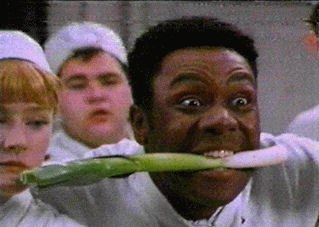
 I'm thinking about adding another "interlude" to my collection, inspired by ADD without a doubt. It's the cookerlude, baby, aimed at collecting thoughts and notes on cooking in order not to forget and to better understand the world that a cook goes through. While I cook nearly every day, I don't consider myself a good cook. I simply don't have the taste-buds for it; but I do love the good food, which, luckily, my gut no longer shows!
I recently discovered a podcast, called/by The Restaurant Guys, which, apart from the insanely long commercials, actually seems quite interesting and is funny enough to keep my attention. Some notes.
Salt: So, we seem to have this internal taste-meter for the stuff, which in some ways is tied to the percentage of salt in salt-water. At the same time, our saliva actually dilutes salt in food, reducing it, meaning there should be a higher percentage in food than salt-water, for us to enjoy it.
Sugar: apparently there's no set limit for that, people love sugar (I must be the exception).
Salt + Sugar: whenever you make a sugary desert, adding a little(!) salt helps the taste; apparently they do funny stuff to each-other in your mouth, a party in your mouth, so to speak.
Taste-enhancers: apart from the above, olive oil, mushrooms, garlic, tomato-paste, alcohol (and much more) enhances the taste in your mouth.
Pretty basic, no? You can listen to the whole episode on what (American) people like in their food, here.
My own world
(This is where I talk a little about what I discovered myself in regard to cooking. Pretty basic too, so I'll try not to embarrass myself.)
I'm a big fan of salads, I make and eat one nearly every day as a meal. I often use canned tuna, but I recently discovered salmon in a can, which tastes better, is less salty, healthier, and costs about the same here in the Netherlands.
But steamed salmon is the best. You can get an expensive steamer, but a cheap solution is a microwave-steamer. I found one in a Chinese store for about €10, you can steam whatever you want in 5-10 mins and it magnifies the taste. Add some green beans and carrots, and you got a great salad for a meal! Add some potatoes or rice, and you won't need the salad.
Last, but not least, sometimes, not always,Ketchup actually makes for an interesting dressing (together with some oil and spices). It often contains vinegar, which salads like, and the tomato mixes well with the salmon-taste.
That's about it for today, I'm not sure how often I'll repeat these cookerludes, but I hope you enjoyed it! The picture is of course of Chef!, the show.
 I took part in a "flirting in business" workshop last night, pretty fun and insightful. It tried to explain the fundamentals of communications to us—around 50 professionals, students, work-seeking-people, etc., both shy and outgoing, all with their own qualities and questions—and I took a lot home from it, including a book by the presenter.
So, apparently a "flirty" conversation has three main components:
- giving attention;
- showing curiosity;
- showing trust.
Several things, like conditioning, fear, and ego stand in the way of change, and the only way to get around it, is to acknowledge the feeling as it happens and know that you have a choice. Good to know! Apparently, a conditioned change—one that lasts—can happen quite quickly, you have to practice it around 15 separate times for it to become internalised.
A round of answers were given concerning what people pay attention to during a first meet, the infamous first impression: it ranged from dry hands (which you can't do anything about), tone of voice, general looks, and, most importantly, the smile, as that overcomes a lot.
It was also interesting to hear that only 7% of the message that we get from people is verbal, and the rest is sensory. That explains why I often don't listen and go on instinct, I guess… :)
Did I take anything big back from that meeting? Not really, except that it's really not that hard to sell yourself, as long as you have a certain awareness of what's going on in your head and what matters to other people.
 I've been planning to write about cinemas again for some time now, but that's going to be a long piece and will have to wait for disposable time and inspiration. Here's some films, I've enjoyed these last months, however.
- Starting with a lecture by Robert J. Sawyer, regarding the difference between Star Trek & Star Wars. I had no idea that the phrase "A long-long time ago, in a place far-far away" makes such a big difference. Essentially, while science fiction was originally a commentary on issues in our own society, that phrase gave George Lucas the license to not-comment, or rather to accept things like racism (towards robots), slavery (robots again), and countless of other stuff. Really a good lecture to listen to, if you're into sci-fi.
- On a related note, I recently (re-)watched Star Trek 1-6. You really notice the shift from slow cinematics in Star Trek 1 and 2 (a la Kubrik's 2001, which I'm not a fan of), followed by more intense action-scenes in the later ones. I think I recorded the social values more on a sub-conscious level. Numbers 4-6 were my favourite, regarding nature (transporting whales through time); the search for God; and retirement. But I have to say, Kirk was at his strongest in the first two movies. Also, something else I didn't know: Leonard Lemoy (Spock) is a multi-talented individual: writer for several films, producer, and of course actor.
- My favourite adventure movie these last few months: Lawrence of Arabia.
- My favourite cartoon: The girl that leapt through time.
- My favourite fantasy: Pan's Labyrinth (picture is my interpretation of Pan)
- A film, which is taking me a long time to watch, but which I will finish because it's good: Francis Ford Coppola's Youth without Youth.
- Excellent commercial, but not mainstream, movies: Into the Wild; There will be blood; No Country for Old Men (the last three, somewhat depressing too); and Juno.
- An excellent series that recently finished and everyone should watch: The Wire. Seasons 1-4 especially.
- An series with potential that will hopefully not be cancelled: The Sarah Connor Chronicles.
Witness the following. A bar that comes in various flavours: chocolate chip, dark "luxury" chocolate etc. Yumm! It's cheap, costs around $1.50 per bar in the local drugstore, currently. And it contains 32 grams of protein. The perfect post-workout snack, it seems.
The only problem? The body doesn't digest it well at all. There are times when it sits in my stomach like lead, and other times, when my body can't wait to get rid of it. Empirically tested, two out of two times, that is what happened to me. Just last night, I woke up at 3 a.m. with a stomach-ache because of that damn bar.
Are snacks doomed to be unhealthy?
Back when I was a vegetarian for a brief two years, the one thing I missed was to have a snack that did not contain either an overdose of sugar, of fat, or of bread. With the exception of perhaps a nut-bar, a fresh juice, or chewing gum, those are pretty much your choices, walking down a street:
- A chocolate-bar: high in fat & sugar
- A burger, sandwich, or a pizza-slice: high in fat, starch, and limited protein
- Fries or chips: high in starch and fat
- A carbonated drink: high in sugar (excl. the light versions) and extremely bad for your teeth
A new era?
Interestingly enough, due to external pressures, I hear that certain supermarkets are changing the layout of their stores, removing snacks and junk-items from the register, and replacing them with healthy options like fruit. Equally interesting, (forgot where I read this) they are expecting a multi-million euro loss because of that policy.
Certain tricks do seem to work in raising those profit-margins. While a kilo of regular apples currently costs around the €1.50/kilo mark, pre-peeling and -cutting those apples, raises that price to ca. €8/kilo. Ka-ching!
Cooking is ingredients!… it's timing!… it's cleanliness!… it's… … …restraint!
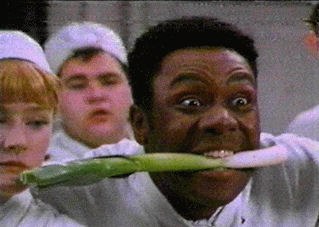 These are just a few of the tips that Gareth Blackstock, chef at Le Chateaux Anglais, and lead character of the British comedy-series "Chef!," delivers to his staff in a kind and gentle manner… not. Even after re-watching this show 10+ years later, I'm still not sure whether Lenny Henry's portrayal of the angry chef is meant to be a realistic, or rather a satiric look at what goes on in these kitchens. The effect it's had on me, in any case, is one of silent terror when I think of kitchens in 2-star restaurants.
There's no denying that, generally, the world of HoReCa consists of flat hierarchies; there's the boss, either the head-manager and/or the head-chef, followed by some type of administrative class of underlings, and finally those that Gareth Blackstock likes to call
"There's the aristocracy, the upper class, the middle class, working class, dumb animals, waiters, creeping things, head lice, people who eat packet soup, then you.."
If you're thinking of high-tech start-ups in the IT-world, multi-star restaurants are their equivalent in the HoReCa-world. Competitive advantage in technology comes from both products that are differentiated enough from the competition and processes that enable a business to produce these products at a sufficiently low cost and high scale to reap a profit.
In restaurants, this is embodied by the chef, whose training, experience, personality, and, I guess, raw talent, inspire fear in all of those around him, especially the ones that feel his wrath. It is an innovation machine difficult to replicate, comes at a high price and is not for the faint of heart.
Everything else: coming up with a business-plan, talking to investors, setting up the site, buying the materials, hiring the people, getting customers to visit, etc.… seems easy, compared to finding, keeping, and managing a good chef. Because as soon as the chef finds out that he is the one that keeps the ball rolling, he is the vital cog in the machine, he will likely fire you as a boss and replace you with one of those people, generally found under head lice and packet soup.
So there you have it; I don't write about cuisine, same as people generally don't think about starting a business in space-flight. They are both sciences reserved for an elite pioneering-class, one that is fearless and willing to risk the laws of nature in order to succeed.
5 links - sense of smell, false green ads, farming boom, Lego, fun e-shopping
0 comments Posted by Unknown at 10:49 AM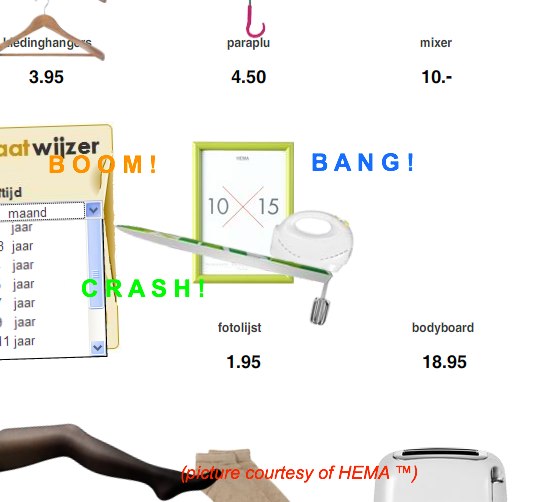 Time for those Sunday-links again. Today, I'll discuss the cocktail that is smell and how some things just don't mix; how green is not all it's cut out to be; a possible shift of power from retail to farming (or not); how lego came to be and where it is going; and how to sell me online shopping.
Previous link-discussions can be found here and my bookmarks here.
Link 1: Starbucks Admits Sensory Mistake - These are the kinds of stories that make me I like the NeuroscienceMarketing-blog. If you follow the science-section of the Economist, you'll know that neuroscience is a big deal anyway. In any case, this story is about how Starbucks designs atmosphere, largely influenced by smells. Apparently, smell of heating egg and cheese sandwiches doesn't mix well with the coffee aroma.
Link 2: False 'Green' Ads Draw Global Scrutiny - Two problems linked to green adverts these days, I think. One is that consumers are growing tired of it. And two is that, as this story shows, just because companies say they are, doesn't mean they are. I like the Norwegian approach to this. They ban green adverts by products that cause more problems, no matter how innovative they are (about hiding it).
Link 3: Farmers Wonder if Boom In Grain Prices Is a Bubble That food-prices are rising is an inescapable fact. But it also presents an interesting shift in the status quo. In the food-chain of the grocery-business, farmers are pretty much at the bottom. Now, even though their own costs are increasing also, they can charge more on top of it and decrease retailers' margins. Time will tell if this is something that will be acceptable for a long time. Certain signals very much suggest to me that farmers may be in the right position to cut out the middle-man and become retailers themselves.
Link 4: The Making of…a LEGO - I'm still a kid at heart, so I love anything to do with games and toys. My parents never bought me much lego as a child, which I regret as I hear it breeds geniuses. In essentially two pages, the article describes how lego came to be, what makes it so perfect, and what the company's strategy is. I was always impressed with the brand-extensions they did with the games, the robots, and the theme-park. A company to follow.
Link 5: Online shopping at Hema.nl - I've linked to this on twitter before, but it brought another smile to my face watching it again. Just when I think that online-shopping has no future, innovative uses of technology surprise me again.
Hot or Not commercials - Axe's "Chocolate Man" vs. Eristoff Black
0 comments Posted by Unknown at 6:53 PMNothing to do with HotorNot's 20 million sale, which I just heard about today, I'm afraid. No, I watched Juno in the cinema today (great flick!), and saw following two commercials: Axe's "Chocolate Man," which was great, vs. Eristoff Black, which was not.
What I like about this short film is that it does give you a similar feeling to what it's like to walk around with a good scent and feel good about yourself. It's so hard to portray smell on video, I can imagine, and chocolate's just a great vehicle for it. The cinema-crowd's reaction was great also, laughing throughout the film.
*************
Update: apparently this is part of a whole viral campaign by Axe. I just found the matching game: Maneater
*************
In contrast…
I don't know about you, but this film just made me feel nervous. It's a commercial for an alcoholic beverage, ok, but nothing in the film suggested anything positive about the experience of drinking it. Instead you have this paranoid image of someone being locked in a glass sphere, pursued by bloodthirsty animals. Even the scene at the end, where it's a guy who apparently hit a shopping-window, is not reassuring, rather it confirms that this is a drink to be treated with caution. The cinema-crowd was totally not into this commercial either.
That's all from me this weekend. Have a nice one!
My relationship with story-telling - a short autobiography part I
0 comments Posted by Unknown at 1:45 PMI'm in a philosophical mood today, after having spend an hour this morning sorting through the rough drafts for this blog (estimated at around 150), which I categorised as "idea," "rough notes," "feature complete," and "send it already." There were so many of them that I found myself a little overwhelmed to address a single one, a little afraid to miss seeing the forest through the trees, and instead decided to write about a core-principle in my life: story-telling.
I'm very attracted to the concept of telling stories. It's perhaps a little difficult to explain, but certainly related to the reason why I write so much, and also integral to what I want to do with my life.
When I grew up, I was reading all the time. From the back of cereal boxes, to encyclopaedias, to even the bible (which I thought was a great fantasy book). As a kid, I also remember building up cities in my room and garden, made out of toy-parts and characters, and constructing visual stories around what was happening.
I did not watch TV until I was 10, but, around that time, I fell in love with fantasy and sci-fi stories, both in book-form and on TV. I liked the way the story was constructed, and loved to imagine myself being there. I remember having magnificent visions of what I imagined the future of society, cities, and the home to look like.
Around 17, I decided to hold my first teen-party (the last one before that was probably around the ages 8-9). At that time, I was playing around in a band and very much into music-culture. I remember coming up with the party idea, which was essentially a visualisation of a club. It was lucky timing. We were just about to move and I had a huge house to my disposal.
The way I visualised it was to have rock-bands playing live in the living-room, a techno-room with a (borrowed, I think) strobe-light in the basement, and some other theme-related room elsewhere. Important were of course drinks and drugs, as, hey, I was 17. And equally important was the concept of complete freedom, which I think was communicated quite clearly.
A large inspiration was this video by the Prodigy - No Good (start the dance):
The end-result was great: around 50 people showed up, 2-3 bands were playing, and people did some crazy stuff, without getting me in trouble. In the end, I was still the one responsible, and took that seriously, but essentially everyone could do what they wanted. I repeated a similar party a few months later, which revolved around the same principles, with some restrictions, though around twice the amount of people.
That's where I'll end this. Lot's of stuff happened since then and will continue to happen, and I hope to write a second part in maybe 5-10 years from now (maybe sooner) about all the adventures I'll hopefully have, and evolutionary leaps I'll hopefully make.
Core to everything, I think, is vision and freedom. When you create a story, you have a vision of the components and the way they fit together into a dynamic process. At the same time, a story-teller must realise that his/her story is just the start for the listener/viewer/experiencer. It's a synergetic interaction between creator and beholder and the end-result can be both unpredictable and quite beautiful sometimes, a risk that, to me, is entirely worth it.
P.S. Happy Valentines day!
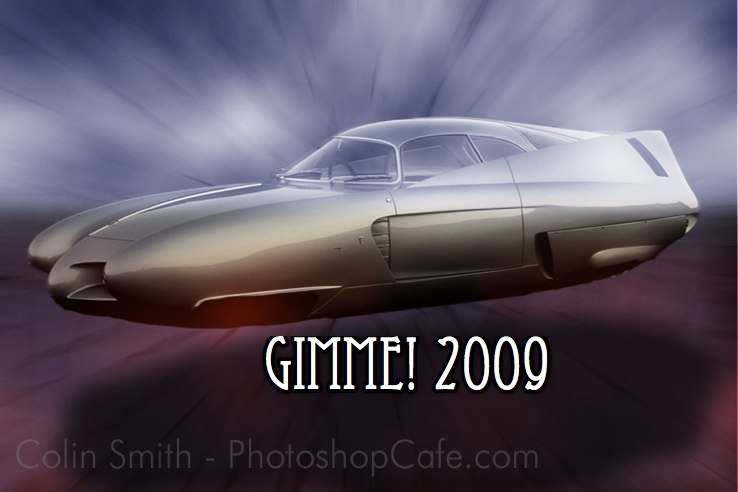
- Cordless earplugs that are also headphones - imagine going to bed and blocking out your partner's snoring, and waking up to the sweet sounds of […insert your sweet sound here…].
- Fluorescent permanent marker - to convert my non-pro Apple laptop-keyboard, into one that lights up in the dark.
- A binder/folder that allows me to bind printed web-articles into an easy to read non-webzine.
- A mobile (!) pad that allows me to draw on paper, which stores these drawings electronically, and allows me to later transfer them to my computer - saw this somewhere for €80, always regret not buying it.
- Some kickin' clothes.
- For my Laptop and iPod to last me through their 3rd year.
- Anything on my wish-list.
For 2OO9
- An Apple laptop that is as light and as thin as possible - So no disk-drive as that can be external. 3-4 USB-ports to compensate would be nice.
- The next OS (10.6 or 11.0) from Apple.
- An iPod with a nice screen and no phone - for music, video, books on the road.
- A small car (unless I live in a big city, then a good rent-a-car service).
- Orexin A.
- More public wifi / or a pan-European service.
- A Wii / DS and time to play it.
- Some kickin' clothes.
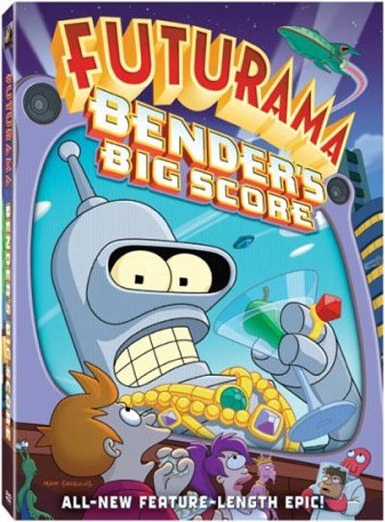 Just a collection of films I enjoyed in 2007.
Eastern Promises - a tale of chasing dreams in cold, criminal London, of finding decency in filth. ★★★☆☆
American Gangster - a tale of value chain analysis and strategy, of pursuing the American dream, a dream that is different for everyone. A great soundtrack also. ★★★★☆
Knocked up - a tale of random accidents that lead to dramatic lifestyle changes, of growing up. A worthy successor to 40 year old virgin. ★★★★☆
Ratatouille - a tale of overcoming any challenge to pursue a dream. Inspired this blogpost a few months ago. ★★★★☆
Bender's Big Score - a tale that binds the whole series together. I was first sceptical but the ending made it all ok. One of the best "episodes" of the series ever. ★★★☆☆
Disturbia - a tale that has been remade over and over again. While I'm getting tired of Mr. LaBeouf, I have to admit that this is the best remake yet. ★★★☆☆
Little Children - a quiet tale of adults being children and children being adults. ★★★☆☆
The Prestige - a tale of pride and a complete disregard for the worthiness of love and people. Great, yet dark, and a hard to watch movie. Can't wait for Batman 2. ★★★☆☆
Freedom Writers - a tale of finding that inner spark in people, one of my most favourite activities in life. I also have a thing for Ms. Swank. Still a story-line that has been remade over and over. ★★★☆☆
Biggest disappointments for 2007
Spider-man - too crowded
1408 - unbalanced
Sunshine - copy of Event Horizon
Zodiac - 30 year long snore-fest
Hot Fuzz - oh, where for art thou, Shaun of the Dead?
 I'm not a big lover of self-help books. My favourite quote of all times regarding this topic is from a movie called "School for Scoundrels," and goes something like this:
"How can you help yourself, when your self sucks?"Indeed.
My attitude towards "The War of Art" is not much different. I actually bought it as a gift for an artist that I know, realising shortly after that giving a book on creativity to an artist is about as useful as giving a book on parenting to an grandmother… or something to that effect.
So I started reading it myself. I call this a "mid-book-review," because I don't like reviewing whole books, rather I prefer writing what comes up from however many pages I read. Also, the first half of The War of Art is quite monotonous and, I would say, masochistic to read.
The first 70 or so pages are all about the barriers or resistance we encounter before we create. Essentially nearly every page describes another type of resistance: drugs, jealous people, procrastination, etc. If I were to read this book for myself, I would feel more and more beads of guilty sweat streaming down my back. My god, how badly I've been treating myself over these years trying to produce a thesis.
There must be some pedagogical law that guilt is not the best teacher. But ok… after reading about ca. 30 guilt-inducing types of resistance, I skipped this part and went straight to the good stuff. How to be a professional artist.
Now, I haven't read much—this is a mid-book review after all—but I think the gist of being a professional is discipline. Getting up early, going to your office (wherever that may be), and producing. But that's not all.
My artist-aquaintance is actually a tremendous producer. She produces paintings like a factory. But she does not get paid. And that I think is the other side of being a professional artist—the paycheque.
From what I can see, The War of Art is meant well. It's meant as a kick in the ass. But, just like all self-help books, it does not actually do the kicking, rather it's you that's meant to kick yourself… easier for some than others.
What is needed then is a framework, a recipe that people can follow to indeed transform into the professional artists they are meant to be. I have not yet found anything resembling that in this book. Instead, just like, I guess, the book, whose title it was inspired by, The Art of War, it is a collection of advice and up to the reader to follow and consult it again and again over the years. When the productivity is falling… what is that resistance? Ah yes, time to kick my ass again.
But I still have to finish the book before I can give a final judgement. If, incidentally, this final judgement is not printed on my blog, then you know how much, or rather, how little there was to say about the final 70, or so, pages…
Some eternal truths, I've learned myself, from producing what seem like countless pages for my thesis, include:
- After a while you enter the zone. It takes around 30 mins to 1 hour then your set to go. I can work for hours on end after that.
- The more your practice, the easier it is to enter a zone. Ever since I started blogging, I've essentially been writing creatively for several hours a day. And I can produce a piece of text fairly quickly, and get into the zone after a few mins already. And I notice the same when you draw on a daily basis or do whatever art you want to do. It all eventually gets easier, and that's why a daily discipline is important.
- Balance is vital. Nothing sucks as much as working your ass off, not quite finishing what you planned (perfectionist), and the only reward there is is the lonely tv, the only thing still "awake" in the middle of the night. Instead, people and experiences are the reward. These experiences also recharge you way more than a workaholic lifestyle ever could. Breaks are, as paradoxical as it may seem, vital to becoming a true workaholic—one who gets intoxicated by his work, sometimes referred to as loving his work.
- Little triggers matter. The greatest trigger ever? Feedback. Packaging your work into little chunks which people can evaluate really helps here. And getting feedback really forces you to create better work.
- It's all about the paycheque. You could say this doesn't apply to a thesis, but it does. A thesis is a piece of work that will be a reference for future job-applications for a long time. It will also help in managing future creative projects that do pay. So it really helps to factor that into the schedule: you are producing, not for the art itself, but because you want to achieve something. What that is is up to you and varies from project to project, but ultimately financial reward—direct or indirect—is a great motivator, not to mention fuel for the engine allowing for the creation of more things.
For now, my recommendation is: if you want to create, just do it. Don't waste time, build up a daily discipline, reward the little successes, get lots of feedback along the way, and always remember to get paid. And if you want to learn, then learning from doing is usually a better choice than learning about learning.
Metaphor: I am the bunny or rather my thesis is. Everything is progressing well, but of course it's a lot of work. More when I'm done.
(via Kottke)
5 links to let people know I'm not dead:
- How to choose a name for your product / service / business by Scott Trimble - not much to say about it, except it rocks.
- The 8 challenges innovations face by Scott Berkun - there's so much talk about how cool innovation is (flying cars, anyone?), and very little about how hard it is to actually bring it to the market. Exactly the topic of my thesis, btw., mostly focussed on Scott's point 3: "Find a sponsor and funding".
- The 2007 Esquire 100 has some awesome food-related stuff. Namely on Luxardo, Sechuan buttons, New Texas Cuisine, Rum, shrinking cocktails, The Best Breakfast in America (mmmh looks good!), Washington Wine, and other cool stuff.
- Understanding Web Design by Jeffrey Zeldman - "Web design is the creation of digital environments that facilitate and encourage human activity; reflect or adapt to individual voices and content; and change gracefully over time while always retaining their identity." Kind of applies to designing other kinds of interactive environments as well (don't shoot me Jeff).
- Wal-Mart’s Environmental Report Card (NYTimes) - the point is that Walmart is continuously increasing its competitive advantage in the area of green tech, which is sure to affect businesses bottom-line in the future. So get busy!
Christine Huang, at the "Trends & Innovation agency", PSFK, points us to a commercial film, shot by Unilever's Axe and featuring David Spade. The subject is… I would guess, food presented in a dirty and sexy package.
Just like Christine, I'm not sure I get it. I don't think it's aimed at European audiences either. But, all in all, definitely an interesting 5 minutes of your life.
The only question I have: So are you guys gonna take a shower now or what?
Incidentally, if this is the first post of mine you're seeing today, also check out my post on Amazon's Jeff Bezos just below.
After my little over-academic look at the cost of real-estate this morning, I thought it would be nice to lighten the mood a little. Check out the video where:
"The New Frontier casino-hotel was imploded early Tuesday, giving a violent end to the second property to open on the Las Vegas Strip. This, to make way for a multibillion-dollar resort bearing The Plaza brand, set to open in 2011."(via Missethoreca.nl)
On a related, but perhaps more aesthetic, note, you might want to check out New York Magazine collection of vintage videos on architecture, ranging from the Brooklyn Bridge in 1899 to the construction of the World Trade Center in 1966-73 (via Kottke).
5 links to think - on Japan, designing experiences, globalisation, and endorsements
0 comments Posted by Unknown at 3:12 PM Really no shortage of interesting links this week, which is always nice. At the same time, it makes choosing 5 that much harder, but here goes.
- An Alien in Japan: Charlie Stross describes his trip to Japan last summer. …From Yokohama to Tokyo to Kyoto; …about shaved cats, getting lost in shopping malls, to Hello Kitty, and extreme bathing, to monorails and re-building history. A very interesting read, which presents some insights into that alien world, Japan.
- Blasting scents into coffee-consumers' brains: Roger Dooley explains the importance of environment to sensory experience, and describes how Nestle's Nespresso found their way into people's noses, brains, and hearts. In coffee, just as with good food and wine, scent is everything! Food for thought.
- Can experience be designed? After reading Bob Jacobson's essay, I'm not so sure. He writes about placing human experience into the centre of the design process, about systemic relationship between information and the environments (see above link as an example), about the difference between user- and human experience design, and how you can probably never design an experience to completely meet a person's expectations. At least, I think that's what he writes. So much of this text is far above my head, but worth reading to guide your mind into new directions, and a must-read for anyone interested in creating experiences. It's all a pre-cursor to a book, which, judging by the range of material, I expect to be published in 2 to 5 years, but which will be well-worth the wait. In the meantime, check out Bob's great blog.
- The downside of franchising: Richard Layman, in his artsy urban blog, writes about how franchises have transformed L.A.… into a clone of just about any other city. A little anecdote: I observed a similar trend when I was last in Belgrade, Serbia, which I hadn't visited since the war. It looks just the same as any other city, and that's sad because I remember there being a lot more authentic clothing- and food-venues. When I see this, I'm not sure I'm a fan of globalisation, or franchising for that matter.
- A twosie on Human brand-carriers (Sounds like a disease, doesn't it?): Two articles discuss this, one, by the NY-Times, on rock-stars and their interaction with brands. As one artist put it: "The barriers are changing and we as artists are making less and less money, and we have to get creative." At the same time, I have great sympathy for artists like Springsteen, Tool, and N.I.N., who refuse to corrupt their art. And another article, by HBR, on endorsements in sports, which is, at last count, a 100 billion dollar industry. I'm fascinated by this phenomenon, so maybe I'll write something about it in the future.
 Note: I decided to rework the first paragraph a little.
How do you notice what you are? I think you notice by doing stuff and measuring your own level of uncomfortableness. Mediators are used to finding the middle-ground, and will feel uncomfortable having to choose sides that make other sides unhappy. Pushers want to do and feel uncomfortable sitting still. And the real-keepers feel uncomfortable in the unreal setting.
Society is a bunch of people, who all fit in different camps and really want other people to be more like them. But what they often don't realise is that if everyone was the same, we would all be making the same mistakes. There would be no growth. Society needs arguments, wars, the occasional explosion, because it shows truth (can you tell my star-sign is Aries - god of war?). After which things need to get done to fix what happened and we finally need to head in the right direction.
The reason I write this, as unrelated to this blog as it may seem, is because every single project will suffer from people-problems. There will be majority and minority groups, there will be a vision that may not match all these groups. There will be a reality that may not match that vision. And there needs to be a middle-ground so that the people and the organisation can continue to function, while growing at the positive rate that it should.
What this means, in a managerial context, is that teams should consist of vital counter-figures, to create a cocktail of vision, execution, reality, and diplomacy. And the best way is to choose people who do what they do best. Not people who bend at every breeze (though during storms, it can be wise to bend), but people who put up a good fight for what they believe in.
OK, my philosophical point, which was inspired by countless hours of sleep-deprivation, is now over. Tomorrow, I'll get back to business as usual. The picture is of course of the movie "War and Peace," based on the equally-titled book by Tolstoy, recently released in a new and better translation .
 Here's an idea on how to market an entirely new concept coming to a town near you. Let's say you rented a store-space in a shopping-street and you have to make modifications. Normally this would be dead time where you would just be spending money on construction.
Reserve a space of about 1-2 metres (3-5 feet) depth behind the shop-window. Make it so that people can't look at all the construction going on behind it, and have a little curtain that you can hang in front of it.
And everyday that you are building, create a different display. One day, you could display a series of pies, another, you could display some bridal dresses. Etc. etc. One day, you could even put some people there, having coffee and reading a book. All the while, keeping the passer-bys guessing at what this new store is about.
What this accomplishes is simple. In our transparent little world, what people love most, is things that stand out and things that are mysterious. And your ever-changing display will keep them wondering during the time where you really can't do much in the way of enchanting customers.
Another thing that you could do is actually use these displays to advertise shops in your street. "Buy pies at neighbour Joe's bakery!" "Get your coffee at Jane's delicious coffee-shop!" Not only does this increase your clout with your neighbours, it may make you some money, and more traffic to them automatically means more traffic to you too!
Of course, one of the dangers is that you're building your momentum up way high and like a pendulum, if you don't prepare for the automatically high expectations that follow, it might swing out of control. So you better end up delivering a nice end-product when your store actually opens!
The picture is courtesy of marwantaher.com
Watching this as I drink my Pepsi Max. Thanks Fred Brunel!

 The


