 This is going to be a nice and short one. April 2008 can be characterised by three types of posts: general business, food and retail (yay!), and interludes-after-interludes (the latter is just a naturaly consequence of time/creativity-problems, sorry). Previous monthly wrap-ups can be found here.
Let's get started!
General business
I think I started with people-businesses, a topic I find interesting and will likely write more about in the future. Essentially, a people business is one whose value is mostly made up of people, which, I believe, includes most start-ups, but excludes businesses like McDonalds, which has a lot of capital costs. There are a number of challenges related to such businesses, such as measuring/increasing productivity, and finding business models that are compatible.
The next (micro-)topic I discussed, was bootstrapping, which I thought depends on three abilities: low cost-living (duh), time-management skills, and a strong goal-orientation (lots of distractions on the way to enlightenment).
Another micro-topic was on taking a detached view towards business. A lot of business-people and entrepreneurs, serial ones mostly, talk about seeing their business as just another business, rather then a passion, executing the right levers to make it succeed and eventually focussing on the next challenges. You have to be strongly motivated by something though, and I guess, following Ram Charan's logic, the passion is for business itself, which can be an exciting and all-consuming activity. Well, that wasn't exactly what I wrote, but is what I was thinking! ;)
Finally, for general business, I linked to three interesting stories, which I quoted here, but which illustrated the importance of the team, the "test," which shows the level of understanding a leader must have about his business, and the "rule," which is that every action has some sort of reaction elsewhere.
Food & Retail
Let's start with the challenges facing the food-industry, which are currently related to economics and the environment. Economics-wise, everyone is seeing high food-prices due to events going on around the world, including a shortage of oil and an increased demand for farming-goods from India and China. Eventually, an equilibrium will happen, either the demand will subside as production happens locally (unlikely in the short-term), or production will increase. Considering I just heard that dairy prices are falling, I'm betting on the latter. For environmental-costs, we are mainly speaking about the cost of transportation. Food is a very global business, which seems to come at a high price to the environment. No solution is in sight for that yet, I don't believe living locally is as yet sustainable, though there are plenty of proponents for that way of living.
A second topic, I looked at, was beer and the way pubs are funded in the Netherlands, which is often through exclusivity-contracts with breweries. It's an interesting situation, as breweries have been facing the problem of commoditisation for that reason; people order "a beer" instead of a Heineken or a Grolsch (mmh, Grolsch). It seems to be good for the horeca-industry as it suffers from high failure-rates, but at the same time, other countries, like the UK, seem to manage without exclusivity-contracts, at least as far as I know. Requires further research.
A retail-topic was about the differences between Spanish Zara & Swedish H&M, both fashion-businesses, with a different business-structure, but otherwise fairly compatible in attitude, I think. Both have a strong design-branch, focus on cheap, high-quality fashion, and have an extremely high IT-focus, which helps them manage logistics and merchandising at an elevated level. The differences arise with Zara being very vertically integrated, owning producers, supplier, and retailers, most likely because Spain is such a low-wage country traditionally. H&M is not so integrated, probably because of Sweden being such a high-wage country. And while H&M is very strong in terms of marketing, Zara does virtually none of it, but draws high repeat-visits from its customers, due to constantly releasing new fashion-lines (3-5 x more then comparable businesses).
Some lists then, Coke Zero no. 1 in the Netherlands, and incidentally the first food-related topic I wrote about, I think. And a list of the top-horeca-businesses in the Netherlands, mostly hotels, but also some retailers, like Hema, which I like as a business.
Interludes
A lot of interludes this month, as it's my way of recharging creative energy. These posts can be divided into ones posted here, and others posted on Tech IT Easy. Let's start with the first.
The flirt was about some of the variables involving flirting, which I consider useful information, but probably not food 'n' retail. The cookerlude was my attempt to do a regular posting on cooking, but I'm still not sure whether I'll go that direction.
On Tech IT Easy, I wrote a couple of interesting posts last month. Two on blogging, why it isn't for everyone and what competitive advantage means for some. One on copyright, which is a topic I'm pretty interested in and which Fidji Simo continued with her usual insights. And the latest on technology-incubators, which relates to research done for my thesis.
That's about it! Happy to close the door to the last month and already busy thinking about the next one!
 This wrap-up covers material up to April 6th, 2008. I will dedicate another one to this month and then hopefully go back to a monthly schedule. Looking backwards is hard, but I find it useful…
Normally this would be a monthly wrap-up, except I postponed it by quite some time. In this post, I try to look back in order to see how far I've come and bring a general set of themes to what I've covered so far.
Tag: The internet
I spent a considerable amount of time writing about the internet, somewhat influenced by my thesis and that I've been blogging for longer on Tech IT Easy.
One thing I looked at extensively was social networking, because, hey, that's the age we're in. I looked at lifestyle-brands, which require a more contextual approach, and how the internet can act as a platform for business to communicate with customers more richly and bi-directionally. A related topic—social network as competitive advantage—was published on Tech IT Easy. At the same time, I don't completely embrace social networking like Facebook, which I'm bearish on and have, to a degree, sadly been proven right.
I also looked at the role of the internet in terms of physical retail, for which a company, called NearbyNow, is offering an interesting service to both retailers and consumers; they allow consumers to browse and reserve goods through the internet or their mobiles, and give more exposure to retailers. At the same time, my outlook for the physical retail of media is bleak, and I expect all of it to go via the internet soon.
Tags: Logistics & green tech
In terms of logistics, I looked at different methodologies of storing and transporting goods across the globe. Very interesting how each continent/country is getting around its disadvantages (e.g. high labour costs in Europe) and compensating with other factor (e.g. more technology in European warehouses = less labour dependancy).
Also green tech is another "trend," well, I expect it to stay around for quite some time. I outlined five reasons why I think business are and should be going green. The mirror-post on Tech IT Easy spawned some interesting discussions.
Tag: Business strategy
Of course, business strategy is somehow involved in all business-topics, nevertheless I did look at a number of issues specifically. One was on entry-strategies into difficult markets, which is something I can't really describe in a few words, but requires speed, stealth, and brains.
I also commented on new business developments in a number of retail-outlets, and how it is only those that are synergetic with a company's core-focus, and can reap advantages like scale & scope, that end up being worth the effort.
Not to forget, I wrote about IKEA again, first, in note-form, talking about the international moves that the company made and why; and second, a summary of the lessons that I learned from IKEA.
Finally, I looked at the social element, human resources, and how companies use coaching and social operating mechanisms to scale their strategy and passion across the organisation. Ford, again, makes an interesting case study for that.
Tag: Entrepreneurship
As always, and somewhat difficult to separate from the above. I looked at the interdependent components of strategy, and financial, organisational, and product-market strategies are really part of a greater whole, when writing your business-plan.
I also looked at some statistics in franchising, and the lower failure rates are one reason to consider it a worthwhile entry-point into the industry. Still, it's not risk-free; There's clearly a lot of work to do beforehand, in terms of choosing the right franchise with growth-potential, financial risk to fund your business, market-risk, when you launch, and competitive risk, after your up and running. Some of this should be overcome with the help of a franchiser, however. Related to this, I posted an overview of the week of a franchise-owner, which was quite diverse and exciting, as well as a look into the drugstore-industry in the Netherlands.
On a softer level, I believe that entrepreneurship is ultimately an exercise in focus, which goes so much easier when you love what you do, but also an exercise in believing in the impossible, even when "facts" may prove you wrong. Micheal Masterson also had some good tips for starting & running companies, more from an investor's perspective.
Tags: Branding & marketing
Again, I already linked to some related post under the internet-heading; I believe that social networking is a big deal in that area these days. Related to this is also the concept of referential marketing value, as opposed to direct marketing value, which wrote about a little here. Clearly this is a dimension that is fairly complex but which the figures show should not be ignored.
I also criticised cinemas' moves into the luxury-segment as faulty branding, because luxury isn't a big differentiating factor during the movie-viewing experience; technology and timing is.
Tags: Food and retail
I could've probably placed these in any of the above categories, but this is after all the food and retail blog. I still take a dual approach here, looking at food-retail through retailers, and then through actual food-venues, like restaurants. There is a difference, but I'm not sure whether I want to or should discriminate between them.
In terms of supermarkets, I discussed a number of worrying trends going on in that world, namely there's less consumer-spending on food and supermarkets are forced to respond by consolidating and pushing efficiency up on the agenda. But I also find the presence of supermarkets like Marqt encouraging and hope they do well.
Also, I recently summarised some points I got from a book on Ahold. It's an interesting company to follow as it's been around for about a century, and has survived several similar challenges, we are facing today (high fuel-prices, recession, etc.)
I also discussed snack-food, which I find particularly flawed in terms of health and which could use an influx of alternative, yet good-tasting snacks.
And I looked at restaurants, which I find scary, but I remain open to. Starbucks level of vertical integration is also a little worrying. It's a like a beast that, as soon as it had to retrench from the market, it eats up more companies from the supply-side, in order to gain a competitive edge over other coffee-retailers. There's just something that worries me about this move.
Finally, I took notes from a very interesting lecture by John Schneeberger, who offered some interesting insights into the world of vegetarianism, organics, and local produce.
Other
Other topics that I didn't mention here, include my links (where I try to link to interesting stories) and my interludes (where I try to write about more fun and personal stuff).
Thoughts (written at the beginning of April!)
There's two challenges ahead, as far as my blogging goes. Topic-wise, I'm fairly open to both big-company and small-company problems, which may be too broad. I also perhaps don't focus enough on food & retail in particular, though that's because I'm a generalist and am still deciding on my passions.
Presentation-wise, I've been analysing some other people's blogs, e.g. TechCrunch's & Jeremy Fain's early days, to see what these guys did different. TechCrunch used a very mechanical approach, the same template for discussing companies, no colourful language, and a regular pattern of several posts a day. Jeremy also blogged a lot and brought information to the table that he himself came up with or that he got from discussions with people.
I do too little of that, because I don't make enough time for it and am more introverted in my approach. I can't really say whether my approach will change from now on, but I'll try to bring more of my personal experiences into posts. Those appear to get a better response (still working on that).
 Dear reader,
If you've been following my blog, which is kind of you, you may have noticed both a drop-off in posts, and, more importantly, a drop-off in relevancy.
To put it bluntly: I'm bored of the topic! I've been researching this industry to the extent that everything seems similar, rising food prices, fmcg-marketing strategies, the "organic" differentiator, etc. etc., it all feels like I've seen it before, and I'm struggling to come up with new and interesting topics.
In addition to this, and this is entirely my fault, I'm stuck with a project that doesn't want to finish itself, my thesis that refuses to get published, or rather that I refuse to be published. The effect is that I'm sitting behind a PC… a lot… and not experiencing/talking with insiders/etc. enough to get fresh perspectives on the field of "third places" and feel productive in that setting.
I'm not going to abandon this blog; no, very likely I'll continue to publish several posts per week. However, some, if not all, will not exactly be on topic; they will likely be discussing things going through my mind, on business, on art, on technology, etc. and hopefully on sounds + food 'n' retail as well.
Until I dig myself out of this valley, and I will, I hope you'll be patient and not hold my lack of focus against me. I still aim to be a producer of excellence in mine and your world.
Sincerely,
Vincent van Wylick
Main honcho @ foodandretail.blogspot.com
 Read it on Tech IT Easy!
 Read it on Tech IT Easy!
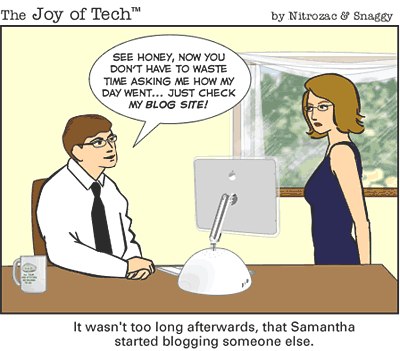
Should the platform for interacting with your customers be "open" both ways?
0 comments Posted by Unknown at 12:00 PMThese next few weeks, my posting-rhythm will slow down due to personal issues, sorry about that. It does however feed into this topic here.
Premise: A couple of things happened these last few days, which I think are noteworthy. The Zuckerberg-interview on SXSW got slaughtered by the twitter-crowd (though there's a human behind every trigger), and which is an example of a BAD interview. There's Steve Balmer, who came across as both human (sympathetic) and capable, an example of a GOOD interview. And there's John Battelle, who wrote two good posts on that every business is a media-business and every business should find a way to engage with its customers.
It's all about PR of course, and somehow some people got it into their head that social media—blogs, social networks, web-sms (my term for Twitter, Pounce, Jaiku,etc.)—is a good way to relate to the public. The problem, if I may call it that, is that these are two-way conversations between people that are essentially observers: users + media. And that, as the Zuckerberg-interview shows, when users + media get angry, they get ANGRY. Now, you could argue, bad publicity is still publicity, I just consider it disruptive.  Business, in my opinion, is two things: a machine that produces output, and engineers that seek to optimise the machine and increase its output. Arguably, user-feedback is useful for tweaking the machine to perform better, and optimally get more users to purchase its output. And outward PR (marketing) also means that more people are aware of your great machine and want the output. Ah, machine-analogies, gotta love them.
Just like the life-cycle-model of a product, which evolves from slow to strong growth, to maturity, and ultimately decline, our machine is very susceptible to tweaking at the early stages, can produce extra output, etc., but ultimately reaches a saturation-point. The same, I believe applies to user-feedback and marketing. The return on investment levels off after a while.
You have the PR, which is the interviews and other kinds of marketing, and there's the user-feedback, which should be restricted to the product-level. And, aside from the life-cycle-model, there is general a limit to the value of both. You don't want a mob disrupting your interviews, no matter how bad they go. You don't want a mob disrupting your business, period, unless you're developing something like a nuclear weapon.
What I'm essentially arguing against is that companies should be 100% social. They should be social enough in order to improve their products and let the people know about them. Should they engage in a two-way conversation? Only if it's directly product-related or your business is bad for the environment (arguably a government-issue), should you engage and customers should vote with their wallets. Note that I'm referring to business-PR here; individuals can blog about whatever they want, if you ask me.
There will always be the "backroom-talk," the social-media people who have opinions on anything, from using Plaxo-scripts to milk Facebook-data, to 17+ ways on how you should (not) run your start-up. And there will always be "Skynet"—the realm of the machines—which have to keep running because social media will not put that food on your table, the farmer will.
This somewhat-cynical article will NOT be mirror-posted on Tech IT Easy tomorrow
Dear readers,
I'll be taking a few days to a few weeks off to reflect on my current state and activities, my goals and the steps needed to reach them. I'll likely post a few thoughts about this on Tech IT Easy in the near future, as that seems more suited for that somehow.
Until then, my links are being still updated and I'll discuss some of them this weekend again. At the end of this month, I'll also wrap-up what I've covered in February 2008.
Until then, take care,
Vincent
 One of the downsides of not being at home for three months is that the mail tends to pile up. The culprit is The (weekly) Economist, which forced my landlord to dedicate a special cabinet just to accommodate them all. He was happy to see me.
My thesis is handed in, and while I'm anxiously waiting for the feedback / grade, I'm doing a variety of stuff to diffuse the thesis-haze that was in my head these last months. One of these is thinking about how I will organise the research that I collect for my work / blog. This is part of a dual trajectory I'm pursuing—one side is research, which I use to build up my knowledge about the field of food & retail, the other side the practical path, which I can now finally pursue freely.
The pile of 15 or so Economists is actually a good exercise to think about what really matters, and I'm going through them quickly, marking the articles that are interesting to read, and later cutting them out and adding them to special folder, after which I may categorise them by country and subject perhaps.
It's easy with The Economist, but there other publications that I'm much less eager to chop into pieces. My books are filled with pencil-marks, as are my Harvard Business Reviews, but there's no way that they'll ever feel the cold blade of my scissors. With those publications, I'm forced to keep all that extra paper and try to get my thoughts to paper as quickly as possible.
The other, sort of, complication are web-articles. I've been printing stuff to pdf and have a special S+FNR folder, reserved for anything from fashion-trends to human-resource management. I'm also going to print them out and add them to my folder for future analysis.
As you can see, I take my research seriously. A probable after-effect of writing a 180-page thesis, studying three academic fields—innovation, entrepreneurship, and finance—and interviewing roughly 300 businesses.
But I wonder how the real bloggers do it. If you're someone who takes blogging seriously, how do you organise your material, or do you organise it? If you do so on paper, I'm curious as to what kind of folders you use (incl. a link to a photo if possible).
Note: If you use a computer to store stuff digitally, I assume you use a personal database, like Devonthink or Jojimbo for the Mac. I'll tell you right now, I've used them all (to organise my thesis) and found it frustrating that they wouldn't do everything I wanted and tried to lock me in in the process (I've spent many hours migrating everything from app to app—it sucks!). They also don't help you much with paper-based materials, like mags, journals, and books. No, on the computer, I prefer a regular folder and to add text & pdf to it. Simple, portable, and cross-platform.
- For Technology, it's arguably Waste-disposal (I'll be writing about this soon on TechITEasy)
- For Media, it's finding a Business-model to compete with free.
- For Food, I would say it's O B E S I T Y.
And yes, I'm back! My 180-page thesis (or 135 at font-size 9) is being checked, and I'm in Rotterdam picking up the pieces of my life and making a delicious milkshake… whoops, I meant a yoghurt-smoothy… gotta watch that diet !!!
 I'm not a big lover of self-help books. My favourite quote of all times regarding this topic is from a movie called "School for Scoundrels," and goes something like this:
"How can you help yourself, when your self sucks?"Indeed.
My attitude towards "The War of Art" is not much different. I actually bought it as a gift for an artist that I know, realising shortly after that giving a book on creativity to an artist is about as useful as giving a book on parenting to an grandmother… or something to that effect.
So I started reading it myself. I call this a "mid-book-review," because I don't like reviewing whole books, rather I prefer writing what comes up from however many pages I read. Also, the first half of The War of Art is quite monotonous and, I would say, masochistic to read.
The first 70 or so pages are all about the barriers or resistance we encounter before we create. Essentially nearly every page describes another type of resistance: drugs, jealous people, procrastination, etc. If I were to read this book for myself, I would feel more and more beads of guilty sweat streaming down my back. My god, how badly I've been treating myself over these years trying to produce a thesis.
There must be some pedagogical law that guilt is not the best teacher. But ok… after reading about ca. 30 guilt-inducing types of resistance, I skipped this part and went straight to the good stuff. How to be a professional artist.
Now, I haven't read much—this is a mid-book review after all—but I think the gist of being a professional is discipline. Getting up early, going to your office (wherever that may be), and producing. But that's not all.
My artist-aquaintance is actually a tremendous producer. She produces paintings like a factory. But she does not get paid. And that I think is the other side of being a professional artist—the paycheque.
From what I can see, The War of Art is meant well. It's meant as a kick in the ass. But, just like all self-help books, it does not actually do the kicking, rather it's you that's meant to kick yourself… easier for some than others.
What is needed then is a framework, a recipe that people can follow to indeed transform into the professional artists they are meant to be. I have not yet found anything resembling that in this book. Instead, just like, I guess, the book, whose title it was inspired by, The Art of War, it is a collection of advice and up to the reader to follow and consult it again and again over the years. When the productivity is falling… what is that resistance? Ah yes, time to kick my ass again.
But I still have to finish the book before I can give a final judgement. If, incidentally, this final judgement is not printed on my blog, then you know how much, or rather, how little there was to say about the final 70, or so, pages…
Some eternal truths, I've learned myself, from producing what seem like countless pages for my thesis, include:
- After a while you enter the zone. It takes around 30 mins to 1 hour then your set to go. I can work for hours on end after that.
- The more your practice, the easier it is to enter a zone. Ever since I started blogging, I've essentially been writing creatively for several hours a day. And I can produce a piece of text fairly quickly, and get into the zone after a few mins already. And I notice the same when you draw on a daily basis or do whatever art you want to do. It all eventually gets easier, and that's why a daily discipline is important.
- Balance is vital. Nothing sucks as much as working your ass off, not quite finishing what you planned (perfectionist), and the only reward there is is the lonely tv, the only thing still "awake" in the middle of the night. Instead, people and experiences are the reward. These experiences also recharge you way more than a workaholic lifestyle ever could. Breaks are, as paradoxical as it may seem, vital to becoming a true workaholic—one who gets intoxicated by his work, sometimes referred to as loving his work.
- Little triggers matter. The greatest trigger ever? Feedback. Packaging your work into little chunks which people can evaluate really helps here. And getting feedback really forces you to create better work.
- It's all about the paycheque. You could say this doesn't apply to a thesis, but it does. A thesis is a piece of work that will be a reference for future job-applications for a long time. It will also help in managing future creative projects that do pay. So it really helps to factor that into the schedule: you are producing, not for the art itself, but because you want to achieve something. What that is is up to you and varies from project to project, but ultimately financial reward—direct or indirect—is a great motivator, not to mention fuel for the engine allowing for the creation of more things.
For now, my recommendation is: if you want to create, just do it. Don't waste time, build up a daily discipline, reward the little successes, get lots of feedback along the way, and always remember to get paid. And if you want to learn, then learning from doing is usually a better choice than learning about learning.
Hi all, let's face it. This blog is on hiatus until beginning of 2008 and as such I can only post the occasional link.
Exhibit 1: 11 Myths of the Small Business Entrepreneur, by Susan Dunn, describes 11 misnomers about entrepreneurship, such as being the boss, being free, independence, etc. All of which are all somewhat incorrect. I already knew most of them, but a good reality-check, nevertheless.Why am I thinking about a framework? With blogging there is a constant trade-off between providing content and linking to content. Well, trade-off is a big word, it would suggest that there is an opportunity cost. Since the only cost of blogging is time, there really is no trade-off in my mind—if someone can phrase words better than you (which comes from having done more research, usually), than you're better off linking to them.
Exhibit 2: Why early stage venture investments fail, by Fred Wilson, outlines two primary reasons why an investment may fail—a dumb and/or misdirected idea—and gave me a cool quote, which made the whole bookmark worthwhile: "the art of a successful deal is figuring out dead ends quickly and trying another and another until you find the one paved with gold (source: Dick Costello)"I am also thinking about the nature of links because it's the 10-year anniversary of blogging, and I read a guide to blogs by one of the first bloggers on the net.
Exhibit 3: Top 10 Tips for New Bloggers From Original Blogger Jorn Barger, by Jorn Blogger, is a list of tips that really made me think. For instance: "if you have more original posts than links, you probably need to learn some humility." Or: "Being truly yourself is always hipper than suppressing a link just because it's not trendy enough." Or: "Always include some adjective describing your own reaction to the linked page (great, useful, imaginative, clever, etc.)." Yes, really an, ahum, insightful guide to being a link-blogger.I don't consider myself a linkblogger, not like Jason Kottke or Robert Scoble at least, both whom I think excel in their craft. And, of course, if everyone were to become a linkblogger—and the rise of link-blogging platforms like Tumblr and del.icio.us would certainly suggest it—then it would lead to a fall in content.
But I feel that I need a framework for what links I post and what links I don't, as the latter are links that I plan to incorporate in my own "original" content (sorry for the lack of humility, Jorn).
I think it's as follows. When I read a cool story, which I think is well-researched and adds some general value to coming up with new ideas, or which falls out of my core-competencies, then I'll link it.
Exhibit 4: The Advertising Slogan Hall of Fame lists some noteworthy slogans between the years 2000-2003, such as: "All the news that's fit to print (NY Times)," or "Let your fingers do the walking (Yellow Pages)," as well as offers a—somewhat spammy—guide to developing your own slogan.Any original content, which I plan to start producing again beginning of 2008, will be in the form of a brainstorm, where I write about what matters to doing business in the food & retail-space. Sometimes these will be somewhat long posts, at other times, they will be short bursts. But whatever happens, I hope it adds just as much value to your life as it does mine, and that it does the legacy of blogs proud.
Another thing I'm thinking about is whether I should be more or less specific about my links. For instance, I link a lot more to stuff about entrepreneurship, innovation, and design, than I do about e.g. food.
Exhibit 5: A bookreview of "Starbucked", by P. J. O’Rourke, NY Times, discusses what the rise of Starbucks may have had on the general coffee-culture in the US, competition, and the fair-use of coffee. I find it pretty balanced, and interesting that between 1989-2007, the number of coffeeshops in the US has grown from 585 to 24,000—57% of which are "mom & pop". And that Starbucks only sources 2% of the global coffee-supply and does not have as much an effect on "fair conditions in coffee" as people may think.It's links like these that a reader of a food & retail blog will perhaps prefer to read.
But the framework should be, I think, one that is based on balance. Content, which i think is already well-produced, and for which the only value I can add, is a link with a well-phrased description, should just be just that: a link. Content, where I think I need to do more research for my own self-development, and where it helps that I write a good piece of text about it, should be written by myself.
Stuff on this blog, for the rest of 2007, will be limited. I plan to produce a list of perhaps my favourite albums of 2007, as music, I think, has a great influence on how people feel in environments that I want to create. After Xmas, I think. And next year, I'll start with an overview of what I've written so far, to continue with a clean slate.
Heh, a good way to present 5 links, I think. For more like these, check out my bookmarks or the Link-tag on this blog.
The picture is part of the Reuters pictures of the year 2007 collection (hope they don't sue me).
 Hello,
In this piece, I am planning to discuss my current thoughts about my thesis, this blog, and my plans for the future.
I suppose, to a great degree I like to be a focussed person. I like to have goals, pursue them, and not get too distracted by things. It's kind of a silly attitude, because life is an exercise in overcoming distractions. As Fred Wilson wrote recently about something that Dick Costolo, co-founder of FeedBurner, said:
"A startup is the process of going down lots of dark alleys only to find that they are dead ends. The art of a successful deal is figuring out that they are dead ends quickly and trying another and another until you find the one paved with gold."I love that quote and I think it's a great attitude in life as well.
But, as I said, I love planting myself behind a project and shutting the door to everything else. I tried doing this here, 8 days ago, and, as a result, underwent a pretty amazing productive period since then. So what are my plans for my thesis?
My thesis on funding high-tech start-ups
As I said, 12 days break, which would give me another 4 days. Truth be told, I have to add writing a conclusion, writing mini-summaries per chapter, an executive summary, and editing the whole thing into the mix, so I will like likely be busy for another 10 days after that. The nice thing about conclusions is that they are already in your head, summaries happen automatically as you edit a piece, and editing is a perfect all-nighter activity.
The not-so-nice part is that we are currently at 150 pages of material, which would more or less make my thesis a book about innovation, entrepreneurship, venture capital, and incubators.
2 thoughts:
- One of my thoughts is to edit it down to a reasonable size and publish the whole thing as a pdf.
- A second thought is that as I write summaries per chapter, I might as well turn them into blogposts about innovation, entrepreneurship, finance, and incubators, and publish them in the form of regular blogposts on Tech IT Easy.
Which brings me to this blog…
The status of (my blog on) sounds + food and retail
The funny thing about this blog is that it is interconnected with my life. Random readers may think this is a nice (or not so nice) blog about subjects concerning music, food, and retail, but it is in fact, what I see as, one of several stages towards forming a career and a business (or series of) in this industry.
So my head has not stopped thinking about this subject, and I've actually been making summaries about interesting topics, and thinking about the shape of things to come. I cannot interrupt this blog too long, at the same time it is reassuring (to me), that even though my publishing took a break, my mind did not.
Concerning this blog then, I will be back and I already have a huge backlog of material to publish here… looking forward to that!
The status of "real life"
As I speak with friends and strangers about my ideas I also realise that there is much that remains to be done in "real life" also. I believe everything starts with a good business-plan with realistic assumptions about what you want to set up. It is the ultimate "social object" towards getting my plans in motion, convincing partners, investors, employees to work with me.
Questions I have received so far include:
- What type of place do you want to set up? My answer has so far been: probably a night-venue, a restaurant or night-club, or something in between (this may come as a surprise to some of my readers, as I write a lot about retail). Ultimately though, I want to set up a successful venue and am flexible on the format.
- Where do you want to set it up? My answer: I'm flexible, but it depends on where I feel most comfortable to set it up.
- How are you going to fund it? My answer: I'll need to save a bit, but I expect my first business to be sponsored, probably over 50%, and will look for suitable working partners also.
- When do you want to set it up? My answer: 3-5 years from now would a realistic number in my mind.
- When do you want to exit? My answer: Depends on how much fun I am having, as well as other factors. I see myself as both a serial entrepreneur and someone who wants to create great things, and I'll have to find the middle-path between both.
Final thoughts
First thing first. Finish my current project, get a degree, close this chapter of my life.
Intermediary thing, publish blog-posts when I can and want to, in between.
Afterwards, blog more, look for a cool job to gain experience, contacts, and cash. I also want to travel for a bit through Europe to decide on a suitable location, check out different formats, and brainstorm with friends.
And then, take the plunge.
So, à bientôt, I hope!
Vincent
Metaphor: I am the bunny or rather my thesis is. Everything is progressing well, but of course it's a lot of work. More when I'm done.
(via Kottke)
5 links to let people know I'm not dead:
- How to choose a name for your product / service / business by Scott Trimble - not much to say about it, except it rocks.
- The 8 challenges innovations face by Scott Berkun - there's so much talk about how cool innovation is (flying cars, anyone?), and very little about how hard it is to actually bring it to the market. Exactly the topic of my thesis, btw., mostly focussed on Scott's point 3: "Find a sponsor and funding".
- The 2007 Esquire 100 has some awesome food-related stuff. Namely on Luxardo, Sechuan buttons, New Texas Cuisine, Rum, shrinking cocktails, The Best Breakfast in America (mmmh looks good!), Washington Wine, and other cool stuff.
- Understanding Web Design by Jeffrey Zeldman - "Web design is the creation of digital environments that facilitate and encourage human activity; reflect or adapt to individual voices and content; and change gracefully over time while always retaining their identity." Kind of applies to designing other kinds of interactive environments as well (don't shoot me Jeff).
- Wal-Mart’s Environmental Report Card (NYTimes) - the point is that Walmart is continuously increasing its competitive advantage in the area of green tech, which is sure to affect businesses bottom-line in the future. So get busy!
 I've set myself a deadline:
12 days to finish my thesis on "funding high-tech start-ups" !!
It's perfectly feasible, but only if I don't get distracted. So no blogging for 12 days, and hopefully I can celebrate my freedom by then.
Wish me luck!
Vincent
 A blog is a service—both to me, and to you, the reader. To me, it serves as a way to collect a large amount of information, and, more importantly, process it so that it stays in my brain. The better, and more focussed the information is, the more it helps me, and the more it becomes useful as a general information-source for you too. There are a couple of specific goals I have, which will certainly affect the status and value of this blog. These are, as follows:
1. Develop a framework of how everything in a food- and retail-business fits together
The reason why I write about a large number of topics is because I see any business as system or a machine made up of a number of components. I need to think on four dimensions: the business-components; the value chain; the past, present, and future of this industry; and how people (incl. me) fit into the picture.
Implication: This simply means that my broad coverage of topics will continue, but that the implicit understanding is that it all needs to fit into one of these four dimensions. It also means that, in addition to researching these topics, I need to start converting the broad framework I have in my mind, to paper.
2. Gain practical experience
I see this on two levels. One, I need to seriously understand the process of retail or food business from start to finish. The best way to accomplish this is to learn by doing. This can be achieved in two ways: the more logical one would be to work at a business that offers a good amount development opportunities—allowing me to see many aspects of that business; and eventually I see myself starting my own business also. The second reason why practical experience is important is reputation. This business in particular is pretty resource-intensive. To start a business you need to have access to a good network of people, and investors. Both trust you more, the more practical experience you have. Put your money where your mouth is.
Implication: This is still some months off, because I still need to finish some business before that. When it does happen, I think it will affect the blog in two ways: one, I will have less time to blog. And two, I will have more practical data that I can share (within reason).
There is a third point—starting my business and everything that involves, but that's a topic for another day. For now, if you have questions or comments about the above, feel free to share.
This blog will continue as usual for now. Expect a new post tomorrow!
The non-sensical picture is a few months old… until I get my camera back from the store (any week now), my ability to draw and and scan into the PC is somewhat constrained.
5 Links: human sigma, link-baiting, neuroscience, brand experience, wine
0 comments Posted by Unknown at 11:47 AM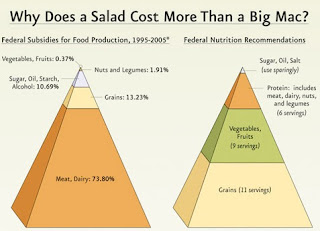 While I'm stuck on writing some other posts—the idea is there, the execution some way off—it is time for another collection of links.
- Using Human Sigma for measuring customer engagement - Mitch Owen reviews a new book on the market, that suggests that evaluating our efforts at customer satisfaction happen on four levels: Confidence, Integrity, Pride, Passion.
- How to coast to a writing career - Valleywag writes an insightful post (for once) about what matters when blogging. I like "AVOID: Blogger ego. If you do blog, just write and forget about it. Don't reply to your comments with more than "Good point, h8rboi, thanks. Don't troll other bloggers for links, or try to get onto Techmeme by posting about whatever's already there. ... People in the real media don't care what your Technorati rank is, they'll just Google you to see what you write." That said, I have no intent to engage on a writing career.
- Mind hacks: an interview with Jonah Lehrer on neuroscience - What I like: "Artists are constantly being forced to reverse-engineer the brain. By reverse-engineering the art - by trying to understand why, exactly, it resonates with us - we can learn about the mind."
- Thirteen examples of successful brand experiences - could be filed under architecture. The British design council points us to 13 different "experience-castles" (my own term), where customers can be enchanted.
- Calculating the carbon footprint of wine - What can I say? It's the new world! Some key-points: organic is not as efficient as we think; distance matters; packaging matters.
- Bonus Link: Why does a salad cost more than a big mac. - A picture says more than a 1000 words. This is just as applicable to Europe btw. Thank Wolsey for inventing the subsidy!
Enjoy! More of this: check out the S+FnR bookmarks—updated 24/7 !
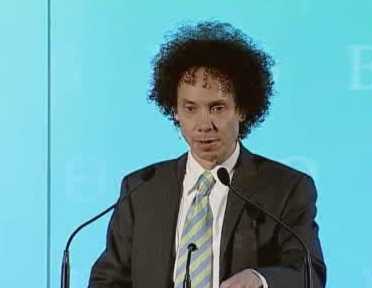 HBR writes about this rule, and Malcolm Gladwell (picture) speaks about it. Essentially, it means that being an expert at anything does not require any special talent (though liking what you do, helps), but instead it requires 10,000 hours of dedicated practice. This applies just as much to musicians, as to technologists, as to retail-entrepreneurs.
Take Candy Dufler, whom I wrote about the other day. She's been playing saxophone since I don't know when, but the hit "Lily was here" is approximately 20 years old. And if you calculate that 10 hours per week of practice, multiplied by 20 years, equals 10,000 hours, and combine that with Dave Stewart's compliment on her "encyclopaedic knowledge of riffs," you understand that she's an expert in her craft.
The point about all this is that anything can be mastered with sufficient practice. Malcolm Gladwell adds to this that this practice is not a solitary activity either, nor is it a matter of simple repetition. Rather it is imperative that it is guided by other experts and mentors, much like Dave Stewart is to Candy Dufler. And it has to push the boundaries, entering areas where the comfort-zone is low.
I think about this 10,000 hour principle a lot. It is very relevant to blogging, for instance. We, the people, are surrounded by experts, be it writers for the Financial Times or Harvard Business Review, or bloggers like Nick Carr, Seth Godin, and countless others. And we reproduce their writing to form a synthesis of it, eventually building a collaborate bucket of knowledge. This is why blogging is great, because it is open, it is curious, and, on the aggregate, self-correcting. But to individuals, it is only beneficial if part of a long-term strategy of dedicated learning and application.
The "Rule" also offers insights into hiring people and finding jobs. If your future employee is not happy (or able) to share his or her know-how, then how can your other employees (or yourself) increase their expertise? And if your job consists of spending countless hours behind an excel-sheet, locked away in a room, then may I suggest that that is what they call dead-end? Alternatively, if you can find someone who can actually present proof that they have 10,000 hours of applied practice behind them (or even half that!), you can feel pretty good about hiring them, and vice versa, they can feel pretty confident that they can add value to the area which they have practised for.
Ultimately, this kind of thinking suggests that we can only improve, and indeed innovate, as people, businesses, or products, by opening up to a ton of information, for a long-long-long time, perhaps forever. In other words, long live the open economy, the tools that connect us, and the computer that is our brain.

- Seth Godin on Permeability - essentially he presents a simple test to see how well integrated an organisation is. Also food for thought for top-managers at a firm. Do my employees know my name and what I stand for? If not, why not?
- Hugh MacCleod on De-Commodification - his current business is wine, and he rightly asks about guarding against being just one of the many. His answer: blogging, aka. micro-branding. I think he could've dug deeper.
- S.B. Johnson on Literary Style and word-count - this one made me think. Steven analyses the average words-per-sentence in best-sellers and classics. His conclusion: books with an average sentence word-count of 20 words or less sell better. Made me count the words of my own sentences in my blog-posts.
- HBR on managing innovation - a nice Q&A in regards to management, creativity, disruption, and solutions. Answers are broad and range from deconstruction, to isolation, to building communities.
- NYTimes on a strange cultural trend in Japan - apparently fear is the new black and designers are creating clothes resembling everyday street-objects, like vending-machines. I can't yet draw any conclusion from this, except that Japan is a different place.
 It's time for another monthly summary (a few days late). This time, rather than the rather unattractive list-view which I used for my month 1-summary, I'm going to try turning the past month's posts into a little story. As I wrote, this blog is my way of learning about this industry, so let's take a look at what I've covered so far.
The Human element
I started the first post of month 2 with one related to self-development, and I kept that thread going for a while. This post was on the the way that leadership has evolved throughout society, from an individualistic to a social kind of leading. A lot of developments today, in business, politics, or other arenas, are so complex, that a form of collaboration is more constructive than tyrannical leadership. This is perhaps made clearest in in the example of Ikea and eBay, who—often by necessity—used collaborative methods to develop and introduce new features and innovations.
Again related to self-development, I also looked at particular careers in retail (with a nice chart) and in knowledge-based firms. Apart from simply researching the functions out there, my conclusions were that different roles require different talents, and that a manager/founder/entrepreneur should take care to surround himself with a diverse kinds of people. A similar point was made in a post on doing what you do best. Again, in the eBay-post, I discussed professionalising your firm quickly, by bringing in talent that can help in growing the business.
The strategic lens
A second big thread last month was business strategy. I started with the coffee-business, mentioning some examples like Coca-Cola, who is expanding into canned coffee, and Leonidas, a chocolatier, who is starting coffee-shops. Later, in two follow-up posts (1 and 2), I drew the conclusion that the coffee-arena is pretty crowded and that I wasn't sure if that was the best area to start a business in.
I also looked at the area of value chains and Porter's five forces, using examples like Ikea, Apple, and Amazon, and before that China and the issue of meeting it's exploding beef-demand. Generally, and the same applies to coffee, I think it's useful to take a horizontal and vertical view at how the industry is organised and find opportunities that way. In the case of China, which imposes some barriers to beef-imports, the answer was to import methodologies and grow beef on Chinese land. Other examples are mentioned in my five-forces post.
Another big topic is climate-change and it again helps to analyse this in terms of the value-chain, i.e. looking at all the internal and external activities related to your company and related to bringing value towards customers. And optimising those to take the cost of climate-change into account, which can later be turned into a significant competitive advantage over your competitors.
And I looked at some examples of Franchising in Germany, noting that retail is clearly leading in that field, and that a big challenge is to transmit tacit knowledge down your (largely decentralised) organisation.
Branding & marketing
Another large topic this month was the issue of customers, and how you market to them. IBM presented a nice white paper, of which I discussed the Well Curve as a possible methodology to understand the customer decision process, which was a second post on this topic.
I also looked at the way some business interact with customers, including T-Mobile and Harvard Business Review, and observed that conversational marketing is definitely a way to increase price-elasticity.
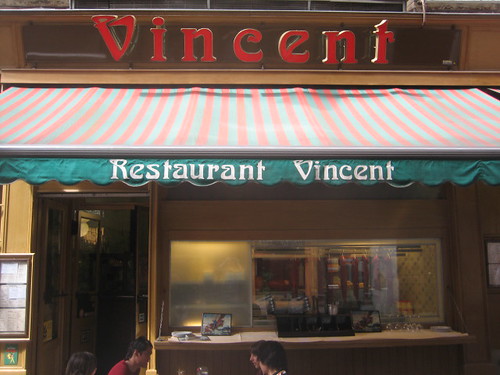
I have not looked much at food-business so far, but I did manage to discuss two restaurants: a pancake-place, where I discussed methods on how to make me remember its damn name, and a restaurant in Germany, which I thought received excellent advice in a show called "Rach - the restaurant tester," in regards to geographic marketing and building a brand.
Finally, even though my forte is not advertising, I came up with a—possibly stupid, but fun—idea on how to advertise a new concept coming to a town near you.
Innovation
Somewhat of a micro-topic, I looked at the way that music-media and money evolved and how that illustrated that customers love convenience, as well as how the Ford SYN-US was developed from start to finish. The latter is very interesting for thinking about what it takes to come up with new innovations.
Finance
Another micro-topic, which I will have to spend more time on in the future. I approached this in two posts. In the first, "other people's money," I reflected on some of the different types of investors there are and how some can add considerable value to growing your business. Also, in the eBay post, I looked at why it was so important for eBay to involve venture capitalists, even though it didn't need the money. The right kind of investor for your business will help you professionalise your business, by helping you find more talent, setting targets to meet, pressuring you to grow, and (hopefully) much more, all besides investing in your business, and taking shares.
Final thoughts
So, pretty diverse stuff I think, and while I could be writing more about food and retail—which will happen—I'm happy to have written and learned about all of these interesting topics.
For the future, I hope to look more at franchising, in-store activities, and particularly at supply chain topics, such as lean manufacturing, logistics, and anything dealing with the supplier-perspective. My future reading-list includes: The Disney Way, The Great Good Place, and The Toyota Way, as well as countless articles, pdf's, blogs, HBR-magazines, and so much more.
Well, here we are. Another month flew by! I enjoyed writing this post, and hope you enjoyed reading it too! For past coverage, you can check my slightly less aesthetically-presented month 1 summary. For more in the area of food and retail, I do encourage people to check my blog-roll on the right, and my bookmarks, updated 24/7.
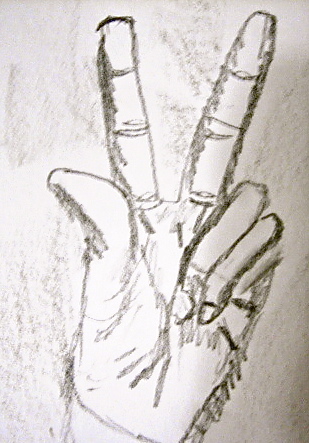
The picture is an exercise of drawing a (my) hand in 5 min. or less.
 Over the years (I've been actively blogging for about two), I must have read around 50 blogposts advising me how to blog. I won't bore you with details, but it all starts with a good title, a good picture tells a 1000 words, and if you can use 5 words instead of 10 to explain something, use 5. That's all true (note that in this post, I'll ignore all of this advice). In addition to that, there are ways to game Google, ways to monetize blogs, ways to draw in crowds, etc. etc.
But really, blogging is nothing new, it's just the word that was new, 5+ years ago. What all this advice, I read about, is for, is copywriting. For that purpose, I'd like to refer people who want to find out how to copywrite, to a blog called "copyblogger," because that one seems to capture most of the essentials. I like their latest post on blogging.
Now, for myself, why do I write? I'll make no pretences, I don't necessarily write for others. http://foodandretail.blogspot.com is the first serious attempt I made at blogging—everything before and during has been and is just for fun. But to me S+FnR is more of an information-system being built, instead of a "copyblog" for others. Sure, it's important to (learn to) write for an audience. I would call it an essential skill, as better writers are also better at a number of things, like debating, analysing, logic, etc.
But what really motivates me is to engage my brain, learn more about how businesses in my sector of choice work, work in that industry, and start my own business there. Over the last year, we've had a lot of discussions on the value of comments over at Tech IT Easy, a sister-blog on technology. The general consensus was that comments are great if they add value. A community is great. But what we wanted over there was to primarily create a group of intelligent contributors, who could maybe teach each other something. I think we have succeeded, though the Tech IT Easy roadmap is long.
For S+FnR, the roadmap is long also, and somewhat mapped out in stages, but mainly a way to grow for me, and hopefully my readers… though the value for them depends entirely on their level of development (mine is low) and their areas of interest.
S+FnR is nearly two months old now, meaning another monthly recap will be posted soon. And I will continue to post a lot of stuff that I find interesting and potentially relevant to this industry, whether it be on marketing, strategy, innovation, finance, logistics, tech, design, food, merchandising, career-choices, music, other media, and whatever else could fit.
I'll also try to post daily, which I started because I thought it might be good for readers, but I also began to get addicted to, not to mention learn more in less time. Of course this is entirely dependant on my time and energy to post!
What else… blogging? Forget about it! This is an information-system which I'm updating 1 day at a time, which you can always comment on/add to, and which will hopefully someday, become a valuable resource for other like-minded people.
P.S. there is of course another, slightly more subtle, motive. The more drawings I create and post on my blog, the closer I come to reaching my goal of becoming the next Vincent van… Gogh… hahahahaha (evil laugh)! The above was a copy I made of this one.

 The


