 The world of business, I think, has a certain illogical—the "human element"—shell around it, but centres around the concept of supply and demand. How you create a business where demand is high, how to you make sure that you have sufficient supply and/or not too much supply. You can see this play out in a number of places, e.g. on the web you have scaling issues, when your service proves to popular (e.g. Twitter), or you have the case of the million+ blogs that are collecting dust, because no-one ever reads them, or because the blogger was unable to gather enough interesting supply.
In restaurants, or food-places, you also see this play out. A couple of months ago, I was going to write about take-out, how some businesses embrace and others avoid it, and why. I think the reason is, at least in part, to control supply. If you control supply, then you can focus on quality and charge a higher price. You also become an artist/creator, rather than a factory.
How do you limit supply? Two ways, I think. Mainly it's the physical space; by limiting the number of seats in your venue, you ensure that a certain quota is set (of course, the question is also whether that quota is met, which comes from quality inspiring demand). By investing in quality-ingredients, you not only limit your budget, but also your production-capacity, and it forces you to limit supply. That's a little vague, I know, I haven't worked it out 100%.
The other way, is to have an increased level of supply. How do take-out and fast-food places do it? By standardising as much as possible. Whether it's the ingredients, which are mainly starch-based (burgers, pizza, noodles, etc.) and cheap, the production-facility (often just an oven, a grill, or a big wok), or a standardised customer-space (from seats stapled to the floor, to waiting-lines, to a website/phone nr.). All of which enables you to deliver mass quickly.
I was thinking about this today after watching "Iron Man," which is one big Burger King (and US-army) commercial, and getting a cheese burger afterwards. Burger King was packed and, ironically, slow. The "waiting in line" method doesn't seem to work that well when you have 50+ people waiting, and a limited space behind the counter to deliver burgers and stuff. People on both sides were bumping into each other constantly, and I actually had to wait over 5 mins, even though I was second in line.
On some level, I like to think that technology can solve a little bit of this problem. If you look at Zara and H&M, which I wrote about last week, both are very advanced in this area, in order to optimise and speed up their production, logistics, and merchandising. Of course, that's on a back-office level, and that's not the same as the front-office, where customers interact with a business. No one wants to be confronted with a screen to do the ordering, but sometimes I wonder if people wouldn't be happier just pressing some buttons in a fast food joint, rather than waiting in line. Of course that would mean more seats, as more people would sit down, and more staff, as someone will have to bring that food to the table.
In the end, it probably comes down to experimentation and constant improvement. That said, apart from the computers that cashiers operate, and quicker food-preparation, not much has changed in the last 50 years for the people doing the actual eating.
The picture is courtesy of lightningspeed.net.
I've included just the top-25 and annotated their focus. What's interesting, but not surprising, is that the majority of companies in that list are not independent horeca-orientated, apart from two: Hennie van der Most and Sjoerd Kooistra, both Dutch horeca-entrepreneurs.
The majority is hotel-chains, though the top-10 is quite diverse; a number of convenience-(fast)food places, resorts, as well as retailers. Interesting that both Ikea and Hema are on that list. Hema, as far as I know, has not been on the horeca-market for long (no revenue reported in 2006), but is already reaping significant successes. Probably my favourite retailer in the Netherlands, btw. Ikea, as I reported before, has been in the restaurant-business since 1971.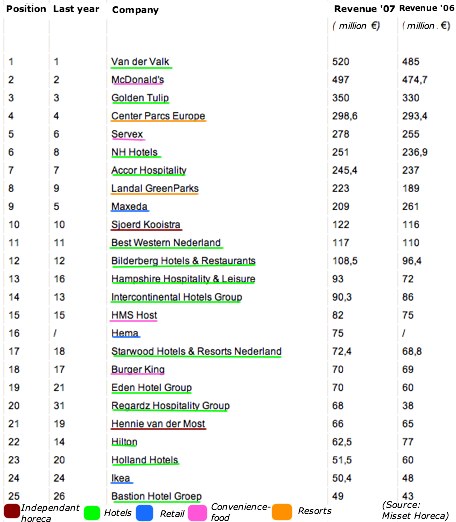
You can see the complete top-100 at Misset Horeca.
 Normally, you would say that alcohol & money don't mix. But in the world of beer, at least in the Netherlands, there is tangled web that has been woven between financiers and the horeca-industry, which is difficult to unwind, and, some people argue, shouldn't be unwound.
First of all, what is investing all about?
It's all about profit, obviously, but it's also about minimising the risk for investors. Two big risks facing investors are informational.
One the one hand, there's moral hazard—the risk that entrepreneurs take their new assets (money) and misuse it in some way; On the other hand, there's adverse selection—the risk that entrepreneurs are not as capable as they claim to be.
Either of these situations requires a different response and a different type of investor. For moral hazard, the typical response is for investors to mingle in the affairs of their investee's operations and strategy and take equity; the so-called active investor, which includes business angels and venture capitalists.
For adverse selection, the typical response is to restrict the entrepreneurs movement through collateral, restrictive, covenants, and and short maturities, to minimise risk-engaging behaviour. This is the realm of the passive investor, which includes banks.
Financial beer-tactics
When looking at these two investors, you see some differences; Active investors take equity—become part owner of the firm—and they do this because they can't do much else to influence the use of their money. Passive investors prefer to use measures like lend against collateral, e.g. real estate or other tangible assets, which they can claim if the investment were to go wrong.
In the case of horeca-owners, you typically do have some kind of physical asset. You occupy a venue, you have machinery, and inventory. This is much more the realm for passive investors, who can relatively safely lend some money against the existing collateral.
There is one complication, however; Horeca is typically known for high failure-rates. I'm not sure why this is so. I guess that the leisure industry is largely sensitive to seasonal differences and economic downturns. And perhaps, the barriers to entry are low; there could be a lot of low-skilled entrepreneurs out there, who are not as capable of running & growing a business as they think. And finally, growth in itself could be a problem, if the capital requirements are significant.
The way investors get around it in the Netherlands is actually not to invest. Instead, they leave it up to breweries, who, against a right of exclusivity, lend a certain sum to the business, or give it a discount, and provided it with the necessary materials, branded of course.
What's the problem?
From my angle, there isn't one really. If horeca is such a risky business, and other investors are unwilling to invest, then I don't think an entrepreneur should complain about a simple exclusivity-contract. And particularly so, because of three factors.
For one, exclusivity is only valid if the brewery has less than 30% market-share. In the case of someone like Heineken, who also owns a number of other beer-brands, and has more than 30% market-share, you can quit such a contract after two months. Then again, Heineken does its best to provide other value-added services to make sure that this doesn't happen.
And second, there's a lot of consolidation in the alcohol-business. And just because a company has a certain exclusivity, it may have such a large portfolio of brands that there isn't any shortage of choice for customers; neither do I think these exclusivity-contracts are 100% bullet-proof.
The third factor seems to be a problem. By not giving customers a choice, they have learned not to care about brand so much when they enter a pub. They just ask for a beer. So for them, unless they're a beer-fanatic, it doesn't matter much. For producers, on the other hand, their brand has become a commodity, at least where nightlife is concerned.
Who cares, right?
Heineken seems to care, and is all for the liberalisation of Dutch pubs. Ignoring that a. this would disrupt a pretty good funding situation for Dutch pubs, and b. that Heineken owns more than 30% of the beer-market, making their exclusivity-deals vulnerable anyway, I do kind of see their point.
By turning a brand into a commodity, you take away marketing-potential. If you can position your beer-brand above that of regular beer, then you can reap higher profits. That makes 100% sense to me, from the brewery's perspective.
And, from what I understand, British pubs don't actually have such exclusive deals with breweries. The question is then, how they get funded, or whether the failure rate is perhaps lower in the UK? That, for now, is a question unanswered to me, but I'll do my best to find out.
(You can always give it to me in the comments.)
Part of this topic was inspired by a good article (unfortunately not online) in Dutch Marketing Tribune, still my favourite Dutch mag.
I just discovered a new podcast called "Big Ideas" (iTunes-link), a series of lectures on anything from the impact of urbanisation on musical tastes, to designing menus for restaurants. Oh, and it's Canadian. Not that that's bad, but some parts of the lecture covered local conditions.
John Schneeberger starts his lecture (dated March 1, 2008) off with the basics of menu-design, namely that they should reflect three things:
- What you stand for? Aka. what kind of food do you like to work with?
- What demographics are you targeting? Income, religious issues, etc.
- What are the current trends? And are they for real or just a fad?
- Customer-decisions are always a trade-off between price and quality
- Traditionally, dishes consist of three components: protein, starch, and vegetables.
- What we understand as taste, actually comes from three sources: fat, salt, and sugar.
Schneeberger discussed three booming trends, vegetarianism, organic food, and local produce, and mentioned a number of challenges related to these.
 Vegetarian cooking
The thing to understand about this, is that it's generally cheaper. Schneeberger mentioned a 1:10 ratio when you compare the cost of producing vegetables to the cost of growing a cow. And while it's a booming trend, the industry, somewhat mis-guidedly, still often focusses on trying to replicate the taste of meat, which is impossible (think veggie-burgers, etc.).
Instead, they should be thinking about nutritional value— vegetarian food has been correlated with lower health-problems and is for that reason often recommended by doctors. The problem with these types of diets is of course that they are low in those qualities we would traditionally associate with taste: fat, salt, and sugar.
To create dishes that people actually enjoy, restaurants have to look globally, e.g. Asia, where more exotic vegetable components can bring some needed flavour to these dishes. I think he mentioned seaweed, but also stinky tofu (see pic), which is a type of fermented tofu and one of the few ways to naturally bring flavour to that type of protein.
The implication is that vegetarian food requires a significant amount of specialisation and is often hard to combine with meat-cooking.
Another complication arises from vegan (no dairy, honey, animal-derived products) versus lacto-ovo (incl. dairy, honey, animal-derived) cooking. The first makes it very hard to create a (traditionally) tasty dish. The second, lacto-ovo, allows for more flexibility, through the use of ingredients like eggs, which not only provide extra protein, but also bring a lot of flexibility to the kitchen. You can, for instance, make foam out if it, which would enable the creation of deserts & soups, etc.
Organic cooking
First of all (and I'm not sure if this is just restricted to Canada), an organic food label refers to the production method, not necessarily the quality and taste. Since organic food is more expensive, and taste is not guaranteed, you have to wonder if your clientele is willing to pay extra for that service (remember the trade-off between price & quality!).
The big selling-point here is the information about the product. People like to know how their food was produced; it has a certain value to know that there are no chemicals or genetically modified components in what you are eating. But again, that must be a value that is clearly advertised and which may not be important to every type of demographic.
Local produce
The advantage for the restaurant is that they can form better relationships with their suppliers, it's also cleaner in terms of carbon footprint (less transport), and it also has some marketing value to a certain demographic.
The disadvantage is that supply cannot be guaranteed during all seasons. Schneeberger mentioned something called a "100 mile diet" for instance, but restaurants catering to that need will probably have problems in the winter.
Thoughts
Overall, a pretty insightful lecture of the more exotic (and trendy) type of cooking and its trade-offs.
These types of specialisation are still pretty niche, require significant resources in terms of tools, know-how, and supplier-relations. But, if executed well, a niche can be extremely profitable.
I thought that it was interesting that all the traditional means of cooking, the ingredients and the taste-makers, were pretty incompatible with these newer trends. As such, you are essentially climbing up a hill, trying to educate the mass-market. At the same time, good execution, together with differentiation from the norm, seems like a formula for success.
 The reasons to love bookstore-cafés is that you get a chance to discover new stuff to read. The reason to hate my particular café is that, every week, even when I ask for a *normal* coffee, the waitress continues to regurgitate the same phrase: "will that be a large of a small?" Anyway…
I read a nice article in the New Yorker today, about a stressed out restaurant-entrepreneur called David Chang, who runs several noodle-bar-styled restaurants in New York City. The Yorker's articles are always so long, but it was a captivating article. I took some notes, which I'll share with you now.
- Waiters make way more money than chefs, simply because of the tips; the figure mentioned was $1700 per 32 hours vs. $350 that chefs make. Turning chefs into waiters, which seems like a logical decision in a noodle-bar, comes with the challenge that these types are not always that domesticated (can't help thinking about Chef! here).
- The front-end of a restaurant—servers(?), the set-up, beverages—is relatively simple (compared to the work that goes into cooking) and can be consolidated across multiple restaurants.
- Personal integrity in cooking—e.g. cutting fish-cakes properly, even though the customer won't notice them in a bowl of ramen—is the difference between a quality-restaurant and a McDonalds or Uno.
- Standards: A piece of chicken can taste wonderful to a customer, he won't know why, but it's actually because it's been prepared (marinated, dried, etc.) for more than 24 hours.
- Quote: "The great thing about fast-food is that you could sell out without worrying about it, because fast-food isn't pretentious and selling out is in the nature of the business."
- Quote: "Cooking is honest work; gives you a way to measure yourself."
The thing about restaurants is that I'm painfully ignorant about so many things going on in that world. Cuisine is like art—it's dynamic and filled with critics. For instance, there's the "foam" trend, mentioned in the article, hot in the 90s, but which I never heard off.
For me, I'm always interested to find out more about this industry, because I want to be part of something that produces culture. But I'm constantly thinking about whether it's wise to enter such an industry without a basic familiarity. It would be like me entering the tech-industry, without being aware of open-source, how to write code, or do project-management; it's just not done.
Food for (mostly, my own) thoughts.
 The reason I like Star Trek, most sci-fi in fact, is because of the space-opera aspect. You don't just tell a story, you design a universe around it. I've been a fan of the show, ever since the age of 10 when I got to watch TV at home. In some ways, sure, the time spent watching the show impoverished my life by taking me away from other endeavours, in other ways, it enriched it by contributing to my ability to dream.
As I grew older, I started paying much more attention to the story-telling aspects of the franchise. For instance, did you know that until the second season of Star Trek, the next generation, the writers didn't create a place for the crew to relax? It was only then that the makers came up with the concept of Ten Forward, hosted by the infamous Guinan (see pic). Later, in its spin-offs, Deep Space Nine and Voyager, we also saw a big role being played by the "lounge", hosted by Quark and Neelix respectively.
It was felt that by introducing this aspect into the show, a third place, it allowed the characters to show a different side of their lives, necessary if you want to teach a complete philosophy about society, as Gene Roddenberry was in fact doing. And of course, it spawned plenty of dramatic stories, that would otherwise never have happened. It allowed for romance, friendship, and conflict to happen, for aliens to meet and interact with one another.
What's interesting about the franchise that each series had a different archetype, which also affected the room for "drama." You could see it as both an evolution and devolution of a story. Star Trek, the original series, was the raw outline of Roddenberry's philosophy about the future of society. The next generation was much more developed and allowed for deeper interpersonal relationships. Deep Space Nine was again an evolutionary step, and much of the stories centred around "life" on the station.
Both Voyager and Enterprise represented a devolution. Voyager introduced the "morale officer", in my opinion, an engineered effort to bring a certain warmth to the story. But it was much less about teaching philosophy, as it was about survival. It showed that Roddenberry's universe was in fact small and could break apart at the edges. But it was still a good story.
Enterprise represents a return to those raw ideas. Perhaps it was felt that the franchise could cover no more new ground, and that a new philosophy had to be designed. It was also a story of survival and the raw pioneering spirit, shown in part in Voyager. But it felt like a military mission, there was little room to form complete characters. Instead we were presented with deep dramas, echoing the 9/11 events, which turned the characters into one-dimensional creatures, much perhaps the way the news depicts the main characters involved in the post-9/11 era.
To me, at least, Star Trek is a good analogy for certain principles in life. That it is not enough to search, but also to build. That friendships and societies are built, not only from the hard work they require, but from the breaks we take to reflect on our actions, and the places that are engineered to cater for that need.
Food for thought.
Cooking is ingredients!… it's timing!… it's cleanliness!… it's… … …restraint!
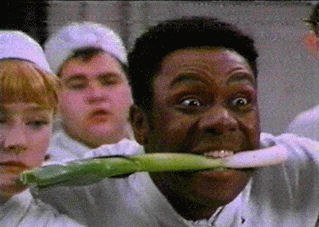 These are just a few of the tips that Gareth Blackstock, chef at Le Chateaux Anglais, and lead character of the British comedy-series "Chef!," delivers to his staff in a kind and gentle manner… not. Even after re-watching this show 10+ years later, I'm still not sure whether Lenny Henry's portrayal of the angry chef is meant to be a realistic, or rather a satiric look at what goes on in these kitchens. The effect it's had on me, in any case, is one of silent terror when I think of kitchens in 2-star restaurants.
There's no denying that, generally, the world of HoReCa consists of flat hierarchies; there's the boss, either the head-manager and/or the head-chef, followed by some type of administrative class of underlings, and finally those that Gareth Blackstock likes to call
"There's the aristocracy, the upper class, the middle class, working class, dumb animals, waiters, creeping things, head lice, people who eat packet soup, then you.."
If you're thinking of high-tech start-ups in the IT-world, multi-star restaurants are their equivalent in the HoReCa-world. Competitive advantage in technology comes from both products that are differentiated enough from the competition and processes that enable a business to produce these products at a sufficiently low cost and high scale to reap a profit.
In restaurants, this is embodied by the chef, whose training, experience, personality, and, I guess, raw talent, inspire fear in all of those around him, especially the ones that feel his wrath. It is an innovation machine difficult to replicate, comes at a high price and is not for the faint of heart.
Everything else: coming up with a business-plan, talking to investors, setting up the site, buying the materials, hiring the people, getting customers to visit, etc.… seems easy, compared to finding, keeping, and managing a good chef. Because as soon as the chef finds out that he is the one that keeps the ball rolling, he is the vital cog in the machine, he will likely fire you as a boss and replace you with one of those people, generally found under head lice and packet soup.
So there you have it; I don't write about cuisine, same as people generally don't think about starting a business in space-flight. They are both sciences reserved for an elite pioneering-class, one that is fearless and willing to risk the laws of nature in order to succeed.
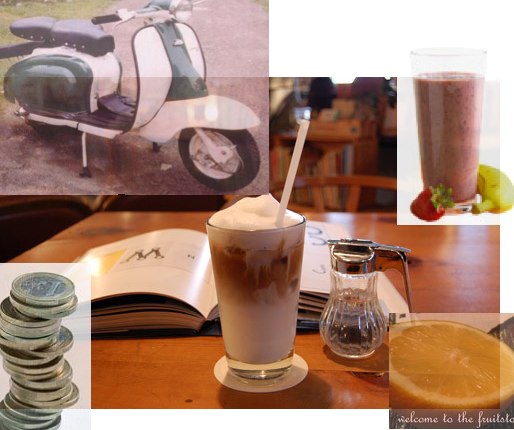 When I first wrote this post this afternoon, it was really long. After cutting it a little it's still really long. Sorry about that.
A lot of people I know from uni are into this thing called New Business Development (NBD). It makes sense, since it's the title of a course we studied together and it was absolutely the best course I've had in my life. Around 60 hours of hell per week for 2-3 months, but one hell of a ride too.
NBD is a necessary mechanism for when your core-business is stagnating. Let's say you have a good high-volume business, but competition is hammering you with low prices. If you can find a new business opportunity that allows you to make money differently, preferably at high margins, it's a good business opportunity. If it's synergetic with your core-focus, then it's an excellent business opportunity. Three small examples I stumbled across these last few days come to mind.
1. Bookstore + café. Verdict: logical
Buying books is a luxury. They serve no real purpose (unless you want them to) and are generally aimed at price-insensitive people. It is also a fairly slow sale. You are selling information, people are swamped with information, and it takes them time to make a decision. Sometimes… not always. I think time + the amount spent on an item also correlates positively, up to a limit.
That combines well with a café. The luxury-aspect allows you to charge more in cafés as well, meaning higher profit margins. Cafés lead people to relax and spend more time in bookstores, meaning they will likely purchase more books too. Combining the high traffic of price-insensitive consumers together with high profit margins and you have a good business. Also, it's a great way to compete against online-retailers, who are not able to add the atmospheric value.
2. Fruit-vendor + fruit-shake stand. Verdict: logical
Fruit is generally a low-margin product. The fruit-vendor in question sells 5 KG of Spanish oranges for €2. You can charge more for fruit-shakes; To the consumer, they taste good, represent health, and require very little in work (all emotional values = higher price-insensitivity). The fruit-retailer sells an orange fruit-shake of 0.5 litres for €2.50. Assuming that's about 1 KG of Spanish oranges, that's quite a lot more profit than €0.40 would give you. But of course there are other considerations.
The fruit-vendor is located right in the centre of Rotterdam on the busiest street. Likely the cost of renting a place is expensive, so is the added cost of producing the shake. The fruit-vendor also competes with a fruit and vegetable market, located a few hundred metres away, and a supermarket, 50 metres away. And his new business competes with other fruit-shake stands. What makes this combination work?
The higher profit margins for convenience-fruit-products, combined with high volume of people passing by is good. It also persuades investors to loan the money for the fruit-shake machinery, which they would probably not do for a low-margin business in a less favourable location. There's a lot of efficiency also; fruit is sourced from the same suppliers, so are packaging-materials, and the retail-space acts as a warehouse. Because fruit is cheap and the retailer has a large selection, he can charge lower prices than the competition and offer more variety. And he enjoys high profit margins even if the volume of fruit-purchases is lower because of the price-competition from the (super-)markets.
3. A eurostore + scooters. Verdict: illogical
This case is a little more complex and contextual. A year ago a eurostore, which is like a dollarstore—a shop offering a great variety of goods at low prices—started offering scooters alongside their regular products. They quickly abandoned the experiment and I have a theory why.
Likely this deal came out of partnership with scooter-retailer/-importer. The eurostore was in a good location with lots of traffic (good for the scooters) and the scooters would give it much higher margins than their regular products. Seems like a win-win.
Consumption of "euro-"goods is different from that of scooters, however. With the first, people expect stuff to break and don't come asking for a warranty. They just buy another. Buying a scooter or anything over a certain amount is very different. People expect extensive information, they may want a test-drive, they certainly want a warranty, and after-sale support.
Since the eurostore is what it is, a store with low margins, this kind of service is out of its realm. It ends up referring customers to the actual scooter-retailer, and very likely the purchase happens there also. Unless you have a contract that specifies this eventuality, gone is the alluring profit-margin. And that, as they say, is that.
Final thoughts
High traffic of goods is a good basis for new business development. It means you have a customer-base to which you can try and sell other products and services, hopefully at a good margin. Location and demographics are important also. Both the book- and the fruit-retailer were well-located and had access to a good demographic, allowing them to sell at high margins and high volume. The eurostore was only well-located. Synergies are vital. For the bookstore it was consumption-pattern and price-insensitivity; for the fruit-vendor it was offering essentially the same product in different packaging; for the eurostore there was little, or rather, none.
Isn't new business development fun? And was my analysis correct?
 When I started this blog as an experiment, I purposefully kept it vague, while maintaining a fairly clear industry-focus. However, taking a value-chain view of food & retail only gives you so much. It allows you to identify tensions and possible opportunities, but unless you want to be a consultant regarding value-chain issues or are the strategist within a business, it doesn't really bring you all that much.
Where the imagination really kicks in—and you need that to think of new business ideas—is when you start matching you— the individual or groups of individuals with a particular skill- and experience-set—with a particular opportunity that you can feel both passionate about, and confident that your skills & resources are sufficient to add value to it.
Blogging about FnR allowed me to look at segments in the industry, such as:
- farming
- supermarkets
- franchises
- online-retailers
- electronics retailers
- coffee-shops
- restaurants
- cinemas
- furniture-stores
- and fitness-studios
- fast-moving consumer-goods
- coffee
- beer
- private labels
- organic food
- and media
However, starting or working in a business is of course more than writing about it. It's the process of building up a vision, gathering up resources to execute it, and executing it. I was reminded of how powerful such a vision can be just last night when I was evaluating a business-idea and what it would take to execute it (I ended up dismissing it for now).
And of course, starting a business is not the same as running a business, the latter of which can be defined as a sustainable* process of making money (*: not in the environmentally-friendly sense of the word). So many stages to go still.
Will this have consequences for this blog? In the short-term, the next few months, probably not much. I'll still be looking at more industry-segments, product-areas, and business-issues. Ultimately though, I will have to focus on one particular industry-segment and one or a set of related product-areas. Of course, when that happens, I'll continue to share my thoughts here, as that is my not-so-secret way to build mindshare (insert: evil laugh).
Take care,
V.
5 links - sense of smell, false green ads, farming boom, Lego, fun e-shopping
0 comments Posted by Unknown at 10:49 AM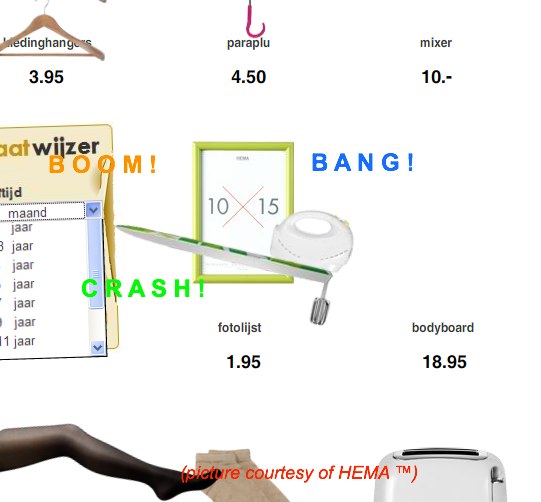 Time for those Sunday-links again. Today, I'll discuss the cocktail that is smell and how some things just don't mix; how green is not all it's cut out to be; a possible shift of power from retail to farming (or not); how lego came to be and where it is going; and how to sell me online shopping.
Previous link-discussions can be found here and my bookmarks here.
Link 1: Starbucks Admits Sensory Mistake - These are the kinds of stories that make me I like the NeuroscienceMarketing-blog. If you follow the science-section of the Economist, you'll know that neuroscience is a big deal anyway. In any case, this story is about how Starbucks designs atmosphere, largely influenced by smells. Apparently, smell of heating egg and cheese sandwiches doesn't mix well with the coffee aroma.
Link 2: False 'Green' Ads Draw Global Scrutiny - Two problems linked to green adverts these days, I think. One is that consumers are growing tired of it. And two is that, as this story shows, just because companies say they are, doesn't mean they are. I like the Norwegian approach to this. They ban green adverts by products that cause more problems, no matter how innovative they are (about hiding it).
Link 3: Farmers Wonder if Boom In Grain Prices Is a Bubble That food-prices are rising is an inescapable fact. But it also presents an interesting shift in the status quo. In the food-chain of the grocery-business, farmers are pretty much at the bottom. Now, even though their own costs are increasing also, they can charge more on top of it and decrease retailers' margins. Time will tell if this is something that will be acceptable for a long time. Certain signals very much suggest to me that farmers may be in the right position to cut out the middle-man and become retailers themselves.
Link 4: The Making of…a LEGO - I'm still a kid at heart, so I love anything to do with games and toys. My parents never bought me much lego as a child, which I regret as I hear it breeds geniuses. In essentially two pages, the article describes how lego came to be, what makes it so perfect, and what the company's strategy is. I was always impressed with the brand-extensions they did with the games, the robots, and the theme-park. A company to follow.
Link 5: Online shopping at Hema.nl - I've linked to this on twitter before, but it brought another smile to my face watching it again. Just when I think that online-shopping has no future, innovative uses of technology surprise me again.
5 links - cool vs. tech, touch-screens, women, pizza, & bookstores
0 comments Posted by Unknown at 12:09 PMMan, I collected so many links, that I'll probably have to write three updates to cover the most important ones. We've got a lot of ground to cover, so let's get started. You can find my previous coverage on interesting links from the web, here, and my continuous stream of bookmarks, here.
Link 1: On Magnetbox - Correlating cool with tech - With pictures like the one below, my work on this blog is really done. Interesting is the rise of computers vs. dance & hip-hop music (both of which are hugely benefiting from the cost-savings made possible by PC-based studios. (A note: low industry-barriers = high chance of suckage!). Also note the fall of art, after the colour TV was introduced. Kottke also made some comments about it.
Link 2: On BuzzFeed - Touch-Screen Ordering - BuzzFeed presents us with some stories about automatised ordering. There are both advantages and disadvantages, I think. Good is that it minimises errors in ordering and can interface well with back-office operations, such as ordering new supplies. It might also fit with the individualistic preference for self-service, I wrote about before. The disadvantage is the cost and the margins of error that information systems bring (I still shudder at the thought of the LAS disaster (pdf)) + the lack of the human factor. Martin Kunzelnick (German) links to some videos of Microsoft's Surface in a restaurant-environment.
Link 3: On Lightspeed Venture Partners - It is no accident that Typhoid Mary was a woman - Although it's a horrible-horrible title, and perhaps an obvious point, I've been coming across many stories about the social qualities that women possess, making them better at PR, marketing, sales, relationship-building. Something to keep in mind for any people-based business.
Link 4: On Reuters - Pizza Hut rolls out nationwide mobile ordering - A news-item (finally), and I'll probably delve into this topic sometime in the future. Arguably, Pizza Hut has been pursuing a different strategy from pretty much 98% of the pizza-restaurants out there. I'm sure that there is considerably brand-loyalty towards Pizza Hut, which will give it an advantage over delivering pizza-franchises, HOWEVER, it will probably be competing on price, which the franchise has not done so far. I'm not sure how that will affect their brand at all, but it's something to keep an eye on.
Link 5: On WSJ - Who's Buying the Bookstore? - arguably, there are few retail-outlets that evoke such an emotional response as bookstores. I find them comforting, and very similar to churches, in the way that it really is expected of you to be silent while browsing (on a side-note, I discussed a link of Dutch bookstore being opened in a church before). It's also a symbol of a community, as WSJ points out. Well, with competitive pressures from Amazon et al., these types of stores are clearly disappearing, or changing into hybrid monsters, which smaller stores can no longer compete with. WSJ points out a phenomenon related to that community-spirit, which is very touching. Capitalism isn't everything, particularly in places that target the softer pleasures in life. I'll have to reflect more on this, as I'm very attracted to these types of stores, and would love to set one up myself.
That's it, for this week. I'll see how I'll catch up on the rest of my links, but this went great (took 20 mins), and I always enjoy re-reading my bookmarks. I hope you do too.
My relationship with story-telling - a short autobiography part I
0 comments Posted by Unknown at 1:45 PMI'm in a philosophical mood today, after having spend an hour this morning sorting through the rough drafts for this blog (estimated at around 150), which I categorised as "idea," "rough notes," "feature complete," and "send it already." There were so many of them that I found myself a little overwhelmed to address a single one, a little afraid to miss seeing the forest through the trees, and instead decided to write about a core-principle in my life: story-telling.
I'm very attracted to the concept of telling stories. It's perhaps a little difficult to explain, but certainly related to the reason why I write so much, and also integral to what I want to do with my life.
When I grew up, I was reading all the time. From the back of cereal boxes, to encyclopaedias, to even the bible (which I thought was a great fantasy book). As a kid, I also remember building up cities in my room and garden, made out of toy-parts and characters, and constructing visual stories around what was happening.
I did not watch TV until I was 10, but, around that time, I fell in love with fantasy and sci-fi stories, both in book-form and on TV. I liked the way the story was constructed, and loved to imagine myself being there. I remember having magnificent visions of what I imagined the future of society, cities, and the home to look like.
Around 17, I decided to hold my first teen-party (the last one before that was probably around the ages 8-9). At that time, I was playing around in a band and very much into music-culture. I remember coming up with the party idea, which was essentially a visualisation of a club. It was lucky timing. We were just about to move and I had a huge house to my disposal.
The way I visualised it was to have rock-bands playing live in the living-room, a techno-room with a (borrowed, I think) strobe-light in the basement, and some other theme-related room elsewhere. Important were of course drinks and drugs, as, hey, I was 17. And equally important was the concept of complete freedom, which I think was communicated quite clearly.
A large inspiration was this video by the Prodigy - No Good (start the dance):
The end-result was great: around 50 people showed up, 2-3 bands were playing, and people did some crazy stuff, without getting me in trouble. In the end, I was still the one responsible, and took that seriously, but essentially everyone could do what they wanted. I repeated a similar party a few months later, which revolved around the same principles, with some restrictions, though around twice the amount of people.
That's where I'll end this. Lot's of stuff happened since then and will continue to happen, and I hope to write a second part in maybe 5-10 years from now (maybe sooner) about all the adventures I'll hopefully have, and evolutionary leaps I'll hopefully make.
Core to everything, I think, is vision and freedom. When you create a story, you have a vision of the components and the way they fit together into a dynamic process. At the same time, a story-teller must realise that his/her story is just the start for the listener/viewer/experiencer. It's a synergetic interaction between creator and beholder and the end-result can be both unpredictable and quite beautiful sometimes, a risk that, to me, is entirely worth it.
P.S. Happy Valentines day!
Cracking impregnable fortresses - on the art of war and blue oceans
0 comments Posted by Unknown at 9:14 AM Every industry has a number of pains. Arguably, a problem in the FMCG (fast-moving consumer goods) sector is that the market is saturated and that margins are fairly low. Over the next few weeks, I plan to take a deeper look at companies within the FMCG-segment for food, in order to understand the structure of the industry better, and the challenges faced by companies—new and existing.
Somewhat related to this, I came across an interesting article at HBR, on "strategies to crack well-guarded markets," which I'll go into now.
I'm a great fan of the book "The Art of War" (not to be confused with "The War of Art," that I reviewed a few months ago…). Sun Tsu offers some timeless and broadly applicable tips on how to fight battles that cannot be won by force alone. The quote I remember best goes something like this (paraphrased):
"A big army is like water; it is fluid, it can envelop you, but it is also hard to control. Fight a big army like you would water, in places where it finds it difficult to move."HBR makes a similar point in their article (abstractly paraphrased to stay in character):
- Thread lightly - using a minimum of resources to enter these new markets also minimises the risk associated with these experiments.
- Be unpredicatable - when doing things fundamentally different from your enemy, you end up catching him off-guard and slow to respond.
- Use a dagger, not a sword - just like Sun Tsu's point about water, it perhaps makes little sense to use a bucket at the beginning. Instead attack there where it least expects it—via a market-niche—and start building towers.
- As well as a combination of any of the above
It reminded me to pick up the book, "Blue Ocean Strategy" again, which describes methods on how to find uncontested market-space, based on an analysis of existing products and companies and their shortcomings.
A pretty obvious example of this is the Nintendo Wii, which Jeremy discussed on Tech IT Easy some time ago, and which is reaching out to a whole new group of consumers, who traditionally not play console-/computer-games. Interestingly, the HBR-article looks at a related company, Jakks Pacific, which has also entered the console-market to compete with the big three, and has done so successfully by competing on price ($20 consoles) and marketing (working with big partners like Disney).
Other examples of Blue Ocean Strategies include Cirque Du Soleil v.s traditional circuses, which is a big inspiration to me personally, and Starbucks in the 80s-90s and on US-soil (!).
In the case of Starbucks, you certainly couldn't argue that their strategy is "blue ocean" in Europe or even globally today. However in the US, when they started, they targeted a niche demand for quality coffee, reshaped the value chain of a coffee-retailer, and initially grew through the acquisition of the Starbucks-brand and coffee-plant. Today the situation is somewhat different, Starbucks is the incumbent and its competitive advantage relies on finding new business opportunities. Whether they succeed, the future will show.
Any successful Blue Ocean Strategy depends, I feel, on the inability of incumbents to react—i.e. focussing on areas which incumbents are either neglecting or are finding it difficult to manoeuvre in. Starbucks is in a different business-cycle now, its novelty has worn off, and other companies can benefit from similar advantages in the value chain, such as sourcing quality raw materials and a huge demand in the market. I guess, to a degree, Starbucks' educational focus has created that market and given competitors a success-formula to emulate.
As mentioned, during the next few weeks, I'll be looking at other food-companies, particularly FMCG-ones, to get a better understanding of the industry and the challenges facing these firms. Who knows, maybe I'll discover some blue oceans…
The picture is courtesy of valuebasedmanagement.net.
 I'm still following my tradition of looking back at what I covered and processing it into a blogpost. The general aim is for me to process the stuff I wrote about before, and give a reader some compressed value of an otherwise unforgiving linear medium. Time waits for no-one.
Why did it take so friggin' long?
For Months 1 & 2, I did so on a monthly basis. Later on, I was interrupted for study-related reasons, so hereby a 3 month summary (though only about 6 weeks of real activity).
Now, if month 1 can be categorised as a focus on market research, design, core-values, the value chain, and trends in FnR, and month 2 on human resources, business strategy, branding & marketing, innovation, and finance, months 3-6 aimed at news & trends, operational issues, marketing & branding, entrepreneurship, and strategy. Phew, what a mouthful… this is going to be a long post, so let's get started.
Micro-topics
Following three headings cover, what I call, micro-topics. They delve into specific situations (news & trends) or issues in running a business (operational, branding & marketing).
News & Trends
I noticed a decreased focus on news these months, simply because I didn't want to re-blog other people's stuff, and found conceptual lenses, and micro-topics more interesting. Also, my links often covered some news, as do my continuously updated bookmarks.
Nevertheless, I tried to identified some trends, namely private labels, organics, and SEPA, which I discussed at some greater depth. For Private labels, I looked at what regions and product lines were doing best, and came to the conclusion that there's huge potential in terms of lifestyle-products and offering higher quality goods than manufacturers can, simply because of the savings in marketing. I discussed lifestyle in a number of other posts, but I will go into those later on.
For organics, which has seen a huge upsurge in the last 5 years, I remain bearish, simply because I see it as a very inefficient, resource, and human-intensive process, that, in combination with the high energy-costs and rising food-prices, may not appeal to consumers increasingly shrinking wallets. That said, innovations are usually inefficient at the start, organics fill a certain need, and more automisation in such production-methods may dissolve many of my arguments.
I also looked at SEPA—the single European payment area—which was just launched (and you should be seeing an option to pay via SEPA in your internet-banking site now). Arguably the most boring post, I've ever, ever written (well, there are some contenders), but since I want Europe to be a single market so that businesses can finally benefit from the same economies of scale as the US, China, India, and Brazil, I thought it be important to discuss it.
Microscopically, and just for fun, I also identified some trends in terms of cinematics, beers, and pie, as well as a changing perception of expertise (more on this when I discuss entrepreneurship later on).
Operational
A second focal point was on operations of food & retail-outlets. I'm fascinated by optimising internal processes of businesses, so one of the topics I focussed on was whether it would be possible to use lean Toyota principles in a Food / Retail environment. I think it is, but at the same time, should not act as a replacement for customer-service. Granted, competition is fierce and any cost-savings should be welcomed, but the differentiating factor should be the amount of cherries on top: service-quality, product-quality, etc. I still need to read the book, though, and I definitely have more to learn/write about this subject.
I also looked at real-estate, fairly extensively, though some topics for future exploration remain. Clearly one of the biggest pains for FnR-venues is location, location, location… (it is also an inherent strategic component to large franchises like McDonalds) and I started with looking at structuring search and using checklists. In a second post I looked at the competitive/cooperative context of choosing a location, and in the third post, I looked at a number of costs that are part of the location choice.
Marketing & Branding
M & B is a continuous micro-topic of mine, even though I don't consider myself a marketeer. Two of my favourite topics include "the service paradox - on self-service and customer-rentention," which discusses the strangely liberating effect that no service has on today's individualised customers and positively affects their loyalty in return… talk about an eye-opener, for me at least… and "Lifestyle products - the costs of educating a market," which looks at the significant marketing-costs associated with starting a company in an unmapped market. As for the latter, I'll definitely be writing more about the particularities of lifestyle-products pretty soon.
The other three topics were interludes—hence the reason why I don't consider myself an expert. I wrote about how much of marketing is based on arguments, how arguments are often designed to distract or confuse an audience, how the consumer is overwhelmed with them, and how their value is ultimately decreased drastically. Very abstract… I also proposed that this is exactly why simple products work exactly so well: kill the argument.
Two more interludes include a review of Malcolm Gladwell's books, which both offer great insight into how people think (and how to market products), and I re-blogged "a marketing plan in a nutshell," kindly provided by an MBA-student at MeFi, which should be useful as a general reference.
Macro-topics
Following are topics that are core to what I write about: entrepreneurship and strategy. The first aiming at starting, running, and growing FnR-related companies, and the second at the bigger picture: taking an industry-perspective, how to interact within the context of a value-chain, core-pains, etc. There is also considerable overlap between the links I discuss now and those that came before.
Entrepreneurship
Looking at my eship-posts, I found that I often take a more personal stance at issues, compared to other disciplines. I think that's related to that the human element is stronger in these businesses, something I found out from speaking to many start-ups, incl. ca. 300 start-ups for my thesis.
In "The business of HoReCa - Hotels, Restaurants, Cafes," I discuss the issue of semantics in regards to choosing a vocation, and the perspective of my father, who helps me think about this area a lot. This is somewhat contrasted by my post on my own generalised (vs. specialised) look at the food & retail-industry, in the sense that I care more about the big picture (for now at least). I'll come back to this in the future, I'm sure.
In my post on "lifestyle-products," which I mentioned before, I also try to approach the topic of starting such a business in a second-world country, through a friend's eyes. Similarly, my post on "How being in the right place at the right time translates to starting a business," takes a very personal, and perhaps subjective approach to the issue.
Some micro- and just-for-fun topics include the "10,000-hours-to-be-an-expert rule," in which I identify a trend that's pretty similar to crowdsourcing expertise. On Tech IT Easy, Georgia Psyllidou discusses a similar phenomenon about how people can find work nowadays, and I think I will approach this topic again in the future. Call it semantic, crowdsourcing, open innovation, etc., but the world is changing, it is getting flatter, which has both implications to finding human resources, as well as distributing knowledge. For instance, in a recent article on HBR, the topic of authentic leadership is discussed entirely from the perspective of 1000s of examples. Worth a read and thought-inspiring!
Another fun topic was the Lowest Common Denominator (LCD). I first approached this abstractly, while under thesis-stress, but I find it a useful way of thinking about simplicity of action. What is the simplest, most basic feature that your product needs, that your strategy needs, that your company needs to work? Later on, I explored this again concerning my friend's lifestyle-business.
The strategic lense
Strategy has always been difficult to conceptualise, I felt, because there's strategy to everything—war, running a business, running your life, getting the girl, etc. That's perhaps the reason why I never got around to writing a thesis for it, and chose entrepreneurship instead.
I discussed IKEA a number of times in my blog, and one strategic issue I approached, were the early years of growth for the company. My philosophy concerning business is that, generally, "where you are from and when you are from matters a great deal to where you are going," and the same applies to IKEA. Of course, IKEA went far beyond Scandinavia, and I hope to get around to discussing the later expansions the company went through.
Amazon & Jeff Bezos was another topic, in which I wrote about Amazon's approach to innovation (very customer-focussed) and Bezos' transformation from entrepreneur to CEO (from micro to macro, challenging for many).
Another topic was the growth strategy of Starbucks (wholly-owned), vs. that of Subway's (franchise), which is clearly receiving a lot of flack these last months. In the article, I commented on some of the reasons given by other smart people, about why these strategies differ. Some good economical reasons were given, however, none, I felt, went into the roots of the issue. Two factors affected Starbucks' strategy: the roots of the business and the roots of the founders.
Somewhat related, a few weeks ago, i discussed the intriguing strategy of Metro-Group, which has placed two electronics-chains into the European market, Media Markt vs. Saturn, seeming to everyone as competitors. Turns out they are the equivalent to a franchise-system (though certainly a more complex one than Subway), which I think are meant to saturate the market.
Some just-for-fun topics included another post on the lowest common denominator, which I felt was a good lens through which simple strategies can be designed; two posts (1 & 2) about big pains the food-industry is feeling (and which ties into my post from yesterday; and why fitness studios are employing such restrictive contracts, which I felt was caused by either an inelasticity of demand or because they were in trouble.
Clearly a number of other topics fit within the strategic paradigm, but I'm not going to discuss them here.
Wrapping up
What about those Sounds?
I'm considering dropping the "Sounds" from S+FnR, however, it is still a very strong topic in the back of my mind as I'd like to work in venues where people dance… No, seriously. The way I'm looking at it is that I have to focus on certain basics first, and music & media will eventually pop up. So the title stays as it is.
Final thoughts
The nice thing about blogging is that you can measure your progress. I measure them both by readers, by feedback, and by my own perception. During the first months, I was very much in the dark about this industry, and to a degree, I still am. But I notice that things start making more sense, there is a certain logic to how processes work, why certain business models are chosen, etc. So, mentally, for me, there is a certain growth and I hope I can continue at that rate in the future.
I'm still on a certain trajectory in my mind, regarding the amount of secondary and primary activities I have to do to reach new levels. On the latter front, I definitely have a much better idea of where I want to go, after having blogged/thought/discussed about these topics for so many months.
That is all! I can enjoy my weekend, enjoy yours, and until next week.
The service-paradox - on self-service and customer-retention
0 comments Posted by Unknown at 11:31 AM Every now and again, you come across something that changes the colour of your perception, that allows you to see the world in different ways. One such moment happened after reading a chapter in the IKEA-book, I wrote about before (1 & 2), on how the customer is deeply involved in the logistical process and the effects and cause of it.
As you may, or may not know, when you shop at IKEA, you generally go into the store, choose the furniture you want, pick up the already-boxed version of that item, put it in a cart, pay, drive home, and assemble it with some tools that are in the box. All-together, the customer at IKEA does 80% of the work related to sales.
I had read, in my bachelor, I think, that the reason that IKEA introduced this system was because of when it first opened its store, there was such a mass of people that their staff couldn't handle it, and that they then just decided to let the mob do all that stuff. I thought that the reason that system remained was cost-saving; I mean, how cheap is that to let customers do all that work for themselves, right? Well, that's definitely a reason, but only part of the story.
The other part is the effect it had on customers. Because you always ask yourself, why would someone go through that, when they can just pay the store a little extra for the transport and the assembly? And that's where it gets interesting.
To start, IKEA, even though it offers low-cost goods, is well-positioned for the middle-class market. The stores are outside the city, and pretty much all their customers have cars, which they can use to transport the furniture back home. I'm not 100% sure if this was by design or a consequence of other factors. But at the very least, the conditions for making the customer part of the logistics process are in place. Still, you kind of wonder. Aren't these exactly the people that could afford a little extra service?
The explanation is culture. Western culture, you could argue, has seen a shift towards individualism. People are over-informed, over-serviced, over-indulged. Sales-clerks and waiters can't wait to throw themselves at you and ask you if you're happy, if you want another…, and another, and another. It's exhausting, both for the store and for the clients.
In comes this place, which tells you, very Scandinavian, here… go do it yourself. Like a party, where you can mix your own cocktails. Where you control what goes in and what comes out. And most of all, where you get the feeling that you are part of a productive ecosystem. It's the good kind of stress.
The book quotes some sociologists, Robert Jungk and Ivan Illich, according to whom, a society which receives too many services, where every screw has a handyman, is a broken society. Services, they say, destroy activities. For every small chore, you can call an expert and let them do work that you actually do yourself. On a larger scale, services destroy the entrepreneurial drive. Also Thomas Düllo, according to whom, we live in a world of indirectness, and because of this, it's very exciting to be asked to do something. A French student was also quoted, calling IKEA: "Lego for Adults."
And there are definitely signs that suggest that society wants to move into another direction: open source, Wikipedia, Make-magazine, do-it-yourself, self-help, etc. Probably even blogging. A collection of niches to be sure, but growing ones.
Ever since reading that chapter, I sit in restaurants, stores, etc. and wonder how this principle can be worked into their or other businesses. For instance, is the take-away coffee part of it, or McDonalds' policy of throw-it-away-yourself, or Amazon. All of these "features" cause both a downward-shift in the bottom-line of "service" businesses, but they also remove the "service." And these businesses are unarguably booming too.
But I also wonder which services can be removed, and which shouldn't. More on that when I have the answer. Or perhaps you have it yourself? Let me know in the comments.
The picture is courtesy of Marco.org
 I have a general philosophy on restrictive business-model: that particular business (or industry) is in pain. Much like when you drive an animal into a corner, it will quickly start bearing its teeth and drawing the line.
I spent today searching for a gym close to me (healthy body = healthy mind), and most of what I met were restrictions and crazy prices, mostly summarised by:
limited opening times (don't people train on weekends?); a fat one-time-only entry-fee; multi-month/year lock-ins; and prices charged per 4 weeks instead of per month.So is the fitness-industry in trouble or is there another reason? I have some theories.
- Low price-elasticity due to the health-boom
- Too much competition - but it's not like barbers, which are on every corner, are trying to lock me into a 1-year contract.
- Too little competition - more likely (see point 4)
- Expensive cost-structure - likely, I imagine it's much higher than for other retail/entertainment-venues.
- Low education entry-barrier, translating into uncreative business models
- Extensive government-restrictions - seriously, what's with the stupid opening-times? High insurance-requirements also likely.
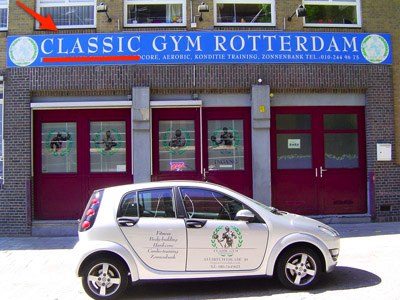
What I want, and sort of found, is the classic model: sweaty seats, instructors who growl at you when asked a stupid question, lots and lots of free weights, and if possible some over-muscular body-building chicks to compare muscle-size with. I'd also like the ability to pay per month, as well as a gym that opens before 8 a.m. (but that apparently is asking for too much).
P.S. Finally found something in that sort of fits the bill (see pic). Classic Gym Rotterdam. I'll be joining tomorrow.
 Hello,
In this piece, I am planning to discuss my current thoughts about my thesis, this blog, and my plans for the future.
I suppose, to a great degree I like to be a focussed person. I like to have goals, pursue them, and not get too distracted by things. It's kind of a silly attitude, because life is an exercise in overcoming distractions. As Fred Wilson wrote recently about something that Dick Costolo, co-founder of FeedBurner, said:
"A startup is the process of going down lots of dark alleys only to find that they are dead ends. The art of a successful deal is figuring out that they are dead ends quickly and trying another and another until you find the one paved with gold."I love that quote and I think it's a great attitude in life as well.
But, as I said, I love planting myself behind a project and shutting the door to everything else. I tried doing this here, 8 days ago, and, as a result, underwent a pretty amazing productive period since then. So what are my plans for my thesis?
My thesis on funding high-tech start-ups
As I said, 12 days break, which would give me another 4 days. Truth be told, I have to add writing a conclusion, writing mini-summaries per chapter, an executive summary, and editing the whole thing into the mix, so I will like likely be busy for another 10 days after that. The nice thing about conclusions is that they are already in your head, summaries happen automatically as you edit a piece, and editing is a perfect all-nighter activity.
The not-so-nice part is that we are currently at 150 pages of material, which would more or less make my thesis a book about innovation, entrepreneurship, venture capital, and incubators.
2 thoughts:
- One of my thoughts is to edit it down to a reasonable size and publish the whole thing as a pdf.
- A second thought is that as I write summaries per chapter, I might as well turn them into blogposts about innovation, entrepreneurship, finance, and incubators, and publish them in the form of regular blogposts on Tech IT Easy.
Which brings me to this blog…
The status of (my blog on) sounds + food and retail
The funny thing about this blog is that it is interconnected with my life. Random readers may think this is a nice (or not so nice) blog about subjects concerning music, food, and retail, but it is in fact, what I see as, one of several stages towards forming a career and a business (or series of) in this industry.
So my head has not stopped thinking about this subject, and I've actually been making summaries about interesting topics, and thinking about the shape of things to come. I cannot interrupt this blog too long, at the same time it is reassuring (to me), that even though my publishing took a break, my mind did not.
Concerning this blog then, I will be back and I already have a huge backlog of material to publish here… looking forward to that!
The status of "real life"
As I speak with friends and strangers about my ideas I also realise that there is much that remains to be done in "real life" also. I believe everything starts with a good business-plan with realistic assumptions about what you want to set up. It is the ultimate "social object" towards getting my plans in motion, convincing partners, investors, employees to work with me.
Questions I have received so far include:
- What type of place do you want to set up? My answer has so far been: probably a night-venue, a restaurant or night-club, or something in between (this may come as a surprise to some of my readers, as I write a lot about retail). Ultimately though, I want to set up a successful venue and am flexible on the format.
- Where do you want to set it up? My answer: I'm flexible, but it depends on where I feel most comfortable to set it up.
- How are you going to fund it? My answer: I'll need to save a bit, but I expect my first business to be sponsored, probably over 50%, and will look for suitable working partners also.
- When do you want to set it up? My answer: 3-5 years from now would a realistic number in my mind.
- When do you want to exit? My answer: Depends on how much fun I am having, as well as other factors. I see myself as both a serial entrepreneur and someone who wants to create great things, and I'll have to find the middle-path between both.
Final thoughts
First thing first. Finish my current project, get a degree, close this chapter of my life.
Intermediary thing, publish blog-posts when I can and want to, in between.
Afterwards, blog more, look for a cool job to gain experience, contacts, and cash. I also want to travel for a bit through Europe to decide on a suitable location, check out different formats, and brainstorm with friends.
And then, take the plunge.
So, à bientôt, I hope!
Vincent
 It's perhaps a curious thing to say, but I think a lot of things in life depend on semantics—the meaning of words.
I should actually be calling my blog "Horeca & Retail" Blog, just because the word horeca describes what I want to do so much better. Horeca is an (Dutch afaik) umbrella-term, that describes the businesses mentioned in the title: hotels, restaurant, and cafes.
I picked "food" instead of horeca, because I couldn't find an English term that described what I wanted as well. There's restaurants, gastronomy, cooking, catering, cafes, etc. but all that is too specific. Incidentally, if a knowledgeable Brit, American, or international happens to know an anglo-term as suitable as Horeca, please let me know!
Whenever I discuss my business ideas with my dad (much more inspiring than any internet-based research), we don't talk about food or retail. I begin with that, because that's what I cover in my blog, but the conversation always evolves to how to run a café or some other kind of drink-related entertainment-venue. In other words, we talk "horeca."
Here's some stuff I learned from him (he used to own some bars and cafes):
- Try to imagine your place as a theatre - you're putting on a show every night.
- Personality of ownership is important - whenever he was active in this business, he tried to look for good partners: people who understood this world and had certain social qualities.
- When looking for investors, look for breweries - this is something I'll have to research.
- Location is not the top-priority for a horeca-venue - people will come if it's worth it.
- Horeca is a troublesome business - somewhat of a general statement, which I hear from a lot of people. Basically, it suffers from weird people-related issues—lot's of stress, lot's of alcohol, terrible working-conditions, funny contractual agreements, etc. And lot's of businesses go bankrupt (well, what else is new).
So, over the next few months, next to continuing to cover certain, universally applicable, retail-topics, I'll try to find out more about how to run entertainment-venues.

 The
The 


