 The world of business, I think, has a certain illogical—the "human element"—shell around it, but centres around the concept of supply and demand. How you create a business where demand is high, how to you make sure that you have sufficient supply and/or not too much supply. You can see this play out in a number of places, e.g. on the web you have scaling issues, when your service proves to popular (e.g. Twitter), or you have the case of the million+ blogs that are collecting dust, because no-one ever reads them, or because the blogger was unable to gather enough interesting supply.
In restaurants, or food-places, you also see this play out. A couple of months ago, I was going to write about take-out, how some businesses embrace and others avoid it, and why. I think the reason is, at least in part, to control supply. If you control supply, then you can focus on quality and charge a higher price. You also become an artist/creator, rather than a factory.
How do you limit supply? Two ways, I think. Mainly it's the physical space; by limiting the number of seats in your venue, you ensure that a certain quota is set (of course, the question is also whether that quota is met, which comes from quality inspiring demand). By investing in quality-ingredients, you not only limit your budget, but also your production-capacity, and it forces you to limit supply. That's a little vague, I know, I haven't worked it out 100%.
The other way, is to have an increased level of supply. How do take-out and fast-food places do it? By standardising as much as possible. Whether it's the ingredients, which are mainly starch-based (burgers, pizza, noodles, etc.) and cheap, the production-facility (often just an oven, a grill, or a big wok), or a standardised customer-space (from seats stapled to the floor, to waiting-lines, to a website/phone nr.). All of which enables you to deliver mass quickly.
I was thinking about this today after watching "Iron Man," which is one big Burger King (and US-army) commercial, and getting a cheese burger afterwards. Burger King was packed and, ironically, slow. The "waiting in line" method doesn't seem to work that well when you have 50+ people waiting, and a limited space behind the counter to deliver burgers and stuff. People on both sides were bumping into each other constantly, and I actually had to wait over 5 mins, even though I was second in line.
On some level, I like to think that technology can solve a little bit of this problem. If you look at Zara and H&M, which I wrote about last week, both are very advanced in this area, in order to optimise and speed up their production, logistics, and merchandising. Of course, that's on a back-office level, and that's not the same as the front-office, where customers interact with a business. No one wants to be confronted with a screen to do the ordering, but sometimes I wonder if people wouldn't be happier just pressing some buttons in a fast food joint, rather than waiting in line. Of course that would mean more seats, as more people would sit down, and more staff, as someone will have to bring that food to the table.
In the end, it probably comes down to experimentation and constant improvement. That said, apart from the computers that cashiers operate, and quicker food-preparation, not much has changed in the last 50 years for the people doing the actual eating.
The picture is courtesy of lightningspeed.net.
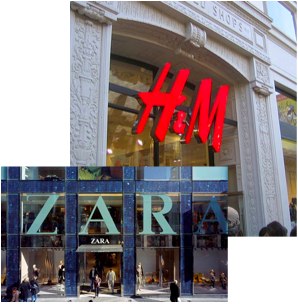 Time for a wee break. In the last week, I've been researching Zara and H&M a little, to better understand the retail-sector and the fashion-segment. I'll probably have to do a follow-up to this post, as there is lots to say about both businesses, but here's some initial impressions, nevertheless.
First off, H&M appears a lot more clean in its approach. Judging by the annual reports alone, H&M not only has a 2007-edition (Zara is only up to 2006), but it is also only 85 pages long (presented in an eco-friendly 2-pages-per-side way), while for Zara, or actually Inditex, it's mother-company, the annual report is a stunning 450 page long!
Now, that's really not all that surprising, as Inditex is composed of a number of companies, and it is extremely vertically integrated, while H&M employs the Nike or Apple model—it designs and it retails, but it doesn't produce.
Why this is so, I can only guess, is due to their origins. Inditex comes from Spain, traditionally a low-waged country, while H&M is Swedish, not a low-waged country. Similar to IKEA, I imagine it was an economical decision to outsource most of its supplies.
It's very hard to separate Inditex from Zara, as both are founded and owned by the same person, Amancio Ortega Gaona, Spain's richest man. Zara has been in existence since 1975. H&M was founded by a Swede, Erling Person, in 1947, who ran the company to ca. the mid-90s, but which has continued to be a family firm.
Their business-philosophies are fairly similar, a low-cost, high-quality approach to fashion, as opposed to traditional brands, where quality most often equals price.
Zara made lots of headlines with its extremely high turnover of products—it produces around 11,000 items annually (as oppsed to 2,000-4,000 for other retailers); 15-20% produced before, 50-60% at the start of the season, and the rest during. If a product fails to do well, it is usually removed after a week in stores.
H&M made headlines with its celebrity-marketing, which is noteworthy, as Zara has virtually no marketing. Instead, because it has such a high turn-over of goods, customers tend to visit it more often, expecting new things—an average of 17 times per year vs. 3 times for other stores!
Both employ mostly a wholly-owned retail-strategy, except in countries where this is not possible. And both are very advanced in their use of IT to manage logistics and production, which is definitely seems to be a key-characteristic of delivering fashion quickly and find ways to decrease costs.
H&M's largest markets are Germany, Sweden, the USA, Spain, and the Netherlands (in terms of sales). For Zara it is Spain, France, Germany, and Mexico (in number of stores).
That's all I can think of in 30 mins or less…
 Read it on Tech IT Easy!
 Just a short tweet.
I'm currently reading a Dutch book on the 2003 crisis at Ahold, but which is actually a historical account of how the corporation came to be. A couple of things I found interesting:
- Ahold actually stands for AH (Albert Heijn) Holdings
- We all know that things are cyclical, but it was interesting to read how a recession and high oil prices were a challenge that Ahold had to face in the 60s-70s, and how they managed to survive.
- In order to inspire Dutch people to shop more, they introduced a financing scheme for fridges, which people couldn't afford at that time. General Motors did a similar thing to help people afford their cars; seems like an interesting way to "upgrade" an economy.
- The fear of a socialist government drove Albert Heijn to look outwards and form Ahold (similar to why IKEA decided to globalise also).
- One of the consequences of politics at that time was the board of directors, meant to provide impartial guidance and represent the workers.
- They made extensive use of consultancies (often McKinsey) whenever they decided on a strategic trajectory.
- One of the directors was a big fan of Harvard Business Review :)
- They use the US as a source of knowledge on how to design their supermarkets. Later on, moving to the US was also seen as a way to increase that learning, as well as a new revenue-source.
- When AH moved to the US, they also brought their own ideas, like, eh, advertising (a terrible, terrible idea).
 The argument for mass-production is that it enables innovations to become cheaper and hence raises the general quality of life of consumers. The argument against mass-production is a more controversial one: that it destroys the unique quality of, let's call it, art.
Starbucks is a very good example of those principles. It brought a higher standard of coffee to the American masses, who, according to Howard Schultz's Starbucks biography, had long been oppressed by low-quality coffee from retailers and coffeeshops alike. At the same time, as the recent crisis at Starbucks illustrates, it has reached a saturation-point: it has brought Starbucks-outlets to every corner in the US, as well as spawned a whole army of competitors, and its brand has become diluted. It has become a commodity.
Back to their roots?
The re-enstatement of Howard Schultz as CEO is a signal, that the business has lost some of its original spirit and is in need of a guiding light. A letter that is rumoured (!) to be written by Schultz confirms that Starbucks will be focussing on re-introducing that original spirit, as hard as that will prove to be. There's only so much that you can change, after your company has reached a certain size. It would, at this point, be like saying that McDonalds is planning to become your corner-restaurant where everybody knows your name and favourite food.
The innovative angle
A friend of mine made me aware of a new coffee-brewing machine on the market, called Clover, which promises to deliver a higher quality coffee to consumers, though also at a higher price. According to Bruce Milletto, a retail consultant to the coffee industry, "a typical American café spends around $50,000 on equipment, about one-quarter of which goes on an espresso machine. At $11,000, a Clover costs the same again." Thus the investment-proposition is not an attractive one to the average cash-strapped café, who would have to spend that kind of money and charge an expected $6 per cup to recuperate that cost.
Following the rules of mass-production, Starbucks + Clover makes for a match made in heaven, and so it is: Starbucks has in fact acquired Coffee Equipment Company, the four-year-old Seattle-based maker of the Clover coffee brewing machine, for an undisclosed sum.
Considering that Starbucks has long been threatened by the commoditisation of coffee in the US, through the birth of literarily 1000s of new franchisers who, on the surface, provide the same value-proposal, though perhaps at a lower quality and price, it makes sense to acquire one piece of machinery that makes a bit of difference in the eyes of certain consumers. Considering the recent partnership with Apple, I believe that these consumers share a similar taste and price-insensitivity, and since that segment appears to be growing, I believe that Starbucks made the right call. They appeal to the type of customer that will pay $6 for a cup, and with their economies of scale, that price is sure to drop to a slightly more acceptable level of (I guess) ca. $5.
The cultural angle
There is another side to this. The USA is not the world, and while Starbucks has been thriving over there, the Europeans (I can't speak for other continents) have enjoyed a coffee-culture for quite some time. For people like my parents, who are respectively citizens from Southern- and Western-Europe, and avid café-visitors, they would not even consider going to the Starbucks in the centre of their German hometown, because there are plenty of alternatives with more atmosphere, more identity. To them, Starbucks is like a McDonalds, a franchise that in fact shares many cultural values—bringing a good to the masses—and does so by building ecosystems of services—from music-retail to the happy-meal—to deepen the (commercial) relationships with its customers.
Consciously and subconsciously, I'm a sympathiser of "unique" café-outlets. I like spending time in them, sometimes hours at a time, read my newspaper in peace, and enjoy a reasonably good coffee at slightly less than $2 a cup. I don't actually care about spending twice that for a coffee, but all the Starbucks's I've been too (exclusively in Germany and the UK, I must admit), have been so devoid of atmosphere that I don't really spend more than a few minutes there, 30 max. The only thing that does attract me about them and similar stores, is that I can grab a cup-to-go, mostly in the summer, and enjoy it out in the sun.
As a citizen of Europe, I think I am a fan of the heritage of the traditional café and don't really want it to go. If that makes me "backwards" or conservative, I am sorry. I want the chance to enjoy a Turkish coffee in Brussels, an Italian coffee in Cologne, or simply a Dutch one here in Rotterdam. I enjoy knowing the history of a pub that has existed for over a 100 years in Antwerp, and the same in Maastricht, or Amsterdam. I want there to be a diversity, and most important, I want that choice to be mine. I don't want there to be a cloned coffeeshop on every corner.
One of the saddest things I heard, while I was in Belgrade last year, was the exactly such a historical café was replaced by a chain (and the coffee stunk too); and I was equally sad to see that nearly all of the traditional retailers I remember from before the war had been replaced by a cloned shopping-centre that would've made any Western city proud: from H&M to Footlocker.
Opponent: Starbucks?
Globalisation is a situation we must all deal with. Its oldest proponents are the FMCG-companies, who are focussed on producing the same good for millions of people. The question is whether coffeeshops should embrace the FMCG-principles like McDonalds and Starbucks clearly have.
Starbucks is a formidable opponent: it is both a roaster, a retailer, and an FMCG-producer. It is strong in the US, and has a significant presence in the rest of the world. It will not go away, And not all believe that their presence is all that disruptive. I don't either, as long as Starbucks knows its limits. There are parts of the world that do not share the same qualities as US-towns. Some cities have long histories and places of heritage that should perhaps not be housing a McDonalds or Starbucks.
In a way cafés are stuck. They need the kind of innovation that Clover brings, but they are not in a position to buy their way in. If they did, they too would have to become mass-marketeers, in order to recuperate that cost. Instead they need to focus on what they do best, and coffee-machine makers to do the same and just license their technology. And whether the latter is able or willing to do that is the question.
I'm not sure how much Clover was acquired for, no one is. And I'm not sure how far Starbucks is willing to go to ensure their qualitative and quantitative dominance of the market. Will they grab every new piece of technology that promises to introduce a higher quality of coffee to consumers, keep it for themselves, and leave the traditional cafés to differentiate themselves simply by their "culture"? Sheer business-principles dictate that they will.
Howard Schultz made me believe, in his book, that it was Starbucks' mission to bring better coffee to the world. Let's hope that a richer coffee does not come at the price of a blander world.
This piece is in fact incomplete. Optimally I should write up a list of actions for coffeeshops to take. However, I am not yet that familiar with all the business-issues facing these organisations and all of my suggestions would be targeted at growing in size and battling on similar terms as a national or global player. And I'm pretty sure that many would not be willing to do that. So I think I'll wait until I have a more objective grasp—from all angles—on the situation, before giving practical advice. Feel free to provide me with that objectivity through your comments.
It's about a week before my birthday, and (Dutch) T-Mobile, as they do every year, decided to send me a gift. And, just like every year, I pretty much throw it out a minute after opening it. This year it was a pink tablecloth with joyful crap written all over it, last year I think it was an inflatable window-decoration, pink also, and I don't remember what it was before.
There's two reasons, why I respect T-Mobile's gesture: one, they make an effort and I appreciate the gesture; and two, they combine their gesture with marketing, which I respect from a business-standpoint.
That said, everything else about it is idiotic. I'm 30 years old, they know this, and I'm seriously not considering using a pink table-cloth. From my phone-patterns, they should also know that I'm not planning on throwing a big party. Had they bothered to do a simple Google-search, they would have known I run a few blogs and decided that this would be a better way to reach me.
They should have given me free cinema-tickets instead. Their marketing-value from the table-cloth is zero because I won't show it to anyone, and am instead calling them tasteless.
If they had given me a cinema-ticket, I would have maybe scanned and pasted it all over this blog, thanking them. At least a 100 people would've read about it and thought about subscribing to T-Mobile. Instead all they now see is this:
Welcome to the internet, T-Mobile.
 I'm still "on a break," but stumbled across this interesting titbit from a book on warehousing-practices. If you don't like reading lists, too bad because it's interesting, but I've also summarised the key-points in the end.
China
- Low labour and land-cost, but high equipment costs, translate into large (e.g. 250,000 square feet), low warehouses like in the US, but often lacking even a forklift.
- Certain goods like consumer electronics, are of such high value, have a short life-cycle, and thus a lower inventory-cost, that expenditure in state-of-the-art technology is justified.
- Certain cost-saving practices, like removing the pallets from shipments in order to ship more goods, cause some inefficiencies other countries, like, eh, re-adding pallets.
East Asia
- A traditional focus on personal relationships and less on computational models, means there's a lack of data and opportunities for improving performance are not well-developed.
- The most active economic areas are separated by lots of water, which means lots of product conveyed by air (for high-value or time-sensitive products) or ship (for bulky items or commodities). The high costs associated with this, are incentives to consolidate freight.
- Therefore, more strong regional hubs, like in Hong-Kong and Singapore, are expected to emerge.
Europe
- High labour-costs and an inflexibility of the work force have lead European warehouses to be more advanced in terms of automation.
- A growing common market will also lead to more economies of scale in the future, leading to larger, centralised warehouses.
India
- Characterised by cheap labour and land-cost, but relatively expensive capital costs (machinery and the like) and an underdeveloped infrastructure (both physical & administrative).
- The markets being supplied are generally local and not very wealthy, which leads to the SKUs not being high cost and there being little incentive to increase efficiency through capital expenditure (IT).
- Global demand means that larger distribution centres are being built around large ports like Mumbai (Bombay). The lack of land there is leading to high prices, comparable to Singapore/Hong-Kong.
North America
- Characterised by a culture of mass-consumption and a uniformity of the market and distribution infrastructure, which translates into large centralised warehouses and accelerating rates of product flow.
- Warehouses are often situated in the countryside surrounding metropolitan areas, which is cheaper, while being well-connected.
- A good telecommunications-infrastructure enables better supply-chain co-ordination; Warehouse management systems are generally advanced, and the rich data leads to better tracking and performance.
- High labour-cost are off-set by using cheaper migration-workers
Singapore, Hong Kong, Japan
- Due to a lack of land and high labour-cost, warehouses tend to be built high.
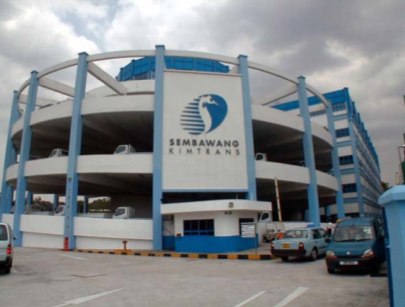
- Elevators are one bottleneck, caused by this style of building, however a Singapore warehouse has found a solution to this: A multi-floor facility with no automation or elevators, but, instead, a spiral truck ramp so that trailers may be docked at any floor (see pic). This does claim more land area, which must be recovered from above, and doesn't work well if trucks have to shuttle between multiple floors.
- While both Singapore and Hong-Kong act as hubs, Singapore is much more international, receiving goods from manufacturers all over Asia and shipping it to other countries; Hong-Kong receives mainly Chinese goods. Also, for the latter, many of the goods come in via trains and trucks, while leaving by ship or flight, while for Singapore it comes and leaves via sea and air.
South and Central America
- Labor costs are low, though not as low as in China, and the nature of its local economy and customers does not justify high equipment expenditure.
- The only exception is Mexico, which can quickly ship products to the US and keep its inventory low, thus justifying state-of-the-art technology.
Final thoughts
Some general conclusions can be drawn.
- Labour costs are a factor when considering automation; automation is a factor when considering optimisation; optimisation is a worthwhile expenditure when dealing with high value goods with a high velocity.
- Cheap land seems a fundamental advantage, looking at the logistical nightmares that Singapore and other high-rise builders must be experiencing.
- Access by land will significantly decrease the cost of transport. Generally, a well-developed infrastructure means more access to wealthy markets and enables warehouses to store high-value/high velocity goods, which is good for them.
The book 'WAREHOUSE & DISTRIBUTION SCIENCE,' which is available as a free download, provides some incredibly detailed info on how to effectively set up warehouses and distribution chains. Well worth a glimpse, if not more.
Cooking is ingredients!… it's timing!… it's cleanliness!… it's… … …restraint!
 These are just a few of the tips that Gareth Blackstock, chef at Le Chateaux Anglais, and lead character of the British comedy-series "Chef!," delivers to his staff in a kind and gentle manner… not. Even after re-watching this show 10+ years later, I'm still not sure whether Lenny Henry's portrayal of the angry chef is meant to be a realistic, or rather a satiric look at what goes on in these kitchens. The effect it's had on me, in any case, is one of silent terror when I think of kitchens in 2-star restaurants.
There's no denying that, generally, the world of HoReCa consists of flat hierarchies; there's the boss, either the head-manager and/or the head-chef, followed by some type of administrative class of underlings, and finally those that Gareth Blackstock likes to call
"There's the aristocracy, the upper class, the middle class, working class, dumb animals, waiters, creeping things, head lice, people who eat packet soup, then you.."
If you're thinking of high-tech start-ups in the IT-world, multi-star restaurants are their equivalent in the HoReCa-world. Competitive advantage in technology comes from both products that are differentiated enough from the competition and processes that enable a business to produce these products at a sufficiently low cost and high scale to reap a profit.
In restaurants, this is embodied by the chef, whose training, experience, personality, and, I guess, raw talent, inspire fear in all of those around him, especially the ones that feel his wrath. It is an innovation machine difficult to replicate, comes at a high price and is not for the faint of heart.
Everything else: coming up with a business-plan, talking to investors, setting up the site, buying the materials, hiring the people, getting customers to visit, etc.… seems easy, compared to finding, keeping, and managing a good chef. Because as soon as the chef finds out that he is the one that keeps the ball rolling, he is the vital cog in the machine, he will likely fire you as a boss and replace you with one of those people, generally found under head lice and packet soup.
So there you have it; I don't write about cuisine, same as people generally don't think about starting a business in space-flight. They are both sciences reserved for an elite pioneering-class, one that is fearless and willing to risk the laws of nature in order to succeed.
The role of the internet for the retail of *physical* goods.
0 comments Posted by Unknown at 9:01 PMOne of the stories, I covered last week in my links, uncovered an interesting statistic. Only about 3% of retail sales in the US happens online. I don't think these stats are at all coincidental. While I see a bright future ahead for the online retail of media-products, I find that what the internet cannot provide, is the "closeness," that is sometimes needed for evaluating certain types of goods, like food and clothing. I have commented on this before, implicitly, with a post on the web as a third place, and about the lack of cohesion that Facebook provides.
At the same time, as The New Yorker story reports, what the internet has changed is how we shop; it is much easier to research and comparison-shop than it was before the internet-days. A survey by Accenture found that ca. 66% of those surveyed compared products online, and another study showed that the internet played a significant role with ca. 75% of electronics purchases.
IInnovate has an interesting podcast interview with Scott Dunlap, CEO of NearbyNow, which has come up with an interesting way to exploit the informational advantages of the internet and mash that with the qualities of physical shopping. Following short video shows how their service works:
Clearly technology has evolved a lot in the last few years, making this possible. NearbyNow works via the web and via mobile. I'm not sure if they are using any location-tracking & matching services, but certainly they are heading in that direction. On the retailers' side, there is plenty of technology that makes this possible also. Electronic inventory and point of sale systems allow both for the checking of stock-levels and for consumers to reserve items to be picked up and tried on at a later date.
One issue that entered my mind, is that of efficiency. The way NearbyNow operates is through malls in the US, most of which are, as I found out, owned by 6 major companies across the nation. US's scale-economies win again! In Europe, the situation appears a little different. Culturally, linguistically, technologically, and legally, it is a much more fragmented market, with far fewer malls also, and that may make it difficult for a unified service like this to operate as efficiently as it would in the US.
There is also the issue of too much transparency, which is worrying to some retailers, and addressed in the podcast-interview. But what does seem certain is that this is exactly the type of service that consumers value, and as such one that any consumer-centric business should encourage.
Will a service like this ever replace shopping in its entirety? No, I'm essentially betting my future that there are plenty of qualities *real* environments will continue to offer over virtual ones. But there is no reason, none at all, to try to integrate the good qualities that the web does possess—information at your fingertips—as elegantly and effectively as possible into those experiences.
 One of the things I do on this blog is deciding on the potential of industry-segments, ranging from farming to coffee-shops, and from grocery to other types of retail. On Tech IT Easy I've previously expressed my scepticism at media (in which I include text, art, audio, video, and gaming), especially in terms of business-models, which I think that segment lacks.
Equally so, I see fairly little space for it in the physical retail segment, simply because it is so much more convenient to purchase and consume it via digital means. The PC (and other tech-gadgets) have essentially become the hub for all things media, and creating barriers to that experience just leads consumers to pursue more convenient ways of experiencing that media. That search for convenience is something that I've also approached in a previous post on this blog.
Let's look at some media-types and how they are being sold online.
For Video - there's iTunes, consoles, and set-top boxes that are controlled by media-producers. In any case, the power-differentials between producers and intermediaries is very unbalanced and it isn't a nice segment to enter as a retailer. Also, let's not forget the free alternatives: YouTube et. al and piracy.
For Audio - again iTunes, Rhapsody, and Amazon MP3 Store, but also smaller digital store for independent artists, like CD-Baby (which operates through iTunes also). Let us again not forget piracy and the fact that much of music is being produced through digital means and it makes sense to organise distribution that way also.
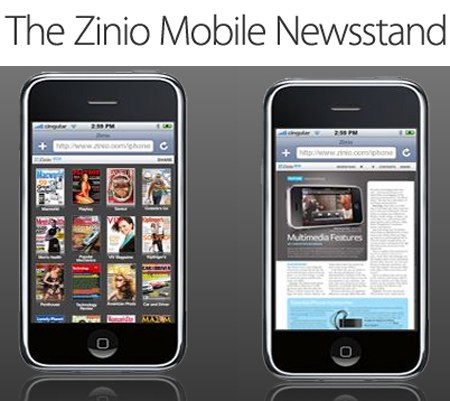
For text - there's again online outlets like Amazon for eBooks (Kindle) and Zinio for magazines. And let's not forget that 99% of text-based media is viewable for free online. Still, admittedly, electronic devices for consumption are not yet able to compete with paper-based methods, at least where price is concerned. Also Audible should not be forgotten as a source for audio-books, recently bought up by Amazon and partially distributed through iTunes again.
For Gaming - I'm not too familiar with the online market for this one. Even so, there's Steam, a digital distribution system by Valve, a platform which they recently opened up for use by other game-publishers. There's also plenty of smaller games being distributed through Xbox-live, the future Playstation Home, and of course the internet.
Finally, Art - here the situation is more complex, while on the other hand being relatively simple. It is complex for artists like my mother, who paints, and conducts business on a personal level by interacting with her customers. On the other hand, there's photography and digital art, arguably the evolution of traditional art, which is easy (for some) to produce digitally and distribute online. I suppose every industry has that friction between the traditional way of doing things and "the new way."
All in all, I don't see media as a big cash-cow for physical retail. I like to think that, because production and distribution becomes cheaper, that its cost will eventually fall to a very low price, allowing for it to be included as an added-value component in the service-proposition of physical retail-outlets (to which I also include restaurants, etc.). I also like to think that creating environments that make the consumption of media a comfortable process (e.g. cinemas) also has some potential.
But my outlook for selling media as a product, something that could easily be sold digitally, remains bleak. Please let me know if there are arguments against my point of view, as I'm here to learn.
5 links—retail-saturation, RFID's costs, elements of fun, tricking shoppers, & home-cinemas
0 comments Posted by Unknown at 10:41 AMIt is time for those links again! This time, we'll be discussing the economics of Apple's physical stores, how Walmart is enforcing RFID, how retailers are trying to trick people to buy more expensive things, how people perceive fun in games, and 10 ultra-geeky home-cinemas.
As usual, my bookmarks can be found here, and the previously covered links, here. Enjoy!
Link 1: Why is Apple saturating (US) cities with retail stores? is a question that Choire Sicha asks on Kottke.org, and lead me to this profit & cost breakdown of Apple's retail stores at Seeking Alpha (see pic below). It does appear it's all about the money, though hard it remains to read Apple's mind 100%. In related news, OObject lists all the items needed to build an Apple store.
Link 2: Is RFID economically feasible? I'm planning to dedicate at least 1-2 posts on RFID on this blog in the future, as I've essentially been following its development since the early coverage on Slashdot. This story on InformationWeek discusses the pressure that Walmart, certainly the biggest champion for RFID in the retail-arena, is putting on its suppliers to finally add RFID into their logistics-chain. As far as I remember, the latter have been complaining about the unfair balance of cost that RFID causes, shifting most of them onto suppliers. I assume, however, that these chips and pallets are reusable.
Link 3: What makes games fun? Lightspeed Venture Partners has an interesting blog, which mostly discusses the business and principles behind digital games. I follow it because games are fun, and if you can understand the source-code of fun, you can replicate it elsewhere. In that spirit, then, it links to an interesting white paper trying to map out what exactly goes on in gamers' heads while playing games. Part 1 is also very much worth a read.
Link 4: A buyer's christmas? The New Yorker digs into consumers' buying behaviour. Interesting is, that people use the net most often to find info, not to buy, but can use that info inside stores (we'll still need ubiquitous internet for it to be shoppers' utopia, however). Equally interesting is, that if a store has two microwaves, consumers will usually buy the cheaper one. With three products, however, they will usually by the mid-priced one. There's still room for trickery, I guess…
Link 5: 10 stunning ultra-geeky home cinemas. In the spirit of my previous post on cinemas & luxury, I thought that this link would be fitting. The Star Trek-themed one is a little too geeky for me, but the Titanic one (no. 6) looks awesome. I'm still doubtful about whether it's about the design or about the movie, but I can't deny that people put a lot of work into designing these.
I'm writing today's post mostly as a way to relax me. I've been in a bit of a panic these last few days because my main machine, my trustworthy mac, is giving me kernel panics and I'm in the middle of a project. It's not a nice feeling, and any repairs, I've been informed, are bound to take 10 days. So, blogging to relax, yes, but don't expect regular ones, especially considering this machine can "explode" at any time.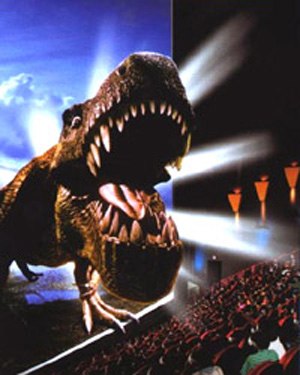 NYTimes recently wrote about a strategy employed by US cinemas to draw in more people. I quote:
"Reserved seating, plush rocking chairs and made-to-order food make Mr. Redford’s Sundance Kabuki theater feel more like a restaurant than a traditional cinema. It also has a 50-foot-high lobby with live bamboo, a glass atrium and reclaimed wood walls. Here, a night at the movies is less about enduring the hordes at the mall and more about feeling pampered."According to the article, big US-chains are building such upscale cinemas to draw people back into the experience.
While I am a big fan of the cinema-experience and actually worked at exactly such a venue, years ago, as a cocktail-mixing barkeeper, I think there are several reasons why such a strategy won't work.
The nature of movie-viewing (1): regardless of how luxurious a place like that is, you'll still have to sit in a dark room and won't actively notice the luxury or people around you, except for before and after the movie. The reason why people like dining in luxury-restaurants is because of the luxury, yes, but also because you share it with a group of people. In cinemas, luxury is not an emotional draw.
The nature of cinemas: cinemas are still very much in a mind-frame of providing experience of the masses. That manifests itself in a McDonalds' mentality of serving guests standardised services, having a lot of seat-rotation, cleaning big rooms (badly) in less than 10 mins, etc. It's a lot of little things, but they add up to a reputation for mediocrity, and people really just come to view the movie and be with their friends.
The nature of movie-viewing (2): YouTube, the internet, modern lifestyles, etc. have created different viewing-patterns, and there is a much greater focus towards viewing media in bursts. I think that the cinema-industry thinks that it is competing with some kind of emulated experience at home, but I don't think that's generally the case. So what are cinemas competing with and should they compete with it?
Luxury is not mass: Cinemas need masses of people coming in, and luxury cinemas actually only aim to address the (imagined!) needs of a few. In my opinion, it is not a customer-focussed strategy, and is for that reason alone bound to fail.
What should cinemas do?
Now, I'm not all against a certain level of luxury. I like comfortable seats as much as the next guy and I'd love a good cocktail every once in a while. But I think standards should be upgraded throughout the cinema, all the way down to the lowest seats, and that everyone should have the option to get a cocktail (if they have the budget).
There's two main selling-points for cinemas, I think, and those are timing and technology. They are still the first to air a film (ignoring piracy), which will hopefully not change. So, for blockbusters, cinemas reign is pretty much guaranteed.
Apart from blockbusters, there's something special about seeing indie movies in cinemas, which I include into timing. I'll never forget watching "Howl's moving castle" in the cinema, it was a magical experience, one that I could never have at home.
As far as technology is concerned, admittedly we are in an age where big screens and high-def visuals and sounds are becoming commoditised, though no one is as yet planning to install a 50 ft. screen in their house, afaik. I do think that cinema-technolgy should be upgraded, all the way to the point of the IMAX-experience.
Admittedly, there are some problems with 3D-tech. It increases the cost of producing a film and won't translate well to home-viewing (I think). But my point is that cinemas should keep differentiating themselves technologically.
People is a third selling-point, though I think that unless you like going with 8+ people to the cinema, you will be able to emulate that at home.
As far as luxury is concerned, again the basics should be present, and cinemas have to make money, but cinemas would become a lot more popular if they kept the price of seats down, increased the quality of service, and charged what they charged for luxuries. The one thing that I can't stress enough is staying a leader in technology (video & audio) as that is truly where the emotional draw for cinemas comes from.
But maybe I'm wrong!? Feel free to let me know in the comments.
5 links - cool vs. tech, touch-screens, women, pizza, & bookstores
0 comments Posted by Unknown at 12:09 PMMan, I collected so many links, that I'll probably have to write three updates to cover the most important ones. We've got a lot of ground to cover, so let's get started. You can find my previous coverage on interesting links from the web, here, and my continuous stream of bookmarks, here.
Link 1: On Magnetbox - Correlating cool with tech - With pictures like the one below, my work on this blog is really done. Interesting is the rise of computers vs. dance & hip-hop music (both of which are hugely benefiting from the cost-savings made possible by PC-based studios. (A note: low industry-barriers = high chance of suckage!). Also note the fall of art, after the colour TV was introduced. Kottke also made some comments about it.
Link 2: On BuzzFeed - Touch-Screen Ordering - BuzzFeed presents us with some stories about automatised ordering. There are both advantages and disadvantages, I think. Good is that it minimises errors in ordering and can interface well with back-office operations, such as ordering new supplies. It might also fit with the individualistic preference for self-service, I wrote about before. The disadvantage is the cost and the margins of error that information systems bring (I still shudder at the thought of the LAS disaster (pdf)) + the lack of the human factor. Martin Kunzelnick (German) links to some videos of Microsoft's Surface in a restaurant-environment.
Link 3: On Lightspeed Venture Partners - It is no accident that Typhoid Mary was a woman - Although it's a horrible-horrible title, and perhaps an obvious point, I've been coming across many stories about the social qualities that women possess, making them better at PR, marketing, sales, relationship-building. Something to keep in mind for any people-based business.
Link 4: On Reuters - Pizza Hut rolls out nationwide mobile ordering - A news-item (finally), and I'll probably delve into this topic sometime in the future. Arguably, Pizza Hut has been pursuing a different strategy from pretty much 98% of the pizza-restaurants out there. I'm sure that there is considerably brand-loyalty towards Pizza Hut, which will give it an advantage over delivering pizza-franchises, HOWEVER, it will probably be competing on price, which the franchise has not done so far. I'm not sure how that will affect their brand at all, but it's something to keep an eye on.
Link 5: On WSJ - Who's Buying the Bookstore? - arguably, there are few retail-outlets that evoke such an emotional response as bookstores. I find them comforting, and very similar to churches, in the way that it really is expected of you to be silent while browsing (on a side-note, I discussed a link of Dutch bookstore being opened in a church before). It's also a symbol of a community, as WSJ points out. Well, with competitive pressures from Amazon et al., these types of stores are clearly disappearing, or changing into hybrid monsters, which smaller stores can no longer compete with. WSJ points out a phenomenon related to that community-spirit, which is very touching. Capitalism isn't everything, particularly in places that target the softer pleasures in life. I'll have to reflect more on this, as I'm very attracted to these types of stores, and would love to set one up myself.
That's it, for this week. I'll see how I'll catch up on the rest of my links, but this went great (took 20 mins), and I always enjoy re-reading my bookmarks. I hope you do too.
What's the biggest pain in your industry II - Carbon emissions
0 comments Posted by Unknown at 11:17 AMContinuing from part I - obesity, this post will be equally light as I have "♫ my mind on my money and my money on my mind… ♫" Or something to that effect.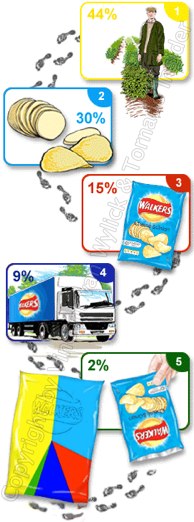 According to a carbon-emission calculation of PepsiCo's Walkers crisps, the majority of carbon emissions come from the production of raw materials (44%) and processing thereof (30%). A Dutch magazine, Tijdschrift voor Marketing, attributes the majority of the carbon footprint to transportation of said materials, and forms the conclusion that more and more production and consumption has to happen on a localised scale.
Even though the makeup of those figures may be open to interpretation—there is no breakdown about what in the first 44% is due to actual farming and what to transportation—perhaps, Mr. Kuiper, the author of that piece, has a point.
In a TED-lecture, James Howard Kunstler argues that the 'hydrogen-economy' is a pipe-dream and we must start thinking about creating urban environments fully equipped with the means of production, transportation, living, and waste-disposal, all in one. Very inspiring, though clearly requiring significant paradigm- and resource-shifts from today's globalised economy.
Clearly transportation comes at a cost, the question is how much the alternative would cost. Building super-farms, creating artificial climates to grow exotic food, waste-disposal, dealing with virus-outbreaks—regarding the latter, farmers already have problems dealing with chickens, sheep, and cows now, let alone having to deal with something like Kunstler's utopian vision—all of which represent costs that have to be accounted for.
But, I don't want to sound like a pessimist. I actually love the idea of a super-farm and a super-urban environment, regardless of the monetary cost. I'm sure plenty a sci-fi artist has tried to draw such a very thing (as have I). It's complicated, expensive, but exciting at the same time.
Asking you a tough question: How would you do it? What would a Kunstler-inspired localised economy look like to you? Is it even possible? … well, something to think about anyway…
Premise of this post: I'm going to get my camera fixed, for the second time in 3 weeks, at a store called Saturn. It is, as far as I know, the only other German chain focussed on consumer-electronics in the Netherlands, next to Media Markt, which is clearly the no. 1 here and in Germany. Ironically, while they appear as competitors to the consumer, they are owned by the same concern, Metro Group.
Now, I don't know the exact reason behind internal store-competition. The only company I worked for, where something like this was the case, was Sony, who allocated annual budgets to individual departments based on their performance. Reminds me a lot of the way governments are run. Of course, bureaucrats have a job for life.
While I was at Sony, I've never seen so many departments closed and managers fired, and both physical locations where I worked in Germany & the Netherlands, are no longer in existence. To a large part, in my opinion, this explains the troubles that Sony is in today, many of which are a disconnect with its audience and, very likely, caused by disconnects within the gigantic company also. But… that's a story for another day.
The other area where I know about examples of internal competitions, are product-lines. Didn't Steve Jobs once say (paraphrased): "If anyone should take marketshare away from one of our products, it should be Apple." I think that this is a conscious decision of Apple and I briefly touched upon it at Tech IT Easy, in regards to form-factor of the Macbook Air (MBA)—the screen, hard-drive, and CPU, which very much overlap with (read: fit into) other products that Apple sells, and, to me, represent economies of scope and scale to the company. It doesn't matter if the MBA sells or doesn't, what matters is that component costs will go down and innovation will go up, which is good for Apple.
Now, none of this really answers the questions why Saturn and Media Markt occupy the same market-segment. And, I have to confess, I just opened my Retail Marketing book to find the answer, and couldn't find it (the book is apparently not focussed on business strategy much).
Both Media Mark & Saturn offer similar features to customers, which are mostly represented on the chart below: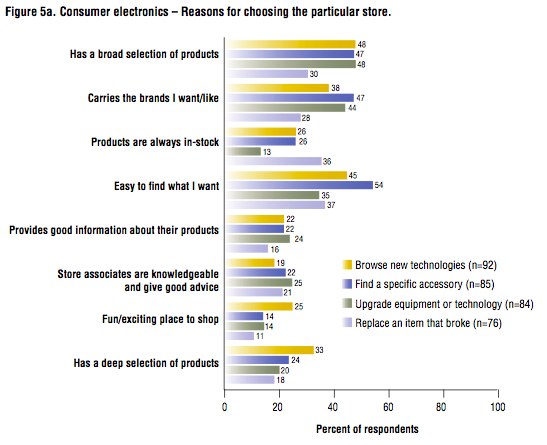
(Source: IBM white paper - "Deeper Customer Insight," which I wrote about several times before)
Some differences are perhaps that Saturn was most often located within another Metro Group-owned store, called Galeria Kaufhof, though I think they are changing that strategy in Germany, and certainly in the Netherlands, where they are stand-alone. Media Markt, as far as I know, has always been stand-alone. Both facilities are rather large, offer parking-facilities, and are usually located within the city (though in Rotterdam, Media Markt takes a more prominent place). And prices, promotions, and brands, while similar, differ in certain areas.
From this, I think it's safe to conclude that market-saturation is a clear goal of Metro-Group. By giving customers not one, but two large options, with separate deals to be had, at separate locations, etc., it appeals to an implicit customer-demand, that of choice, and takes attention away from other, "lesser," and certainly not Metro Group-owned choices.
Something else that is interesting, is mentioned on both companies' websites. Both chains are very decentralised in their management-structure. Every store acts as a self-sufficient enterprise, co-owned by each director, who, with his/her team, is responsible for how the store is run, and ultimately, how successful it is. Kind of sounds like a franchise.
So, I can only conclude that the internal competition paradigm is very much similar to that of Sony's, to force individual stores to perform better.
I think it's an interesting strategy and clearly Metro-Group is the winner here. How this plays out for individual stores and their share-holding directors is uncertain and clearly depends on the skill-level of store-management and the level of support given by their parent-company.

- Cordless earplugs that are also headphones - imagine going to bed and blocking out your partner's snoring, and waking up to the sweet sounds of […insert your sweet sound here…].
- Fluorescent permanent marker - to convert my non-pro Apple laptop-keyboard, into one that lights up in the dark.
- A binder/folder that allows me to bind printed web-articles into an easy to read non-webzine.
- A mobile (!) pad that allows me to draw on paper, which stores these drawings electronically, and allows me to later transfer them to my computer - saw this somewhere for €80, always regret not buying it.
- Some kickin' clothes.
- For my Laptop and iPod to last me through their 3rd year.
- Anything on my wish-list.
For 2OO9
- An Apple laptop that is as light and as thin as possible - So no disk-drive as that can be external. 3-4 USB-ports to compensate would be nice.
- The next OS (10.6 or 11.0) from Apple.
- An iPod with a nice screen and no phone - for music, video, books on the road.
- A small car (unless I live in a big city, then a good rent-a-car service).
- Orexin A.
- More public wifi / or a pan-European service.
- A Wii / DS and time to play it.
- Some kickin' clothes.
Amazon's Jeff Bezos on strategy & innovation (not Kindle-related!)
0 comments Posted by Unknown at 1:44 PM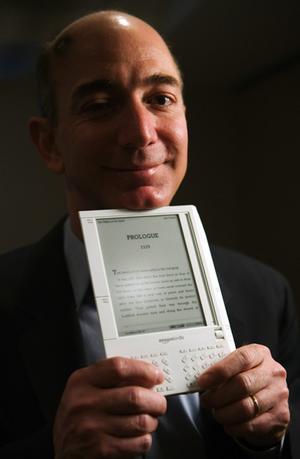 I'm writing this post for two reasons. One is that I am incredibly interested in the subject of leadership and try to learn about it in whatever way I can. A second reason is that, even though my main focus on my blog is food and retail, what Matthias calls "old economy" (thanks Matthias!), I try to also be very aware of "the past, present, and future of this industry," and (internet-)technology plays very much a part in the future of retail.
In terms of leadership, Amazon's Jeff Bezos is a good person to study—a man who created perhaps the most iconic garage-based venture since Apple, and who managed to not only take his company, Amazon, public, but also stay on as CEO until now, something that is rare amongst founders. In terms of retail, Amazon is itself great company to study. It has transformed the book-industry, and is doing amazing work in terms of providing infrastructure for web-based infrastructure. And, even though they are not as yet selling any books in the Netherlands. I'm hoping that SEPA, to be introduced next year, will change that.
Before I continue, this is not really a Kindle-related post. While we're on the subject, however, let me say that I'm a big fan of ebook-readers. At the same time, there are certain advantages to paper-reading, which I'm especially experiencing since I started my own blog—namely that I can write on them. I know I can take notes on Kindle, but it's not the same. And I think the price-point of either the device ($400), or the books (a $10 intro-price), or both, is just too high for something that can be produced in mass and has no printing-, and hardly any distribution-costs attached to it.
Speaking of notes, I took some while reading a nice HBR-interview with Jeff Bezos, in which he discusses his take on strategy, innovation, customers, ... and not Kindle. I'll share these, and my thoughts on them, with you now.
Innovation at Amazon
There are generally two types of innovation, the radical kind and the incremental (or process) kind. My general belief is that, while retail on the internet radically transformed the way we shop, and will continue to do so, ultimately it is an evolution in process. Instead of giving our credit-card to the clerk, we type in a number behind a screen, etc. etc. And, since the internet has taken off, this kind of process-innovation has become much more prevalent. Now, instead of clicking 5 times to buy a product, I can click once: yay! Before you ask, "so what is 'radical' innovation to you?" I'll just say: "Space, flying car, people living under water, that kind of stuff. So get busy!"
Amazon has of course just announced the Kindle, which could be interpreted as an innovative move. But again, what will make this innovation shine, if it does, is Amazon's incredible process-strength, namely that they can deliver the device to nearly every household in the Western world at beautiful economies of scale. For now, these are paying of for Amazon, but knowing their business-model, it's pretty certain that this will pay off for consumer too… eventually.
What I like about Amazon (and got from the interview) are that they have an incredible experiment-based culture and generally take a long-term view—both rare with public companies. In terms of experiments, these are encouraged on a company-wide level, and due to the nature of experiments, are both had to predict and not unknown to fail. One example of an experiment which became an enormous, but unplanned, success, is the Amazon-associates program.
As far as time-frame is concerned, innovations at Amazon usually take 5-7 years before they make any meaningful impact on the company's economic situation. This is a big risk and is offset in a number of ways. One is to minimise the costs of experiments. Amazon has a web lab just for that purpose, which undertakes these experiments on a massive scale, collects real usage data on what works best, and is constantly trying to push the costs of these experiments down. Again, taking a long-term view, it helps when building innovation on things that won't change in the next 5-10 years. For Amazon, these are basic customer preferences, such as: choice, low prices, and fast delivery (hello Kindle?).
There are three more core-attitudes, which I think have a big impact on the way innovation takes shape at Amazon. One is, to always ask the question "why not?" According to Bezos, the biggest mistakes at Amazon come from not doing something, rather than taking the risk. And asking "why not?" instead of "why should we do it?" opens up a whole other universe of possibilities. Similarly, there are lot of difficult decisions that Amazon has had to make over the years, such as allowing reviews on their site. The vital question there was "what is better for the customer?" Last, but not least, I like this line in regards to making experiments a success: "Be stubborn on the vision, and flexible on the details."
Strategy at Amazon
The other part of innovation is execution, some of which was already discussed above. Much of decision-making comes out of the way a corporate culture is shaped. Some cultures are hierarchical, some are flat, some are individualistic, some are collective. From my understanding of things, Amazon has both a departmental structure (which would suggest some hierarchy) and takes decisions collectively. Both senior management and departmental management have mechanisms through which this collectivity manifests itself. Seniors meet once a week for four hours and once-twice a year for a two-day meeting. Homework is assigned before and the latter type of meeting deals mostly with long-term issues. Department-management has a similar system.
Some more general characteristics of corporate culture were mentioned in the interview, namely that they can be incredibly stable over time, and are self-perpetuating in the sense that they attract people who like that culture (and repel those that don't). While a company's corporate culture is probably the hardest to replicate, and can thus be a tremendous competitive advantage, the rigidity of the culture can both mean that there are limits to what it can do (and should do), and it can sometimes hamper innovation during turbulent times. At the same time, a culture can by nature be open to change, which should overcome some rigidity.
A few weeks ago, on my blog, I wrote a post on Porter's five forces in which I outlined what I think matters in strategy, but also that it pays off to stay close to customers. Jeff Bezos shares a similar view-point, for a number of reasons. One, customer-needs change more slowly than a lot of other things, e.g. tech; and two, following the competition doesn't work well in fast-changing environments, e.g. tech. A third point is that being too competitor-focussed can result in a passive attitude once a certain dominance has been reached in an industry. You can argue about this either way, but when you look at certain large companies (no names), this "hey, we won, so why innovate?"-attitude, is definitely one that is recognisable.
One way that Amazon tries to stay close to customer-needs is by enforcing rotation. Every new employee has to spend time in their fulfilment-centres with the first year, every two years, employees have to do two days of customer service, and everyone has to be able to work in a call-centre. That includes Jeff Bezos.
Finally, he also had some advice as how to survive the transition from the founder of a start-up, to the CEO of a multinational, public company. It's simple (yeah right!). When you start, the main question is "How?"; as you grow, the question is "What?"; and when you're huge, the question becomes "Who?" There you go, the secret to being the leader of a big company.
Final thoughts
One of the weaknesses of secondary information, such as what came from this interview, is that I (and you) have to trust everything that is in the article. I can't ask follow-up questions and can't tell, by body-language, tone, or otherwise, whether some points are more important than others, or more true than others. Therefore I try to be careful to treat each piece of information as part of a greater whole. In other words, I may come across information that conflicts with what Bezos said in the interview. If it's noteworthy, I'll write a new post about it. One piece of important data, released perhaps a month after the interview, is the release of Kindle, which, as mentioned, I am sceptical of.
Two things I learned from the interview is that innovation takes time, especially to make it economically viable, for both the business and the consumer. In my opinion Kindle, in order to fit the philosophy of Amazon (which is not Apple after-all), has to drop in price, as do the books. It's a matter of ethics, of being customer-focussed, and of being a process-innovator. I can only assume, that over the next years, this is exactly what will happen.
The other thing I learned is to constantly be open to innovation that can benefit the customer. This point has been made many times in the words above, yet it bears repeating. A company can be incredibly rigid, the bigger it becomes. Competition can become incredibly threatening. Technology can change from one day to the next. But what doesn't change is that customers will pay you for products that make them happy. And I fear that a lot, a lot of businesses have forgotten that as they became big, arrogant, and focussed on anything but what customers want.
Finally, while I may be focussed on "old economy" topics, I think Amazon teaches some interesting lessons on how to remain high-touch in a high-tech environment. As such, this certainly won't be the last time I touch upon the topic of technology in retail.
Further reading
If you're interested in the topic of leadership, you mean also want to check out a list of free podcast-interviews with a number of CEOs, ranging from Google's Eric Schmidt to, indeed, Jeff Bezos, which I posted on Tech IT Easy a few months ago. Worth a listen. Oh, and don't forget to check out the original article on HBR.
This article is mirror-posted on Tech IT Easy.

There are few things in this world I hate more than electronical problems. Yesterday, I had a new harddrive installed in my Mac-laptop. I could have done it myself, but, by my estimates, it would have required me unscrewing and rescrewing approximately 40 screws. So, no thanks! I was in Germany on this occasion and gave the shop my mobile number. The only problem, I found out later, was that my phone refused to roam.
While I was waiting, I saw some beautiful atmospheric places, which I wanted to photograph. Only on that day, my neverfailing camera decided it was a good day to never turn on again... great!
When I came home, I tried to install OS X Leopard (the new Mac-OS), but it somehow screwed up and I was up until 2 a.m., trying to fix it (i.e. re-install). Along with that, my new harddrive makes some strange popping sounds every five minutes, which I unsterstand is a software-issue, but since this drive was advertised to be quiet as a mouse, it's annoying nevertheless.
So, yesterday could very well be described as bland and just plain uninspiring. I'll take a few days off from this blog, to focus on the essentials, and will hopefully be back in full force by this weekend.
HBS Working Knowledge, in an article on lean principles in services industries, lists the four principles that the Toyota Production System is based on:
Rule 1: All work shall be highly specified as to content, sequence, timing, and outcome.
Rule 2: Every customer-supplier connection must be direct, and there must be an unambiguous yes or no way to send requests and receive responses.
Rule 3: The pathway for every product and service must be simple and direct.
Rule 4: Any improvement must be made in accordance with the scientific method, under the guidance of a teacher, at the lowest possible level in the organization.
I love stuff that saves me reading a whole book, but would this work in a food / retail environment? I can't say 100%, but I can hypothesise.
Let's take a restaurant or coffee-shop. The way I see the information-flow is in the shape of a funnel, which is wide on both ends and quite narrow in the middle.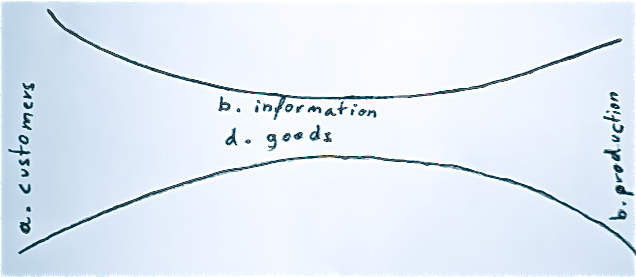
(If the words are unclear, it's, from left to right, a. customers, b. information, d. goods, and b. production (though the last should be c.))
Essentially:
- customers have a ton of choice when they order
- they narrow down this choice to their selected items
- pass it onto the waiter
- who passes it onto a kitchen
- where another wide selection of ingredients is narrowed down
- and the end-product is produced
- which is again delivered to the customer.
Rule 1 - Specification of content, sequence, timing, and outcome?
Content is the stuff on the menu, which can be set to a limited number of choices, matching the availability of ingredients in the kitchen. Sequence are points a to d on the picture. Timing is an unwritten agreement between the customers and the food-place that their order will be delivered as quickly as possible. Outcome will be the satisfied customer (who will pay for his order).
Rule 2 - A direct customer-supplier connection / yes or no communication?
Again, this should be possible, by making the menu as transparent as possible and the kitchen organised to produce pre-specified combinations quickly. As for the direct connection, there are several ways this could be happening. A low-tech way would be a number associated with an item on the menu. Little miscommunication can happen on the way to the kitchen. One high-tech way being used right now is electronic notepads, which communicate with the kitchen or bar. I'm not a fan of it, because I think it erects a barrier (of slowness) between the customer and the waiter, but ok, it's a somewhat direct link. Another way could be to simply give the customer an electronic menu. It works online, why couldn't it work on a food-venue environment? The customer presses some buttons, the kitchen gets the order, the waiter delivers or the customer picks it up. Simple (but probably expensive).
Rule 3 - Simple / direct pathway for every product or service?
I'm a little confused by how this differs from rule 2, so I'll probably have to pick up the book after all… damn.
Rule 4 - Bottom-up scientifically co-ordinated improvements?
The key to successful growth is writing a manual / formula that can be reproduced over and over. If you can capture the components of quality that distinguish your venues from competitors, you can take over the world. What this rule means to me is that with a manual should come expertise, and this expertise should be used to train people from the lowest level upwards. The lowest level in the restaurant-scenario is the customer or the customer-interface. Placing experts in that vicinity, ensures a good bottom-up approach and improvements that are targeted at improving the customer-experience. This will also provide quick feedback about what could be wrong in other parts of the supply-chain, e.g. the communication, the timing, the quality of the food/drinks, etc.
Final thoughts
Now, of course, I won't pretend that these four rules are a replacement for me learning more about lean operations. I'll definitely be picking up The Toyota Way, to grasp the more subtle nuances. This was simply an exercise to see if lean principles can be applied to other—non-car—areas. I think they can. At the same time I don't think that leanness is necessarily an excuse for frugality either. It simplifies operations to focus on other areas instead, like e.g. improve the end-product quality for customers.
 It's time for another monthly summary (a few days late). This time, rather than the rather unattractive list-view which I used for my month 1-summary, I'm going to try turning the past month's posts into a little story. As I wrote, this blog is my way of learning about this industry, so let's take a look at what I've covered so far.
The Human element
I started the first post of month 2 with one related to self-development, and I kept that thread going for a while. This post was on the the way that leadership has evolved throughout society, from an individualistic to a social kind of leading. A lot of developments today, in business, politics, or other arenas, are so complex, that a form of collaboration is more constructive than tyrannical leadership. This is perhaps made clearest in in the example of Ikea and eBay, who—often by necessity—used collaborative methods to develop and introduce new features and innovations.
Again related to self-development, I also looked at particular careers in retail (with a nice chart) and in knowledge-based firms. Apart from simply researching the functions out there, my conclusions were that different roles require different talents, and that a manager/founder/entrepreneur should take care to surround himself with a diverse kinds of people. A similar point was made in a post on doing what you do best. Again, in the eBay-post, I discussed professionalising your firm quickly, by bringing in talent that can help in growing the business.
The strategic lens
A second big thread last month was business strategy. I started with the coffee-business, mentioning some examples like Coca-Cola, who is expanding into canned coffee, and Leonidas, a chocolatier, who is starting coffee-shops. Later, in two follow-up posts (1 and 2), I drew the conclusion that the coffee-arena is pretty crowded and that I wasn't sure if that was the best area to start a business in.
I also looked at the area of value chains and Porter's five forces, using examples like Ikea, Apple, and Amazon, and before that China and the issue of meeting it's exploding beef-demand. Generally, and the same applies to coffee, I think it's useful to take a horizontal and vertical view at how the industry is organised and find opportunities that way. In the case of China, which imposes some barriers to beef-imports, the answer was to import methodologies and grow beef on Chinese land. Other examples are mentioned in my five-forces post.
Another big topic is climate-change and it again helps to analyse this in terms of the value-chain, i.e. looking at all the internal and external activities related to your company and related to bringing value towards customers. And optimising those to take the cost of climate-change into account, which can later be turned into a significant competitive advantage over your competitors.
And I looked at some examples of Franchising in Germany, noting that retail is clearly leading in that field, and that a big challenge is to transmit tacit knowledge down your (largely decentralised) organisation.
Branding & marketing
Another large topic this month was the issue of customers, and how you market to them. IBM presented a nice white paper, of which I discussed the Well Curve as a possible methodology to understand the customer decision process, which was a second post on this topic.
I also looked at the way some business interact with customers, including T-Mobile and Harvard Business Review, and observed that conversational marketing is definitely a way to increase price-elasticity.
I have not looked much at food-business so far, but I did manage to discuss two restaurants: a pancake-place, where I discussed methods on how to make me remember its damn name, and a restaurant in Germany, which I thought received excellent advice in a show called "Rach - the restaurant tester," in regards to geographic marketing and building a brand.
Finally, even though my forte is not advertising, I came up with a—possibly stupid, but fun—idea on how to advertise a new concept coming to a town near you.
Innovation
Somewhat of a micro-topic, I looked at the way that music-media and money evolved and how that illustrated that customers love convenience, as well as how the Ford SYN-US was developed from start to finish. The latter is very interesting for thinking about what it takes to come up with new innovations.
Finance
Another micro-topic, which I will have to spend more time on in the future. I approached this in two posts. In the first, "other people's money," I reflected on some of the different types of investors there are and how some can add considerable value to growing your business. Also, in the eBay post, I looked at why it was so important for eBay to involve venture capitalists, even though it didn't need the money. The right kind of investor for your business will help you professionalise your business, by helping you find more talent, setting targets to meet, pressuring you to grow, and (hopefully) much more, all besides investing in your business, and taking shares.
Final thoughts
So, pretty diverse stuff I think, and while I could be writing more about food and retail—which will happen—I'm happy to have written and learned about all of these interesting topics.
For the future, I hope to look more at franchising, in-store activities, and particularly at supply chain topics, such as lean manufacturing, logistics, and anything dealing with the supplier-perspective. My future reading-list includes: The Disney Way, The Great Good Place, and The Toyota Way, as well as countless articles, pdf's, blogs, HBR-magazines, and so much more.
Well, here we are. Another month flew by! I enjoyed writing this post, and hope you enjoyed reading it too! For past coverage, you can check my slightly less aesthetically-presented month 1 summary. For more in the area of food and retail, I do encourage people to check my blog-roll on the right, and my bookmarks, updated 24/7.
The picture is an exercise of drawing a (my) hand in 5 min. or less.

 The
The 


