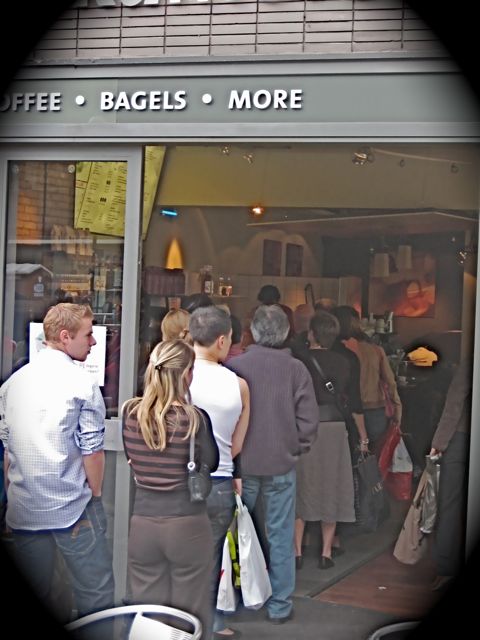
 It's a fair question. Look at the picture on the right. This should be a familiar view in just about any city: a long queue for a tall latte. The picture suggests several things. One, that coffee seems to be a popular product; two, that there is space for more coffee-shops; or three, that this particular coffee-shop should perhaps improve its service.
The truth is that this trend is scary for many an existing coffee-shop owner. Because the café, in Europe, has been around for quite some time, centuries for all I know. Yet if you walk just down the street from where I took that picture at a Rotterdam coffee-shop, you'll see a line of traditional cafes, spacious and atmospheric, yet entirely empty. The fact that people would line up at this particular coffee-shop—the only Starbucks-like venue in Rotterdam—suggests that they don't care about space, about atmosphere. All they are about is convenience (if you call waiting for 5 mins. a convenience); coffee-to-go; and exotically-named and expensive coffee. What is happening here is not so much the comoditisation of coffee itself, rather the comoditisation (read: non-importance) of the coffee-selling venue.
I'm not sure if people would care whether they bought a coffee at McDonalds or the Metropole-cafe in Brussels anymore, to be honest. If the selling point is how quickly you can get the coffee and get out, what does it matter if the venue is a palace, ready to serve its customers on its hands and knees?
There are plenty of stories about "how Starbucks drove me out of business" (here's a borderline case), strangely outweighed by stories about "how Starbucks saved my life" (here's one). And with McDonalds increasingly getting ready to become a competitor to Starbucks, and other venues, like Leonidas, a Belgian chocolatier, transforming their previous chocolate-laced focus into a coffee-one, I don't think it's unnatural to be afraid. If a coffee-venue is a commodity, then how hard is it to change your existing venue? Insert some coffee-pumping machines, put a to-go sign on your door, and you're set.
So what should an entrepreneur do? Leave or fight? Yesterday's odd post about Beef, of all things, did suggest another way of looking at business: on a system-level. What was essential to the Chinese beef industry, to meet demand? Proximity to the market, amongst other factors. And what is essential to the coffee-industry? Probably not more coffee-venues, but maybe something else.
When you look at the way the coffee-industry is structured, and probably most industries, it's like a funnel: there are a number of coffee-producers (not sure how many), and a definitely greater number of coffee-venues. The latter is battling for the attention of customers. They do so by engaging in new business development opportunities, both internally (e.g. music), and externally (e.g. coffee in cans). They need to open more and more locations to maintain their air of convenience, just look at the picture above. They need to brand themselves as the number one place to go, versus all the 100s of other new and traditional venues. They need properly trained staff. They need good coffee, and other quick food-products, etc.
This would suggest following openings*:
- marketing consultants
- new business developers
- new business providers
- real-estate agents
- customer service consultants
- coffee-buyers
- temp-agencies
- quick food producers, e.g. a bakers
- and I don't know what else.
The point is that, while a certain, most obvious, business opportunity is shrinking, doesn't mean that there isn't a need for more business. As a (creative) entrepreneur, you just have to look outside the coffee-cup (read: box) and see if customers and coffee-venues would not be in need of other services. And perhaps I am wrong, and because it is so easy to implement a "to-go" formula, it is actually easy to start some kind of food-related venue and add the coffee on top.
Anyway, all this coffee-talk is making me thirsty for one myself.
In this regular segment I focus on news of note (to me at least), about brands that I'm familiar with. I may someday write about Nordstrom, Costco, and Walmart, whom I hear great things about in terms of service, supply-chain management, and frugality, but until I come in contact with what they sell, I'm not sure I can say much. That said, I'm aware that Walmart made moves into Germany (and failed, which intrigues me), and has taken over at least one chains (Asda) in the UK as well, which I have visited. So never say never.
Coca-Cola and Nestlé Coca-Cola has, for a third time, partnered up with Nestlé, this time to develop coffee and tea-products. The previous times, the company worked Nestlé to develop Enviga, a calory-burning drink; and with L'Oréal, a daughter-company of Nestlé, to develop the beauty-drink Lumae. So reports Dutch Marketing Tribune.
A few months ago on Tech IT Easy, I expressed my wonderment at the Coke Zero brand and what their aim was there, as well as held a rant on how un-innovative "junk"-drink (or -food) brands are in general. I think this is an interesting move. It won't make the world a better place, perhaps, but it'll be more colourful.
Similarly, I know that Starbucks formed a partnership with PepsiCo a few years back, to develop canned coffee-drinks, also to be sold in supermarkets. So this could very well be a competitive move, by either Nestlé and/or Coca-Cola to compete with a perceived threat of Pepsico's or Starbucks reach into customers' taste-buds. Update: Looks like MSNBC reported on a similar story last year.
Leonidas expands to the cafe-arena In other, coffee-related news, Belgian chocolate-manufacturer and retailer Leonidas is opening a coffee-outlet in the Netherlands, a first step of what it calls a worldwide expansion of its products and outlets. This according to Dutch publisher, Elsevier.
Again similarities can be drawn with Starbucks (sorry, SB-haters), which started as a producer and retailer of coffee-beans, before it expanded into the business of coffee-bars as well. I think what both Leonidas and Starbucks have in common is a reputation of offering fine products as well as offering a third place which customers feel comfortable in. It's a relatively easy step-up for Leonidas, if its experiment were to succeed, because it can simply adapt its existing retail-outlets.
Isn't the world of coffee exciting?

 The
The 


