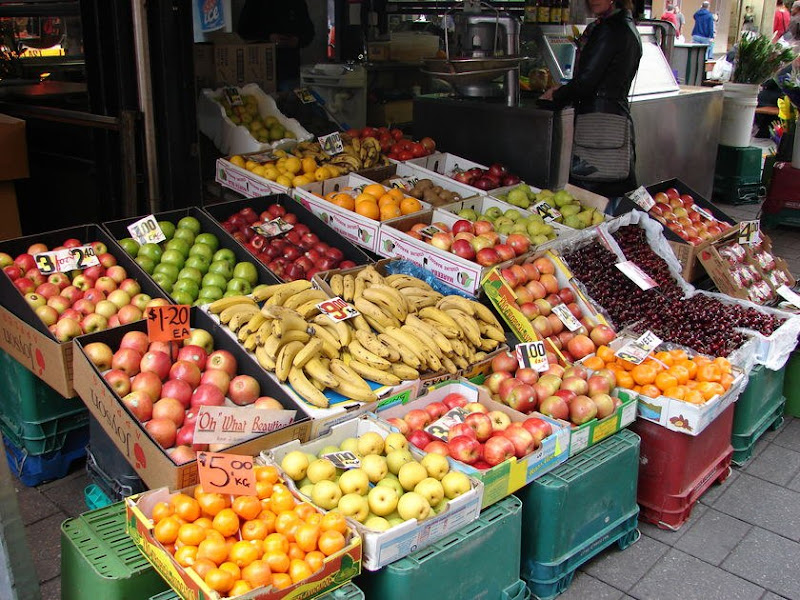
 Take a look at this quote, which I posted a few days ago:
"There should be a rule: before helping the environment in one market, we should be required to think through the impacts on other markets." (source: Freakonomics blog).Or, to put it differently, every action has a (sometimes equal) reaction (I think the traditional phrasing ignores the human element). The idea that everything is interconnected is both fun to right-brained generalists like me (not a compliment), and scary at the same time. The global economy is very complex and, I would say, impossible to regulate.
There's a couple of things going on the world, which I'm sure everyone is aware of. There's a number of wars, there's the weakened dollar, there's some kind of housing-related recession going on, there's a shortage of oil, our planet is perceived as suffering and currently being saved (I hope), there's India and China, the rise of the Anglo-Saxon system, etc. etc.
And some of the biggest problems facing the food-industry (depending where you are in the chain), are rising food-prices, which relates to that oil-shortage (both in terms of pricing, but also because of alternative fuels using farm-products), the rise of India and China, and some other factors; and the costs of keeping green, which has largely been inspired by companies like Wal-Mart, but also by the (exaggerated) need for global diversity by customers (which the food-industry is also partially to blame for).
The solutions vary, and are, so far, very defensive in their nature. For the cost of going green, most pollution comes from transport and the solution is to either use the most eco-friendly way to go: on land, by train, across water, by ship; or to go local—which companies like Marqt seem to focus on, but which also comes with the pitfall of seasonal shortage.
For rising food-prices, again one solution is to go local, to save on transport and have some control over how farmers work, and be able to charge higher prices to the rising local-conscious consumer. But a bigger solution is for more food-production to happen (much of it currently goes to India & China, or to biofuels), and possibly from smaller farmers. The problem here is that it will take time (some estimate decades) for smaller farmers to get ready.
Both are definitely big picture-problems, and will take time to solve. One thing, I'm personally looking at, are micro-lending sites like Kiva.org, which put you into contact with local farmers, allowing you to help them out in your own way. From a Venture Voice interview with one of the founders, I understand that some of these investments happen within the context of a community, where each member keeps watch over the other's use and repayment of the funds, in order to ensure a good outcome, and so loans will continue to come in. But, while I think it's well worth the effort, this is still a small-picture solution to a much larger problem.
The way it looks right now, the solutions have to be planned in the long-term and on a large scale. There is definitely space in the farming-segment for more production to happen. In the mean time, food-prices will continue rise, as will the price of educating consumers to make more responsible choices. I like Tesco's approach in labelling the origins of their food and allowing people to make more carbon-friendly (locally focussed) decisions. But that doesn't solve the problem for farmers in remote areas of course.
Sigh, if you just got a headache, I sympathise, as I just got one too.
Further reading:
- NYTimes: Environmental Cost of Shipping Groceries Around the World
- Economist: The new face of hunger
- Buzzfeed: Food Hoarding
I've included just the top-25 and annotated their focus. What's interesting, but not surprising, is that the majority of companies in that list are not independent horeca-orientated, apart from two: Hennie van der Most and Sjoerd Kooistra, both Dutch horeca-entrepreneurs.
The majority is hotel-chains, though the top-10 is quite diverse; a number of convenience-(fast)food places, resorts, as well as retailers. Interesting that both Ikea and Hema are on that list. Hema, as far as I know, has not been on the horeca-market for long (no revenue reported in 2006), but is already reaping significant successes. Probably my favourite retailer in the Netherlands, btw. Ikea, as I reported before, has been in the restaurant-business since 1971.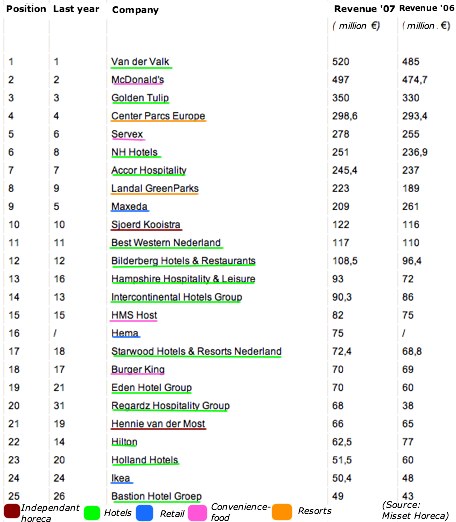
You can see the complete top-100 at Misset Horeca.
 I'm thinking about adding another "interlude" to my collection, inspired by ADD without a doubt. It's the cookerlude, baby, aimed at collecting thoughts and notes on cooking in order not to forget and to better understand the world that a cook goes through. While I cook nearly every day, I don't consider myself a good cook. I simply don't have the taste-buds for it; but I do love the good food, which, luckily, my gut no longer shows!
I recently discovered a podcast, called/by The Restaurant Guys, which, apart from the insanely long commercials, actually seems quite interesting and is funny enough to keep my attention. Some notes.
Salt: So, we seem to have this internal taste-meter for the stuff, which in some ways is tied to the percentage of salt in salt-water. At the same time, our saliva actually dilutes salt in food, reducing it, meaning there should be a higher percentage in food than salt-water, for us to enjoy it.
Sugar: apparently there's no set limit for that, people love sugar (I must be the exception).
Salt + Sugar: whenever you make a sugary desert, adding a little(!) salt helps the taste; apparently they do funny stuff to each-other in your mouth, a party in your mouth, so to speak.
Taste-enhancers: apart from the above, olive oil, mushrooms, garlic, tomato-paste, alcohol (and much more) enhances the taste in your mouth.
Pretty basic, no? You can listen to the whole episode on what (American) people like in their food, here.
My own world
(This is where I talk a little about what I discovered myself in regard to cooking. Pretty basic too, so I'll try not to embarrass myself.)
I'm a big fan of salads, I make and eat one nearly every day as a meal. I often use canned tuna, but I recently discovered salmon in a can, which tastes better, is less salty, healthier, and costs about the same here in the Netherlands.
But steamed salmon is the best. You can get an expensive steamer, but a cheap solution is a microwave-steamer. I found one in a Chinese store for about €10, you can steam whatever you want in 5-10 mins and it magnifies the taste. Add some green beans and carrots, and you got a great salad for a meal! Add some potatoes or rice, and you won't need the salad.
Last, but not least, sometimes, not always,Ketchup actually makes for an interesting dressing (together with some oil and spices). It often contains vinegar, which salads like, and the tomato mixes well with the salmon-taste.
That's about it for today, I'm not sure how often I'll repeat these cookerludes, but I hope you enjoyed it! The picture is of course of Chef!, the show.
According to Distrifood.nl (Dutch) the " man's cola" showed a nice profit this last year, making it the top new introduction to a brand in 2007.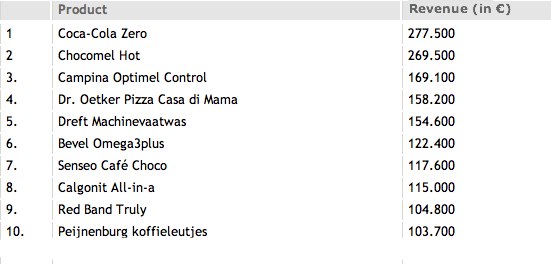
(Source picture: Elsevier.nl (Dutch))
I only point this out, since Coke Zero is one of the first food-related topics I wrote about on Tech IT Easy; a, fairly clear, signal that it was time to "spin-off" to this blog.
I just discovered a new podcast called "Big Ideas" (iTunes-link), a series of lectures on anything from the impact of urbanisation on musical tastes, to designing menus for restaurants. Oh, and it's Canadian. Not that that's bad, but some parts of the lecture covered local conditions.
John Schneeberger starts his lecture (dated March 1, 2008) off with the basics of menu-design, namely that they should reflect three things:
- What you stand for? Aka. what kind of food do you like to work with?
- What demographics are you targeting? Income, religious issues, etc.
- What are the current trends? And are they for real or just a fad?
- Customer-decisions are always a trade-off between price and quality
- Traditionally, dishes consist of three components: protein, starch, and vegetables.
- What we understand as taste, actually comes from three sources: fat, salt, and sugar.
Schneeberger discussed three booming trends, vegetarianism, organic food, and local produce, and mentioned a number of challenges related to these.
 Vegetarian cooking
The thing to understand about this, is that it's generally cheaper. Schneeberger mentioned a 1:10 ratio when you compare the cost of producing vegetables to the cost of growing a cow. And while it's a booming trend, the industry, somewhat mis-guidedly, still often focusses on trying to replicate the taste of meat, which is impossible (think veggie-burgers, etc.).
Instead, they should be thinking about nutritional value— vegetarian food has been correlated with lower health-problems and is for that reason often recommended by doctors. The problem with these types of diets is of course that they are low in those qualities we would traditionally associate with taste: fat, salt, and sugar.
To create dishes that people actually enjoy, restaurants have to look globally, e.g. Asia, where more exotic vegetable components can bring some needed flavour to these dishes. I think he mentioned seaweed, but also stinky tofu (see pic), which is a type of fermented tofu and one of the few ways to naturally bring flavour to that type of protein.
The implication is that vegetarian food requires a significant amount of specialisation and is often hard to combine with meat-cooking.
Another complication arises from vegan (no dairy, honey, animal-derived products) versus lacto-ovo (incl. dairy, honey, animal-derived) cooking. The first makes it very hard to create a (traditionally) tasty dish. The second, lacto-ovo, allows for more flexibility, through the use of ingredients like eggs, which not only provide extra protein, but also bring a lot of flexibility to the kitchen. You can, for instance, make foam out if it, which would enable the creation of deserts & soups, etc.
Organic cooking
First of all (and I'm not sure if this is just restricted to Canada), an organic food label refers to the production method, not necessarily the quality and taste. Since organic food is more expensive, and taste is not guaranteed, you have to wonder if your clientele is willing to pay extra for that service (remember the trade-off between price & quality!).
The big selling-point here is the information about the product. People like to know how their food was produced; it has a certain value to know that there are no chemicals or genetically modified components in what you are eating. But again, that must be a value that is clearly advertised and which may not be important to every type of demographic.
Local produce
The advantage for the restaurant is that they can form better relationships with their suppliers, it's also cleaner in terms of carbon footprint (less transport), and it also has some marketing value to a certain demographic.
The disadvantage is that supply cannot be guaranteed during all seasons. Schneeberger mentioned something called a "100 mile diet" for instance, but restaurants catering to that need will probably have problems in the winter.
Thoughts
Overall, a pretty insightful lecture of the more exotic (and trendy) type of cooking and its trade-offs.
These types of specialisation are still pretty niche, require significant resources in terms of tools, know-how, and supplier-relations. But, if executed well, a niche can be extremely profitable.
I thought that it was interesting that all the traditional means of cooking, the ingredients and the taste-makers, were pretty incompatible with these newer trends. As such, you are essentially climbing up a hill, trying to educate the mass-market. At the same time, good execution, together with differentiation from the norm, seems like a formula for success.
I took this title from a report on the future of Dutch supermarkets (English pdf). It identifies a number challenges to come, one of which is "stomach share," which is apparently a big deal because of the following three factors:
- Population decline: which translates into less consumers buying food
- Increased longevity: and older people have a lower caloric intake
- Increased awareness of health-issues: which also translates to a lower caloric intake.
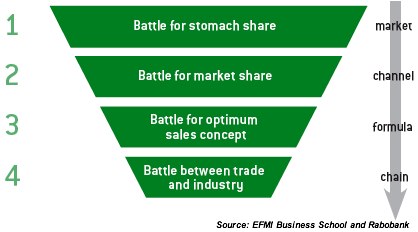
What the authors are seeing is that players from the bottom of the market (the discounters) are moving upwards, by broadening their assortment of goods, and players from the top of the market (luxury-stores) are moving downwards, by improving their prices. A number of underlying things are going on here: luxury-stores can become cheaper by improving the efficiency of their stores and sourcing cheaper brands. And discounters can increase their offering through their relationship with suppliers.
Following HBS-quote, from an article entitled "Finding success in the middle of the market", sheds some light how Tesco does it:
A company controls midfield by fielding a complete product line that includes backs and forwards. In its supermarkets, Tesco, the successful UK retailer, offers consumers three options—good, better and best—in most high turnover product categories. In addition, Tesco doesn't just sell groceries through one-size-fits-all supermarkets. Recognizing the need to shape as well as respond to an increasingly segmented market, Tesco reaches its consumers through at least seven different store formats, from convenient Tesco Express outlets at one end of the spectrum to full assortment hypermarkets at the other. But, within all its stores, Tesco implements the same merchandising principles: Better, Simpler, Cheaper.Can you guess who the loser is yet? Well, according to both the report and much data on the net, the losers are the new, innovative concepts, that may offer certain values to consumers on an ethical or health level, but are not able to reap the same advantages as more established players are.
That is also the answer why so many organic companies are being bought up by fmcg-companies. There's an interesting overview here; but if you want to follow one in real-time, check out this Inc. magazine blog run by Honest Tea, which has recently given away 40% of their company to Coca-Cola.
Of course that is only part of the answer. Consumers are not just focussed on price. And, while consumer-awareness of the global situation and their own health is clearly growing, that's not the whole answer either. People's lives are becoming ever more complex and convenience is a big selling point these days.
It's those companies that can combine a high level of consumer-responsiveness, together with assortment and price, that will capture the hearts of consumers. But I guess what is out, is the solo single-product-serving player in the market, purely focussed on softer advantages like "ethics," and forgetting that consumers still(!) have limited disposable income for their food-expenses, as well a limited time to engage in these activities.
Entrepreneurial method: believe something is impossible? Enter 'double-think'
0 comments Posted by Unknown at 9:10 AMYesterday, I read an HBR-article by Roger Martin, on his book "The opposable mind", the ability for people to think contradicting thoughts and act on them at the same time (this may sound familiar, if you've ever read 1984).
My first instinct was to throw it out. I didn't like that he used the first few paragraphs to discredit other thinkers on leadership; and I didn't find his proposed method for coming up with a business-model particularly compatible with the general idea of "chaos" that he was proposing (more on that later). I even wrote an impassioned article about it, but waited a day before publishing it (no April fools from me this year). None of my criticism was directed at his core-concept, btw., I do believe in the ability to think contradicting thoughts, and act on them also.
After a night of sleep, I came to the conclusion that Martin's article was effective. Because it required me to think the article had faulty qualities, while the core-idea was right. And that was the very idea of 'double think'! Then I started thinking, what other areas could you apply this to? Pick one!
- My perception of the internet is that it's indiscriminately linear—we forget things the day after they are published. So how could you make it less linear?
- The perception of food is that it doesn't do well in e-commerce—they perish and people value touch. So how can you sell food via the internet?
- My perception of restaurants is that it requires a genius cook, who is both expensive and hard to handle. So how can you start a restaurant without such an individual, or better yet, how can you start a restaurant with one?
Martin's method for coming up a business-model looks like this:
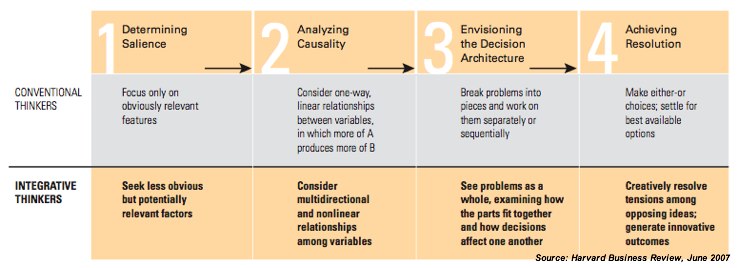
In other words, you need to identify your core-customers, understand that their decision-process is not linear; understand the equally multi-dimensional architecture of your business, industry, and economy; and come out with a product/service that meets these opportunities.
Whether this is the best way to come up with an impossible idea, I'm not sure. But it seems like a logical thing to do after you come up with an idea and are looking to place it within a commercial context.
He uses one example throughout the article, that of Red Hat Linux, which, I completely agree, is one of the best examples to choose. It is free software, but it's a commercial success, which goes against conventional thinking, at least at that time. And instead of just acting as a commodity or becoming proprietary charge-ware, they decided to make a services-company out of it, and a market-leader at that. So how would you turn your open-source product into a commercial success? If that isn't 'double think', I don't know what is.
 The reasons to love bookstore-cafés is that you get a chance to discover new stuff to read. The reason to hate my particular café is that, every week, even when I ask for a *normal* coffee, the waitress continues to regurgitate the same phrase: "will that be a large of a small?" Anyway…
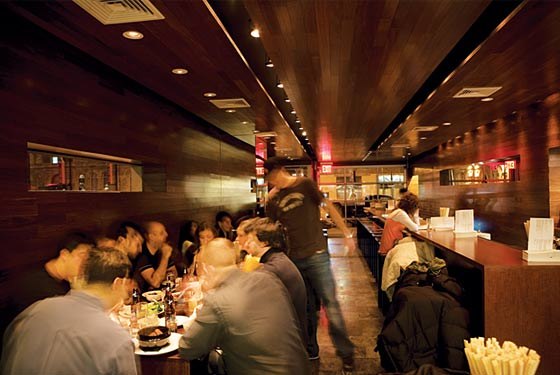
I read a nice article in the New Yorker today, about a stressed out restaurant-entrepreneur called David Chang, who runs several noodle-bar-styled restaurants in New York City. The Yorker's articles are always so long, but it was a captivating article. I took some notes, which I'll share with you now.
- Waiters make way more money than chefs, simply because of the tips; the figure mentioned was $1700 per 32 hours vs. $350 that chefs make. Turning chefs into waiters, which seems like a logical decision in a noodle-bar, comes with the challenge that these types are not always that domesticated (can't help thinking about Chef! here).
- The front-end of a restaurant—servers(?), the set-up, beverages—is relatively simple (compared to the work that goes into cooking) and can be consolidated across multiple restaurants.
- Personal integrity in cooking—e.g. cutting fish-cakes properly, even though the customer won't notice them in a bowl of ramen—is the difference between a quality-restaurant and a McDonalds or Uno.
- Standards: A piece of chicken can taste wonderful to a customer, he won't know why, but it's actually because it's been prepared (marinated, dried, etc.) for more than 24 hours.
- Quote: "The great thing about fast-food is that you could sell out without worrying about it, because fast-food isn't pretentious and selling out is in the nature of the business."
- Quote: "Cooking is honest work; gives you a way to measure yourself."
The thing about restaurants is that I'm painfully ignorant about so many things going on in that world. Cuisine is like art—it's dynamic and filled with critics. For instance, there's the "foam" trend, mentioned in the article, hot in the 90s, but which I never heard off.
For me, I'm always interested to find out more about this industry, because I want to be part of something that produces culture. But I'm constantly thinking about whether it's wise to enter such an industry without a basic familiarity. It would be like me entering the tech-industry, without being aware of open-source, how to write code, or do project-management; it's just not done.
Food for (mostly, my own) thoughts.
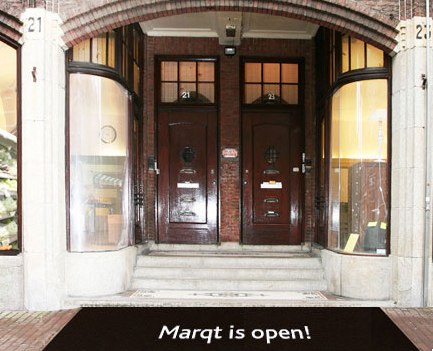 Marqt is a market for farmers, recently launched in Amsterdam by Quirijn Bolle en Meike Beeren (both ex-Ahold). Can't really sum it up much more than that.
It focusses on two opportunities: from the supply-side, many farmers want to sell their products, but are unable to because of the power-play from regular retailers and/or at relatively low profit-margins. Last year, when I briefly looked at the organic boom, I already thought that there is an opportunity here, for farmers to become retailers themselves.
This is made possible by the other part of this equation, an elevated demand by customers for natural and ethical produce, and, to a lesser degree, local produce.
Bolle and Beeren rightly identified an absence of identity in food-retailers, an absence of accountability for the product-decisions they make. But they also identified a need by consumers for quality-guarantees.
Because you have to wonder, how is Marqt different from the regular outdoor-market that exists in every city? Well, here's one difference, and I'll try to give an example. 'Tis the season of mangoes, and I'm hooked. I've been buying these babies at €1 a piece at my supermarket, but stumbled across some great deals at the local market: €2.50 for a box of 8! The only problem: about 6 of these were either unripe or overripe. And who do I complain to? One of the 100s of vendors on the market, whose name or brand I don't even remember?
From my understanding (I don't live in Amsterdam), Marqt-products are more expensive than those of local markets, about on par with regular supermarket-foods. They work with partners that are able to supply in greater numbers, offer a quality-guarantee, and, very interesting, train Marqt's staff to understand and explain how products work.
Their added value is that they can offer suppliers higher margins, and consumers a richer shopping-experience. And from what I hear, though I have no numbers, the store is doing reasonably well.
Two other interesting facets: Marqt houses individual suppliers' stores. So you have Store X for dairy, store Y for meat, and store Z for bread. Marqt provides the space, the staff, the marketing, and collects a percentage of the profits.
Also interesting: the store doesn't accept cash. It's progressive, I agree, but also great marketing-value, sure to raise an eyebrow or 1000. And it saves money on the back-end, though I hope they get rid of the €0.50 transaction-fee.
I think it's a great idea, and hope the store continues to do well. Gives me hope, both in terms of opportunities for retail-entrepreneurship, and entrepreneurship in the Netherlands in general, which (in my opinion) could use a boost.
Witness the following. A bar that comes in various flavours: chocolate chip, dark "luxury" chocolate etc. Yumm! It's cheap, costs around $1.50 per bar in the local drugstore, currently. And it contains 32 grams of protein. The perfect post-workout snack, it seems.
The only problem? The body doesn't digest it well at all. There are times when it sits in my stomach like lead, and other times, when my body can't wait to get rid of it. Empirically tested, two out of two times, that is what happened to me. Just last night, I woke up at 3 a.m. with a stomach-ache because of that damn bar.
Are snacks doomed to be unhealthy?
Back when I was a vegetarian for a brief two years, the one thing I missed was to have a snack that did not contain either an overdose of sugar, of fat, or of bread. With the exception of perhaps a nut-bar, a fresh juice, or chewing gum, those are pretty much your choices, walking down a street:
- A chocolate-bar: high in fat & sugar
- A burger, sandwich, or a pizza-slice: high in fat, starch, and limited protein
- Fries or chips: high in starch and fat
- A carbonated drink: high in sugar (excl. the light versions) and extremely bad for your teeth
A new era?
Interestingly enough, due to external pressures, I hear that certain supermarkets are changing the layout of their stores, removing snacks and junk-items from the register, and replacing them with healthy options like fruit. Equally interesting, (forgot where I read this) they are expecting a multi-million euro loss because of that policy.
Certain tricks do seem to work in raising those profit-margins. While a kilo of regular apples currently costs around the €1.50/kilo mark, pre-peeling and -cutting those apples, raises that price to ca. €8/kilo. Ka-ching!
5 links: the obvious one, brand-logic, happy places, e-toys, neuroscience
0 comments Posted by Unknown at 11:02 AM It's Sunday again, and I have a nice big collection of links today: on running a cheap yet effective start-up; on why brands exist; on creating happy places for yourself and employees; on the business of children; and finally on a whole load of neuroscience. The aesthetically pleasing picture of Marilyn links to a particularly disgusting image of a "healthy" burger—my initial choice of illustration. You have been warned.
Previous link-discussions can be found here.
Link 1: the obvious one - Seriously, unless you actually used this weekend to, eh, have a life, you'll have noticed the firestorm started by Jason Calicanis, continued with Duncan Riley, tempered by Jason Fried, and the final words of wisdom by Micheal Arrington. Crazy, how opinionated these entrepreneurs/bloggers are, right? Yeah, right. A good read if you're (thinking about) running your own business, with like lazy employees and expensive tables.
Link 2: A brief history of brands - well actually a blurb about a book. I like:
"Branding became necessary when large-scale economies started mass-producing commodities such as alcoholic drinks, cosmetics and textiles. Ancient societies not only imposed strict forms of quality control over these commodities, but as today they needed to convey value to the consumer. Wengrow finds that commodities in any complex, large society needs to pass through a "nexus of authenticity.""
Link 3: the architecture of happiness -
"There are three concepts central to the “yoga of the home”…. The first rule is to align your schedule with universal schedules by getting up and going to bed with the sun. “We try to keep lightweight and low furnishings in the north and east — to create an openness — so that we can draw in the healthy early morning sun,” says Cox. Heavier, taller furniture goes in the south and west. Second is bringing nature indoors — plants, natural fibers, no synthetics. “Vastu is the first intentionally green science,” Cox says. And last, vastu asks us to “celebrate who we are and what we love” by surrounding ourselves with things that have meaning. “When someone enters our living room and we’re not in the room yet, we want this guest to get a sense of who we are,” she says. “The room speaks of us.”"I've been thinking about this topic and the general issue of creating happy places for a while. A worthwhile read is also Frank Addante, a serial entrepreneur, on choosing the office-space for his start-up: link 1 and 2.
Link 4: building a toy e-commerce store - since I linked to Lego last time this seemed appropriate. In all seriousness however, I think the subscription-model + children is a cash-cow; kids always want more stuff and have old stuff to get rid off. Applicable not just for toys, but clothing and furniture as well.
Link 5: Some neuroscientific stuff - ignorant shoppers are blissful, though information that stimulates the imagination still works (as do quality-labels as they allow you to charge a premium); body-language works for consumers, in other words an in-store-television-advert or one of those annoyingly friendly taster-people in supermarkets, should cause people to buy more food. A little bird tells me this applies more to the US than the French; 15% of women don't like perfume, which is interesting I think as I'm not a big fan either; and Art-adverts work, enough said. And yes, EurekAlert is my new favourite site.
 When I first wrote this post this afternoon, it was really long. After cutting it a little it's still really long. Sorry about that.
A lot of people I know from uni are into this thing called New Business Development (NBD). It makes sense, since it's the title of a course we studied together and it was absolutely the best course I've had in my life. Around 60 hours of hell per week for 2-3 months, but one hell of a ride too.
NBD is a necessary mechanism for when your core-business is stagnating. Let's say you have a good high-volume business, but competition is hammering you with low prices. If you can find a new business opportunity that allows you to make money differently, preferably at high margins, it's a good business opportunity. If it's synergetic with your core-focus, then it's an excellent business opportunity. Three small examples I stumbled across these last few days come to mind.
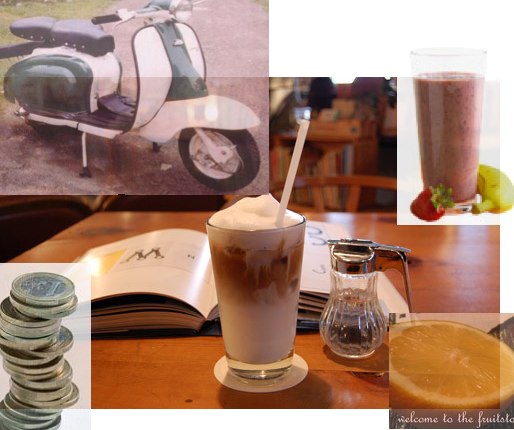
1. Bookstore + café. Verdict: logical
Buying books is a luxury. They serve no real purpose (unless you want them to) and are generally aimed at price-insensitive people. It is also a fairly slow sale. You are selling information, people are swamped with information, and it takes them time to make a decision. Sometimes… not always. I think time + the amount spent on an item also correlates positively, up to a limit.
That combines well with a café. The luxury-aspect allows you to charge more in cafés as well, meaning higher profit margins. Cafés lead people to relax and spend more time in bookstores, meaning they will likely purchase more books too. Combining the high traffic of price-insensitive consumers together with high profit margins and you have a good business. Also, it's a great way to compete against online-retailers, who are not able to add the atmospheric value.
2. Fruit-vendor + fruit-shake stand. Verdict: logical
Fruit is generally a low-margin product. The fruit-vendor in question sells 5 KG of Spanish oranges for €2. You can charge more for fruit-shakes; To the consumer, they taste good, represent health, and require very little in work (all emotional values = higher price-insensitivity). The fruit-retailer sells an orange fruit-shake of 0.5 litres for €2.50. Assuming that's about 1 KG of Spanish oranges, that's quite a lot more profit than €0.40 would give you. But of course there are other considerations.
The fruit-vendor is located right in the centre of Rotterdam on the busiest street. Likely the cost of renting a place is expensive, so is the added cost of producing the shake. The fruit-vendor also competes with a fruit and vegetable market, located a few hundred metres away, and a supermarket, 50 metres away. And his new business competes with other fruit-shake stands. What makes this combination work?
The higher profit margins for convenience-fruit-products, combined with high volume of people passing by is good. It also persuades investors to loan the money for the fruit-shake machinery, which they would probably not do for a low-margin business in a less favourable location. There's a lot of efficiency also; fruit is sourced from the same suppliers, so are packaging-materials, and the retail-space acts as a warehouse. Because fruit is cheap and the retailer has a large selection, he can charge lower prices than the competition and offer more variety. And he enjoys high profit margins even if the volume of fruit-purchases is lower because of the price-competition from the (super-)markets.
3. A eurostore + scooters. Verdict: illogical
This case is a little more complex and contextual. A year ago a eurostore, which is like a dollarstore—a shop offering a great variety of goods at low prices—started offering scooters alongside their regular products. They quickly abandoned the experiment and I have a theory why.
Likely this deal came out of partnership with scooter-retailer/-importer. The eurostore was in a good location with lots of traffic (good for the scooters) and the scooters would give it much higher margins than their regular products. Seems like a win-win.
Consumption of "euro-"goods is different from that of scooters, however. With the first, people expect stuff to break and don't come asking for a warranty. They just buy another. Buying a scooter or anything over a certain amount is very different. People expect extensive information, they may want a test-drive, they certainly want a warranty, and after-sale support.
Since the eurostore is what it is, a store with low margins, this kind of service is out of its realm. It ends up referring customers to the actual scooter-retailer, and very likely the purchase happens there also. Unless you have a contract that specifies this eventuality, gone is the alluring profit-margin. And that, as they say, is that.
Final thoughts
High traffic of goods is a good basis for new business development. It means you have a customer-base to which you can try and sell other products and services, hopefully at a good margin. Location and demographics are important also. Both the book- and the fruit-retailer were well-located and had access to a good demographic, allowing them to sell at high margins and high volume. The eurostore was only well-located. Synergies are vital. For the bookstore it was consumption-pattern and price-insensitivity; for the fruit-vendor it was offering essentially the same product in different packaging; for the eurostore there was little, or rather, none.
Isn't new business development fun? And was my analysis correct?
5 links - sense of smell, false green ads, farming boom, Lego, fun e-shopping
0 comments Posted by Unknown at 10:49 AM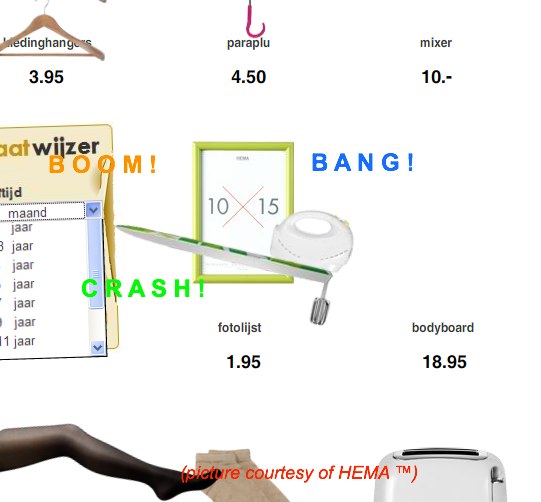 Time for those Sunday-links again. Today, I'll discuss the cocktail that is smell and how some things just don't mix; how green is not all it's cut out to be; a possible shift of power from retail to farming (or not); how lego came to be and where it is going; and how to sell me online shopping.
Previous link-discussions can be found here and my bookmarks here.
Link 1: Starbucks Admits Sensory Mistake - These are the kinds of stories that make me I like the NeuroscienceMarketing-blog. If you follow the science-section of the Economist, you'll know that neuroscience is a big deal anyway. In any case, this story is about how Starbucks designs atmosphere, largely influenced by smells. Apparently, smell of heating egg and cheese sandwiches doesn't mix well with the coffee aroma.
Link 2: False 'Green' Ads Draw Global Scrutiny - Two problems linked to green adverts these days, I think. One is that consumers are growing tired of it. And two is that, as this story shows, just because companies say they are, doesn't mean they are. I like the Norwegian approach to this. They ban green adverts by products that cause more problems, no matter how innovative they are (about hiding it).
Link 3: Farmers Wonder if Boom In Grain Prices Is a Bubble That food-prices are rising is an inescapable fact. But it also presents an interesting shift in the status quo. In the food-chain of the grocery-business, farmers are pretty much at the bottom. Now, even though their own costs are increasing also, they can charge more on top of it and decrease retailers' margins. Time will tell if this is something that will be acceptable for a long time. Certain signals very much suggest to me that farmers may be in the right position to cut out the middle-man and become retailers themselves.
Link 4: The Making of…a LEGO - I'm still a kid at heart, so I love anything to do with games and toys. My parents never bought me much lego as a child, which I regret as I hear it breeds geniuses. In essentially two pages, the article describes how lego came to be, what makes it so perfect, and what the company's strategy is. I was always impressed with the brand-extensions they did with the games, the robots, and the theme-park. A company to follow.
Link 5: Online shopping at Hema.nl - I've linked to this on twitter before, but it brought another smile to my face watching it again. Just when I think that online-shopping has no future, innovative uses of technology surprise me again.
5 links - cool vs. tech, touch-screens, women, pizza, & bookstores
0 comments Posted by Unknown at 12:09 PMMan, I collected so many links, that I'll probably have to write three updates to cover the most important ones. We've got a lot of ground to cover, so let's get started. You can find my previous coverage on interesting links from the web, here, and my continuous stream of bookmarks, here.
Link 1: On Magnetbox - Correlating cool with tech - With pictures like the one below, my work on this blog is really done. Interesting is the rise of computers vs. dance & hip-hop music (both of which are hugely benefiting from the cost-savings made possible by PC-based studios. (A note: low industry-barriers = high chance of suckage!). Also note the fall of art, after the colour TV was introduced. Kottke also made some comments about it.
Link 2: On BuzzFeed - Touch-Screen Ordering - BuzzFeed presents us with some stories about automatised ordering. There are both advantages and disadvantages, I think. Good is that it minimises errors in ordering and can interface well with back-office operations, such as ordering new supplies. It might also fit with the individualistic preference for self-service, I wrote about before. The disadvantage is the cost and the margins of error that information systems bring (I still shudder at the thought of the LAS disaster (pdf)) + the lack of the human factor. Martin Kunzelnick (German) links to some videos of Microsoft's Surface in a restaurant-environment.
Link 3: On Lightspeed Venture Partners - It is no accident that Typhoid Mary was a woman - Although it's a horrible-horrible title, and perhaps an obvious point, I've been coming across many stories about the social qualities that women possess, making them better at PR, marketing, sales, relationship-building. Something to keep in mind for any people-based business.
Link 4: On Reuters - Pizza Hut rolls out nationwide mobile ordering - A news-item (finally), and I'll probably delve into this topic sometime in the future. Arguably, Pizza Hut has been pursuing a different strategy from pretty much 98% of the pizza-restaurants out there. I'm sure that there is considerably brand-loyalty towards Pizza Hut, which will give it an advantage over delivering pizza-franchises, HOWEVER, it will probably be competing on price, which the franchise has not done so far. I'm not sure how that will affect their brand at all, but it's something to keep an eye on.
Link 5: On WSJ - Who's Buying the Bookstore? - arguably, there are few retail-outlets that evoke such an emotional response as bookstores. I find them comforting, and very similar to churches, in the way that it really is expected of you to be silent while browsing (on a side-note, I discussed a link of Dutch bookstore being opened in a church before). It's also a symbol of a community, as WSJ points out. Well, with competitive pressures from Amazon et al., these types of stores are clearly disappearing, or changing into hybrid monsters, which smaller stores can no longer compete with. WSJ points out a phenomenon related to that community-spirit, which is very touching. Capitalism isn't everything, particularly in places that target the softer pleasures in life. I'll have to reflect more on this, as I'm very attracted to these types of stores, and would love to set one up myself.
That's it, for this week. I'll see how I'll catch up on the rest of my links, but this went great (took 20 mins), and I always enjoy re-reading my bookmarks. I hope you do too.
 I've long been interested in the idea of franchising, though I'm somewhat conflicted about how to look at it. One the one side, it seems* like a relatively easy way to start a business, on the other side, it seems* a relatively cheap way to grow your business (*: within limits).
WSJ recently published an excellent study on high-performing franchises in the US. The choice of franchises is extensive, just like I concluded in my post on top-German franchises. At the same time, the most apparent choice, that of food, seems less and less attractive, and I quote from WSJ:
In particular, fast-food and casual-dining businesses, while still showing strength, with eight names on the list, also are facing pressure from wage and food cost increases. To lower operating costs, several food franchises already are shuttering some locations.Arguably, a business that is thinking about growing through franchising is faced with some restrictions. Writing a franchisees-manual is a scientific process, you'll probably have to restrict the complexity of operations so that they can be replicated, and there will still be some overhead related to managing the brand and some of the more problematic franchisees.
I think that it is that standardisation of operations, made big through the economies of scale so easily achievable in the US, that is bring competitive problems to chains, even to wholly owned ones like Starbucks. If your core-product is simple, and your business uses a simplified operation, then how hard is it for your competitors to replicate your whole business-model and -strategy in the long-term, really? It is only if your business strategy includes complex competitive advantages, such as extensive vertical and horizontal integration across the value chain, and/or if your business-model is based on "high-tech" components or processes, that you have a real chance of beating the clones. And to relate it to the rising operating costs, mentioned above, business with true competitive advantage can raise profit-margins or off-set the costs elsewhere, instead of having to close operations.
But ok, long-term strategic considerations aside, I see franchising is an attractive way to enter the business-world as an entrepreneur. The question of whether it's faux or real entrepreneurship, is not pertinent, I think. Considering that you have a wide range of choice of franchise-business opportunities, you'll still have to work hard to succeed, and the growth-opportunities can include starting multiple franchises also, it is not that different from starting any other kind of business. In my mind, I compare it to internet-entrepreneurship, which also relies on a large amount of free tools and distribution-mechanisms, but is still dependant on that special something for it to be successful.
What makes franchising particularly attractive, is the decreased amount of risk. According to a study in the Netherlands, 65% of franchises are still standing after 3 years. Compare that to independent start-ups, of which only 15% are alive at that time.
A large cause is, I'm sure, the level of support from the parent-company, which differ from business to business, and can include delivery of goods, marketing, administrative and IT services, made cheaper through centralisation. And they are frequently guided through the process of setting up and running the business, including legal advice. In exchange, they give away either a percentage of profits (ranging from 5 to 40%) or a set monthly sum to the franchiser.
The WSJ-article also lists the amount of investment typically needed to start a franchise. It ranges from ca. $5200 for an automotive company, to a staggering $1,3 million for a steakhouse. Of the 25 franchises recorded, only 5 received some kind of financial assistance (none of which in food). Another article at WSJ discusses some of the attitudes towards financing franchises, particularly during the current US-recession. Incidentally, another article in Dutch Elsevier magazine, sees franchising as an excellent way for businesses to grow during a recession, as it requires less human costs.
All in all, it is probably a safer way to start a business, though with all the points I made above, I don't think of it as 'light' entrepreneurship. There's clearly a lot of risk involved, beforehand, in terms of choosing the right franchise with growth-potential, financial risk to fund your business, market-risk, when you launch, and competitive risk, after your up and running.
I still want to discuss this topic further at a future date, particularly focussing on what its like to turn your own business into a franchise, and some other stuff related to buying into one.
The picture is courtesy of friendlyfranchising.com
Building lifestyle-brands and the role that the internet can play
0 comments Posted by Unknown at 7:21 PM I'm a little distracted from blogging, I'm sorry. My current activities include a last-minute scrabble-play of my thesis, to make it a more logical read, and applying for jobs. And, not unsurprisingly, I'm having some writer's block as a result.
My post from a few weeks ago, about my anonymous friend, who's running a lifestyle-orientated business in a developing market, certainly opened my eyes to this area of the market.
Today, I'll talk about another company, Milner (cheese). There was an interesting article in Dutch marketing-magazine, Tijdschrift voor Marketing, on Milner's positioning-strategy from mass to lifestyle, which I'll discuss now, and which also lead to a post on Tech IT Easy about social networks as a strategic marketing-tool.
Milner = FMCG
Milner is considered a FMCG-company, that's fast-moving consumer goods, and falls into segment 2 on my food-industry map from last week. As I observed there also, this segment is usually the driver, if not always the conductor, of consumer-marketing.
The company is currently strongly present within the health-segment for cheese in the Netherlands, with over 50% market-share. This segment is also seeing between 60-70% growth from cheeses in general.
One thing that is clear for FMCGs is that margins are generally low (generally under 10%), competition is high, and as I made clear in my post on Tech IT Easy, features can easily be emulated by other companies.
Generating complex competitive advantages
The differentiating factor is the relationship the brand has with the consumer and vice versa. A brand that is designed for a lifestyle will generally have a much higher emotional value to consumers, than one based on features like cost or taste alone.
The logical conclusion is that those companies with deeper relationships to their customers will enjoy a higher competitive advantages over companies that do not focus on these relationships. And the complex nature of relationship is one that is difficult to emulate, hence giving companies a sustainable lead in the market.
But how to do that?
Paradigm-shift towards lifestyle
A lifestyle-product can be defined as a product that is built around the context of a certain group of consumers, resulting in an emotional value, as well as one based on features. This also has implications on the product-marketing strategies that a lifestyle-orientated company undertakes. As you may remember, the company my friend operates, still spends a considerable amount on marketing-activities after 2 years.
The theory that Milner cheese employs goes as follows. A great pain for food is health—which is really just an after-effect of the lifestyle people are leading. People are constantly looking for answers, so-called lifehacks, or more diet and exercise-related advice, all to regain power over their lives, minds, and bodies.
The key-issue is how to reach these customers. By addressing the pain that customers are feeling, by helping them live a healthier life, Milner is engaging in a relationship with its customers.
How does it do that?
How the internet fits into this
Traditionally, internet-marketing expenditure for FMCGs is quite low, around the 2% mark. Milner's budget currently assigns 10-15% to internet-marketing. It is able to do so, because it is already relatively well-positioned in terms of its brand and communication, so it feels more confident to experiment with new mediums.
As mentioned in my post on the food-industry-map, marketing to consumers is the responsibility of the consumer-goods-segment, however the degree that this activity is outsourced, depends on the amount of resources available to the company and the level of complexity of the activity. Arguably, both the novelty of internet-marketing to Milner, and particularly engaging into a relationship with consumers, make marketing fairly complex affair and the company did this via a third party, Advance, an interactive marking agency.
Advance set up a site called Je Beste Dag (translated: your best day), which advises visitors on how to have better days, based on a questionnaire they fill out. The first stage of the strategy is to build up a large mass of consumers that give out their email-adresses for further advice. Currently, there's 1 million people connected to the site. The second stage is to deepen that relationship, by encouraging return-visits and ultimately start a conversation.
It's both a time- and cost-consuming process for Milner. Essentially it is the sole sponsor of the campaign and has been running this campaign for nearly half a year no, without seeing any types of new product-developments yet. It is however working together with (other) marketing-agencies to develop its brands, which includes the design, positioning, quality, etc., as well as new product developments.
The interesting part of the whole process is that the majority of visitors already knows Milner, before even visiting the site. In other words, this clearly is an interactive marketing-campaign, which deepens the relationship between company and customer beyond the brand. Also, while the segment that Milner markets to via traditional channels, usually falls in the age-groups of 40-60, the age-group it is reaching now falls between 25-45, 60% of which don't yet have children.
Final thoughts
It is uncertain what exactly will come out of this. Milner is treating their internet-campaign as just another marketing-channel and holding Advance to targets it must meet. Which also allows them to measure its effectiveness. However, with a million young people connected to the site, and the communication-channels open, my gut tells me that they will be pretty happy.
The conversational aspects that the internet provides are certainly no surprise to the regular internet-user, however many web-companies are finding it difficult to generate sustainable business-models (e.g. Twitter / Facebook). As I made clear in my post on Tech IT Easy, I think these kinds of marketing-campaigns open up some possibilities there.
What's the biggest pain in your industry II - Carbon emissions
0 comments Posted by Unknown at 11:17 AMContinuing from part I - obesity, this post will be equally light as I have "♫ my mind on my money and my money on my mind… ♫" Or something to that effect.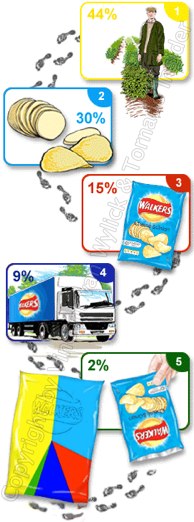 According to a carbon-emission calculation of PepsiCo's Walkers crisps, the majority of carbon emissions come from the production of raw materials (44%) and processing thereof (30%). A Dutch magazine, Tijdschrift voor Marketing, attributes the majority of the carbon footprint to transportation of said materials, and forms the conclusion that more and more production and consumption has to happen on a localised scale.
Even though the makeup of those figures may be open to interpretation—there is no breakdown about what in the first 44% is due to actual farming and what to transportation—perhaps, Mr. Kuiper, the author of that piece, has a point.
In a TED-lecture, James Howard Kunstler argues that the 'hydrogen-economy' is a pipe-dream and we must start thinking about creating urban environments fully equipped with the means of production, transportation, living, and waste-disposal, all in one. Very inspiring, though clearly requiring significant paradigm- and resource-shifts from today's globalised economy.
Clearly transportation comes at a cost, the question is how much the alternative would cost. Building super-farms, creating artificial climates to grow exotic food, waste-disposal, dealing with virus-outbreaks—regarding the latter, farmers already have problems dealing with chickens, sheep, and cows now, let alone having to deal with something like Kunstler's utopian vision—all of which represent costs that have to be accounted for.
But, I don't want to sound like a pessimist. I actually love the idea of a super-farm and a super-urban environment, regardless of the monetary cost. I'm sure plenty a sci-fi artist has tried to draw such a very thing (as have I). It's complicated, expensive, but exciting at the same time.
Asking you a tough question: How would you do it? What would a Kunstler-inspired localised economy look like to you? Is it even possible? … well, something to think about anyway…
 I'm spending a lot of time with a friend this week, who runs a start-up in a developing (2nd world) country in the lifestyle-food sector. I won't mention his name, his company or focus, or his country, nor anything confidential, because I don't want the information to be used against him. Instead, I'll talk about some general principles, that I've identified.
The irrelevance of business-literature
We both studied at Rotterdam school of management (sometimes known as Erasmus), and spent some time there last night. Funnily, I came across an article in a university-published journal identifying 6 traits of leadership to ask for in the "new" workforce. Keywords included: ethics, diversity, global outlook, tech savvy, adaptive capacity, and the X-factor (charisma?). I asked him, as a joke, which he thought applied to him. Global and adaptive, he responded. The rest meant virtually nothing to him. As a start-up, I guess, you have to do what you have to do, to stay alive.
The advantages of 2nd world start-ups
I distinguish between 1st world (e.g. the Netherlands), 2nd world (e.g. Brazil), and 3rd world (e.g. a large part of Africa), when I look at countries. 1st world countries are mature in their development, 2n world countries are not yet mature, but their economies are growing pretty fast, and 3rd world… well, I'm pretty depressed about that, though sometimes there's surprising pockets of entrepreneurship and innovation.
The advantage of a fast growing economy is that people are still figuring stuff out, meaning there are a lot of inefficiencies and gaps in the market. Another advantage, in his country's case, is the interests of governments in boosting those economies. If your innovative, the grants you receive may be both easier to get and larger in size than anything available in 1st world countries.
For start-ups, another advantage is that you can look at what works in a 1st world country and use that for your own business. This principle is not exclusive to start-ups, it's also relevant to the innovation race between Europe and the US, for instance.
The costs of educating a market
My friend operates a lifestyle-food start-up, as I said. One gap in 2nd world markets is usually that that segment is underdeveloped. But, if the economy is booming, wealth is increasing, and that certainly has a positive effect on the luxury-market.
However, when you introduce a new product to a market, you'll have to build the market up first. There are various approaches to marketing, I'll just go into the one that my friend used.
Essentially, you want to get your products into a supermarket, and you want people to buy the food. Sometimes one, sometimes both will take some convincing. In the beginning. he spent a lot of time in supermarkets, getting people to taste his food. After that went well, he could use that success to convince other supermarkets to become customers also.
Two advantages of supermarkets: they usually have pre-written contracts for suppliers so you don't have to draft them yourself. And they sometimes operate in chains, which makes it easier to get larger customers.
There's two further things to do with food, to make customer-adoption a little easier. One is to sell it in an easily digestible fashion, e.g. a snack. Two is to not do so, and instead provide customers with instructions to prepare the food. You could do this on the packaging, a website, and even more drastically (can't mention what). My friend is pretty active in this area.
Another problem with 2nd world countries is that, while your food may be part of a lifestyle in the 1st world, it's close to impossible to lead that lifestyle over there, because all the components are not there yet. So, in fact, you don't use that lifestyle as a marketing-term. Instead, focus on health-advantages, as that is often the underlying driver for such demand.
Still, even after more than a year, my friend spends about half of his monthly expenditure on marketing—which goes through a marketing-agency that designs the brand, the colours, etc.
Global outlook?
As a start-up, you have to work within certain boundaries: limited money, staff, production-facilities, time, etc.
The clients for a food-company may very well be supermarkets, which, as I mentioned, have the ability to buy a lot. My friend is expanding into other countries, but he's carefully picking the ones that don't exceed his capabilities.
He prefers a fragmented market, where he can concentrate on a one or two chains at a time, not a market where there's national chains that could bleed him dry.
Related to this, fragmented markets are usually underdeveloped also, so in fact he is exporting to countries similar to his own. That, at least, is as theoretically expected.
Theory, schmeory.
While there are certainly concepts that can be found in a number of different fields, ranging from entrepreneurship & strategy, innovation, supply-chain management, and marketing, it remains a matter of being practical, and specific to the business.
Entrepreneurship is a 60-80 hour / week job, usually. You don't have time to check out business-journals, etc. to do your job.
P.S. his business-plan was 2 pages long.
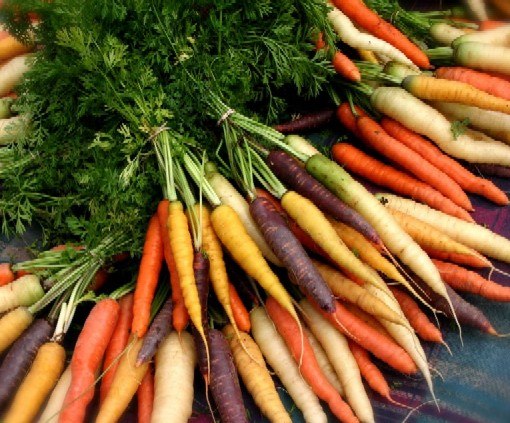
And those… are the facts of life. More, if I can think of it. The picture is completely unrelated to his product.
- For Technology, it's arguably Waste-disposal (I'll be writing about this soon on TechITEasy)
- For Media, it's finding a Business-model to compete with free.
- For Food, I would say it's O B E S I T Y.
And yes, I'm back! My 180-page thesis (or 135 at font-size 9) is being checked, and I'm in Rotterdam picking up the pieces of my life and making a delicious milkshake… whoops, I meant a yoghurt-smoothy… gotta watch that diet !!!
 Dear all,
My fingers are really itching to get back into blogging and pursuing my passions. I've also lately been thinking that my interest in the communicative arts is perhaps a sign to go into marketing. I wonder how "blogger for 2+ years" looks on a resumé?
Today, I started with writing my conclusions for my thesis, which involves me going through it, and picking up the pieces that I like. That should also lead to a better introduction and executive summary. My next deadline is for this Sunday (or before), after which some more detail-work will need to happen (cutting/editing, checking/formatting references, prettying up some graphics etc.).
Btw. now that I'm actually reading what I wrote, I'm liking what I'm seeing. It'll be hard to cut much.
5 Links
I need to take a break for 30 min., so I'll take a look at if I bookmarked something interesting for y'all. I wish I could write something more in-depth, but it would just be too distracting at the moment.
- St. Petersburg Times (US) has a very interesting write-up about a new "health food restaurant and Hip-Hop-themed video-gaming business," called HipHopSodaShop, that is opening in their 'hood. This would normally be nothing special, except I'm pretty interested in symbiotic businesses, and particularly anything reflecting popular culture. The article includes a number of details related to the legal aspects, the financing, etc. Worth a read. More details can also be found via BuzzFeed.
- Ha! MetaFilter does a write-up about a new bookstore opening in one of my hometowns, Maastricht, where my parents live and where I attended school for 5 years. The bookstore, Selexyz, is actually located in a Dominican church and makes for some interesting pictures. I was hoping to visit it last weekend, but I only got to see some of Maastricht's other architectural gems (the city is booming with development) and two of its museums.
- Yahoo-news publishes a list of 80 things to watch out for in 2008, from a marketeer's perspective. Big things include the Beijing Olympics and the US-elections of course. I also like "De-teching," "Eco-fatigue," "Green weddings," "Hip-hop's Retro Kids," "Intellectual luxury," … and actually 30 more I think.
- PSFK points us to an Economist article about the decline of the shopping mall in the US. Honestly, if I had a choice, I would prefer for my shop to be located in one of the new open city projects in Maastricht or elsewhere, than in a dusty high-riser with artificial light and air. PSFK also writes that "consumerism is thriving in downtown shopping districts and outdoor shopping meccas," rather than in the infamous mall.
- 2 for 1: Starbucks is in trouble. The Starbucks Gossip Blog points us to two stories. One on McDonalds converting its venues to Starbucks-clones (surprise, surprise), another on Howard Schultz taking back the reigns (a Dell manoeuvre?).
Happy reading!
The picture is of course my own… jumping into 2008!

 The
The 


