 Still don't have too much time at the moment, but trying to produce content if possible, in a quick and (hopefully) digestible format. Some qualities of entrepreneurs that I'm thinking about:
- Perseverance: This is a tough, tough issue. I consider myself a person that bites into a project and doesn't let go; at the same time there are times when you have to or should abandon an idea. Even so, a start-up is an 80 hour a week job (let's say), it has stakeholders—investors, partners, employees—and it may take some time to go into the black. Perseverance is probably the most important quality to possess, but I'd love for it to be simpler to know when to persevere and when to abandon.
- Instinct: it's a funny thing, this one. There is of course good and bad instinct (e.g. bravery vs. fear), but sometimes a "bad" instinct is a good one too (fear > jump > evade car). And even if you try to follow your instinct, your rational self—your experiences, education, arrogance, other emotions—will want to interfere with it. The reason to follow instinct is because it's quicker and a more natural way to be (and my theory is that natural = confidence = charisma and all that good stuff). Still a tough one.
- Inside-knowledge: in an industry, sure saves you a lot of time finding contacts and focussing on the right stuff.
- The numbers: are important in a numbers-business. And every business is ultimately a numbers business, maybe not at the beginning when there's lots of growth, but certainly at that point when either your wallet begins to look empty or a competitor is moving in next door.
- Money: is kind of nice. The more you have, the less you need to give away in equity. Of course, rich parents help, but so does having an investment-portfolio. Investing in your industry means that you keep track of the latest trends, of your competition, and if you make money from that, that's a qualifier that your instincts are correct. And, ultimately, giving away equity to the right people, means having a smaller piece, perhaps, but of a bigger pie.
The picture is courtesy of fairinvestment.co.uk
 Disjointed, because I don't have the time or energy to write a beautiful essay about empowerment—I'm not even 100% certain what it means yet. And in a way, by writing about 'empowerment,' I'm breaking the first rule, which is "Don't speak about empowerment." Or at least it seems that way. Currently, there's around 505,000 articles online about the term, which qualifies it as a hype and as such something that has already been discussed too much. But also, empowerment is basically about trust, a behaviour, and how can you talk about a behaviour, you just behave.
I think I first came across the concept, without even using that term. A few years ago, I read a book on ants, called "Emergence." It was a great book, I thought, about how ants at every level exchange signals, in the shape of pheromones, to indicate what they were doing and whether they needed help. A completely decentralised organisation, and the only thing the queen needed to do was produce babies, which, equivalent in business-talk, is, I guess, take care of human resources. I was so excited about it, that it became a research proposal for my master-thesis in strategic management, and was very quickly rejected, as I guess I hadn't related it well to strategy.
I again came across the concept last week, after reading an interview with the then-CEO, Dennis Bakke, and the then-chairman, Roger Sant, of AES, a power-company, which was, at least at the time of the interview (1998), very big on empowerment. And it seemed to work pretty well for them, if you look at their share-price, it rose pretty steadily up to 1998, and even more up to ca. 2001. Though, it hasn't been doing quite as well these last few years.
Reading the interview, I got the impression that empowerment is a religion, which in itself is hard to quantify into a set of rules. Essentially, at AES, it was (or is, I don't know) a system of open exchange flows; people could evaluate each other's performance, investment-decisions were decentralised and crowd-sourced, job-rotation was common, and micro-teams of ca. 10 people, focussed on different projects and tasks, were spread all around the organisation. And that seemed to work pretty well.
But there were also some downsides, such as that the company didn't work well with other companies—rather, it preferred a contractual relationship—and there were constant pressure to revert back to the traditional top-down model, from the public, share-holders, even employees. Essentially, every employee at AES becomes a kind of mini-CEO, which is clearly not something everyone is conformable with.
And the question is, and I haven't figure that out 100% yet, is how you come from that top-down view of human "resources," to a decentralised ant-like model? The key-word, which is equally hyped but seems to apply, is "delegation"—i.e. shifting executive responsibilities out to a team.
I think the problem of this is quite well spelled out in a recent interview with Brad Bird from Pixar, who was at one point confronted with a team that was demoralised. The former director had taken their work and evaluated it in private, giving written comments to individuals, not giving them a chance to give any input. And in order to turn that team around, he had stand in front of them for two months, evaluating the work, in public, and encouraging to take part, through questions. Two months, it took to go from the traditional model to one of empowerment, and just for that team.
The good news is that for start-ups, this is pretty much the way it should be from day 1. The bad news is that for big companies, or as soon as a start-ups grows bigger, the dissonance between people becomes larger and larger. And you have to—if you want to, at least—find ways to decrease that gap, probably most easily achieved through team-building after team-building exercise.
Anyway, not much more to say about this for now, but empowerment is cool, let's leave it at that.
Ah yeah, I forgot! I liked these interview questions, which were typical of an AES job-interview at that time, and made me think about my own opinion on empowerment:
- Should everyone be treated equally? Explain.
- What do you do when something needs to be done and no procedure exists?
- What self-improvement-efforts are you making?
- Recall a time when people around you weren't being entirely honest. What did you do?
- What does "fair" mean to you? How important is fairness?
- For what have you been counselled about the most?
- What is the most difficult situation you have faced? What did you feel? How did you react?
- Describe two important achievements.
- Tell me about a time when a decision was needed and no supervisor was available.
- What kind of rewards are most satisfying to you?
- What does "fun on the job" mean to you?
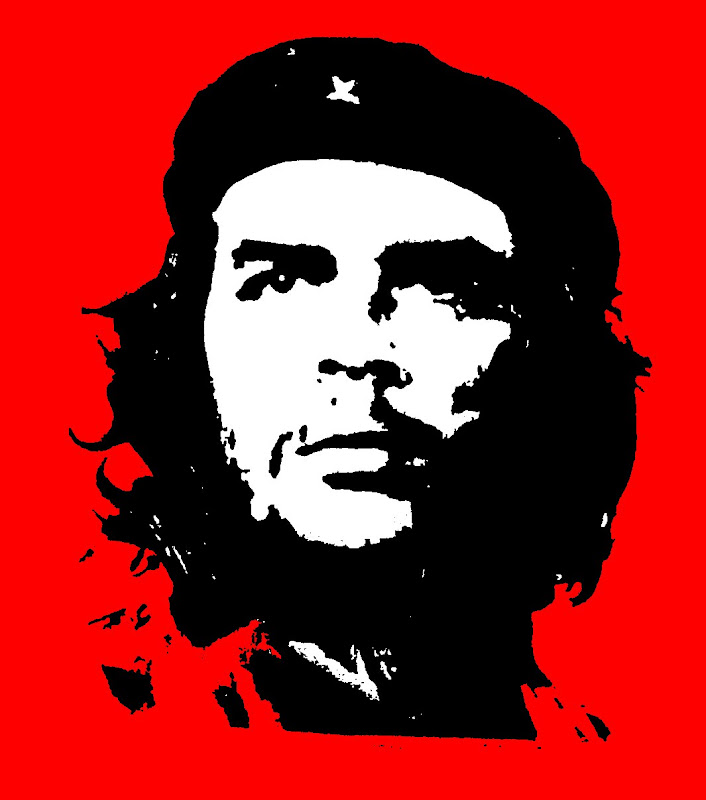
The picture is of course of Che Guevara, who wasn't an entirely nice guy, but does stand for this whole "power to the people" movement.
All right, in 10 mins or less…
I just started reading a series of essays, entitled "Wish I'd known: Insights and inspirations from the journeys of successful entrepreneurs." Do a search, and you'll find it for free online. One essay finishes with:
"I wish I'd started younger and wish I appreciated how much family and friends would support me beyond what was reasonable and fair. I wish I'd know it was OK to have fun and in so doing not taken myself so seriously—the journey is often superior to the destination."Words to live by!
Last weekend, I wrote the acknowledgements for my thesis. The cherry on top, which I'd left for one of the last things to finish. And it would've been impossible to write it before anyhow, as even in the last lap there were/are people driving me on.
During the writing, one person died, another got terminal cancer. Both much too young and undeserving of such a fate. And both of whom I consider good friends, whom I trusted and who trusted me. In part it was the thoughts about them that prevented me from giving up.
But, strangely perhaps, it was also my little brother, just 19 years of age, that was unrelenting in pushing me forward and not letting me quit. It was as silly as him telling me 6 months ago, "I want you to finish this in three weeks," which got me to get my act together, perhaps taking longer than three weeks, but not stopping until I was done.
And it was all the people I interviewed for this study—my subjects, and ultimately my customers—all of whom unquestionably agreed to share their wisdom and whom I ultimately do it for.
It's only about a page worth of acknowledgements, but it is for the people on that page that I spent countless months writing, that I ultimately produced a 120 page-document for, and without whom I wouldn't be anywhere close to where I am today.
That… is the value of support and why nothing is impossible!
(No picture, as I found nothing that could do them justice)
 I'm thinking about adding another "interlude" to my collection, inspired by ADD without a doubt. It's the cookerlude, baby, aimed at collecting thoughts and notes on cooking in order not to forget and to better understand the world that a cook goes through. While I cook nearly every day, I don't consider myself a good cook. I simply don't have the taste-buds for it; but I do love the good food, which, luckily, my gut no longer shows!
I recently discovered a podcast, called/by The Restaurant Guys, which, apart from the insanely long commercials, actually seems quite interesting and is funny enough to keep my attention. Some notes.
Salt: So, we seem to have this internal taste-meter for the stuff, which in some ways is tied to the percentage of salt in salt-water. At the same time, our saliva actually dilutes salt in food, reducing it, meaning there should be a higher percentage in food than salt-water, for us to enjoy it.
Sugar: apparently there's no set limit for that, people love sugar (I must be the exception).
Salt + Sugar: whenever you make a sugary desert, adding a little(!) salt helps the taste; apparently they do funny stuff to each-other in your mouth, a party in your mouth, so to speak.
Taste-enhancers: apart from the above, olive oil, mushrooms, garlic, tomato-paste, alcohol (and much more) enhances the taste in your mouth.
Pretty basic, no? You can listen to the whole episode on what (American) people like in their food, here.
My own world
(This is where I talk a little about what I discovered myself in regard to cooking. Pretty basic too, so I'll try not to embarrass myself.)
I'm a big fan of salads, I make and eat one nearly every day as a meal. I often use canned tuna, but I recently discovered salmon in a can, which tastes better, is less salty, healthier, and costs about the same here in the Netherlands.
But steamed salmon is the best. You can get an expensive steamer, but a cheap solution is a microwave-steamer. I found one in a Chinese store for about €10, you can steam whatever you want in 5-10 mins and it magnifies the taste. Add some green beans and carrots, and you got a great salad for a meal! Add some potatoes or rice, and you won't need the salad.
Last, but not least, sometimes, not always,Ketchup actually makes for an interesting dressing (together with some oil and spices). It often contains vinegar, which salads like, and the tomato mixes well with the salmon-taste.
That's about it for today, I'm not sure how often I'll repeat these cookerludes, but I hope you enjoyed it! The picture is of course of Chef!, the show.
 I took part in a "flirting in business" workshop last night, pretty fun and insightful. It tried to explain the fundamentals of communications to us—around 50 professionals, students, work-seeking-people, etc., both shy and outgoing, all with their own qualities and questions—and I took a lot home from it, including a book by the presenter.
So, apparently a "flirty" conversation has three main components:
- giving attention;
- showing curiosity;
- showing trust.
Several things, like conditioning, fear, and ego stand in the way of change, and the only way to get around it, is to acknowledge the feeling as it happens and know that you have a choice. Good to know! Apparently, a conditioned change—one that lasts—can happen quite quickly, you have to practice it around 15 separate times for it to become internalised.
A round of answers were given concerning what people pay attention to during a first meet, the infamous first impression: it ranged from dry hands (which you can't do anything about), tone of voice, general looks, and, most importantly, the smile, as that overcomes a lot.
It was also interesting to hear that only 7% of the message that we get from people is verbal, and the rest is sensory. That explains why I often don't listen and go on instinct, I guess… :)
Did I take anything big back from that meeting? Not really, except that it's really not that hard to sell yourself, as long as you have a certain awareness of what's going on in your head and what matters to other people.
 Dear reader,
If you've been following my blog, which is kind of you, you may have noticed both a drop-off in posts, and, more importantly, a drop-off in relevancy.
To put it bluntly: I'm bored of the topic! I've been researching this industry to the extent that everything seems similar, rising food prices, fmcg-marketing strategies, the "organic" differentiator, etc. etc., it all feels like I've seen it before, and I'm struggling to come up with new and interesting topics.
In addition to this, and this is entirely my fault, I'm stuck with a project that doesn't want to finish itself, my thesis that refuses to get published, or rather that I refuse to be published. The effect is that I'm sitting behind a PC… a lot… and not experiencing/talking with insiders/etc. enough to get fresh perspectives on the field of "third places" and feel productive in that setting.
I'm not going to abandon this blog; no, very likely I'll continue to publish several posts per week. However, some, if not all, will not exactly be on topic; they will likely be discussing things going through my mind, on business, on art, on technology, etc. and hopefully on sounds + food 'n' retail as well.
Until I dig myself out of this valley, and I will, I hope you'll be patient and not hold my lack of focus against me. I still aim to be a producer of excellence in mine and your world.
Sincerely,
Vincent van Wylick
Main honcho @ foodandretail.blogspot.com
 An interesting quote from the Economist this week. Particularly, because I personally suffer from it, and imagine a lot of other people & businesses do too.
Mr. Fellows [CEO of Callaway golfing equipment] believes that the "fundamental principles of running a company don't change just because the product category is different." In his view, Callaway's problems stemmed from the fact that it saw itself as a golf business, not as a consumer-goods company. He resolved to focus on "what the consumer wants, not our own feelings about what the game of golf should be."It doesn't matter if you're the CEO of a company, an investor, a sales-person, a blogger, etc., I think everyone has an idea of what they want and what customers should want. But what it really comes down to is the latter.
Face Value, my favourite section in the Economist, every week.
The picture is courtesy of digitalfreak.net
 Hey, a little busy at the moment, but here's some links, I've enjoyed recently.
- Jim Donald's, former Starbucks' CEO, month by Patricia Sellers (Fortune): After listening to an interview with Frank Addante on Venture Voice, where he said "Time is a finite asset!", I looked up "time-management CEO" on Google, and this is the first thing I found. Some good tips on meetings, getting up at 6, and generally managing your time.
- Monocle design-notes by Dan Hill: I printed this 32-page (!) document out this morning, and it will probably take me a few days to digest it, but I'm already enjoying the first few pages, where he writes about the vision behind Monocle as a mag. and as an internet-publication and how the multi-disciplinary team reflected this.
- 10 Ways to Improve Your Programming Productivity by Matt Moore: I love productivity-stuff, and think most of these tips apply to any activity really.
- The 7th Deadly Claim — “Best Value” by Jeff Sexton (Future Now): "The problem for most companies is that they don’t do BOTH well: Either they don’t do enough to persuade customers of the product’s value, or they price their high-quality item even higher than what they’ve been able to substantiate to the market."
- How Facebook Is Like Ikea by Tim Harford (Slate): Considering I wrote about something related a few months ago…
 I am not a born bootstrapper, let me make that clear from the start. I just like titles that include words starting with the same letter (is there a term for that?).
Bootstrapping is, in my own definition, "the ability to generate growth on minimal financial resources." I was first going to call it "the ability to survive on minimal resources," however that would make most of the third world bootstrapping-geniuses.
No, it's when entrepreneurs have an idea that they want to grow into a commercial business, and since finding funding is difficult and less preferable for some, they do so with minimal financial means, perhaps while maintaining another source of income and by generating organic growth—revenues derived from within the company. In sociology, there is a concept called bricolage, which means more or less the same.
What makes a born bootstrapper, or rather a good one? I think it requires three qualities:
- The first is certainly the ability to live cheaply, and I'll refer you to one of Jeremy's post where he makes the point quite eloquently. The ability to live without luxury, eating at discounters, buying second-hand furniture (or dragging it off the street), living in cheaper areas, and, most importantly, to delay paying the bills, are certainly key-components here. As is, making resource-choices for your business. Easy to do when you work in software, less so in physical businesses, though inventory is fun to play around with.
- The second quality is time-management. You need to generate growth within your company and pay the rent, so you have to make choices. You have to find alternative revenue-streams, perhaps get another job, and work on your business during your free time. It requires you to set some clear priorities, skip the weekly cinema-visit or the time spent with your loved ones.
- The third and final quality, is to be goal-orientated. You could place that under time-management, perhaps, but where bootstrapping is most likely to fail is when motivation drops. You need to keep your eye on the ball at all times; the priority for a bootstrapper is to grow the business, not keep a stable job, and you need to see the light at the end of a tunnel and keep going until you reach it.
The picture is courtesy of rockies-ice.com
 Ten tips, taken from an essay written by Masterson, entitled "The Winner's Rule", from the book "Just One Thing
Advice is a funny thing. I don't think it's advice at all; rather it's a set of criteria or truths, and fairly shallow ones at that. They ignore the context a person, a reader, a student, a business goes through. And what if we all met these same criteria? Wouldn't the world be a much more boring place? As such, treat all "advice" with care.
I can classify Masterson's points into two categories: Business-related & person-related.
Business-related
1. It's not a business until you make the first sale.
2. The most effective way to enter a new market, is to offer a popular product at a drastically reduced price.
3. Sell, sell, sell: keep on increasing the perceived value, allowing you to ramp up the price, and increase profit margins.
All of these are sort of straight-forward, I think, though certain terms should be qualified. For instance, what does a 'sale' mean? It's easy to understand it within the context of a product going over the counter, but what about service-companies or the many web-businesses that fund themselves through advertising (if that)? I would nominate the first "rule" to be: It's not a business until you make money.
The second and third points, to me, seem like a typical VC-thing to say. Scale, scale, scale. Sell cheap and sell much. And worry about increasing the profit-margins later on. Again, it should be qualified, depending on the type of business. For instance, the internet is a market-place for countless cheap (or free) and mass-products; but as a result many products/services have become simple commodities, with no one willing to pay for them, and businesses having to look towards advertising as a funding-source (shudder).
Personality-related
4. When choosing a business, pick the one that can be grown without your personal involvement.
5. Before investing, know exactly how much you're willing to lose, and get out before you hit that point.
6. First, improve your strengths. Then, eliminate your weaknesses.
7. Focussing is more effective, than a diversified approach.
8. Let your winners run, and cut your losers off… quickly.
9. 80% of success comes from 20% of your resources.
10. Try to always focus on the good of the whole, vs. the good of the one (applies to any relationship).
Lot's more to say here.
Completely agreed with point four, as entrepreneurship should not be about enslaving yourself to another organisation, at least not for life. Many entrepreneurs seem to ignore that rule, however. Also, VCs often prefer to replace the founders with more qualified executives to "grow the pie."
Point five is spoken like an investor and is very much dependant on the perception of risk you have. Entrepreneurs are reputed to be risk-taking people, however the smart entrepreneur takes a calculated risk, and understanding how much you're willing to lose is part of that.
Point six and seven are a personal weakness of mine, I'm too damn curious for my own good sometimes, more interested in exploring areas (of myself or in life) that are unknown to me, rather than that which is known. That may change, but is certainly not a criteria that I personally meet. I wrote about focus before, btw. Differs from person to person.
Point eight comes with experience, I think. On the one hand, you need to have perseverance, even when things are hard or going badly, especially during the early stages of a start-up. On the other hand, a reality-check is price-less. I suggest bouncing your ideas off as many people as possible.
Point nine is true, nothing to add.
Point ten is about understanding the core-principles of business and, even as an employee, doing all you can to make that business (instead of yourself) profitable. Ram Charan is a good man to read on that.
Good essay, made me think about my place in the world.
Read more entrepreneurship articles here.
Entrepreneurial method: believe something is impossible? Enter 'double-think'
0 comments Posted by Unknown at 9:10 AMYesterday, I read an HBR-article by Roger Martin, on his book "The opposable mind", the ability for people to think contradicting thoughts and act on them at the same time (this may sound familiar, if you've ever read 1984).
My first instinct was to throw it out. I didn't like that he used the first few paragraphs to discredit other thinkers on leadership; and I didn't find his proposed method for coming up with a business-model particularly compatible with the general idea of "chaos" that he was proposing (more on that later). I even wrote an impassioned article about it, but waited a day before publishing it (no April fools from me this year). None of my criticism was directed at his core-concept, btw., I do believe in the ability to think contradicting thoughts, and act on them also.
After a night of sleep, I came to the conclusion that Martin's article was effective. Because it required me to think the article had faulty qualities, while the core-idea was right. And that was the very idea of 'double think'! Then I started thinking, what other areas could you apply this to? Pick one!
- My perception of the internet is that it's indiscriminately linear—we forget things the day after they are published. So how could you make it less linear?
- The perception of food is that it doesn't do well in e-commerce—they perish and people value touch. So how can you sell food via the internet?
- My perception of restaurants is that it requires a genius cook, who is both expensive and hard to handle. So how can you start a restaurant without such an individual, or better yet, how can you start a restaurant with one?
Martin's method for coming up a business-model looks like this:
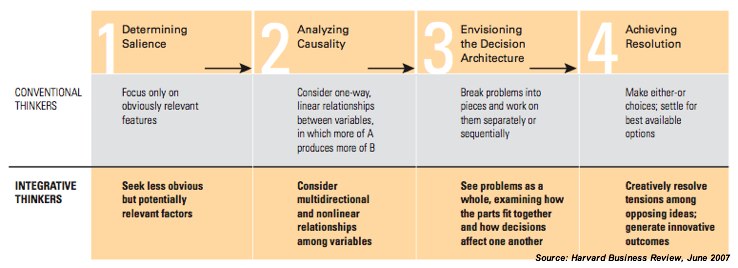
In other words, you need to identify your core-customers, understand that their decision-process is not linear; understand the equally multi-dimensional architecture of your business, industry, and economy; and come out with a product/service that meets these opportunities.
Whether this is the best way to come up with an impossible idea, I'm not sure. But it seems like a logical thing to do after you come up with an idea and are looking to place it within a commercial context.
He uses one example throughout the article, that of Red Hat Linux, which, I completely agree, is one of the best examples to choose. It is free software, but it's a commercial success, which goes against conventional thinking, at least at that time. And instead of just acting as a commodity or becoming proprietary charge-ware, they decided to make a services-company out of it, and a market-leader at that. So how would you turn your open-source product into a commercial success? If that isn't 'double think', I don't know what is.
 The reason I like Star Trek, most sci-fi in fact, is because of the space-opera aspect. You don't just tell a story, you design a universe around it. I've been a fan of the show, ever since the age of 10 when I got to watch TV at home. In some ways, sure, the time spent watching the show impoverished my life by taking me away from other endeavours, in other ways, it enriched it by contributing to my ability to dream.
As I grew older, I started paying much more attention to the story-telling aspects of the franchise. For instance, did you know that until the second season of Star Trek, the next generation, the writers didn't create a place for the crew to relax? It was only then that the makers came up with the concept of Ten Forward, hosted by the infamous Guinan (see pic). Later, in its spin-offs, Deep Space Nine and Voyager, we also saw a big role being played by the "lounge", hosted by Quark and Neelix respectively.
It was felt that by introducing this aspect into the show, a third place, it allowed the characters to show a different side of their lives, necessary if you want to teach a complete philosophy about society, as Gene Roddenberry was in fact doing. And of course, it spawned plenty of dramatic stories, that would otherwise never have happened. It allowed for romance, friendship, and conflict to happen, for aliens to meet and interact with one another.
What's interesting about the franchise that each series had a different archetype, which also affected the room for "drama." You could see it as both an evolution and devolution of a story. Star Trek, the original series, was the raw outline of Roddenberry's philosophy about the future of society. The next generation was much more developed and allowed for deeper interpersonal relationships. Deep Space Nine was again an evolutionary step, and much of the stories centred around "life" on the station.
Both Voyager and Enterprise represented a devolution. Voyager introduced the "morale officer", in my opinion, an engineered effort to bring a certain warmth to the story. But it was much less about teaching philosophy, as it was about survival. It showed that Roddenberry's universe was in fact small and could break apart at the edges. But it was still a good story.
Enterprise represents a return to those raw ideas. Perhaps it was felt that the franchise could cover no more new ground, and that a new philosophy had to be designed. It was also a story of survival and the raw pioneering spirit, shown in part in Voyager. But it felt like a military mission, there was little room to form complete characters. Instead we were presented with deep dramas, echoing the 9/11 events, which turned the characters into one-dimensional creatures, much perhaps the way the news depicts the main characters involved in the post-9/11 era.
To me, at least, Star Trek is a good analogy for certain principles in life. That it is not enough to search, but also to build. That friendships and societies are built, not only from the hard work they require, but from the breaks we take to reflect on our actions, and the places that are engineered to cater for that need.
Food for thought.
I decided that the one thing that was missing, for myself, on this blog, was the "fun" post, where I could write about the softer side of sounds + food & retail. The other two sides, facts & opinion, are also areas I plan to develop on, but without fun, there's no balance. Therefore, I am re-instating the interlude, but trying to not exaggerate, like I did during my thesis-break.
The reason to like fiction, I guess, is because, unlike the mechanics of business, its dreamlike qualities encourage the viewer to think abstractly. And abstract thoughts, to bring it back to business, lead to creative ideas that no-one had before, and have the potential to create market-spaces, no one imagine before that. At least that is my theory.
Two of the following movies are quite surreal: one is about adulthood and the other about childhood. They are both about creativity, about dealing with the demands of real life, and about embracing your passions.  "Where the heart is"
A typical 80s flick, where the characters are misaligned with the hard-cruel "real" world. In this case, the two beautiful daughters (Uma Thurman and Suzy Amis) and one son (the guy who plays McKay in Stargate Atlantis, if that means anything to you) are disowned by their wealthy father and placed in a broken down house in the middle of the business-district. What I liked about the film is that the house becomes a place of self-expression, and each individual that inhabits it is an artist of some kind. The father eventually loses all his money also and ends up living in this house, and he comes to accept that the world doesn't revolve around money, but around believing in what you do. A light comedy with some deeper principles. 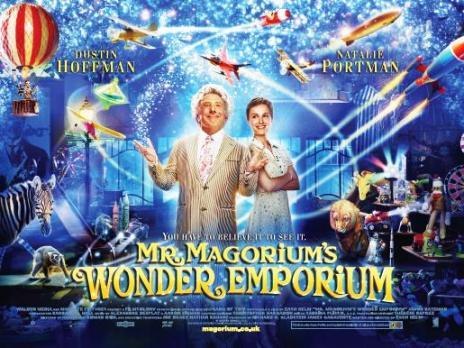 "Mr. Magorium's Wonder Emporium"
Here's an interesting exercise: Get a block of wood, as bland as possible. And believe in it.
The weird thing about it is that the block of wood is you. Anything can happen to it, as long as you believe in it. The block may initially appear lifeless, but it is your faith and work that makes it more than its parts, so to say. And that block can be anything. A piece of clay that you turn into a sculpture, a room that you turn into a living thing, an idea that you turn into a business. All it takes is a little faith.
Well, that is the extent of my learning from this film, which was really about a toy-shop that is alive and a girl, Natalie Portman, who refused to accept it was her destiny to run it. It's entirely not meant for my age but I enjoyed it nevertheless.
That's it from me this week, I'll be spending this Easter with my family. Have a good one and until the next time!
 I'm currently reading "What the CEO wants you to know," by Ram Charan, and it's safe to say that it belongs in the top 10 business-books, I've ever read. It's only 140 pages short, but filled with advice that is extremely easy to digest, that I'll be sure to re-read it several times later on, and can warmly recommend to others too.
One chapter in the book struck me particularly, on coaching, as I consider it a vital skill in business-relationships. Although I think Mr. Charan paints a bit of a rosy picture, I consider it a good standard to aim for. Some quotes:
How would you feel if someone gave you positive feedback on the things you're doing well and specific suggestions for building your skills? Chances are you would feel that you had a personal coach, someone who wanted to hep you succeed. You would feel energized. I can tell you from experience that it works. You can do it for those who report to you, and in the process, you will expand your own capacity.The chapter also goes into a number of examples from real life.
…
Coaching is not a performance review. It's not about what someone did last year, and it's not about money. It's very personal. You're hitting the person between the eyes. You're helping him face his blind sides and learn to do things better. The feedback has to be honest and direct. No sugar coating.
…
Self-confident, secure leaders love to give true feedback because they know that growing people is their responsibility. By true feedback, I mean saying what they really think. Too often, people hesitate because they know they may be wrong, or that they feel reprisal. But chances are your instincts are correct, and they'll improve over time. I've seen numerous times that when you put experienced businesspeople around a table and they talk candidly about an individual, the judgements converge very quickly. It's not had to zero in on the most critical thing the person needs to improve.
Some people say this kind of coaching is a good idea, but their company doesn't have the ambiance for it. Still, you can start with three of four people who would be receptive for it.
Charan's book is all about understanding business principles and setting a limited number of fundamental priorities to improve a business. Coaching is a logical extension to that, as when you clearly communicate what the business priorities should be and how that individual can get there, that's essentially coaching (and makes your life considerably easier in the process).
The author also co-wrote a book called "Execution," which I haven't read, but based on this book, believe is a good choice if you need a more modern read. "What the CEO wants you to know," is from 2000, but I consider it timeless advice.
 When I started this blog as an experiment, I purposefully kept it vague, while maintaining a fairly clear industry-focus. However, taking a value-chain view of food & retail only gives you so much. It allows you to identify tensions and possible opportunities, but unless you want to be a consultant regarding value-chain issues or are the strategist within a business, it doesn't really bring you all that much.
Where the imagination really kicks in—and you need that to think of new business ideas—is when you start matching you— the individual or groups of individuals with a particular skill- and experience-set—with a particular opportunity that you can feel both passionate about, and confident that your skills & resources are sufficient to add value to it.
Blogging about FnR allowed me to look at segments in the industry, such as:
- farming
- supermarkets
- franchises
- online-retailers
- electronics retailers
- coffee-shops
- restaurants
- cinemas
- furniture-stores
- and fitness-studios
- fast-moving consumer-goods
- coffee
- beer
- private labels
- organic food
- and media
However, starting or working in a business is of course more than writing about it. It's the process of building up a vision, gathering up resources to execute it, and executing it. I was reminded of how powerful such a vision can be just last night when I was evaluating a business-idea and what it would take to execute it (I ended up dismissing it for now).
And of course, starting a business is not the same as running a business, the latter of which can be defined as a sustainable* process of making money (*: not in the environmentally-friendly sense of the word). So many stages to go still.
Will this have consequences for this blog? In the short-term, the next few months, probably not much. I'll still be looking at more industry-segments, product-areas, and business-issues. Ultimately though, I will have to focus on one particular industry-segment and one or a set of related product-areas. Of course, when that happens, I'll continue to share my thoughts here, as that is my not-so-secret way to build mindshare (insert: evil laugh).
Take care,
V.
Dear readers,
I'll be taking a few days to a few weeks off to reflect on my current state and activities, my goals and the steps needed to reach them. I'll likely post a few thoughts about this on Tech IT Easy in the near future, as that seems more suited for that somehow.
Until then, my links are being still updated and I'll discuss some of them this weekend again. At the end of this month, I'll also wrap-up what I've covered in February 2008.
Until then, take care,
Vincent
 If you follow my blogging-history, you may have noticed that I write about books… a lot! There are several reasons for this. One is certainly that I am a bookworm—I enjoy reading books, learning new things, and whenever I enter a bookstore, I go into a trance and start studying books to buy now or in the future. Case in point: I wasn't planning it, but I bought two more today! Talk about impulse-buy… More on those in a sec…
The other reason is more complicated. I actually think that books translate better to blogging than much of real life. This clearly differs from blogger to blogger. You won't find Robert Scoble blogging about books much, nor Fred Wilson, both of whom blog on more daily issues (Scoble is also a media-guy). Both John Gruber and Jason Kottke do cover books, but often base their writings on articles and other shorter readings.
For myself, it is different and I can give several examples of this. One, I was a pretty regular blogger until about a year and a half ago, when I started on a project of researching venture capital in the Netherlands. Not only was it a time-intensive process, but I was constantly questioning myself as to whether my blogging was ethical or not. There were certain topics reigning in my life, relating to that company, which i could just not disclose. A similar thing happened before that, when I worked at a high-tech start-up, and most recently, while completing my thesis.
There are several blogging friends I could mention (F., J., C., & M.), where you notice this same phenomenon.
Books instead, as well as articles, offer a foundation to build upon. One, they are public, which dismisses any confidentiality issues. Two, if they are well-written, they communicate core-ideas well, and you can add to that with your own knowledge. The complication with reading is of course, similar to writing, finding the time to do so. I think I found a doable system, by reading just before sleep, but I don't know how that will hold up in future projects.
The way I choose books (and articles)
As I look back at my short life, I find that I've evolved in the choices of books I made, and most recently after engaging on this trajectory—the food & retail blog and the underlying purpose that serves. While before, my choice of business-books was somewhat restrained to general management, strategy, and entrepreneurship books, I now choose books purposefully that fill a gap in my knowledge and focussed on business-issues in this industry.
Some examples
I choose the McDonalds (coverage here & here) and Starbucks books (here, here & here), because they seemed like a good venue-point from which to understand how food-businesses work. My interest has always been towards chains of businesses, not individual ones, so that was also a bonus. Similarly, the IKEA-book (here) offered insights into retail, and the eBay-book (here), while less relevant, into starting a business and running a community.
The Disney-book (here), which I'm currently reading, gives me insights into building a framework around the soft discipline of entertainment, story-telling, etc. It is very relevant to my earlier post today on cinemas, which is clearly a raw perspective, but one I hope I can refine, as entertainment is a core-value I have.
The two books, I've chosen today, are on two diverse, yet, to me, relevant subjects. "Managers as mentors" is about what the title suggests. The reason I chose it, is because I'm not a fan of the traditional perception of management. I find it a hard world. The way I relate to people is through learning and teaching. I've raised my brother since I was 11, as my parents were often away from home, and find it very rewarding to see him become an adult. I have a similar relationship towards people, where I like to turn them into more than they imagine themselves to be. So this book seemed right. That is not to say, that I have any problem with firing people that I don't feel have potential. ;-)
The second book is even more interesting to me, it's called "the growth strategies of hotel chains - best business practices by leading companies." It's very strategy-orientated, covering principles of diversification vs. specialisation, vertical/horizontal/diagonal integration, m&a's, franchising vs. ownership, branding & globalisation, and US vs. European differences, as well as examples of said leading chains at the end of each chapter. Exactly up my alley! Needless to say, I will read it after the Disney book!
So what about you?
Now, a discussion is only valuable if more people take part. So please, if you have an opinion on this, or on a better research-methodology for blogs, let me know in the comments!
The picture is courtesy of brandtarot.com
My relationship with story-telling - a short autobiography part I
0 comments Posted by Unknown at 1:45 PMI'm in a philosophical mood today, after having spend an hour this morning sorting through the rough drafts for this blog (estimated at around 150), which I categorised as "idea," "rough notes," "feature complete," and "send it already." There were so many of them that I found myself a little overwhelmed to address a single one, a little afraid to miss seeing the forest through the trees, and instead decided to write about a core-principle in my life: story-telling.
I'm very attracted to the concept of telling stories. It's perhaps a little difficult to explain, but certainly related to the reason why I write so much, and also integral to what I want to do with my life.
When I grew up, I was reading all the time. From the back of cereal boxes, to encyclopaedias, to even the bible (which I thought was a great fantasy book). As a kid, I also remember building up cities in my room and garden, made out of toy-parts and characters, and constructing visual stories around what was happening.
I did not watch TV until I was 10, but, around that time, I fell in love with fantasy and sci-fi stories, both in book-form and on TV. I liked the way the story was constructed, and loved to imagine myself being there. I remember having magnificent visions of what I imagined the future of society, cities, and the home to look like.
Around 17, I decided to hold my first teen-party (the last one before that was probably around the ages 8-9). At that time, I was playing around in a band and very much into music-culture. I remember coming up with the party idea, which was essentially a visualisation of a club. It was lucky timing. We were just about to move and I had a huge house to my disposal.
The way I visualised it was to have rock-bands playing live in the living-room, a techno-room with a (borrowed, I think) strobe-light in the basement, and some other theme-related room elsewhere. Important were of course drinks and drugs, as, hey, I was 17. And equally important was the concept of complete freedom, which I think was communicated quite clearly.
A large inspiration was this video by the Prodigy - No Good (start the dance):
The end-result was great: around 50 people showed up, 2-3 bands were playing, and people did some crazy stuff, without getting me in trouble. In the end, I was still the one responsible, and took that seriously, but essentially everyone could do what they wanted. I repeated a similar party a few months later, which revolved around the same principles, with some restrictions, though around twice the amount of people.
That's where I'll end this. Lot's of stuff happened since then and will continue to happen, and I hope to write a second part in maybe 5-10 years from now (maybe sooner) about all the adventures I'll hopefully have, and evolutionary leaps I'll hopefully make.
Core to everything, I think, is vision and freedom. When you create a story, you have a vision of the components and the way they fit together into a dynamic process. At the same time, a story-teller must realise that his/her story is just the start for the listener/viewer/experiencer. It's a synergetic interaction between creator and beholder and the end-result can be both unpredictable and quite beautiful sometimes, a risk that, to me, is entirely worth it.
P.S. Happy Valentines day!
 One of the downsides of not being at home for three months is that the mail tends to pile up. The culprit is The (weekly) Economist, which forced my landlord to dedicate a special cabinet just to accommodate them all. He was happy to see me.
My thesis is handed in, and while I'm anxiously waiting for the feedback / grade, I'm doing a variety of stuff to diffuse the thesis-haze that was in my head these last months. One of these is thinking about how I will organise the research that I collect for my work / blog. This is part of a dual trajectory I'm pursuing—one side is research, which I use to build up my knowledge about the field of food & retail, the other side the practical path, which I can now finally pursue freely.
The pile of 15 or so Economists is actually a good exercise to think about what really matters, and I'm going through them quickly, marking the articles that are interesting to read, and later cutting them out and adding them to special folder, after which I may categorise them by country and subject perhaps.
It's easy with The Economist, but there other publications that I'm much less eager to chop into pieces. My books are filled with pencil-marks, as are my Harvard Business Reviews, but there's no way that they'll ever feel the cold blade of my scissors. With those publications, I'm forced to keep all that extra paper and try to get my thoughts to paper as quickly as possible.
The other, sort of, complication are web-articles. I've been printing stuff to pdf and have a special S+FNR folder, reserved for anything from fashion-trends to human-resource management. I'm also going to print them out and add them to my folder for future analysis.
As you can see, I take my research seriously. A probable after-effect of writing a 180-page thesis, studying three academic fields—innovation, entrepreneurship, and finance—and interviewing roughly 300 businesses.
But I wonder how the real bloggers do it. If you're someone who takes blogging seriously, how do you organise your material, or do you organise it? If you do so on paper, I'm curious as to what kind of folders you use (incl. a link to a photo if possible).
Note: If you use a computer to store stuff digitally, I assume you use a personal database, like Devonthink or Jojimbo for the Mac. I'll tell you right now, I've used them all (to organise my thesis) and found it frustrating that they wouldn't do everything I wanted and tried to lock me in in the process (I've spent many hours migrating everything from app to app—it sucks!). They also don't help you much with paper-based materials, like mags, journals, and books. No, on the computer, I prefer a regular folder and to add text & pdf to it. Simple, portable, and cross-platform.
How being in the right place at the right time translates to entrepreneurship
0 comments Posted by Unknown at 12:53 PM If there's one I thing I learned from my thesis it's that everything is part of a system. Most often, this system's purpose is to shift resources from and to various interconnected, yet diverse and complementary parties.
In regards to entrepreneurship, and pretty much everything else, I have a philosophy: everything happens for a reason, usually related to how you respond to opportunities. And to bring it back to that interconnected system, being in the right spot, where you can intercept flows of ideas, people, and resources, tremendously increases the chances of you finding the right business to be in.
Two examples
Two people that are fairly close to me are perfect examples of that phenomenon. They shall remain nameless, for obvious reasons. They are both pretty bright, but what contributed to their lives most, is being where it mattered.
One of my friends did a very smart thing. We studied together and when he moved back to his Eastern-European country, he noticed that a lot of traffic was coming in from the European Union, in terms of regional funds aimed at bringing the country up to par for future integration.
So he started a consultancy with some friends, to advise companies on how to apply for those funds. Initially, he thought it might just be a hobby. But what actually happened was that a lot of traffic was coming in terms of companies—start-ups, looking for funding. And it allowed him to find a business to buy into, which was well-postioned to fill a current need, and had the capabilities, but not the business expertise to succeed.
A second friend of mine was also someone who I knew would always start his own business. But he did the smart thing when he graduated (actually he did several smart things before too). He got a job at a corporation counselling start-ups on how to deploy that corporation's technology. So, just like my other friend, he got a lot of traffic in terms of ideas and people, and all he had to wait for is the right idea that would fulfil a niche in the market. And bingo. I'm not sure if he planned it that way, but he's now the founder of a start-up, filling up a need.
Underlying principles
Right places matter, but so does mentality and a number of other factors. It's not enough to just be there. The reason you are there is because you are of value to whatever network you are part of. Following are I think some factors to consider:
- Be open to opportunities
- Make strategic choices about your initial placement
- Be of value to the network you are a part of - that means being an authority, which means you have to have some schooling
- Make strategic choices about the start-ups that you encounter - are they filling a gap in the market, can you fill a gap in their organisation?
- Go back to your initial network - analyse whether all the elements necessary for success are there—smart people, funding, exit-options, technology—and can be carried over.
- If yes: launch and succeed.
I always knew I wanted to start a business. Plenty of people at plenty of times, have counselled me to just jump in and do it. I didn't, because I felt the alignment wasn't there—between me, a business, and a need.
The way I'm visualising my path into this industry is among similar lines. Become a valuable resource myself. Find & build a network, where I can contribute value too. And then decide, based on timing, technology/idea, people, market-niche, and other elements needed for it to be a success.
Note to the reader: I'm still processing a lot of material I want to write about. Most of it is food and/or retail related, I promise. Expect at least two posts related to IKEA this week, on economics, design, branding, and customer-retention schemes.

 The


