 Disjointed, because I don't have the time or energy to write a beautiful essay about empowerment—I'm not even 100% certain what it means yet. And in a way, by writing about 'empowerment,' I'm breaking the first rule, which is "Don't speak about empowerment." Or at least it seems that way. Currently, there's around 505,000 articles online about the term, which qualifies it as a hype and as such something that has already been discussed too much. But also, empowerment is basically about trust, a behaviour, and how can you talk about a behaviour, you just behave.
I think I first came across the concept, without even using that term. A few years ago, I read a book on ants, called "Emergence." It was a great book, I thought, about how ants at every level exchange signals, in the shape of pheromones, to indicate what they were doing and whether they needed help. A completely decentralised organisation, and the only thing the queen needed to do was produce babies, which, equivalent in business-talk, is, I guess, take care of human resources. I was so excited about it, that it became a research proposal for my master-thesis in strategic management, and was very quickly rejected, as I guess I hadn't related it well to strategy.
I again came across the concept last week, after reading an interview with the then-CEO, Dennis Bakke, and the then-chairman, Roger Sant, of AES, a power-company, which was, at least at the time of the interview (1998), very big on empowerment. And it seemed to work pretty well for them, if you look at their share-price, it rose pretty steadily up to 1998, and even more up to ca. 2001. Though, it hasn't been doing quite as well these last few years.
Reading the interview, I got the impression that empowerment is a religion, which in itself is hard to quantify into a set of rules. Essentially, at AES, it was (or is, I don't know) a system of open exchange flows; people could evaluate each other's performance, investment-decisions were decentralised and crowd-sourced, job-rotation was common, and micro-teams of ca. 10 people, focussed on different projects and tasks, were spread all around the organisation. And that seemed to work pretty well.
But there were also some downsides, such as that the company didn't work well with other companies—rather, it preferred a contractual relationship—and there were constant pressure to revert back to the traditional top-down model, from the public, share-holders, even employees. Essentially, every employee at AES becomes a kind of mini-CEO, which is clearly not something everyone is conformable with.
And the question is, and I haven't figure that out 100% yet, is how you come from that top-down view of human "resources," to a decentralised ant-like model? The key-word, which is equally hyped but seems to apply, is "delegation"—i.e. shifting executive responsibilities out to a team.
I think the problem of this is quite well spelled out in a recent interview with Brad Bird from Pixar, who was at one point confronted with a team that was demoralised. The former director had taken their work and evaluated it in private, giving written comments to individuals, not giving them a chance to give any input. And in order to turn that team around, he had stand in front of them for two months, evaluating the work, in public, and encouraging to take part, through questions. Two months, it took to go from the traditional model to one of empowerment, and just for that team.
The good news is that for start-ups, this is pretty much the way it should be from day 1. The bad news is that for big companies, or as soon as a start-ups grows bigger, the dissonance between people becomes larger and larger. And you have to—if you want to, at least—find ways to decrease that gap, probably most easily achieved through team-building after team-building exercise.
Anyway, not much more to say about this for now, but empowerment is cool, let's leave it at that.
Ah yeah, I forgot! I liked these interview questions, which were typical of an AES job-interview at that time, and made me think about my own opinion on empowerment:
- Should everyone be treated equally? Explain.
- What do you do when something needs to be done and no procedure exists?
- What self-improvement-efforts are you making?
- Recall a time when people around you weren't being entirely honest. What did you do?
- What does "fair" mean to you? How important is fairness?
- For what have you been counselled about the most?
- What is the most difficult situation you have faced? What did you feel? How did you react?
- Describe two important achievements.
- Tell me about a time when a decision was needed and no supervisor was available.
- What kind of rewards are most satisfying to you?
- What does "fun on the job" mean to you?
The picture is of course of Che Guevara, who wasn't an entirely nice guy, but does stand for this whole "power to the people" movement.


- Starting with a lecture by Robert J. Sawyer, regarding the difference between Star Trek & Star Wars. I had no idea that the phrase "A long-long time ago, in a place far-far away" makes such a big difference. Essentially, while science fiction was originally a commentary on issues in our own society, that phrase gave George Lucas the license to not-comment, or rather to accept things like racism (towards robots), slavery (robots again), and countless of other stuff. Really a good lecture to listen to, if you're into sci-fi.
- On a related note, I recently (re-)watched Star Trek 1-6. You really notice the shift from slow cinematics in Star Trek 1 and 2 (a la Kubrik's 2001, which I'm not a fan of), followed by more intense action-scenes in the later ones. I think I recorded the social values more on a sub-conscious level. Numbers 4-6 were my favourite, regarding nature (transporting whales through time); the search for God; and retirement. But I have to say, Kirk was at his strongest in the first two movies. Also, something else I didn't know: Leonard Lemoy (Spock) is a multi-talented individual: writer for several films, producer, and of course actor.
- My favourite adventure movie these last few months: Lawrence of Arabia.
- My favourite cartoon: The girl that leapt through time.
- My favourite fantasy: Pan's Labyrinth (picture is my interpretation of Pan)
- A film, which is taking me a long time to watch, but which I will finish because it's good: Francis Ford Coppola's Youth without Youth.
- Excellent commercial, but not mainstream, movies: Into the Wild; There will be blood; No Country for Old Men (the last three, somewhat depressing too); and Juno.
- An excellent series that recently finished and everyone should watch: The Wire. Seasons 1-4 especially.
- An series with potential that will hopefully not be cancelled: The Sarah Connor Chronicles.
I just discovered a new podcast called "Big Ideas" (iTunes-link), a series of lectures on anything from the impact of urbanisation on musical tastes, to designing menus for restaurants. Oh, and it's Canadian. Not that that's bad, but some parts of the lecture covered local conditions.
John Schneeberger starts his lecture (dated March 1, 2008) off with the basics of menu-design, namely that they should reflect three things:
- What you stand for? Aka. what kind of food do you like to work with?
- What demographics are you targeting? Income, religious issues, etc.
- What are the current trends? And are they for real or just a fad?
- Customer-decisions are always a trade-off between price and quality
- Traditionally, dishes consist of three components: protein, starch, and vegetables.
- What we understand as taste, actually comes from three sources: fat, salt, and sugar.
Schneeberger discussed three booming trends, vegetarianism, organic food, and local produce, and mentioned a number of challenges related to these.
 Vegetarian cooking
The thing to understand about this, is that it's generally cheaper. Schneeberger mentioned a 1:10 ratio when you compare the cost of producing vegetables to the cost of growing a cow. And while it's a booming trend, the industry, somewhat mis-guidedly, still often focusses on trying to replicate the taste of meat, which is impossible (think veggie-burgers, etc.).
Instead, they should be thinking about nutritional value— vegetarian food has been correlated with lower health-problems and is for that reason often recommended by doctors. The problem with these types of diets is of course that they are low in those qualities we would traditionally associate with taste: fat, salt, and sugar.
To create dishes that people actually enjoy, restaurants have to look globally, e.g. Asia, where more exotic vegetable components can bring some needed flavour to these dishes. I think he mentioned seaweed, but also stinky tofu (see pic), which is a type of fermented tofu and one of the few ways to naturally bring flavour to that type of protein.
The implication is that vegetarian food requires a significant amount of specialisation and is often hard to combine with meat-cooking.
Another complication arises from vegan (no dairy, honey, animal-derived products) versus lacto-ovo (incl. dairy, honey, animal-derived) cooking. The first makes it very hard to create a (traditionally) tasty dish. The second, lacto-ovo, allows for more flexibility, through the use of ingredients like eggs, which not only provide extra protein, but also bring a lot of flexibility to the kitchen. You can, for instance, make foam out if it, which would enable the creation of deserts & soups, etc.
Organic cooking
First of all (and I'm not sure if this is just restricted to Canada), an organic food label refers to the production method, not necessarily the quality and taste. Since organic food is more expensive, and taste is not guaranteed, you have to wonder if your clientele is willing to pay extra for that service (remember the trade-off between price & quality!).
The big selling-point here is the information about the product. People like to know how their food was produced; it has a certain value to know that there are no chemicals or genetically modified components in what you are eating. But again, that must be a value that is clearly advertised and which may not be important to every type of demographic.
Local produce
The advantage for the restaurant is that they can form better relationships with their suppliers, it's also cleaner in terms of carbon footprint (less transport), and it also has some marketing value to a certain demographic.
The disadvantage is that supply cannot be guaranteed during all seasons. Schneeberger mentioned something called a "100 mile diet" for instance, but restaurants catering to that need will probably have problems in the winter.
Thoughts
Overall, a pretty insightful lecture of the more exotic (and trendy) type of cooking and its trade-offs.
These types of specialisation are still pretty niche, require significant resources in terms of tools, know-how, and supplier-relations. But, if executed well, a niche can be extremely profitable.
I thought that it was interesting that all the traditional means of cooking, the ingredients and the taste-makers, were pretty incompatible with these newer trends. As such, you are essentially climbing up a hill, trying to educate the mass-market. At the same time, good execution, together with differentiation from the norm, seems like a formula for success.
 The argument for mass-production is that it enables innovations to become cheaper and hence raises the general quality of life of consumers. The argument against mass-production is a more controversial one: that it destroys the unique quality of, let's call it, art.
Starbucks is a very good example of those principles. It brought a higher standard of coffee to the American masses, who, according to Howard Schultz's Starbucks biography, had long been oppressed by low-quality coffee from retailers and coffeeshops alike. At the same time, as the recent crisis at Starbucks illustrates, it has reached a saturation-point: it has brought Starbucks-outlets to every corner in the US, as well as spawned a whole army of competitors, and its brand has become diluted. It has become a commodity.
Back to their roots?
The re-enstatement of Howard Schultz as CEO is a signal, that the business has lost some of its original spirit and is in need of a guiding light. A letter that is rumoured (!) to be written by Schultz confirms that Starbucks will be focussing on re-introducing that original spirit, as hard as that will prove to be. There's only so much that you can change, after your company has reached a certain size. It would, at this point, be like saying that McDonalds is planning to become your corner-restaurant where everybody knows your name and favourite food.
The innovative angle
A friend of mine made me aware of a new coffee-brewing machine on the market, called Clover, which promises to deliver a higher quality coffee to consumers, though also at a higher price. According to Bruce Milletto, a retail consultant to the coffee industry, "a typical American café spends around $50,000 on equipment, about one-quarter of which goes on an espresso machine. At $11,000, a Clover costs the same again." Thus the investment-proposition is not an attractive one to the average cash-strapped café, who would have to spend that kind of money and charge an expected $6 per cup to recuperate that cost.
Following the rules of mass-production, Starbucks + Clover makes for a match made in heaven, and so it is: Starbucks has in fact acquired Coffee Equipment Company, the four-year-old Seattle-based maker of the Clover coffee brewing machine, for an undisclosed sum.
Considering that Starbucks has long been threatened by the commoditisation of coffee in the US, through the birth of literarily 1000s of new franchisers who, on the surface, provide the same value-proposal, though perhaps at a lower quality and price, it makes sense to acquire one piece of machinery that makes a bit of difference in the eyes of certain consumers. Considering the recent partnership with Apple, I believe that these consumers share a similar taste and price-insensitivity, and since that segment appears to be growing, I believe that Starbucks made the right call. They appeal to the type of customer that will pay $6 for a cup, and with their economies of scale, that price is sure to drop to a slightly more acceptable level of (I guess) ca. $5.
The cultural angle
There is another side to this. The USA is not the world, and while Starbucks has been thriving over there, the Europeans (I can't speak for other continents) have enjoyed a coffee-culture for quite some time. For people like my parents, who are respectively citizens from Southern- and Western-Europe, and avid café-visitors, they would not even consider going to the Starbucks in the centre of their German hometown, because there are plenty of alternatives with more atmosphere, more identity. To them, Starbucks is like a McDonalds, a franchise that in fact shares many cultural values—bringing a good to the masses—and does so by building ecosystems of services—from music-retail to the happy-meal—to deepen the (commercial) relationships with its customers.
Consciously and subconsciously, I'm a sympathiser of "unique" café-outlets. I like spending time in them, sometimes hours at a time, read my newspaper in peace, and enjoy a reasonably good coffee at slightly less than $2 a cup. I don't actually care about spending twice that for a coffee, but all the Starbucks's I've been too (exclusively in Germany and the UK, I must admit), have been so devoid of atmosphere that I don't really spend more than a few minutes there, 30 max. The only thing that does attract me about them and similar stores, is that I can grab a cup-to-go, mostly in the summer, and enjoy it out in the sun.
As a citizen of Europe, I think I am a fan of the heritage of the traditional café and don't really want it to go. If that makes me "backwards" or conservative, I am sorry. I want the chance to enjoy a Turkish coffee in Brussels, an Italian coffee in Cologne, or simply a Dutch one here in Rotterdam. I enjoy knowing the history of a pub that has existed for over a 100 years in Antwerp, and the same in Maastricht, or Amsterdam. I want there to be a diversity, and most important, I want that choice to be mine. I don't want there to be a cloned coffeeshop on every corner.
One of the saddest things I heard, while I was in Belgrade last year, was the exactly such a historical café was replaced by a chain (and the coffee stunk too); and I was equally sad to see that nearly all of the traditional retailers I remember from before the war had been replaced by a cloned shopping-centre that would've made any Western city proud: from H&M to Footlocker.
Opponent: Starbucks?
Globalisation is a situation we must all deal with. Its oldest proponents are the FMCG-companies, who are focussed on producing the same good for millions of people. The question is whether coffeeshops should embrace the FMCG-principles like McDonalds and Starbucks clearly have.
Starbucks is a formidable opponent: it is both a roaster, a retailer, and an FMCG-producer. It is strong in the US, and has a significant presence in the rest of the world. It will not go away, And not all believe that their presence is all that disruptive. I don't either, as long as Starbucks knows its limits. There are parts of the world that do not share the same qualities as US-towns. Some cities have long histories and places of heritage that should perhaps not be housing a McDonalds or Starbucks.
In a way cafés are stuck. They need the kind of innovation that Clover brings, but they are not in a position to buy their way in. If they did, they too would have to become mass-marketeers, in order to recuperate that cost. Instead they need to focus on what they do best, and coffee-machine makers to do the same and just license their technology. And whether the latter is able or willing to do that is the question.
I'm not sure how much Clover was acquired for, no one is. And I'm not sure how far Starbucks is willing to go to ensure their qualitative and quantitative dominance of the market. Will they grab every new piece of technology that promises to introduce a higher quality of coffee to consumers, keep it for themselves, and leave the traditional cafés to differentiate themselves simply by their "culture"? Sheer business-principles dictate that they will.
Howard Schultz made me believe, in his book, that it was Starbucks' mission to bring better coffee to the world. Let's hope that a richer coffee does not come at the price of a blander world.
This piece is in fact incomplete. Optimally I should write up a list of actions for coffeeshops to take. However, I am not yet that familiar with all the business-issues facing these organisations and all of my suggestions would be targeted at growing in size and battling on similar terms as a national or global player. And I'm pretty sure that many would not be willing to do that. So I think I'll wait until I have a more objective grasp—from all angles—on the situation, before giving practical advice. Feel free to provide me with that objectivity through your comments.
Should the platform for interacting with your customers be "open" both ways?
0 comments Posted by Unknown at 12:00 PMThese next few weeks, my posting-rhythm will slow down due to personal issues, sorry about that. It does however feed into this topic here.
Premise: A couple of things happened these last few days, which I think are noteworthy. The Zuckerberg-interview on SXSW got slaughtered by the twitter-crowd (though there's a human behind every trigger), and which is an example of a BAD interview. There's Steve Balmer, who came across as both human (sympathetic) and capable, an example of a GOOD interview. And there's John Battelle, who wrote two good posts on that every business is a media-business and every business should find a way to engage with its customers.
It's all about PR of course, and somehow some people got it into their head that social media—blogs, social networks, web-sms (my term for Twitter, Pounce, Jaiku,etc.)—is a good way to relate to the public. The problem, if I may call it that, is that these are two-way conversations between people that are essentially observers: users + media. And that, as the Zuckerberg-interview shows, when users + media get angry, they get ANGRY. Now, you could argue, bad publicity is still publicity, I just consider it disruptive.  Business, in my opinion, is two things: a machine that produces output, and engineers that seek to optimise the machine and increase its output. Arguably, user-feedback is useful for tweaking the machine to perform better, and optimally get more users to purchase its output. And outward PR (marketing) also means that more people are aware of your great machine and want the output. Ah, machine-analogies, gotta love them.
Just like the life-cycle-model of a product, which evolves from slow to strong growth, to maturity, and ultimately decline, our machine is very susceptible to tweaking at the early stages, can produce extra output, etc., but ultimately reaches a saturation-point. The same, I believe applies to user-feedback and marketing. The return on investment levels off after a while.
You have the PR, which is the interviews and other kinds of marketing, and there's the user-feedback, which should be restricted to the product-level. And, aside from the life-cycle-model, there is general a limit to the value of both. You don't want a mob disrupting your interviews, no matter how bad they go. You don't want a mob disrupting your business, period, unless you're developing something like a nuclear weapon.
What I'm essentially arguing against is that companies should be 100% social. They should be social enough in order to improve their products and let the people know about them. Should they engage in a two-way conversation? Only if it's directly product-related or your business is bad for the environment (arguably a government-issue), should you engage and customers should vote with their wallets. Note that I'm referring to business-PR here; individuals can blog about whatever they want, if you ask me.
There will always be the "backroom-talk," the social-media people who have opinions on anything, from using Plaxo-scripts to milk Facebook-data, to 17+ ways on how you should (not) run your start-up. And there will always be "Skynet"—the realm of the machines—which have to keep running because social media will not put that food on your table, the farmer will.
This somewhat-cynical article will NOT be mirror-posted on Tech IT Easy tomorrow
 Let's face it, even with nature knocking on our door, some accountant will still ask what this whole thing is going to cost. Science, facts, morality… it's not enough. I compare it to smoking; even though everyone knows smoking kills, it took pressure—social, governmental, commercial—for people to quit. And the same applies to businesses going green.
Without further ado, here's five pressures that make the business-case for companies to change.
1. Governmental pressure - let's ignore for a fact that government is the one keeping its finger on the pulse of scientific research, social, business, and technological trends. But what is hard to ignore is that the government is actively pushing businesses to change, either by punishing the wrong-doers, by subsidising clean practices and technologies, or by providing new infrastructures around these new rules, allowing for businesses to dispose of their waste in better ways and use alternative, cleaner energy-sources.
2. Consumer pressure - like with smoking, not all consumers have been following the new green "religion" quite as passionately. That said, there are the early adopters, the geeks, the pressure-groups, that are insisting on businesses changing their ways. And those businesses are themselves customers to their suppliers and are doing the same thing to them.
3. Business climate pressure - apart from the above, two things will strongly pressure businesses to change: costs and competition. The rising cost of fuel, electricity, and water, etc., as well as the cost of disposing their waste, is a good incentive to implement technologies that help conserve energy and produce less waste. Similarly, as competition will do the same, businesses are forced to respond.
4. Knowledge-carriers - with the amount of scientific research being produced everyday, it was only a matter of time before methodologies would be developed to help businesses become greener. Since this is still a specialised activity, both commercial parties (consultants) and governmental institutions are there to advise companies on how to change.
5. New technologies - new inventions are constantly being brought to the market, that help businesses conserve energy or get it from alternative sources. Think: technology to monitor and regulate energy-use, water-conserving toilets, more efficient lights, green roofs, etc.
Anything I missed?
In a way, you can't blame businesses for resisting. There have been lot's of change-initiatives these last decades—from ERP to joint ventures—which have produced questionable, if not disastrous results. For change to happen, it must be driven by strategy first, because doing business is like doing war. There is a high price for failure and no one will be congratulating the loser.
But what is certain, is that eventually there will be no more choice. Those that are slow to react will do so at the cost of an unsympathetic government, of the competition racing ahead, and of customers dropping their support.
This article is mirror-posted on tech IT easy, where there's also an interesting discussion going on. Why do people end up going green?
5 links - sense of smell, false green ads, farming boom, Lego, fun e-shopping
0 comments Posted by Unknown at 10:49 AM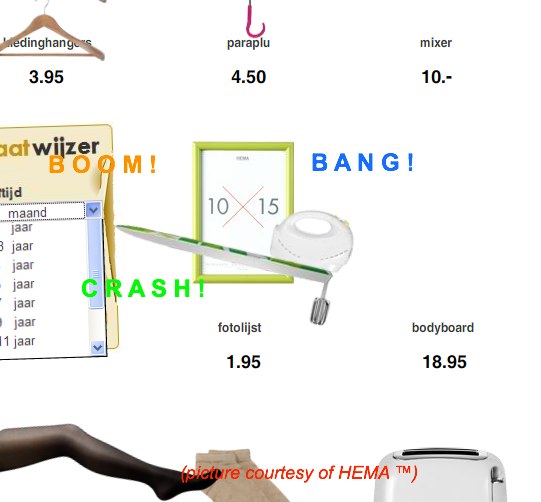 Time for those Sunday-links again. Today, I'll discuss the cocktail that is smell and how some things just don't mix; how green is not all it's cut out to be; a possible shift of power from retail to farming (or not); how lego came to be and where it is going; and how to sell me online shopping.
Previous link-discussions can be found here and my bookmarks here.
Link 1: Starbucks Admits Sensory Mistake - These are the kinds of stories that make me I like the NeuroscienceMarketing-blog. If you follow the science-section of the Economist, you'll know that neuroscience is a big deal anyway. In any case, this story is about how Starbucks designs atmosphere, largely influenced by smells. Apparently, smell of heating egg and cheese sandwiches doesn't mix well with the coffee aroma.
Link 2: False 'Green' Ads Draw Global Scrutiny - Two problems linked to green adverts these days, I think. One is that consumers are growing tired of it. And two is that, as this story shows, just because companies say they are, doesn't mean they are. I like the Norwegian approach to this. They ban green adverts by products that cause more problems, no matter how innovative they are (about hiding it).
Link 3: Farmers Wonder if Boom In Grain Prices Is a Bubble That food-prices are rising is an inescapable fact. But it also presents an interesting shift in the status quo. In the food-chain of the grocery-business, farmers are pretty much at the bottom. Now, even though their own costs are increasing also, they can charge more on top of it and decrease retailers' margins. Time will tell if this is something that will be acceptable for a long time. Certain signals very much suggest to me that farmers may be in the right position to cut out the middle-man and become retailers themselves.
Link 4: The Making of…a LEGO - I'm still a kid at heart, so I love anything to do with games and toys. My parents never bought me much lego as a child, which I regret as I hear it breeds geniuses. In essentially two pages, the article describes how lego came to be, what makes it so perfect, and what the company's strategy is. I was always impressed with the brand-extensions they did with the games, the robots, and the theme-park. A company to follow.
Link 5: Online shopping at Hema.nl - I've linked to this on twitter before, but it brought another smile to my face watching it again. Just when I think that online-shopping has no future, innovative uses of technology surprise me again.
 If you follow my blogging-history, you may have noticed that I write about books… a lot! There are several reasons for this. One is certainly that I am a bookworm—I enjoy reading books, learning new things, and whenever I enter a bookstore, I go into a trance and start studying books to buy now or in the future. Case in point: I wasn't planning it, but I bought two more today! Talk about impulse-buy… More on those in a sec…
The other reason is more complicated. I actually think that books translate better to blogging than much of real life. This clearly differs from blogger to blogger. You won't find Robert Scoble blogging about books much, nor Fred Wilson, both of whom blog on more daily issues (Scoble is also a media-guy). Both John Gruber and Jason Kottke do cover books, but often base their writings on articles and other shorter readings.
For myself, it is different and I can give several examples of this. One, I was a pretty regular blogger until about a year and a half ago, when I started on a project of researching venture capital in the Netherlands. Not only was it a time-intensive process, but I was constantly questioning myself as to whether my blogging was ethical or not. There were certain topics reigning in my life, relating to that company, which i could just not disclose. A similar thing happened before that, when I worked at a high-tech start-up, and most recently, while completing my thesis.
There are several blogging friends I could mention (F., J., C., & M.), where you notice this same phenomenon.
Books instead, as well as articles, offer a foundation to build upon. One, they are public, which dismisses any confidentiality issues. Two, if they are well-written, they communicate core-ideas well, and you can add to that with your own knowledge. The complication with reading is of course, similar to writing, finding the time to do so. I think I found a doable system, by reading just before sleep, but I don't know how that will hold up in future projects.
The way I choose books (and articles)
As I look back at my short life, I find that I've evolved in the choices of books I made, and most recently after engaging on this trajectory—the food & retail blog and the underlying purpose that serves. While before, my choice of business-books was somewhat restrained to general management, strategy, and entrepreneurship books, I now choose books purposefully that fill a gap in my knowledge and focussed on business-issues in this industry.
Some examples
I choose the McDonalds (coverage here & here) and Starbucks books (here, here & here), because they seemed like a good venue-point from which to understand how food-businesses work. My interest has always been towards chains of businesses, not individual ones, so that was also a bonus. Similarly, the IKEA-book (here) offered insights into retail, and the eBay-book (here), while less relevant, into starting a business and running a community.
The Disney-book (here), which I'm currently reading, gives me insights into building a framework around the soft discipline of entertainment, story-telling, etc. It is very relevant to my earlier post today on cinemas, which is clearly a raw perspective, but one I hope I can refine, as entertainment is a core-value I have.
The two books, I've chosen today, are on two diverse, yet, to me, relevant subjects. "Managers as mentors" is about what the title suggests. The reason I chose it, is because I'm not a fan of the traditional perception of management. I find it a hard world. The way I relate to people is through learning and teaching. I've raised my brother since I was 11, as my parents were often away from home, and find it very rewarding to see him become an adult. I have a similar relationship towards people, where I like to turn them into more than they imagine themselves to be. So this book seemed right. That is not to say, that I have any problem with firing people that I don't feel have potential. ;-)
The second book is even more interesting to me, it's called "the growth strategies of hotel chains - best business practices by leading companies." It's very strategy-orientated, covering principles of diversification vs. specialisation, vertical/horizontal/diagonal integration, m&a's, franchising vs. ownership, branding & globalisation, and US vs. European differences, as well as examples of said leading chains at the end of each chapter. Exactly up my alley! Needless to say, I will read it after the Disney book!
So what about you?
Now, a discussion is only valuable if more people take part. So please, if you have an opinion on this, or on a better research-methodology for blogs, let me know in the comments!
The picture is courtesy of brandtarot.com
What's the biggest pain in your industry II - Carbon emissions
0 comments Posted by Unknown at 11:17 AMContinuing from part I - obesity, this post will be equally light as I have "♫ my mind on my money and my money on my mind… ♫" Or something to that effect.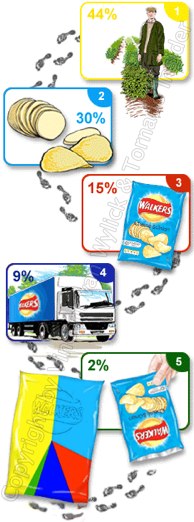 According to a carbon-emission calculation of PepsiCo's Walkers crisps, the majority of carbon emissions come from the production of raw materials (44%) and processing thereof (30%). A Dutch magazine, Tijdschrift voor Marketing, attributes the majority of the carbon footprint to transportation of said materials, and forms the conclusion that more and more production and consumption has to happen on a localised scale.
Even though the makeup of those figures may be open to interpretation—there is no breakdown about what in the first 44% is due to actual farming and what to transportation—perhaps, Mr. Kuiper, the author of that piece, has a point.
In a TED-lecture, James Howard Kunstler argues that the 'hydrogen-economy' is a pipe-dream and we must start thinking about creating urban environments fully equipped with the means of production, transportation, living, and waste-disposal, all in one. Very inspiring, though clearly requiring significant paradigm- and resource-shifts from today's globalised economy.
Clearly transportation comes at a cost, the question is how much the alternative would cost. Building super-farms, creating artificial climates to grow exotic food, waste-disposal, dealing with virus-outbreaks—regarding the latter, farmers already have problems dealing with chickens, sheep, and cows now, let alone having to deal with something like Kunstler's utopian vision—all of which represent costs that have to be accounted for.
But, I don't want to sound like a pessimist. I actually love the idea of a super-farm and a super-urban environment, regardless of the monetary cost. I'm sure plenty a sci-fi artist has tried to draw such a very thing (as have I). It's complicated, expensive, but exciting at the same time.
Asking you a tough question: How would you do it? What would a Kunstler-inspired localised economy look like to you? Is it even possible? … well, something to think about anyway…
 I have a general philosophy on restrictive business-model: that particular business (or industry) is in pain. Much like when you drive an animal into a corner, it will quickly start bearing its teeth and drawing the line.
I spent today searching for a gym close to me (healthy body = healthy mind), and most of what I met were restrictions and crazy prices, mostly summarised by:
limited opening times (don't people train on weekends?); a fat one-time-only entry-fee; multi-month/year lock-ins; and prices charged per 4 weeks instead of per month.So is the fitness-industry in trouble or is there another reason? I have some theories.
- Low price-elasticity due to the health-boom
- Too much competition - but it's not like barbers, which are on every corner, are trying to lock me into a 1-year contract.
- Too little competition - more likely (see point 4)
- Expensive cost-structure - likely, I imagine it's much higher than for other retail/entertainment-venues.
- Low education entry-barrier, translating into uncreative business models
- Extensive government-restrictions - seriously, what's with the stupid opening-times? High insurance-requirements also likely.
What I want, and sort of found, is the classic model: sweaty seats, instructors who growl at you when asked a stupid question, lots and lots of free weights, and if possible some over-muscular body-building chicks to compare muscle-size with. I'd also like the ability to pay per month, as well as a gym that opens before 8 a.m. (but that apparently is asking for too much).
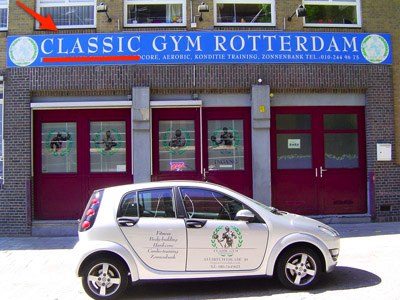
P.S. Finally found something in that sort of fits the bill (see pic). Classic Gym Rotterdam. I'll be joining tomorrow.
- For Technology, it's arguably Waste-disposal (I'll be writing about this soon on TechITEasy)
- For Media, it's finding a Business-model to compete with free.
- For Food, I would say it's O B E S I T Y.
And yes, I'm back! My 180-page thesis (or 135 at font-size 9) is being checked, and I'm in Rotterdam picking up the pieces of my life and making a delicious milkshake… whoops, I meant a yoghurt-smoothy… gotta watch that diet !!!
 This week, I seem to be taking somewhat of a personal angle, where I express my own views, rather than report and analyse those of others. I'm not sure if this is good or bad, but, after reading Fred Wilson's view on it, I think it's sometimes necessary to instil some personality into a blog.
One thing in life that I am very sceptical about is marketing, and there is one particular kind that annoys me the most. I call this argumentative marketing, and I define arguments as:
Constructing a logical set of information, meant to replace the logic present in the mind of the audience.In other words, arguments often serve the purpose of distracting or confusing the person or group they are targeted at.
That it is not meant as arguments not containing any information! No, I think knowing that a knife can cut through a metal can of food is quite interesting! But if I were a chef and all I wanted to do is chop vegetables, and I already had a perfectly good knife, this information could also be considered distracting.
Arguments are very prevalent in our global society. Not only is advertising the number one business-model in on- and off-line media, but there are quite a number of jobs centered around constructing arguments. Take students, lawyers, politicians, consultants, marketeers, sales-people, a certain type of manager, etc. And let's not forget bloggers!
And I think the market for arguments, people, is quite saturated with them also, meaning that the value of arguments is constantly decreasing.
As always, this means that other opportunities open up, which some marketeers are already exploiting. Let's not market at all!
One way to do that would be to simplify the argument to the essentials. Have the product or service itself tell the story, by illustrating clear and simple values, which customers can grasp and share with the rest of the world.
Examples are:
- Google-search: just search
- iPod: 1 button-play
- Fast-food: colourful, good-smelling food and drinks, easily accessible (there does seem to be a trend towards more info, but I'm seriously doubting that it will last, or that it matters to 98% of customers)
- Amazon's Kindle (still sceptical): one click shopping anywhere (in the US)
- And, last but not least, the lack of title-sequences in the series "Lost," and pretty much any movie or series afterwards!
The picture is courtesy of allaboutadtips.com
Amazon's Jeff Bezos on strategy & innovation (not Kindle-related!)
0 comments Posted by Unknown at 1:44 PM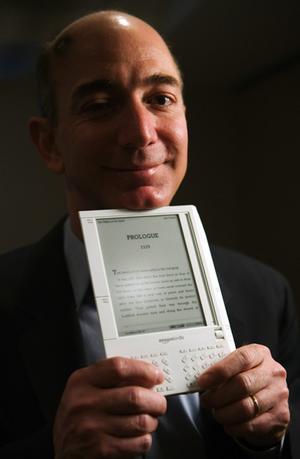 I'm writing this post for two reasons. One is that I am incredibly interested in the subject of leadership and try to learn about it in whatever way I can. A second reason is that, even though my main focus on my blog is food and retail, what Matthias calls "old economy" (thanks Matthias!), I try to also be very aware of "the past, present, and future of this industry," and (internet-)technology plays very much a part in the future of retail.
In terms of leadership, Amazon's Jeff Bezos is a good person to study—a man who created perhaps the most iconic garage-based venture since Apple, and who managed to not only take his company, Amazon, public, but also stay on as CEO until now, something that is rare amongst founders. In terms of retail, Amazon is itself great company to study. It has transformed the book-industry, and is doing amazing work in terms of providing infrastructure for web-based infrastructure. And, even though they are not as yet selling any books in the Netherlands. I'm hoping that SEPA, to be introduced next year, will change that.
Before I continue, this is not really a Kindle-related post. While we're on the subject, however, let me say that I'm a big fan of ebook-readers. At the same time, there are certain advantages to paper-reading, which I'm especially experiencing since I started my own blog—namely that I can write on them. I know I can take notes on Kindle, but it's not the same. And I think the price-point of either the device ($400), or the books (a $10 intro-price), or both, is just too high for something that can be produced in mass and has no printing-, and hardly any distribution-costs attached to it.
Speaking of notes, I took some while reading a nice HBR-interview with Jeff Bezos, in which he discusses his take on strategy, innovation, customers, ... and not Kindle. I'll share these, and my thoughts on them, with you now.
Innovation at Amazon
There are generally two types of innovation, the radical kind and the incremental (or process) kind. My general belief is that, while retail on the internet radically transformed the way we shop, and will continue to do so, ultimately it is an evolution in process. Instead of giving our credit-card to the clerk, we type in a number behind a screen, etc. etc. And, since the internet has taken off, this kind of process-innovation has become much more prevalent. Now, instead of clicking 5 times to buy a product, I can click once: yay! Before you ask, "so what is 'radical' innovation to you?" I'll just say: "Space, flying car, people living under water, that kind of stuff. So get busy!"
Amazon has of course just announced the Kindle, which could be interpreted as an innovative move. But again, what will make this innovation shine, if it does, is Amazon's incredible process-strength, namely that they can deliver the device to nearly every household in the Western world at beautiful economies of scale. For now, these are paying of for Amazon, but knowing their business-model, it's pretty certain that this will pay off for consumer too… eventually.
What I like about Amazon (and got from the interview) are that they have an incredible experiment-based culture and generally take a long-term view—both rare with public companies. In terms of experiments, these are encouraged on a company-wide level, and due to the nature of experiments, are both had to predict and not unknown to fail. One example of an experiment which became an enormous, but unplanned, success, is the Amazon-associates program.
As far as time-frame is concerned, innovations at Amazon usually take 5-7 years before they make any meaningful impact on the company's economic situation. This is a big risk and is offset in a number of ways. One is to minimise the costs of experiments. Amazon has a web lab just for that purpose, which undertakes these experiments on a massive scale, collects real usage data on what works best, and is constantly trying to push the costs of these experiments down. Again, taking a long-term view, it helps when building innovation on things that won't change in the next 5-10 years. For Amazon, these are basic customer preferences, such as: choice, low prices, and fast delivery (hello Kindle?).
There are three more core-attitudes, which I think have a big impact on the way innovation takes shape at Amazon. One is, to always ask the question "why not?" According to Bezos, the biggest mistakes at Amazon come from not doing something, rather than taking the risk. And asking "why not?" instead of "why should we do it?" opens up a whole other universe of possibilities. Similarly, there are lot of difficult decisions that Amazon has had to make over the years, such as allowing reviews on their site. The vital question there was "what is better for the customer?" Last, but not least, I like this line in regards to making experiments a success: "Be stubborn on the vision, and flexible on the details."
Strategy at Amazon
The other part of innovation is execution, some of which was already discussed above. Much of decision-making comes out of the way a corporate culture is shaped. Some cultures are hierarchical, some are flat, some are individualistic, some are collective. From my understanding of things, Amazon has both a departmental structure (which would suggest some hierarchy) and takes decisions collectively. Both senior management and departmental management have mechanisms through which this collectivity manifests itself. Seniors meet once a week for four hours and once-twice a year for a two-day meeting. Homework is assigned before and the latter type of meeting deals mostly with long-term issues. Department-management has a similar system.
Some more general characteristics of corporate culture were mentioned in the interview, namely that they can be incredibly stable over time, and are self-perpetuating in the sense that they attract people who like that culture (and repel those that don't). While a company's corporate culture is probably the hardest to replicate, and can thus be a tremendous competitive advantage, the rigidity of the culture can both mean that there are limits to what it can do (and should do), and it can sometimes hamper innovation during turbulent times. At the same time, a culture can by nature be open to change, which should overcome some rigidity.
A few weeks ago, on my blog, I wrote a post on Porter's five forces in which I outlined what I think matters in strategy, but also that it pays off to stay close to customers. Jeff Bezos shares a similar view-point, for a number of reasons. One, customer-needs change more slowly than a lot of other things, e.g. tech; and two, following the competition doesn't work well in fast-changing environments, e.g. tech. A third point is that being too competitor-focussed can result in a passive attitude once a certain dominance has been reached in an industry. You can argue about this either way, but when you look at certain large companies (no names), this "hey, we won, so why innovate?"-attitude, is definitely one that is recognisable.
One way that Amazon tries to stay close to customer-needs is by enforcing rotation. Every new employee has to spend time in their fulfilment-centres with the first year, every two years, employees have to do two days of customer service, and everyone has to be able to work in a call-centre. That includes Jeff Bezos.
Finally, he also had some advice as how to survive the transition from the founder of a start-up, to the CEO of a multinational, public company. It's simple (yeah right!). When you start, the main question is "How?"; as you grow, the question is "What?"; and when you're huge, the question becomes "Who?" There you go, the secret to being the leader of a big company.
Final thoughts
One of the weaknesses of secondary information, such as what came from this interview, is that I (and you) have to trust everything that is in the article. I can't ask follow-up questions and can't tell, by body-language, tone, or otherwise, whether some points are more important than others, or more true than others. Therefore I try to be careful to treat each piece of information as part of a greater whole. In other words, I may come across information that conflicts with what Bezos said in the interview. If it's noteworthy, I'll write a new post about it. One piece of important data, released perhaps a month after the interview, is the release of Kindle, which, as mentioned, I am sceptical of.
Two things I learned from the interview is that innovation takes time, especially to make it economically viable, for both the business and the consumer. In my opinion Kindle, in order to fit the philosophy of Amazon (which is not Apple after-all), has to drop in price, as do the books. It's a matter of ethics, of being customer-focussed, and of being a process-innovator. I can only assume, that over the next years, this is exactly what will happen.
The other thing I learned is to constantly be open to innovation that can benefit the customer. This point has been made many times in the words above, yet it bears repeating. A company can be incredibly rigid, the bigger it becomes. Competition can become incredibly threatening. Technology can change from one day to the next. But what doesn't change is that customers will pay you for products that make them happy. And I fear that a lot, a lot of businesses have forgotten that as they became big, arrogant, and focussed on anything but what customers want.
Finally, while I may be focussed on "old economy" topics, I think Amazon teaches some interesting lessons on how to remain high-touch in a high-tech environment. As such, this certainly won't be the last time I touch upon the topic of technology in retail.
Further reading
If you're interested in the topic of leadership, you mean also want to check out a list of free podcast-interviews with a number of CEOs, ranging from Google's Eric Schmidt to, indeed, Jeff Bezos, which I posted on Tech IT Easy a few months ago. Worth a listen. Oh, and don't forget to check out the original article on HBR.
This article is mirror-posted on Tech IT Easy.
I've written two posts in the past, reviewing Gladwell's books, Blink and The Tipping Point. Both posts are no longer online and thus game for reproduction. Following will be these two reviews (lightly edited), which were already rather short, and would make for a good marketing-related interlude.
"The Tipping Point - How Little Things Can Make a Big Difference" (reviewed October 2006)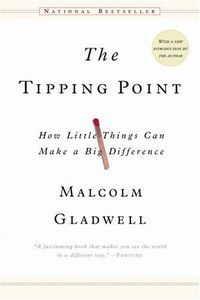 I read The Tipping Point by Malcolm Gladwell, about a year ago, a slightly older book from 2000, but with some timeless insights on viral marketing and tipping the user-adoption scale.
Essentially, the author takes takes cues from biology and epidemiology to explain how ideas can spread like virusses, facilitated by three key-players: Connectors, Mavens, and Salesmen. Each of these play a role at different stages of the adoption process, with Mavens acting as the knowledgeable early adopter, the Connectors acting as hubs between groups of user, and Salesman taking care of the last mile, the mainstream-market.
The book explains how people take in information, using a variety of examples from TV-shows to Sneakers, as well as how companies can shape their marketing-efforts to gain access to those three key-figures. Only in the afterword, does Gladwell cover issues like email and the rule of 150 - the latter refers to “Dunbar's Number,” which proposes there are limits to our cognitive social functions and that it's only possible to actively maintain a certain sized (150 people) social circle (Whether this still applies today can perhaps be disputed).
The Tipping Point does a fairly good job in translating social theories to practice, better so than recent attempts like Freakonomics (which, in my opinion, was too abstract), and the insights will continue to be relevant. That said, I expect that some trendspotting-practices of companies will change, or have changed drastically since the time of writing, in the sense that consumer-driven products seem to be taking off, as well as “long-tail” business (which may or may not be the same thing) . Perhaps his newest book, Blink, corrects this.
"Blink - The Power of Thinking Without Thinking" (reviewed December 2006) “If you Blink, you're dead!” This must be a phrase you hear in movies often, mostly when one character has a gun pointed at another (editor: seriously, this must be the corniest start of a post ever). Gladwell has definitely taken this phrase to an extreme, attempting to research everything about it.
My first reaction when hearing this book was “Malcolm, what were you thinking when wrote this book?” The space of two seconds—the time it takes to blink—turns out to be gigantic and many people wouldn't even know where to begin exploring what happens there. But mr. Gladwell does his best, looking through the lenses of experts from various disciplines and giving a broad range of examples.
The book starts with describing the purchase of a statue by a museum. After consulting many experts they decide the statue is authentic and pay a huge sum for it. Then, however, another expert, one from the field this time, takes a quick look and feels something is wrong with it. And he's right, the statue is in fact a fake. Malcolm Gladwell asks the question as to why some people have an instinct that can judge things, people, and situations more quicly, than studied experts can over the space of weeks, months, or years. The answer is perhaps obvious: practice.
Following this example, Gladwell proceeds to describe the fields of rleationship-therapy, facial recognition science, security, sociology, and some others, where the practice of instinct, or rather the rapid understanding of situations, is very important, so much so that there are therapists that can predict whether a relationship will end quickly or last forever, are able to tell if you're lying, can teach policemen to judge whether a person is drawing a gun or a mobile phone. But where the book really shines is in understanding where racism and discrimination comes from, which, Gladwell shows, can have deadly consequences in fields like police-work, and which continues to be relevant in today's polarised society.
I see Blink as a book aimed at experts, but sold in a mainstream-market. There are principles in the book which are clearly valuable to everyone, yet to get there it takes hard work and practice. But, having read and reviewed his previous book, The Tipping Point, I believe the point is not for the reader to become a genius. Rather, it's to surround yourself with the right people that have access to this knowledge. The example of the museum clearly shows the usefulness of this.
For further reading you may want to check out this Scientific American Mind article, on the science behind facial recognition (and exposing lies).
Final thoughts
Blink and the Tipping Point are at different points in Gladwell's evolutionary scale, and I think, judging by his latest speech and his soon-to-be-released book on "the workplace of the future," he's more and more moving towards understanding the upper regions of the brain. At the same time, an inherent risk in this approach is usually that you forget that there are real people involved, and I don't get a sense that this is happening.
Rather, when you listen to his speech on the nature of intelligence, and read his books, you see that he is very careful to understand the context of why something happens, not just the occurrence itself. And that context alone makes for some excellent reading, because I suspect that that is one of of the secret ingredients to becoming one of the geniuses that Gladwell describes.
 I suck up data wherever I go (it's a curse, I know). Just last week, as I was waiting for my laptop-drive to be installed, I sat in a German bank and came across a magazine, called VR-future. Two articles caught my eye, one on the Bio*-boom in Germany, and another on Switzerland—a country that fascinates me, but that's a story for another day.
The bio-trend article consisted of an interview with Dr. Alexander Gerber, the Germany CEO of the BÖLW (the foundation for organic products in Germany) and revealed some interesting info on this segment. While it focussed entirely on Germany, I do think it brings some interesting insights on this topic in general. (*: "bio" being the German term for organic)
Now, I should say, that I'm generally weary of the word "Boom," as I inadvertedly associate it with the word "Bust." Any market is subject to the laws of supply and demand, and a boom usually suggest an explosion of one or both, eventually leading to some fall-off after a while. I have no doubt that the same will happen to the Bio-sphere as well. There are also particularities about the organic market which I do not like, and I will go into those in my final thoughts.
The rest of this post is structured as follows. I will begin with the definition of organic, then some stats on sales, after which I will look at employment-trends, and expected areas for growth. I'll conclude with some final thoughts, to answer why I am bearish on this whole organic trend.
So, what is "bio" or organic?
From Wikipedia:
For crops, it means they were grown without the use of conventional pesticides, artificial fertilizers, human waste, or sewage sludge, and that they were processed without ionizing radiation or food additives. For animals, it means they were reared without the routine use of antibiotics and without the use of growth hormones. In most countries, organic produce must not be genetically modified.
Bio-Sales
Worldwide, while the percentage is low (Wikipedia reports 1-2% of food), it is showing far quicker growth than conventional food. In the US, Wikipedia reports a 17-20% annual growth of organic food in the last few years before 2004(!), compared to 2-3% for regular food. 2.6% of food sold there is organic. In Europe, while I don't have the stats on exact growth-rates, the percentage of of agricultural land being used to grow organic produce, is on average 3.9%, with Austria (11%) and Italy (8.4%) leading the pack.
In Germany, the annual revenue from bio-products with discounters and supermarkets has more than doubled since 2000, up to € 4,6 billion in 2006. And, at the moment (2007), Bio-products have a 3% share of sales in small food-stores, which is expected to double by 2010. The level of food-prices, held low by government subsidies, is expected to rise in the future, which… will probably not mean much to the bottom-line of retailers and producers. And, apart from the ethical considerations, bio in Germany has very much become a lifestyle product, translating into lower price-sensitivity. According to Gerber also, a new bio-supermarket opens every week.
With all this positivity, there is the somewhat counter-intuitive trend that farmers in Germany are complaining about falling incomes, and annual growth in their area has slowed down from 20% in 2000 to 0,4% in 2006. I imagine that is so because the market is maturing and because large buyers are pushing the prices down. A similar trend is being reported in the documentary, The Future of Food. Gerber also mentioned that there is a lacklustre support from the German government and the European Union in terms of subsidies.
Employment-trends
In general, the organic sector is a pretty people-intensive industry. While I don't have global stats, in Germany, about 160.000 people are involved in creating, processing, and selling bio-wares. In the last 7 years, the employment in bio-related sectors has doubled, especially in processing and sales.
On the farming-side of things, a third more people are employed than in traditional farming. And there is a need for people in production, processing, and sales, especially in the last two areas. In addition to this, the bio-sphere is very consulting-intensive, meaning there's also a need for highly trained personnel.
With is all this need for people, the German education-system does not yet offer truly specialised courses in this area. There is a program, however, co-sponsored by the BÖLW, the government, and the companies involved, which offers training for practitioners interested in working in the organic industry. Generally however, "learning by doing" is encouraged in this field, which, incidentally, also explains the high number of consultants.
Growth-trends
Gerber sees three areas for growth: Small cities, food-venues, and apparel/cosmetics. Regarding the first, Bio-supermarkets and -shops are starting to be set up in German cities with less than 50.000 people. And there are many of those in Germany.
He also expects growth in food venues, both fast and traditional, who currently receive around 25% of food-related spending, in which bio is still only taking up a very small percentage. Finally, Gerber also expects a larger bio-component in textiles and cosmetics, though I have no stats on how important that industry is.
Some final thoughts
The organic value-chain seems to be organised in a fairly similar fashion to the traditional way of producing, processing, and selling farm-goods. Some points of note are the way that bio-products are produced, the accountability-aspects, and the educational ones.
For the first, the natural way of producing these products will require some serious adaptation by producers and distributors. And since information is such an important component to bio-products, and by now a legal requirement, it will also require producers, distributors, retailers, and marketeers to set up new procedures for extracting and exchanging information. Finally, the fact that this is a fairly new market and official training-courses seem as yet to be lacking, there is a need for educating both businesses and consumers.
All of this translates into higher costs of production, which is reflected in higher prices for consumers (Wikipedia reports this to be 10 - 40% more than with conventional products). It is only a good thing that the end-products have lifestyle and ethical value, meaning that customers will be less price-sensitive about them. But will this be enough in the long-term?
In general, farming is already highly dependant on government-subsidies, which is already a bad sign for bio-produce as that seems even less efficient. And the increased demand for goods like wheat and dairy-products, from countries like India and China, means that there is actually a need for more, rather than less efficiency in farming.
Also, the current boom in food-education seems one that is limited. Eventually, the market for information will mature, customers will know all they need to know, and will be looking at other differentiators, most likely price. Large retailers, who are able to keep prices down when needed, are better-positioned for this, versus the more specialised shops who seem to be purely focussed on lifestyle, and hence high prices. Eventually, as the market becomes mature, I expect there to be a fall-out for both smaller bio-shops and in the area of consultants and niche-marketeers.
All in all, while I'm no expert on organic produce, and while I am fairly optimistic about demand continuing to rise, I'm not sure if there are still big profits to be made on the supply-side, even though there seems to be explosive growth in that area.
That said, I'm not bearish on all things organic. Bio-food in food-venues like restaurants and similar is very intriguing and, I think, will fit very well into this environment, where fresh food and good food is a strong differentiator. I'll have to collect more data on this, but I'll definitely write something on business in this area in the future.
The picture is courtesy of Petdiscounters.com and was chosen purely for effect.
 As has become my custom, during my brief life as a blogger, I like to review books, while reading them, not necessarily after I'm finished. The book, I'm currently reading, is aptly titled "Ikea - The Secret of Its Success," a Dutch translation of a German biography of the business and its founder, Ingvar Kamprad. I've until now read very little in terms of European business, and looked forward to getting a grasp on the European mentality if there is such a thing. To be honest, there are vast cultural differences between countries in Europe, though Ikea's continental growth does serve as an interesting lens to understand some of the issues at play.
My initial thought when meeting people and businesses is that where you are from and when you are from matters a great deal to where you are going. There are a great number of social values that come from living in a given location, at a given time. Similarly, Ikea has had a particular past, which I think define the company and explain its goals.
Where Ikea's from, Sweden, is a strange, alien place to me, even more so, 80 odd years ago, when Ingvar Kamprad, Ikea's founder was born, and 60 years ago, when he founded the company. Painfully, I notice that my own business-education has been coloured by "Western" values, or rather Anglo-saxon capitalist ones, which give (the illusion that) individuals (have) pretty much free reign to reach their dreams, and Ingvar's story is very different from that (though he did achieve his dream, I think).
Briefly, before I describe Ikea's history, what is different about the company, as opposed to other multinationals?
- It is still a private company
- It thinks like a community, which has major consequences on work-relations and innovation
- Work-relations: historically, wages are kept low, workers are treated like family, there are no large power-differentials, and I don't think people get fired much.
- Innovation: the way the business develops often comes out of collaborative thinking—how can we make life easier for our workers, how can we make life easier for our customers? Very organic, pragmatic, and frugal!
Ingvar Kamprad, who had by that time already migrated to Denmark for related reasons, had himself had a particular past. He grew up on a farm in a small commune, where value was placed on hard work and family. Originally of Germany, emigrated to Sweden, his family felt some affinity with the Nazi-cause of freeing parts of Germany, separated after the first World War. Ingvar only abandoned these values in his late 20s, after having finished a business-degree and getting married.
By that time he already possessed a strong trader's spirit, importing small goods like pens at low cost, and selling them via mail to his customers at a small profit. He later expanded this to furniture, which organically evolved to what became Ikea. Much of his thinking was pragmatic and he wasn't afraid to listen to the advice of his co-workers, and ignore the advice of his competitors—the more established furniture-retailers. Business boomed, of course, and he soon built more warehouses (which acted as store-fronts) in other major cities in Sweden.
But the taxes were killing him. So much so, that he had to live in debt for several years, while being the owner of a very well-todo store. So, for this, and other reasons, he decided to migrate with his family to Denmark, while keeping Ikea in Sweden. Later he would move to Switserland and do something that probably goes against the grain of every capitalist out there. He gave the business away.
He did so for reasons of continuity. He did not want there to be confusion after he was gone, and he did not want his kids to feel pressured to take over the business. Instead he created a foundation (stichting), called INGKA, in the Netherlands, to make sure that Ikea belonged to Ikea, and not to the whimsical demands of its (future) leaders.
That's as far as I'll go today.
Every book has a different lesson in it. This one on Ikea is about its heritage, its values which are deeply ingrained into the Swedish perception of social community, and how these can be preserved as the business grows. I can't wait to learn more about Ikea and find out. I'm about 50% into the book, writing this, and I want to write about Ikea's expansion at a later date, as well as their internal workings. If you do read Dutch, I do recommend picking the book up here, and for German, check the German Amazon-store here.
For other book-reviews, check out my look at McDonalds "Grinding It Out" here and here, as well as at Starbucks' "Pour Your Heart Into It" here and here.
 Someone smart once said:
If "markets are conversations", then yeah, how you talk to people is the DNA of marketing.Becky Carroll, from the Customers Rock! blog wrote a good piece on what customers want yesterday. I'm afraid that I'm not at the stage yet where I can clearly express what customers want (need to do more research), but something struck me as interesting. In her post she also referred to something Michele Miller wrote (me linking to something she's linking to is very metaweb, I know), namely what actions of retailers make her less price-sensitive.
One is very cool, a free return policy on shoes at NB Web Express (though they also write personalised notes to customers). This is a very interesting business-tactic, and I will certainly discuss this further, probably on Tech IT Easy, in relation to similar strategies on the web.
The two others are examples where the retailer took the time to inform the customer via conversation.
What is interesting here, is that it's very hard to place a value on conversation, yet it is incredibly valuable to people. I sometimes chastise myself for falling for another "special" deal, simply because the person selling it to me seemed so nice and personable. Which brings forth the point that it's very easy to fall into the trap of being perceived as manipulative.
The way to get around it, I think, is to put people on the store-front who are both passionate and well-informed about the product. Passion is an emotion, very hard to fake, or acquire.
For example, in the last year, I've (inadvertedly) convinced about five people to buy Macs because I love my own so much. People actually tell me I should work for Apple, because I make such good case for their products. My passion for Apple comes from spending years building and repairing PCs and digging the Windows OS, so much so that I hate it with a passion. And as soon as I entered the world of OS X, I was in love with it's simple elegance… OK, I'm not going to do a sales-pitch on you, but beware! If you ask me for support on Windows. I'll just advise you to get a Mac.
Imagine the idea of the Apple Genius in the store, or the Starbucks Barista. And then, come down from the cloud and realise that you're actually paying a premium for both of these companies' products.
That is the value of conversation, the value of passion.
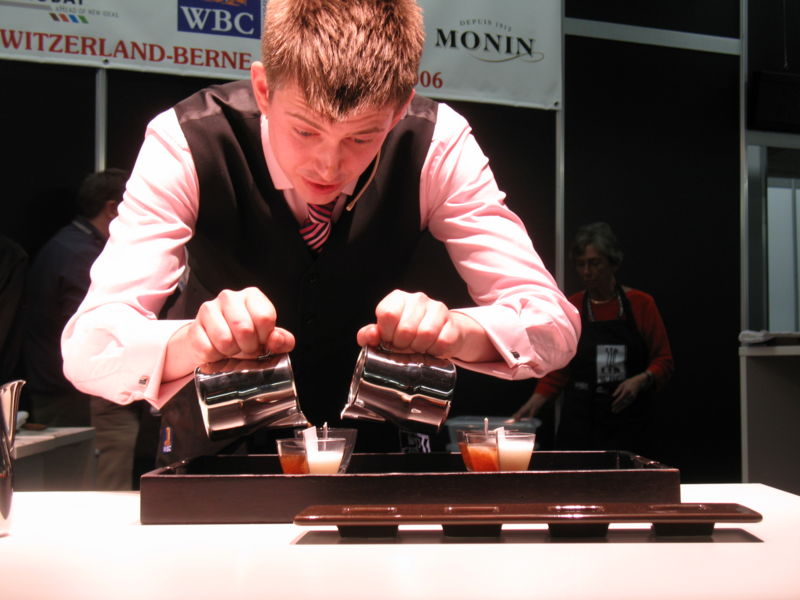
The picture is of James Hoffman, during the World Barista Championship.
 So I watched this movie yesterday, I think it illustrates the concept of shareholders and investors, and what businesses really stand for, quite well. In part, you have a responsibility towards your employees today. In part, and that's where investors come in, you have a responsibility towards the future. In a sense, if both stakeholders were to communicate, the world would be a better world…
For me, it's a pretty safe bet that if I want to start a business, I'll need investors. And people starting a business in the world of food/retail venues, will definitely need a team also. Both will be depending on getting paid; the employees depending on today's cash flow, and the investors betting on a future value. That is life and the way this resource-intensive industry works.
The fact is that venture-backed firms—firms that have external and usually active investors, which hold a share in the business—are usually more successful that firms that are not. The reason for this is that active investors, while sometimes appearing cruel, actually make a business more efficient through various mechanisms such "fat-"trimming and performance-based investing, and also through their know-how and contacts in the industry.
This of course depends on the type of investors you have. On Tech IT Easy, I wrote about the four types of business angels, namely:
- Operational Expertise Business Angels: These have been or are major executives in the industry they are again investing in and are instrumental in growing the company through providing both financing, expertise, and contacts to suppliers, partners, and customers. Venture capitalists highly value these types of early-stage investors.
- Financial Returns Business Angels: These are high-worth individuals, but characterised by a passive involvement in the companies they invest in, except for maybe some business-advice. Too many of these types has a negative effect on attracting venture capitalists, as it does not grow the financial pie.
- Guardian Business Angels: These are probably the most active types, provide a lot of support, take seats on the board of directors, help find venture capitalists, and are highly valued by them. Since entrepreneurship is a highly people-chemical business, this makes sense.
- Professional Entrepreneur Business Angels: These are investors with the personal experience of having set up their own firms. Also the most well-know type, I think. They may sometimes invest outside of their expertise, which can be a problem, but have a lot of experience in and provide support with market-research, building up the company, meeting milestones, and other business-building activities. They are also highly valued by venture capitalists.
Garbage-in-garbage-out
When dealing with investors, it's important to find out what their expectations are. On what basis are they valuing your business. If it's garbage, there is no point in continuing with an investor. I'm not going to define garbage extensively, but if an investor is only after personal profit, then that's a sign of garbage. If he or she is after maximising profit for the business, that is better.. to the degree that the core-values of the business don't get minimised.
That's why it's better to deal with investors that have at least two qualities*, preferably three. One: he or she has to know the industry, or else how can they accurately calculate the value—taking into account stuff that can't be entered in formulas; Two: depending on the stage of the business, he or she will have to be in it for several years, at least 7 when it concerns a start-ups, I would think. And three, he or she has to be what is called a Mensch.
(*: feel free to correct me on any of those).
In terms of employees, you also need a certain profile of people. They need to be dedicated to the business, not necessarily their pay-check; They need to understand business-concerns, and for that to happen, be involved with the business beyond their job-function. They need to understand and share similar values, which again requires two-way communication.
The implication for management is fairly clear, I think. When trying to reconcile both parties, you need to understand you're dealing with someone beyond their job-description. Employees, active investors, shareholders, customers, all have something in common. They are human, they can have vision, they can learn, grow, adapt, change, do. This is important during the selection stage—which employees will I hire, who will I ask to invest in me?—and the co-operative stage—how will I find the middle-ground between these people's concerns?
Other people's money? Get rid of the "other," get rid of the dissonance, and you're on the right track.
This is more of a personal* rant than anything purely retail related (*: isn't anything blogged personal?), but I've been in a terrible mood these last few days, and what better way to get out of a mood than a good spiteful rant, lashing out at innocent tools like the ones below.
I hate two things about business: 1. Post-floatation PR = total snore-fest. 2. Anything related to math = like sinking a nail into my brain... slowly. Both problems are fairly related, I think, and I will explain why.
1. Post-floatation public relations
My life is an exercise in duality. I've been rich, I've been poor' I've been hated, I've been popular; I studied strategic management and I studied entrepreneurship. There's something I really loved about strategy and there are things that I really hated, such as: there's no starting position as a strategist. If you want to work in this field, you either start as an analyst (snore-fest x 1000), become a consultant (shoot me now), or you start your own business (yay). That's were entrepreneurship comes in: multi-flavoured coke (yes strategy is in there somewhere).
This summer I read 3 books on companies: eBay's Perfect Store, McDonalds' Grinding it out , and Starbucks' Pour your heart into it. The only one which I could read all the way through was McDonalds.
I was eating up the words of both the Starbucks-book and the eBay-one, for about 60% of the time. Then snore-fest happened. The companies went public. For McDonalds, it actually worked out. Ray Kroc has a knack for staying in touch with his core-values and managed to remove himself from much of the mess. Or perhaps it was because he wrote the book decades after and his trauma was over. For Starbucks/eBay, as soon as the companies went public (in the book), I had to stop reading, and when I eventually resumed, it was at 1/10ths the pace of the pre-floatation material. I haven't even finished the Starbucks book yet (only 50 pages to go), because he's writing about his charity and about protesters.
You get the best insight into what it feels like to go public in the eBay book, because it was written by an excellent and somewhat objective journalist: Adam Cohen. He interviews people throughout the book, gets their emotions, the way they worked, what was exciting about the company that was profitable from day 1. Before the IPO, it seemed like it was a wolf amongst other wolves and some lions. People were happy, excited, and stressed about the ride. The best chapters I've ever read in a business-book.
Then, the company turned into an elephant and everything seemed more abstract, more distant, like pesky little flies. Any wolves on the horizon and the company tried to gobble them up. And more and more people came onboard, diluting a lot of the core-values of the founding staff. I still thinks it's a great book, but what a snore-fest at the end.
Same with Starbucks, though I reserve my final judgement for when I finish it. I loved the way the company was started, and I also to a degree love the stuff that happened after the IPO. But it suddenly got a lot more boring, more about PR, about how to handle investors and stake-holders. How to deal with people who attacked Starbucks just because it was a prime-target, because attacking it would solve all the problems in the developed world.
The difference between entrepreneurship and corporations. If you hate a start-up, start your own. If you hate a corporation, write an angry letter, or better, get a job there... Enough said.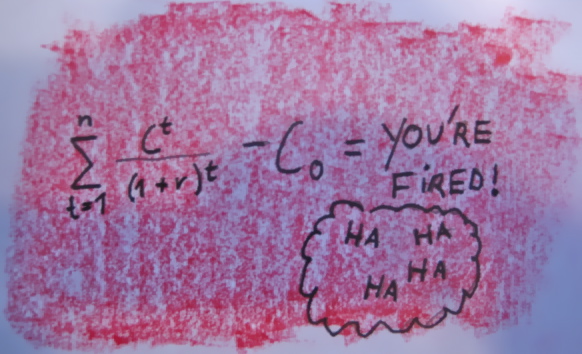
2. Mathematical business
This really is a much deeper hate, one which I've had for an insanely long time. First, I must say that I'm more of a right-brained person than a left-brained one. No, forget that, I am human. I like psychology, I like predicting trends, I like innovation, I like creativity, I like risk. All of which I don't think are very well contained in formulas.
Now that of course means that I love statistics, because it predicts trends and confirms my own feelings about stuff. I love the book, Freakonomics. But I abhor it when formulas lead to the abstraction of values, much like the above rant on PR. To some degree, I can imagine Hitler sitting in his bunker with his partners in crime, calculating the ROI of Germans vs. Jews and deciding the former was a safer bet. And when I look at business today, I imagine bankers, even Jewish ones, make similar decisions about a businesses' assets and employees, making financial (read: life or death) decisions on paper everyday, never considering that there is life where a formula cannot penetrate.
More entertainingly, remember the Ben Stiller movie: "Along came Polly?" Ben Stiller is a risk-analyst, afraid of any discrepancy. And along comes Jennifer Aniston (Polly) who throws his whole life upside down, so much so, that he decides to make a risk-analysis of whether or not he should have a relationship with her!? That is what I'm talking about! For another good risk-analysis vs. Lo-o-ove movie, check out "Knocked Up."
Ok, my rant is done. It was largely stimulated by an article about "balanced scorecard," I think. I feel better now. Hope you do too.
The formula in the picture is for Net Present Value.

 The
The 


