 The world of business, I think, has a certain illogical—the "human element"—shell around it, but centres around the concept of supply and demand. How you create a business where demand is high, how to you make sure that you have sufficient supply and/or not too much supply. You can see this play out in a number of places, e.g. on the web you have scaling issues, when your service proves to popular (e.g. Twitter), or you have the case of the million+ blogs that are collecting dust, because no-one ever reads them, or because the blogger was unable to gather enough interesting supply.
In restaurants, or food-places, you also see this play out. A couple of months ago, I was going to write about take-out, how some businesses embrace and others avoid it, and why. I think the reason is, at least in part, to control supply. If you control supply, then you can focus on quality and charge a higher price. You also become an artist/creator, rather than a factory.
How do you limit supply? Two ways, I think. Mainly it's the physical space; by limiting the number of seats in your venue, you ensure that a certain quota is set (of course, the question is also whether that quota is met, which comes from quality inspiring demand). By investing in quality-ingredients, you not only limit your budget, but also your production-capacity, and it forces you to limit supply. That's a little vague, I know, I haven't worked it out 100%.
The other way, is to have an increased level of supply. How do take-out and fast-food places do it? By standardising as much as possible. Whether it's the ingredients, which are mainly starch-based (burgers, pizza, noodles, etc.) and cheap, the production-facility (often just an oven, a grill, or a big wok), or a standardised customer-space (from seats stapled to the floor, to waiting-lines, to a website/phone nr.). All of which enables you to deliver mass quickly.
I was thinking about this today after watching "Iron Man," which is one big Burger King (and US-army) commercial, and getting a cheese burger afterwards. Burger King was packed and, ironically, slow. The "waiting in line" method doesn't seem to work that well when you have 50+ people waiting, and a limited space behind the counter to deliver burgers and stuff. People on both sides were bumping into each other constantly, and I actually had to wait over 5 mins, even though I was second in line.
On some level, I like to think that technology can solve a little bit of this problem. If you look at Zara and H&M, which I wrote about last week, both are very advanced in this area, in order to optimise and speed up their production, logistics, and merchandising. Of course, that's on a back-office level, and that's not the same as the front-office, where customers interact with a business. No one wants to be confronted with a screen to do the ordering, but sometimes I wonder if people wouldn't be happier just pressing some buttons in a fast food joint, rather than waiting in line. Of course that would mean more seats, as more people would sit down, and more staff, as someone will have to bring that food to the table.
In the end, it probably comes down to experimentation and constant improvement. That said, apart from the computers that cashiers operate, and quicker food-preparation, not much has changed in the last 50 years for the people doing the actual eating.
The picture is courtesy of lightningspeed.net.
 Hey, a little busy at the moment, but here's some links, I've enjoyed recently.
- Jim Donald's, former Starbucks' CEO, month by Patricia Sellers (Fortune): After listening to an interview with Frank Addante on Venture Voice, where he said "Time is a finite asset!", I looked up "time-management CEO" on Google, and this is the first thing I found. Some good tips on meetings, getting up at 6, and generally managing your time.
- Monocle design-notes by Dan Hill: I printed this 32-page (!) document out this morning, and it will probably take me a few days to digest it, but I'm already enjoying the first few pages, where he writes about the vision behind Monocle as a mag. and as an internet-publication and how the multi-disciplinary team reflected this.
- 10 Ways to Improve Your Programming Productivity by Matt Moore: I love productivity-stuff, and think most of these tips apply to any activity really.
- The 7th Deadly Claim — “Best Value” by Jeff Sexton (Future Now): "The problem for most companies is that they don’t do BOTH well: Either they don’t do enough to persuade customers of the product’s value, or they price their high-quality item even higher than what they’ve been able to substantiate to the market."
- How Facebook Is Like Ikea by Tim Harford (Slate): Considering I wrote about something related a few months ago…
 The reason I like Star Trek, most sci-fi in fact, is because of the space-opera aspect. You don't just tell a story, you design a universe around it. I've been a fan of the show, ever since the age of 10 when I got to watch TV at home. In some ways, sure, the time spent watching the show impoverished my life by taking me away from other endeavours, in other ways, it enriched it by contributing to my ability to dream.
As I grew older, I started paying much more attention to the story-telling aspects of the franchise. For instance, did you know that until the second season of Star Trek, the next generation, the writers didn't create a place for the crew to relax? It was only then that the makers came up with the concept of Ten Forward, hosted by the infamous Guinan (see pic). Later, in its spin-offs, Deep Space Nine and Voyager, we also saw a big role being played by the "lounge", hosted by Quark and Neelix respectively.
It was felt that by introducing this aspect into the show, a third place, it allowed the characters to show a different side of their lives, necessary if you want to teach a complete philosophy about society, as Gene Roddenberry was in fact doing. And of course, it spawned plenty of dramatic stories, that would otherwise never have happened. It allowed for romance, friendship, and conflict to happen, for aliens to meet and interact with one another.
What's interesting about the franchise that each series had a different archetype, which also affected the room for "drama." You could see it as both an evolution and devolution of a story. Star Trek, the original series, was the raw outline of Roddenberry's philosophy about the future of society. The next generation was much more developed and allowed for deeper interpersonal relationships. Deep Space Nine was again an evolutionary step, and much of the stories centred around "life" on the station.
Both Voyager and Enterprise represented a devolution. Voyager introduced the "morale officer", in my opinion, an engineered effort to bring a certain warmth to the story. But it was much less about teaching philosophy, as it was about survival. It showed that Roddenberry's universe was in fact small and could break apart at the edges. But it was still a good story.
Enterprise represents a return to those raw ideas. Perhaps it was felt that the franchise could cover no more new ground, and that a new philosophy had to be designed. It was also a story of survival and the raw pioneering spirit, shown in part in Voyager. But it felt like a military mission, there was little room to form complete characters. Instead we were presented with deep dramas, echoing the 9/11 events, which turned the characters into one-dimensional creatures, much perhaps the way the news depicts the main characters involved in the post-9/11 era.
To me, at least, Star Trek is a good analogy for certain principles in life. That it is not enough to search, but also to build. That friendships and societies are built, not only from the hard work they require, but from the breaks we take to reflect on our actions, and the places that are engineered to cater for that need.
Food for thought.
I decided that the one thing that was missing, for myself, on this blog, was the "fun" post, where I could write about the softer side of sounds + food & retail. The other two sides, facts & opinion, are also areas I plan to develop on, but without fun, there's no balance. Therefore, I am re-instating the interlude, but trying to not exaggerate, like I did during my thesis-break.
The reason to like fiction, I guess, is because, unlike the mechanics of business, its dreamlike qualities encourage the viewer to think abstractly. And abstract thoughts, to bring it back to business, lead to creative ideas that no-one had before, and have the potential to create market-spaces, no one imagine before that. At least that is my theory.
Two of the following movies are quite surreal: one is about adulthood and the other about childhood. They are both about creativity, about dealing with the demands of real life, and about embracing your passions.  "Where the heart is"
A typical 80s flick, where the characters are misaligned with the hard-cruel "real" world. In this case, the two beautiful daughters (Uma Thurman and Suzy Amis) and one son (the guy who plays McKay in Stargate Atlantis, if that means anything to you) are disowned by their wealthy father and placed in a broken down house in the middle of the business-district. What I liked about the film is that the house becomes a place of self-expression, and each individual that inhabits it is an artist of some kind. The father eventually loses all his money also and ends up living in this house, and he comes to accept that the world doesn't revolve around money, but around believing in what you do. A light comedy with some deeper principles. 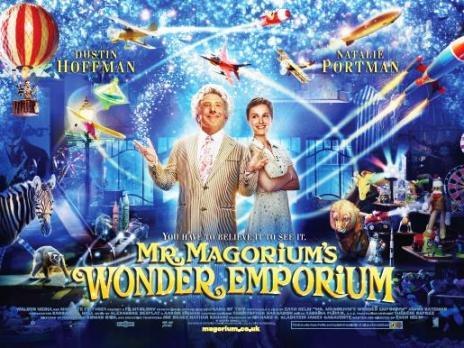 "Mr. Magorium's Wonder Emporium"
Here's an interesting exercise: Get a block of wood, as bland as possible. And believe in it.
The weird thing about it is that the block of wood is you. Anything can happen to it, as long as you believe in it. The block may initially appear lifeless, but it is your faith and work that makes it more than its parts, so to say. And that block can be anything. A piece of clay that you turn into a sculpture, a room that you turn into a living thing, an idea that you turn into a business. All it takes is a little faith.
Well, that is the extent of my learning from this film, which was really about a toy-shop that is alive and a girl, Natalie Portman, who refused to accept it was her destiny to run it. It's entirely not meant for my age but I enjoyed it nevertheless.
That's it from me this week, I'll be spending this Easter with my family. Have a good one and until the next time!
 I'm still "on a break," but stumbled across this interesting titbit from a book on warehousing-practices. If you don't like reading lists, too bad because it's interesting, but I've also summarised the key-points in the end.
China
- Low labour and land-cost, but high equipment costs, translate into large (e.g. 250,000 square feet), low warehouses like in the US, but often lacking even a forklift.
- Certain goods like consumer electronics, are of such high value, have a short life-cycle, and thus a lower inventory-cost, that expenditure in state-of-the-art technology is justified.
- Certain cost-saving practices, like removing the pallets from shipments in order to ship more goods, cause some inefficiencies other countries, like, eh, re-adding pallets.
East Asia
- A traditional focus on personal relationships and less on computational models, means there's a lack of data and opportunities for improving performance are not well-developed.
- The most active economic areas are separated by lots of water, which means lots of product conveyed by air (for high-value or time-sensitive products) or ship (for bulky items or commodities). The high costs associated with this, are incentives to consolidate freight.
- Therefore, more strong regional hubs, like in Hong-Kong and Singapore, are expected to emerge.
Europe
- High labour-costs and an inflexibility of the work force have lead European warehouses to be more advanced in terms of automation.
- A growing common market will also lead to more economies of scale in the future, leading to larger, centralised warehouses.
India
- Characterised by cheap labour and land-cost, but relatively expensive capital costs (machinery and the like) and an underdeveloped infrastructure (both physical & administrative).
- The markets being supplied are generally local and not very wealthy, which leads to the SKUs not being high cost and there being little incentive to increase efficiency through capital expenditure (IT).
- Global demand means that larger distribution centres are being built around large ports like Mumbai (Bombay). The lack of land there is leading to high prices, comparable to Singapore/Hong-Kong.
North America
- Characterised by a culture of mass-consumption and a uniformity of the market and distribution infrastructure, which translates into large centralised warehouses and accelerating rates of product flow.
- Warehouses are often situated in the countryside surrounding metropolitan areas, which is cheaper, while being well-connected.
- A good telecommunications-infrastructure enables better supply-chain co-ordination; Warehouse management systems are generally advanced, and the rich data leads to better tracking and performance.
- High labour-cost are off-set by using cheaper migration-workers
Singapore, Hong Kong, Japan
- Due to a lack of land and high labour-cost, warehouses tend to be built high.
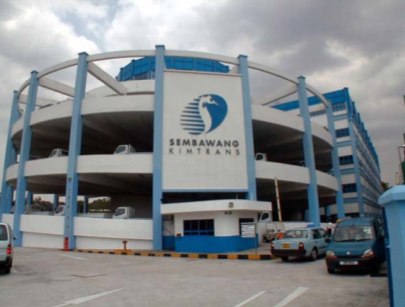
- Elevators are one bottleneck, caused by this style of building, however a Singapore warehouse has found a solution to this: A multi-floor facility with no automation or elevators, but, instead, a spiral truck ramp so that trailers may be docked at any floor (see pic). This does claim more land area, which must be recovered from above, and doesn't work well if trucks have to shuttle between multiple floors.
- While both Singapore and Hong-Kong act as hubs, Singapore is much more international, receiving goods from manufacturers all over Asia and shipping it to other countries; Hong-Kong receives mainly Chinese goods. Also, for the latter, many of the goods come in via trains and trucks, while leaving by ship or flight, while for Singapore it comes and leaves via sea and air.
South and Central America
- Labor costs are low, though not as low as in China, and the nature of its local economy and customers does not justify high equipment expenditure.
- The only exception is Mexico, which can quickly ship products to the US and keep its inventory low, thus justifying state-of-the-art technology.
Final thoughts
Some general conclusions can be drawn.
- Labour costs are a factor when considering automation; automation is a factor when considering optimisation; optimisation is a worthwhile expenditure when dealing with high value goods with a high velocity.
- Cheap land seems a fundamental advantage, looking at the logistical nightmares that Singapore and other high-rise builders must be experiencing.
- Access by land will significantly decrease the cost of transport. Generally, a well-developed infrastructure means more access to wealthy markets and enables warehouses to store high-value/high velocity goods, which is good for them.
The book 'WAREHOUSE & DISTRIBUTION SCIENCE,' which is available as a free download, provides some incredibly detailed info on how to effectively set up warehouses and distribution chains. Well worth a glimpse, if not more.
5 links: the obvious one, brand-logic, happy places, e-toys, neuroscience
0 comments Posted by Unknown at 11:02 AM It's Sunday again, and I have a nice big collection of links today: on running a cheap yet effective start-up; on why brands exist; on creating happy places for yourself and employees; on the business of children; and finally on a whole load of neuroscience. The aesthetically pleasing picture of Marilyn links to a particularly disgusting image of a "healthy" burger—my initial choice of illustration. You have been warned.
Previous link-discussions can be found here.
Link 1: the obvious one - Seriously, unless you actually used this weekend to, eh, have a life, you'll have noticed the firestorm started by Jason Calicanis, continued with Duncan Riley, tempered by Jason Fried, and the final words of wisdom by Micheal Arrington. Crazy, how opinionated these entrepreneurs/bloggers are, right? Yeah, right. A good read if you're (thinking about) running your own business, with like lazy employees and expensive tables.
Link 2: A brief history of brands - well actually a blurb about a book. I like:
"Branding became necessary when large-scale economies started mass-producing commodities such as alcoholic drinks, cosmetics and textiles. Ancient societies not only imposed strict forms of quality control over these commodities, but as today they needed to convey value to the consumer. Wengrow finds that commodities in any complex, large society needs to pass through a "nexus of authenticity.""
Link 3: the architecture of happiness -
"There are three concepts central to the “yoga of the home”…. The first rule is to align your schedule with universal schedules by getting up and going to bed with the sun. “We try to keep lightweight and low furnishings in the north and east — to create an openness — so that we can draw in the healthy early morning sun,” says Cox. Heavier, taller furniture goes in the south and west. Second is bringing nature indoors — plants, natural fibers, no synthetics. “Vastu is the first intentionally green science,” Cox says. And last, vastu asks us to “celebrate who we are and what we love” by surrounding ourselves with things that have meaning. “When someone enters our living room and we’re not in the room yet, we want this guest to get a sense of who we are,” she says. “The room speaks of us.”"I've been thinking about this topic and the general issue of creating happy places for a while. A worthwhile read is also Frank Addante, a serial entrepreneur, on choosing the office-space for his start-up: link 1 and 2.
Link 4: building a toy e-commerce store - since I linked to Lego last time this seemed appropriate. In all seriousness however, I think the subscription-model + children is a cash-cow; kids always want more stuff and have old stuff to get rid off. Applicable not just for toys, but clothing and furniture as well.
Link 5: Some neuroscientific stuff - ignorant shoppers are blissful, though information that stimulates the imagination still works (as do quality-labels as they allow you to charge a premium); body-language works for consumers, in other words an in-store-television-advert or one of those annoyingly friendly taster-people in supermarkets, should cause people to buy more food. A little bird tells me this applies more to the US than the French; 15% of women don't like perfume, which is interesting I think as I'm not a big fan either; and Art-adverts work, enough said. And yes, EurekAlert is my new favourite site.
5 links - sense of smell, false green ads, farming boom, Lego, fun e-shopping
0 comments Posted by Unknown at 10:49 AM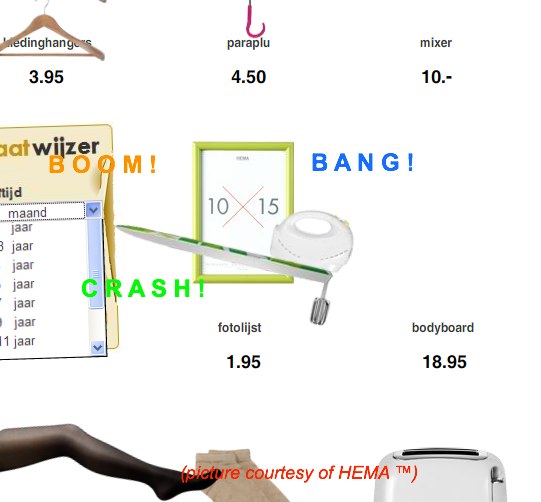 Time for those Sunday-links again. Today, I'll discuss the cocktail that is smell and how some things just don't mix; how green is not all it's cut out to be; a possible shift of power from retail to farming (or not); how lego came to be and where it is going; and how to sell me online shopping.
Previous link-discussions can be found here and my bookmarks here.
Link 1: Starbucks Admits Sensory Mistake - These are the kinds of stories that make me I like the NeuroscienceMarketing-blog. If you follow the science-section of the Economist, you'll know that neuroscience is a big deal anyway. In any case, this story is about how Starbucks designs atmosphere, largely influenced by smells. Apparently, smell of heating egg and cheese sandwiches doesn't mix well with the coffee aroma.
Link 2: False 'Green' Ads Draw Global Scrutiny - Two problems linked to green adverts these days, I think. One is that consumers are growing tired of it. And two is that, as this story shows, just because companies say they are, doesn't mean they are. I like the Norwegian approach to this. They ban green adverts by products that cause more problems, no matter how innovative they are (about hiding it).
Link 3: Farmers Wonder if Boom In Grain Prices Is a Bubble That food-prices are rising is an inescapable fact. But it also presents an interesting shift in the status quo. In the food-chain of the grocery-business, farmers are pretty much at the bottom. Now, even though their own costs are increasing also, they can charge more on top of it and decrease retailers' margins. Time will tell if this is something that will be acceptable for a long time. Certain signals very much suggest to me that farmers may be in the right position to cut out the middle-man and become retailers themselves.
Link 4: The Making of…a LEGO - I'm still a kid at heart, so I love anything to do with games and toys. My parents never bought me much lego as a child, which I regret as I hear it breeds geniuses. In essentially two pages, the article describes how lego came to be, what makes it so perfect, and what the company's strategy is. I was always impressed with the brand-extensions they did with the games, the robots, and the theme-park. A company to follow.
Link 5: Online shopping at Hema.nl - I've linked to this on twitter before, but it brought another smile to my face watching it again. Just when I think that online-shopping has no future, innovative uses of technology surprise me again.
5 links—retail-saturation, RFID's costs, elements of fun, tricking shoppers, & home-cinemas
0 comments Posted by Unknown at 10:41 AMIt is time for those links again! This time, we'll be discussing the economics of Apple's physical stores, how Walmart is enforcing RFID, how retailers are trying to trick people to buy more expensive things, how people perceive fun in games, and 10 ultra-geeky home-cinemas.
As usual, my bookmarks can be found here, and the previously covered links, here. Enjoy!
Link 1: Why is Apple saturating (US) cities with retail stores? is a question that Choire Sicha asks on Kottke.org, and lead me to this profit & cost breakdown of Apple's retail stores at Seeking Alpha (see pic below). It does appear it's all about the money, though hard it remains to read Apple's mind 100%. In related news, OObject lists all the items needed to build an Apple store.
Link 2: Is RFID economically feasible? I'm planning to dedicate at least 1-2 posts on RFID on this blog in the future, as I've essentially been following its development since the early coverage on Slashdot. This story on InformationWeek discusses the pressure that Walmart, certainly the biggest champion for RFID in the retail-arena, is putting on its suppliers to finally add RFID into their logistics-chain. As far as I remember, the latter have been complaining about the unfair balance of cost that RFID causes, shifting most of them onto suppliers. I assume, however, that these chips and pallets are reusable.
Link 3: What makes games fun? Lightspeed Venture Partners has an interesting blog, which mostly discusses the business and principles behind digital games. I follow it because games are fun, and if you can understand the source-code of fun, you can replicate it elsewhere. In that spirit, then, it links to an interesting white paper trying to map out what exactly goes on in gamers' heads while playing games. Part 1 is also very much worth a read.
Link 4: A buyer's christmas? The New Yorker digs into consumers' buying behaviour. Interesting is, that people use the net most often to find info, not to buy, but can use that info inside stores (we'll still need ubiquitous internet for it to be shoppers' utopia, however). Equally interesting is, that if a store has two microwaves, consumers will usually buy the cheaper one. With three products, however, they will usually by the mid-priced one. There's still room for trickery, I guess…
Link 5: 10 stunning ultra-geeky home cinemas. In the spirit of my previous post on cinemas & luxury, I thought that this link would be fitting. The Star Trek-themed one is a little too geeky for me, but the Titanic one (no. 6) looks awesome. I'm still doubtful about whether it's about the design or about the movie, but I can't deny that people put a lot of work into designing these.
I'm writing today's post mostly as a way to relax me. I've been in a bit of a panic these last few days because my main machine, my trustworthy mac, is giving me kernel panics and I'm in the middle of a project. It's not a nice feeling, and any repairs, I've been informed, are bound to take 10 days. So, blogging to relax, yes, but don't expect regular ones, especially considering this machine can "explode" at any time.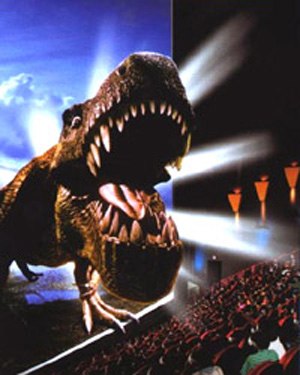 NYTimes recently wrote about a strategy employed by US cinemas to draw in more people. I quote:
"Reserved seating, plush rocking chairs and made-to-order food make Mr. Redford’s Sundance Kabuki theater feel more like a restaurant than a traditional cinema. It also has a 50-foot-high lobby with live bamboo, a glass atrium and reclaimed wood walls. Here, a night at the movies is less about enduring the hordes at the mall and more about feeling pampered."According to the article, big US-chains are building such upscale cinemas to draw people back into the experience.
While I am a big fan of the cinema-experience and actually worked at exactly such a venue, years ago, as a cocktail-mixing barkeeper, I think there are several reasons why such a strategy won't work.
The nature of movie-viewing (1): regardless of how luxurious a place like that is, you'll still have to sit in a dark room and won't actively notice the luxury or people around you, except for before and after the movie. The reason why people like dining in luxury-restaurants is because of the luxury, yes, but also because you share it with a group of people. In cinemas, luxury is not an emotional draw.
The nature of cinemas: cinemas are still very much in a mind-frame of providing experience of the masses. That manifests itself in a McDonalds' mentality of serving guests standardised services, having a lot of seat-rotation, cleaning big rooms (badly) in less than 10 mins, etc. It's a lot of little things, but they add up to a reputation for mediocrity, and people really just come to view the movie and be with their friends.
The nature of movie-viewing (2): YouTube, the internet, modern lifestyles, etc. have created different viewing-patterns, and there is a much greater focus towards viewing media in bursts. I think that the cinema-industry thinks that it is competing with some kind of emulated experience at home, but I don't think that's generally the case. So what are cinemas competing with and should they compete with it?
Luxury is not mass: Cinemas need masses of people coming in, and luxury cinemas actually only aim to address the (imagined!) needs of a few. In my opinion, it is not a customer-focussed strategy, and is for that reason alone bound to fail.
What should cinemas do?
Now, I'm not all against a certain level of luxury. I like comfortable seats as much as the next guy and I'd love a good cocktail every once in a while. But I think standards should be upgraded throughout the cinema, all the way down to the lowest seats, and that everyone should have the option to get a cocktail (if they have the budget).
There's two main selling-points for cinemas, I think, and those are timing and technology. They are still the first to air a film (ignoring piracy), which will hopefully not change. So, for blockbusters, cinemas reign is pretty much guaranteed.
Apart from blockbusters, there's something special about seeing indie movies in cinemas, which I include into timing. I'll never forget watching "Howl's moving castle" in the cinema, it was a magical experience, one that I could never have at home.
As far as technology is concerned, admittedly we are in an age where big screens and high-def visuals and sounds are becoming commoditised, though no one is as yet planning to install a 50 ft. screen in their house, afaik. I do think that cinema-technolgy should be upgraded, all the way to the point of the IMAX-experience.
Admittedly, there are some problems with 3D-tech. It increases the cost of producing a film and won't translate well to home-viewing (I think). But my point is that cinemas should keep differentiating themselves technologically.
People is a third selling-point, though I think that unless you like going with 8+ people to the cinema, you will be able to emulate that at home.
As far as luxury is concerned, again the basics should be present, and cinemas have to make money, but cinemas would become a lot more popular if they kept the price of seats down, increased the quality of service, and charged what they charged for luxuries. The one thing that I can't stress enough is staying a leader in technology (video & audio) as that is truly where the emotional draw for cinemas comes from.
But maybe I'm wrong!? Feel free to let me know in the comments.
5 links - cool vs. tech, touch-screens, women, pizza, & bookstores
0 comments Posted by Unknown at 12:09 PMMan, I collected so many links, that I'll probably have to write three updates to cover the most important ones. We've got a lot of ground to cover, so let's get started. You can find my previous coverage on interesting links from the web, here, and my continuous stream of bookmarks, here.
Link 1: On Magnetbox - Correlating cool with tech - With pictures like the one below, my work on this blog is really done. Interesting is the rise of computers vs. dance & hip-hop music (both of which are hugely benefiting from the cost-savings made possible by PC-based studios. (A note: low industry-barriers = high chance of suckage!). Also note the fall of art, after the colour TV was introduced. Kottke also made some comments about it.
Link 2: On BuzzFeed - Touch-Screen Ordering - BuzzFeed presents us with some stories about automatised ordering. There are both advantages and disadvantages, I think. Good is that it minimises errors in ordering and can interface well with back-office operations, such as ordering new supplies. It might also fit with the individualistic preference for self-service, I wrote about before. The disadvantage is the cost and the margins of error that information systems bring (I still shudder at the thought of the LAS disaster (pdf)) + the lack of the human factor. Martin Kunzelnick (German) links to some videos of Microsoft's Surface in a restaurant-environment.
Link 3: On Lightspeed Venture Partners - It is no accident that Typhoid Mary was a woman - Although it's a horrible-horrible title, and perhaps an obvious point, I've been coming across many stories about the social qualities that women possess, making them better at PR, marketing, sales, relationship-building. Something to keep in mind for any people-based business.
Link 4: On Reuters - Pizza Hut rolls out nationwide mobile ordering - A news-item (finally), and I'll probably delve into this topic sometime in the future. Arguably, Pizza Hut has been pursuing a different strategy from pretty much 98% of the pizza-restaurants out there. I'm sure that there is considerably brand-loyalty towards Pizza Hut, which will give it an advantage over delivering pizza-franchises, HOWEVER, it will probably be competing on price, which the franchise has not done so far. I'm not sure how that will affect their brand at all, but it's something to keep an eye on.
Link 5: On WSJ - Who's Buying the Bookstore? - arguably, there are few retail-outlets that evoke such an emotional response as bookstores. I find them comforting, and very similar to churches, in the way that it really is expected of you to be silent while browsing (on a side-note, I discussed a link of Dutch bookstore being opened in a church before). It's also a symbol of a community, as WSJ points out. Well, with competitive pressures from Amazon et al., these types of stores are clearly disappearing, or changing into hybrid monsters, which smaller stores can no longer compete with. WSJ points out a phenomenon related to that community-spirit, which is very touching. Capitalism isn't everything, particularly in places that target the softer pleasures in life. I'll have to reflect more on this, as I'm very attracted to these types of stores, and would love to set one up myself.
That's it, for this week. I'll see how I'll catch up on the rest of my links, but this went great (took 20 mins), and I always enjoy re-reading my bookmarks. I hope you do too.
Hot or Not commercials - Axe's "Chocolate Man" vs. Eristoff Black
0 comments Posted by Unknown at 6:53 PMNothing to do with HotorNot's 20 million sale, which I just heard about today, I'm afraid. No, I watched Juno in the cinema today (great flick!), and saw following two commercials: Axe's "Chocolate Man," which was great, vs. Eristoff Black, which was not.
What I like about this short film is that it does give you a similar feeling to what it's like to walk around with a good scent and feel good about yourself. It's so hard to portray smell on video, I can imagine, and chocolate's just a great vehicle for it. The cinema-crowd's reaction was great also, laughing throughout the film.
*************
Update: apparently this is part of a whole viral campaign by Axe. I just found the matching game: Maneater
*************
In contrast…
I don't know about you, but this film just made me feel nervous. It's a commercial for an alcoholic beverage, ok, but nothing in the film suggested anything positive about the experience of drinking it. Instead you have this paranoid image of someone being locked in a glass sphere, pursued by bloodthirsty animals. Even the scene at the end, where it's a guy who apparently hit a shopping-window, is not reassuring, rather it confirms that this is a drink to be treated with caution. The cinema-crowd was totally not into this commercial either.
That's all from me this weekend. Have a nice one!
My relationship with story-telling - a short autobiography part I
0 comments Posted by Unknown at 1:45 PMI'm in a philosophical mood today, after having spend an hour this morning sorting through the rough drafts for this blog (estimated at around 150), which I categorised as "idea," "rough notes," "feature complete," and "send it already." There were so many of them that I found myself a little overwhelmed to address a single one, a little afraid to miss seeing the forest through the trees, and instead decided to write about a core-principle in my life: story-telling.
I'm very attracted to the concept of telling stories. It's perhaps a little difficult to explain, but certainly related to the reason why I write so much, and also integral to what I want to do with my life.
When I grew up, I was reading all the time. From the back of cereal boxes, to encyclopaedias, to even the bible (which I thought was a great fantasy book). As a kid, I also remember building up cities in my room and garden, made out of toy-parts and characters, and constructing visual stories around what was happening.
I did not watch TV until I was 10, but, around that time, I fell in love with fantasy and sci-fi stories, both in book-form and on TV. I liked the way the story was constructed, and loved to imagine myself being there. I remember having magnificent visions of what I imagined the future of society, cities, and the home to look like.
Around 17, I decided to hold my first teen-party (the last one before that was probably around the ages 8-9). At that time, I was playing around in a band and very much into music-culture. I remember coming up with the party idea, which was essentially a visualisation of a club. It was lucky timing. We were just about to move and I had a huge house to my disposal.
The way I visualised it was to have rock-bands playing live in the living-room, a techno-room with a (borrowed, I think) strobe-light in the basement, and some other theme-related room elsewhere. Important were of course drinks and drugs, as, hey, I was 17. And equally important was the concept of complete freedom, which I think was communicated quite clearly.
A large inspiration was this video by the Prodigy - No Good (start the dance):
The end-result was great: around 50 people showed up, 2-3 bands were playing, and people did some crazy stuff, without getting me in trouble. In the end, I was still the one responsible, and took that seriously, but essentially everyone could do what they wanted. I repeated a similar party a few months later, which revolved around the same principles, with some restrictions, though around twice the amount of people.
That's where I'll end this. Lot's of stuff happened since then and will continue to happen, and I hope to write a second part in maybe 5-10 years from now (maybe sooner) about all the adventures I'll hopefully have, and evolutionary leaps I'll hopefully make.
Core to everything, I think, is vision and freedom. When you create a story, you have a vision of the components and the way they fit together into a dynamic process. At the same time, a story-teller must realise that his/her story is just the start for the listener/viewer/experiencer. It's a synergetic interaction between creator and beholder and the end-result can be both unpredictable and quite beautiful sometimes, a risk that, to me, is entirely worth it.
P.S. Happy Valentines day!
What's the biggest pain in your industry II - Carbon emissions
0 comments Posted by Unknown at 11:17 AMContinuing from part I - obesity, this post will be equally light as I have "♫ my mind on my money and my money on my mind… ♫" Or something to that effect.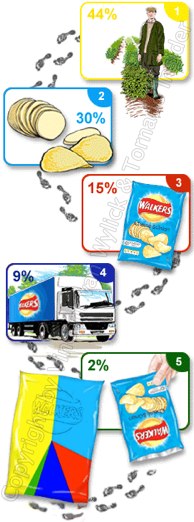 According to a carbon-emission calculation of PepsiCo's Walkers crisps, the majority of carbon emissions come from the production of raw materials (44%) and processing thereof (30%). A Dutch magazine, Tijdschrift voor Marketing, attributes the majority of the carbon footprint to transportation of said materials, and forms the conclusion that more and more production and consumption has to happen on a localised scale.
Even though the makeup of those figures may be open to interpretation—there is no breakdown about what in the first 44% is due to actual farming and what to transportation—perhaps, Mr. Kuiper, the author of that piece, has a point.
In a TED-lecture, James Howard Kunstler argues that the 'hydrogen-economy' is a pipe-dream and we must start thinking about creating urban environments fully equipped with the means of production, transportation, living, and waste-disposal, all in one. Very inspiring, though clearly requiring significant paradigm- and resource-shifts from today's globalised economy.
Clearly transportation comes at a cost, the question is how much the alternative would cost. Building super-farms, creating artificial climates to grow exotic food, waste-disposal, dealing with virus-outbreaks—regarding the latter, farmers already have problems dealing with chickens, sheep, and cows now, let alone having to deal with something like Kunstler's utopian vision—all of which represent costs that have to be accounted for.
But, I don't want to sound like a pessimist. I actually love the idea of a super-farm and a super-urban environment, regardless of the monetary cost. I'm sure plenty a sci-fi artist has tried to draw such a very thing (as have I). It's complicated, expensive, but exciting at the same time.
Asking you a tough question: How would you do it? What would a Kunstler-inspired localised economy look like to you? Is it even possible? … well, something to think about anyway…
Lowest common denominators - the key to simple business strategies?
0 comments Posted by Unknown at 12:02 PM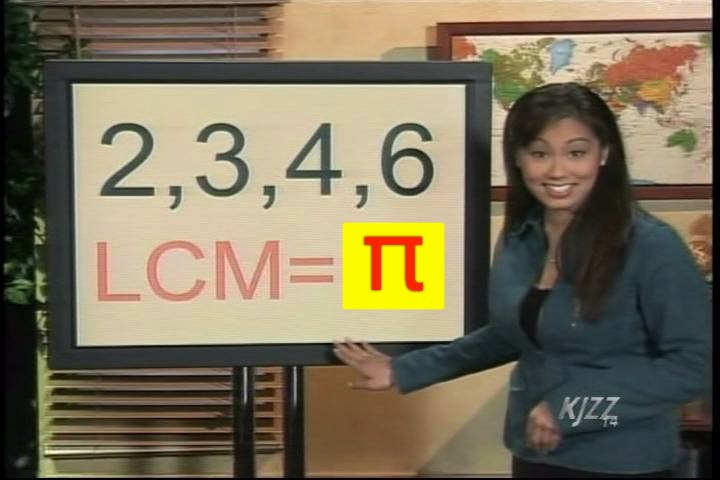 Arguably, I managed to write some strange posts while I was writing my thesis… some of which seem completely unrelated to this blog, and which I may shift to another blog, my first blog, which I'm resurrecting just for these types of "philosophical" topics.
Still, I liked my post on the lowest common denominator (LCD) from a few months ago, simply because I can still apply that thinking to other disciplines also. To remind you, the LCD is defined as the "lowest"—least useful, least advanced, or similar—member of a class.
The LCD of business-components
It came back to me last night, when thinking about what I wrote in my last post, on how it was difficult to sell a lifestyle product, if conditions for that lifestyle are not yet present. So you find other unique selling points (USPs), and in this case it was health as that was a key driver. To me that is finding the LCD in marketing—you find the "keyword(s)" that connects your product's message with the context of the customer.
Another example. I was thinking about writing about IKEA this week again, but it was such a simple point that a paragraph will do. IKEA is well-known for its design, yet also for its low prices. Actually design was never core-objective, it was finding the cheapest way to produce and to distribute. Design came afterwards, and was even then a matter of working with what you have: whether it's a certain kind of wood from Poland, or the hollowing of walls to make them lighter, or removing the legs from a table for packaging. It's all a matter of lowering the costs, and only afterwards about making it look nice. The LCD of production is finding that sweet spot between a cost that works for a business and a design + price that works for the customer.
Business-planning = the reduction of assumptions
One of the first things we learned in our entrepreneurship-masters, is that business-planning is a fantasy-story—we make up stuff that we hope is believable. If we can reduce the assumptions in the document, however, to the level that an outside party (and inside parties) start finding it believable, that is the key to the mission-statement, the operational plan, and to finding funding.
Bringing things down to the LCD is a way of reducing assumptions and convincing others of my idea. Explaining that production is subject to costs and design comes later is logical; or that reaching customers is a matter of finding the simplest things that connect us.
Essentially, a business-plan is a simplification of reality. Your financial predictions will likely be off by a lot or (hopefully) a little. Your marketing-plan will make certain simplified assumptions about your customers. Your production-plan will assume that all goes well. Keeping it essential, however, does have a better chance of convincing investors, etc. that you can see through the mist and identify the key-drivers for success.
Simplicity, yes, but not of skills
As I wrote last time, it's good to know the LCD of whatever you're doing for yourself. It's not good to shout it out to the world (oh, the irony!), as that really decreases your competitive advantage.
Still, while focussing on LCDs arguable simplifies the strategy, finding those LCDs and profiting from them is a matter of skill and study, of knowing your processes, your industry, your customers, etc.
Abstraction…
Now if all of this seems pretty abstract to you, you're not alone. I'm still trying to figure stuff out for myself. One reason is certainly the fact that you need to have the skills, the know-how to accurately identify key-aspects of a business-strategy, which differs from business to business. Another possible reason is that I'm completely wrong about this (let's hope not).
A final reason is that I still need to write a recap of months 3-6, which I'll try to do this weekend, before going on to other topics.
Anyway, agree or disagree? Let me know in the comments.
The service-paradox - on self-service and customer-retention
0 comments Posted by Unknown at 11:31 AM Every now and again, you come across something that changes the colour of your perception, that allows you to see the world in different ways. One such moment happened after reading a chapter in the IKEA-book, I wrote about before (1 & 2), on how the customer is deeply involved in the logistical process and the effects and cause of it.
As you may, or may not know, when you shop at IKEA, you generally go into the store, choose the furniture you want, pick up the already-boxed version of that item, put it in a cart, pay, drive home, and assemble it with some tools that are in the box. All-together, the customer at IKEA does 80% of the work related to sales.
I had read, in my bachelor, I think, that the reason that IKEA introduced this system was because of when it first opened its store, there was such a mass of people that their staff couldn't handle it, and that they then just decided to let the mob do all that stuff. I thought that the reason that system remained was cost-saving; I mean, how cheap is that to let customers do all that work for themselves, right? Well, that's definitely a reason, but only part of the story.
The other part is the effect it had on customers. Because you always ask yourself, why would someone go through that, when they can just pay the store a little extra for the transport and the assembly? And that's where it gets interesting.
To start, IKEA, even though it offers low-cost goods, is well-positioned for the middle-class market. The stores are outside the city, and pretty much all their customers have cars, which they can use to transport the furniture back home. I'm not 100% sure if this was by design or a consequence of other factors. But at the very least, the conditions for making the customer part of the logistics process are in place. Still, you kind of wonder. Aren't these exactly the people that could afford a little extra service?
The explanation is culture. Western culture, you could argue, has seen a shift towards individualism. People are over-informed, over-serviced, over-indulged. Sales-clerks and waiters can't wait to throw themselves at you and ask you if you're happy, if you want another…, and another, and another. It's exhausting, both for the store and for the clients.
In comes this place, which tells you, very Scandinavian, here… go do it yourself. Like a party, where you can mix your own cocktails. Where you control what goes in and what comes out. And most of all, where you get the feeling that you are part of a productive ecosystem. It's the good kind of stress.
The book quotes some sociologists, Robert Jungk and Ivan Illich, according to whom, a society which receives too many services, where every screw has a handyman, is a broken society. Services, they say, destroy activities. For every small chore, you can call an expert and let them do work that you actually do yourself. On a larger scale, services destroy the entrepreneurial drive. Also Thomas Düllo, according to whom, we live in a world of indirectness, and because of this, it's very exciting to be asked to do something. A French student was also quoted, calling IKEA: "Lego for Adults."
And there are definitely signs that suggest that society wants to move into another direction: open source, Wikipedia, Make-magazine, do-it-yourself, self-help, etc. Probably even blogging. A collection of niches to be sure, but growing ones.
Ever since reading that chapter, I sit in restaurants, stores, etc. and wonder how this principle can be worked into their or other businesses. For instance, is the take-away coffee part of it, or McDonalds' policy of throw-it-away-yourself, or Amazon. All of these "features" cause both a downward-shift in the bottom-line of "service" businesses, but they also remove the "service." And these businesses are unarguably booming too.
But I also wonder which services can be removed, and which shouldn't. More on that when I have the answer. Or perhaps you have it yourself? Let me know in the comments.
The picture is courtesy of Marco.org
 One of the downsides of not being at home for three months is that the mail tends to pile up. The culprit is The (weekly) Economist, which forced my landlord to dedicate a special cabinet just to accommodate them all. He was happy to see me.
My thesis is handed in, and while I'm anxiously waiting for the feedback / grade, I'm doing a variety of stuff to diffuse the thesis-haze that was in my head these last months. One of these is thinking about how I will organise the research that I collect for my work / blog. This is part of a dual trajectory I'm pursuing—one side is research, which I use to build up my knowledge about the field of food & retail, the other side the practical path, which I can now finally pursue freely.
The pile of 15 or so Economists is actually a good exercise to think about what really matters, and I'm going through them quickly, marking the articles that are interesting to read, and later cutting them out and adding them to special folder, after which I may categorise them by country and subject perhaps.
It's easy with The Economist, but there other publications that I'm much less eager to chop into pieces. My books are filled with pencil-marks, as are my Harvard Business Reviews, but there's no way that they'll ever feel the cold blade of my scissors. With those publications, I'm forced to keep all that extra paper and try to get my thoughts to paper as quickly as possible.
The other, sort of, complication are web-articles. I've been printing stuff to pdf and have a special S+FNR folder, reserved for anything from fashion-trends to human-resource management. I'm also going to print them out and add them to my folder for future analysis.
As you can see, I take my research seriously. A probable after-effect of writing a 180-page thesis, studying three academic fields—innovation, entrepreneurship, and finance—and interviewing roughly 300 businesses.
But I wonder how the real bloggers do it. If you're someone who takes blogging seriously, how do you organise your material, or do you organise it? If you do so on paper, I'm curious as to what kind of folders you use (incl. a link to a photo if possible).
Note: If you use a computer to store stuff digitally, I assume you use a personal database, like Devonthink or Jojimbo for the Mac. I'll tell you right now, I've used them all (to organise my thesis) and found it frustrating that they wouldn't do everything I wanted and tried to lock me in in the process (I've spent many hours migrating everything from app to app—it sucks!). They also don't help you much with paper-based materials, like mags, journals, and books. No, on the computer, I prefer a regular folder and to add text & pdf to it. Simple, portable, and cross-platform.
 Why am I preoccupied with art? Realistically speaking, apart from collecting links and inspiring quotes, all I have time for these days is doing some drawing. I like to hold discussions with artists, both about their art and the state of their industry. And I like to think that thinking in artistic ways helps me in other areas also, e.g. how to be more creative, how to see patterns, perhaps how to set up a business that people enjoy spending time at.
Of course, it's a lot of fun too…
Following is a list of things, I've learned/thought about art, starting specifically with drawing, and then about more general stuff about art—economics, DRM, innovation, etc.
- Details are great, but the big picture is better - try drawing a christmas-tree and find out
- Ways to decrease focus on detail - get some children's tools: wax colours, paint, big markers, etc.
- Every object's colour is made up of a number of sub-colours, which then result in that glorious mish-mash, called a [insert your favourite classical artist here] painting. E.g. a leaf is green, but really there's yellow and blue in there, maybe a taint of orange and purple.
- White and black are not colours because they ignore the principle above.
- Nature is a great way to learn drawing.
- Shadows are hard.
- Perspective is hard.
- Capturing movement is super-hard.
- Abstract art is hard.
- Everything can be mastered with practice.
- Recognising shape is something you learn from practice.
- Drawing upside-down—i.e. taking a picture and turning it upside down—is also a great way to trick the brain into drawing the shape instead of the mental picture your mind has already created of that shape.
- Remembering shape and reproducing it from memory requires even more practice.
- Keep a clean workspace so that you can start with a fresh mind the next day.
- Reading 'The War of Art' will not make you a better artist. Practice, day-in-day-out will may make you a better artist. The book may help you become a more effective artist however.
Broad strokes:
- Drawing is a right-brained activity, as such it is no surprise that most artists don't like or want to engage in the left-brained activity of making money from it. Guilty as charged.
- Art is surprisingly similar to innovation - both are quite incompatible with economic principles, aka. making a quick buck.
- The democratisation of art through the internet and subsidies has levelled the playing-field. Everyone can be (read: call themselves) an artist now. As such, discovering truly unique art becomes hard.
- As soon as something can become digital, it loses tremendous value. Outlook for the market-place for digital products: bleak.
- As painful as it sounds to all thieves out there, DRM is a necessary measure in making money from art—at least if you're a producer. That, or become a communist and get paid by the government. Recent discussion on DRM on Tech IT Easy.
- Collaboration is another great way to make money from art.
- Just like in innovation, using both methods and creating art/end-products that are hard to replicate, is an important component of success.
The picture is, incidentally, total crap, and shows how much I still need to learn. Nature is beautiful and oh so hard to replicate on paper.
 Dear all,
My fingers are really itching to get back into blogging and pursuing my passions. I've also lately been thinking that my interest in the communicative arts is perhaps a sign to go into marketing. I wonder how "blogger for 2+ years" looks on a resumé?
Today, I started with writing my conclusions for my thesis, which involves me going through it, and picking up the pieces that I like. That should also lead to a better introduction and executive summary. My next deadline is for this Sunday (or before), after which some more detail-work will need to happen (cutting/editing, checking/formatting references, prettying up some graphics etc.).
Btw. now that I'm actually reading what I wrote, I'm liking what I'm seeing. It'll be hard to cut much.
5 Links
I need to take a break for 30 min., so I'll take a look at if I bookmarked something interesting for y'all. I wish I could write something more in-depth, but it would just be too distracting at the moment.
- St. Petersburg Times (US) has a very interesting write-up about a new "health food restaurant and Hip-Hop-themed video-gaming business," called HipHopSodaShop, that is opening in their 'hood. This would normally be nothing special, except I'm pretty interested in symbiotic businesses, and particularly anything reflecting popular culture. The article includes a number of details related to the legal aspects, the financing, etc. Worth a read. More details can also be found via BuzzFeed.
- Ha! MetaFilter does a write-up about a new bookstore opening in one of my hometowns, Maastricht, where my parents live and where I attended school for 5 years. The bookstore, Selexyz, is actually located in a Dominican church and makes for some interesting pictures. I was hoping to visit it last weekend, but I only got to see some of Maastricht's other architectural gems (the city is booming with development) and two of its museums.
- Yahoo-news publishes a list of 80 things to watch out for in 2008, from a marketeer's perspective. Big things include the Beijing Olympics and the US-elections of course. I also like "De-teching," "Eco-fatigue," "Green weddings," "Hip-hop's Retro Kids," "Intellectual luxury," … and actually 30 more I think.
- PSFK points us to an Economist article about the decline of the shopping mall in the US. Honestly, if I had a choice, I would prefer for my shop to be located in one of the new open city projects in Maastricht or elsewhere, than in a dusty high-riser with artificial light and air. PSFK also writes that "consumerism is thriving in downtown shopping districts and outdoor shopping meccas," rather than in the infamous mall.
- 2 for 1: Starbucks is in trouble. The Starbucks Gossip Blog points us to two stories. One on McDonalds converting its venues to Starbucks-clones (surprise, surprise), another on Howard Schultz taking back the reigns (a Dell manoeuvre?).
Happy reading!
The picture is of course my own… jumping into 2008!
- Cordless earplugs that are also headphones - imagine going to bed and blocking out your partner's snoring, and waking up to the sweet sounds of […insert your sweet sound here…].
- Fluorescent permanent marker - to convert my non-pro Apple laptop-keyboard, into one that lights up in the dark.
- A binder/folder that allows me to bind printed web-articles into an easy to read non-webzine.
- A mobile (!) pad that allows me to draw on paper, which stores these drawings electronically, and allows me to later transfer them to my computer - saw this somewhere for €80, always regret not buying it.
- Some kickin' clothes.
- For my Laptop and iPod to last me through their 3rd year.
- Anything on my wish-list.
For 2OO9
- An Apple laptop that is as light and as thin as possible - So no disk-drive as that can be external. 3-4 USB-ports to compensate would be nice.
- The next OS (10.6 or 11.0) from Apple.
- An iPod with a nice screen and no phone - for music, video, books on the road.
- A small car (unless I live in a big city, then a good rent-a-car service).
- Orexin A.
- More public wifi / or a pan-European service.
- A Wii / DS and time to play it.
- Some kickin' clothes.
 Just a collection of films I enjoyed in 2007.
Eastern Promises - a tale of chasing dreams in cold, criminal London, of finding decency in filth. ★★★☆☆
American Gangster - a tale of value chain analysis and strategy, of pursuing the American dream, a dream that is different for everyone. A great soundtrack also. ★★★★☆
Knocked up - a tale of random accidents that lead to dramatic lifestyle changes, of growing up. A worthy successor to 40 year old virgin. ★★★★☆
Ratatouille - a tale of overcoming any challenge to pursue a dream. Inspired this blogpost a few months ago. ★★★★☆
Bender's Big Score - a tale that binds the whole series together. I was first sceptical but the ending made it all ok. One of the best "episodes" of the series ever. ★★★☆☆
Disturbia - a tale that has been remade over and over again. While I'm getting tired of Mr. LaBeouf, I have to admit that this is the best remake yet. ★★★☆☆
Little Children - a quiet tale of adults being children and children being adults. ★★★☆☆
The Prestige - a tale of pride and a complete disregard for the worthiness of love and people. Great, yet dark, and a hard to watch movie. Can't wait for Batman 2. ★★★☆☆
Freedom Writers - a tale of finding that inner spark in people, one of my most favourite activities in life. I also have a thing for Ms. Swank. Still a story-line that has been remade over and over. ★★★☆☆
Biggest disappointments for 2007
Spider-man - too crowded
1408 - unbalanced
Sunshine - copy of Event Horizon
Zodiac - 30 year long snore-fest
Hot Fuzz - oh, where for art thou, Shaun of the Dead?

 The
The 


