 I'm thinking about adding another "interlude" to my collection, inspired by ADD without a doubt. It's the cookerlude, baby, aimed at collecting thoughts and notes on cooking in order not to forget and to better understand the world that a cook goes through. While I cook nearly every day, I don't consider myself a good cook. I simply don't have the taste-buds for it; but I do love the good food, which, luckily, my gut no longer shows!
I recently discovered a podcast, called/by The Restaurant Guys, which, apart from the insanely long commercials, actually seems quite interesting and is funny enough to keep my attention. Some notes.
Salt: So, we seem to have this internal taste-meter for the stuff, which in some ways is tied to the percentage of salt in salt-water. At the same time, our saliva actually dilutes salt in food, reducing it, meaning there should be a higher percentage in food than salt-water, for us to enjoy it.
Sugar: apparently there's no set limit for that, people love sugar (I must be the exception).
Salt + Sugar: whenever you make a sugary desert, adding a little(!) salt helps the taste; apparently they do funny stuff to each-other in your mouth, a party in your mouth, so to speak.
Taste-enhancers: apart from the above, olive oil, mushrooms, garlic, tomato-paste, alcohol (and much more) enhances the taste in your mouth.
Pretty basic, no? You can listen to the whole episode on what (American) people like in their food, here.
My own world
(This is where I talk a little about what I discovered myself in regard to cooking. Pretty basic too, so I'll try not to embarrass myself.)
I'm a big fan of salads, I make and eat one nearly every day as a meal. I often use canned tuna, but I recently discovered salmon in a can, which tastes better, is less salty, healthier, and costs about the same here in the Netherlands.
But steamed salmon is the best. You can get an expensive steamer, but a cheap solution is a microwave-steamer. I found one in a Chinese store for about €10, you can steam whatever you want in 5-10 mins and it magnifies the taste. Add some green beans and carrots, and you got a great salad for a meal! Add some potatoes or rice, and you won't need the salad.
Last, but not least, sometimes, not always,Ketchup actually makes for an interesting dressing (together with some oil and spices). It often contains vinegar, which salads like, and the tomato mixes well with the salmon-taste.
That's about it for today, I'm not sure how often I'll repeat these cookerludes, but I hope you enjoyed it! The picture is of course of Chef!, the show.
According to Distrifood.nl (Dutch) the " man's cola" showed a nice profit this last year, making it the top new introduction to a brand in 2007.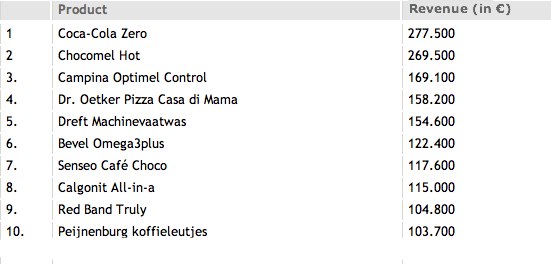
(Source picture: Elsevier.nl (Dutch))
I only point this out, since Coke Zero is one of the first food-related topics I wrote about on Tech IT Easy; a, fairly clear, signal that it was time to "spin-off" to this blog.
 I am not a born bootstrapper, let me make that clear from the start. I just like titles that include words starting with the same letter (is there a term for that?).
Bootstrapping is, in my own definition, "the ability to generate growth on minimal financial resources." I was first going to call it "the ability to survive on minimal resources," however that would make most of the third world bootstrapping-geniuses.
No, it's when entrepreneurs have an idea that they want to grow into a commercial business, and since finding funding is difficult and less preferable for some, they do so with minimal financial means, perhaps while maintaining another source of income and by generating organic growth—revenues derived from within the company. In sociology, there is a concept called bricolage, which means more or less the same.
What makes a born bootstrapper, or rather a good one? I think it requires three qualities:
- The first is certainly the ability to live cheaply, and I'll refer you to one of Jeremy's post where he makes the point quite eloquently. The ability to live without luxury, eating at discounters, buying second-hand furniture (or dragging it off the street), living in cheaper areas, and, most importantly, to delay paying the bills, are certainly key-components here. As is, making resource-choices for your business. Easy to do when you work in software, less so in physical businesses, though inventory is fun to play around with.
- The second quality is time-management. You need to generate growth within your company and pay the rent, so you have to make choices. You have to find alternative revenue-streams, perhaps get another job, and work on your business during your free time. It requires you to set some clear priorities, skip the weekly cinema-visit or the time spent with your loved ones.
- The third and final quality, is to be goal-orientated. You could place that under time-management, perhaps, but where bootstrapping is most likely to fail is when motivation drops. You need to keep your eye on the ball at all times; the priority for a bootstrapper is to grow the business, not keep a stable job, and you need to see the light at the end of a tunnel and keep going until you reach it.
The picture is courtesy of rockies-ice.com
I just discovered a new podcast called "Big Ideas" (iTunes-link), a series of lectures on anything from the impact of urbanisation on musical tastes, to designing menus for restaurants. Oh, and it's Canadian. Not that that's bad, but some parts of the lecture covered local conditions.
John Schneeberger starts his lecture (dated March 1, 2008) off with the basics of menu-design, namely that they should reflect three things:
- What you stand for? Aka. what kind of food do you like to work with?
- What demographics are you targeting? Income, religious issues, etc.
- What are the current trends? And are they for real or just a fad?
- Customer-decisions are always a trade-off between price and quality
- Traditionally, dishes consist of three components: protein, starch, and vegetables.
- What we understand as taste, actually comes from three sources: fat, salt, and sugar.
Schneeberger discussed three booming trends, vegetarianism, organic food, and local produce, and mentioned a number of challenges related to these.
 Vegetarian cooking
The thing to understand about this, is that it's generally cheaper. Schneeberger mentioned a 1:10 ratio when you compare the cost of producing vegetables to the cost of growing a cow. And while it's a booming trend, the industry, somewhat mis-guidedly, still often focusses on trying to replicate the taste of meat, which is impossible (think veggie-burgers, etc.).
Instead, they should be thinking about nutritional value— vegetarian food has been correlated with lower health-problems and is for that reason often recommended by doctors. The problem with these types of diets is of course that they are low in those qualities we would traditionally associate with taste: fat, salt, and sugar.
To create dishes that people actually enjoy, restaurants have to look globally, e.g. Asia, where more exotic vegetable components can bring some needed flavour to these dishes. I think he mentioned seaweed, but also stinky tofu (see pic), which is a type of fermented tofu and one of the few ways to naturally bring flavour to that type of protein.
The implication is that vegetarian food requires a significant amount of specialisation and is often hard to combine with meat-cooking.
Another complication arises from vegan (no dairy, honey, animal-derived products) versus lacto-ovo (incl. dairy, honey, animal-derived) cooking. The first makes it very hard to create a (traditionally) tasty dish. The second, lacto-ovo, allows for more flexibility, through the use of ingredients like eggs, which not only provide extra protein, but also bring a lot of flexibility to the kitchen. You can, for instance, make foam out if it, which would enable the creation of deserts & soups, etc.
Organic cooking
First of all (and I'm not sure if this is just restricted to Canada), an organic food label refers to the production method, not necessarily the quality and taste. Since organic food is more expensive, and taste is not guaranteed, you have to wonder if your clientele is willing to pay extra for that service (remember the trade-off between price & quality!).
The big selling-point here is the information about the product. People like to know how their food was produced; it has a certain value to know that there are no chemicals or genetically modified components in what you are eating. But again, that must be a value that is clearly advertised and which may not be important to every type of demographic.
Local produce
The advantage for the restaurant is that they can form better relationships with their suppliers, it's also cleaner in terms of carbon footprint (less transport), and it also has some marketing value to a certain demographic.
The disadvantage is that supply cannot be guaranteed during all seasons. Schneeberger mentioned something called a "100 mile diet" for instance, but restaurants catering to that need will probably have problems in the winter.
Thoughts
Overall, a pretty insightful lecture of the more exotic (and trendy) type of cooking and its trade-offs.
These types of specialisation are still pretty niche, require significant resources in terms of tools, know-how, and supplier-relations. But, if executed well, a niche can be extremely profitable.
I thought that it was interesting that all the traditional means of cooking, the ingredients and the taste-makers, were pretty incompatible with these newer trends. As such, you are essentially climbing up a hill, trying to educate the mass-market. At the same time, good execution, together with differentiation from the norm, seems like a formula for success.
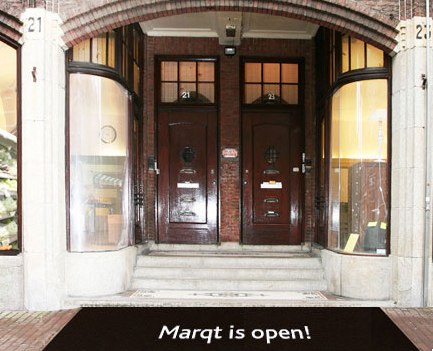 Marqt is a market for farmers, recently launched in Amsterdam by Quirijn Bolle en Meike Beeren (both ex-Ahold). Can't really sum it up much more than that.
It focusses on two opportunities: from the supply-side, many farmers want to sell their products, but are unable to because of the power-play from regular retailers and/or at relatively low profit-margins. Last year, when I briefly looked at the organic boom, I already thought that there is an opportunity here, for farmers to become retailers themselves.
This is made possible by the other part of this equation, an elevated demand by customers for natural and ethical produce, and, to a lesser degree, local produce.
Bolle and Beeren rightly identified an absence of identity in food-retailers, an absence of accountability for the product-decisions they make. But they also identified a need by consumers for quality-guarantees.
Because you have to wonder, how is Marqt different from the regular outdoor-market that exists in every city? Well, here's one difference, and I'll try to give an example. 'Tis the season of mangoes, and I'm hooked. I've been buying these babies at €1 a piece at my supermarket, but stumbled across some great deals at the local market: €2.50 for a box of 8! The only problem: about 6 of these were either unripe or overripe. And who do I complain to? One of the 100s of vendors on the market, whose name or brand I don't even remember?
From my understanding (I don't live in Amsterdam), Marqt-products are more expensive than those of local markets, about on par with regular supermarket-foods. They work with partners that are able to supply in greater numbers, offer a quality-guarantee, and, very interesting, train Marqt's staff to understand and explain how products work.
Their added value is that they can offer suppliers higher margins, and consumers a richer shopping-experience. And from what I hear, though I have no numbers, the store is doing reasonably well.
Two other interesting facets: Marqt houses individual suppliers' stores. So you have Store X for dairy, store Y for meat, and store Z for bread. Marqt provides the space, the staff, the marketing, and collects a percentage of the profits.
Also interesting: the store doesn't accept cash. It's progressive, I agree, but also great marketing-value, sure to raise an eyebrow or 1000. And it saves money on the back-end, though I hope they get rid of the €0.50 transaction-fee.
I think it's a great idea, and hope the store continues to do well. Gives me hope, both in terms of opportunities for retail-entrepreneurship, and entrepreneurship in the Netherlands in general, which (in my opinion) could use a boost.
Witness the following. A bar that comes in various flavours: chocolate chip, dark "luxury" chocolate etc. Yumm! It's cheap, costs around $1.50 per bar in the local drugstore, currently. And it contains 32 grams of protein. The perfect post-workout snack, it seems.
The only problem? The body doesn't digest it well at all. There are times when it sits in my stomach like lead, and other times, when my body can't wait to get rid of it. Empirically tested, two out of two times, that is what happened to me. Just last night, I woke up at 3 a.m. with a stomach-ache because of that damn bar.
Are snacks doomed to be unhealthy?
Back when I was a vegetarian for a brief two years, the one thing I missed was to have a snack that did not contain either an overdose of sugar, of fat, or of bread. With the exception of perhaps a nut-bar, a fresh juice, or chewing gum, those are pretty much your choices, walking down a street:
- A chocolate-bar: high in fat & sugar
- A burger, sandwich, or a pizza-slice: high in fat, starch, and limited protein
- Fries or chips: high in starch and fat
- A carbonated drink: high in sugar (excl. the light versions) and extremely bad for your teeth
A new era?
Interestingly enough, due to external pressures, I hear that certain supermarkets are changing the layout of their stores, removing snacks and junk-items from the register, and replacing them with healthy options like fruit. Equally interesting, (forgot where I read this) they are expecting a multi-million euro loss because of that policy.
Certain tricks do seem to work in raising those profit-margins. While a kilo of regular apples currently costs around the €1.50/kilo mark, pre-peeling and -cutting those apples, raises that price to ca. €8/kilo. Ka-ching!
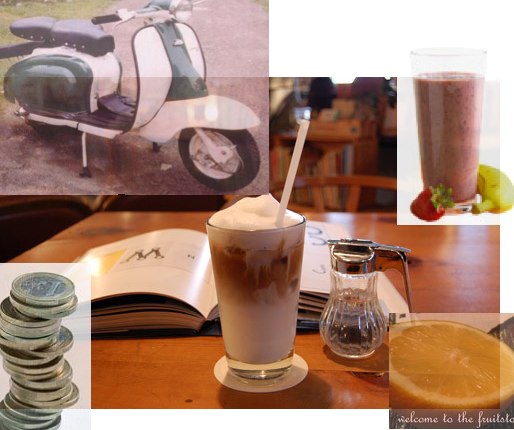 When I first wrote this post this afternoon, it was really long. After cutting it a little it's still really long. Sorry about that.
A lot of people I know from uni are into this thing called New Business Development (NBD). It makes sense, since it's the title of a course we studied together and it was absolutely the best course I've had in my life. Around 60 hours of hell per week for 2-3 months, but one hell of a ride too.
NBD is a necessary mechanism for when your core-business is stagnating. Let's say you have a good high-volume business, but competition is hammering you with low prices. If you can find a new business opportunity that allows you to make money differently, preferably at high margins, it's a good business opportunity. If it's synergetic with your core-focus, then it's an excellent business opportunity. Three small examples I stumbled across these last few days come to mind.
1. Bookstore + café. Verdict: logical
Buying books is a luxury. They serve no real purpose (unless you want them to) and are generally aimed at price-insensitive people. It is also a fairly slow sale. You are selling information, people are swamped with information, and it takes them time to make a decision. Sometimes… not always. I think time + the amount spent on an item also correlates positively, up to a limit.
That combines well with a café. The luxury-aspect allows you to charge more in cafés as well, meaning higher profit margins. Cafés lead people to relax and spend more time in bookstores, meaning they will likely purchase more books too. Combining the high traffic of price-insensitive consumers together with high profit margins and you have a good business. Also, it's a great way to compete against online-retailers, who are not able to add the atmospheric value.
2. Fruit-vendor + fruit-shake stand. Verdict: logical
Fruit is generally a low-margin product. The fruit-vendor in question sells 5 KG of Spanish oranges for €2. You can charge more for fruit-shakes; To the consumer, they taste good, represent health, and require very little in work (all emotional values = higher price-insensitivity). The fruit-retailer sells an orange fruit-shake of 0.5 litres for €2.50. Assuming that's about 1 KG of Spanish oranges, that's quite a lot more profit than €0.40 would give you. But of course there are other considerations.
The fruit-vendor is located right in the centre of Rotterdam on the busiest street. Likely the cost of renting a place is expensive, so is the added cost of producing the shake. The fruit-vendor also competes with a fruit and vegetable market, located a few hundred metres away, and a supermarket, 50 metres away. And his new business competes with other fruit-shake stands. What makes this combination work?
The higher profit margins for convenience-fruit-products, combined with high volume of people passing by is good. It also persuades investors to loan the money for the fruit-shake machinery, which they would probably not do for a low-margin business in a less favourable location. There's a lot of efficiency also; fruit is sourced from the same suppliers, so are packaging-materials, and the retail-space acts as a warehouse. Because fruit is cheap and the retailer has a large selection, he can charge lower prices than the competition and offer more variety. And he enjoys high profit margins even if the volume of fruit-purchases is lower because of the price-competition from the (super-)markets.
3. A eurostore + scooters. Verdict: illogical
This case is a little more complex and contextual. A year ago a eurostore, which is like a dollarstore—a shop offering a great variety of goods at low prices—started offering scooters alongside their regular products. They quickly abandoned the experiment and I have a theory why.
Likely this deal came out of partnership with scooter-retailer/-importer. The eurostore was in a good location with lots of traffic (good for the scooters) and the scooters would give it much higher margins than their regular products. Seems like a win-win.
Consumption of "euro-"goods is different from that of scooters, however. With the first, people expect stuff to break and don't come asking for a warranty. They just buy another. Buying a scooter or anything over a certain amount is very different. People expect extensive information, they may want a test-drive, they certainly want a warranty, and after-sale support.
Since the eurostore is what it is, a store with low margins, this kind of service is out of its realm. It ends up referring customers to the actual scooter-retailer, and very likely the purchase happens there also. Unless you have a contract that specifies this eventuality, gone is the alluring profit-margin. And that, as they say, is that.
Final thoughts
High traffic of goods is a good basis for new business development. It means you have a customer-base to which you can try and sell other products and services, hopefully at a good margin. Location and demographics are important also. Both the book- and the fruit-retailer were well-located and had access to a good demographic, allowing them to sell at high margins and high volume. The eurostore was only well-located. Synergies are vital. For the bookstore it was consumption-pattern and price-insensitivity; for the fruit-vendor it was offering essentially the same product in different packaging; for the eurostore there was little, or rather, none.
Isn't new business development fun? And was my analysis correct?
Building lifestyle-brands and the role that the internet can play
0 comments Posted by Unknown at 7:21 PM I'm a little distracted from blogging, I'm sorry. My current activities include a last-minute scrabble-play of my thesis, to make it a more logical read, and applying for jobs. And, not unsurprisingly, I'm having some writer's block as a result.
My post from a few weeks ago, about my anonymous friend, who's running a lifestyle-orientated business in a developing market, certainly opened my eyes to this area of the market.
Today, I'll talk about another company, Milner (cheese). There was an interesting article in Dutch marketing-magazine, Tijdschrift voor Marketing, on Milner's positioning-strategy from mass to lifestyle, which I'll discuss now, and which also lead to a post on Tech IT Easy about social networks as a strategic marketing-tool.
Milner = FMCG
Milner is considered a FMCG-company, that's fast-moving consumer goods, and falls into segment 2 on my food-industry map from last week. As I observed there also, this segment is usually the driver, if not always the conductor, of consumer-marketing.
The company is currently strongly present within the health-segment for cheese in the Netherlands, with over 50% market-share. This segment is also seeing between 60-70% growth from cheeses in general.
One thing that is clear for FMCGs is that margins are generally low (generally under 10%), competition is high, and as I made clear in my post on Tech IT Easy, features can easily be emulated by other companies.
Generating complex competitive advantages
The differentiating factor is the relationship the brand has with the consumer and vice versa. A brand that is designed for a lifestyle will generally have a much higher emotional value to consumers, than one based on features like cost or taste alone.
The logical conclusion is that those companies with deeper relationships to their customers will enjoy a higher competitive advantages over companies that do not focus on these relationships. And the complex nature of relationship is one that is difficult to emulate, hence giving companies a sustainable lead in the market.
But how to do that?
Paradigm-shift towards lifestyle
A lifestyle-product can be defined as a product that is built around the context of a certain group of consumers, resulting in an emotional value, as well as one based on features. This also has implications on the product-marketing strategies that a lifestyle-orientated company undertakes. As you may remember, the company my friend operates, still spends a considerable amount on marketing-activities after 2 years.
The theory that Milner cheese employs goes as follows. A great pain for food is health—which is really just an after-effect of the lifestyle people are leading. People are constantly looking for answers, so-called lifehacks, or more diet and exercise-related advice, all to regain power over their lives, minds, and bodies.
The key-issue is how to reach these customers. By addressing the pain that customers are feeling, by helping them live a healthier life, Milner is engaging in a relationship with its customers.
How does it do that?
How the internet fits into this
Traditionally, internet-marketing expenditure for FMCGs is quite low, around the 2% mark. Milner's budget currently assigns 10-15% to internet-marketing. It is able to do so, because it is already relatively well-positioned in terms of its brand and communication, so it feels more confident to experiment with new mediums.
As mentioned in my post on the food-industry-map, marketing to consumers is the responsibility of the consumer-goods-segment, however the degree that this activity is outsourced, depends on the amount of resources available to the company and the level of complexity of the activity. Arguably, both the novelty of internet-marketing to Milner, and particularly engaging into a relationship with consumers, make marketing fairly complex affair and the company did this via a third party, Advance, an interactive marking agency.
Advance set up a site called Je Beste Dag (translated: your best day), which advises visitors on how to have better days, based on a questionnaire they fill out. The first stage of the strategy is to build up a large mass of consumers that give out their email-adresses for further advice. Currently, there's 1 million people connected to the site. The second stage is to deepen that relationship, by encouraging return-visits and ultimately start a conversation.
It's both a time- and cost-consuming process for Milner. Essentially it is the sole sponsor of the campaign and has been running this campaign for nearly half a year no, without seeing any types of new product-developments yet. It is however working together with (other) marketing-agencies to develop its brands, which includes the design, positioning, quality, etc., as well as new product developments.
The interesting part of the whole process is that the majority of visitors already knows Milner, before even visiting the site. In other words, this clearly is an interactive marketing-campaign, which deepens the relationship between company and customer beyond the brand. Also, while the segment that Milner markets to via traditional channels, usually falls in the age-groups of 40-60, the age-group it is reaching now falls between 25-45, 60% of which don't yet have children.
Final thoughts
It is uncertain what exactly will come out of this. Milner is treating their internet-campaign as just another marketing-channel and holding Advance to targets it must meet. Which also allows them to measure its effectiveness. However, with a million young people connected to the site, and the communication-channels open, my gut tells me that they will be pretty happy.
The conversational aspects that the internet provides are certainly no surprise to the regular internet-user, however many web-companies are finding it difficult to generate sustainable business-models (e.g. Twitter / Facebook). As I made clear in my post on Tech IT Easy, I think these kinds of marketing-campaigns open up some possibilities there.
 I'm spending a lot of time with a friend this week, who runs a start-up in a developing (2nd world) country in the lifestyle-food sector. I won't mention his name, his company or focus, or his country, nor anything confidential, because I don't want the information to be used against him. Instead, I'll talk about some general principles, that I've identified.
The irrelevance of business-literature
We both studied at Rotterdam school of management (sometimes known as Erasmus), and spent some time there last night. Funnily, I came across an article in a university-published journal identifying 6 traits of leadership to ask for in the "new" workforce. Keywords included: ethics, diversity, global outlook, tech savvy, adaptive capacity, and the X-factor (charisma?). I asked him, as a joke, which he thought applied to him. Global and adaptive, he responded. The rest meant virtually nothing to him. As a start-up, I guess, you have to do what you have to do, to stay alive.
The advantages of 2nd world start-ups
I distinguish between 1st world (e.g. the Netherlands), 2nd world (e.g. Brazil), and 3rd world (e.g. a large part of Africa), when I look at countries. 1st world countries are mature in their development, 2n world countries are not yet mature, but their economies are growing pretty fast, and 3rd world… well, I'm pretty depressed about that, though sometimes there's surprising pockets of entrepreneurship and innovation.
The advantage of a fast growing economy is that people are still figuring stuff out, meaning there are a lot of inefficiencies and gaps in the market. Another advantage, in his country's case, is the interests of governments in boosting those economies. If your innovative, the grants you receive may be both easier to get and larger in size than anything available in 1st world countries.
For start-ups, another advantage is that you can look at what works in a 1st world country and use that for your own business. This principle is not exclusive to start-ups, it's also relevant to the innovation race between Europe and the US, for instance.
The costs of educating a market
My friend operates a lifestyle-food start-up, as I said. One gap in 2nd world markets is usually that that segment is underdeveloped. But, if the economy is booming, wealth is increasing, and that certainly has a positive effect on the luxury-market.
However, when you introduce a new product to a market, you'll have to build the market up first. There are various approaches to marketing, I'll just go into the one that my friend used.
Essentially, you want to get your products into a supermarket, and you want people to buy the food. Sometimes one, sometimes both will take some convincing. In the beginning. he spent a lot of time in supermarkets, getting people to taste his food. After that went well, he could use that success to convince other supermarkets to become customers also.
Two advantages of supermarkets: they usually have pre-written contracts for suppliers so you don't have to draft them yourself. And they sometimes operate in chains, which makes it easier to get larger customers.
There's two further things to do with food, to make customer-adoption a little easier. One is to sell it in an easily digestible fashion, e.g. a snack. Two is to not do so, and instead provide customers with instructions to prepare the food. You could do this on the packaging, a website, and even more drastically (can't mention what). My friend is pretty active in this area.
Another problem with 2nd world countries is that, while your food may be part of a lifestyle in the 1st world, it's close to impossible to lead that lifestyle over there, because all the components are not there yet. So, in fact, you don't use that lifestyle as a marketing-term. Instead, focus on health-advantages, as that is often the underlying driver for such demand.
Still, even after more than a year, my friend spends about half of his monthly expenditure on marketing—which goes through a marketing-agency that designs the brand, the colours, etc.
Global outlook?
As a start-up, you have to work within certain boundaries: limited money, staff, production-facilities, time, etc.
The clients for a food-company may very well be supermarkets, which, as I mentioned, have the ability to buy a lot. My friend is expanding into other countries, but he's carefully picking the ones that don't exceed his capabilities.
He prefers a fragmented market, where he can concentrate on a one or two chains at a time, not a market where there's national chains that could bleed him dry.
Related to this, fragmented markets are usually underdeveloped also, so in fact he is exporting to countries similar to his own. That, at least, is as theoretically expected.
Theory, schmeory.
While there are certainly concepts that can be found in a number of different fields, ranging from entrepreneurship & strategy, innovation, supply-chain management, and marketing, it remains a matter of being practical, and specific to the business.
Entrepreneurship is a 60-80 hour / week job, usually. You don't have time to check out business-journals, etc. to do your job.
P.S. his business-plan was 2 pages long.
And those… are the facts of life. More, if I can think of it. The picture is completely unrelated to his product.

 The
The 


