 When I first wrote this post this afternoon, it was really long. After cutting it a little it's still really long. Sorry about that.
A lot of people I know from uni are into this thing called New Business Development (NBD). It makes sense, since it's the title of a course we studied together and it was absolutely the best course I've had in my life. Around 60 hours of hell per week for 2-3 months, but one hell of a ride too.
NBD is a necessary mechanism for when your core-business is stagnating. Let's say you have a good high-volume business, but competition is hammering you with low prices. If you can find a new business opportunity that allows you to make money differently, preferably at high margins, it's a good business opportunity. If it's synergetic with your core-focus, then it's an excellent business opportunity. Three small examples I stumbled across these last few days come to mind.
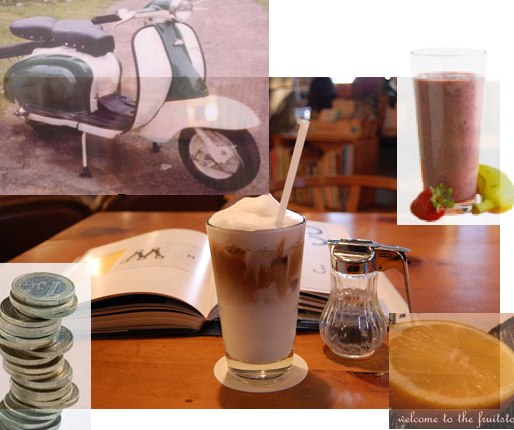
1. Bookstore + café. Verdict: logical
Buying books is a luxury. They serve no real purpose (unless you want them to) and are generally aimed at price-insensitive people. It is also a fairly slow sale. You are selling information, people are swamped with information, and it takes them time to make a decision. Sometimes… not always. I think time + the amount spent on an item also correlates positively, up to a limit.
That combines well with a café. The luxury-aspect allows you to charge more in cafés as well, meaning higher profit margins. Cafés lead people to relax and spend more time in bookstores, meaning they will likely purchase more books too. Combining the high traffic of price-insensitive consumers together with high profit margins and you have a good business. Also, it's a great way to compete against online-retailers, who are not able to add the atmospheric value.
2. Fruit-vendor + fruit-shake stand. Verdict: logical
Fruit is generally a low-margin product. The fruit-vendor in question sells 5 KG of Spanish oranges for €2. You can charge more for fruit-shakes; To the consumer, they taste good, represent health, and require very little in work (all emotional values = higher price-insensitivity). The fruit-retailer sells an orange fruit-shake of 0.5 litres for €2.50. Assuming that's about 1 KG of Spanish oranges, that's quite a lot more profit than €0.40 would give you. But of course there are other considerations.
The fruit-vendor is located right in the centre of Rotterdam on the busiest street. Likely the cost of renting a place is expensive, so is the added cost of producing the shake. The fruit-vendor also competes with a fruit and vegetable market, located a few hundred metres away, and a supermarket, 50 metres away. And his new business competes with other fruit-shake stands. What makes this combination work?
The higher profit margins for convenience-fruit-products, combined with high volume of people passing by is good. It also persuades investors to loan the money for the fruit-shake machinery, which they would probably not do for a low-margin business in a less favourable location. There's a lot of efficiency also; fruit is sourced from the same suppliers, so are packaging-materials, and the retail-space acts as a warehouse. Because fruit is cheap and the retailer has a large selection, he can charge lower prices than the competition and offer more variety. And he enjoys high profit margins even if the volume of fruit-purchases is lower because of the price-competition from the (super-)markets.
3. A eurostore + scooters. Verdict: illogical
This case is a little more complex and contextual. A year ago a eurostore, which is like a dollarstore—a shop offering a great variety of goods at low prices—started offering scooters alongside their regular products. They quickly abandoned the experiment and I have a theory why.
Likely this deal came out of partnership with scooter-retailer/-importer. The eurostore was in a good location with lots of traffic (good for the scooters) and the scooters would give it much higher margins than their regular products. Seems like a win-win.
Consumption of "euro-"goods is different from that of scooters, however. With the first, people expect stuff to break and don't come asking for a warranty. They just buy another. Buying a scooter or anything over a certain amount is very different. People expect extensive information, they may want a test-drive, they certainly want a warranty, and after-sale support.
Since the eurostore is what it is, a store with low margins, this kind of service is out of its realm. It ends up referring customers to the actual scooter-retailer, and very likely the purchase happens there also. Unless you have a contract that specifies this eventuality, gone is the alluring profit-margin. And that, as they say, is that.
Final thoughts
High traffic of goods is a good basis for new business development. It means you have a customer-base to which you can try and sell other products and services, hopefully at a good margin. Location and demographics are important also. Both the book- and the fruit-retailer were well-located and had access to a good demographic, allowing them to sell at high margins and high volume. The eurostore was only well-located. Synergies are vital. For the bookstore it was consumption-pattern and price-insensitivity; for the fruit-vendor it was offering essentially the same product in different packaging; for the eurostore there was little, or rather, none.
Isn't new business development fun? And was my analysis correct?
The role of the internet for the retail of *physical* goods.
0 comments Posted by Unknown at 9:01 PMOne of the stories, I covered last week in my links, uncovered an interesting statistic. Only about 3% of retail sales in the US happens online. I don't think these stats are at all coincidental. While I see a bright future ahead for the online retail of media-products, I find that what the internet cannot provide, is the "closeness," that is sometimes needed for evaluating certain types of goods, like food and clothing. I have commented on this before, implicitly, with a post on the web as a third place, and about the lack of cohesion that Facebook provides.
At the same time, as The New Yorker story reports, what the internet has changed is how we shop; it is much easier to research and comparison-shop than it was before the internet-days. A survey by Accenture found that ca. 66% of those surveyed compared products online, and another study showed that the internet played a significant role with ca. 75% of electronics purchases.
IInnovate has an interesting podcast interview with Scott Dunlap, CEO of NearbyNow, which has come up with an interesting way to exploit the informational advantages of the internet and mash that with the qualities of physical shopping. Following short video shows how their service works:
Clearly technology has evolved a lot in the last few years, making this possible. NearbyNow works via the web and via mobile. I'm not sure if they are using any location-tracking & matching services, but certainly they are heading in that direction. On the retailers' side, there is plenty of technology that makes this possible also. Electronic inventory and point of sale systems allow both for the checking of stock-levels and for consumers to reserve items to be picked up and tried on at a later date.
One issue that entered my mind, is that of efficiency. The way NearbyNow operates is through malls in the US, most of which are, as I found out, owned by 6 major companies across the nation. US's scale-economies win again! In Europe, the situation appears a little different. Culturally, linguistically, technologically, and legally, it is a much more fragmented market, with far fewer malls also, and that may make it difficult for a unified service like this to operate as efficiently as it would in the US.
There is also the issue of too much transparency, which is worrying to some retailers, and addressed in the podcast-interview. But what does seem certain is that this is exactly the type of service that consumers value, and as such one that any consumer-centric business should encourage.
Will a service like this ever replace shopping in its entirety? No, I'm essentially betting my future that there are plenty of qualities *real* environments will continue to offer over virtual ones. But there is no reason, none at all, to try to integrate the good qualities that the web does possess—information at your fingertips—as elegantly and effectively as possible into those experiences.
What's the biggest pain in your industry II - Carbon emissions
0 comments Posted by Unknown at 11:17 AMContinuing from part I - obesity, this post will be equally light as I have "♫ my mind on my money and my money on my mind… ♫" Or something to that effect.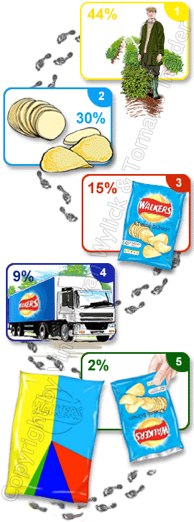 According to a carbon-emission calculation of PepsiCo's Walkers crisps, the majority of carbon emissions come from the production of raw materials (44%) and processing thereof (30%). A Dutch magazine, Tijdschrift voor Marketing, attributes the majority of the carbon footprint to transportation of said materials, and forms the conclusion that more and more production and consumption has to happen on a localised scale.
Even though the makeup of those figures may be open to interpretation—there is no breakdown about what in the first 44% is due to actual farming and what to transportation—perhaps, Mr. Kuiper, the author of that piece, has a point.
In a TED-lecture, James Howard Kunstler argues that the 'hydrogen-economy' is a pipe-dream and we must start thinking about creating urban environments fully equipped with the means of production, transportation, living, and waste-disposal, all in one. Very inspiring, though clearly requiring significant paradigm- and resource-shifts from today's globalised economy.
Clearly transportation comes at a cost, the question is how much the alternative would cost. Building super-farms, creating artificial climates to grow exotic food, waste-disposal, dealing with virus-outbreaks—regarding the latter, farmers already have problems dealing with chickens, sheep, and cows now, let alone having to deal with something like Kunstler's utopian vision—all of which represent costs that have to be accounted for.
But, I don't want to sound like a pessimist. I actually love the idea of a super-farm and a super-urban environment, regardless of the monetary cost. I'm sure plenty a sci-fi artist has tried to draw such a very thing (as have I). It's complicated, expensive, but exciting at the same time.
Asking you a tough question: How would you do it? What would a Kunstler-inspired localised economy look like to you? Is it even possible? … well, something to think about anyway…
Essentially private labels, also sometimes called house brands, are products branded either with the name of the retailer, or, at times, sharing some kind of umbrella-name, decided by the distributor or otherwise. But what private labels really represent, to me, is the ultimate example of a power-struggle between a retailer and suppliers. Sometimes, but not always, it also means that some kind of vertical integration has been taking place between retailers and manufacturers, or, at the very least, packaging plants.
For now, I'll just be looking at some stats on private labels. At a later date, I'll take a look at more supplier-retailers dynamics, branding strategies, etc.
Geographic share
According to an ACNielsen report (pdf), the global* market-share for private brands was 17% in 2005 (* global meaning 38 countries and 80 categories), and had grown 6% that year.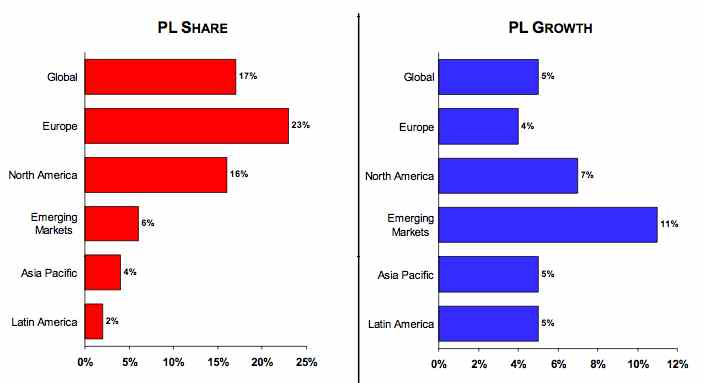
Figure 1: Share & growth rates of private label by region (based on value sales) (source: ACNielsen, 2005)
Europe has the largest market-share with 23%, and Latin America the smallest, with 2%. Top countries included Switzerland, with 45%, Germany, with 30%, and the UK, with 28%. The largest Private Label growth happened, unsurprisingly, in emerging markets (11%) like Croatia (77%), Greece (24%), and Thailand (18%).
One big growth-contributor in Europe is the strong growth of hard discounters, such as Aldi or Lidl (both German chains), who are present in every European country and expanding rapidly. With Aldi, for instance, private labels make up 95% of sales.
Private label foods
Category-wise, refrigerated foods have the largest overall share of private labels, namely 32%. Complete ready meals take the lead here, with an average of 47% private label-share. In the UK, 97% of ready-meal sales are in fact private label.
Another significant private label food, or rather drink, was milk, of which private labels make up 43% of sales.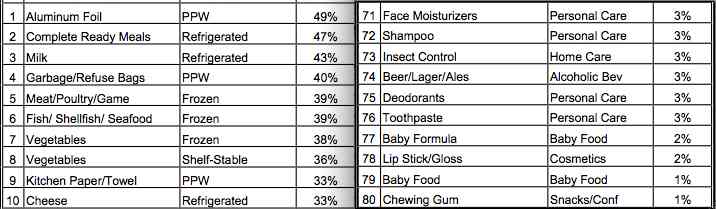
Figure 2: Value shares of private label by category (source: ACNielsen, 2005)
Other high private label food-products include frozen meat (39%), fish (39%), and vegetables (38%), and 37% for shelved vegetables. Frozen pizza is at number 27, with 17%, tea and coffee at numbers 37 and 38, with 14% and 13% respectively. Wine is at number 44, with 12%. And Beer is all the way at the bottom, at number 74 with 3% !
Among the fastest growing foods are drinking yoghurt (28% growth), baby food (20%), chocolate (13%), and water (13%).
Pricing trends
One of the strengths of private labels is of course that they are cheaper, on average 31% less than manufacturer brands. Emerging markets showed the biggest discount, with PL-goods costing 41% less on average. Europe wasn't lagging in this respect either, with an average price difference of -37%. On a country level, Greece, Australia, and Germany were taking the lead with, respectively, -48%, -47%, and -46% discounts (compared to manufacturer brands).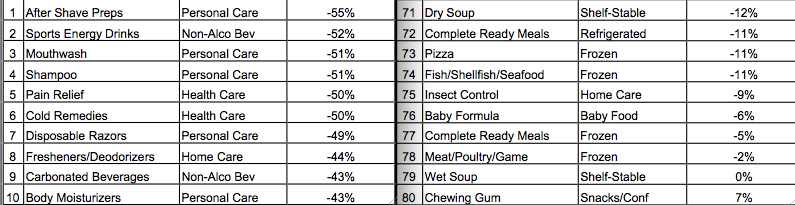
Figure 3: Price differential of private label by category (source: ACNielsen, 2005)
Again, concentrating on food-categories, the products that received the biggest discounts were Sports Energy Drinks (-55%), carbonated beverages (-43%), cereals (-40%), wine (-38%), and tea (-37%). Food-categories taking the least in discounts, included chewing gum (+7%), wet soup (no difference), meat (-2%), and ready meals (-5% <- I guess that explains their high market-share).
Final thoughts
That market share is increasing more quickly in emerging countries is not surprising. Retailers there will likely not be mature and/or consolidated enough to focus on such a strategy, but this is clearly changing.
Germany's dominance is also interesting, as both Aldi and Lidl originate from there. One of my next posts will be on Ikea's European growth and Germany's also very strong there, which suggests a certain preference for low prices with German customers.
Switzerland is still somewhat of an enigma, but I'll try to find out more about it.
In terms of products, both the dominance of private labels amongst ready-made meals, and that their prices are quite similar to regular brands, is very interesting. It could suggest that customers either don't care much for quality and brand-differentiation in that sector, or that private label brands are actually quite good. The price-level would suggest the latter conclusion.
Generally speaking, refrigerated goods are different in the eyes of consumers, I think, less scrutinised perhaps, and worthy of more investigation. Milk is of course similar to water, and hence not really a product where brand makes a huge difference.
What else? Certain beverages, like coffee, wine, and beer are quite interesting, as their private label share is quite low. This would suggest a high brand-sensitivity in these sectors. The low percentage for beer (3%) is certainly striking.
More on private labels as I come to it.
 Still following the great book on Retail Marketing, by Dr. P. McGoldrick, this time I'll cover the different types of cost that are included in buying, developing, and running retail locations. For previous coverage, check out post I and II
Before buying property, considerable data analysis must happen in regards into estimating turnover, which comes from data on competition, accessibility, and population. And a calculation of costs must happen, least of which is the purchase price, and more complex will be three types of cost: development costs; running costs; and contextual* costs (*: for lack of a better word).
Much of this cost data will likely come from negotiations with site developers, lease owners, and an estimation of the costs involved in the development of the location.
Naturally, with the proliferation of the internet, there are plenty of databases that offer interested parties an overview of typical sums per region or type of location. Though the following are mostly aimed at private individuals, both My-Currency and Zillow offer these types of services, and Jeremy Fain wrote about a French service, called BMyKey.com on Tech IT Easy.
Purchase price
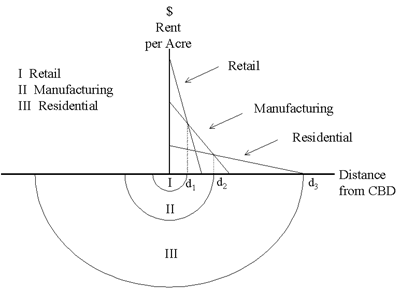
Traditionally, rent bid theory explains a lot of price-differencials within an inner-city environment. Variety and women's clothing stores would typically pay the highest rents and grocery stores the lowest. With the emergence of superstores and their focus on out-of-town locations, this formula can not be applied so generously anymore, though, as mentioned, I think that it should logically still apply to inner-city environments, and probably to inner-malls ones also.
And while buying the property may cost a certain sum, it is not atypical that the three of the following types of cost will far outweigh the initial purchase price.
Development costs
Three types of estimates need to be made here: design estimates, which include the costs of the architectural work; bid estimates, which involves negotiating the costs of labor, material and equipment; and control estimates, which are the costs of monitoring the project-development. For more info on these, check out this document.
In addition to this there are a number of costs that can be substantial, but are sometimes not taken into account. One is site preparation, which be steep, especially if the land needs to be converted or extensive demolishing needs to take place.
In addition to this local authorities can impose a number of restrictions on the height of the building, other architectural and landscaping aspects, and demand significant concessions from retailers to build there. All of which can at the very least slow down development considerably.
Running costs
The choice of location, site, and design can greatly affect the cost of running the operation once it's constructed. For instance, multiple floors and parking will mean that lifts will need to be maintained regularly. A location with a high crime-rate will require higher security-costs and lead to more theft. And high employment and income areas will also lead to issues regarding staff recruitment and retention.
Contextual costs
I made up this term, but it actually includes costs like delivery, promotion, and the impact on other branches of the business. Delivery costs are affected by the location choice of the outlet—how accessible it is via road or otherwise; how remote it is from the main distribution network. Promotion costs are also a factor (but a topic for another day). And the impact on other branches are a very important factor to consider. The higher the existing market-share in an area, the greater the potential loss, though, according to the book, this is often accepted as a necessary trade-off to a high growth strategy.
Final thoughts
Clearly real estate is something that needs to be thought about as part of a long-term strategy and with the help of professionals. And some of this is probably not applicable to start-ups in the retail-space. That said, choosing a location by itself is already a science—whether you rent, lease, buy, or build it. And both the direct costs—purchase or rent—and indirect costs—development, running, and contextual—will play an important part in the decision-making and business-planning.
Until now, I have mainly covered the issue of competition and cost in relation to a real-estate strategy. I'll probably not go into population and accessibility just yet, and will instead focus more on more complicated tools used in real estate strategy, beyond the simple checklist, which I covered in my first post on this. These include mathematical, mapping, and some other models, as well as, hopefully, some more data on the role of IT in this process.
For a more in-depth reading, I of course recommend buying the book on Retail Marketing, which largely inspired this article.
"The nature of water is that it avoids heights and hastens to the low-lands. When a dam is broken, the water cascades with irresistabke force. The shape of an army resembles water. To take advantage of an army's unpreparedness, attack him when he does not expect it, avoid his strength and strike his emptiness. And like water, man can oppose you."Tsung Yu in The art of war
 In my last article on the subject of real estate, I mentioned four areas which retailers must focus on: population, accessibility, competition, and cost. This was taken from the book Retail Marketing, whose author, Dr. Peter McGoldrick, taught me the subject some years ago.
Of these four, the one I like the most is competition, as, like in the quote, it can be somewhat fluid, it's about people, and it can drive innovation. There's actually two ways to think about competition: as either a destructive, or as a synergetic force. I'll go into both modes of thinking, and hopefully looking at it through the lens of real estate helps.
The nature of real estate competition is quite complex. For one, it is hard to take into account indirect competition such as substitutes, and difficult to guess the response that your presence will have on existing retail outlets. In addition to this, all the other factors—cost, population, and accessibility—can affect your competitive potential. Say that you settle down into an area outside of the city, and a competitor decides to intercept customers on their route to you, by placing their outlet in a more convenient location. Any real-estate strategy has to take these possible contingencies into account, hopefully not allowing them to happen all together.
There are also different ways to think about market-saturation, and I expect most cities can appear fairly saturated nowadays. But not all hope is lost. For one, new business can drive old ones out of business. Second, large areas may contain local pockets which can still present opportunities. And third, new retail-formats (some examples here) can enable large superstores to still compete in smaller markets.
The issue of magnetism is another very important factor. Not all competition is bad, rather certain anchor stores, even if they compete with you, can drive a lot of traffic your way. Studies have shown that the presence of these anchor-stores can severely benefit your store's profitability. These anchors can sometimes be single stores, e.g. a Starbucks, or groupings of smaller stores, e.g. fashion, antiques, etc.
Similarly, grouping with other stores can severely reduce the cost of doing business (e.g. shared parking and security), and also act as a risk-reducing factor.
There should be some caution, however. While a study by Brown in 1991 (see book) showed that shoppers were 35% more likely to visit adjacent stores that were of similar type (vs. the dissimilar kind), this only applied to comparison and convenience goods, and more specifically to clothing, department, and variety shops, but not to retail services! And I assume that the latter includes places like coffee-shops and mobile phone-stores.
Hopefully, that was a little more concrete than my last introductory post on this. Of all things relating to entrepreneurship, the real-estate part is the one that is probably the most complex, and it would definitely be advisable to work with real professionals on this—though understanding the issues always helps.
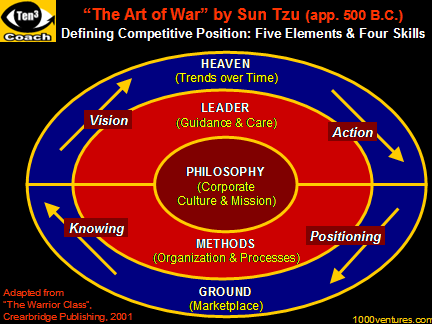
The picture is courtesy of 1000ventures.com
Thinking about Real Estate - holistic approach & checklists
0 comments Posted by Unknown at 11:08 AM I don't know anything about real estate. My sister wants to buy an apartment in Dublin. My father used to own several houses in Germany, the Netherlands, and Belgium. Back in his day, banks were much more liberal about lending money to house-buyers, often sponsoring up to 90% (I think). The climate is far less friendly now and I hope my sis has better luck in Ireland, where house-prices are booming.
Apart from the finance-question, there are of course questions pertaining to the actual and future value of your purchase. Is the price good and will the value increase? Is the location good, why, why not? Does the building need work, how much will it cost? How will your repay the money you borrowed / spent on it? What is your exit-strategy?
Retail Location-location-location
"You can be the best retailer in the world, but if you set up shop in the wrong place, you'll never do much business. If you operate from the wrong properties, you start with your hands tied behind your back."(Clarke and Rowley, 1995, from a book, called "Retail Marketing," I had on my bookshelf)
While many variables in the marketing-mix can be adjusted in a fairly short time-frame, setting up a new location can take years and the price of failure is high. Hence it probably represents the most important decision a retail-business ever has to make.
According to 1999-stats, each square meter (±3 square feet) in a British grocery-superstore was estimated to cost €750 (±500 UK-pounds). And we are talking several 10,000s square meters for that type of store. Such serious commitments automatically mean that a retailer needs to incorporate a real estate-strategy into his business, estimating whether the future will make his asset a profitable one, or a liability. McDonald's, and I'm sure any major player in this arena, operates much in the same way.
A little anecdote. The reason why I read the McDonald's-biography, was because of these words:
After a few beers in hand, and there was a pause in the crowd, Ray [Kroc, founder of McDonald's] asked everyone in the room, "What business am I in?" The room was silent and people were laughing. No one gave Ray an answer so he asked the question again, in a more serious tone, "What business do you think I am in?" A brave soul yelled out, "Who in the world doesn't know you're in the hamburger business?" Ray laughed and said, "No ladies and gentlemen, I am not in the hamburger business. I am in the business of real estate."Location Techniques
While, in theory, a systematic sequence, starting with the general appraisal of the area down to the specific site characteristics, would be optimal, this usually only works well with businesses that have medium- to long-term real estate-strategies. Other businesses, where the need for speed is higher, often do not benefit from the luxury of such an approach. Generally though, a location strategy can be split into three:
- Search: where the focus would be on finding the right area for a location
- Viability: where more focus is placed on specific sites and estimating turnover
- Micro: where the features of the site are examined in the context of potential store performance.
The Checklist
This is the most common tool, at least reported in a study from 1996 (see the "Retail Marketing" book for more). The reasons mentioned at its relatively low cost and technical expertise requirements. While I imagine that today's location-suveyor has more sophisticated tools available, I don't think that factors such as cost and technical expertise should be left out of the picture. In many cases, a checklist will be the first tool that people, especially those with small businesses and limited budgets, will reach towards. For similar (well time-related) reasons, I will focus on this tool alone today, and look at more sophisticated tools in a future post.
Essentially we are speaking of lists, which can vary according to the focus of the store, and cover a series of key-areas. As for the first, the positioning of businesses, the book mentions four dimensions: price, convenience, variety, and proximity, and presents checklists according to each factor. For instance, for convenience, we would be looking at traffic flows to and from the store, visibility of the store, distance to competitors, and geo-demographics. You get the idea.
As to the areas to cover in a checklist, those can include: population-data, such as disposable income per capita, home-ownership levels (which would affect DIY-stores), current shopping patterns, etc. Accessibility-data, which can include public transport infrastructure, parking, access to staff, access to pedestrians, etc. Competition-data, which looks at variables such as existing retail activity, saturation of demand, etc. And finally, cost-data, which includes, well everything that needs to be paid.
Each area will require different research-methods also, ranging from going to your local government, to using commercial databases, to surveying customers directly.
Final thoughts
I'm being a little vague here, because I happen to know and like the professor, Dr. Peter McGoldrick (with his funny-looking moustache), whose book I'm quoting from and hope that people, who are interested in this subject, will buy it.
I'll go more into the subject of locational positioning at a later date. The book does cover more sophisticated methods, such as mapping, geographic information systems (GIS), the analogue method, and mathematical models like multiple-regression techniques. I'll look at those, and at more current developments, as stuff may have changed since the 2002-edition of my book.
The picture is courtesy of currentanalysis.com

 The


