I've included just the top-25 and annotated their focus. What's interesting, but not surprising, is that the majority of companies in that list are not independent horeca-orientated, apart from two: Hennie van der Most and Sjoerd Kooistra, both Dutch horeca-entrepreneurs.
The majority is hotel-chains, though the top-10 is quite diverse; a number of convenience-(fast)food places, resorts, as well as retailers. Interesting that both Ikea and Hema are on that list. Hema, as far as I know, has not been on the horeca-market for long (no revenue reported in 2006), but is already reaping significant successes. Probably my favourite retailer in the Netherlands, btw. Ikea, as I reported before, has been in the restaurant-business since 1971.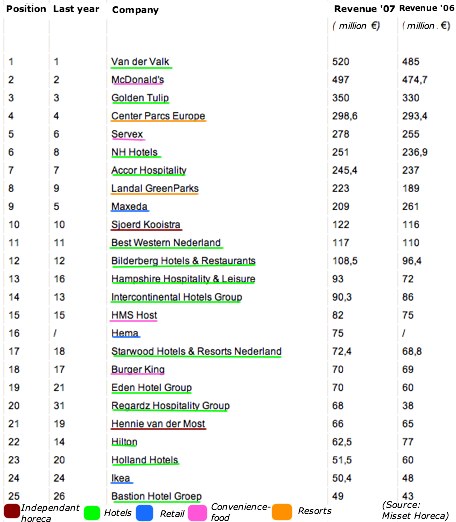
You can see the complete top-100 at Misset Horeca.
 When I started this blog, and my general thoughts about the area of food & retail, it was all about the people. A quality staff and happy customers, what more do you want? And I have to say, from past experiences, that I don't really like businesses that don't place people first.
For instance, one individual I worked with, suggested using handicapped people to put together a product manually. I instantly disliked him. Not that I don't want handicapped people to be productive, but it was the thought behind it; to find a "stupid" workforce, which you can save tons of money on. It was just distasteful.
Another company I worked for was very process-orientated.
There's nothing wrong with that of course, but it was a big company with a reputation for innovation and that is why I joined. And you expect such a company to at least push forward a solid project. Well, as it turned out, the organisation's core-strategy was to start a large number of risky projects and have them compete with each-other. Those that would fail would simply be abandoned, and their staff was expected to fall on their swords… metaphorically. The effect was an incredibly high turn-over of employees, all three projects I worked on no longer exist, and it deeply soured my feelings about this company.
Both these examples, to me, represent a lack of respect for the human element. I realise that business is a hard world, but if projects were designed to be solid in the first place, there would be less of a need for these kinds of practices. Just my 2 cents.
Part 2 - the challenges that people businesses face
HBR (Again! I'm sorry, but I read a lot of HBR-articles!) published an article about people businesses some time ago, which I enjoyed. Following are some notes + thoughts about it.
- People businesses are defined as: "operations which are characterised by 1. high overal employee costs, 2. a high ratio of employee costs to capital costs, and 3. limited spending on activities, such as R&D, aimed at generating future revenue."
- In a top-40 list of people-businesses, published in that same article, only a few qualify as food and/or retail related. These are the Hospital Corporation of America, Tenet Healthcare, Marriott hotels, and Accor hotels.
- For instance, a business like McDonalds does not classify as a people business; it has substantial assets in terms of brand & real-estate, and relatively low people-cost.
- People-businesses face a number of challenges, related to performance measurement, people-management, compensation, and business models.
- Measuring productivity is more important in these businesses, then other economic performance indicators, like return on assets or investment. The challenge is finding the right indicators (employee productivity & profitability), as well as benchmarking it against other companies (employee figures do not always need to be made public).
- To manage people, you need to align employees' interests with business objectives & execution. And you need to find ways to measure performance (see above) continuously and see where your weak spots are.
- Compensation is key, as productivity is very sensitive to it, and is a primary determinant of shareholder risks & returns. Other factors to consider are variability—productivity varies across the workforce and how do you get the most out of a diverse workforce—and reach—sometimes the lowest on the ladder are as, if not more important to a firm's performance, and how do you motivate these people to do their jobs as good as possible?
- There are a number of business models are used in these types of businesses: pricing per hour is a safe method, but does not account for extra performance; a fixed price per output allows companies to shave costs off the inputs and thus increase their profit-margins. It is very susceptible to a high-skilled workforce; a success-fee or commission offers the best returns, but also the greatest risks; some companies use a hybrid of these three.
- The strategic weakness with these types of businesses is that your assets are mobile and can walk out the door. By creating value above and beyond your employees, you can diversify some of that risk away. Of course, you could also try to keep your employees ;).
I guess it's up to individual businesses how they want to measure their firm's performance. The most straightforward is certainly return on assets or investment. But even that leads to some question-marks, particularly in today's highly software-based economy, where assets are no longer as necessary, or pricey, as they once were.
For my part, I still think that people are a key-asset to a business, and it's interesting to look at how exactly you motivate a workforce and get the most out of them, as well as how to overcome the challenges related to a people-based business.
Equally interesting is how to align the business-model to match the needs of your assets—the people. Since people are motivated by (financial & non-financial) compensation, do you keep the pay-rate aligned with time-spent; fixed; aligned with performance; or a hybrid of the three? I think the hybrid is always the best choice, but even then some combinations work better than others.
And retaining employees is also an interesting problem; though much less so in countries like France, where getting rid of them is a problem, and differently in places like Silicon Valley, where inter-firm mobility is a key-requirement for many employees. I think the solution is completely personal and cultural, and everybody's answer will be different on this.
The picture is courtesy of prairienet.org
- For Technology, it's arguably Waste-disposal (I'll be writing about this soon on TechITEasy)
- For Media, it's finding a Business-model to compete with free.
- For Food, I would say it's O B E S I T Y.
And yes, I'm back! My 180-page thesis (or 135 at font-size 9) is being checked, and I'm in Rotterdam picking up the pieces of my life and making a delicious milkshake… whoops, I meant a yoghurt-smoothy… gotta watch that diet !!!
 Not too long ago, asked the question about whether coffee is a bad business to be in, taking into account the exploding number of quick coffee-stops, as well as the fact that global players like Starbucks, and the soon-to-come McDonalds café, are saturating the market. There's another part to this, which I actually discussed before, but I didn't make the connection: coffee as a soft-drink.
In the Starbucks-book, "Pour your heart into it," Howard Schultz talks about how Starbucks got into the canned coffee business, with the help of a chemist and Pepsi. The chemist had come up with a method to captured the essence of coffee into an extract, which enabled Starbucks to add it to a number of new products, such as ice-cream and indeed "porta-coffee," also leading to more business-opportunities outside of Starbucks-outlets. Pepsico had the "porta" knowledge, as well as the distribution-channels, and from what I hear their partnership was a raging success.
About a month ago, I wrote that Coca-Cola had entered a partnership with Nestle, to develop similar products, and just read about a another partnership between Coke and illy, a premium brand of coffee and related products.
The rest of this post is speculation:
Now I'm sure that the coffee-makers will do their best to not have the can equal a taste of fresh coffee, though at the same time more competition in canned coffee will definitely drive the quality upwards. Perhaps up to a point where it will perhaps convince customers not to wait in the long queue associated with "good" coffee, and instead get a quickie at a supermarket or in a machine at work. Similarly, an increase in downstream-marketing by producers, may lead to an increased demand for these products up the chain, at cafés, giving Starbucks-, illy-, and Nestle-outlets an advantage over generic coffee-producers. Thinking defensively, all of this sounds pretty bad for existing cafés. I'm not a fan of thinking defensively however.
Offensively speaking, this is an opportunity. Comoditised coffee means that there is more space left for other activities which help increase the value of "third places." Comoditised coffee also means that the overall quality of coffee will go up, and that consumers will look for other selling-points. By taking a license on illy or Nestle coffee (I don't think/know if Starbucks licenses), cafés can profit from the downstream marketing that is already happening. Even cans of coffee can present an added value, for instance in large queue-situations (like the ones I discussed last time), which I perceive as an excellent opportunity for offering tasters.
And really, this may not change much for cafés. The manufacturers' downstream marketing towards consumers may cause an increased demand for illy or Nestle-coffee (or cans) in cafés, pressuring them to take it into their assortment. But the same has happened with drinks like soda and beer for decades, though I'm sure that there are some horror-stories to tell here too. And so far, canned coffee has definitely been lacking the taste department, so it may not all represent competition for existing drink-venues. I may be making an elephant out of a fly. In any case, interesting to think about and to see how this will play out.
Oh, and the picture is meant to represent a cup, spilling coffee. If it looks like crap (the coffee kinda does), my apologies.
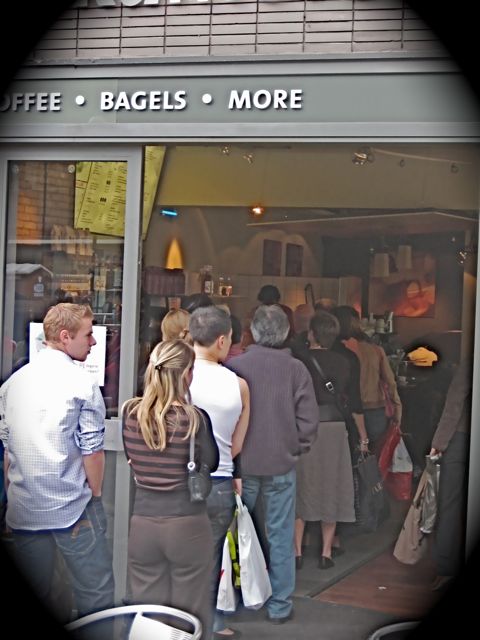 It's a fair question. Look at the picture on the right. This should be a familiar view in just about any city: a long queue for a tall latte. The picture suggests several things. One, that coffee seems to be a popular product; two, that there is space for more coffee-shops; or three, that this particular coffee-shop should perhaps improve its service.
The truth is that this trend is scary for many an existing coffee-shop owner. Because the café, in Europe, has been around for quite some time, centuries for all I know. Yet if you walk just down the street from where I took that picture at a Rotterdam coffee-shop, you'll see a line of traditional cafes, spacious and atmospheric, yet entirely empty. The fact that people would line up at this particular coffee-shop—the only Starbucks-like venue in Rotterdam—suggests that they don't care about space, about atmosphere. All they are about is convenience (if you call waiting for 5 mins. a convenience); coffee-to-go; and exotically-named and expensive coffee. What is happening here is not so much the comoditisation of coffee itself, rather the comoditisation (read: non-importance) of the coffee-selling venue.
I'm not sure if people would care whether they bought a coffee at McDonalds or the Metropole-cafe in Brussels anymore, to be honest. If the selling point is how quickly you can get the coffee and get out, what does it matter if the venue is a palace, ready to serve its customers on its hands and knees?
There are plenty of stories about "how Starbucks drove me out of business" (here's a borderline case), strangely outweighed by stories about "how Starbucks saved my life" (here's one). And with McDonalds increasingly getting ready to become a competitor to Starbucks, and other venues, like Leonidas, a Belgian chocolatier, transforming their previous chocolate-laced focus into a coffee-one, I don't think it's unnatural to be afraid. If a coffee-venue is a commodity, then how hard is it to change your existing venue? Insert some coffee-pumping machines, put a to-go sign on your door, and you're set.
So what should an entrepreneur do? Leave or fight? Yesterday's odd post about Beef, of all things, did suggest another way of looking at business: on a system-level. What was essential to the Chinese beef industry, to meet demand? Proximity to the market, amongst other factors. And what is essential to the coffee-industry? Probably not more coffee-venues, but maybe something else.
When you look at the way the coffee-industry is structured, and probably most industries, it's like a funnel: there are a number of coffee-producers (not sure how many), and a definitely greater number of coffee-venues. The latter is battling for the attention of customers. They do so by engaging in new business development opportunities, both internally (e.g. music), and externally (e.g. coffee in cans). They need to open more and more locations to maintain their air of convenience, just look at the picture above. They need to brand themselves as the number one place to go, versus all the 100s of other new and traditional venues. They need properly trained staff. They need good coffee, and other quick food-products, etc.
This would suggest following openings*:
- marketing consultants
- new business developers
- new business providers
- real-estate agents
- customer service consultants
- coffee-buyers
- temp-agencies
- quick food producers, e.g. a bakers
- and I don't know what else.
The point is that, while a certain, most obvious, business opportunity is shrinking, doesn't mean that there isn't a need for more business. As a (creative) entrepreneur, you just have to look outside the coffee-cup (read: box) and see if customers and coffee-venues would not be in need of other services. And perhaps I am wrong, and because it is so easy to implement a "to-go" formula, it is actually easy to start some kind of food-related venue and add the coffee on top.
Anyway, all this coffee-talk is making me thirsty for one myself.
This is more of a personal* rant than anything purely retail related (*: isn't anything blogged personal?), but I've been in a terrible mood these last few days, and what better way to get out of a mood than a good spiteful rant, lashing out at innocent tools like the ones below.
I hate two things about business: 1. Post-floatation PR = total snore-fest. 2. Anything related to math = like sinking a nail into my brain... slowly. Both problems are fairly related, I think, and I will explain why.
1. Post-floatation public relations
My life is an exercise in duality. I've been rich, I've been poor' I've been hated, I've been popular; I studied strategic management and I studied entrepreneurship. There's something I really loved about strategy and there are things that I really hated, such as: there's no starting position as a strategist. If you want to work in this field, you either start as an analyst (snore-fest x 1000), become a consultant (shoot me now), or you start your own business (yay). That's were entrepreneurship comes in: multi-flavoured coke (yes strategy is in there somewhere).
This summer I read 3 books on companies: eBay's Perfect Store, McDonalds' Grinding it out , and Starbucks' Pour your heart into it. The only one which I could read all the way through was McDonalds.
I was eating up the words of both the Starbucks-book and the eBay-one, for about 60% of the time. Then snore-fest happened. The companies went public. For McDonalds, it actually worked out. Ray Kroc has a knack for staying in touch with his core-values and managed to remove himself from much of the mess. Or perhaps it was because he wrote the book decades after and his trauma was over. For Starbucks/eBay, as soon as the companies went public (in the book), I had to stop reading, and when I eventually resumed, it was at 1/10ths the pace of the pre-floatation material. I haven't even finished the Starbucks book yet (only 50 pages to go), because he's writing about his charity and about protesters.
You get the best insight into what it feels like to go public in the eBay book, because it was written by an excellent and somewhat objective journalist: Adam Cohen. He interviews people throughout the book, gets their emotions, the way they worked, what was exciting about the company that was profitable from day 1. Before the IPO, it seemed like it was a wolf amongst other wolves and some lions. People were happy, excited, and stressed about the ride. The best chapters I've ever read in a business-book.
Then, the company turned into an elephant and everything seemed more abstract, more distant, like pesky little flies. Any wolves on the horizon and the company tried to gobble them up. And more and more people came onboard, diluting a lot of the core-values of the founding staff. I still thinks it's a great book, but what a snore-fest at the end.
Same with Starbucks, though I reserve my final judgement for when I finish it. I loved the way the company was started, and I also to a degree love the stuff that happened after the IPO. But it suddenly got a lot more boring, more about PR, about how to handle investors and stake-holders. How to deal with people who attacked Starbucks just because it was a prime-target, because attacking it would solve all the problems in the developed world.
The difference between entrepreneurship and corporations. If you hate a start-up, start your own. If you hate a corporation, write an angry letter, or better, get a job there... Enough said.
2. Mathematical business
This really is a much deeper hate, one which I've had for an insanely long time. First, I must say that I'm more of a right-brained person than a left-brained one. No, forget that, I am human. I like psychology, I like predicting trends, I like innovation, I like creativity, I like risk. All of which I don't think are very well contained in formulas.
Now that of course means that I love statistics, because it predicts trends and confirms my own feelings about stuff. I love the book, Freakonomics. But I abhor it when formulas lead to the abstraction of values, much like the above rant on PR. To some degree, I can imagine Hitler sitting in his bunker with his partners in crime, calculating the ROI of Germans vs. Jews and deciding the former was a safer bet. And when I look at business today, I imagine bankers, even Jewish ones, make similar decisions about a businesses' assets and employees, making financial (read: life or death) decisions on paper everyday, never considering that there is life where a formula cannot penetrate.
More entertainingly, remember the Ben Stiller movie: "Along came Polly?" Ben Stiller is a risk-analyst, afraid of any discrepancy. And along comes Jennifer Aniston (Polly) who throws his whole life upside down, so much so, that he decides to make a risk-analysis of whether or not he should have a relationship with her!? That is what I'm talking about! For another good risk-analysis vs. Lo-o-ove movie, check out "Knocked Up."
Ok, my rant is done. It was largely stimulated by an article about "balanced scorecard," I think. I feel better now. Hope you do too.
The formula in the picture is for Net Present Value.

 The
The 


