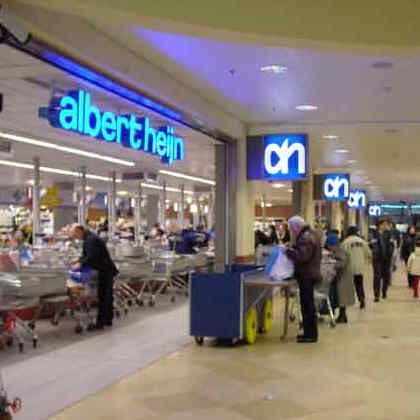
 Just a short tweet.
I'm currently reading a Dutch book on the 2003 crisis at Ahold, but which is actually a historical account of how the corporation came to be. A couple of things I found interesting:
- Ahold actually stands for AH (Albert Heijn) Holdings
- We all know that things are cyclical, but it was interesting to read how a recession and high oil prices were a challenge that Ahold had to face in the 60s-70s, and how they managed to survive.
- In order to inspire Dutch people to shop more, they introduced a financing scheme for fridges, which people couldn't afford at that time. General Motors did a similar thing to help people afford their cars; seems like an interesting way to "upgrade" an economy.
- The fear of a socialist government drove Albert Heijn to look outwards and form Ahold (similar to why IKEA decided to globalise also).
- One of the consequences of politics at that time was the board of directors, meant to provide impartial guidance and represent the workers.
- They made extensive use of consultancies (often McKinsey) whenever they decided on a strategic trajectory.
- One of the directors was a big fan of Harvard Business Review :)
- They use the US as a source of knowledge on how to design their supermarkets. Later on, moving to the US was also seen as a way to increase that learning, as well as a new revenue-source.
- When AH moved to the US, they also brought their own ideas, like, eh, advertising (a terrible, terrible idea).
I took this title from a report on the future of Dutch supermarkets (English pdf). It identifies a number challenges to come, one of which is "stomach share," which is apparently a big deal because of the following three factors:
- Population decline: which translates into less consumers buying food
- Increased longevity: and older people have a lower caloric intake
- Increased awareness of health-issues: which also translates to a lower caloric intake.
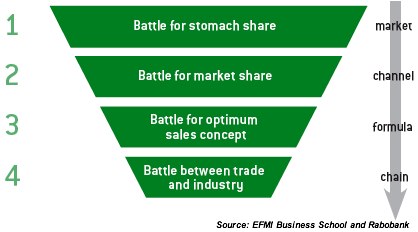
What the authors are seeing is that players from the bottom of the market (the discounters) are moving upwards, by broadening their assortment of goods, and players from the top of the market (luxury-stores) are moving downwards, by improving their prices. A number of underlying things are going on here: luxury-stores can become cheaper by improving the efficiency of their stores and sourcing cheaper brands. And discounters can increase their offering through their relationship with suppliers.
Following HBS-quote, from an article entitled "Finding success in the middle of the market", sheds some light how Tesco does it:
A company controls midfield by fielding a complete product line that includes backs and forwards. In its supermarkets, Tesco, the successful UK retailer, offers consumers three options—good, better and best—in most high turnover product categories. In addition, Tesco doesn't just sell groceries through one-size-fits-all supermarkets. Recognizing the need to shape as well as respond to an increasingly segmented market, Tesco reaches its consumers through at least seven different store formats, from convenient Tesco Express outlets at one end of the spectrum to full assortment hypermarkets at the other. But, within all its stores, Tesco implements the same merchandising principles: Better, Simpler, Cheaper.Can you guess who the loser is yet? Well, according to both the report and much data on the net, the losers are the new, innovative concepts, that may offer certain values to consumers on an ethical or health level, but are not able to reap the same advantages as more established players are.
That is also the answer why so many organic companies are being bought up by fmcg-companies. There's an interesting overview here; but if you want to follow one in real-time, check out this Inc. magazine blog run by Honest Tea, which has recently given away 40% of their company to Coca-Cola.
Of course that is only part of the answer. Consumers are not just focussed on price. And, while consumer-awareness of the global situation and their own health is clearly growing, that's not the whole answer either. People's lives are becoming ever more complex and convenience is a big selling point these days.
It's those companies that can combine a high level of consumer-responsiveness, together with assortment and price, that will capture the hearts of consumers. But I guess what is out, is the solo single-product-serving player in the market, purely focussed on softer advantages like "ethics," and forgetting that consumers still(!) have limited disposable income for their food-expenses, as well a limited time to engage in these activities.
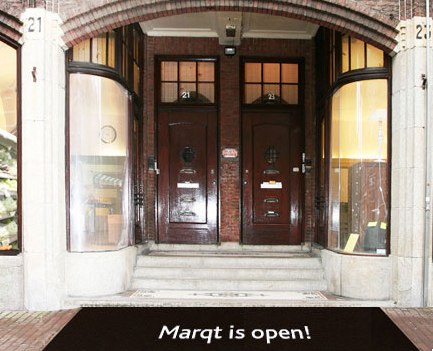 Marqt is a market for farmers, recently launched in Amsterdam by Quirijn Bolle en Meike Beeren (both ex-Ahold). Can't really sum it up much more than that.
It focusses on two opportunities: from the supply-side, many farmers want to sell their products, but are unable to because of the power-play from regular retailers and/or at relatively low profit-margins. Last year, when I briefly looked at the organic boom, I already thought that there is an opportunity here, for farmers to become retailers themselves.
This is made possible by the other part of this equation, an elevated demand by customers for natural and ethical produce, and, to a lesser degree, local produce.
Bolle and Beeren rightly identified an absence of identity in food-retailers, an absence of accountability for the product-decisions they make. But they also identified a need by consumers for quality-guarantees.
Because you have to wonder, how is Marqt different from the regular outdoor-market that exists in every city? Well, here's one difference, and I'll try to give an example. 'Tis the season of mangoes, and I'm hooked. I've been buying these babies at €1 a piece at my supermarket, but stumbled across some great deals at the local market: €2.50 for a box of 8! The only problem: about 6 of these were either unripe or overripe. And who do I complain to? One of the 100s of vendors on the market, whose name or brand I don't even remember?
From my understanding (I don't live in Amsterdam), Marqt-products are more expensive than those of local markets, about on par with regular supermarket-foods. They work with partners that are able to supply in greater numbers, offer a quality-guarantee, and, very interesting, train Marqt's staff to understand and explain how products work.
Their added value is that they can offer suppliers higher margins, and consumers a richer shopping-experience. And from what I hear, though I have no numbers, the store is doing reasonably well.
Two other interesting facets: Marqt houses individual suppliers' stores. So you have Store X for dairy, store Y for meat, and store Z for bread. Marqt provides the space, the staff, the marketing, and collects a percentage of the profits.
Also interesting: the store doesn't accept cash. It's progressive, I agree, but also great marketing-value, sure to raise an eyebrow or 1000. And it saves money on the back-end, though I hope they get rid of the €0.50 transaction-fee.
I think it's a great idea, and hope the store continues to do well. Gives me hope, both in terms of opportunities for retail-entrepreneurship, and entrepreneurship in the Netherlands in general, which (in my opinion) could use a boost.
I'm currently working on a wrap-up of what I wrote about in months 3-6. It's usually a monthly tradition (see months 1 & 2), but this one is extra long and taking me some time. Apologies for the silence this has been causing this week.
One of the things, I'm working on is a work in progress, a map of the food-industry. Step 1 is to identify the individual segments, which, I should note, are probably transferable to a great number of industries. Future iterations will include identifying specific companies in each segment, as well as sub-segments, and specific segment-pains also. 
- Segment 1 - the production of raw materials: This can involve anything from growing coffee-beans, to potatoes, to rubber and trees (later used for packaging). Some vertical integration with segment 2 and perhaps 3.
- Segment 2 - the production of consumer-goods: The activities here involve sourcing raw materials and producing them into goods, ready for retail. From my understanding, there are a number of super-producers (Unilever, P&G, etc.) and more specialised ones. Some vertical integration with other segments, plenty of horizontal integration also.
- Segment 3 - retail: A diversified segment, consisting of super-markets, specialised stores, and hybrids (which combine retail with other services like music, etc.). Some vertical integration occurring, with e.g. private labels, and large franchises like McDonalds & Starbucks that communicate directly with segment 1.
- Segment 4 - consumers: too diversified for me to summarise at this stage. What I do note is that the reach of customers is increasing up the value chain: organics, enviromentalism, etc. are all signs of this.
- Sub-segments - marketing & logistics: It has been my observation that the degree that these are externalised depends on the resources available within and the complexities of the tasks. What I also noticed is that it's the supplier, not the buyer, that takes care of these things. And finally, that it's segment 2 that is usually responsible for marketing their products to segment 4, the consumers. I expect that something similar is or will be occurring from segment 1 to segment 4, to address concerns consumers may be having about production-methods.
- Meta-segment A - regulation: It has been my observation from my thesis that the government is a factor at pretty much every stage of the process of bringing a product to the market. It is a tool both for consumers, for larger interest-groups, and for businesses to stimulate change within industries, with all the consequences that has. Again, regulations pertaining to organic & green production-methods, as well as human rights and memberships of trade-unions are just a few of many factors to consider here.
- Meta-segment B - optimisation: This is where I would place consultancies, which are super-specialists aimed at improving processes in and between organisations, but also aiming at customers who are having more and more information at their disposal, more cash, and more complex needs.
I'm hoping to finish up my wrap-up by this weekend and that it will be business as usual next week.
- For Technology, it's arguably Waste-disposal (I'll be writing about this soon on TechITEasy)
- For Media, it's finding a Business-model to compete with free.
- For Food, I would say it's O B E S I T Y.
And yes, I'm back! My 180-page thesis (or 135 at font-size 9) is being checked, and I'm in Rotterdam picking up the pieces of my life and making a delicious milkshake… whoops, I meant a yoghurt-smoothy… gotta watch that diet !!!
If you read further into the ACNielsen-report (pdf), I wrote about two days ago, you'll have seen that retailers' private label-strategy seems to be focussed on certain key-areas, namely:
- General health
- Weight-loss
- Organics / Fair Trade
- and Food for kids
At the same time, there are lot of savings on the marketing side for private labels. Retailers are in fact huge market research factories—every move that a customer makes in their store, with their products, can be entered into a database and used for future marketing strategies.
And having full control over shelf-space, shelf-placement, and in-store marketing means that the budget for these can be minimised.
All of which has three implications:
- That more of the budget can be allocated to the quality of private label products.
- That it pays off to have an elaborate in-store-system to collect consumer-data.
- And that independent product-manufacturers are perhaps screwed.
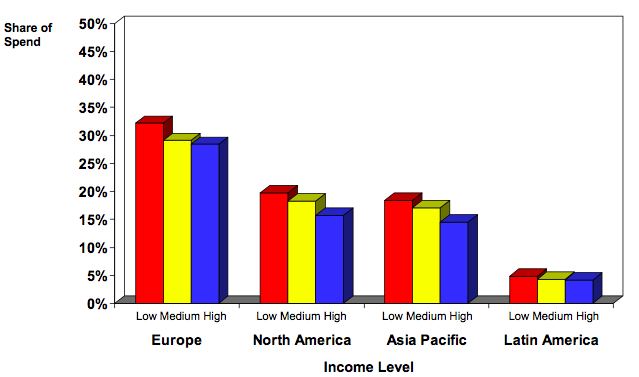
Figure 1: Private label share of spend segmented by income level (source: ACNielsen, 2005)
Of course, this doesn't mean that independent product-manufacturers are completely screwed. It puts pressure on them to become more innovative with their products and marketing than they ever were before. Which is the right kind of pressure.
Final thoughts
There's not much not to like about private labels. In many ways it's a more efficient system. Less time and money needs to be spent on the marketing-side, and more can spent on the back-end—the production. At the same time, independent manufacturers will have the advantage of flexibility. They can (perhaps) adapt quicker to market-trends, or perhaps even lead them.
Not all market-research needs to happen in the store either, some also needs to happen where the consumption happens—at home or elsewhere. And large independent manufacturers perhaps have a better foothold on general trends in society, than retailers, who are mostly restricted to what happens in their store.
(On a related note, one of my early posts on this blog discussed P&G's strategy towards shopper-marketing, worth checking out!)
So it's perhaps not a black-and-white situation. But I think that, looking at Starbucks, which is essentially a private label, that this strategy has considerable merit, because it gives retailers a lot of power over the quality of these products and how these are sold. It essentially shifts the brand up towards the retailer, instead of it remaining on the product-level.
More on this as I come across it.
Essentially private labels, also sometimes called house brands, are products branded either with the name of the retailer, or, at times, sharing some kind of umbrella-name, decided by the distributor or otherwise. But what private labels really represent, to me, is the ultimate example of a power-struggle between a retailer and suppliers. Sometimes, but not always, it also means that some kind of vertical integration has been taking place between retailers and manufacturers, or, at the very least, packaging plants.
For now, I'll just be looking at some stats on private labels. At a later date, I'll take a look at more supplier-retailers dynamics, branding strategies, etc.
Geographic share
According to an ACNielsen report (pdf), the global* market-share for private brands was 17% in 2005 (* global meaning 38 countries and 80 categories), and had grown 6% that year.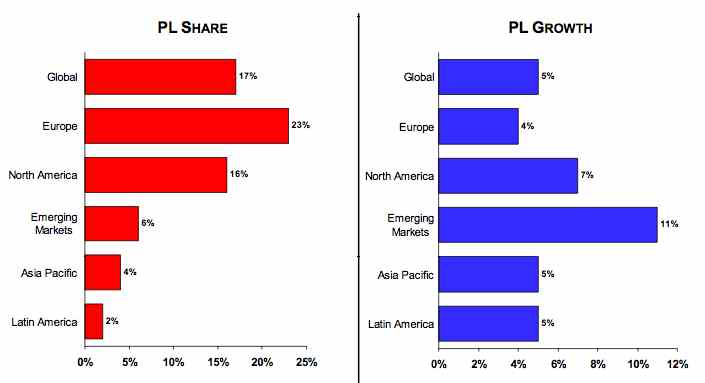
Figure 1: Share & growth rates of private label by region (based on value sales) (source: ACNielsen, 2005)
Europe has the largest market-share with 23%, and Latin America the smallest, with 2%. Top countries included Switzerland, with 45%, Germany, with 30%, and the UK, with 28%. The largest Private Label growth happened, unsurprisingly, in emerging markets (11%) like Croatia (77%), Greece (24%), and Thailand (18%).
One big growth-contributor in Europe is the strong growth of hard discounters, such as Aldi or Lidl (both German chains), who are present in every European country and expanding rapidly. With Aldi, for instance, private labels make up 95% of sales.
Private label foods
Category-wise, refrigerated foods have the largest overall share of private labels, namely 32%. Complete ready meals take the lead here, with an average of 47% private label-share. In the UK, 97% of ready-meal sales are in fact private label.
Another significant private label food, or rather drink, was milk, of which private labels make up 43% of sales.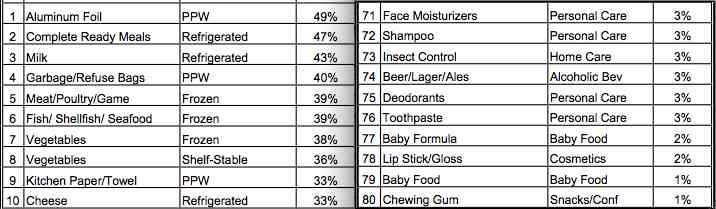
Figure 2: Value shares of private label by category (source: ACNielsen, 2005)
Other high private label food-products include frozen meat (39%), fish (39%), and vegetables (38%), and 37% for shelved vegetables. Frozen pizza is at number 27, with 17%, tea and coffee at numbers 37 and 38, with 14% and 13% respectively. Wine is at number 44, with 12%. And Beer is all the way at the bottom, at number 74 with 3% !
Among the fastest growing foods are drinking yoghurt (28% growth), baby food (20%), chocolate (13%), and water (13%).
Pricing trends
One of the strengths of private labels is of course that they are cheaper, on average 31% less than manufacturer brands. Emerging markets showed the biggest discount, with PL-goods costing 41% less on average. Europe wasn't lagging in this respect either, with an average price difference of -37%. On a country level, Greece, Australia, and Germany were taking the lead with, respectively, -48%, -47%, and -46% discounts (compared to manufacturer brands).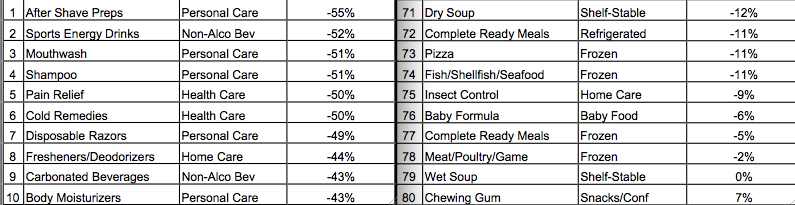
Figure 3: Price differential of private label by category (source: ACNielsen, 2005)
Again, concentrating on food-categories, the products that received the biggest discounts were Sports Energy Drinks (-55%), carbonated beverages (-43%), cereals (-40%), wine (-38%), and tea (-37%). Food-categories taking the least in discounts, included chewing gum (+7%), wet soup (no difference), meat (-2%), and ready meals (-5% <- I guess that explains their high market-share).
Final thoughts
That market share is increasing more quickly in emerging countries is not surprising. Retailers there will likely not be mature and/or consolidated enough to focus on such a strategy, but this is clearly changing.
Germany's dominance is also interesting, as both Aldi and Lidl originate from there. One of my next posts will be on Ikea's European growth and Germany's also very strong there, which suggests a certain preference for low prices with German customers.
Switzerland is still somewhat of an enigma, but I'll try to find out more about it.
In terms of products, both the dominance of private labels amongst ready-made meals, and that their prices are quite similar to regular brands, is very interesting. It could suggest that customers either don't care much for quality and brand-differentiation in that sector, or that private label brands are actually quite good. The price-level would suggest the latter conclusion.
Generally speaking, refrigerated goods are different in the eyes of consumers, I think, less scrutinised perhaps, and worthy of more investigation. Milk is of course similar to water, and hence not really a product where brand makes a huge difference.
What else? Certain beverages, like coffee, wine, and beer are quite interesting, as their private label share is quite low. This would suggest a high brand-sensitivity in these sectors. The low percentage for beer (3%) is certainly striking.
More on private labels as I come to it.
 Still following the great book on Retail Marketing, by Dr. P. McGoldrick, this time I'll cover the different types of cost that are included in buying, developing, and running retail locations. For previous coverage, check out post I and II
Before buying property, considerable data analysis must happen in regards into estimating turnover, which comes from data on competition, accessibility, and population. And a calculation of costs must happen, least of which is the purchase price, and more complex will be three types of cost: development costs; running costs; and contextual* costs (*: for lack of a better word).
Much of this cost data will likely come from negotiations with site developers, lease owners, and an estimation of the costs involved in the development of the location.
Naturally, with the proliferation of the internet, there are plenty of databases that offer interested parties an overview of typical sums per region or type of location. Though the following are mostly aimed at private individuals, both My-Currency and Zillow offer these types of services, and Jeremy Fain wrote about a French service, called BMyKey.com on Tech IT Easy.
Purchase price
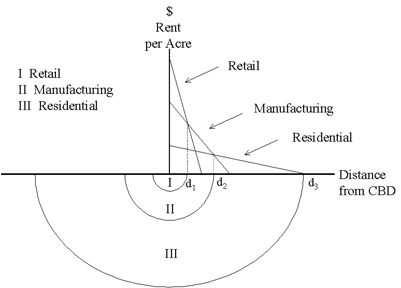
Traditionally, rent bid theory explains a lot of price-differencials within an inner-city environment. Variety and women's clothing stores would typically pay the highest rents and grocery stores the lowest. With the emergence of superstores and their focus on out-of-town locations, this formula can not be applied so generously anymore, though, as mentioned, I think that it should logically still apply to inner-city environments, and probably to inner-malls ones also.
And while buying the property may cost a certain sum, it is not atypical that the three of the following types of cost will far outweigh the initial purchase price.
Development costs
Three types of estimates need to be made here: design estimates, which include the costs of the architectural work; bid estimates, which involves negotiating the costs of labor, material and equipment; and control estimates, which are the costs of monitoring the project-development. For more info on these, check out this document.
In addition to this there are a number of costs that can be substantial, but are sometimes not taken into account. One is site preparation, which be steep, especially if the land needs to be converted or extensive demolishing needs to take place.
In addition to this local authorities can impose a number of restrictions on the height of the building, other architectural and landscaping aspects, and demand significant concessions from retailers to build there. All of which can at the very least slow down development considerably.
Running costs
The choice of location, site, and design can greatly affect the cost of running the operation once it's constructed. For instance, multiple floors and parking will mean that lifts will need to be maintained regularly. A location with a high crime-rate will require higher security-costs and lead to more theft. And high employment and income areas will also lead to issues regarding staff recruitment and retention.
Contextual costs
I made up this term, but it actually includes costs like delivery, promotion, and the impact on other branches of the business. Delivery costs are affected by the location choice of the outlet—how accessible it is via road or otherwise; how remote it is from the main distribution network. Promotion costs are also a factor (but a topic for another day). And the impact on other branches are a very important factor to consider. The higher the existing market-share in an area, the greater the potential loss, though, according to the book, this is often accepted as a necessary trade-off to a high growth strategy.
Final thoughts
Clearly real estate is something that needs to be thought about as part of a long-term strategy and with the help of professionals. And some of this is probably not applicable to start-ups in the retail-space. That said, choosing a location by itself is already a science—whether you rent, lease, buy, or build it. And both the direct costs—purchase or rent—and indirect costs—development, running, and contextual—will play an important part in the decision-making and business-planning.
Until now, I have mainly covered the issue of competition and cost in relation to a real-estate strategy. I'll probably not go into population and accessibility just yet, and will instead focus more on more complicated tools used in real estate strategy, beyond the simple checklist, which I covered in my first post on this. These include mathematical, mapping, and some other models, as well as, hopefully, some more data on the role of IT in this process.
For a more in-depth reading, I of course recommend buying the book on Retail Marketing, which largely inspired this article.
"The nature of water is that it avoids heights and hastens to the low-lands. When a dam is broken, the water cascades with irresistabke force. The shape of an army resembles water. To take advantage of an army's unpreparedness, attack him when he does not expect it, avoid his strength and strike his emptiness. And like water, man can oppose you."Tsung Yu in The art of war
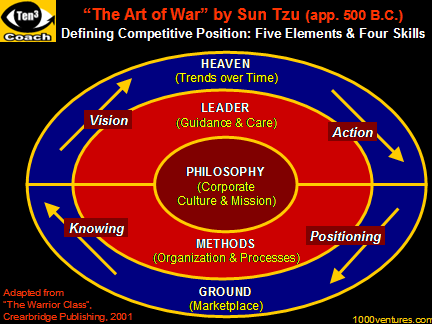 In my last article on the subject of real estate, I mentioned four areas which retailers must focus on: population, accessibility, competition, and cost. This was taken from the book Retail Marketing, whose author, Dr. Peter McGoldrick, taught me the subject some years ago.
 Of these four, the one I like the most is competition, as, like in the quote, it can be somewhat fluid, it's about people, and it can drive innovation. There's actually two ways to think about competition: as either a destructive, or as a synergetic force. I'll go into both modes of thinking, and hopefully looking at it through the lens of real estate helps.
The nature of real estate competition is quite complex. For one, it is hard to take into account indirect competition such as substitutes, and difficult to guess the response that your presence will have on existing retail outlets. In addition to this, all the other factors—cost, population, and accessibility—can affect your competitive potential. Say that you settle down into an area outside of the city, and a competitor decides to intercept customers on their route to you, by placing their outlet in a more convenient location. Any real-estate strategy has to take these possible contingencies into account, hopefully not allowing them to happen all together.
There are also different ways to think about market-saturation, and I expect most cities can appear fairly saturated nowadays. But not all hope is lost. For one, new business can drive old ones out of business. Second, large areas may contain local pockets which can still present opportunities. And third, new retail-formats (some examples here) can enable large superstores to still compete in smaller markets.
The issue of magnetism is another very important factor. Not all competition is bad, rather certain anchor stores, even if they compete with you, can drive a lot of traffic your way. Studies have shown that the presence of these anchor-stores can severely benefit your store's profitability. These anchors can sometimes be single stores, e.g. a Starbucks, or groupings of smaller stores, e.g. fashion, antiques, etc.
Similarly, grouping with other stores can severely reduce the cost of doing business (e.g. shared parking and security), and also act as a risk-reducing factor.
There should be some caution, however. While a study by Brown in 1991 (see book) showed that shoppers were 35% more likely to visit adjacent stores that were of similar type (vs. the dissimilar kind), this only applied to comparison and convenience goods, and more specifically to clothing, department, and variety shops, but not to retail services! And I assume that the latter includes places like coffee-shops and mobile phone-stores.
Hopefully, that was a little more concrete than my last introductory post on this. Of all things relating to entrepreneurship, the real-estate part is the one that is probably the most complex, and it would definitely be advisable to work with real professionals on this—though understanding the issues always helps.
The picture is courtesy of 1000ventures.com
Thinking about Real Estate - holistic approach & checklists
0 comments Posted by Unknown at 11:08 AM I don't know anything about real estate. My sister wants to buy an apartment in Dublin. My father used to own several houses in Germany, the Netherlands, and Belgium. Back in his day, banks were much more liberal about lending money to house-buyers, often sponsoring up to 90% (I think). The climate is far less friendly now and I hope my sis has better luck in Ireland, where house-prices are booming.
Apart from the finance-question, there are of course questions pertaining to the actual and future value of your purchase. Is the price good and will the value increase? Is the location good, why, why not? Does the building need work, how much will it cost? How will your repay the money you borrowed / spent on it? What is your exit-strategy?
Retail Location-location-location
"You can be the best retailer in the world, but if you set up shop in the wrong place, you'll never do much business. If you operate from the wrong properties, you start with your hands tied behind your back."(Clarke and Rowley, 1995, from a book, called "Retail Marketing," I had on my bookshelf)
While many variables in the marketing-mix can be adjusted in a fairly short time-frame, setting up a new location can take years and the price of failure is high. Hence it probably represents the most important decision a retail-business ever has to make.
According to 1999-stats, each square meter (±3 square feet) in a British grocery-superstore was estimated to cost €750 (±500 UK-pounds). And we are talking several 10,000s square meters for that type of store. Such serious commitments automatically mean that a retailer needs to incorporate a real estate-strategy into his business, estimating whether the future will make his asset a profitable one, or a liability. McDonald's, and I'm sure any major player in this arena, operates much in the same way.
A little anecdote. The reason why I read the McDonald's-biography, was because of these words:
After a few beers in hand, and there was a pause in the crowd, Ray [Kroc, founder of McDonald's] asked everyone in the room, "What business am I in?" The room was silent and people were laughing. No one gave Ray an answer so he asked the question again, in a more serious tone, "What business do you think I am in?" A brave soul yelled out, "Who in the world doesn't know you're in the hamburger business?" Ray laughed and said, "No ladies and gentlemen, I am not in the hamburger business. I am in the business of real estate."Location Techniques
While, in theory, a systematic sequence, starting with the general appraisal of the area down to the specific site characteristics, would be optimal, this usually only works well with businesses that have medium- to long-term real estate-strategies. Other businesses, where the need for speed is higher, often do not benefit from the luxury of such an approach. Generally though, a location strategy can be split into three:
- Search: where the focus would be on finding the right area for a location
- Viability: where more focus is placed on specific sites and estimating turnover
- Micro: where the features of the site are examined in the context of potential store performance.
The Checklist
This is the most common tool, at least reported in a study from 1996 (see the "Retail Marketing" book for more). The reasons mentioned at its relatively low cost and technical expertise requirements. While I imagine that today's location-suveyor has more sophisticated tools available, I don't think that factors such as cost and technical expertise should be left out of the picture. In many cases, a checklist will be the first tool that people, especially those with small businesses and limited budgets, will reach towards. For similar (well time-related) reasons, I will focus on this tool alone today, and look at more sophisticated tools in a future post.
Essentially we are speaking of lists, which can vary according to the focus of the store, and cover a series of key-areas. As for the first, the positioning of businesses, the book mentions four dimensions: price, convenience, variety, and proximity, and presents checklists according to each factor. For instance, for convenience, we would be looking at traffic flows to and from the store, visibility of the store, distance to competitors, and geo-demographics. You get the idea.
As to the areas to cover in a checklist, those can include: population-data, such as disposable income per capita, home-ownership levels (which would affect DIY-stores), current shopping patterns, etc. Accessibility-data, which can include public transport infrastructure, parking, access to staff, access to pedestrians, etc. Competition-data, which looks at variables such as existing retail activity, saturation of demand, etc. And finally, cost-data, which includes, well everything that needs to be paid.
Each area will require different research-methods also, ranging from going to your local government, to using commercial databases, to surveying customers directly.
Final thoughts
I'm being a little vague here, because I happen to know and like the professor, Dr. Peter McGoldrick (with his funny-looking moustache), whose book I'm quoting from and hope that people, who are interested in this subject, will buy it.
I'll go more into the subject of locational positioning at a later date. The book does cover more sophisticated methods, such as mapping, geographic information systems (GIS), the analogue method, and mathematical models like multiple-regression techniques. I'll look at those, and at more current developments, as stuff may have changed since the 2002-edition of my book.
The picture is courtesy of currentanalysis.com
 I suck up data wherever I go (it's a curse, I know). Just last week, as I was waiting for my laptop-drive to be installed, I sat in a German bank and came across a magazine, called VR-future. Two articles caught my eye, one on the Bio*-boom in Germany, and another on Switzerland—a country that fascinates me, but that's a story for another day.
The bio-trend article consisted of an interview with Dr. Alexander Gerber, the Germany CEO of the BÖLW (the foundation for organic products in Germany) and revealed some interesting info on this segment. While it focussed entirely on Germany, I do think it brings some interesting insights on this topic in general. (*: "bio" being the German term for organic)
Now, I should say, that I'm generally weary of the word "Boom," as I inadvertedly associate it with the word "Bust." Any market is subject to the laws of supply and demand, and a boom usually suggest an explosion of one or both, eventually leading to some fall-off after a while. I have no doubt that the same will happen to the Bio-sphere as well. There are also particularities about the organic market which I do not like, and I will go into those in my final thoughts.
The rest of this post is structured as follows. I will begin with the definition of organic, then some stats on sales, after which I will look at employment-trends, and expected areas for growth. I'll conclude with some final thoughts, to answer why I am bearish on this whole organic trend.
So, what is "bio" or organic?
From Wikipedia:
For crops, it means they were grown without the use of conventional pesticides, artificial fertilizers, human waste, or sewage sludge, and that they were processed without ionizing radiation or food additives. For animals, it means they were reared without the routine use of antibiotics and without the use of growth hormones. In most countries, organic produce must not be genetically modified.
Bio-Sales
Worldwide, while the percentage is low (Wikipedia reports 1-2% of food), it is showing far quicker growth than conventional food. In the US, Wikipedia reports a 17-20% annual growth of organic food in the last few years before 2004(!), compared to 2-3% for regular food. 2.6% of food sold there is organic. In Europe, while I don't have the stats on exact growth-rates, the percentage of of agricultural land being used to grow organic produce, is on average 3.9%, with Austria (11%) and Italy (8.4%) leading the pack.
In Germany, the annual revenue from bio-products with discounters and supermarkets has more than doubled since 2000, up to € 4,6 billion in 2006. And, at the moment (2007), Bio-products have a 3% share of sales in small food-stores, which is expected to double by 2010. The level of food-prices, held low by government subsidies, is expected to rise in the future, which… will probably not mean much to the bottom-line of retailers and producers. And, apart from the ethical considerations, bio in Germany has very much become a lifestyle product, translating into lower price-sensitivity. According to Gerber also, a new bio-supermarket opens every week.
With all this positivity, there is the somewhat counter-intuitive trend that farmers in Germany are complaining about falling incomes, and annual growth in their area has slowed down from 20% in 2000 to 0,4% in 2006. I imagine that is so because the market is maturing and because large buyers are pushing the prices down. A similar trend is being reported in the documentary, The Future of Food. Gerber also mentioned that there is a lacklustre support from the German government and the European Union in terms of subsidies.
Employment-trends
In general, the organic sector is a pretty people-intensive industry. While I don't have global stats, in Germany, about 160.000 people are involved in creating, processing, and selling bio-wares. In the last 7 years, the employment in bio-related sectors has doubled, especially in processing and sales.
On the farming-side of things, a third more people are employed than in traditional farming. And there is a need for people in production, processing, and sales, especially in the last two areas. In addition to this, the bio-sphere is very consulting-intensive, meaning there's also a need for highly trained personnel.
With is all this need for people, the German education-system does not yet offer truly specialised courses in this area. There is a program, however, co-sponsored by the BÖLW, the government, and the companies involved, which offers training for practitioners interested in working in the organic industry. Generally however, "learning by doing" is encouraged in this field, which, incidentally, also explains the high number of consultants.
Growth-trends
Gerber sees three areas for growth: Small cities, food-venues, and apparel/cosmetics. Regarding the first, Bio-supermarkets and -shops are starting to be set up in German cities with less than 50.000 people. And there are many of those in Germany.
He also expects growth in food venues, both fast and traditional, who currently receive around 25% of food-related spending, in which bio is still only taking up a very small percentage. Finally, Gerber also expects a larger bio-component in textiles and cosmetics, though I have no stats on how important that industry is.
Some final thoughts
The organic value-chain seems to be organised in a fairly similar fashion to the traditional way of producing, processing, and selling farm-goods. Some points of note are the way that bio-products are produced, the accountability-aspects, and the educational ones.
For the first, the natural way of producing these products will require some serious adaptation by producers and distributors. And since information is such an important component to bio-products, and by now a legal requirement, it will also require producers, distributors, retailers, and marketeers to set up new procedures for extracting and exchanging information. Finally, the fact that this is a fairly new market and official training-courses seem as yet to be lacking, there is a need for educating both businesses and consumers.
All of this translates into higher costs of production, which is reflected in higher prices for consumers (Wikipedia reports this to be 10 - 40% more than with conventional products). It is only a good thing that the end-products have lifestyle and ethical value, meaning that customers will be less price-sensitive about them. But will this be enough in the long-term?
In general, farming is already highly dependant on government-subsidies, which is already a bad sign for bio-produce as that seems even less efficient. And the increased demand for goods like wheat and dairy-products, from countries like India and China, means that there is actually a need for more, rather than less efficiency in farming.
Also, the current boom in food-education seems one that is limited. Eventually, the market for information will mature, customers will know all they need to know, and will be looking at other differentiators, most likely price. Large retailers, who are able to keep prices down when needed, are better-positioned for this, versus the more specialised shops who seem to be purely focussed on lifestyle, and hence high prices. Eventually, as the market becomes mature, I expect there to be a fall-out for both smaller bio-shops and in the area of consultants and niche-marketeers.
All in all, while I'm no expert on organic produce, and while I am fairly optimistic about demand continuing to rise, I'm not sure if there are still big profits to be made on the supply-side, even though there seems to be explosive growth in that area.
That said, I'm not bearish on all things organic. Bio-food in food-venues like restaurants and similar is very intriguing and, I think, will fit very well into this environment, where fresh food and good food is a strong differentiator. I'll have to collect more data on this, but I'll definitely write something on business in this area in the future.
The picture is courtesy of Petdiscounters.com and was chosen purely for effect.
IBM's nice white paper, which I briefly touched on before, describes a model for mapping how customers make decisions in a given setting. It looks at three types of retail-outlets: Grocery, consumer-electronics, and apparel (clothing), and explains how each type of store has different types of customers, with different motives for visiting, and different in-store behaviour.
For instance, with grocery-shoppers, they map two types of shoppers, those that shop for replenishment and those that shop for convenience. The figure below shows the different reasons why they would visit a store and what they value inside the store: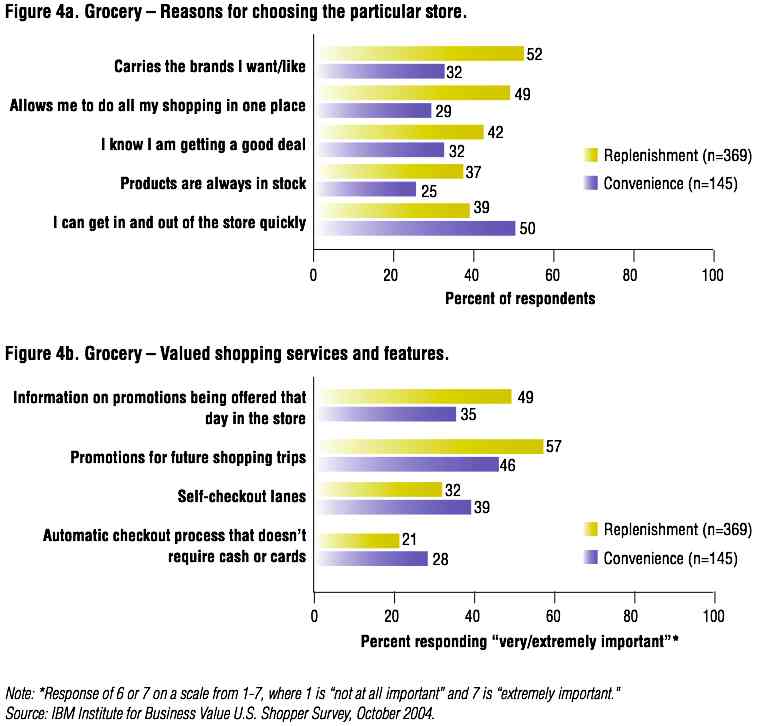
Really, what this flows out of is an analytical technique, IBM calls: "consumer decision process (CDP) modelling," which analyses consumers in five phases:
- Qualitative market research, to identify elements that impact target decisions: what, who, when, where.
- Create individual CDP maps and organise elements into stages
- Validate and create a market-representative view
- Develop quantitative model to prioritise impact of 100s of "why" elements
- Leverage CDP insights to drive revenue opportunities
For instance, in the case of customers for complex electronics, like high-end sound-systems, customers would benefit from a focus on education at the beginning of the decision-making process, and on a high level of technical support after the purchase had been made. This has implications on staffing and marketing. At the same time, this can also affect stock-inventory. With products like these, where people prefer home-deliver and possibly installation, it is often not necessary to carry large amounts of stock within the store, again reducing costs on that front.
Note: this article will be mirror-posted on Tech IT Easy.
 Not too long ago, asked the question about whether coffee is a bad business to be in, taking into account the exploding number of quick coffee-stops, as well as the fact that global players like Starbucks, and the soon-to-come McDonalds café, are saturating the market. There's another part to this, which I actually discussed before, but I didn't make the connection: coffee as a soft-drink.
In the Starbucks-book, "Pour your heart into it," Howard Schultz talks about how Starbucks got into the canned coffee business, with the help of a chemist and Pepsi. The chemist had come up with a method to captured the essence of coffee into an extract, which enabled Starbucks to add it to a number of new products, such as ice-cream and indeed "porta-coffee," also leading to more business-opportunities outside of Starbucks-outlets. Pepsico had the "porta" knowledge, as well as the distribution-channels, and from what I hear their partnership was a raging success.
About a month ago, I wrote that Coca-Cola had entered a partnership with Nestle, to develop similar products, and just read about a another partnership between Coke and illy, a premium brand of coffee and related products.
The rest of this post is speculation:
Now I'm sure that the coffee-makers will do their best to not have the can equal a taste of fresh coffee, though at the same time more competition in canned coffee will definitely drive the quality upwards. Perhaps up to a point where it will perhaps convince customers not to wait in the long queue associated with "good" coffee, and instead get a quickie at a supermarket or in a machine at work. Similarly, an increase in downstream-marketing by producers, may lead to an increased demand for these products up the chain, at cafés, giving Starbucks-, illy-, and Nestle-outlets an advantage over generic coffee-producers. Thinking defensively, all of this sounds pretty bad for existing cafés. I'm not a fan of thinking defensively however.
Offensively speaking, this is an opportunity. Comoditised coffee means that there is more space left for other activities which help increase the value of "third places." Comoditised coffee also means that the overall quality of coffee will go up, and that consumers will look for other selling-points. By taking a license on illy or Nestle coffee (I don't think/know if Starbucks licenses), cafés can profit from the downstream marketing that is already happening. Even cans of coffee can present an added value, for instance in large queue-situations (like the ones I discussed last time), which I perceive as an excellent opportunity for offering tasters.
And really, this may not change much for cafés. The manufacturers' downstream marketing towards consumers may cause an increased demand for illy or Nestle-coffee (or cans) in cafés, pressuring them to take it into their assortment. But the same has happened with drinks like soda and beer for decades, though I'm sure that there are some horror-stories to tell here too. And so far, canned coffee has definitely been lacking the taste department, so it may not all represent competition for existing drink-venues. I may be making an elephant out of a fly. In any case, interesting to think about and to see how this will play out.
Oh, and the picture is meant to represent a cup, spilling coffee. If it looks like crap (the coffee kinda does), my apologies.

Well, while I still want an iPhone, especially now that it's dropped to a price where the synergy between media-player, mobile PC, and phone is actually quite compelling, I was much more interested to hear the news about yet another partnership, this time with Starbucks. If you aren't a faithful reader of Tech IT Easy, you may not have noticed that lately I spent a lot of time discussing food-related things (completely unrelated to tech of course) and in particular, several posts about Starbucks. The first was on how Starbucks uses vertical integration to maintain a high level of quality throughout their value chain (it is not a franchise!), and the second, more tech after-all, on the concept of a third place and how the web fit into this.
The third place
I hopefully do not need to go into this again too much, as much of the definition can be found on my post and on Wikipedia. But essentially a third place is the space between home-life and work-life, where we try to find some time for ourselves.
Starbucks has really been pushing this concept, both in their amazing book, and of course in their stores. I should mention that, as a European, I'm quite spoiled as far as third places / food-related leisure venues go, and Starbucks, in my opinion, could use some... personality, for lack of a better word. But that is mainly the legacy of scale economies, which is king in the US, and lead to the global and uniform-looking chains, like McDonalds (see my other post on that here), that we are used to seeing, of which Europe, in turn, has very little to offer.
How has Starbucks tried to make their venues third-place worthy? Well it starts with creating a place where people like to be. Initially, Starbucks was a coffee-bean retailer, not selling coffee-drinks, and a big credo at that time, and ever since then, was to educate people about coffee. This is based on two vital ingredients: excellent coffee and a staff both qualified and approachable. And education and customer-service are pretty much the core of Starbucks, as I see it.
Second is creating an atmosphere that makes people feel at home. Here, music plays an important part as well as providing places where people can work and browse the internet. This has manifested itself in several partnership, with music-producers and artists, incl. Apple, as well as T-mobile to provide fairly global internet-coverage in their chains.
The latest is of course Apple's announcement that people will be able to buy songs currently playing in a Starbucks at a finger-click through itunes, and at no internet-charge.
Starbucks the retailer
After reading the book "Pour your heart into it," I've always seen Starbucks as much more than a simple coffee-chain. The company is aggressively forming partnerships to offer customers a richer experience in their stores, and expanding their reach into supermarkets as well, in order to gain mind-share. And, as Schultz announced in the Apple Keynote, the company is still in its embryonic stages, which I can easily believe.
Focussing purely on their retail-outlets for now (and not their innovative shifts into people's homes), that is what their coffee-houses are in fact becoming. Building on the reputation of their coffee, Starbucks has been extending that to other products in their stores as well, always using the credo of "quality first." While, similar to Apple, this quality comes at a premium, Starbucks is playing into current market -trends that quality leads to less price-sensitive customers, and as long as the company keeps doing well, it can keep charging these prices.
What I see is a shift from the supermarket, book- or music-stores, to places where people come first of all to relax and second to surround themselves in a type of glamour, listen to good music and buy it, read a good book and buy it, have a great coffee and buy some beans to take home.
This is only made possible because Starbucks has a strong control over their value chain and a lot of marketing power at its disposal. A regular coffee-chain, which does not own its own coffee-factories, nor have the financial capacity to own multiple stores, instead franchising them, does not have the same negotiating strength with partners to guarantee this level of quality.
While Starbucks did not entirely start from the ground up—Howard Schultz actually acquired the bean-maker after a while and took their name, it clearly pays off to start as high as possible on the value-chain, as a manufacturer, while having a keen eye for what customers want.

 The
The 


