 The world of business, I think, has a certain illogical—the "human element"—shell around it, but centres around the concept of supply and demand. How you create a business where demand is high, how to you make sure that you have sufficient supply and/or not too much supply. You can see this play out in a number of places, e.g. on the web you have scaling issues, when your service proves to popular (e.g. Twitter), or you have the case of the million+ blogs that are collecting dust, because no-one ever reads them, or because the blogger was unable to gather enough interesting supply.
In restaurants, or food-places, you also see this play out. A couple of months ago, I was going to write about take-out, how some businesses embrace and others avoid it, and why. I think the reason is, at least in part, to control supply. If you control supply, then you can focus on quality and charge a higher price. You also become an artist/creator, rather than a factory.
How do you limit supply? Two ways, I think. Mainly it's the physical space; by limiting the number of seats in your venue, you ensure that a certain quota is set (of course, the question is also whether that quota is met, which comes from quality inspiring demand). By investing in quality-ingredients, you not only limit your budget, but also your production-capacity, and it forces you to limit supply. That's a little vague, I know, I haven't worked it out 100%.
The other way, is to have an increased level of supply. How do take-out and fast-food places do it? By standardising as much as possible. Whether it's the ingredients, which are mainly starch-based (burgers, pizza, noodles, etc.) and cheap, the production-facility (often just an oven, a grill, or a big wok), or a standardised customer-space (from seats stapled to the floor, to waiting-lines, to a website/phone nr.). All of which enables you to deliver mass quickly.
I was thinking about this today after watching "Iron Man," which is one big Burger King (and US-army) commercial, and getting a cheese burger afterwards. Burger King was packed and, ironically, slow. The "waiting in line" method doesn't seem to work that well when you have 50+ people waiting, and a limited space behind the counter to deliver burgers and stuff. People on both sides were bumping into each other constantly, and I actually had to wait over 5 mins, even though I was second in line.
On some level, I like to think that technology can solve a little bit of this problem. If you look at Zara and H&M, which I wrote about last week, both are very advanced in this area, in order to optimise and speed up their production, logistics, and merchandising. Of course, that's on a back-office level, and that's not the same as the front-office, where customers interact with a business. No one wants to be confronted with a screen to do the ordering, but sometimes I wonder if people wouldn't be happier just pressing some buttons in a fast food joint, rather than waiting in line. Of course that would mean more seats, as more people would sit down, and more staff, as someone will have to bring that food to the table.
In the end, it probably comes down to experimentation and constant improvement. That said, apart from the computers that cashiers operate, and quicker food-preparation, not much has changed in the last 50 years for the people doing the actual eating.
The picture is courtesy of lightningspeed.net.
A VC: From Messes To Successes:
"The prescription for turning these messes into successes is really pretty straightforward. You need to build the team and bring in people who excel at the blocking and tackling and the PLANNING that most startups don't have the time or inclination to do. And you need to gradually change the culture of the business from one that is all about the product to one that is about the entire company. Sometimes, often times, that means changing the people around. And that's never easy. And it's even harder to change the people around when it was the initial team that made the product so popular in the first place. So you have to somehow find a way to add the 'operational' people without drowning out the 'product' people."
Eggbeater: Chef Owners Who Work The Line
I'm starting to think people should take a test before they open a restaurant. It will be like a triathlon: you must work the line, well, if not stellar. You must understand and be able to explain one P&L statement. You must understand why raw fish and cooked meat cannot share the same bin in the walk-in. You must understand how to make cookies, one dessert with chocolate that's not a molten chocolate cake and it would be great if you knew the difference between panna cotta and creme brulee. The test would list a series of questions and you would be graded on how much responsibility you took for your own actions or the actions of those you hired. For bonus points you might have to research why all the restaurants in your location before yours failed, or cooking in and creating a menu for a kitchen with no Latinos (or your State/ Country picks for easy-to-exploit-able peoples.)
Freakonomics: The Consequences of Being Green
There should be a rule: before helping the environment in one market, we should be required to think through the impacts on other markets.
I've included just the top-25 and annotated their focus. What's interesting, but not surprising, is that the majority of companies in that list are not independent horeca-orientated, apart from two: Hennie van der Most and Sjoerd Kooistra, both Dutch horeca-entrepreneurs.
The majority is hotel-chains, though the top-10 is quite diverse; a number of convenience-(fast)food places, resorts, as well as retailers. Interesting that both Ikea and Hema are on that list. Hema, as far as I know, has not been on the horeca-market for long (no revenue reported in 2006), but is already reaping significant successes. Probably my favourite retailer in the Netherlands, btw. Ikea, as I reported before, has been in the restaurant-business since 1971.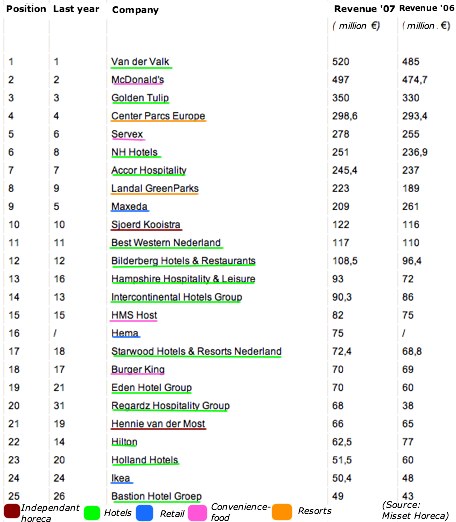
You can see the complete top-100 at Misset Horeca.
 I'm thinking about adding another "interlude" to my collection, inspired by ADD without a doubt. It's the cookerlude, baby, aimed at collecting thoughts and notes on cooking in order not to forget and to better understand the world that a cook goes through. While I cook nearly every day, I don't consider myself a good cook. I simply don't have the taste-buds for it; but I do love the good food, which, luckily, my gut no longer shows!
I recently discovered a podcast, called/by The Restaurant Guys, which, apart from the insanely long commercials, actually seems quite interesting and is funny enough to keep my attention. Some notes.
Salt: So, we seem to have this internal taste-meter for the stuff, which in some ways is tied to the percentage of salt in salt-water. At the same time, our saliva actually dilutes salt in food, reducing it, meaning there should be a higher percentage in food than salt-water, for us to enjoy it.
Sugar: apparently there's no set limit for that, people love sugar (I must be the exception).
Salt + Sugar: whenever you make a sugary desert, adding a little(!) salt helps the taste; apparently they do funny stuff to each-other in your mouth, a party in your mouth, so to speak.
Taste-enhancers: apart from the above, olive oil, mushrooms, garlic, tomato-paste, alcohol (and much more) enhances the taste in your mouth.
Pretty basic, no? You can listen to the whole episode on what (American) people like in their food, here.
My own world
(This is where I talk a little about what I discovered myself in regard to cooking. Pretty basic too, so I'll try not to embarrass myself.)
I'm a big fan of salads, I make and eat one nearly every day as a meal. I often use canned tuna, but I recently discovered salmon in a can, which tastes better, is less salty, healthier, and costs about the same here in the Netherlands.
But steamed salmon is the best. You can get an expensive steamer, but a cheap solution is a microwave-steamer. I found one in a Chinese store for about €10, you can steam whatever you want in 5-10 mins and it magnifies the taste. Add some green beans and carrots, and you got a great salad for a meal! Add some potatoes or rice, and you won't need the salad.
Last, but not least, sometimes, not always,Ketchup actually makes for an interesting dressing (together with some oil and spices). It often contains vinegar, which salads like, and the tomato mixes well with the salmon-taste.
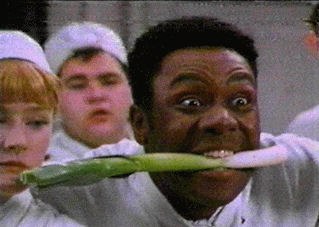
That's about it for today, I'm not sure how often I'll repeat these cookerludes, but I hope you enjoyed it! The picture is of course of Chef!, the show.
 When I started this blog, and my general thoughts about the area of food & retail, it was all about the people. A quality staff and happy customers, what more do you want? And I have to say, from past experiences, that I don't really like businesses that don't place people first.
For instance, one individual I worked with, suggested using handicapped people to put together a product manually. I instantly disliked him. Not that I don't want handicapped people to be productive, but it was the thought behind it; to find a "stupid" workforce, which you can save tons of money on. It was just distasteful.
Another company I worked for was very process-orientated.
There's nothing wrong with that of course, but it was a big company with a reputation for innovation and that is why I joined. And you expect such a company to at least push forward a solid project. Well, as it turned out, the organisation's core-strategy was to start a large number of risky projects and have them compete with each-other. Those that would fail would simply be abandoned, and their staff was expected to fall on their swords… metaphorically. The effect was an incredibly high turn-over of employees, all three projects I worked on no longer exist, and it deeply soured my feelings about this company.
Both these examples, to me, represent a lack of respect for the human element. I realise that business is a hard world, but if projects were designed to be solid in the first place, there would be less of a need for these kinds of practices. Just my 2 cents.
Part 2 - the challenges that people businesses face
HBR (Again! I'm sorry, but I read a lot of HBR-articles!) published an article about people businesses some time ago, which I enjoyed. Following are some notes + thoughts about it.
- People businesses are defined as: "operations which are characterised by 1. high overal employee costs, 2. a high ratio of employee costs to capital costs, and 3. limited spending on activities, such as R&D, aimed at generating future revenue."
- In a top-40 list of people-businesses, published in that same article, only a few qualify as food and/or retail related. These are the Hospital Corporation of America, Tenet Healthcare, Marriott hotels, and Accor hotels.
- For instance, a business like McDonalds does not classify as a people business; it has substantial assets in terms of brand & real-estate, and relatively low people-cost.
- People-businesses face a number of challenges, related to performance measurement, people-management, compensation, and business models.
- Measuring productivity is more important in these businesses, then other economic performance indicators, like return on assets or investment. The challenge is finding the right indicators (employee productivity & profitability), as well as benchmarking it against other companies (employee figures do not always need to be made public).
- To manage people, you need to align employees' interests with business objectives & execution. And you need to find ways to measure performance (see above) continuously and see where your weak spots are.
- Compensation is key, as productivity is very sensitive to it, and is a primary determinant of shareholder risks & returns. Other factors to consider are variability—productivity varies across the workforce and how do you get the most out of a diverse workforce—and reach—sometimes the lowest on the ladder are as, if not more important to a firm's performance, and how do you motivate these people to do their jobs as good as possible?
- There are a number of business models are used in these types of businesses: pricing per hour is a safe method, but does not account for extra performance; a fixed price per output allows companies to shave costs off the inputs and thus increase their profit-margins. It is very susceptible to a high-skilled workforce; a success-fee or commission offers the best returns, but also the greatest risks; some companies use a hybrid of these three.
- The strategic weakness with these types of businesses is that your assets are mobile and can walk out the door. By creating value above and beyond your employees, you can diversify some of that risk away. Of course, you could also try to keep your employees ;).
I guess it's up to individual businesses how they want to measure their firm's performance. The most straightforward is certainly return on assets or investment. But even that leads to some question-marks, particularly in today's highly software-based economy, where assets are no longer as necessary, or pricey, as they once were.
For my part, I still think that people are a key-asset to a business, and it's interesting to look at how exactly you motivate a workforce and get the most out of them, as well as how to overcome the challenges related to a people-based business.
Equally interesting is how to align the business-model to match the needs of your assets—the people. Since people are motivated by (financial & non-financial) compensation, do you keep the pay-rate aligned with time-spent; fixed; aligned with performance; or a hybrid of the three? I think the hybrid is always the best choice, but even then some combinations work better than others.
And retaining employees is also an interesting problem; though much less so in countries like France, where getting rid of them is a problem, and differently in places like Silicon Valley, where inter-firm mobility is a key-requirement for many employees. I think the solution is completely personal and cultural, and everybody's answer will be different on this.
The picture is courtesy of prairienet.org
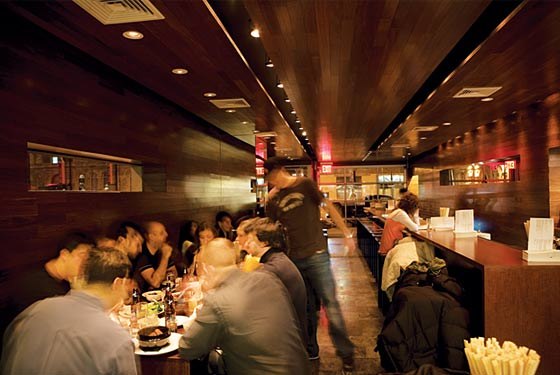 The reasons to love bookstore-cafés is that you get a chance to discover new stuff to read. The reason to hate my particular café is that, every week, even when I ask for a *normal* coffee, the waitress continues to regurgitate the same phrase: "will that be a large of a small?" Anyway…
I read a nice article in the New Yorker today, about a stressed out restaurant-entrepreneur called David Chang, who runs several noodle-bar-styled restaurants in New York City. The Yorker's articles are always so long, but it was a captivating article. I took some notes, which I'll share with you now.
- Waiters make way more money than chefs, simply because of the tips; the figure mentioned was $1700 per 32 hours vs. $350 that chefs make. Turning chefs into waiters, which seems like a logical decision in a noodle-bar, comes with the challenge that these types are not always that domesticated (can't help thinking about Chef! here).
- The front-end of a restaurant—servers(?), the set-up, beverages—is relatively simple (compared to the work that goes into cooking) and can be consolidated across multiple restaurants.
- Personal integrity in cooking—e.g. cutting fish-cakes properly, even though the customer won't notice them in a bowl of ramen—is the difference between a quality-restaurant and a McDonalds or Uno.
- Standards: A piece of chicken can taste wonderful to a customer, he won't know why, but it's actually because it's been prepared (marinated, dried, etc.) for more than 24 hours.
- Quote: "The great thing about fast-food is that you could sell out without worrying about it, because fast-food isn't pretentious and selling out is in the nature of the business."
- Quote: "Cooking is honest work; gives you a way to measure yourself."
The thing about restaurants is that I'm painfully ignorant about so many things going on in that world. Cuisine is like art—it's dynamic and filled with critics. For instance, there's the "foam" trend, mentioned in the article, hot in the 90s, but which I never heard off.
For me, I'm always interested to find out more about this industry, because I want to be part of something that produces culture. But I'm constantly thinking about whether it's wise to enter such an industry without a basic familiarity. It would be like me entering the tech-industry, without being aware of open-source, how to write code, or do project-management; it's just not done.
Food for (mostly, my own) thoughts.
Cooking is ingredients!… it's timing!… it's cleanliness!… it's… … …restraint!
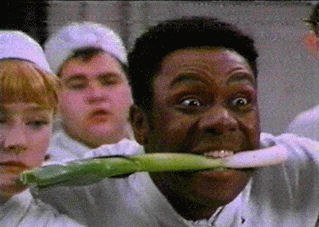 These are just a few of the tips that Gareth Blackstock, chef at Le Chateaux Anglais, and lead character of the British comedy-series "Chef!," delivers to his staff in a kind and gentle manner… not. Even after re-watching this show 10+ years later, I'm still not sure whether Lenny Henry's portrayal of the angry chef is meant to be a realistic, or rather a satiric look at what goes on in these kitchens. The effect it's had on me, in any case, is one of silent terror when I think of kitchens in 2-star restaurants.
There's no denying that, generally, the world of HoReCa consists of flat hierarchies; there's the boss, either the head-manager and/or the head-chef, followed by some type of administrative class of underlings, and finally those that Gareth Blackstock likes to call
"There's the aristocracy, the upper class, the middle class, working class, dumb animals, waiters, creeping things, head lice, people who eat packet soup, then you.."
If you're thinking of high-tech start-ups in the IT-world, multi-star restaurants are their equivalent in the HoReCa-world. Competitive advantage in technology comes from both products that are differentiated enough from the competition and processes that enable a business to produce these products at a sufficiently low cost and high scale to reap a profit.
In restaurants, this is embodied by the chef, whose training, experience, personality, and, I guess, raw talent, inspire fear in all of those around him, especially the ones that feel his wrath. It is an innovation machine difficult to replicate, comes at a high price and is not for the faint of heart.
Everything else: coming up with a business-plan, talking to investors, setting up the site, buying the materials, hiring the people, getting customers to visit, etc.… seems easy, compared to finding, keeping, and managing a good chef. Because as soon as the chef finds out that he is the one that keeps the ball rolling, he is the vital cog in the machine, he will likely fire you as a boss and replace you with one of those people, generally found under head lice and packet soup.
So there you have it; I don't write about cuisine, same as people generally don't think about starting a business in space-flight. They are both sciences reserved for an elite pioneering-class, one that is fearless and willing to risk the laws of nature in order to succeed.
5 links - cool vs. tech, touch-screens, women, pizza, & bookstores
0 comments Posted by Unknown at 12:09 PMMan, I collected so many links, that I'll probably have to write three updates to cover the most important ones. We've got a lot of ground to cover, so let's get started. You can find my previous coverage on interesting links from the web, here, and my continuous stream of bookmarks, here.
Link 1: On Magnetbox - Correlating cool with tech - With pictures like the one below, my work on this blog is really done. Interesting is the rise of computers vs. dance & hip-hop music (both of which are hugely benefiting from the cost-savings made possible by PC-based studios. (A note: low industry-barriers = high chance of suckage!). Also note the fall of art, after the colour TV was introduced. Kottke also made some comments about it.
Link 2: On BuzzFeed - Touch-Screen Ordering - BuzzFeed presents us with some stories about automatised ordering. There are both advantages and disadvantages, I think. Good is that it minimises errors in ordering and can interface well with back-office operations, such as ordering new supplies. It might also fit with the individualistic preference for self-service, I wrote about before. The disadvantage is the cost and the margins of error that information systems bring (I still shudder at the thought of the LAS disaster (pdf)) + the lack of the human factor. Martin Kunzelnick (German) links to some videos of Microsoft's Surface in a restaurant-environment.
Link 3: On Lightspeed Venture Partners - It is no accident that Typhoid Mary was a woman - Although it's a horrible-horrible title, and perhaps an obvious point, I've been coming across many stories about the social qualities that women possess, making them better at PR, marketing, sales, relationship-building. Something to keep in mind for any people-based business.
Link 4: On Reuters - Pizza Hut rolls out nationwide mobile ordering - A news-item (finally), and I'll probably delve into this topic sometime in the future. Arguably, Pizza Hut has been pursuing a different strategy from pretty much 98% of the pizza-restaurants out there. I'm sure that there is considerably brand-loyalty towards Pizza Hut, which will give it an advantage over delivering pizza-franchises, HOWEVER, it will probably be competing on price, which the franchise has not done so far. I'm not sure how that will affect their brand at all, but it's something to keep an eye on.
Link 5: On WSJ - Who's Buying the Bookstore? - arguably, there are few retail-outlets that evoke such an emotional response as bookstores. I find them comforting, and very similar to churches, in the way that it really is expected of you to be silent while browsing (on a side-note, I discussed a link of Dutch bookstore being opened in a church before). It's also a symbol of a community, as WSJ points out. Well, with competitive pressures from Amazon et al., these types of stores are clearly disappearing, or changing into hybrid monsters, which smaller stores can no longer compete with. WSJ points out a phenomenon related to that community-spirit, which is very touching. Capitalism isn't everything, particularly in places that target the softer pleasures in life. I'll have to reflect more on this, as I'm very attracted to these types of stores, and would love to set one up myself.
That's it, for this week. I'll see how I'll catch up on the rest of my links, but this went great (took 20 mins), and I always enjoy re-reading my bookmarks. I hope you do too.
 I've long been interested in the idea of franchising, though I'm somewhat conflicted about how to look at it. One the one side, it seems* like a relatively easy way to start a business, on the other side, it seems* a relatively cheap way to grow your business (*: within limits).
WSJ recently published an excellent study on high-performing franchises in the US. The choice of franchises is extensive, just like I concluded in my post on top-German franchises. At the same time, the most apparent choice, that of food, seems less and less attractive, and I quote from WSJ:
In particular, fast-food and casual-dining businesses, while still showing strength, with eight names on the list, also are facing pressure from wage and food cost increases. To lower operating costs, several food franchises already are shuttering some locations.Arguably, a business that is thinking about growing through franchising is faced with some restrictions. Writing a franchisees-manual is a scientific process, you'll probably have to restrict the complexity of operations so that they can be replicated, and there will still be some overhead related to managing the brand and some of the more problematic franchisees.
I think that it is that standardisation of operations, made big through the economies of scale so easily achievable in the US, that is bring competitive problems to chains, even to wholly owned ones like Starbucks. If your core-product is simple, and your business uses a simplified operation, then how hard is it for your competitors to replicate your whole business-model and -strategy in the long-term, really? It is only if your business strategy includes complex competitive advantages, such as extensive vertical and horizontal integration across the value chain, and/or if your business-model is based on "high-tech" components or processes, that you have a real chance of beating the clones. And to relate it to the rising operating costs, mentioned above, business with true competitive advantage can raise profit-margins or off-set the costs elsewhere, instead of having to close operations.
But ok, long-term strategic considerations aside, I see franchising is an attractive way to enter the business-world as an entrepreneur. The question of whether it's faux or real entrepreneurship, is not pertinent, I think. Considering that you have a wide range of choice of franchise-business opportunities, you'll still have to work hard to succeed, and the growth-opportunities can include starting multiple franchises also, it is not that different from starting any other kind of business. In my mind, I compare it to internet-entrepreneurship, which also relies on a large amount of free tools and distribution-mechanisms, but is still dependant on that special something for it to be successful.
What makes franchising particularly attractive, is the decreased amount of risk. According to a study in the Netherlands, 65% of franchises are still standing after 3 years. Compare that to independent start-ups, of which only 15% are alive at that time.
A large cause is, I'm sure, the level of support from the parent-company, which differ from business to business, and can include delivery of goods, marketing, administrative and IT services, made cheaper through centralisation. And they are frequently guided through the process of setting up and running the business, including legal advice. In exchange, they give away either a percentage of profits (ranging from 5 to 40%) or a set monthly sum to the franchiser.
The WSJ-article also lists the amount of investment typically needed to start a franchise. It ranges from ca. $5200 for an automotive company, to a staggering $1,3 million for a steakhouse. Of the 25 franchises recorded, only 5 received some kind of financial assistance (none of which in food). Another article at WSJ discusses some of the attitudes towards financing franchises, particularly during the current US-recession. Incidentally, another article in Dutch Elsevier magazine, sees franchising as an excellent way for businesses to grow during a recession, as it requires less human costs.
All in all, it is probably a safer way to start a business, though with all the points I made above, I don't think of it as 'light' entrepreneurship. There's clearly a lot of risk involved, beforehand, in terms of choosing the right franchise with growth-potential, financial risk to fund your business, market-risk, when you launch, and competitive risk, after your up and running.
I still want to discuss this topic further at a future date, particularly focussing on what its like to turn your own business into a franchise, and some other stuff related to buying into one.
The picture is courtesy of friendlyfranchising.com
I'm currently working on a wrap-up of what I wrote about in months 3-6. It's usually a monthly tradition (see months 1 & 2), but this one is extra long and taking me some time. Apologies for the silence this has been causing this week.
One of the things, I'm working on is a work in progress, a map of the food-industry. Step 1 is to identify the individual segments, which, I should note, are probably transferable to a great number of industries. Future iterations will include identifying specific companies in each segment, as well as sub-segments, and specific segment-pains also. 
- Segment 1 - the production of raw materials: This can involve anything from growing coffee-beans, to potatoes, to rubber and trees (later used for packaging). Some vertical integration with segment 2 and perhaps 3.
- Segment 2 - the production of consumer-goods: The activities here involve sourcing raw materials and producing them into goods, ready for retail. From my understanding, there are a number of super-producers (Unilever, P&G, etc.) and more specialised ones. Some vertical integration with other segments, plenty of horizontal integration also.
- Segment 3 - retail: A diversified segment, consisting of super-markets, specialised stores, and hybrids (which combine retail with other services like music, etc.). Some vertical integration occurring, with e.g. private labels, and large franchises like McDonalds & Starbucks that communicate directly with segment 1.
- Segment 4 - consumers: too diversified for me to summarise at this stage. What I do note is that the reach of customers is increasing up the value chain: organics, enviromentalism, etc. are all signs of this.
- Sub-segments - marketing & logistics: It has been my observation that the degree that these are externalised depends on the resources available within and the complexities of the tasks. What I also noticed is that it's the supplier, not the buyer, that takes care of these things. And finally, that it's segment 2 that is usually responsible for marketing their products to segment 4, the consumers. I expect that something similar is or will be occurring from segment 1 to segment 4, to address concerns consumers may be having about production-methods.
- Meta-segment A - regulation: It has been my observation from my thesis that the government is a factor at pretty much every stage of the process of bringing a product to the market. It is a tool both for consumers, for larger interest-groups, and for businesses to stimulate change within industries, with all the consequences that has. Again, regulations pertaining to organic & green production-methods, as well as human rights and memberships of trade-unions are just a few of many factors to consider here.
- Meta-segment B - optimisation: This is where I would place consultancies, which are super-specialists aimed at improving processes in and between organisations, but also aiming at customers who are having more and more information at their disposal, more cash, and more complex needs.
I'm hoping to finish up my wrap-up by this weekend and that it will be business as usual next week.
The service-paradox - on self-service and customer-retention
0 comments Posted by Unknown at 11:31 AM Every now and again, you come across something that changes the colour of your perception, that allows you to see the world in different ways. One such moment happened after reading a chapter in the IKEA-book, I wrote about before (1 & 2), on how the customer is deeply involved in the logistical process and the effects and cause of it.
As you may, or may not know, when you shop at IKEA, you generally go into the store, choose the furniture you want, pick up the already-boxed version of that item, put it in a cart, pay, drive home, and assemble it with some tools that are in the box. All-together, the customer at IKEA does 80% of the work related to sales.
I had read, in my bachelor, I think, that the reason that IKEA introduced this system was because of when it first opened its store, there was such a mass of people that their staff couldn't handle it, and that they then just decided to let the mob do all that stuff. I thought that the reason that system remained was cost-saving; I mean, how cheap is that to let customers do all that work for themselves, right? Well, that's definitely a reason, but only part of the story.
The other part is the effect it had on customers. Because you always ask yourself, why would someone go through that, when they can just pay the store a little extra for the transport and the assembly? And that's where it gets interesting.
To start, IKEA, even though it offers low-cost goods, is well-positioned for the middle-class market. The stores are outside the city, and pretty much all their customers have cars, which they can use to transport the furniture back home. I'm not 100% sure if this was by design or a consequence of other factors. But at the very least, the conditions for making the customer part of the logistics process are in place. Still, you kind of wonder. Aren't these exactly the people that could afford a little extra service?
The explanation is culture. Western culture, you could argue, has seen a shift towards individualism. People are over-informed, over-serviced, over-indulged. Sales-clerks and waiters can't wait to throw themselves at you and ask you if you're happy, if you want another…, and another, and another. It's exhausting, both for the store and for the clients.
In comes this place, which tells you, very Scandinavian, here… go do it yourself. Like a party, where you can mix your own cocktails. Where you control what goes in and what comes out. And most of all, where you get the feeling that you are part of a productive ecosystem. It's the good kind of stress.
The book quotes some sociologists, Robert Jungk and Ivan Illich, according to whom, a society which receives too many services, where every screw has a handyman, is a broken society. Services, they say, destroy activities. For every small chore, you can call an expert and let them do work that you actually do yourself. On a larger scale, services destroy the entrepreneurial drive. Also Thomas Düllo, according to whom, we live in a world of indirectness, and because of this, it's very exciting to be asked to do something. A French student was also quoted, calling IKEA: "Lego for Adults."
And there are definitely signs that suggest that society wants to move into another direction: open source, Wikipedia, Make-magazine, do-it-yourself, self-help, etc. Probably even blogging. A collection of niches to be sure, but growing ones.
Ever since reading that chapter, I sit in restaurants, stores, etc. and wonder how this principle can be worked into their or other businesses. For instance, is the take-away coffee part of it, or McDonalds' policy of throw-it-away-yourself, or Amazon. All of these "features" cause both a downward-shift in the bottom-line of "service" businesses, but they also remove the "service." And these businesses are unarguably booming too.
But I also wonder which services can be removed, and which shouldn't. More on that when I have the answer. Or perhaps you have it yourself? Let me know in the comments.
The picture is courtesy of Marco.org
 One of the downsides of not being at home for three months is that the mail tends to pile up. The culprit is The (weekly) Economist, which forced my landlord to dedicate a special cabinet just to accommodate them all. He was happy to see me.
My thesis is handed in, and while I'm anxiously waiting for the feedback / grade, I'm doing a variety of stuff to diffuse the thesis-haze that was in my head these last months. One of these is thinking about how I will organise the research that I collect for my work / blog. This is part of a dual trajectory I'm pursuing—one side is research, which I use to build up my knowledge about the field of food & retail, the other side the practical path, which I can now finally pursue freely.
The pile of 15 or so Economists is actually a good exercise to think about what really matters, and I'm going through them quickly, marking the articles that are interesting to read, and later cutting them out and adding them to special folder, after which I may categorise them by country and subject perhaps.
It's easy with The Economist, but there other publications that I'm much less eager to chop into pieces. My books are filled with pencil-marks, as are my Harvard Business Reviews, but there's no way that they'll ever feel the cold blade of my scissors. With those publications, I'm forced to keep all that extra paper and try to get my thoughts to paper as quickly as possible.
The other, sort of, complication are web-articles. I've been printing stuff to pdf and have a special S+FNR folder, reserved for anything from fashion-trends to human-resource management. I'm also going to print them out and add them to my folder for future analysis.
As you can see, I take my research seriously. A probable after-effect of writing a 180-page thesis, studying three academic fields—innovation, entrepreneurship, and finance—and interviewing roughly 300 businesses.
But I wonder how the real bloggers do it. If you're someone who takes blogging seriously, how do you organise your material, or do you organise it? If you do so on paper, I'm curious as to what kind of folders you use (incl. a link to a photo if possible).
Note: If you use a computer to store stuff digitally, I assume you use a personal database, like Devonthink or Jojimbo for the Mac. I'll tell you right now, I've used them all (to organise my thesis) and found it frustrating that they wouldn't do everything I wanted and tried to lock me in in the process (I've spent many hours migrating everything from app to app—it sucks!). They also don't help you much with paper-based materials, like mags, journals, and books. No, on the computer, I prefer a regular folder and to add text & pdf to it. Simple, portable, and cross-platform.
- For Technology, it's arguably Waste-disposal (I'll be writing about this soon on TechITEasy)
- For Media, it's finding a Business-model to compete with free.
- For Food, I would say it's O B E S I T Y.
And yes, I'm back! My 180-page thesis (or 135 at font-size 9) is being checked, and I'm in Rotterdam picking up the pieces of my life and making a delicious milkshake… whoops, I meant a yoghurt-smoothy… gotta watch that diet !!!
 Hello,
In this piece, I am planning to discuss my current thoughts about my thesis, this blog, and my plans for the future.
I suppose, to a great degree I like to be a focussed person. I like to have goals, pursue them, and not get too distracted by things. It's kind of a silly attitude, because life is an exercise in overcoming distractions. As Fred Wilson wrote recently about something that Dick Costolo, co-founder of FeedBurner, said:
"A startup is the process of going down lots of dark alleys only to find that they are dead ends. The art of a successful deal is figuring out that they are dead ends quickly and trying another and another until you find the one paved with gold."I love that quote and I think it's a great attitude in life as well.
But, as I said, I love planting myself behind a project and shutting the door to everything else. I tried doing this here, 8 days ago, and, as a result, underwent a pretty amazing productive period since then. So what are my plans for my thesis?
My thesis on funding high-tech start-ups
As I said, 12 days break, which would give me another 4 days. Truth be told, I have to add writing a conclusion, writing mini-summaries per chapter, an executive summary, and editing the whole thing into the mix, so I will like likely be busy for another 10 days after that. The nice thing about conclusions is that they are already in your head, summaries happen automatically as you edit a piece, and editing is a perfect all-nighter activity.
The not-so-nice part is that we are currently at 150 pages of material, which would more or less make my thesis a book about innovation, entrepreneurship, venture capital, and incubators.
2 thoughts:
- One of my thoughts is to edit it down to a reasonable size and publish the whole thing as a pdf.
- A second thought is that as I write summaries per chapter, I might as well turn them into blogposts about innovation, entrepreneurship, finance, and incubators, and publish them in the form of regular blogposts on Tech IT Easy.
Which brings me to this blog…
The status of (my blog on) sounds + food and retail
The funny thing about this blog is that it is interconnected with my life. Random readers may think this is a nice (or not so nice) blog about subjects concerning music, food, and retail, but it is in fact, what I see as, one of several stages towards forming a career and a business (or series of) in this industry.
So my head has not stopped thinking about this subject, and I've actually been making summaries about interesting topics, and thinking about the shape of things to come. I cannot interrupt this blog too long, at the same time it is reassuring (to me), that even though my publishing took a break, my mind did not.
Concerning this blog then, I will be back and I already have a huge backlog of material to publish here… looking forward to that!
The status of "real life"
As I speak with friends and strangers about my ideas I also realise that there is much that remains to be done in "real life" also. I believe everything starts with a good business-plan with realistic assumptions about what you want to set up. It is the ultimate "social object" towards getting my plans in motion, convincing partners, investors, employees to work with me.
Questions I have received so far include:
- What type of place do you want to set up? My answer has so far been: probably a night-venue, a restaurant or night-club, or something in between (this may come as a surprise to some of my readers, as I write a lot about retail). Ultimately though, I want to set up a successful venue and am flexible on the format.
- Where do you want to set it up? My answer: I'm flexible, but it depends on where I feel most comfortable to set it up.
- How are you going to fund it? My answer: I'll need to save a bit, but I expect my first business to be sponsored, probably over 50%, and will look for suitable working partners also.
- When do you want to set it up? My answer: 3-5 years from now would a realistic number in my mind.
- When do you want to exit? My answer: Depends on how much fun I am having, as well as other factors. I see myself as both a serial entrepreneur and someone who wants to create great things, and I'll have to find the middle-path between both.
Final thoughts
First thing first. Finish my current project, get a degree, close this chapter of my life.
Intermediary thing, publish blog-posts when I can and want to, in between.
Afterwards, blog more, look for a cool job to gain experience, contacts, and cash. I also want to travel for a bit through Europe to decide on a suitable location, check out different formats, and brainstorm with friends.
And then, take the plunge.
So, à bientôt, I hope!
Vincent
Metaphor: I am the bunny or rather my thesis is. Everything is progressing well, but of course it's a lot of work. More when I'm done.
(via Kottke)
5 links to let people know I'm not dead:
- How to choose a name for your product / service / business by Scott Trimble - not much to say about it, except it rocks.
- The 8 challenges innovations face by Scott Berkun - there's so much talk about how cool innovation is (flying cars, anyone?), and very little about how hard it is to actually bring it to the market. Exactly the topic of my thesis, btw., mostly focussed on Scott's point 3: "Find a sponsor and funding".
- The 2007 Esquire 100 has some awesome food-related stuff. Namely on Luxardo, Sechuan buttons, New Texas Cuisine, Rum, shrinking cocktails, The Best Breakfast in America (mmmh looks good!), Washington Wine, and other cool stuff.
- Understanding Web Design by Jeffrey Zeldman - "Web design is the creation of digital environments that facilitate and encourage human activity; reflect or adapt to individual voices and content; and change gracefully over time while always retaining their identity." Kind of applies to designing other kinds of interactive environments as well (don't shoot me Jeff).
- Wal-Mart’s Environmental Report Card (NYTimes) - the point is that Walmart is continuously increasing its competitive advantage in the area of green tech, which is sure to affect businesses bottom-line in the future. So get busy!
 A few months ago, I wrote about Starbucks' vertically integrated strategy. This morning, i wanted to link to it, so I did a Google Blog-search. Usually a search for Starbucks and "vertical integration" would yield my blogpost first, but now it's the no. 2 result.
Somehow, the net has started discussing why Starbucks had a corporate strategy that involved owning all of its subsidiaries and Subway's strategy went a different way.
There seem to be a number of theories on the market. Namely that Starbucks
- … cares less about cross-store cannibalization
- … has a higher need for monitoring
- … relies more on “impulse sales”
- … has higher profit-margins
Some good posts about this are written here and here (both by Josh Wright), here (Stephen Bainbridge), here (Keith Sharfman), and here (Paul Jaminet)
All excellent theories in their own right, and all very rational. However, in my experience, people, and we are talking about people here, often don't behave rationally (at least not as rationally as economic theory dictates). Instead they behave in ways that they are able—either through innate capability or through their environment.
Starbucks did not start as retailer, it did not even start as a store owned by Howard Schultz. It was a coffee-bean roaster and vendor. Its aim was to educate the US-population, which was—according to Schultz—a wide open market in terms of high-quality coffee. Schultz, who first worked there as an employee, started an independant coffee-chain, and only a few years later took over the Starbucks-business (incl. the roasting factory) and the brand-name. But the core-idea remained that it had to deliver quality-products and quality-education to its customers. Along with this, Schultz was highly educated, had plenty of work-experience, and venture capital behind him.
Subway started as a retailer. According to the history, published on their site, Fred DeLuca started Subway's as a 17 year-old and $1,000 starting-capital. Subway had, as far as I know, no world-changing mission. It was a sandwich-store, one of many, and one of it's key assets was to be more efficient and qualitatively better than its competition.
I still think that the stories of these two men, their business-idea, and the environment they started it in, is the key-deciding factor of why one decided to expand wholly-owned and the other through franchising. I haven't studied Subway, but I have McDonald's, and the same dynamic can be witnessed there.
Now, you can go all "economic theory" on this, and focus on points like that coffee is a product that requires much more monitoring than sandwich-ingredients. And I think that's completely correct. Not to mention that Starbucks has a very different employee-based strategy than Subway—they like theirs to be smart and pay them well. And I also think that due to Starbucks's high real-estate presence, franchising for them has become an unfeasible solution. But I think the first two factors are the cause and the latter is the consequence of Starbucks's wholly-owned strategy.
When you start out, whether to franchise or not is a completely personal decision. It comes down to how comfortable you feel about whether you can offer your customers the highest quality possible, while maintaining healthy economic growth.
And your initial decisions will clearly have some kind of lock-in effect later on, which is something I only realised after reading the linked-to blogposts and writing my own.
 It's perhaps a curious thing to say, but I think a lot of things in life depend on semantics—the meaning of words.
I should actually be calling my blog "Horeca & Retail" Blog, just because the word horeca describes what I want to do so much better. Horeca is an (Dutch afaik) umbrella-term, that describes the businesses mentioned in the title: hotels, restaurant, and cafes.
I picked "food" instead of horeca, because I couldn't find an English term that described what I wanted as well. There's restaurants, gastronomy, cooking, catering, cafes, etc. but all that is too specific. Incidentally, if a knowledgeable Brit, American, or international happens to know an anglo-term as suitable as Horeca, please let me know!
Whenever I discuss my business ideas with my dad (much more inspiring than any internet-based research), we don't talk about food or retail. I begin with that, because that's what I cover in my blog, but the conversation always evolves to how to run a café or some other kind of drink-related entertainment-venue. In other words, we talk "horeca."
Here's some stuff I learned from him (he used to own some bars and cafes):
- Try to imagine your place as a theatre - you're putting on a show every night.
- Personality of ownership is important - whenever he was active in this business, he tried to look for good partners: people who understood this world and had certain social qualities.
- When looking for investors, look for breweries - this is something I'll have to research.
- Location is not the top-priority for a horeca-venue - people will come if it's worth it.
- Horeca is a troublesome business - somewhat of a general statement, which I hear from a lot of people. Basically, it suffers from weird people-related issues—lot's of stress, lot's of alcohol, terrible working-conditions, funny contractual agreements, etc. And lot's of businesses go bankrupt (well, what else is new).
So, over the next few months, next to continuing to cover certain, universally applicable, retail-topics, I'll try to find out more about how to run entertainment-venues.
 This week, I seem to be taking somewhat of a personal angle, where I express my own views, rather than report and analyse those of others. I'm not sure if this is good or bad, but, after reading Fred Wilson's view on it, I think it's sometimes necessary to instil some personality into a blog.
One thing in life that I am very sceptical about is marketing, and there is one particular kind that annoys me the most. I call this argumentative marketing, and I define arguments as:
Constructing a logical set of information, meant to replace the logic present in the mind of the audience.In other words, arguments often serve the purpose of distracting or confusing the person or group they are targeted at.
That it is not meant as arguments not containing any information! No, I think knowing that a knife can cut through a metal can of food is quite interesting! But if I were a chef and all I wanted to do is chop vegetables, and I already had a perfectly good knife, this information could also be considered distracting.
Arguments are very prevalent in our global society. Not only is advertising the number one business-model in on- and off-line media, but there are quite a number of jobs centered around constructing arguments. Take students, lawyers, politicians, consultants, marketeers, sales-people, a certain type of manager, etc. And let's not forget bloggers!
And I think the market for arguments, people, is quite saturated with them also, meaning that the value of arguments is constantly decreasing.
As always, this means that other opportunities open up, which some marketeers are already exploiting. Let's not market at all!
One way to do that would be to simplify the argument to the essentials. Have the product or service itself tell the story, by illustrating clear and simple values, which customers can grasp and share with the rest of the world.
Examples are:
- Google-search: just search
- iPod: 1 button-play
- Fast-food: colourful, good-smelling food and drinks, easily accessible (there does seem to be a trend towards more info, but I'm seriously doubting that it will last, or that it matters to 98% of customers)
- Amazon's Kindle (still sceptical): one click shopping anywhere (in the US)
- And, last but not least, the lack of title-sequences in the series "Lost," and pretty much any movie or series afterwards!
The picture is courtesy of allaboutadtips.com
 A blog is a service—both to me, and to you, the reader. To me, it serves as a way to collect a large amount of information, and, more importantly, process it so that it stays in my brain. The better, and more focussed the information is, the more it helps me, and the more it becomes useful as a general information-source for you too. There are a couple of specific goals I have, which will certainly affect the status and value of this blog. These are, as follows:
1. Develop a framework of how everything in a food- and retail-business fits together
The reason why I write about a large number of topics is because I see any business as system or a machine made up of a number of components. I need to think on four dimensions: the business-components; the value chain; the past, present, and future of this industry; and how people (incl. me) fit into the picture.
Implication: This simply means that my broad coverage of topics will continue, but that the implicit understanding is that it all needs to fit into one of these four dimensions. It also means that, in addition to researching these topics, I need to start converting the broad framework I have in my mind, to paper.
2. Gain practical experience
I see this on two levels. One, I need to seriously understand the process of retail or food business from start to finish. The best way to accomplish this is to learn by doing. This can be achieved in two ways: the more logical one would be to work at a business that offers a good amount development opportunities—allowing me to see many aspects of that business; and eventually I see myself starting my own business also. The second reason why practical experience is important is reputation. This business in particular is pretty resource-intensive. To start a business you need to have access to a good network of people, and investors. Both trust you more, the more practical experience you have. Put your money where your mouth is.
Implication: This is still some months off, because I still need to finish some business before that. When it does happen, I think it will affect the blog in two ways: one, I will have less time to blog. And two, I will have more practical data that I can share (within reason).
There is a third point—starting my business and everything that involves, but that's a topic for another day. For now, if you have questions or comments about the above, feel free to share.
This blog will continue as usual for now. Expect a new post tomorrow!
The non-sensical picture is a few months old… until I get my camera back from the store (any week now), my ability to draw and and scan into the PC is somewhat constrained.
"The nature of water is that it avoids heights and hastens to the low-lands. When a dam is broken, the water cascades with irresistabke force. The shape of an army resembles water. To take advantage of an army's unpreparedness, attack him when he does not expect it, avoid his strength and strike his emptiness. And like water, man can oppose you."Tsung Yu in The art of war
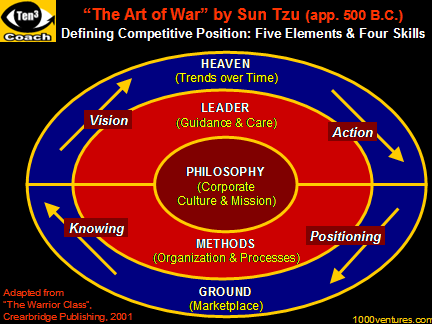 In my last article on the subject of real estate, I mentioned four areas which retailers must focus on: population, accessibility, competition, and cost. This was taken from the book Retail Marketing, whose author, Dr. Peter McGoldrick, taught me the subject some years ago.
 Of these four, the one I like the most is competition, as, like in the quote, it can be somewhat fluid, it's about people, and it can drive innovation. There's actually two ways to think about competition: as either a destructive, or as a synergetic force. I'll go into both modes of thinking, and hopefully looking at it through the lens of real estate helps.
The nature of real estate competition is quite complex. For one, it is hard to take into account indirect competition such as substitutes, and difficult to guess the response that your presence will have on existing retail outlets. In addition to this, all the other factors—cost, population, and accessibility—can affect your competitive potential. Say that you settle down into an area outside of the city, and a competitor decides to intercept customers on their route to you, by placing their outlet in a more convenient location. Any real-estate strategy has to take these possible contingencies into account, hopefully not allowing them to happen all together.
There are also different ways to think about market-saturation, and I expect most cities can appear fairly saturated nowadays. But not all hope is lost. For one, new business can drive old ones out of business. Second, large areas may contain local pockets which can still present opportunities. And third, new retail-formats (some examples here) can enable large superstores to still compete in smaller markets.
The issue of magnetism is another very important factor. Not all competition is bad, rather certain anchor stores, even if they compete with you, can drive a lot of traffic your way. Studies have shown that the presence of these anchor-stores can severely benefit your store's profitability. These anchors can sometimes be single stores, e.g. a Starbucks, or groupings of smaller stores, e.g. fashion, antiques, etc.
Similarly, grouping with other stores can severely reduce the cost of doing business (e.g. shared parking and security), and also act as a risk-reducing factor.
There should be some caution, however. While a study by Brown in 1991 (see book) showed that shoppers were 35% more likely to visit adjacent stores that were of similar type (vs. the dissimilar kind), this only applied to comparison and convenience goods, and more specifically to clothing, department, and variety shops, but not to retail services! And I assume that the latter includes places like coffee-shops and mobile phone-stores.
Hopefully, that was a little more concrete than my last introductory post on this. Of all things relating to entrepreneurship, the real-estate part is the one that is probably the most complex, and it would definitely be advisable to work with real professionals on this—though understanding the issues always helps.
The picture is courtesy of 1000ventures.com

 The
The 


