 Hey, a little busy at the moment, but here's some links, I've enjoyed recently.
- Jim Donald's, former Starbucks' CEO, month by Patricia Sellers (Fortune): After listening to an interview with Frank Addante on Venture Voice, where he said "Time is a finite asset!", I looked up "time-management CEO" on Google, and this is the first thing I found. Some good tips on meetings, getting up at 6, and generally managing your time.
- Monocle design-notes by Dan Hill: I printed this 32-page (!) document out this morning, and it will probably take me a few days to digest it, but I'm already enjoying the first few pages, where he writes about the vision behind Monocle as a mag. and as an internet-publication and how the multi-disciplinary team reflected this.
- 10 Ways to Improve Your Programming Productivity by Matt Moore: I love productivity-stuff, and think most of these tips apply to any activity really.
- The 7th Deadly Claim — “Best Value” by Jeff Sexton (Future Now): "The problem for most companies is that they don’t do BOTH well: Either they don’t do enough to persuade customers of the product’s value, or they price their high-quality item even higher than what they’ve been able to substantiate to the market."
- How Facebook Is Like Ikea by Tim Harford (Slate): Considering I wrote about something related a few months ago…
 The argument for mass-production is that it enables innovations to become cheaper and hence raises the general quality of life of consumers. The argument against mass-production is a more controversial one: that it destroys the unique quality of, let's call it, art.
Starbucks is a very good example of those principles. It brought a higher standard of coffee to the American masses, who, according to Howard Schultz's Starbucks biography, had long been oppressed by low-quality coffee from retailers and coffeeshops alike. At the same time, as the recent crisis at Starbucks illustrates, it has reached a saturation-point: it has brought Starbucks-outlets to every corner in the US, as well as spawned a whole army of competitors, and its brand has become diluted. It has become a commodity.
Back to their roots?
The re-enstatement of Howard Schultz as CEO is a signal, that the business has lost some of its original spirit and is in need of a guiding light. A letter that is rumoured (!) to be written by Schultz confirms that Starbucks will be focussing on re-introducing that original spirit, as hard as that will prove to be. There's only so much that you can change, after your company has reached a certain size. It would, at this point, be like saying that McDonalds is planning to become your corner-restaurant where everybody knows your name and favourite food.
The innovative angle
A friend of mine made me aware of a new coffee-brewing machine on the market, called Clover, which promises to deliver a higher quality coffee to consumers, though also at a higher price. According to Bruce Milletto, a retail consultant to the coffee industry, "a typical American café spends around $50,000 on equipment, about one-quarter of which goes on an espresso machine. At $11,000, a Clover costs the same again." Thus the investment-proposition is not an attractive one to the average cash-strapped café, who would have to spend that kind of money and charge an expected $6 per cup to recuperate that cost.
Following the rules of mass-production, Starbucks + Clover makes for a match made in heaven, and so it is: Starbucks has in fact acquired Coffee Equipment Company, the four-year-old Seattle-based maker of the Clover coffee brewing machine, for an undisclosed sum.
Considering that Starbucks has long been threatened by the commoditisation of coffee in the US, through the birth of literarily 1000s of new franchisers who, on the surface, provide the same value-proposal, though perhaps at a lower quality and price, it makes sense to acquire one piece of machinery that makes a bit of difference in the eyes of certain consumers. Considering the recent partnership with Apple, I believe that these consumers share a similar taste and price-insensitivity, and since that segment appears to be growing, I believe that Starbucks made the right call. They appeal to the type of customer that will pay $6 for a cup, and with their economies of scale, that price is sure to drop to a slightly more acceptable level of (I guess) ca. $5.
The cultural angle
There is another side to this. The USA is not the world, and while Starbucks has been thriving over there, the Europeans (I can't speak for other continents) have enjoyed a coffee-culture for quite some time. For people like my parents, who are respectively citizens from Southern- and Western-Europe, and avid café-visitors, they would not even consider going to the Starbucks in the centre of their German hometown, because there are plenty of alternatives with more atmosphere, more identity. To them, Starbucks is like a McDonalds, a franchise that in fact shares many cultural values—bringing a good to the masses—and does so by building ecosystems of services—from music-retail to the happy-meal—to deepen the (commercial) relationships with its customers.
Consciously and subconsciously, I'm a sympathiser of "unique" café-outlets. I like spending time in them, sometimes hours at a time, read my newspaper in peace, and enjoy a reasonably good coffee at slightly less than $2 a cup. I don't actually care about spending twice that for a coffee, but all the Starbucks's I've been too (exclusively in Germany and the UK, I must admit), have been so devoid of atmosphere that I don't really spend more than a few minutes there, 30 max. The only thing that does attract me about them and similar stores, is that I can grab a cup-to-go, mostly in the summer, and enjoy it out in the sun.
As a citizen of Europe, I think I am a fan of the heritage of the traditional café and don't really want it to go. If that makes me "backwards" or conservative, I am sorry. I want the chance to enjoy a Turkish coffee in Brussels, an Italian coffee in Cologne, or simply a Dutch one here in Rotterdam. I enjoy knowing the history of a pub that has existed for over a 100 years in Antwerp, and the same in Maastricht, or Amsterdam. I want there to be a diversity, and most important, I want that choice to be mine. I don't want there to be a cloned coffeeshop on every corner.
One of the saddest things I heard, while I was in Belgrade last year, was the exactly such a historical café was replaced by a chain (and the coffee stunk too); and I was equally sad to see that nearly all of the traditional retailers I remember from before the war had been replaced by a cloned shopping-centre that would've made any Western city proud: from H&M to Footlocker.
Opponent: Starbucks?
Globalisation is a situation we must all deal with. Its oldest proponents are the FMCG-companies, who are focussed on producing the same good for millions of people. The question is whether coffeeshops should embrace the FMCG-principles like McDonalds and Starbucks clearly have.
Starbucks is a formidable opponent: it is both a roaster, a retailer, and an FMCG-producer. It is strong in the US, and has a significant presence in the rest of the world. It will not go away, And not all believe that their presence is all that disruptive. I don't either, as long as Starbucks knows its limits. There are parts of the world that do not share the same qualities as US-towns. Some cities have long histories and places of heritage that should perhaps not be housing a McDonalds or Starbucks.
In a way cafés are stuck. They need the kind of innovation that Clover brings, but they are not in a position to buy their way in. If they did, they too would have to become mass-marketeers, in order to recuperate that cost. Instead they need to focus on what they do best, and coffee-machine makers to do the same and just license their technology. And whether the latter is able or willing to do that is the question.
I'm not sure how much Clover was acquired for, no one is. And I'm not sure how far Starbucks is willing to go to ensure their qualitative and quantitative dominance of the market. Will they grab every new piece of technology that promises to introduce a higher quality of coffee to consumers, keep it for themselves, and leave the traditional cafés to differentiate themselves simply by their "culture"? Sheer business-principles dictate that they will.
Howard Schultz made me believe, in his book, that it was Starbucks' mission to bring better coffee to the world. Let's hope that a richer coffee does not come at the price of a blander world.
This piece is in fact incomplete. Optimally I should write up a list of actions for coffeeshops to take. However, I am not yet that familiar with all the business-issues facing these organisations and all of my suggestions would be targeted at growing in size and battling on similar terms as a national or global player. And I'm pretty sure that many would not be willing to do that. So I think I'll wait until I have a more objective grasp—from all angles—on the situation, before giving practical advice. Feel free to provide me with that objectivity through your comments.
5 links - sense of smell, false green ads, farming boom, Lego, fun e-shopping
0 comments Posted by Unknown at 10:49 AM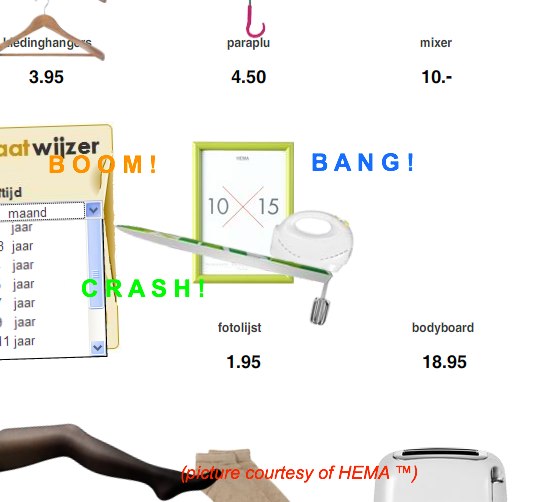 Time for those Sunday-links again. Today, I'll discuss the cocktail that is smell and how some things just don't mix; how green is not all it's cut out to be; a possible shift of power from retail to farming (or not); how lego came to be and where it is going; and how to sell me online shopping.
Previous link-discussions can be found here and my bookmarks here.
Link 1: Starbucks Admits Sensory Mistake - These are the kinds of stories that make me I like the NeuroscienceMarketing-blog. If you follow the science-section of the Economist, you'll know that neuroscience is a big deal anyway. In any case, this story is about how Starbucks designs atmosphere, largely influenced by smells. Apparently, smell of heating egg and cheese sandwiches doesn't mix well with the coffee aroma.
Link 2: False 'Green' Ads Draw Global Scrutiny - Two problems linked to green adverts these days, I think. One is that consumers are growing tired of it. And two is that, as this story shows, just because companies say they are, doesn't mean they are. I like the Norwegian approach to this. They ban green adverts by products that cause more problems, no matter how innovative they are (about hiding it).
Link 3: Farmers Wonder if Boom In Grain Prices Is a Bubble That food-prices are rising is an inescapable fact. But it also presents an interesting shift in the status quo. In the food-chain of the grocery-business, farmers are pretty much at the bottom. Now, even though their own costs are increasing also, they can charge more on top of it and decrease retailers' margins. Time will tell if this is something that will be acceptable for a long time. Certain signals very much suggest to me that farmers may be in the right position to cut out the middle-man and become retailers themselves.
Link 4: The Making of…a LEGO - I'm still a kid at heart, so I love anything to do with games and toys. My parents never bought me much lego as a child, which I regret as I hear it breeds geniuses. In essentially two pages, the article describes how lego came to be, what makes it so perfect, and what the company's strategy is. I was always impressed with the brand-extensions they did with the games, the robots, and the theme-park. A company to follow.
Link 5: Online shopping at Hema.nl - I've linked to this on twitter before, but it brought another smile to my face watching it again. Just when I think that online-shopping has no future, innovative uses of technology surprise me again.
Cracking impregnable fortresses - on the art of war and blue oceans
0 comments Posted by Unknown at 9:14 AM Every industry has a number of pains. Arguably, a problem in the FMCG (fast-moving consumer goods) sector is that the market is saturated and that margins are fairly low. Over the next few weeks, I plan to take a deeper look at companies within the FMCG-segment for food, in order to understand the structure of the industry better, and the challenges faced by companies—new and existing.
Somewhat related to this, I came across an interesting article at HBR, on "strategies to crack well-guarded markets," which I'll go into now.
I'm a great fan of the book "The Art of War" (not to be confused with "The War of Art," that I reviewed a few months ago…). Sun Tsu offers some timeless and broadly applicable tips on how to fight battles that cannot be won by force alone. The quote I remember best goes something like this (paraphrased):
"A big army is like water; it is fluid, it can envelop you, but it is also hard to control. Fight a big army like you would water, in places where it finds it difficult to move."HBR makes a similar point in their article (abstractly paraphrased to stay in character):
- Thread lightly - using a minimum of resources to enter these new markets also minimises the risk associated with these experiments.
- Be unpredicatable - when doing things fundamentally different from your enemy, you end up catching him off-guard and slow to respond.
- Use a dagger, not a sword - just like Sun Tsu's point about water, it perhaps makes little sense to use a bucket at the beginning. Instead attack there where it least expects it—via a market-niche—and start building towers.
- As well as a combination of any of the above
It reminded me to pick up the book, "Blue Ocean Strategy" again, which describes methods on how to find uncontested market-space, based on an analysis of existing products and companies and their shortcomings.
A pretty obvious example of this is the Nintendo Wii, which Jeremy discussed on Tech IT Easy some time ago, and which is reaching out to a whole new group of consumers, who traditionally not play console-/computer-games. Interestingly, the HBR-article looks at a related company, Jakks Pacific, which has also entered the console-market to compete with the big three, and has done so successfully by competing on price ($20 consoles) and marketing (working with big partners like Disney).
Other examples of Blue Ocean Strategies include Cirque Du Soleil v.s traditional circuses, which is a big inspiration to me personally, and Starbucks in the 80s-90s and on US-soil (!).
In the case of Starbucks, you certainly couldn't argue that their strategy is "blue ocean" in Europe or even globally today. However in the US, when they started, they targeted a niche demand for quality coffee, reshaped the value chain of a coffee-retailer, and initially grew through the acquisition of the Starbucks-brand and coffee-plant. Today the situation is somewhat different, Starbucks is the incumbent and its competitive advantage relies on finding new business opportunities. Whether they succeed, the future will show.
Any successful Blue Ocean Strategy depends, I feel, on the inability of incumbents to react—i.e. focussing on areas which incumbents are either neglecting or are finding it difficult to manoeuvre in. Starbucks is in a different business-cycle now, its novelty has worn off, and other companies can benefit from similar advantages in the value chain, such as sourcing quality raw materials and a huge demand in the market. I guess, to a degree, Starbucks' educational focus has created that market and given competitors a success-formula to emulate.
As mentioned, during the next few weeks, I'll be looking at other food-companies, particularly FMCG-ones, to get a better understanding of the industry and the challenges facing these firms. Who knows, maybe I'll discover some blue oceans…
The picture is courtesy of valuebasedmanagement.net.
Hi all, let's face it. This blog is on hiatus until beginning of 2008 and as such I can only post the occasional link.
Exhibit 1: 11 Myths of the Small Business Entrepreneur, by Susan Dunn, describes 11 misnomers about entrepreneurship, such as being the boss, being free, independence, etc. All of which are all somewhat incorrect. I already knew most of them, but a good reality-check, nevertheless.Why am I thinking about a framework? With blogging there is a constant trade-off between providing content and linking to content. Well, trade-off is a big word, it would suggest that there is an opportunity cost. Since the only cost of blogging is time, there really is no trade-off in my mind—if someone can phrase words better than you (which comes from having done more research, usually), than you're better off linking to them.
Exhibit 2: Why early stage venture investments fail, by Fred Wilson, outlines two primary reasons why an investment may fail—a dumb and/or misdirected idea—and gave me a cool quote, which made the whole bookmark worthwhile: "the art of a successful deal is figuring out dead ends quickly and trying another and another until you find the one paved with gold (source: Dick Costello)"I am also thinking about the nature of links because it's the 10-year anniversary of blogging, and I read a guide to blogs by one of the first bloggers on the net.
Exhibit 3: Top 10 Tips for New Bloggers From Original Blogger Jorn Barger, by Jorn Blogger, is a list of tips that really made me think. For instance: "if you have more original posts than links, you probably need to learn some humility." Or: "Being truly yourself is always hipper than suppressing a link just because it's not trendy enough." Or: "Always include some adjective describing your own reaction to the linked page (great, useful, imaginative, clever, etc.)." Yes, really an, ahum, insightful guide to being a link-blogger.I don't consider myself a linkblogger, not like Jason Kottke or Robert Scoble at least, both whom I think excel in their craft. And, of course, if everyone were to become a linkblogger—and the rise of link-blogging platforms like Tumblr and del.icio.us would certainly suggest it—then it would lead to a fall in content.
But I feel that I need a framework for what links I post and what links I don't, as the latter are links that I plan to incorporate in my own "original" content (sorry for the lack of humility, Jorn).
I think it's as follows. When I read a cool story, which I think is well-researched and adds some general value to coming up with new ideas, or which falls out of my core-competencies, then I'll link it.
Exhibit 4: The Advertising Slogan Hall of Fame lists some noteworthy slogans between the years 2000-2003, such as: "All the news that's fit to print (NY Times)," or "Let your fingers do the walking (Yellow Pages)," as well as offers a—somewhat spammy—guide to developing your own slogan.Any original content, which I plan to start producing again beginning of 2008, will be in the form of a brainstorm, where I write about what matters to doing business in the food & retail-space. Sometimes these will be somewhat long posts, at other times, they will be short bursts. But whatever happens, I hope it adds just as much value to your life as it does mine, and that it does the legacy of blogs proud.
Another thing I'm thinking about is whether I should be more or less specific about my links. For instance, I link a lot more to stuff about entrepreneurship, innovation, and design, than I do about e.g. food.
Exhibit 5: A bookreview of "Starbucked", by P. J. O’Rourke, NY Times, discusses what the rise of Starbucks may have had on the general coffee-culture in the US, competition, and the fair-use of coffee. I find it pretty balanced, and interesting that between 1989-2007, the number of coffeeshops in the US has grown from 585 to 24,000—57% of which are "mom & pop". And that Starbucks only sources 2% of the global coffee-supply and does not have as much an effect on "fair conditions in coffee" as people may think.It's links like these that a reader of a food & retail blog will perhaps prefer to read.
But the framework should be, I think, one that is based on balance. Content, which i think is already well-produced, and for which the only value I can add, is a link with a well-phrased description, should just be just that: a link. Content, where I think I need to do more research for my own self-development, and where it helps that I write a good piece of text about it, should be written by myself.
Stuff on this blog, for the rest of 2007, will be limited. I plan to produce a list of perhaps my favourite albums of 2007, as music, I think, has a great influence on how people feel in environments that I want to create. After Xmas, I think. And next year, I'll start with an overview of what I've written so far, to continue with a clean slate.
Heh, a good way to present 5 links, I think. For more like these, check out my bookmarks or the Link-tag on this blog.
The picture is part of the Reuters pictures of the year 2007 collection (hope they don't sue me).
 A few months ago, I wrote about Starbucks' vertically integrated strategy. This morning, i wanted to link to it, so I did a Google Blog-search. Usually a search for Starbucks and "vertical integration" would yield my blogpost first, but now it's the no. 2 result.
Somehow, the net has started discussing why Starbucks had a corporate strategy that involved owning all of its subsidiaries and Subway's strategy went a different way.
There seem to be a number of theories on the market. Namely that Starbucks
- … cares less about cross-store cannibalization
- … has a higher need for monitoring
- … relies more on “impulse sales”
- … has higher profit-margins
Some good posts about this are written here and here (both by Josh Wright), here (Stephen Bainbridge), here (Keith Sharfman), and here (Paul Jaminet)
All excellent theories in their own right, and all very rational. However, in my experience, people, and we are talking about people here, often don't behave rationally (at least not as rationally as economic theory dictates). Instead they behave in ways that they are able—either through innate capability or through their environment.
Starbucks did not start as retailer, it did not even start as a store owned by Howard Schultz. It was a coffee-bean roaster and vendor. Its aim was to educate the US-population, which was—according to Schultz—a wide open market in terms of high-quality coffee. Schultz, who first worked there as an employee, started an independant coffee-chain, and only a few years later took over the Starbucks-business (incl. the roasting factory) and the brand-name. But the core-idea remained that it had to deliver quality-products and quality-education to its customers. Along with this, Schultz was highly educated, had plenty of work-experience, and venture capital behind him.
Subway started as a retailer. According to the history, published on their site, Fred DeLuca started Subway's as a 17 year-old and $1,000 starting-capital. Subway had, as far as I know, no world-changing mission. It was a sandwich-store, one of many, and one of it's key assets was to be more efficient and qualitatively better than its competition.
I still think that the stories of these two men, their business-idea, and the environment they started it in, is the key-deciding factor of why one decided to expand wholly-owned and the other through franchising. I haven't studied Subway, but I have McDonald's, and the same dynamic can be witnessed there.
Now, you can go all "economic theory" on this, and focus on points like that coffee is a product that requires much more monitoring than sandwich-ingredients. And I think that's completely correct. Not to mention that Starbucks has a very different employee-based strategy than Subway—they like theirs to be smart and pay them well. And I also think that due to Starbucks's high real-estate presence, franchising for them has become an unfeasible solution. But I think the first two factors are the cause and the latter is the consequence of Starbucks's wholly-owned strategy.
When you start out, whether to franchise or not is a completely personal decision. It comes down to how comfortable you feel about whether you can offer your customers the highest quality possible, while maintaining healthy economic growth.
And your initial decisions will clearly have some kind of lock-in effect later on, which is something I only realised after reading the linked-to blogposts and writing my own.
If you read further into the ACNielsen-report (pdf), I wrote about two days ago, you'll have seen that retailers' private label-strategy seems to be focussed on certain key-areas, namely:
- General health
- Weight-loss
- Organics / Fair Trade
- and Food for kids
At the same time, there are lot of savings on the marketing side for private labels. Retailers are in fact huge market research factories—every move that a customer makes in their store, with their products, can be entered into a database and used for future marketing strategies.
And having full control over shelf-space, shelf-placement, and in-store marketing means that the budget for these can be minimised.
All of which has three implications:
- That more of the budget can be allocated to the quality of private label products.
- That it pays off to have an elaborate in-store-system to collect consumer-data.
- And that independent product-manufacturers are perhaps screwed.
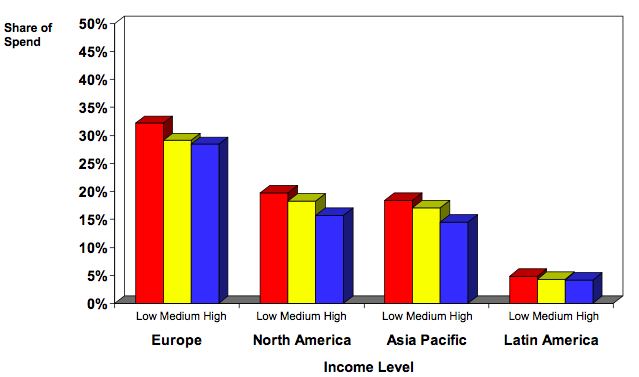
Figure 1: Private label share of spend segmented by income level (source: ACNielsen, 2005)
Of course, this doesn't mean that independent product-manufacturers are completely screwed. It puts pressure on them to become more innovative with their products and marketing than they ever were before. Which is the right kind of pressure.
Final thoughts
There's not much not to like about private labels. In many ways it's a more efficient system. Less time and money needs to be spent on the marketing-side, and more can spent on the back-end—the production. At the same time, independent manufacturers will have the advantage of flexibility. They can (perhaps) adapt quicker to market-trends, or perhaps even lead them.
Not all market-research needs to happen in the store either, some also needs to happen where the consumption happens—at home or elsewhere. And large independent manufacturers perhaps have a better foothold on general trends in society, than retailers, who are mostly restricted to what happens in their store.
(On a related note, one of my early posts on this blog discussed P&G's strategy towards shopper-marketing, worth checking out!)
So it's perhaps not a black-and-white situation. But I think that, looking at Starbucks, which is essentially a private label, that this strategy has considerable merit, because it gives retailers a lot of power over the quality of these products and how these are sold. It essentially shifts the brand up towards the retailer, instead of it remaining on the product-level.
More on this as I come across it.
 Not too long ago, asked the question about whether coffee is a bad business to be in, taking into account the exploding number of quick coffee-stops, as well as the fact that global players like Starbucks, and the soon-to-come McDonalds café, are saturating the market. There's another part to this, which I actually discussed before, but I didn't make the connection: coffee as a soft-drink.
In the Starbucks-book, "Pour your heart into it," Howard Schultz talks about how Starbucks got into the canned coffee business, with the help of a chemist and Pepsi. The chemist had come up with a method to captured the essence of coffee into an extract, which enabled Starbucks to add it to a number of new products, such as ice-cream and indeed "porta-coffee," also leading to more business-opportunities outside of Starbucks-outlets. Pepsico had the "porta" knowledge, as well as the distribution-channels, and from what I hear their partnership was a raging success.
About a month ago, I wrote that Coca-Cola had entered a partnership with Nestle, to develop similar products, and just read about a another partnership between Coke and illy, a premium brand of coffee and related products.
The rest of this post is speculation:
Now I'm sure that the coffee-makers will do their best to not have the can equal a taste of fresh coffee, though at the same time more competition in canned coffee will definitely drive the quality upwards. Perhaps up to a point where it will perhaps convince customers not to wait in the long queue associated with "good" coffee, and instead get a quickie at a supermarket or in a machine at work. Similarly, an increase in downstream-marketing by producers, may lead to an increased demand for these products up the chain, at cafés, giving Starbucks-, illy-, and Nestle-outlets an advantage over generic coffee-producers. Thinking defensively, all of this sounds pretty bad for existing cafés. I'm not a fan of thinking defensively however.
Offensively speaking, this is an opportunity. Comoditised coffee means that there is more space left for other activities which help increase the value of "third places." Comoditised coffee also means that the overall quality of coffee will go up, and that consumers will look for other selling-points. By taking a license on illy or Nestle coffee (I don't think/know if Starbucks licenses), cafés can profit from the downstream marketing that is already happening. Even cans of coffee can present an added value, for instance in large queue-situations (like the ones I discussed last time), which I perceive as an excellent opportunity for offering tasters.
And really, this may not change much for cafés. The manufacturers' downstream marketing towards consumers may cause an increased demand for illy or Nestle-coffee (or cans) in cafés, pressuring them to take it into their assortment. But the same has happened with drinks like soda and beer for decades, though I'm sure that there are some horror-stories to tell here too. And so far, canned coffee has definitely been lacking the taste department, so it may not all represent competition for existing drink-venues. I may be making an elephant out of a fly. In any case, interesting to think about and to see how this will play out.
Oh, and the picture is meant to represent a cup, spilling coffee. If it looks like crap (the coffee kinda does), my apologies.
 It's a fair question. Look at the picture on the right. This should be a familiar view in just about any city: a long queue for a tall latte. The picture suggests several things. One, that coffee seems to be a popular product; two, that there is space for more coffee-shops; or three, that this particular coffee-shop should perhaps improve its service.
The truth is that this trend is scary for many an existing coffee-shop owner. Because the café, in Europe, has been around for quite some time, centuries for all I know. Yet if you walk just down the street from where I took that picture at a Rotterdam coffee-shop, you'll see a line of traditional cafes, spacious and atmospheric, yet entirely empty. The fact that people would line up at this particular coffee-shop—the only Starbucks-like venue in Rotterdam—suggests that they don't care about space, about atmosphere. All they are about is convenience (if you call waiting for 5 mins. a convenience); coffee-to-go; and exotically-named and expensive coffee. What is happening here is not so much the comoditisation of coffee itself, rather the comoditisation (read: non-importance) of the coffee-selling venue.
I'm not sure if people would care whether they bought a coffee at McDonalds or the Metropole-cafe in Brussels anymore, to be honest. If the selling point is how quickly you can get the coffee and get out, what does it matter if the venue is a palace, ready to serve its customers on its hands and knees?
There are plenty of stories about "how Starbucks drove me out of business" (here's a borderline case), strangely outweighed by stories about "how Starbucks saved my life" (here's one). And with McDonalds increasingly getting ready to become a competitor to Starbucks, and other venues, like Leonidas, a Belgian chocolatier, transforming their previous chocolate-laced focus into a coffee-one, I don't think it's unnatural to be afraid. If a coffee-venue is a commodity, then how hard is it to change your existing venue? Insert some coffee-pumping machines, put a to-go sign on your door, and you're set.
So what should an entrepreneur do? Leave or fight? Yesterday's odd post about Beef, of all things, did suggest another way of looking at business: on a system-level. What was essential to the Chinese beef industry, to meet demand? Proximity to the market, amongst other factors. And what is essential to the coffee-industry? Probably not more coffee-venues, but maybe something else.
When you look at the way the coffee-industry is structured, and probably most industries, it's like a funnel: there are a number of coffee-producers (not sure how many), and a definitely greater number of coffee-venues. The latter is battling for the attention of customers. They do so by engaging in new business development opportunities, both internally (e.g. music), and externally (e.g. coffee in cans). They need to open more and more locations to maintain their air of convenience, just look at the picture above. They need to brand themselves as the number one place to go, versus all the 100s of other new and traditional venues. They need properly trained staff. They need good coffee, and other quick food-products, etc.
This would suggest following openings*:
- marketing consultants
- new business developers
- new business providers
- real-estate agents
- customer service consultants
- coffee-buyers
- temp-agencies
- quick food producers, e.g. a bakers
- and I don't know what else.
The point is that, while a certain, most obvious, business opportunity is shrinking, doesn't mean that there isn't a need for more business. As a (creative) entrepreneur, you just have to look outside the coffee-cup (read: box) and see if customers and coffee-venues would not be in need of other services. And perhaps I am wrong, and because it is so easy to implement a "to-go" formula, it is actually easy to start some kind of food-related venue and add the coffee on top.
Anyway, all this coffee-talk is making me thirsty for one myself.
This is more of a personal* rant than anything purely retail related (*: isn't anything blogged personal?), but I've been in a terrible mood these last few days, and what better way to get out of a mood than a good spiteful rant, lashing out at innocent tools like the ones below.
I hate two things about business: 1. Post-floatation PR = total snore-fest. 2. Anything related to math = like sinking a nail into my brain... slowly. Both problems are fairly related, I think, and I will explain why.
1. Post-floatation public relations
My life is an exercise in duality. I've been rich, I've been poor' I've been hated, I've been popular; I studied strategic management and I studied entrepreneurship. There's something I really loved about strategy and there are things that I really hated, such as: there's no starting position as a strategist. If you want to work in this field, you either start as an analyst (snore-fest x 1000), become a consultant (shoot me now), or you start your own business (yay). That's were entrepreneurship comes in: multi-flavoured coke (yes strategy is in there somewhere).
This summer I read 3 books on companies: eBay's Perfect Store, McDonalds' Grinding it out , and Starbucks' Pour your heart into it. The only one which I could read all the way through was McDonalds.
I was eating up the words of both the Starbucks-book and the eBay-one, for about 60% of the time. Then snore-fest happened. The companies went public. For McDonalds, it actually worked out. Ray Kroc has a knack for staying in touch with his core-values and managed to remove himself from much of the mess. Or perhaps it was because he wrote the book decades after and his trauma was over. For Starbucks/eBay, as soon as the companies went public (in the book), I had to stop reading, and when I eventually resumed, it was at 1/10ths the pace of the pre-floatation material. I haven't even finished the Starbucks book yet (only 50 pages to go), because he's writing about his charity and about protesters.
You get the best insight into what it feels like to go public in the eBay book, because it was written by an excellent and somewhat objective journalist: Adam Cohen. He interviews people throughout the book, gets their emotions, the way they worked, what was exciting about the company that was profitable from day 1. Before the IPO, it seemed like it was a wolf amongst other wolves and some lions. People were happy, excited, and stressed about the ride. The best chapters I've ever read in a business-book.
Then, the company turned into an elephant and everything seemed more abstract, more distant, like pesky little flies. Any wolves on the horizon and the company tried to gobble them up. And more and more people came onboard, diluting a lot of the core-values of the founding staff. I still thinks it's a great book, but what a snore-fest at the end.
Same with Starbucks, though I reserve my final judgement for when I finish it. I loved the way the company was started, and I also to a degree love the stuff that happened after the IPO. But it suddenly got a lot more boring, more about PR, about how to handle investors and stake-holders. How to deal with people who attacked Starbucks just because it was a prime-target, because attacking it would solve all the problems in the developed world.
The difference between entrepreneurship and corporations. If you hate a start-up, start your own. If you hate a corporation, write an angry letter, or better, get a job there... Enough said.
2. Mathematical business
This really is a much deeper hate, one which I've had for an insanely long time. First, I must say that I'm more of a right-brained person than a left-brained one. No, forget that, I am human. I like psychology, I like predicting trends, I like innovation, I like creativity, I like risk. All of which I don't think are very well contained in formulas.
Now that of course means that I love statistics, because it predicts trends and confirms my own feelings about stuff. I love the book, Freakonomics. But I abhor it when formulas lead to the abstraction of values, much like the above rant on PR. To some degree, I can imagine Hitler sitting in his bunker with his partners in crime, calculating the ROI of Germans vs. Jews and deciding the former was a safer bet. And when I look at business today, I imagine bankers, even Jewish ones, make similar decisions about a businesses' assets and employees, making financial (read: life or death) decisions on paper everyday, never considering that there is life where a formula cannot penetrate.
More entertainingly, remember the Ben Stiller movie: "Along came Polly?" Ben Stiller is a risk-analyst, afraid of any discrepancy. And along comes Jennifer Aniston (Polly) who throws his whole life upside down, so much so, that he decides to make a risk-analysis of whether or not he should have a relationship with her!? That is what I'm talking about! For another good risk-analysis vs. Lo-o-ove movie, check out "Knocked Up."
Ok, my rant is done. It was largely stimulated by an article about "balanced scorecard," I think. I feel better now. Hope you do too.
The formula in the picture is for Net Present Value.
In this regular segment I focus on news of note (to me at least), about brands that I'm familiar with. I may someday write about Nordstrom, Costco, and Walmart, whom I hear great things about in terms of service, supply-chain management, and frugality, but until I come in contact with what they sell, I'm not sure I can say much. That said, I'm aware that Walmart made moves into Germany (and failed, which intrigues me), and has taken over at least one chains (Asda) in the UK as well, which I have visited. So never say never.
Coca-Cola and Nestlé Coca-Cola has, for a third time, partnered up with Nestlé, this time to develop coffee and tea-products. The previous times, the company worked Nestlé to develop Enviga, a calory-burning drink; and with L'Oréal, a daughter-company of Nestlé, to develop the beauty-drink Lumae. So reports Dutch Marketing Tribune.
A few months ago on Tech IT Easy, I expressed my wonderment at the Coke Zero brand and what their aim was there, as well as held a rant on how un-innovative "junk"-drink (or -food) brands are in general. I think this is an interesting move. It won't make the world a better place, perhaps, but it'll be more colourful.
Similarly, I know that Starbucks formed a partnership with PepsiCo a few years back, to develop canned coffee-drinks, also to be sold in supermarkets. So this could very well be a competitive move, by either Nestlé and/or Coca-Cola to compete with a perceived threat of Pepsico's or Starbucks reach into customers' taste-buds. Update: Looks like MSNBC reported on a similar story last year.
Leonidas expands to the cafe-arena In other, coffee-related news, Belgian chocolate-manufacturer and retailer Leonidas is opening a coffee-outlet in the Netherlands, a first step of what it calls a worldwide expansion of its products and outlets. This according to Dutch publisher, Elsevier.
Again similarities can be drawn with Starbucks (sorry, SB-haters), which started as a producer and retailer of coffee-beans, before it expanded into the business of coffee-bars as well. I think what both Leonidas and Starbucks have in common is a reputation of offering fine products as well as offering a third place which customers feel comfortable in. It's a relatively easy step-up for Leonidas, if its experiment were to succeed, because it can simply adapt its existing retail-outlets.
Isn't the world of coffee exciting?

Well, while I still want an iPhone, especially now that it's dropped to a price where the synergy between media-player, mobile PC, and phone is actually quite compelling, I was much more interested to hear the news about yet another partnership, this time with Starbucks. If you aren't a faithful reader of Tech IT Easy, you may not have noticed that lately I spent a lot of time discussing food-related things (completely unrelated to tech of course) and in particular, several posts about Starbucks. The first was on how Starbucks uses vertical integration to maintain a high level of quality throughout their value chain (it is not a franchise!), and the second, more tech after-all, on the concept of a third place and how the web fit into this.
The third place
I hopefully do not need to go into this again too much, as much of the definition can be found on my post and on Wikipedia. But essentially a third place is the space between home-life and work-life, where we try to find some time for ourselves.
Starbucks has really been pushing this concept, both in their amazing book, and of course in their stores. I should mention that, as a European, I'm quite spoiled as far as third places / food-related leisure venues go, and Starbucks, in my opinion, could use some... personality, for lack of a better word. But that is mainly the legacy of scale economies, which is king in the US, and lead to the global and uniform-looking chains, like McDonalds (see my other post on that here), that we are used to seeing, of which Europe, in turn, has very little to offer.
How has Starbucks tried to make their venues third-place worthy? Well it starts with creating a place where people like to be. Initially, Starbucks was a coffee-bean retailer, not selling coffee-drinks, and a big credo at that time, and ever since then, was to educate people about coffee. This is based on two vital ingredients: excellent coffee and a staff both qualified and approachable. And education and customer-service are pretty much the core of Starbucks, as I see it.
Second is creating an atmosphere that makes people feel at home. Here, music plays an important part as well as providing places where people can work and browse the internet. This has manifested itself in several partnership, with music-producers and artists, incl. Apple, as well as T-mobile to provide fairly global internet-coverage in their chains.
The latest is of course Apple's announcement that people will be able to buy songs currently playing in a Starbucks at a finger-click through itunes, and at no internet-charge.
Starbucks the retailer
After reading the book "Pour your heart into it," I've always seen Starbucks as much more than a simple coffee-chain. The company is aggressively forming partnerships to offer customers a richer experience in their stores, and expanding their reach into supermarkets as well, in order to gain mind-share. And, as Schultz announced in the Apple Keynote, the company is still in its embryonic stages, which I can easily believe.
Focussing purely on their retail-outlets for now (and not their innovative shifts into people's homes), that is what their coffee-houses are in fact becoming. Building on the reputation of their coffee, Starbucks has been extending that to other products in their stores as well, always using the credo of "quality first." While, similar to Apple, this quality comes at a premium, Starbucks is playing into current market -trends that quality leads to less price-sensitive customers, and as long as the company keeps doing well, it can keep charging these prices.
What I see is a shift from the supermarket, book- or music-stores, to places where people come first of all to relax and second to surround themselves in a type of glamour, listen to good music and buy it, read a good book and buy it, have a great coffee and buy some beans to take home.
This is only made possible because Starbucks has a strong control over their value chain and a lot of marketing power at its disposal. A regular coffee-chain, which does not own its own coffee-factories, nor have the financial capacity to own multiple stores, instead franchising them, does not have the same negotiating strength with partners to guarantee this level of quality.
While Starbucks did not entirely start from the ground up—Howard Schultz actually acquired the bean-maker after a while and took their name, it clearly pays off to start as high as possible on the value-chain, as a manufacturer, while having a keen eye for what customers want.

 The


