 One of the things I do on this blog is deciding on the potential of industry-segments, ranging from farming to coffee-shops, and from grocery to other types of retail. On Tech IT Easy I've previously expressed my scepticism at media (in which I include text, art, audio, video, and gaming), especially in terms of business-models, which I think that segment lacks.
Equally so, I see fairly little space for it in the physical retail segment, simply because it is so much more convenient to purchase and consume it via digital means. The PC (and other tech-gadgets) have essentially become the hub for all things media, and creating barriers to that experience just leads consumers to pursue more convenient ways of experiencing that media. That search for convenience is something that I've also approached in a previous post on this blog.
Let's look at some media-types and how they are being sold online.
For Video - there's iTunes, consoles, and set-top boxes that are controlled by media-producers. In any case, the power-differentials between producers and intermediaries is very unbalanced and it isn't a nice segment to enter as a retailer. Also, let's not forget the free alternatives: YouTube et. al and piracy.
For Audio - again iTunes, Rhapsody, and Amazon MP3 Store, but also smaller digital store for independent artists, like CD-Baby (which operates through iTunes also). Let us again not forget piracy and the fact that much of music is being produced through digital means and it makes sense to organise distribution that way also.
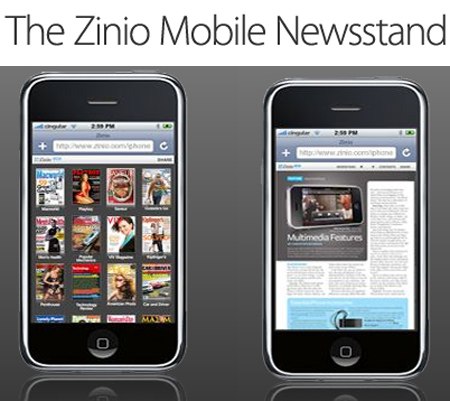
For text - there's again online outlets like Amazon for eBooks (Kindle) and Zinio for magazines. And let's not forget that 99% of text-based media is viewable for free online. Still, admittedly, electronic devices for consumption are not yet able to compete with paper-based methods, at least where price is concerned. Also Audible should not be forgotten as a source for audio-books, recently bought up by Amazon and partially distributed through iTunes again.
For Gaming - I'm not too familiar with the online market for this one. Even so, there's Steam, a digital distribution system by Valve, a platform which they recently opened up for use by other game-publishers. There's also plenty of smaller games being distributed through Xbox-live, the future Playstation Home, and of course the internet.
Finally, Art - here the situation is more complex, while on the other hand being relatively simple. It is complex for artists like my mother, who paints, and conducts business on a personal level by interacting with her customers. On the other hand, there's photography and digital art, arguably the evolution of traditional art, which is easy (for some) to produce digitally and distribute online. I suppose every industry has that friction between the traditional way of doing things and "the new way."
All in all, I don't see media as a big cash-cow for physical retail. I like to think that, because production and distribution becomes cheaper, that its cost will eventually fall to a very low price, allowing for it to be included as an added-value component in the service-proposition of physical retail-outlets (to which I also include restaurants, etc.). I also like to think that creating environments that make the consumption of media a comfortable process (e.g. cinemas) also has some potential.
But my outlook for selling media as a product, something that could easily be sold digitally, remains bleak. Please let me know if there are arguments against my point of view, as I'm here to learn.
Dear readers,
I'll be taking a few days to a few weeks off to reflect on my current state and activities, my goals and the steps needed to reach them. I'll likely post a few thoughts about this on Tech IT Easy in the near future, as that seems more suited for that somehow.
Until then, my links are being still updated and I'll discuss some of them this weekend again. At the end of this month, I'll also wrap-up what I've covered in February 2008.
Until then, take care,
Vincent
Premise of this post: Jeremy wrote a nice post today about the boons of starting young and I spent some time this morning advising my sister on writing a business-plan.
A picture says more than a 1000 words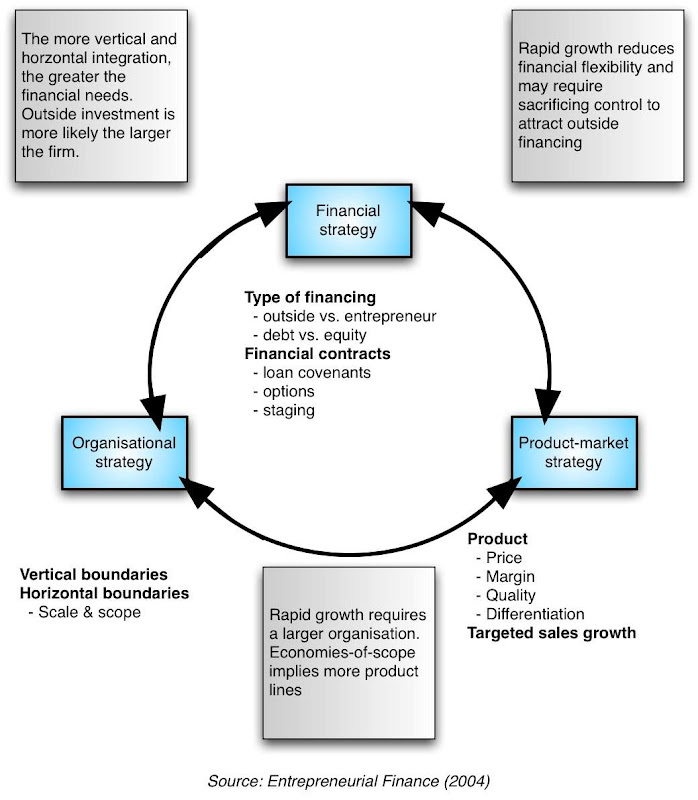
Strategy consists of three components, the financial, the product-market, and the organisational. All are interdependent and when they are in harmony, the chances of success are greatest.
For example, a larger organisation, which is a consequence of a more complicated product-market strategy, will also increase the need for financing, very likely the external kind.
Essentially you have to decide:
- What type of product(s) do you want to launch? What kind of market are you targeting?
- Do you want to be big (less control) or small (more control)?
- Do you feel comfortable with giving away shares of your business to investors?
I created the picture myself, but it was inspired by a graph in the book "Entrepreneurial Finance".
"The Disney Way" oh, how I hate thee, as a book, so far (UPDATED!)
0 comments Posted by Unknown at 9:27 AMUPDATE: After skimming through the book, I did manage to find some more informative chapters on how to structure creative enterprises. So, I'll raise my score of the book to 5/10, and will update when there's more to say. I was actually not planning to write anything too bookish this week, having championed their status for more than a few days last week. I just want to say that, ever since starting reading TDW, I found myself growing more and more uncomfortable for a few reasons.
First of all, the credo that the book is trying to sell to me is "Dream, believe, dare, do." Yes, I remembered it without checking the book. DBDD is such a simple system, meant to emulate Walt Disney & Co's way of thinking, that pretty much any idiot can remember it.
And that is how I feel like I'm being treated. Like an idiot, who can't remember more than four words.
The book is split up into parts, representing each of the four "magic words." I started on 'Dream,' expecting to find practical story-boarding tips. I'm not yet done, so maybe at the end, but all I've been reading was about companies that the authors consulted, which had "big problems" and now are "a leader in their industry." There is very little, except for between the lines, which I can use as a case-study for me to think that I can replicate this in my own company.
The method most mentioned, is to create a "Dream Resort" (always capitalised, because it's the authors' business). If you go to a Dream Resort, all your creative barriers will fall away, the magic will happen. Believe it! Well, until I see something that justifies spending 1000s of dollars on consultants, or how I can replicate some methods on my own, I don't believe it.
The only instructions I remember reading so far, was a pseudo-sociological experiment with monkeys. Apparently, if you put 99 monkeys on a beach with sandy fruits, one monkey will work out how to wash his fruit in the sea and make it taste better, and eventually the other monkeys will learn from him. And, I paraphrase: "That's how companies learn too." We are all monkeys!
Somewhat ironic, the authors mention several characteristics that people don't like about how big companies are managed, such as arrogance and not including employees in solving problems. I would like to add treating people condescendingly to that list.
The lack of dreams, you could argue, is a big-company problem, which is another incompatibility-issue with some readers like me. There is no creative barrier, really, what is needed is a framework to build a business around it.
Also, small companies are flatter, there are less structural problems preventing the spread of ideas, it is actually a survival mechanism that everyone takes part in steering/fixing the machine that is a start-up.
Anyway, I decided to give this book until the end of the 'Dreams' chapter. If I don't get clear-cut language by then, I'll skim and throw it away.
And I still can't believe that I'm being advertised to buy services in a book that I already bought. An end-of-book brochure is fine, but so far it's very much over the top.
Reviewer's current grade: 3/10 and I'm being generous.
5 links—retail-saturation, RFID's costs, elements of fun, tricking shoppers, & home-cinemas
0 comments Posted by Unknown at 10:41 AMIt is time for those links again! This time, we'll be discussing the economics of Apple's physical stores, how Walmart is enforcing RFID, how retailers are trying to trick people to buy more expensive things, how people perceive fun in games, and 10 ultra-geeky home-cinemas.
As usual, my bookmarks can be found here, and the previously covered links, here. Enjoy!
Link 1: Why is Apple saturating (US) cities with retail stores? is a question that Choire Sicha asks on Kottke.org, and lead me to this profit & cost breakdown of Apple's retail stores at Seeking Alpha (see pic below). It does appear it's all about the money, though hard it remains to read Apple's mind 100%. In related news, OObject lists all the items needed to build an Apple store.
Link 2: Is RFID economically feasible? I'm planning to dedicate at least 1-2 posts on RFID on this blog in the future, as I've essentially been following its development since the early coverage on Slashdot. This story on InformationWeek discusses the pressure that Walmart, certainly the biggest champion for RFID in the retail-arena, is putting on its suppliers to finally add RFID into their logistics-chain. As far as I remember, the latter have been complaining about the unfair balance of cost that RFID causes, shifting most of them onto suppliers. I assume, however, that these chips and pallets are reusable.
Link 3: What makes games fun? Lightspeed Venture Partners has an interesting blog, which mostly discusses the business and principles behind digital games. I follow it because games are fun, and if you can understand the source-code of fun, you can replicate it elsewhere. In that spirit, then, it links to an interesting white paper trying to map out what exactly goes on in gamers' heads while playing games. Part 1 is also very much worth a read.
Link 4: A buyer's christmas? The New Yorker digs into consumers' buying behaviour. Interesting is, that people use the net most often to find info, not to buy, but can use that info inside stores (we'll still need ubiquitous internet for it to be shoppers' utopia, however). Equally interesting is, that if a store has two microwaves, consumers will usually buy the cheaper one. With three products, however, they will usually by the mid-priced one. There's still room for trickery, I guess…
Link 5: 10 stunning ultra-geeky home cinemas. In the spirit of my previous post on cinemas & luxury, I thought that this link would be fitting. The Star Trek-themed one is a little too geeky for me, but the Titanic one (no. 6) looks awesome. I'm still doubtful about whether it's about the design or about the movie, but I can't deny that people put a lot of work into designing these.

 The


