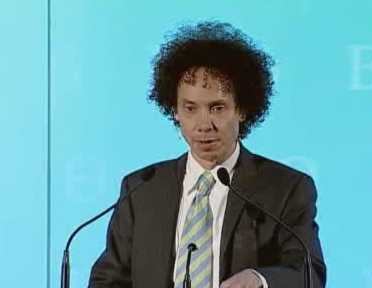
 HBR writes about this rule, and Malcolm Gladwell (picture) speaks about it. Essentially, it means that being an expert at anything does not require any special talent (though liking what you do, helps), but instead it requires 10,000 hours of dedicated practice. This applies just as much to musicians, as to technologists, as to retail-entrepreneurs.
Take Candy Dufler, whom I wrote about the other day. She's been playing saxophone since I don't know when, but the hit "Lily was here" is approximately 20 years old. And if you calculate that 10 hours per week of practice, multiplied by 20 years, equals 10,000 hours, and combine that with Dave Stewart's compliment on her "encyclopaedic knowledge of riffs," you understand that she's an expert in her craft.
The point about all this is that anything can be mastered with sufficient practice. Malcolm Gladwell adds to this that this practice is not a solitary activity either, nor is it a matter of simple repetition. Rather it is imperative that it is guided by other experts and mentors, much like Dave Stewart is to Candy Dufler. And it has to push the boundaries, entering areas where the comfort-zone is low.
I think about this 10,000 hour principle a lot. It is very relevant to blogging, for instance. We, the people, are surrounded by experts, be it writers for the Financial Times or Harvard Business Review, or bloggers like Nick Carr, Seth Godin, and countless others. And we reproduce their writing to form a synthesis of it, eventually building a collaborate bucket of knowledge. This is why blogging is great, because it is open, it is curious, and, on the aggregate, self-correcting. But to individuals, it is only beneficial if part of a long-term strategy of dedicated learning and application.
The "Rule" also offers insights into hiring people and finding jobs. If your future employee is not happy (or able) to share his or her know-how, then how can your other employees (or yourself) increase their expertise? And if your job consists of spending countless hours behind an excel-sheet, locked away in a room, then may I suggest that that is what they call dead-end? Alternatively, if you can find someone who can actually present proof that they have 10,000 hours of applied practice behind them (or even half that!), you can feel pretty good about hiring them, and vice versa, they can feel pretty confident that they can add value to the area which they have practised for.
Ultimately, this kind of thinking suggests that we can only improve, and indeed innovate, as people, businesses, or products, by opening up to a ton of information, for a long-long-long time, perhaps forever. In other words, long live the open economy, the tools that connect us, and the computer that is our brain.
Thinking about Real Estate - holistic approach & checklists
0 comments Posted by Unknown at 11:08 AM I don't know anything about real estate. My sister wants to buy an apartment in Dublin. My father used to own several houses in Germany, the Netherlands, and Belgium. Back in his day, banks were much more liberal about lending money to house-buyers, often sponsoring up to 90% (I think). The climate is far less friendly now and I hope my sis has better luck in Ireland, where house-prices are booming.
Apart from the finance-question, there are of course questions pertaining to the actual and future value of your purchase. Is the price good and will the value increase? Is the location good, why, why not? Does the building need work, how much will it cost? How will your repay the money you borrowed / spent on it? What is your exit-strategy?
Retail Location-location-location
"You can be the best retailer in the world, but if you set up shop in the wrong place, you'll never do much business. If you operate from the wrong properties, you start with your hands tied behind your back."(Clarke and Rowley, 1995, from a book, called "Retail Marketing," I had on my bookshelf)
While many variables in the marketing-mix can be adjusted in a fairly short time-frame, setting up a new location can take years and the price of failure is high. Hence it probably represents the most important decision a retail-business ever has to make.
According to 1999-stats, each square meter (±3 square feet) in a British grocery-superstore was estimated to cost €750 (±500 UK-pounds). And we are talking several 10,000s square meters for that type of store. Such serious commitments automatically mean that a retailer needs to incorporate a real estate-strategy into his business, estimating whether the future will make his asset a profitable one, or a liability. McDonald's, and I'm sure any major player in this arena, operates much in the same way.
A little anecdote. The reason why I read the McDonald's-biography, was because of these words:
After a few beers in hand, and there was a pause in the crowd, Ray [Kroc, founder of McDonald's] asked everyone in the room, "What business am I in?" The room was silent and people were laughing. No one gave Ray an answer so he asked the question again, in a more serious tone, "What business do you think I am in?" A brave soul yelled out, "Who in the world doesn't know you're in the hamburger business?" Ray laughed and said, "No ladies and gentlemen, I am not in the hamburger business. I am in the business of real estate."Location Techniques
While, in theory, a systematic sequence, starting with the general appraisal of the area down to the specific site characteristics, would be optimal, this usually only works well with businesses that have medium- to long-term real estate-strategies. Other businesses, where the need for speed is higher, often do not benefit from the luxury of such an approach. Generally though, a location strategy can be split into three:
- Search: where the focus would be on finding the right area for a location
- Viability: where more focus is placed on specific sites and estimating turnover
- Micro: where the features of the site are examined in the context of potential store performance.
The Checklist
This is the most common tool, at least reported in a study from 1996 (see the "Retail Marketing" book for more). The reasons mentioned at its relatively low cost and technical expertise requirements. While I imagine that today's location-suveyor has more sophisticated tools available, I don't think that factors such as cost and technical expertise should be left out of the picture. In many cases, a checklist will be the first tool that people, especially those with small businesses and limited budgets, will reach towards. For similar (well time-related) reasons, I will focus on this tool alone today, and look at more sophisticated tools in a future post.
Essentially we are speaking of lists, which can vary according to the focus of the store, and cover a series of key-areas. As for the first, the positioning of businesses, the book mentions four dimensions: price, convenience, variety, and proximity, and presents checklists according to each factor. For instance, for convenience, we would be looking at traffic flows to and from the store, visibility of the store, distance to competitors, and geo-demographics. You get the idea.
As to the areas to cover in a checklist, those can include: population-data, such as disposable income per capita, home-ownership levels (which would affect DIY-stores), current shopping patterns, etc. Accessibility-data, which can include public transport infrastructure, parking, access to staff, access to pedestrians, etc. Competition-data, which looks at variables such as existing retail activity, saturation of demand, etc. And finally, cost-data, which includes, well everything that needs to be paid.
Each area will require different research-methods also, ranging from going to your local government, to using commercial databases, to surveying customers directly.
Final thoughts
I'm being a little vague here, because I happen to know and like the professor, Dr. Peter McGoldrick (with his funny-looking moustache), whose book I'm quoting from and hope that people, who are interested in this subject, will buy it.
I'll go more into the subject of locational positioning at a later date. The book does cover more sophisticated methods, such as mapping, geographic information systems (GIS), the analogue method, and mathematical models like multiple-regression techniques. I'll look at those, and at more current developments, as stuff may have changed since the 2002-edition of my book.
The picture is courtesy of currentanalysis.com
 I suck up data wherever I go (it's a curse, I know). Just last week, as I was waiting for my laptop-drive to be installed, I sat in a German bank and came across a magazine, called VR-future. Two articles caught my eye, one on the Bio*-boom in Germany, and another on Switzerland—a country that fascinates me, but that's a story for another day.
The bio-trend article consisted of an interview with Dr. Alexander Gerber, the Germany CEO of the BÖLW (the foundation for organic products in Germany) and revealed some interesting info on this segment. While it focussed entirely on Germany, I do think it brings some interesting insights on this topic in general. (*: "bio" being the German term for organic)
Now, I should say, that I'm generally weary of the word "Boom," as I inadvertedly associate it with the word "Bust." Any market is subject to the laws of supply and demand, and a boom usually suggest an explosion of one or both, eventually leading to some fall-off after a while. I have no doubt that the same will happen to the Bio-sphere as well. There are also particularities about the organic market which I do not like, and I will go into those in my final thoughts.
The rest of this post is structured as follows. I will begin with the definition of organic, then some stats on sales, after which I will look at employment-trends, and expected areas for growth. I'll conclude with some final thoughts, to answer why I am bearish on this whole organic trend.
So, what is "bio" or organic?
From Wikipedia:
For crops, it means they were grown without the use of conventional pesticides, artificial fertilizers, human waste, or sewage sludge, and that they were processed without ionizing radiation or food additives. For animals, it means they were reared without the routine use of antibiotics and without the use of growth hormones. In most countries, organic produce must not be genetically modified.
Bio-Sales
Worldwide, while the percentage is low (Wikipedia reports 1-2% of food), it is showing far quicker growth than conventional food. In the US, Wikipedia reports a 17-20% annual growth of organic food in the last few years before 2004(!), compared to 2-3% for regular food. 2.6% of food sold there is organic. In Europe, while I don't have the stats on exact growth-rates, the percentage of of agricultural land being used to grow organic produce, is on average 3.9%, with Austria (11%) and Italy (8.4%) leading the pack.
In Germany, the annual revenue from bio-products with discounters and supermarkets has more than doubled since 2000, up to € 4,6 billion in 2006. And, at the moment (2007), Bio-products have a 3% share of sales in small food-stores, which is expected to double by 2010. The level of food-prices, held low by government subsidies, is expected to rise in the future, which… will probably not mean much to the bottom-line of retailers and producers. And, apart from the ethical considerations, bio in Germany has very much become a lifestyle product, translating into lower price-sensitivity. According to Gerber also, a new bio-supermarket opens every week.
With all this positivity, there is the somewhat counter-intuitive trend that farmers in Germany are complaining about falling incomes, and annual growth in their area has slowed down from 20% in 2000 to 0,4% in 2006. I imagine that is so because the market is maturing and because large buyers are pushing the prices down. A similar trend is being reported in the documentary, The Future of Food. Gerber also mentioned that there is a lacklustre support from the German government and the European Union in terms of subsidies.
Employment-trends
In general, the organic sector is a pretty people-intensive industry. While I don't have global stats, in Germany, about 160.000 people are involved in creating, processing, and selling bio-wares. In the last 7 years, the employment in bio-related sectors has doubled, especially in processing and sales.
On the farming-side of things, a third more people are employed than in traditional farming. And there is a need for people in production, processing, and sales, especially in the last two areas. In addition to this, the bio-sphere is very consulting-intensive, meaning there's also a need for highly trained personnel.
With is all this need for people, the German education-system does not yet offer truly specialised courses in this area. There is a program, however, co-sponsored by the BÖLW, the government, and the companies involved, which offers training for practitioners interested in working in the organic industry. Generally however, "learning by doing" is encouraged in this field, which, incidentally, also explains the high number of consultants.
Growth-trends
Gerber sees three areas for growth: Small cities, food-venues, and apparel/cosmetics. Regarding the first, Bio-supermarkets and -shops are starting to be set up in German cities with less than 50.000 people. And there are many of those in Germany.
He also expects growth in food venues, both fast and traditional, who currently receive around 25% of food-related spending, in which bio is still only taking up a very small percentage. Finally, Gerber also expects a larger bio-component in textiles and cosmetics, though I have no stats on how important that industry is.
Some final thoughts
The organic value-chain seems to be organised in a fairly similar fashion to the traditional way of producing, processing, and selling farm-goods. Some points of note are the way that bio-products are produced, the accountability-aspects, and the educational ones.
For the first, the natural way of producing these products will require some serious adaptation by producers and distributors. And since information is such an important component to bio-products, and by now a legal requirement, it will also require producers, distributors, retailers, and marketeers to set up new procedures for extracting and exchanging information. Finally, the fact that this is a fairly new market and official training-courses seem as yet to be lacking, there is a need for educating both businesses and consumers.
All of this translates into higher costs of production, which is reflected in higher prices for consumers (Wikipedia reports this to be 10 - 40% more than with conventional products). It is only a good thing that the end-products have lifestyle and ethical value, meaning that customers will be less price-sensitive about them. But will this be enough in the long-term?
In general, farming is already highly dependant on government-subsidies, which is already a bad sign for bio-produce as that seems even less efficient. And the increased demand for goods like wheat and dairy-products, from countries like India and China, means that there is actually a need for more, rather than less efficiency in farming.
Also, the current boom in food-education seems one that is limited. Eventually, the market for information will mature, customers will know all they need to know, and will be looking at other differentiators, most likely price. Large retailers, who are able to keep prices down when needed, are better-positioned for this, versus the more specialised shops who seem to be purely focussed on lifestyle, and hence high prices. Eventually, as the market becomes mature, I expect there to be a fall-out for both smaller bio-shops and in the area of consultants and niche-marketeers.
All in all, while I'm no expert on organic produce, and while I am fairly optimistic about demand continuing to rise, I'm not sure if there are still big profits to be made on the supply-side, even though there seems to be explosive growth in that area.
That said, I'm not bearish on all things organic. Bio-food in food-venues like restaurants and similar is very intriguing and, I think, will fit very well into this environment, where fresh food and good food is a strong differentiator. I'll have to collect more data on this, but I'll definitely write something on business in this area in the future.
The picture is courtesy of Petdiscounters.com and was chosen purely for effect.
I'm preparing a few posts for this week, but had the chance to watch a documentary about Dutch artist, Candy Dulfer this evening. She made a very favourable impression on me. Her most famous song, "Lily was here," was a spontaneous collaboration with Dave Stewart, recorded some 18 years ago. Stewart, whom she describes as her mentor, in turn describes her style as "very fluid," and her knowledge of riffs "encyclopaedic," which makes her an excellent collaborator with other artists.
Love the song, love the person. Enjoy!

There are few things in this world I hate more than electronical problems. Yesterday, I had a new harddrive installed in my Mac-laptop. I could have done it myself, but, by my estimates, it would have required me unscrewing and rescrewing approximately 40 screws. So, no thanks! I was in Germany on this occasion and gave the shop my mobile number. The only problem, I found out later, was that my phone refused to roam.
While I was waiting, I saw some beautiful atmospheric places, which I wanted to photograph. Only on that day, my neverfailing camera decided it was a good day to never turn on again... great!
When I came home, I tried to install OS X Leopard (the new Mac-OS), but it somehow screwed up and I was up until 2 a.m., trying to fix it (i.e. re-install). Along with that, my new harddrive makes some strange popping sounds every five minutes, which I unsterstand is a software-issue, but since this drive was advertised to be quiet as a mouse, it's annoying nevertheless.
So, yesterday could very well be described as bland and just plain uninspiring. I'll take a few days off from this blog, to focus on the essentials, and will hopefully be back in full force by this weekend.

 The
The 


