 I've set myself a deadline:
12 days to finish my thesis on "funding high-tech start-ups" !!
It's perfectly feasible, but only if I don't get distracted. So no blogging for 12 days, and hopefully I can celebrate my freedom by then.
Wish me luck!
Vincent
 A few months ago, I wrote about Starbucks' vertically integrated strategy. This morning, i wanted to link to it, so I did a Google Blog-search. Usually a search for Starbucks and "vertical integration" would yield my blogpost first, but now it's the no. 2 result.
Somehow, the net has started discussing why Starbucks had a corporate strategy that involved owning all of its subsidiaries and Subway's strategy went a different way.
There seem to be a number of theories on the market. Namely that Starbucks
- … cares less about cross-store cannibalization
- … has a higher need for monitoring
- … relies more on “impulse sales”
- … has higher profit-margins
Some good posts about this are written here and here (both by Josh Wright), here (Stephen Bainbridge), here (Keith Sharfman), and here (Paul Jaminet)
All excellent theories in their own right, and all very rational. However, in my experience, people, and we are talking about people here, often don't behave rationally (at least not as rationally as economic theory dictates). Instead they behave in ways that they are able—either through innate capability or through their environment.
Starbucks did not start as retailer, it did not even start as a store owned by Howard Schultz. It was a coffee-bean roaster and vendor. Its aim was to educate the US-population, which was—according to Schultz—a wide open market in terms of high-quality coffee. Schultz, who first worked there as an employee, started an independant coffee-chain, and only a few years later took over the Starbucks-business (incl. the roasting factory) and the brand-name. But the core-idea remained that it had to deliver quality-products and quality-education to its customers. Along with this, Schultz was highly educated, had plenty of work-experience, and venture capital behind him.
Subway started as a retailer. According to the history, published on their site, Fred DeLuca started Subway's as a 17 year-old and $1,000 starting-capital. Subway had, as far as I know, no world-changing mission. It was a sandwich-store, one of many, and one of it's key assets was to be more efficient and qualitatively better than its competition.
I still think that the stories of these two men, their business-idea, and the environment they started it in, is the key-deciding factor of why one decided to expand wholly-owned and the other through franchising. I haven't studied Subway, but I have McDonald's, and the same dynamic can be witnessed there.
Now, you can go all "economic theory" on this, and focus on points like that coffee is a product that requires much more monitoring than sandwich-ingredients. And I think that's completely correct. Not to mention that Starbucks has a very different employee-based strategy than Subway—they like theirs to be smart and pay them well. And I also think that due to Starbucks's high real-estate presence, franchising for them has become an unfeasible solution. But I think the first two factors are the cause and the latter is the consequence of Starbucks's wholly-owned strategy.
When you start out, whether to franchise or not is a completely personal decision. It comes down to how comfortable you feel about whether you can offer your customers the highest quality possible, while maintaining healthy economic growth.
And your initial decisions will clearly have some kind of lock-in effect later on, which is something I only realised after reading the linked-to blogposts and writing my own.
If you read further into the ACNielsen-report (pdf), I wrote about two days ago, you'll have seen that retailers' private label-strategy seems to be focussed on certain key-areas, namely:
- General health
- Weight-loss
- Organics / Fair Trade
- and Food for kids
At the same time, there are lot of savings on the marketing side for private labels. Retailers are in fact huge market research factories—every move that a customer makes in their store, with their products, can be entered into a database and used for future marketing strategies.
And having full control over shelf-space, shelf-placement, and in-store marketing means that the budget for these can be minimised.
All of which has three implications:
- That more of the budget can be allocated to the quality of private label products.
- That it pays off to have an elaborate in-store-system to collect consumer-data.
- And that independent product-manufacturers are perhaps screwed.
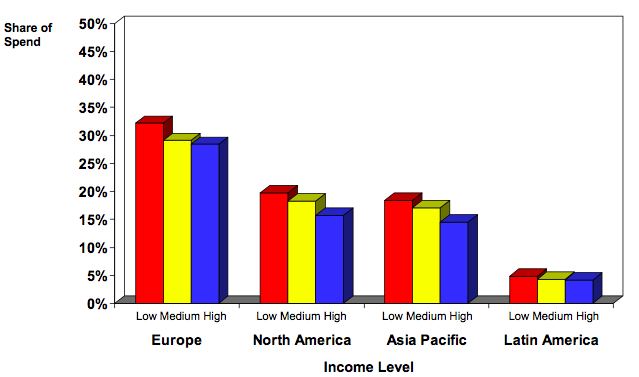
Figure 1: Private label share of spend segmented by income level (source: ACNielsen, 2005)
Of course, this doesn't mean that independent product-manufacturers are completely screwed. It puts pressure on them to become more innovative with their products and marketing than they ever were before. Which is the right kind of pressure.
Final thoughts
There's not much not to like about private labels. In many ways it's a more efficient system. Less time and money needs to be spent on the marketing-side, and more can spent on the back-end—the production. At the same time, independent manufacturers will have the advantage of flexibility. They can (perhaps) adapt quicker to market-trends, or perhaps even lead them.
Not all market-research needs to happen in the store either, some also needs to happen where the consumption happens—at home or elsewhere. And large independent manufacturers perhaps have a better foothold on general trends in society, than retailers, who are mostly restricted to what happens in their store.
(On a related note, one of my early posts on this blog discussed P&G's strategy towards shopper-marketing, worth checking out!)
So it's perhaps not a black-and-white situation. But I think that, looking at Starbucks, which is essentially a private label, that this strategy has considerable merit, because it gives retailers a lot of power over the quality of these products and how these are sold. It essentially shifts the brand up towards the retailer, instead of it remaining on the product-level.
More on this as I come across it.
Just some random thoughts for this evening…
Imax
 Making 3-d films is an expensive and complex process. You need to shoot from separate perspectives, one for each eye. And it requires a specific environment to be viewed in. A dark room yes, a screen, and glasses, but most of all, the distance between you and the screen needs to be as large as possible to get the full 3-dimensional effect.
I think all cinemas should go 3-D. With home-cinemas becoming so accessible and prominent, with movie-piracy, I think the best way for a film to stay exclusive is to make it in a format that is hard to replicate at home, and where it's hard to give a copy to your friend.
I like cinemas, because they are a social experience to be shared with friends. Just like going out clubbing, or eating in a restaurant. It's a third place that has been in constant trouble since the television, the videotape and derivatives, and the internet. I hope that innovation will continue to happen, and, more importantly, will continue to be exploited.
Guinness
 Give me a whiskey over a beer any day… but of all beers, Guinness is probably my favourite. It just feels like a real drink, and I fondly remember discovering it for real in Dublin, Ireland a few years ago. What I also like is that the whole process of drinking it is a ritual.
Guinness has been around for ca. 250 years, and it's constantly remained a niche-product. Over the last decade or so, it has tried to fight back the competition with a number of varieties, the latest of which is Guinness Red. It's supposed to be a lighter, sweeter version of the brew.
I'm sceptical. I think Guinness should try to remain special and not try to become closer to other, regular beers. But that's just me.
Pie
 Lately there seems to be a revival of pie in US popular media. Last week I saw a movie, called Waitress. It's about a… waitress, who lives with an abusive husband and wants to get out. Her therapy is making pie. Every time she has an experience, she invents a new recipe to match in her head.
It's a sweet movie, worth a watch.
And then there's a new series this season, called Pushing Daisies, which is about a guy who has the power to bring people back to life… but only for a minute because then someone else has to die… it's complicated. But he also owns a pie-shop, and again this whole series is quite ingrained with this whole pie-ritual.
Not a bad series either, light entertainment until Lost and Battlestar Galactica start again.
But really, I don't get what has brought about this focus on pies and wish someone could explain it to me. What's the big deal?
Have a nice weekend!

 The
The 


