 I'm still following my tradition of looking back at what I covered and processing it into a blogpost. The general aim is for me to process the stuff I wrote about before, and give a reader some compressed value of an otherwise unforgiving linear medium. Time waits for no-one.
Why did it take so friggin' long?
For Months 1 & 2, I did so on a monthly basis. Later on, I was interrupted for study-related reasons, so hereby a 3 month summary (though only about 6 weeks of real activity).
Now, if month 1 can be categorised as a focus on market research, design, core-values, the value chain, and trends in FnR, and month 2 on human resources, business strategy, branding & marketing, innovation, and finance, months 3-6 aimed at news & trends, operational issues, marketing & branding, entrepreneurship, and strategy. Phew, what a mouthful… this is going to be a long post, so let's get started.
Micro-topics
Following three headings cover, what I call, micro-topics. They delve into specific situations (news & trends) or issues in running a business (operational, branding & marketing).
News & Trends
I noticed a decreased focus on news these months, simply because I didn't want to re-blog other people's stuff, and found conceptual lenses, and micro-topics more interesting. Also, my links often covered some news, as do my continuously updated bookmarks.
Nevertheless, I tried to identified some trends, namely private labels, organics, and SEPA, which I discussed at some greater depth. For Private labels, I looked at what regions and product lines were doing best, and came to the conclusion that there's huge potential in terms of lifestyle-products and offering higher quality goods than manufacturers can, simply because of the savings in marketing. I discussed lifestyle in a number of other posts, but I will go into those later on.
For organics, which has seen a huge upsurge in the last 5 years, I remain bearish, simply because I see it as a very inefficient, resource, and human-intensive process, that, in combination with the high energy-costs and rising food-prices, may not appeal to consumers increasingly shrinking wallets. That said, innovations are usually inefficient at the start, organics fill a certain need, and more automisation in such production-methods may dissolve many of my arguments.
I also looked at SEPA—the single European payment area—which was just launched (and you should be seeing an option to pay via SEPA in your internet-banking site now). Arguably the most boring post, I've ever, ever written (well, there are some contenders), but since I want Europe to be a single market so that businesses can finally benefit from the same economies of scale as the US, China, India, and Brazil, I thought it be important to discuss it.
Microscopically, and just for fun, I also identified some trends in terms of cinematics, beers, and pie, as well as a changing perception of expertise (more on this when I discuss entrepreneurship later on).
Operational
A second focal point was on operations of food & retail-outlets. I'm fascinated by optimising internal processes of businesses, so one of the topics I focussed on was whether it would be possible to use lean Toyota principles in a Food / Retail environment. I think it is, but at the same time, should not act as a replacement for customer-service. Granted, competition is fierce and any cost-savings should be welcomed, but the differentiating factor should be the amount of cherries on top: service-quality, product-quality, etc. I still need to read the book, though, and I definitely have more to learn/write about this subject.
I also looked at real-estate, fairly extensively, though some topics for future exploration remain. Clearly one of the biggest pains for FnR-venues is location, location, location… (it is also an inherent strategic component to large franchises like McDonalds) and I started with looking at structuring search and using checklists. In a second post I looked at the competitive/cooperative context of choosing a location, and in the third post, I looked at a number of costs that are part of the location choice.
Marketing & Branding
M & B is a continuous micro-topic of mine, even though I don't consider myself a marketeer. Two of my favourite topics include "the service paradox - on self-service and customer-rentention," which discusses the strangely liberating effect that no service has on today's individualised customers and positively affects their loyalty in return… talk about an eye-opener, for me at least… and "Lifestyle products - the costs of educating a market," which looks at the significant marketing-costs associated with starting a company in an unmapped market. As for the latter, I'll definitely be writing more about the particularities of lifestyle-products pretty soon.
The other three topics were interludes—hence the reason why I don't consider myself an expert. I wrote about how much of marketing is based on arguments, how arguments are often designed to distract or confuse an audience, how the consumer is overwhelmed with them, and how their value is ultimately decreased drastically. Very abstract… I also proposed that this is exactly why simple products work exactly so well: kill the argument.
Two more interludes include a review of Malcolm Gladwell's books, which both offer great insight into how people think (and how to market products), and I re-blogged "a marketing plan in a nutshell," kindly provided by an MBA-student at MeFi, which should be useful as a general reference.
Macro-topics
Following are topics that are core to what I write about: entrepreneurship and strategy. The first aiming at starting, running, and growing FnR-related companies, and the second at the bigger picture: taking an industry-perspective, how to interact within the context of a value-chain, core-pains, etc. There is also considerable overlap between the links I discuss now and those that came before.
Entrepreneurship
Looking at my eship-posts, I found that I often take a more personal stance at issues, compared to other disciplines. I think that's related to that the human element is stronger in these businesses, something I found out from speaking to many start-ups, incl. ca. 300 start-ups for my thesis.
In "The business of HoReCa - Hotels, Restaurants, Cafes," I discuss the issue of semantics in regards to choosing a vocation, and the perspective of my father, who helps me think about this area a lot. This is somewhat contrasted by my post on my own generalised (vs. specialised) look at the food & retail-industry, in the sense that I care more about the big picture (for now at least). I'll come back to this in the future, I'm sure.
In my post on "lifestyle-products," which I mentioned before, I also try to approach the topic of starting such a business in a second-world country, through a friend's eyes. Similarly, my post on "How being in the right place at the right time translates to starting a business," takes a very personal, and perhaps subjective approach to the issue.
Some micro- and just-for-fun topics include the "10,000-hours-to-be-an-expert rule," in which I identify a trend that's pretty similar to crowdsourcing expertise. On Tech IT Easy, Georgia Psyllidou discusses a similar phenomenon about how people can find work nowadays, and I think I will approach this topic again in the future. Call it semantic, crowdsourcing, open innovation, etc., but the world is changing, it is getting flatter, which has both implications to finding human resources, as well as distributing knowledge. For instance, in a recent article on HBR, the topic of authentic leadership is discussed entirely from the perspective of 1000s of examples. Worth a read and thought-inspiring!
Another fun topic was the Lowest Common Denominator (LCD). I first approached this abstractly, while under thesis-stress, but I find it a useful way of thinking about simplicity of action. What is the simplest, most basic feature that your product needs, that your strategy needs, that your company needs to work? Later on, I explored this again concerning my friend's lifestyle-business.
The strategic lense
Strategy has always been difficult to conceptualise, I felt, because there's strategy to everything—war, running a business, running your life, getting the girl, etc. That's perhaps the reason why I never got around to writing a thesis for it, and chose entrepreneurship instead.
I discussed IKEA a number of times in my blog, and one strategic issue I approached, were the early years of growth for the company. My philosophy concerning business is that, generally, "where you are from and when you are from matters a great deal to where you are going," and the same applies to IKEA. Of course, IKEA went far beyond Scandinavia, and I hope to get around to discussing the later expansions the company went through.
Amazon & Jeff Bezos was another topic, in which I wrote about Amazon's approach to innovation (very customer-focussed) and Bezos' transformation from entrepreneur to CEO (from micro to macro, challenging for many).
Another topic was the growth strategy of Starbucks (wholly-owned), vs. that of Subway's (franchise), which is clearly receiving a lot of flack these last months. In the article, I commented on some of the reasons given by other smart people, about why these strategies differ. Some good economical reasons were given, however, none, I felt, went into the roots of the issue. Two factors affected Starbucks' strategy: the roots of the business and the roots of the founders.
Somewhat related, a few weeks ago, i discussed the intriguing strategy of Metro-Group, which has placed two electronics-chains into the European market, Media Markt vs. Saturn, seeming to everyone as competitors. Turns out they are the equivalent to a franchise-system (though certainly a more complex one than Subway), which I think are meant to saturate the market.
Some just-for-fun topics included another post on the lowest common denominator, which I felt was a good lens through which simple strategies can be designed; two posts (1 & 2) about big pains the food-industry is feeling (and which ties into my post from yesterday; and why fitness studios are employing such restrictive contracts, which I felt was caused by either an inelasticity of demand or because they were in trouble.
Clearly a number of other topics fit within the strategic paradigm, but I'm not going to discuss them here.
Wrapping up
What about those Sounds?
I'm considering dropping the "Sounds" from S+FnR, however, it is still a very strong topic in the back of my mind as I'd like to work in venues where people dance… No, seriously. The way I'm looking at it is that I have to focus on certain basics first, and music & media will eventually pop up. So the title stays as it is.
Final thoughts
The nice thing about blogging is that you can measure your progress. I measure them both by readers, by feedback, and by my own perception. During the first months, I was very much in the dark about this industry, and to a degree, I still am. But I notice that things start making more sense, there is a certain logic to how processes work, why certain business models are chosen, etc. So, mentally, for me, there is a certain growth and I hope I can continue at that rate in the future.
I'm still on a certain trajectory in my mind, regarding the amount of secondary and primary activities I have to do to reach new levels. On the latter front, I definitely have a much better idea of where I want to go, after having blogged/thought/discussed about these topics for so many months.
That is all! I can enjoy my weekend, enjoy yours, and until next week.
I'm currently working on a wrap-up of what I wrote about in months 3-6. It's usually a monthly tradition (see months 1 & 2), but this one is extra long and taking me some time. Apologies for the silence this has been causing this week.
One of the things, I'm working on is a work in progress, a map of the food-industry. Step 1 is to identify the individual segments, which, I should note, are probably transferable to a great number of industries. Future iterations will include identifying specific companies in each segment, as well as sub-segments, and specific segment-pains also. 
- Segment 1 - the production of raw materials: This can involve anything from growing coffee-beans, to potatoes, to rubber and trees (later used for packaging). Some vertical integration with segment 2 and perhaps 3.
- Segment 2 - the production of consumer-goods: The activities here involve sourcing raw materials and producing them into goods, ready for retail. From my understanding, there are a number of super-producers (Unilever, P&G, etc.) and more specialised ones. Some vertical integration with other segments, plenty of horizontal integration also.
- Segment 3 - retail: A diversified segment, consisting of super-markets, specialised stores, and hybrids (which combine retail with other services like music, etc.). Some vertical integration occurring, with e.g. private labels, and large franchises like McDonalds & Starbucks that communicate directly with segment 1.
- Segment 4 - consumers: too diversified for me to summarise at this stage. What I do note is that the reach of customers is increasing up the value chain: organics, enviromentalism, etc. are all signs of this.
- Sub-segments - marketing & logistics: It has been my observation that the degree that these are externalised depends on the resources available within and the complexities of the tasks. What I also noticed is that it's the supplier, not the buyer, that takes care of these things. And finally, that it's segment 2 that is usually responsible for marketing their products to segment 4, the consumers. I expect that something similar is or will be occurring from segment 1 to segment 4, to address concerns consumers may be having about production-methods.
- Meta-segment A - regulation: It has been my observation from my thesis that the government is a factor at pretty much every stage of the process of bringing a product to the market. It is a tool both for consumers, for larger interest-groups, and for businesses to stimulate change within industries, with all the consequences that has. Again, regulations pertaining to organic & green production-methods, as well as human rights and memberships of trade-unions are just a few of many factors to consider here.
- Meta-segment B - optimisation: This is where I would place consultancies, which are super-specialists aimed at improving processes in and between organisations, but also aiming at customers who are having more and more information at their disposal, more cash, and more complex needs.
I'm hoping to finish up my wrap-up by this weekend and that it will be business as usual next week.
What's the biggest pain in your industry II - Carbon emissions
0 comments Posted by Unknown at 11:17 AMContinuing from part I - obesity, this post will be equally light as I have "♫ my mind on my money and my money on my mind… ♫" Or something to that effect.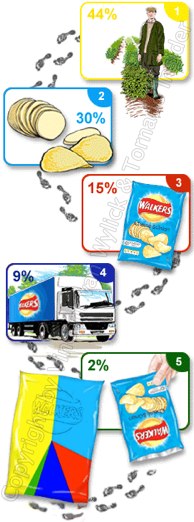 According to a carbon-emission calculation of PepsiCo's Walkers crisps, the majority of carbon emissions come from the production of raw materials (44%) and processing thereof (30%). A Dutch magazine, Tijdschrift voor Marketing, attributes the majority of the carbon footprint to transportation of said materials, and forms the conclusion that more and more production and consumption has to happen on a localised scale.
Even though the makeup of those figures may be open to interpretation—there is no breakdown about what in the first 44% is due to actual farming and what to transportation—perhaps, Mr. Kuiper, the author of that piece, has a point.
In a TED-lecture, James Howard Kunstler argues that the 'hydrogen-economy' is a pipe-dream and we must start thinking about creating urban environments fully equipped with the means of production, transportation, living, and waste-disposal, all in one. Very inspiring, though clearly requiring significant paradigm- and resource-shifts from today's globalised economy.
Clearly transportation comes at a cost, the question is how much the alternative would cost. Building super-farms, creating artificial climates to grow exotic food, waste-disposal, dealing with virus-outbreaks—regarding the latter, farmers already have problems dealing with chickens, sheep, and cows now, let alone having to deal with something like Kunstler's utopian vision—all of which represent costs that have to be accounted for.
But, I don't want to sound like a pessimist. I actually love the idea of a super-farm and a super-urban environment, regardless of the monetary cost. I'm sure plenty a sci-fi artist has tried to draw such a very thing (as have I). It's complicated, expensive, but exciting at the same time.
Asking you a tough question: How would you do it? What would a Kunstler-inspired localised economy look like to you? Is it even possible? … well, something to think about anyway…
Premise of this post: I'm going to get my camera fixed, for the second time in 3 weeks, at a store called Saturn. It is, as far as I know, the only other German chain focussed on consumer-electronics in the Netherlands, next to Media Markt, which is clearly the no. 1 here and in Germany. Ironically, while they appear as competitors to the consumer, they are owned by the same concern, Metro Group.
Now, I don't know the exact reason behind internal store-competition. The only company I worked for, where something like this was the case, was Sony, who allocated annual budgets to individual departments based on their performance. Reminds me a lot of the way governments are run. Of course, bureaucrats have a job for life.
While I was at Sony, I've never seen so many departments closed and managers fired, and both physical locations where I worked in Germany & the Netherlands, are no longer in existence. To a large part, in my opinion, this explains the troubles that Sony is in today, many of which are a disconnect with its audience and, very likely, caused by disconnects within the gigantic company also. But… that's a story for another day.
The other area where I know about examples of internal competitions, are product-lines. Didn't Steve Jobs once say (paraphrased): "If anyone should take marketshare away from one of our products, it should be Apple." I think that this is a conscious decision of Apple and I briefly touched upon it at Tech IT Easy, in regards to form-factor of the Macbook Air (MBA)—the screen, hard-drive, and CPU, which very much overlap with (read: fit into) other products that Apple sells, and, to me, represent economies of scope and scale to the company. It doesn't matter if the MBA sells or doesn't, what matters is that component costs will go down and innovation will go up, which is good for Apple.
Now, none of this really answers the questions why Saturn and Media Markt occupy the same market-segment. And, I have to confess, I just opened my Retail Marketing book to find the answer, and couldn't find it (the book is apparently not focussed on business strategy much).
Both Media Mark & Saturn offer similar features to customers, which are mostly represented on the chart below: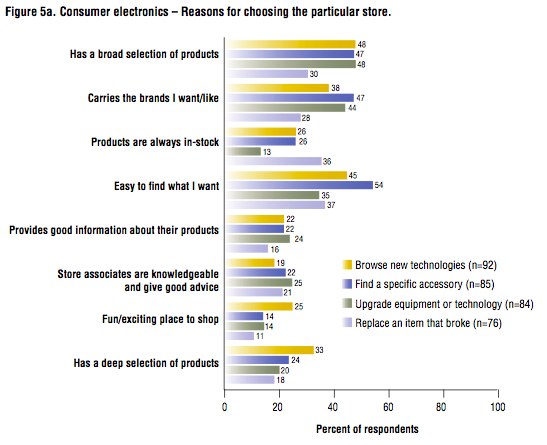
(Source: IBM white paper - "Deeper Customer Insight," which I wrote about several times before)
Some differences are perhaps that Saturn was most often located within another Metro Group-owned store, called Galeria Kaufhof, though I think they are changing that strategy in Germany, and certainly in the Netherlands, where they are stand-alone. Media Markt, as far as I know, has always been stand-alone. Both facilities are rather large, offer parking-facilities, and are usually located within the city (though in Rotterdam, Media Markt takes a more prominent place). And prices, promotions, and brands, while similar, differ in certain areas.
From this, I think it's safe to conclude that market-saturation is a clear goal of Metro-Group. By giving customers not one, but two large options, with separate deals to be had, at separate locations, etc., it appeals to an implicit customer-demand, that of choice, and takes attention away from other, "lesser," and certainly not Metro Group-owned choices.
Something else that is interesting, is mentioned on both companies' websites. Both chains are very decentralised in their management-structure. Every store acts as a self-sufficient enterprise, co-owned by each director, who, with his/her team, is responsible for how the store is run, and ultimately, how successful it is. Kind of sounds like a franchise.
So, I can only conclude that the internal competition paradigm is very much similar to that of Sony's, to force individual stores to perform better.
I think it's an interesting strategy and clearly Metro-Group is the winner here. How this plays out for individual stores and their share-holding directors is uncertain and clearly depends on the skill-level of store-management and the level of support given by their parent-company.
Lowest common denominators - the key to simple business strategies?
0 comments Posted by Unknown at 12:02 PM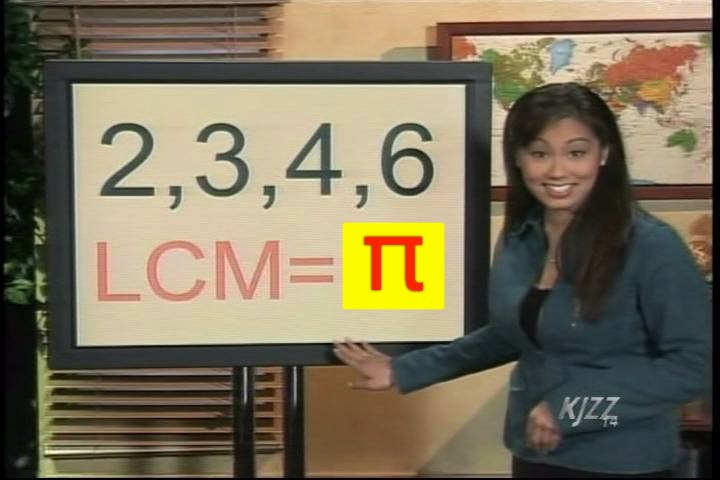 Arguably, I managed to write some strange posts while I was writing my thesis… some of which seem completely unrelated to this blog, and which I may shift to another blog, my first blog, which I'm resurrecting just for these types of "philosophical" topics.
Still, I liked my post on the lowest common denominator (LCD) from a few months ago, simply because I can still apply that thinking to other disciplines also. To remind you, the LCD is defined as the "lowest"—least useful, least advanced, or similar—member of a class.
The LCD of business-components
It came back to me last night, when thinking about what I wrote in my last post, on how it was difficult to sell a lifestyle product, if conditions for that lifestyle are not yet present. So you find other unique selling points (USPs), and in this case it was health as that was a key driver. To me that is finding the LCD in marketing—you find the "keyword(s)" that connects your product's message with the context of the customer.
Another example. I was thinking about writing about IKEA this week again, but it was such a simple point that a paragraph will do. IKEA is well-known for its design, yet also for its low prices. Actually design was never core-objective, it was finding the cheapest way to produce and to distribute. Design came afterwards, and was even then a matter of working with what you have: whether it's a certain kind of wood from Poland, or the hollowing of walls to make them lighter, or removing the legs from a table for packaging. It's all a matter of lowering the costs, and only afterwards about making it look nice. The LCD of production is finding that sweet spot between a cost that works for a business and a design + price that works for the customer.
Business-planning = the reduction of assumptions
One of the first things we learned in our entrepreneurship-masters, is that business-planning is a fantasy-story—we make up stuff that we hope is believable. If we can reduce the assumptions in the document, however, to the level that an outside party (and inside parties) start finding it believable, that is the key to the mission-statement, the operational plan, and to finding funding.
Bringing things down to the LCD is a way of reducing assumptions and convincing others of my idea. Explaining that production is subject to costs and design comes later is logical; or that reaching customers is a matter of finding the simplest things that connect us.
Essentially, a business-plan is a simplification of reality. Your financial predictions will likely be off by a lot or (hopefully) a little. Your marketing-plan will make certain simplified assumptions about your customers. Your production-plan will assume that all goes well. Keeping it essential, however, does have a better chance of convincing investors, etc. that you can see through the mist and identify the key-drivers for success.
Simplicity, yes, but not of skills
As I wrote last time, it's good to know the LCD of whatever you're doing for yourself. It's not good to shout it out to the world (oh, the irony!), as that really decreases your competitive advantage.
Still, while focussing on LCDs arguable simplifies the strategy, finding those LCDs and profiting from them is a matter of skill and study, of knowing your processes, your industry, your customers, etc.
Abstraction…
Now if all of this seems pretty abstract to you, you're not alone. I'm still trying to figure stuff out for myself. One reason is certainly the fact that you need to have the skills, the know-how to accurately identify key-aspects of a business-strategy, which differs from business to business. Another possible reason is that I'm completely wrong about this (let's hope not).
A final reason is that I still need to write a recap of months 3-6, which I'll try to do this weekend, before going on to other topics.
Anyway, agree or disagree? Let me know in the comments.

 The
The 


